 by Tom Gurney
Tom Gurney BSc (Hons) is an art history expert with over 20 years experience
Published on June 19, 2020 / Updated on August 16, 2026
Email: tomgurney1@gmail.com / Phone: +44 7429 011000
Pieter Bruegel Workshop, Copies and Attribution: Introduction
Pieter Bruegel the Elder is one of the most famous painters of the northern Renaissance, but his surviving painted oeuvre is small, complicated and heavily mediated by copies. Only about forty paintings by him are generally preserved, while many of his best-known compositions circulated through later versions by his son, his son's workshop, other family members, followers and copyists [6]. That means a museum label beside a Bruegel image is not a technicality. It is often the first public clue to whether the viewer is looking at a painting accepted as autograph, a faithful early copy, a later work after a lost original, a version by Pieter Brueghel the Younger, a work from the wider Brueghel family, or a questioned attribution.
This page is a reader-service guide to those distinctions. It is not a list of every disputed Bruegel object. It explains the main words museums use, why the spelling Bruegel and Brueghel matters, how copies can preserve lost inventions, and why works such as *Landscape with the Fall of Icarus*, *Massacre of the Innocents*, *Winter Landscape with a Bird Trap*, *The Wine of Saint Martin's Day* and the two Tower of Babel paintings should be approached with careful attribution language.
For the broader life and work of the artist, start with the Pieter Bruegel the Elder overview, the biography and the survey of Bruegel's paintings. For a focused list of difficult cases, see disputed attributions.
At a Glance
- Core distinctionPieter Bruegel the Elder is the sixteenth-century artist usually meant by "Bruegel"; many later copies and continuations belong to the Brueghel family and its workshops.
- Autographa work accepted as by Bruegel the Elder's own hand. It may or may not be signed.
- Copya painting that repeats an existing composition, sometimes very closely, and may still be historically important.
- After Pieter Bruegel the Eldera work based on a Bruegel invention rather than necessarily painted by him.
- Attributed toa cautious museum judgment that assigns a work to an artist but signals that the evidence is not the same as a fully secure autograph label.
- Circle, follower or workshopuseful labels for works related by style, design or production context, without claiming direct authorship by Bruegel the Elder.
- Most important cautiondo not treat all images called "Bruegel" as paintings by Pieter Bruegel the Elder.
- Best reading habitalways check the artist line, date, support, collection and any words such as "copy after," "circle," "attributed to" or question marks.
Contents
- Introduction
- Why Attribution Matters
- Bruegel And Brueghel: The Family Problem
- Autograph, Copy, After, Workshop
- Icarus And The Question Mark
- Massacre Of The Innocents: Original, Copy, Alteration
- Winter Landscape With A Bird Trap And The Copy Tradition
- Census Copies And Lost Preparatory Evidence
- Rediscovery And Authentication: The Wine Of Saint Martin's Day
- Towers, Versions And The Word "Original"
Why Attribution Matters
Attribution matters for Bruegel because the artist's fame is much larger than the number of paintings securely by his hand. The Royal Museums of Fine Arts of Belgium describe the surviving paintings as extremely rare and valuable, with only about forty preserved [6]. At the same time, the museum presents Bruegel together with works by his sons and other followers, because later versions are part of how his art was remembered, collected and transmitted.
That double reality creates a common reader problem. A composition can be unquestionably "Bruegelian" while the particular object in front of the viewer is not accepted as painted by Pieter Bruegel the Elder. A winter landscape, census scene, massacre scene or peasant festival may come from a Bruegel design, from a family workshop, from a follower, from a later copy, or from a much-debated object whose status is still under technical study. The title alone rarely answers the attribution question.
Museum language is designed to slow the viewer down at exactly this point. "Pieter Bruegel the Elder" is not the same as "copy after Pieter Bruegel the Elder." "Attributed to Pieter Brueghel the Younger" is not the same as "by Pieter Bruegel the Elder." "Circle of" does not mean a work was painted in the master's studio. A question mark in an artist line is not decoration; it is a visible sign that the object sits in a zone of uncertainty.
These distinctions are not only about market value. They affect how we read the work. An autograph Bruegel painting can tell us directly about the painter's handling, revisions, materials and compositional decisions. A copy can tell us about demand, workshop practice, lost drawings, collecting taste and the afterlife of a design. A restored or altered painting can preserve several historical moments at once. A disputed work can show where evidence has not yet settled.
Careful attribution language therefore protects both the artist and the viewer. It avoids giving Bruegel the Elder credit for objects not securely his, but it also prevents important copies from being dismissed as worthless imitations. In Bruegel's case, copies are often central evidence for how his inventions travelled through early modern Europe.
Bruegel And Brueghel: The Family Problem
The spelling is one of the easiest places to get lost. The painter known today as Pieter Bruegel the Elder is usually written without the "h" in English museum usage. His sons are normally written Pieter Brueghel the Younger and Jan Brueghel the Elder, with the "h." That spelling difference is not a perfect universal rule across every older text or catalogue, but it is a helpful modern signal.
The Kunsthistorisches Museum presents Bruegel the Elder as the founder of a successful dynasty of painters. His sons were young when he died in 1569, yet both became major figures in the family's artistic afterlife. Pieter Brueghel the Younger made his name as his father's copyist, while Jan Brueghel the Elder became famous for his own refined art, including detailed still lifes and landscapes [1].
This family situation is crucial. Pieter Brueghel the Younger did not simply make occasional echoes of his father's art. His career was deeply tied to the demand for Bruegel compositions. Some works repeated famous designs in numerous versions, sometimes with small changes in colour, detail, figure placement or omitted motifs. In other cases, copies may preserve evidence of lost originals or preparatory material.
Jan Brueghel the Elder belongs differently in the story. He was also a son of Pieter Bruegel the Elder, but his reputation is not built primarily on copying his father's large peasant and winter compositions. He became an independent master associated with finely worked landscapes, flowers, animals and collaborations. Museum labels that say "Jan Brueghel" should not be folded automatically into the world of Pieter Brueghel the Younger copies.
The key public caution is simple: Bruegel and Brueghel are related names, not interchangeable authors. The family was a dynasty, not one hand stretched across generations. When a label names Pieter Bruegel the Elder, Pieter Brueghel the Younger, Jan Brueghel the Elder, a follower, a copyist or a workshop, it is telling the viewer where the object sits inside a family tradition that lasted long after the elder painter's short career.
Autograph, Copy, After, Workshop
"Autograph" is the word specialists use for a work accepted as by the artist's own hand. It does not simply mean "signed." Some autograph works are signed, some are not, and some signatures are damaged, fragmentary or rediscovered only after restoration. The autograph question depends on a larger body of evidence: style, handling, underdrawing, support, materials, provenance, documented history, technical examination and comparison with accepted works.
"Copy" is a more flexible word than many visitors expect. A copy may be late, weak and distant from the original, but it may also be early, high quality and historically revealing. Copies can be made by a son, an assistant, an independent workshop, a follower or an unknown painter. They can repeat a surviving original, preserve a lost composition, translate a design into another format, or adapt details for a new market.
"After Pieter Bruegel the Elder" usually means that the composition depends on a Bruegel invention. It does not by itself say that Bruegel painted the object. The phrase is especially useful for works whose design descends from Bruegel but whose execution belongs to another hand. A museum may combine this with a second attribution line, such as "attributed to Pieter Brueghel the Younger," to distinguish invention from execution.
"Workshop" suggests production connected to an artist's studio or enterprise. In the Brueghel family context, this can matter a great deal, because repeated compositions were produced for an eager market. But the term should be read carefully. A workshop label is not a quiet way of saying "the master definitely painted some of it." It is a statement about production context, not a guaranteed division of hands.
"Circle of," "follower of" and "school of" usually step farther away from direct authorship. They indicate relationship in style, geography, period or influence, but they reduce the claim of direct connection. The precise meaning can vary between institutions, so the safest approach is to read each museum's label literally and avoid upgrading it in casual language.
These labels are not failures of confidence. They are part of responsible art history. Bruegel's paintings are rare, his designs were popular, and the family copy tradition was unusually strong. A careful label lets a museum say what it knows, what it suspects and what remains open.
Icarus And The Question Mark
*Landscape with the Fall of Icarus* is one of the best examples of why Bruegel attribution needs caution. The composition is famous: a ploughman works in the foreground, ships move across the water, and Icarus, reduced to a pair of legs disappearing into the sea, is almost missed. It is a brilliant Bruegelian idea. The object in Brussels, however, has long raised questions about attribution, date, painting technique and restoration.
In April 2026, the Royal Museums of Fine Arts of Belgium announced a new technical study of The Fall of Icarus. The museum stated that doubts had been expressed about the work's attribution, dating, technique and the extent of restoration, and that new non-invasive analyses and scientific imaging were being carried out with the Royal Institute for Cultural Heritage. Results are expected at a Bruegel exhibition in autumn 2028, while the painting was expected to return to the museum around October 2026 [3].
That means public writing should avoid presenting the Brussels painting as a settled autograph Bruegel without qualification. Better language is: the Brussels Landscape with the Fall of Icarus, traditionally associated with Bruegel and currently under renewed technical study; or the RMFAB painting related to Bruegel's Fall of Icarus composition. Where a museum label includes a question mark, the question mark should travel with the discussion.
This caution does not make the painting unimportant. On the contrary, the uncertainty is part of its importance. It shows how a famous image can be loved, reproduced and discussed while the material object remains difficult. It also shows why museum research can change public understanding slowly. Technical imaging does not simply "solve" attribution by magic; it adds evidence about paint layers, support, underdrawing, condition, restoration and handling. The final judgment still requires art-historical interpretation.
For readers, the practical rule is this: admire the image, but do not flatten the label. A questioned Bruegel-related painting can be central to the public imagination while still requiring cautious attribution.
Massacre Of The Innocents: Original, Copy, Alteration
*Massacre of the Innocents* is a different kind of attribution lesson because more than one object matters. The Royal Collection Trust identifies its painting as Massacre of the Innocents by Pieter Bruegel the Elder, dated about 1565-67 [4]. The Kunsthistorisches Museum in Vienna, by contrast, catalogues its related painting as a copy after Pieter Bruegel the Elder, attributed with caution to Pieter Brueghel the Younger, from the fourth quarter of the sixteenth century [5].
Those are not rival labels for the same object. They describe different paintings. The Royal Collection version is the autograph basis discussed by RCT. The Vienna painting is a high-quality copy after the father's picture, probably connected with the son's production. KHM notes that minimal errors and omissions, together with wood dating, support the copy judgment despite the painting's quality [5].
The Royal Collection painting also has an extraordinary history of alteration. RCT explains that Bruegel originally painted the slaughter of infants from the Gospel of Matthew, translated into a snowy Netherlandish village. Very early in the painting's history, before 1621, the most disturbing details were painted over. Murdered children became bundles, food or animals. During conservation in the 1980s, most of that historic overpaint was retained because it had itself become an old part of the object's history [4].
This is where attribution and condition meet. The question is not only "who painted it?" but also "which historical state are we seeing?" In the Royal Collection painting, the visible surface contains Bruegel's work and later intervention. The overpaint changed the apparent subject, softened the horror and created a double reading: village plunder on the surface, biblical massacre beneath. Conservation did not simply return the object to an imagined original state, because the later alteration had acquired its own historical significance.
For public writing, it is safest to keep three statements separate: Bruegel the Elder's invention of the subject, the Royal Collection autograph painting and its historic overpaint, and the KHM copy after the father's composition. Combining them into one simplified "Bruegel painting" loses the very evidence that makes the case instructive.
Winter Landscape With A Bird Trap And The Copy Tradition
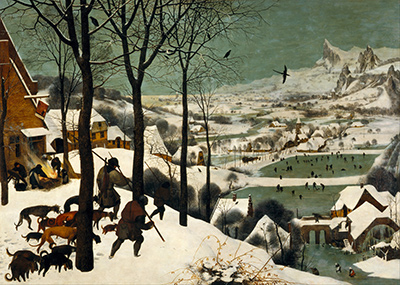
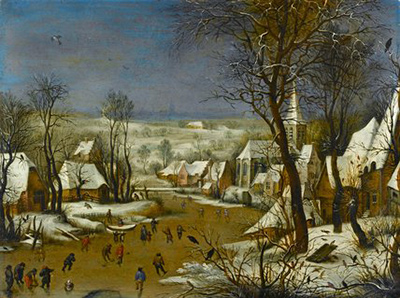
*Winter Landscape with a Bird Trap* may be Bruegel's most revealing case for sheer popularity. The Royal Museums of Fine Arts of Belgium identifies the 1565 winter scene in Brussels as one of its Bruegel masterpieces and describes it as Bruegel's most-copied work [6]. The subject is modest at first glance: a frozen village, skaters on ice, bare trees, cottages, birds and a trap set at the right. Yet the design proved extraordinarily durable.
KHM's artist page notes roughly a hundred copies after the composition, evidence of its remarkable appeal. Its own version is catalogued not as an autograph Bruegel but as Winterlandscape with Bird-Trap, circle of Pieter Bruegel the Elder, dated 1601, and described as one of the oldest and highest-quality examples [1]. That kind of label is easy to misread. "One of the oldest and highest-quality examples" does not mean "by Bruegel the Elder." It means the copy tradition itself has an internal history and hierarchy.
Why did this small winter composition travel so widely? Partly because it offered an instantly recognizable mood: cold air, frozen water, communal play and latent danger. The bird trap may carry proverbial or moral associations, and the skaters can suggest the uncertain footing of human life, but KHM's wording is properly cautious about overclaiming symbolic certainty [1]. The design works because it is both simple and open. It can be enjoyed as a winter landscape, read as moral warning, copied for domestic settings and recognized as part of the Bruegel family brand.
For readers, the important lesson is that popularity multiplies objects. A famous Bruegel composition may survive in many painted versions, and those versions do not all have the same status. One version may be an accepted original; another may be a son's workshop copy; another may belong to a circle or follower; another may be later and weaker. The image may look familiar in all of them, but the label determines what kind of evidence each object provides.
Census Copies And Lost Preparatory Evidence
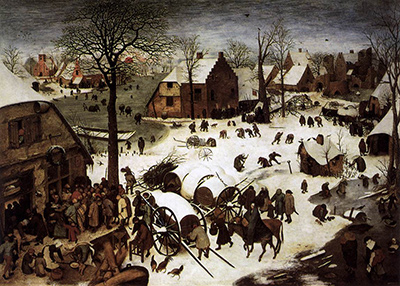
The copy tradition can also preserve clues that are no longer visible in the original. The Museum Mayer van den Bergh explains this clearly through The Census at Bethlehem. The original painting of 1566 is in the Royal Museums of Fine Arts of Belgium. The Museum Mayer van den Bergh copy was probably produced before 1600. Pieter Brueghel the Younger and his workers made thirteen versions in total, varying colours and sometimes omitting or changing elements from the original [7].
The most important detail is that all the copies share a motif not visible in the original painting but present in Bruegel the Elder's preparatory drawing. Museum Mayer van den Bergh draws the conclusion that Pieter Brueghel the Younger used that drawing by his father when making copies [7]. This is a powerful reminder that a copy is not always simply a derivative object looking backward at a finished painting. It may also preserve information about workshop resources, inherited drawings and production methods.
The Census case helps explain how Pieter Brueghel the Younger could make faithful versions decades after his father's death. He was a child when Pieter Bruegel the Elder died, so he was not simply repeating memories of watching his father work. Copies may have depended on drawings, cartoons, intermediate models, other painted versions and workshop practice. The exact path can differ from object to object, but the general caution remains: copying is evidence-rich, not evidence-free.
For the viewer, this changes the question. Instead of asking only whether a copy is "real," ask what kind of reality it records. Does it preserve a lost detail? Does it show how a Bruegel design was adapted for later buyers? Does it reveal the son's relation to his father's inventions? Does it help reconstruct a missing original? A copy cannot replace an autograph painting, but it can answer questions an autograph painting no longer answers.
Rediscovery And Authentication: The Wine Of Saint Martin's Day
*The Wine of Saint Martin's Day* shows the other side of attribution: sometimes a work once treated otherwise can be accepted as autograph after close study. The Prado identifies the painting as Pieter Bruegel the Elder, dated 1566-67, painted in glue-size on twill-weave canvas [8]. The museum's research account explains that the large canvas had been little known, had previously been attributed in print to Pieter Brueghel the Younger by a writer who had not seen it at first hand, and entered the Prado for study in 2009 [9].
Technical and conservation work changed the picture. The Prado reported that study and cleaning revealed Bruegel's distinctive handling beneath later varnish and condition problems. The attribution was strengthened decisively when Bruegel's signature, though worn and incomplete, and remains of a Roman-numeral date were found at the lower left. The museum concluded that the work is an original by Pieter Bruegel the Elder and described it as one of the most important discoveries concerning his oeuvre in many years [9].
This case is important because it shows that attribution is not only a downgrading exercise. Museum research may reject an old claim, but it may also recover one. A work can move from obscurity or mistaken association toward secure acceptance when material evidence, style, provenance and conservation findings converge.
The support also matters. The Wine of Saint Martin's Day is a tuchlein-type work, painted in glue-size tempera on linen rather than the oil-on-panel format many viewers expect from Bruegel. That unusual survival helps explain why material study was so important. A painting's support, binding medium, weave, ground and paint behaviour are not dry technical details. They are part of the attribution argument.
The Prado case should not make readers assume that every questioned Bruegel-related work is waiting to be confirmed. It teaches a more balanced lesson: careful evidence can move a label, but the direction depends on the evidence. Rediscovery is thrilling when it happens, precisely because it is rare.
Towers, Versions And The Word "Original"
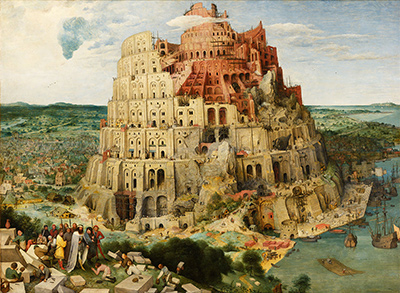
Bruegel's Tower of Babel paintings show another attribution category: separate autograph versions. The large Vienna *Tower of Babel* is a signed and dated 1563 painting in the Kunsthistorisches Museum. Museum Boijmans Van Beuningen identifies its smaller *Little Tower of Babel* as Pieter Bruegel (I), circa 1568 [10].
These are not a simple original-and-copy pair. The Rotterdam painting is a separate autograph version of the subject, smaller, later and different in format and mood. Boijmans notes that Bruegel painted three versions of the subject: the large Vienna version, the smaller Rotterdam version and another now lost [10]. KHM similarly describes the Vienna composition as the most famous and most often copied or varied depiction of the tower [11].
This distinction matters because "original" can mean more than one thing in ordinary speech. A viewer might ask which Tower of Babel is "the original." The better answer is that Vienna and Rotterdam are both accepted Bruegel paintings of the subject, while many later works depend on the broader Babel type he established. An artist can return to a subject and make a second autograph version. A later artist can also copy that subject. The label tells us which situation we are in.
The same caution helps across the Bruegel corpus. A title alone does not identify authorship. A museum may hold an autograph Bruegel, a copy after Bruegel, a version by Pieter Brueghel the Younger, or a work from the circle of the family. When famous compositions exist in several forms, "the Bruegel" is rarely precise enough.
Museum Labels And Technical Research
Modern Bruegel attribution depends increasingly on technical research, but that research works best when paired with careful looking and documentary history. KHM's Bruegel research initiative studied the museum's twelve panel paintings with non-invasive methods, including infrared photography, infrared reflectography, X-radiography, X-ray fluorescence analysis and 3D mapping. The project examined panel construction, technique, handling, materials, art-historical questions and provenance [2].
The value of these tools is that they let researchers see more than the visible surface. Infrared methods can reveal underdrawing beneath paint. X-ray imaging can clarify support, ground and pigments. X-ray fluorescence can identify elemental composition. High-resolution and comparative imaging allow viewers and scholars to study small details, revisions and surface condition. KHM's Inside Bruegel project made many of these materials accessible for close study [2].
Technical research can reveal artist changes, as KHM notes for some Bruegel compositions, including alterations made when a painting was already far advanced [2]. Such changes are important because they can point to creative decision-making rather than mechanical copying. But the absence or presence of revision is never a single automatic test. A copyist can also change details, and an autograph work may be carefully planned. Attribution is cumulative.
Museum labels are the public expression of that cumulative judgment. They compress a great deal of evidence into a few words. A strong label may say "Pieter Bruegel the Elder." A more cautious label may add a question mark, use "attributed to," or separate "copy after" from "attributed to." A responsible reader should treat those words as evidence, not as footnotes to ignore.
The 2026 RMFAB study of The Fall of Icarus is a useful public example of attribution in motion. The museum did not announce a final answer; it announced new research aimed at clarifying the work's status within Bruegel's oeuvre [3]. That is often how art-historical knowledge changes: by adding better images, better material evidence and better comparisons, then letting a revised judgment emerge carefully.
How To Use Caution Without Losing The Art
Attribution caution should sharpen looking, not drain pleasure from it. A copy after Bruegel can be beautiful, historically important and deeply useful. A questioned painting can still be central to how generations have imagined Bruegel. A work by Pieter Brueghel the Younger can be significant in its own right, even when it depends on his father's invention. A restored painting can preserve several stages of meaning at once.
The safest habit is to name both the image and the object. Instead of writing "Bruegel's Massacre of the Innocents" without context, specify whether you mean the Royal Collection painting by Pieter Bruegel the Elder or the KHM copy after the father's composition. Instead of treating every Winter Landscape with a Bird Trap as the same painting, check whether the institution calls it Bruegel, Brueghel, circle, follower or copy. Instead of calling the Brussels Icarus a secure autograph, note that its attribution and technique are under renewed museum study.
Also avoid making uncertainty sound like scandal. Museums revise labels because evidence changes, methods improve and scholarly consensus moves. That is especially true for artists whose works were copied early and often. Bruegel's fame produced a landscape of related objects: originals, autograph variants, copies, copies after lost works, workshop products and later family continuations. The complexity is not an embarrassment around the art. It is part of the history of the art.
For students and museum visitors, the practical checklist is short. Read the artist line before the title. Notice whether the artist is Pieter Bruegel the Elder, Pieter Brueghel the Younger, Jan Brueghel the Elder, "after," "copy after," "attributed to," "circle of" or "follower of." Check the date: a work dated after 1569 cannot be by Bruegel the Elder, though it may repeat his composition. Check the medium and support, especially when technical evidence is central. Finally, compare the museum's words with the image, rather than replacing them with a familiar headline.
The reward is a more honest Bruegel. The elder painter remains extraordinary, but he no longer has to carry every object produced under the force of his reputation. His sons and followers become visible as historical agents. Copies become evidence of demand, inheritance and transmission. Museum labels become part of the story rather than obstacles to it.
That is the right way to approach Bruegel attribution: with delight, patience and exact language.
Discussion
Which detail most changes how you read Workshop, Copies and Attribution: the subject, the setting, the social context, the handling of space, or the way Bruegel directs attention across the surface?
Reader Insights
Start with the part of Workshop, Copies and Attribution that first catches your eye, then follow the smaller incidents around it. Bruegel often makes meaning accumulate through repeated acts of noticing rather than through one obvious focal point.
Think about how this page's evidence connects image, audience and setting. A Bruegel composition can be comic, observational, devotional, political or all of these at once depending on how its details are organized.
Where does the work leave interpretation deliberately unsettled? The strongest Bruegel pages often turn on tensions between delight and warning, ordinary life and moral structure, or invention and later copying.
Join the Conversation
Share the detail, source question or comparison that would most help another reader look again.
References
- Kunsthistorisches Museum Wien, [Pieter Bruegel the Elder]( https://www.khm.at/en/digital/artists/pieter-bruegel-the-elder).
- Kunsthistorisches Museum Wien, [Researching Bruegel]( https://www.bruegel2018.at/en/researching-bruegel/).
- Royal Museums of Fine Arts of Belgium, [New technical study of The Fall of Icarus]( https://fine-arts-museum.be/en/news/new-technical-study-of-the-fall-of-icaru).
- Royal Collection Trust, [Massacre of the Innocents]( https://www.rct.uk/collection/stories/surprising-revelations/massacre-of-the-innocents).
- Kunsthistorisches Museum Wien, [Massacre of the Innocents]( https://www.khm.at/en/artworks/massacre-of-the-innocents-332).
- Royal Museums of Fine Arts of Belgium, [Bruegel. The Originals]( https://fine-arts-museum.be/en/exhibitions/bruegel-the-originals).
- Museum Mayer van den Bergh, [The Census at Bethlehem]( https://museummayervandenbergh.be/en/page/census-bethlehem).
- Museo Nacional del Prado, [The Wine of Saint Martin's Day]( https://www.museodelprado.es/en/the-collection/art-work/the-wine-of-saint-martins-day/e6d44e39-77fb-4deb-a5ed-0a99fbe76847).
- Museo Nacional del Prado, [The Wine of Saint Martin's Day research and restoration]( https://www.museodelprado.es/en/learn/research/studies-and-restorations/resource/the-wine-of-saint-martins-day/6a4a9c81-e2f3-41b2-9a73-c0d8e5020dab).
- Museum Boijmans Van Beuningen, [The Tower of Babel]( https://www.boijmans.nl/en/collection/artworks/3723/the-tower-of-babel).
- Kunsthistorisches Museum Wien, [The Tower of Babel]( https://www.khm.at/en/object/323/).