


 by Tom Gurney
Tom Gurney BSc (Hons) is an art history expert with over 20 years experience
Published on June 19, 2020 / Updated on August 9, 2026
Email: tomgurney1@gmail.com / Phone: +44 7429 011000
Rembrandt Family and Household: Introduction
Rembrandt's family life is often reduced to a few dramatic names: Saskia, Hendrickje, Titus. That shorthand misses the real shape of the evidence. His household was not only a private setting behind the art. It was a place where marriage, children, inheritance, reputation, church discipline, property, studio work and business survival crossed one another.
The surviving records do not let us hear every private conversation. They do something different. Betrothal registers, wills, baptism entries, burial records and notarial documents show how the people closest to Rembrandt lived within the legal and social structures of seventeenth-century Amsterdam. Saskia van Uylenburgh, Hendrickje Stoffels, Titus van Rijn, Cornelia, Magdalena van Loo and Titia should not be treated as scenery around a famous painter. They help explain the world in which he worked.
This page follows Rembrandt's household as a family history and a working structure. It keeps the full bankruptcy story to the bankruptcy page and the final years to the late-years page, but it shows why neither story makes sense without family, inheritance and domestic responsibility.
Contents
- Introduction
- Why Rembrandt's Household Matters
- Saskia van Uylenburgh
- Children, Loss and Titus
- Saskia's Death and Will
- The Household After Saskia
- Hendrickje Stoffels and Cornelia
- Titus as Heir, Son and Partner
- House, Studio and Business
- Magdalena van Loo and Titia
Why Rembrandt's Household Matters
Rembrandt's biography is unusually rich in documents. Stadsarchief Amsterdam records his betrothal to Saskia, Saskia's burial and will, Hendrickje Stoffels's appearance before church elders, later family records, and Rembrandt's own burial. GeschiedenisLokaal Amsterdam preserves accessible routes into Titus's testament, the transfer of the house to Titus, Titus and Magdalena van Loo's betrothal, and the baptism of Titia. These records are not literary scenes. They were made for church, civic or legal purposes.
That is why they have to be read carefully. A will can show inheritance, but not the whole emotional life of a marriage. A church-council record can show social discipline, but not the full dignity of Hendrickje's place in the household. A baptism record can identify parents and witnesses, but not the private meaning of a child's birth. The evidence is strongest when it is allowed to remain documentary.
The household also matters because Rembrandt's work was made in and around it. The Breestraat house was a home, a studio, a teaching space, a place for clients and a storehouse for art, costumes, books and objects. Family life and studio life were not sealed apart. Titus's inheritance, Hendrickje's later business role and the transfer of property into Titus's name show that domestic relationships could affect how Rembrandt continued to live and work.
Saskia van Uylenburgh
Saskia van Uylenburgh entered Rembrandt's life through a powerful family connection. She was related to Hendrick van Uylenburgh, the Amsterdam dealer and entrepreneur whose circle helped Rembrandt enter the city's portrait market. That connection is important, but Saskia should not be reduced to a useful introduction. She belonged to a family network with its own status, property and expectations.
Stadsarchief Amsterdam records that Rembrandt and Saskia registered their betrothal at the Oude Kerk on 10 June 1634. Rembrandt signed the register himself. Saskia was represented by Jan Cornelis van Uylenburgh, and the record places Rembrandt in the Breestraat at that time. The couple married at Sint Annaparochie in Friesland on 2 July 1634.
Those details help correct the romantic haze that often surrounds Saskia. She is often discussed through images associated with youth, costume, Flora imagery and domestic happiness. Some works may reasonably be connected with her presence or with Rembrandt's imagination of love, abundance and role-playing. But the safest foundation is the record: marriage, family connection, residence, children, will and burial.
Saskia was Rembrandt's wife in the years of his rapid Amsterdam rise. She belonged to the period of portrait success, public ambition and the acquisition of the Breestraat house. Her life with Rembrandt therefore sits at the intersection of professional success and family formation.
Children, Loss and Titus
Rembrandt and Saskia had several children, but only Titus survived childhood. That fact is often mentioned quickly, yet it is central to the household story. Early modern family life was marked by high child mortality, and the loss of children formed part of the emotional and practical world in which families lived. The records should not be pressed into melodrama, but they do show a household repeatedly touched by death.
Titus became the child through whom Saskia's property and Rembrandt's future obligations were most sharply focused. He was not only Rembrandt's son. He was also Saskia's heir. That dual position made him central to later records about property, debts and household arrangements.
The danger is to make Titus seem like a legal problem rather than a person. The documents are full of legal language because that is what has survived. But behind the records was a boy growing up inside an artist's household, surrounded by Rembrandt, Hendrickje Stoffels, Cornelia, pupils, works of art and the material world of the studio.
Titus also connects the family page to several later parts of the Rembrandt story. His testament, his inheritance, the house transfer, the business arrangement with Hendrickje, his marriage to Magdalena van Loo and the baptism of his daughter Titia all show how his life remained tied to Rembrandt's circumstances.
Saskia's Death and Will
Saskia died in June 1642 and was buried in the Oude Kerk. Stadsarchief Amsterdam records her burial on 19 June 1642 and gives the testament context: on 5 June 1642, shortly before her death, Saskia made a will naming Titus as her heir. Rembrandt was left to manage Titus's possessions.
That arrangement shaped the rest of the household history. It meant that property questions after Saskia's death were not simply matters of Rembrandt's personal spending or collecting. They involved the rights of a child heir. When financial pressure later intensified, Titus's inheritance became part of the legal landscape.
Saskia's grave also appears in the record. Stadsarchief notes that Rembrandt later sold it. This is the kind of fact that can be made too dramatic if isolated from context. It belongs to a wider pattern of property, debt and household decision-making after Saskia's death, not to a simple symbolic story about grief or decline.
The best way to understand Saskia's place in Rembrandt's biography is to hold two truths together. She was personally important to him, and she was also legally important to the household. The records preserve the second truth more clearly than the first, but both matter.
The Household After Saskia
After Saskia's death, Rembrandt's household became more complicated. Geertje Dircx and Hendrickje Stoffels both appear in the broader story, but they need different kinds of caution. The surviving evidence around them has often attracted gossip, and that can distort the real historical issue: how a widowed artist's household functioned inside Amsterdam's legal and religious culture.
Geertje Dircx is connected with the post-Saskia household and with later legal conflict. The Stadsarchief material notes that the Amsterdam archives preserve documents relating to the Geertje Dircx matter, but a careful family history should not turn that into a dramatic subplot without direct record-by-record control. She belongs in the story because she helps show that Rembrandt's domestic arrangements after Saskia were not simple, not because she provides scandal.
Hendrickje Stoffels becomes the more sustained figure in the later household. She came from Bredevoort and appears in Amsterdam records in connection with Rembrandt and Cornelia. She was never Rembrandt's wife in a formal church or civic sense, but she was part of his domestic and working life for many years. The absence of marriage has often been used to frame her story as irregular or romantic. The records suggest a more practical and socially pressured reality.
One reason Rembrandt may not have married Hendrickje is connected, in the Stadsarchief account, with Saskia's will and the inheritance consequences marriage could have carried. That possibility should be stated with care. It helps explain why household structure, reputation and property could be intertwined, but it does not prove every motive.
Hendrickje Stoffels and Cornelia
Hendrickje's most sensitive record is the church-council material from 1654. Stadsarchief Amsterdam records that church elders summoned her before she appeared on 23 July 1654, in the context of her relationship with Rembrandt and her pregnancy. This evidence is important because it shows how religious discipline and social judgement touched the household. It should not be used as a sensational label for Hendrickje herself.
Cornelia, the daughter of Rembrandt and Hendrickje, was baptised in the Oude Kerk on 30 October 1654 according to the Stadsarchief route exposed through OpenArchieven. The record identifies Rembrandt as father and Hendrickje Stoffels as mother. Until the direct Stadsarchief baptism record is used in full, the safest role for this evidence is to establish Cornelia's place in the household chronology.
The church-council record and Cornelia's baptism belong together because they show how private life entered public record. They do not tell the whole story of Hendrickje's relationship with Rembrandt, and they do not reduce Cornelia's birth to controversy. They show a household in which affection, dependency, reputation and law were all present.
Hendrickje's later importance becomes even clearer after the financial crisis. In December 1660, she and Titus formed a business arrangement that employed Rembrandt. That arrangement belongs in fuller detail on the bankruptcy page, but it matters here because it proves that Hendrickje was not merely a domestic presence. She helped shape the structure through which Rembrandt continued to work.
Titus as Heir, Son and Partner
Titus's place in the household changed as he grew older. GeschiedenisLokaal Amsterdam records that he made a testament on 24 November 1655, when he was fourteen. The page places him in the Jodenbreestraat household with Rembrandt, Hendrickje and Cornelia, and connects the testament to Saskia's inheritance and family concerns about Titus's share.
This is one of the clearest examples of family and finance crossing. Titus inherited from Saskia, lived with Rembrandt, and became part of later arrangements that affected the household's future. His testament should not be read as a child suddenly becoming independent in the modern sense. It belongs to a legal culture in which inheritance, guardianship and family property had to be formally managed.
On 17 May 1656, Rembrandt placed the Jodenbreestraat or Sint Antoniesbreestraat house in Titus's name as part of Titus's share of Saskia's inheritance, according to GeschiedenisLokaal Amsterdam. Less than two months later, Rembrandt entered insolvency proceedings. The bankruptcy page carries the full legal sequence, but the family significance is clear: the house was not only an asset. It was tied to Saskia's child.
Titus later joined Hendrickje in the 1660 business structure that employed Rembrandt. That arrangement is sometimes described as a way to shield work from creditors, but it is also a sign of household cooperation. Titus was a son and heir, but also a practical participant in the conditions that allowed his father to keep working.
House, Studio and Business
Rembrandt's household cannot be separated from the Breestraat house. Museum Rembrandthuis and Rembrandthuis scholarship make clear that the house was a living and working environment: residence, studio, teaching space, office and collection setting. The same rooms that held family life also held pupils, art, objects, costumes, prints, books and professional activity.
This matters because Rembrandt's family story was not confined to meals, births and burials. A household at this level was also an economic unit. Pupils could be trained there. Clients could come there. Objects could serve both collecting and studio use. Legal documents could turn household possessions into evidence of debt. A family member's inheritance could affect property. A partner and a son could later create a business arrangement around the artist's labor.
The 1656 inventory and the later financial records belong primarily to the bankruptcy page, but they also reveal the household's structure. They show that art-making, collecting, teaching and domestic life were materially close. Rembrandt's home was not a quiet backdrop to genius. It was one of the places where his art was made possible and where its risks became visible.
The household was therefore both intimate and public. It contained private bonds, but it also faced church elders, notaries, creditors, clients, pupils and family representatives. That is the setting in which Saskia, Hendrickje, Titus and Cornelia should be understood.
Magdalena van Loo and Titia
The later family story continued through Titus's marriage. GeschiedenisLokaal Amsterdam records the betrothal of Titus van Rijn and Magdalena van Loo on 10 February 1668. Rembrandt accompanied Titus at the registration, while Magdalena's side was represented through family permission. The marriage followed on 28 February 1668 in the Nieuwe Kerk.
This record matters because it places Rembrandt beside his son in a formal family moment near the end of his life. It also reminds readers that the family story did not stop with Saskia's will or the 1656 financial crisis. Titus was building his own household.
Titus died in 1668, before the birth of his daughter. Titia, daughter of Titus and Magdalena, was baptised on 22 March 1669 in the Nieuwezijds Kapel. GeschiedenisLokaal records Rembrandt and Anna Huijbrechts as witnesses, with Francois van Bijler also appearing in the record context. The same account connects Titia to later inheritance of rare objects, antiquities, paintings and drawings from Rembrandt.
Titia's baptism gives Rembrandt's final year a different tone from the usual story of old age and loss. There was loss, certainly. But there was also continuity: a granddaughter, witnesses, guardianship, property and memory moving into another generation.
Art and Family Images
Rembrandt's family has often been sought in his art. Saskia has been connected with Flora imagery, domestic fancy and certain portraits. Hendrickje has long been associated with paintings such as the National Gallery's Portrait of Hendrickje Stoffels, though object records often carry caution about sitter identity, date and interpretation. Titus appears in the wider imagination of Rembrandt's late household and in works traditionally connected with him.
The important rule is not to make images do more than the evidence allows. A painting may be emotionally close to a family story without being a document of that story. Costume, role-playing and biblical or mythological subjects complicate identification. A title attached by later viewers can make a sitter seem more certain than the record supports.
This caution does not make the family less important to the art. It makes the connection more honest. Rembrandt lived among people whose faces, responsibilities, losses and legal claims shaped his world. His art is full of human pressure, but it rarely translates directly into biography. The household gives context; the paintings and prints still need to be seen as works of invention.
Two inherited family-member routes are being folded into this page rather than kept as separate thin URLs. The old pages for Harmen Gerritszoon van Rijn and Neeltgen Willemsdochter van Zuytbrouck pointed towards family imagery, but the safest public treatment is cautious: these images are useful as family-context material and as examples of the way Rembrandt's close circle has been sought in drawings and prints, not as simple documentary proof of likeness.
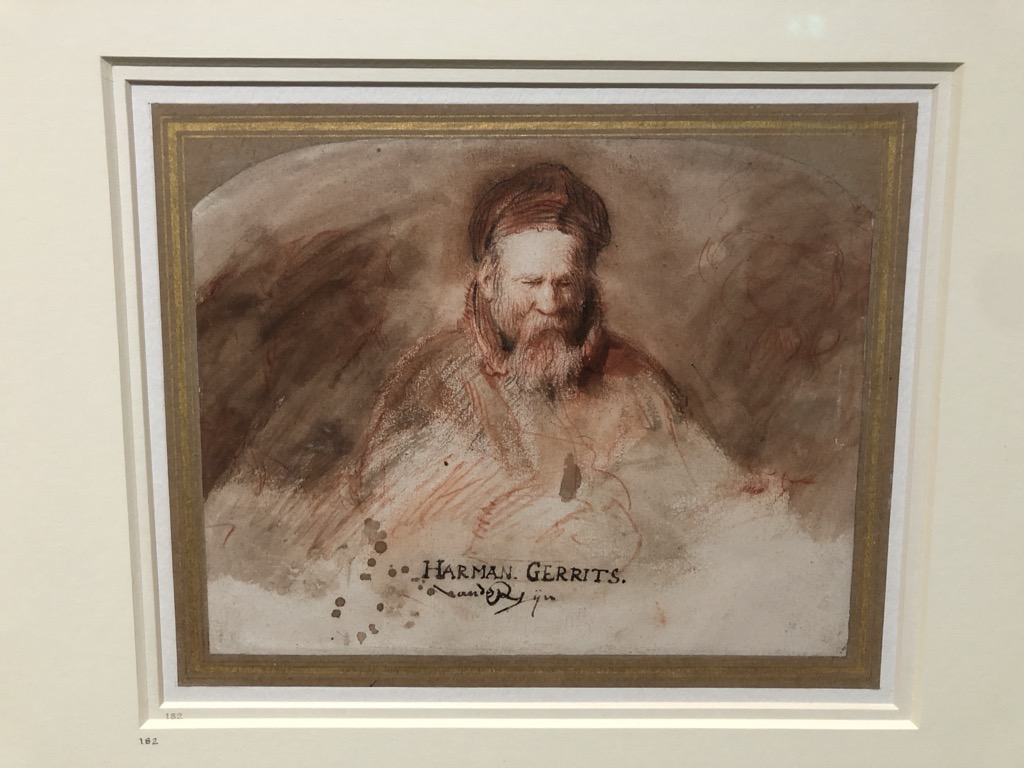
Drawing traditionally identified as Harmen Gerritsz van Rijn, Rembrandt's father
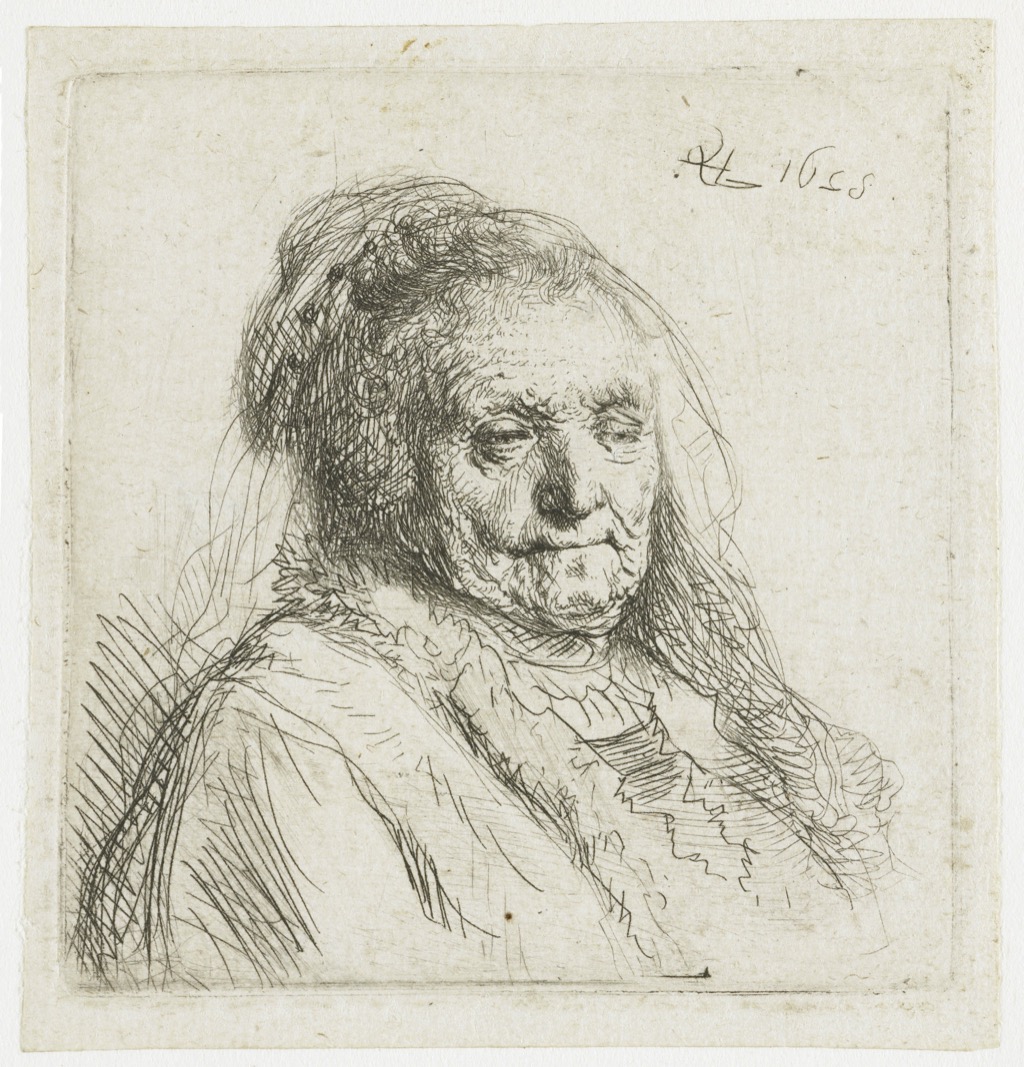
Rembrandt, The Artist's Mother, Head and Bust, Three-Quarters Right
The mother image also connects to the active Rembrandt print pages for The Artist's Mother, Head and Bust, Three-Quarters Right and The Artist's Mother, Head Only, Full Face. Those pages are better places for print-specific detail, while this biography page explains why family identification needs careful handling.
Myths to Avoid
The first myth is that Saskia was only Rembrandt's muse. She was his wife, part of the Uylenburgh network, mother of Titus and a legal presence through her will.
The second myth is that Hendrickje's story is mainly a scandal. The surviving records show social discipline and an unmarried household, but they also show a woman who belonged to Rembrandt's family life and later business survival.
The third myth is that Titus matters only because of inheritance. He was an heir, but also a son, household member, later partner in business arrangements, husband to Magdalena and father of Titia.
The fourth myth is that Rembrandt's family story simply proves decline. The documents include hardship, death and conflict, but they also show continuity, practical cooperation and the structures that kept work possible.
The final myth is that documents reveal everything. They reveal dates, relationships, legal acts and social pressures. They do not reveal every feeling. A good biography lets the documents speak clearly without pretending they are the whole household.
Frequently Asked Questions About Rembrandt's Family
Yes. They had several children, but only Titus survived childhood. Titus became Saskia's heir and later played an important role in Rembrandt's household and business circumstances.
Hendrickje Stoffels was part of Rembrandt's household after Saskia's death and was Cornelia's mother. She also later joined Titus in a business arrangement that employed Rembrandt after his financial crisis.
Cornelia was the daughter of Rembrandt and Hendrickje Stoffels. A Stadsarchief Amsterdam baptism record route identifies her baptism at the Oude Kerk on 30 October 1654.
Magdalena van Loo married Titus van Rijn in 1668. Their daughter Titia was baptised in 1669, with Rembrandt appearing as a witness.
Family life affected Rembrandt through inheritance, property, household structure, business arrangements, studio life and reputation. It did not simply inspire the art; it shaped the conditions in which the art was made.
Discussion
What part of Rembrandt Family and Household most changes your view of the artist: the documents, the household setting, the Amsterdam career, the financial pressures, or the paintings and prints made around the same time?
Reader Insights
Read Rembrandt Family and Household through evidence as much as legend: dates, contracts, houses, family ties and later records all shape the story.
Pair the biography with one painting and one print from the same period to see how life events and artistic decisions overlap without becoming the same thing.
Which detail feels most useful for understanding Rembrandt as a working artist rather than only as a famous name?
Join the Conversation
Have a thought or observation about Rembrandt Family and Household? Share it below. Thoughtful responses may be added to this section as the Rembrandt pages develop.
References
- Stadsarchief Amsterdam, Rembrandt en Saskia (in Dutch): https://www.amsterdam.nl/stadsarchief/stukken/beroemd/rembrandt-saskia/
- Stadsarchief Amsterdam, Saskia begraven (in Dutch): https://www.amsterdam.nl/stadsarchief/stukken/dood/saskia-begraven/
- Stadsarchief Amsterdam, Hendrickje Stoffels church-council record page (in Dutch): https://www.amsterdam.nl/stadsarchief/stukken/liefde-lust/hoererije/
- GeschiedenisLokaal Amsterdam, Testament van Titus (in Dutch): https://geschiedenislokaalamsterdam.nl/bronnen/testament-van-titus
- GeschiedenisLokaal Amsterdam, Rembrandt laat zijn huis aan Titus na (in Dutch): https://geschiedenislokaalamsterdam.nl/bronnen/rembrandt-laat-zijn-huis-aan-titus-na
- GeschiedenisLokaal Amsterdam, Ondertrouw Titus en Magdalena van Loo (in Dutch): https://geschiedenislokaalamsterdam.nl/bronnen/ondertrouw-titus-en-magdalena-van-loo
- GeschiedenisLokaal Amsterdam, De doop van kleindochter Titia (in Dutch): https://geschiedenislokaalamsterdam.nl/bronnen/de-doop-van-kleindochter-titia
- OpenArchieven / Stadsarchief Amsterdam, Cornelia baptism route lead (in Dutch): https://www.openarchieven.nl/saa%3A4f4650b7-6abc-dae4-ad1b-a915a0da7247
- Stadsarchief Amsterdam, Rembrandt burial page (in Dutch): https://www.amsterdam.nl/stadsarchief/stukken/dood/rembrandt/
- Stadsarchief Amsterdam, De geldzaken van Rembrandt (in Dutch): https://www.amsterdam.nl/stadsarchief/nieuws/rembrandt-0/
- Museum Rembrandthuis, Meet Rembrandt: https://www.rembrandthuis.nl/en/find-out-more/meet-rembrandt/
- Rembrandthuis, Leonore van Sloten, Stappen in de Reconstructie van een Leven (in Dutch): https://www.rembrandthuis.nl/de/kronieken/stappen-in-de-reconstructie-van-een-leven/
- Radboud University, Rembrandt Documents Project: https://www.ru.nl/en/research/research-projects/rembrandt-documents-project
- National Gallery of Art, Washington, Rembrandt van Rijn artist biography: https://www.nga.gov/artists/1822-rembrandt-van-rijn
- National Gallery, London, Rembrandt artist biography: https://www.nationalgallery.org.uk/artists/rembrandt
- National Gallery, London, Portrait of Hendrickje Stoffels: https://www.nationalgallery.org.uk/paintings/rembrandt-portrait-of-hendrickje-stoffels
- Wikimedia Commons / Ashmolean Museum image route, Drawing of Harman Gerrits (Rembrandt's father): https://commons.wikimedia.org/wiki/File:Drawing_of_Harman_Gerrits_(Rembrandt%27s_father)_-_Q83383193_(no_frame).jpg
- Wikimedia Commons / Rijksmuseum image route, Rembrandt, The Artist's Mother, Head and Bust, Three-Quarters Right: https://commons.wikimedia.org/wiki/File:B354_Rembrandt.jpg
 Rembrandt.jpg)