


 by Tom Gurney
Tom Gurney BSc (Hons) is an art history expert with over 20 years experience
Published on June 19, 2020 / Updated on August 9, 2026
Email: tomgurney1@gmail.com / Phone: +44 7429 011000
Rembrandt Self-Portraits: Introduction
Rembrandt's self-portraits are among the most famous sustained acts of self-representation in European art. They show a young painter testing expressions, a successful Amsterdam professional in costume, an old master confronting age, and a printmaker using copper and paper to turn his own face into a field of experiment.
They are often described as autobiographical, and they do carry the pressure of a life. Rembrandt was born in Leiden in 1606, built his career in Amsterdam, enjoyed major success, suffered financial collapse, outlived several people closest to him and continued to work until his death in 1669. Yet the self-portraits are not simple diary pages. They are made objects. They involve costume, studio practice, market identity, technical experiment, role-playing, self-scrutiny and artistic ambition.
This page introduces Rembrandt's self-portraits as a group. It connects them to his biography, paintings, drawings, etchings, style and technique, and to the larger questions of attribution and corpus history that shape every serious Rembrandt study.
Contents
- Introduction
- Why Rembrandt's Self-Portraits Are Hard to Count
- A Face Used for Experiment
- Self-Fashioning in Leiden and Amsterdam
- Tronies, Costume and Role-Playing
- The Painted Self-Portraits
- Etched Self-Portraits
- Drawings and the Problem of Attribution
- Studio, Market and Artistic Identity
- Late Self-Portraits
Why Rembrandt's Self-Portraits Are Hard to Count
There is no single permanent number for Rembrandt's self-portraits. Some summaries count only paintings. Others include etchings and drawings. Some include works now accepted as Rembrandt's own hand, while others discuss works that were once accepted but have since been reassigned to pupils, followers, school or circle.
That is why readers may see different totals in books, museums and online summaries. A high count usually includes paintings, prints and drawings together. A lower count may refer only to painted self-portraits accepted in a particular catalogue or museum tradition. The Rembrandt Research Project and the published Corpus of Rembrandt Paintings made these boundaries part of the modern discussion, and the Rembrandt Database helps show why records, literature and technical evidence have to be read together.
The count question is not a distraction. It goes to the heart of the subject. Rembrandt worked in a studio, taught pupils and produced images that were copied, collected and reattributed over time. A face that looks "Rembrandt-like" may be by Rembrandt, by someone close to him, after him, or formerly attributed to him. A careful viewer should therefore ask what kind of object is being discussed: painting, drawing, etching, impression, state, accepted work, studio work or later copy.
For the self-portraits, uncertainty also protects the art from a false neatness. Rembrandt did not leave a tidy sequence arranged for modern biography. He left a complicated body of objects that shows him using himself again and again as model, persona, surface and problem.
A Face Used for Experiment
One reason Rembrandt returned to his own face so often is practical. A mirror gives the artist an available sitter. It allows repeated study of expression, light, age, texture and costume without the pressure of a paying patron. In Rembrandt's case, that practical advantage became one of the great engines of his art.
The early self-portraits often feel exploratory. Rembrandt tests open mouths, knitted brows, startled looks, laughter, shadowed eyes, curly hair, unusual hats and dramatic lighting. Some of these images belong close to the world of the tronie, a type of character head or expression study rather than a conventional portrait of a named sitter. In that context, Rembrandt's own face becomes a laboratory. He can be youth, soldier, beggar, courtly figure, painter, observer or theatrical character.
This matters because it keeps the self-portraits from becoming too narrow. They are not only attempts to reveal the "real Rembrandt." Sometimes they do the opposite: they show how identity can be made, staged, tried on and transformed. A hat, collar, chain, shadow or grimace can shift the meaning of the same face.
The habit links Rembrandt's self-portraits to his wider art. His biblical figures, beggars, scholars, soldiers and old men often depend on the same intense study of face and gesture. By studying himself, he strengthened the expressive range he could bring to other subjects.
Self-Fashioning in Leiden and Amsterdam
Rembrandt's early career began in Leiden, where he trained, worked near Jan Lievens and developed a taste for dramatic faces, costume and narrative pressure. The early self-portraits belong to that world of ambition. They show a young artist asking how far expression and light can go.
When Rembrandt moved into the Amsterdam art market, the self-portrait gained another role. He was no longer only a young experimenter. He was a professional painter among patrons, collectors, pupils and competitors. Self-portraits could present him as a learned artist, a fashionable figure, a maker with status or a master conscious of earlier traditions.
Costume is central to that process. Rembrandt's self-portraits rarely present everyday dress in a simple documentary way. Berets, caps, collars, gorgets, chains, rich fabrics and imagined historical clothing let him move between portrait, theatre and memory. A costume may suggest old-master dignity, courtliness, military bravado or studio play. The viewer sees Rembrandt, but also sees Rembrandt making an image of Rembrandt.
That self-fashioning should not be dismissed as vanity. In the seventeenth-century art market, identity mattered. A painter's reputation depended on skill, recognisable manner, learned ambition and the ability to attract attention. Self-portraits helped Rembrandt define what kind of artist he wanted viewers and collectors to encounter.
Tronies, Costume and Role-Playing
The word tronie is useful for Rembrandt because it reminds readers that not every head is a straightforward portrait. A tronie may study expression, type, costume, age, exotic dress, laughter, fear or theatrical character. It can look personal without functioning as a conventional likeness.
Rembrandt's self-portrait practice often moves near this territory. A face may be his own, but the image is not necessarily a confession. A grimace can be a study of emotion. A costume can be a role. A shadowed face can be a test of light. A turban or historical cap can turn the painter into a figure from another time.
This role-playing also connects Rembrandt to the broader Dutch fascination with character, surface and illusion. Paintings and prints could offer viewers a face that seemed psychologically alive while also reminding them that art is made through choices. Rembrandt's self-portraits often hold both truths at once. The face feels intimate, but the costume announces construction.
That tension is part of their modern appeal. Viewers want to meet Rembrandt directly. The self-portraits allow that desire, then complicate it. They ask whether a painted self is ever simply a self, or whether it is always also a performance before an imagined audience.
The Painted Self-Portraits
The painted self-portraits make Rembrandt's physical presence feel unusually strong. Paint lets him build flesh, hair, collars, shadows and highlights as material substance. In some works, the surface is relatively smooth and descriptive. In others, especially late works, the paint becomes thicker, broader and more visibly worked.
The 1659 Self-Portrait in the National Gallery of Art, Washington is one of the clearest anchors. The official title is simply Self-Portrait, though the painting is often identified by its beret and turned-up collar. The museum record gives the object facts: Rembrandt van Rijn, 1659, oil on canvas, 84.5 x 66 cm, accession 1937.1.72, Andrew W. Mellon Collection.
The painting was made after Rembrandt's financial crisis, but it should not be reduced to that history. The National Gallery of Art catalogue shows how much the picture depends on artistic construction: old-master memory, costume, pose, double ground, transparent brown underpaint, thick impasto in the face, incised hair and later conservation history. The self-portrait is grave, but it is also a statement of authority.
Its force lies in balance. The face is old and intensely present. The hands and body are quieter. The beret and collar frame the head. The gaze presses outward without theatrical exaggeration. Rembrandt lets biography enter the picture, but he also makes the viewer see the intelligence of paint.
Etched Self-Portraits
Rembrandt's etched self-portraits are just as important as the painted ones. Etching gave him a different way to multiply and vary self-representation. A plate could be worked, printed, altered, printed again and circulated as impressions. The result was not a copy of a painting, but an original printed object shaped by line, acid, drypoint, ink, paper and pressure.
The Art Institute of Chicago's Self-Portrait Etching at a Window is a strong example for a self-portrait hub because it shows Rembrandt as both sitter and maker. The artist appears at a window or ledge, looking outward while holding the tools of his work. The image turns self-portraiture into a statement about the act of making. It also connects the self-portraits to the wider etchings page, where state, impression, paper and print handling matter.
Etched self-portraits can feel more immediate than paintings because line carries thought so visibly. A few marks can describe a brow, cheek, shadow or curl. Dense hatching can create darkness; open paper can become light. Drypoint burr can soften an edge. Differences between impressions may change the mood of the same design.
They also helped Rembrandt's self-image travel. A painted self-portrait usually remained a single object in one collection. An etching could reach collectors and viewers far beyond one room. Through prints, Rembrandt's face became part of a wider market and a wider conversation about artistic identity.
Drawings and the Problem of Attribution
Rembrandt's drawings add another layer, though they require caution. Drawing attributions can be especially unstable because sheets pass through collections, inscriptions may be later, and pupils or followers could work in related ways. The strongest drawing discussions now pay close attention to paper, ink, wash, condition, comparison and current institutional records.
For self-portraiture, drawings matter less as a tidy group than as evidence of how Rembrandt thought with line. A drawn self-image, if accepted, can show quickness, searching and revision in ways different from paint or etching. Even when the object is not a self-portrait, Rembrandt's drawings help explain the self-portraits because they reveal his attention to gesture, posture and the expressive economy of marks.
This is why the self-portraits page belongs beside the drawings page and the style and technique page. Rembrandt's art is not divided neatly by medium. A facial type, pose or expressive problem might move from mirror study to drawing, from drawing to etching, or from costume play to painting. The links are not always direct, but the habits of looking are shared.
The drawing caution also reinforces the count caution. When readers ask how many self-portraits Rembrandt made, drawings are one reason the answer changes. The boundary between Rembrandt, school, circle and follower is not always simple, and honest labels matter.
Studio, Market and Artistic Identity
Rembrandt's self-portraits were made in relation to a studio and a market. They were not isolated private exercises. He trained pupils, worked for patrons, collected objects, sold works and built a recognisable artistic persona. His self-images helped define that persona.
In the studio, the self-portrait could demonstrate skill. It showed how the painter handled flesh, shadow, costume, likeness, expression and texture. It may also have helped pupils and collectors understand the master's manner. In a culture of portraiture, a painter who could make his own face compelling advertised his power over other faces too.
In the market, self-portraits could carry value because they offered Rembrandt by Rembrandt. The artist's face became a kind of signature, but one more complex than a name. It could be youthful, courtly, comic, tragic, learned or old. It could claim status or test disguise. It could place Rembrandt among earlier masters while also making his own manner unmistakable.
This is why the self-portraits connect so closely to the corpus and attribution pages. A successful artistic identity creates followers and copies. It also creates later confusion. Rembrandt's self-image became so powerful that works near his manner could be pulled toward his name. Modern attribution study is one way of sorting admiration from evidence.
Late Self-Portraits
The late self-portraits are the works that most strongly shape Rembrandt's modern reputation. They appear after financial crisis, household loss and changes in professional status, but they are not only records of suffering. They are also among his most deliberate claims to artistic authority.
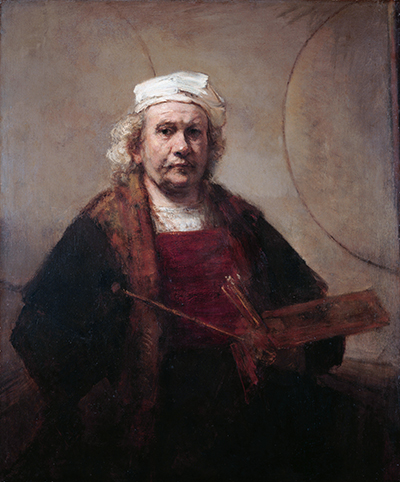
The 1659 National Gallery of Art painting presents Rembrandt in beret and raised collar, with a direct gaze and a face built from living paint. It belongs to the same late territory as the Frick self-portrait, the National Gallery, London Self Portrait at the Age of 63 and the Kenwood Self-Portrait with Two Circles. Each work presents the older artist differently, but together they show Rembrandt using age as a pictorial resource rather than hiding it.
The National Gallery, London painting, dated 1669, is especially moving because it belongs to the final year of Rembrandt's life. Its broad handling and direct presence have often been read as a last confrontation with the viewer. It should still be read as art, not merely as biography. The costume, surface, light and pose all make the encounter.
In the late self-portraits, finish is rarely the point. Thick paint, rough passages, dark grounds and abbreviated forms do not signal carelessness. They concentrate attention. Rembrandt lets the viewer see that likeness can be made from visible work. Age becomes not just a subject, but a way of proving what paint can still do.
Self-Portrait with Two Circles
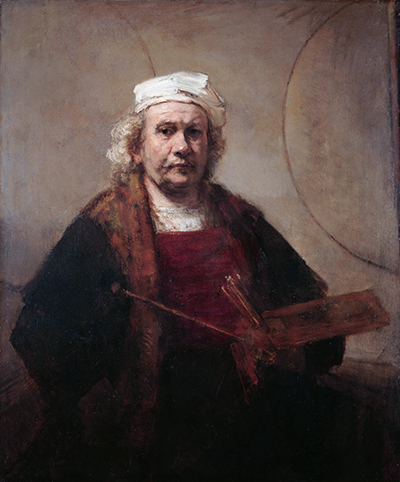
Self-Portrait with Two Circles at Kenwood is one of Rembrandt's most famous late self-images. English Heritage presents it as a painting of Rembrandt as painter, holding the tools of his profession, with two circular forms behind him. It came to Kenwood through the Iveagh Bequest and remains one of the central works associated with the house.
The circles have invited many interpretations. They have been linked to artistic mastery, geometry, theory, studio practice, ancient anecdotes and symbolic meanings. The safest reading is cautious: the circles matter, but they are not a solved code. Rembrandt leaves them powerful partly because they remain unresolved.
The painting's main force lies in self-presentation. Rembrandt stands before the viewer as a maker. The tools identify profession. The circles turn the surface behind him into a challenge. The body is broad, the face alert, the handling forceful. The image is not just "Rembrandt at the end of life." It is Rembrandt staging the question of what it means to be a painter.
Kenwood also shows why object details need care. English Heritage, Art UK, Google Arts & Culture and CODART records preserve related but not always identical measurement and display information. A careful account can discuss the painting's meaning without pretending that every factual field is equally settled in every record.
Biography Without Reducing the Pictures
It is impossible to keep biography out of Rembrandt's self-portraits, and it would be wrong to try. The young self-images belong to ambition. The Amsterdam self-portraits belong to professional identity. The late works belong to a life marked by success, debt, loss and endurance.
But biography should guide looking, not replace it. A self-portrait made after bankruptcy is not automatically a picture of bankruptcy. A late face is not automatically a confession. A costume is not automatically disguise. A direct gaze is not automatically truth. Rembrandt's power lies in making these possibilities active without letting any one of them close the work down.
The best way to read the self-portraits is to move between life and making. Ask what was happening in Rembrandt's career, then ask how the object is built. Look at light, costume, medium, surface, line, state, impression, revision and condition. Then return to the face. The face will feel different after the object has been taken seriously.
This approach also keeps Rembrandt from becoming a myth of solitary genius. He worked in cities, studios, households and markets. He made art for viewers. His self-portraits are personal, but they are also social objects designed to be seen, collected, compared and remembered.
How to Use This Hub
Use this self-portraits page as the entry point into Rembrandt's self-image across media. For a close study of one painting, begin with the 1659 Self-Portrait in the National Gallery of Art, Washington. It gives the clearest combination of object facts, late self-presentation, technical evidence and conservation history.
For the most famous late artistic statement, move to Self-Portrait with Two Circles. It sits beside the 1659 painting because both works ask how Rembrandt presents authority after crisis, but they answer in different ways.
Use the biography and late years pages when the life story matters. Use the paintings page for the place of self-portraits within Rembrandt's painted corpus. Use the etchings page when states, impressions and printed self-images become central. Use the drawings page for line, study and attribution caution. Use style and technique for paint surface, impasto, underpaint, drypoint and the way marks become presence. Use workshop and attribution, plus the corpus page, when the question is whether a particular self-image is by Rembrandt, near Rembrandt or no longer accepted as his.
The self-portraits reward this movement between pages because they were never only one thing. They are likenesses, experiments, performances, market objects, technical tests, late reflections and claims of artistic identity. Rembrandt's face is the subject, but the deeper subject is what art can make a face do.
Frequently Asked Questions About Rembrandt Self-Portraits
He used his own face as an available model, a study of expression, a way to test light and costume, a professional identity, and a subject through which he could explore age, status, technique and artistic authority.
They are connected to his life, but they are not simple diary entries. They involve costume, role-playing, market identity, studio practice and technical experiment as well as personal likeness.
Several compete for that place. The 1659 Self-Portrait in the National Gallery of Art, Washington and Self-Portrait with Two Circles at Kenwood are two of the most important late examples.
Yes. Rembrandt made important self-portraits in etching. These printed works show him using line, plate work, state, impression, paper and ink to create self-images that could circulate beyond a single painted object.
Discussion
Which route through Rembrandt Self-Portraits helps most: close looking, technical evidence, documentary context, museum attribution, or links to individual Rembrandt works?
Reader Insights
Treat Rembrandt Self-Portraits as a route through Rembrandt's wider practice, not as a detached side topic.
Look for moments where museum records, technical study or attribution history alter the simplest version of the story.
Which comparison would help most next: a secure Rembrandt, a workshop work, a print, a drawing or a late painting?
Join the Conversation
Have a thought or observation about Rembrandt Self-Portraits? Share it below. Thoughtful responses may be added to this section as the Rembrandt pages develop.
References
- National Gallery of Art, Washington, Self-Portrait, 1659, accession 1937.1.72: https://www.nga.gov/artworks/79-self-portrait
- National Gallery of Art, Washington, Arthur K. Wheelock Jr., Rembrandt van Rijn, Self-Portrait, 1659, in Dutch Paintings of the Seventeenth Century: https://www.nga.gov/research/publications/dutch-paintings-seventeenth-century/rembrandt-van-rijn-self-portrait-1659
- English Heritage, Kenwood Rembrandt self-portrait route: https://production.english-heritage.org.uk/visit/places/kenwood/history-stories-kenwood/rembrandt-self-portrait/
- English Heritage, Face to Face: https://www.english-heritage.org.uk/visit/inspire-me/face-to-face-english-heritage-through-portraits-at-our-properties/
- Art UK, Self Portrait with Two Circles: https://artuk.org/discover/artworks/self-portrait-with-two-circles-191815
- CODART Canon, Self-Portrait with Two Circles: https://canon.codart.nl/artwork/self-portrait-2/
- National Gallery, London, Self Portrait at the Age of 63: https://www.nationalgallery.org.uk/paintings/rembrandt-self-portrait-at-the-age-of-63
- Art Institute of Chicago, Self-Portrait Etching at a Window: https://www.artic.edu/artworks/181616/self-portrait-etching-at-a-window
- Rijksmuseum, Rembrandt collection set: https://www.rijksmuseum.nl/en/collection/set/Rembrandt--98fe3b7b-608d-4366-3514-08dd024ac890
- Rembrandt Database, mission and scope: https://rembrandtdatabase.org/about/mission-and-scope.html
- Rembrandt Database, A Corpus of Rembrandt Paintings: https://rembrandtdatabase.org/literature/corpus.html
- Rembrandt Database, What is presented and why: https://rembrandtdatabase.org/about/what-is-presented-and-why.html
- National Gallery of Art, Washington, Issues of Attribution: Rembrandt and Workshop: https://www.nga.gov/research/publications/dutch-paintings-seventeenth-century/issues-attribution-rembrandt-workshop
 Rembrandt.jpg)