


 by Tom Gurney
Tom Gurney BSc (Hons) is an art history expert with over 20 years experience
Published on June 19, 2020 / Updated on August 9, 2026
Email: tomgurney1@gmail.com / Phone: +44 7429 011000
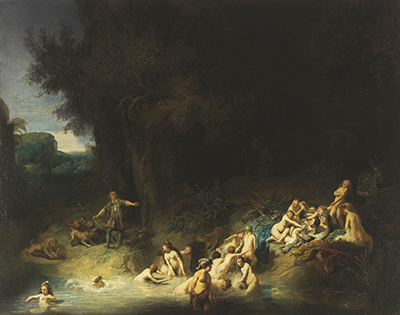
Diana Bathing with her Nymphs combines the stories of Actaeon and Callisto in one early Rembrandt mythological scene
Rembrandt completed his own version in 1634 although there were also several other drawings and etchings that took in the same theme. This particular painting can now be found at the Wasserburg Anholt, Isselburg as part of the Salm-Salm princely collection.
This complex painting combines two parts of Ovid's Metamorphoses series of tales and then adds some unrelated additional figures on top. The left hand side outlines Actaeon's punishment as he is turned into a stag and then killed by his own dogs. Other artists to have taken the work of Ovid into their own art include Pablo Picasso in his Blind Minotaur, Spinners by Diego Velazquez and Titian's Death of Actaeon and Diana and Callisto.
On the opposing side of the canvas you will then see Diana's nymphs revealing Callisto's rape by Jupiter and the resultant pregnancy. Despite her unfortunate ordeal, she is banished by Diana in a seemingly unfair narrative.
This famous series would prove inspirational to many artists from around this artistic period and several other key names from the Renaissance and Baroque periods would produce their own paintings to bring these words to life.
The Wasserburg Anholt in Isselburg also holds works by Jan van Goyen and Gerard ter Borch (Portrait of Gesina ter Borch as a shepherdess) in their collection plus porcelain, weaponry and armoury. This impressive building also has a large set of gardens which draw in crowds just by themselves.
Object Notes and Research Context
This painting is unusually dense because it joins two episodes from Ovid's Metamorphoses. Actaeon intrudes on Diana bathing and is punished by transformation into a stag; Callisto, one of Diana's companions, is exposed as pregnant after Jupiter's assault and is expelled from the chaste company. Rembrandt compresses discovery, shame, violence and punishment into a single woodland bathing scene.
Recent scholarship on Rembrandt's female nudes has used this work as an important comparison for Woman Bathing in a Stream because both pictures resist a single easy category. The Anholt Diana is mythological, but it also lets Rembrandt test bodies, laughter, fear, looking and moral exposure in ways that are more psychologically unsettled than a conventional classical illustration.
The painting belongs beside Susanna and the Elders, Bathsheba at Her Bath and Woman Bathing in a Stream, because all four subjects involve looking, vulnerability and the tension between biblical or mythological story and Rembrandt's close observation of the human body.
The double-subject structure is the page's main asset. Actaeon's punishment and Callisto's exposure are normally separate episodes, but Rembrandt puts them into one unstable scene of looking and discovery. That compression means readers need a little more mythological guidance than a simple artwork page would normally require.
The painting also belongs in Rembrandt's wider treatment of female vulnerability. Unlike an idealised classical nude, the bodies here are awkward, startled and socially entangled. That makes it a useful comparison for Susanna, Bathsheba and other scenes where a woman's body is placed under scrutiny. That ethical discomfort is part of the painting's force.
The two punishments are important to identify. Actaeon is discovered as an intruder and will be transformed; Callisto is discovered as pregnant and expelled from Diana's circle. Explaining both episodes prevents the picture from being reduced to a generic bathing scene.
The painting belongs with Rembrandt's mythology and nude-body subjects rather than with biography. Its strongest value is the unusually crowded mythological structure and the way Rembrandt turns classical source material into an uneasy scene of exposure.
That makes the page a useful mythology support route rather than a purely decorative nude-artwork entry.
Further Rembrandt Context
This shorter legacy page remains part of the Rembrandt archive. For fuller context, use the refreshed Rembrandt pages below, which explain the artist's biography, media, technique, attribution issues and major works in greater depth.
For secure object data, attribution and collection history, compare Diana Bathing with her Nymphs with Actaeon and Callisto with the relevant museum or catalogue record before treating older page text as final.
 Rembrandt.jpg)
Discussion
What feels most useful when looking at Diana Bathing with her Nymphs with Actaeon and Callisto: the subject, the handling of light, the medium, the attribution history, or its place within Rembrandt's wider painting output?
Reader Insights
Set this page beside the refreshed Rembrandt hubs before relying on older summaries alone.
Rembrandt pages often need museum records, catalogue history and attribution caution, especially where older sources use broader labels.
Which detail would you most want clarified next: date, medium, collection, attribution, subject, condition or comparison with another Rembrandt work?
Join the Conversation
Have a thought or observation about Diana Bathing with her Nymphs with Actaeon and Callisto? Share it below. Thoughtful responses may be added as the Rembrandt archive continues to be reviewed.