


 by Tom Gurney
Tom Gurney BSc (Hons) is an art history expert with over 20 years experience
Published on June 19, 2020 / Updated on August 9, 2026
Email: tomgurney1@gmail.com / Phone: +44 7429 011000
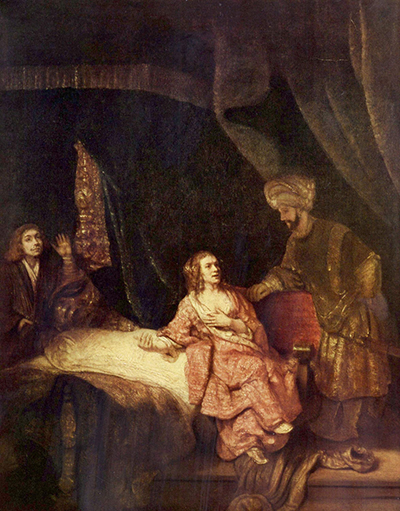
Joseph and Potiphar's Wife belongs to Rembrandt's wider treatment of Joseph in prints, drawings and workshop painting
Rembrandt produced several bedside scenes but often they were the result of an illness or sexual daliance. In this case the subject is a little different, though still with a sexual connection. Joseph is accused of trying to seduce Potiphar's wife, where as in fact he escaped after rejecting her advances. This is a chapter from the book of Genesis in the Old Testament.
It is believed that Rembrandt van Rijn designed the overall composition of this painting and carefully posed the figures, but the actual painting was predominantly completed by one of his workshop assistants, under his supervision.
It was inevitable that someone taught by this great master would also display a similar style within their work. It is understandable that paintings from this period have sometimes proved difficult to attribute between an artist and his studio.
The complaint made by Potiphar's wife to her husband has Joseph added into the scene by Rembrandt, when the original biblical story would have him elsewhere. False accusation and a betrayal of justice is a significant topic for this artist, perhaps his use of it here is influenced by an ongoing lawsuit where Geertje Dirckx claimed that he had promised to marry her. Such a scenario today seems entirely laughable but clearly society at that time would treat such claims differently, at least to the point of giving them the time of day.
Object Notes and Research Context
The National Gallery of Art catalogue treats the 1655 Washington painting as a Rembrandt workshop work, not as a simple autograph painting. That distinction improves the page: the dramatic accusation before Potiphar belongs to Rembrandt's studio world, while the artist's own engagement with the subject is also visible in the 1634 etching of Joseph escaping the attempted seduction.
The British Museum's impression of the 1634 etching records Rembrandt's direct printmaking solution: Potiphar's wife lies in the shadowed bed curtains while Joseph pulls away into the light, making the contrast between desire, accusation and virtue visually legible. The later workshop painting shifts the emphasis from the physical attempted seduction to the moral and narrative aftermath, with the abandoned garment becoming evidence in a false charge.
The subject involves two related but different moments in Genesis 39. It belongs beside Bathsheba at Her Bath, Susanna and the Elders, and Woman Taken in Adultery as related Rembrandt treatments of accusation, sexual vulnerability and moral judgement.
Genesis 39 is the key narrative background. Joseph is enslaved in Potiphar's household, resists the advances of Potiphar's wife, and leaves his garment behind when he escapes. That garment becomes the false evidence used against him. Rembrandt's secure etching and the Washington workshop painting therefore treat two connected phases of the story: temptation and accusation.
The attribution warning is not a downgrade but a useful teaching point. Rembrandt's workshop could absorb his compositions, biblical interests and figure types without every surviving painting being fully autograph. The workshop-and-attribution and prints contexts explain why a workshop painting and a Rembrandt etching can belong together without being treated as the same kind of object.
The garment motif is the hinge between seduction and accusation. Joseph's abandoned cloak becomes false proof against him, just as clothing and fabric often carry moral or narrative weight in Rembrandt's biblical scenes.
The Washington work belongs in Rembrandt's orbit, not as an isolated failure of attribution. Workshop status, print comparison and biblical narrative together give the URL a clear reason to remain active.
Further Rembrandt Context
This shorter legacy page remains part of the Rembrandt archive. For fuller context, use the refreshed Rembrandt pages below, which explain the artist's biography, media, technique, attribution issues and major works in greater depth.
For secure object data, attribution and collection history, compare Joseph and Potiphar's Wife with the relevant museum or catalogue record before treating older page text as final.
 Rembrandt.jpg)
Discussion
What feels most useful when looking at Joseph and Potiphar's Wife: the subject, the handling of light, the medium, the attribution history, or its place within Rembrandt's wider painting output?
Reader Insights
Set this page beside the refreshed Rembrandt hubs before relying on older summaries alone.
Rembrandt pages often need museum records, catalogue history and attribution caution, especially where older sources use broader labels.
Which detail would you most want clarified next: date, medium, collection, attribution, subject, condition or comparison with another Rembrandt work?
Join the Conversation
Have a thought or observation about Joseph and Potiphar's Wife? Share it below. Thoughtful responses may be added as the Rembrandt archive continues to be reviewed.