 by Tom Gurney
Tom Gurney BSc (Hons) is an art history expert with over 20 years experience
Published on June 19, 2020 / Updated on August 2, 2026
Email: tomgurney1@gmail.com / Phone: +44 7429 011000
Contents
Introduction
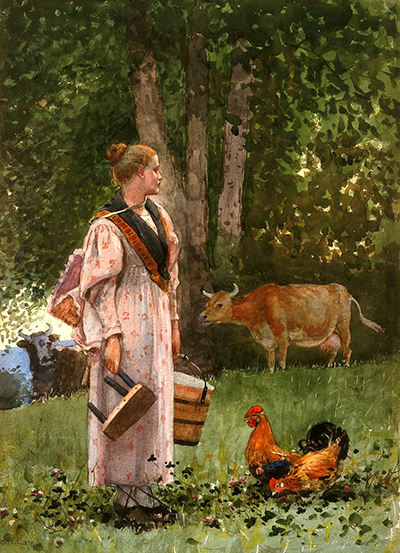
Winslow Homer's The Milk Maid is an 1878 watercolor that belongs to the rural figure and domestic labor side of his 1870s work. The National Gallery of Art records the work as watercolor over graphite on wove paper, with a sheet size of 50.3 x 36.1 cm, or 19 13/16 x 14 3/16 inches. The NGA object record lists the credit line as Gift of Ruth K. Henschel in memory of her husband, Charles R. Henschel, and gives the accession number 1975.92.11. [1]
Those details are the safest foundation for the article. The Milk Maid does not need to be inflated into one of Homer's major narrative paintings. It is a work on paper, built around a standing young woman, farm animals, trees, a pail and a small stool. Its value inside the Homer cluster is connective: it helps readers see how Homer used watercolor for rural subjects that sit between figure study, farm work and ordinary outdoor life. [2]
The scene is quiet but not empty. The milkmaid stands on a grassy hillside with two cows nearby and poultry close to her feet. She holds the tools of work rather than acting out a dramatic incident. Homer makes the farm setting legible through practical details: the pail, the stool, the animals, the sloping ground and the shaded trees. The effect is not sentimental storytelling so much as close attention to a moment before or after labor. [3]
A Rural Watercolor From 1878
The date matters because 1878 sits inside a broader phase when Homer was working with rural, childhood, leisure and watercolor subjects. The local Watercolours hub packet identifies watercolor as central to Homer's experiment with mobility, light, paper and place. The Milk Maid fits that route cleanly. It is not simply a farm subject; it is a farm subject made through the light, economy and surface of watercolor over graphite. [4]
The Art Institute of Chicago's record for another 1878 Homer watercolor, Apple Picking, gives useful nearby context for this rural watercolor moment. AIC connects that work to Homer's stay at Houghton Farm near Mountainville, New York, and to a group of farm and orchard subjects from that summer. The NGA record for The Milk Maid does not need to be forced into every detail of that context, but its Valentine/Henschel provenance and 1878 date place it close to the same rural watercolor world. [5]
Relation To Fresh Eggs And Rural Figure Pages
The Milk Maid pairs naturally with Fresh Eggs. Both pages concern young women, farm labor and works on paper, and both help the Watercolours hub show that Homer's watercolor practice was not limited to coastal travel subjects. Fresh Eggs brings baskets, eggs, straw and poultry into a compact farm setting. The Milk Maid shifts the labor toward cattle, dairy work and the outdoor hillside. [6]
The article also belongs near On the Stile, Weaning the Calf, Crossing the Pasture and Boys in a Pasture. Those links is best used as a rural corridor, not as a claim that Homer made a formal series. Together, they let readers compare how his 1870s subjects move between children, women, animals, fields, chores, rest and rural social life. [1]
This makes The Milk Maid useful even at modest scale. The major Homer pages will carry Civil War, marine peril, Reconstruction and late seascape weight. This article does something quieter. It preserves a rural watercolor stop where ordinary work is held still long enough to be looked at: a figure, a pail, a stool, cows, chickens, grass and trees arranged with disciplined simplicity. [2]
Discussion
Winslow Homer rewards close looking because his strongest images rarely close down into one easy meaning. Use the prompts below to test how the work changes as you move between subject, place, medium and history.
Reader Insights
First Look
What detail in The Milk Maid changes how the whole work feels?
Homer's Method
Where do you see Homer's balance between clear observation and unresolved meaning?
Cluster Context
Which related Homer work helps you read this page more carefully?
Join the Conversation
Share a thoughtful observation below, especially if a detail, source connection or related Homer page changed the way you read the work.
References
- National Gallery of Art object record, The Milk Maid, Winslow Homer, 1878, accession
1975.92.11: https://www.nga.gov/artworks/55586-milk-maid - Art Institute of Chicago archived object record, Apple Picking, Winslow Homer, 1878, used only for nearby Houghton Farm / 1878 rural watercolor context: https://archive.artic.edu/homer/artwork/183669
- National Gallery of Art artist record: https://www.nga.gov/artists/1401-winslow-homer
- National Gallery of Art, Winslow Homer publication: https://www.nga.gov/research/publications/winslow-homer
- Art Institute of Chicago, Watercolors by Winslow Homer: The Color of Light overview: https://archive.artic.edu/homer_exhb/overview/
- Local Winslow Homer Phase 1 approval brief, provisional URL decision matrix, medium-hub source packet, homepage/biography source packet, internal-link ledger, quote ledger, glossary ledger and Tom image-policy ledger dated 2026-07-20.
 Winslow Homer.jpg)