 Buy Art Prints Now
from Amazon
* As an Amazon Associate I earn from qualifying purchases.
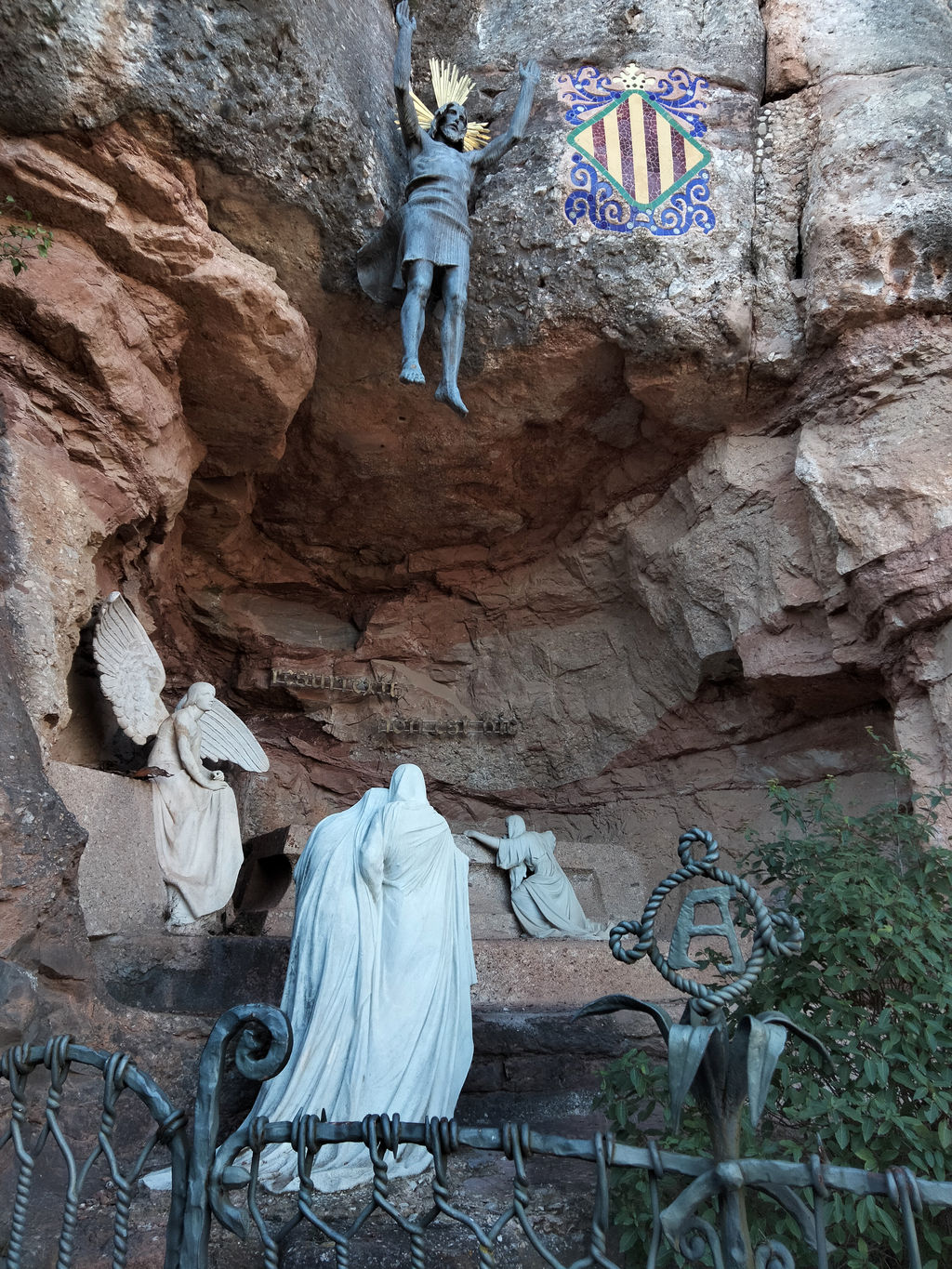
The restored First Mystery of Glory at Montserrat. Enric. Image source. CC BY-SA 4.0. Resized for the web. This reproduction uses the same CC BY-SA 4.0 licence.
 by Tom Gurney
Tom Gurney BSc (Hons) is an art history expert with over 20 years experience
Email: tomgurney1@gmail.com / Phone: +44 7429 011000
First Mystery of Glory at Montserrat: Introduction
On the walk from Montserrat’s monastery to the Santa Cova, the path widens beside a hollow in the cliff. Inside it, an angel sits at an open tomb. Three women gather below the rough overhang, while the bronze figure of the risen Christ hangs high against the rock outside. Antoni Gaudí began the First Mystery of Glory by enlarging a natural recess and making room for people to stop across from it. The mountain supplies both the shelter of the burial place and the exposed face on which Christ appears. [1] [2]
At a Glance
- Catalan titlePrimer Misteri de Glòria
- SubjectThe Resurrection of Christ
- LocationCamí de la Santa Cova, Montserrat, in Collbató, Catalonia
- CommissionerLliga Espiritual de la Mare de Déu de Montserrat
- DatesGaudí’s campaign, 1903–07. Monument blessed in 1916. Major restoration completed in 2013.
- Principal artistsAntoni Gaudí, Josep Llimona, Dionís Renart and Jeroni Martorell
This work across Antoni Gaudí’s career
First Mystery of Glory at Montserrat (current article)
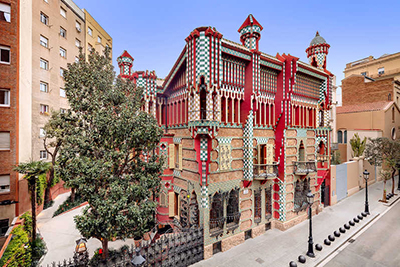
Early 1900s, first campaignCasa Vicens
1883–1885: Original summer houseSagrada Família
1883–1926: Gaudí’s tenurePalau Güell
1886–1890: Main building campaignPark Güell
1900–1914: Residential estate worksCasa Batlló
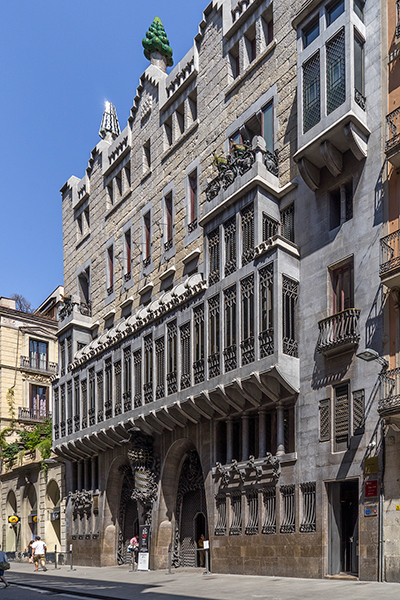
1904–1906: RemodellingCasa Milà
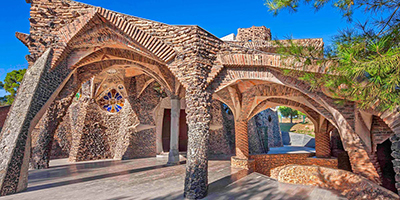
1906–1912: Apartment houseChurch of Colònia Güell
1908–1915: From the start of building work to the opening of the lower churchContents
- Along the Rosari Monumental
- A commission shaped by subscriptions
- The angel and the later sculptural group
- Jeroni Martorell and the edge of the scene
- Damage, repair and the recovered position of Christ
Along the Rosari Monumental
The walk leads from the sanctuary towards the Holy Grotto, where tradition places the discovery of the image of Our Lady of Montserrat. In 1896 Jaume Collell, a canon of Vic, launched the project that became the Rosari Monumental. Patrons and religious associations took responsibility for individual monuments. The fifteen stations follow the traditional rosary’s mysteries of Joy, Sorrow and Glory. A pilgrim passes from episodes of Christ’s infancy to the Passion, then reaches the Resurrection at the beginning of the final group. The path is nearly straight and rises gently on this last stretch towards the chapel. The Glorious Mysteries face east, where the morning sun can reach them. [1] [2] [3]
At the Resurrection station, the recess sits slightly back from the path. The Consell Antoni Gaudí describes how stones from the excavation were used to extend the narrow ledge over the drop. A curved stone bench followed the contour of the retaining wall. The extra width made it possible to pause clear of people passing and stand far enough back to see the hollow and the rock above it in one view. [1] [2]
A commission shaped by subscriptions
In June 1899 Ricard Permanyer, then president of the Lliga Espiritual de la Mare de Déu de Montserrat, wrote to Abbot Josep Deàs asking for the League to undertake the monument. Deàs agreed. The League publicly committed itself in April 1903, and Gaudí presented his scheme to its board on 15 May. Subscriptions would determine how much the sponsors could build. Gaudí proposed cutting a burial place into the rock and setting a gilded bronze Christ above an altar. If funds allowed, Gaudí proposed a garden recalling Christ’s appearance to Mary Magdalene. He even envisaged drawing electricity up from Monistrol to evoke the lights that, in the local legend, led shepherds to the holy image. [3] [4] [5]
The board authorised work late in December 1903. The initial excavation involved the contractor Josep Bayó i Font under the supervision of Gaudí’s collaborator Joan Rubió i Bellver. By August 1907 Josep Llimona’s bronze Christ, cast by Esteve Barberí in Olot, had been installed above the hollow. The cave had been opened up and the terrace prepared for the garden. The Catalan shield was already on the cliff. The Abbey credits its execution to Jaume Bayó. Broken pieces of tile form the mosaic, or trencadís, setting a compact field of colour directly into the stone. [3] [4] [5]
The position of the bronze became contentious. David Galí and Raquel Lacuesta describe the figure as hanging below the shield in the initial arrangement, creating a hierarchy that some found objectionable. The Abbey records Deàs’s dissatisfaction with the siting. The disagreement coincided with a shortage of funds, and work stalled as Gaudí withdrew from the commission. The shield’s presence also had a public meaning for the patrons. Josep Galobart records Enric Prat de la Riba’s 1906 association of the monument with Catalonia’s national renewal, a civic reading of the biblical subject. On the bronze plaque made by Ballarín, the League offers the work in the name of the piety of Catalonia and calls it a sign of every resurrection. [3] [4] [5]
The angel and the later sculptural group
A photograph published in the Revista Montserratina in 1911 records the angel and tomb in place. Deàs recalled their installation by a later board of the League without supplying a year. Llimona’s angel sits on the tilted slab at the tomb, a setting that followed Gaudí’s project in part. Galobart reproduces the photograph alongside views from 1916. The earlier image documents the angel and tomb before the women and the iron enclosure joined the composition. [3] [4] [5]
Watch films on Gaudí’s architecture
Explore the Sagrada Família, Casa Milà and Casa Batlló, then consider Gaudí’s place in European Art Nouveau.
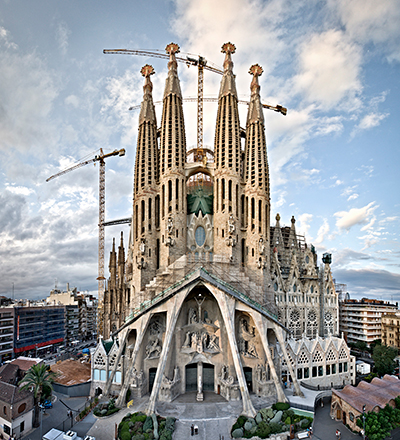
Gaudí, Sagrada Família
Beth Harris and Steven Zucker look at the façades, branching columns and the Gothic precedents behind the basilica. The film records the building around its 2010 consecration.
Watch on YouTubeIn June 1912 work resumed under a revised scheme. Llimona made a model that took account of suggestions from Deàs. Christ was moved eastwards, to the upper right of the recess and a little above the shield in Galí and Lacuesta’s account. Dionís Renart, who worked in Llimona’s workshop, used the model to carve the Three Marys, installed in January 1916. One woman kneels with her arms reaching across the tomb. The other two stand further back, close together. The kneeling figure draws the eye into the tomb scene. A gap separates her gesture from the quieter exchange of the standing pair. [3] [4] [5]
The Generalitat’s inventory description reproduced by the Col·legi d’Arquitectes de Catalunya draws attention to the setting’s theatrical depth and the higher position of the bronze beyond the cave. The Collbató heritage inventory identifies white marble in the lower group. The pale marble catches what light reaches into the hollow. Higher up, the arms of the bronze open across the exposed face of the cliff. This arrangement represents the Resurrection by joining the women’s encounter at the empty tomb with an image of Christ already risen. The next station on the walk has its own subject, the Ascension, carved in relief by Josep Reynés for a monument designed by Bonaventura Bassegoda. [3] [6] [7]
Jeroni Martorell and the edge of the scene
Jeroni Martorell supervised completion and resolved how the monument met the ground in front of it. An undated handwritten cost note reproduced from his papers at the Arxiu Històric de la Ciutat de Barcelona records separate expenses for the Bayó contractor’s labour and for the stonecutter. Galí and Lacuesta connect these costs tentatively to the final works. Martorell also designed the wrought-iron enclosure, fabricated by the Ballarín firm in Barcelona. Its six sections undulate between uprights. The open mesh keeps the lower figures visible, and a thorned stem runs across most of the grille. A cross and the letters alpha and omega rise above three of the uprights among sprays of lilies. Galí and Lacuesta trace a specific parallel for this group of symbols in the openings of Gaudí’s church at Colònia Güell. [3] [5]
A photograph published in April 1916 shows the sculptural group before the enclosure. A September view shows the grille in place, setting a boundary between the figures and the people walking past. On 29 October the monument was blessed and the Rosari Monumental formally inaugurated. That afternoon a procession followed the route to the Resurrection station, where the League presented the work as an offering to Our Lady of Montserrat. The station that opened the Glorious Mysteries was the last of the fifteen to be completed. [3] [7]
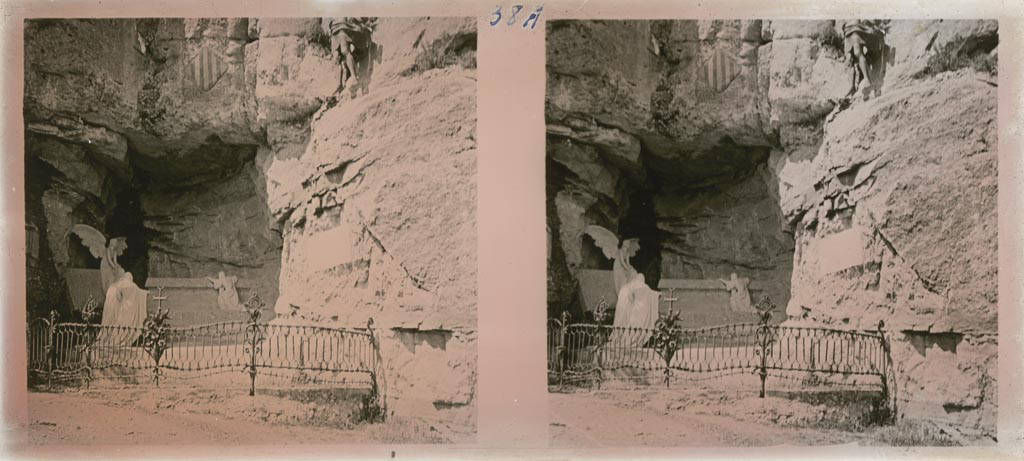
Josep Domènech i Sàbat’s stereoscopic photograph records the First Mystery of Glory at Montserrat, with the grotto visible from the path. Josep Domènech i Sàbat, Arxiu Fotogràfic del Centre Excursionista de Catalunya. Image source. Public domain. Resized for the web.
Damage, repair and the recovered position of Christ
At the start of the Spanish Civil War in 1936, the sculptures suffered severe damage. The angel lost its wings, heads and limbs were broken, and the Latin inscription announcing the Resurrection disappeared. Francesc Folguera supervised the post-war repair, which the League marked with a pilgrimage on 7 and 8 June 1947 in the context of the celebrations for the enthronement of Our Lady of Montserrat. Galobart reproduces the commemorative notice for the blessing on 8 June. The service began at the Santa Cova, and the procession approached the repaired monument from the chapel end of the route. [3] [4]
Anton Baraut directed the restoration completed in 2013, promoted by the monastery, the Diputació de Tarragona, the Generalitat’s heritage directorate and the Institut Català del Sòl. The team treated the bronze and returned it to the position identified with Gaudí’s arrangement. It reinstated the inscription “Ressurrexit, non est hic” (“He has risen, he is not here”), cleaned the cave and tomb, and restored the lower sculptures, shield, offering plaques and grille. It also reordered the planting and reconstructed the lookout and bench. As you approach today, the position of the bronze recalls Gaudí’s first installation. The women around the tomb and the grille through which you see them still give the approach much of the form it acquired under Llimona and Martorell. [4] [5] [8]
The restored setting at Montserrat places the risen Christ above the group in the grotto. Enric. Image source. CC BY-SA 4.0. Resized for the web. This reproduction uses the same CC BY-SA 4.0 licence.
Browse the buildings and designs
Explore Gaudí’s buildings, landscapes and designed objects, alongside lost works and projects known through documents. The entries identify collaborative and attributed work where relevant.
| Name | Date | Place, use and survival |
|---|---|---|
| Casa Vicens | 1883–85, original house | Summer house with a later enlargement. |
| Güell Pavilions and Estate | 1880s | Estate entrance and service buildings. The site and gardens changed in later campaigns. |
| Palau Güell | 1886–90, main campaign | Restored urban mansion in the Raval. |
| Teresian College | Late 1880s | College and convent adapted from an earlier project. The existing annex chapel is by Gabriel Borrell i Cardona. |
| Casa Calvet | Late 1890s | Textile premises and dwellings. |
| Torre Bellesguard | Early 1900s | House and site works beside traces of an earlier royal residence. |
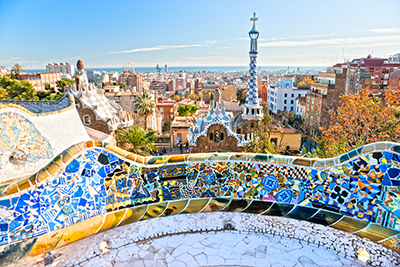
| Park Güell | c. 1900–14, estate works | Partly realised residential estate, later a public park. |
| Gaudí House Museum | Early 1900s; Gaudí lived here 1906–25 | Estate show house designed by Francesc Berenguer, later Gaudí’s residence. |
| Portal Miralles | Early 1900s | Surviving estate gateway and a length of enclosing wall. |
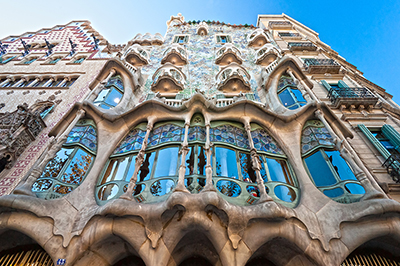
| Casa Batlló | 1904–06, remodelling | Remodel of an existing residential building. |
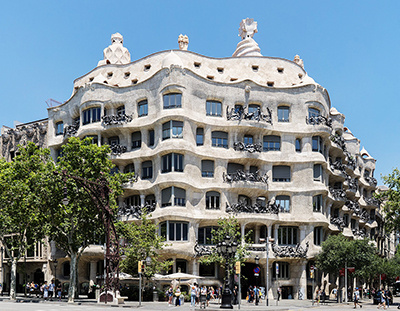
| Casa Milà | 1906–12 | Apartment block, later restored. |
| Sagrada Família | Begun 1882; Gaudí from 1883 | Basilica built in successive campaigns under Gaudí and other architects. |
| Sagrada Família Schools | Early 1900s, original school | School subsequently rebuilt and relocated on the site. |
| Plaça Reial Lampposts | 1878 commission; installed 1879 | Municipal street furniture. |
| Sant Pacià Mosaic Pavement | Late 1870s | Tessellated church pavement. |
| Nau Gaudí and the Mataró Workers’ Cooperative | 1883, bleach hall | Mataró. Restored bleach hall and a separate surviving latrine building within a larger scheme. |
| Bodegas Güell | 1890s | Garraf. Winery and service buildings, with drawings credited by the architects’ archive to Gaudí and Francesc Berenguer. |
| Church of Colònia Güell | Begun 1908; lower church opened 1915 | Santa Coloma de Cervelló. Lower church of a partly realised design. |
| Jardins Artigas | Early 1900s | La Pobla de Lillet. Restored riverside garden. |
| Xalet del Catllaràs | Early 1900s | La Pobla de Lillet. Lodge associated with the mines. Research published by the Consell distinguishes Gaudí’s design from decisions made in execution. |
| First Mystery of Glory at Montserrat | Early 1900s, first campaign | Montserrat. Monument to the Resurrection in a larger devotional ensemble, executed in phases. |
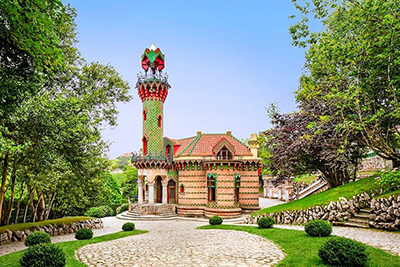
| El Capricho de Gaudí | 1880s | Comillas. Summer villa, subsequently restored. |
| Puerta de los Pájaros | Early 1900s, attributed | Comillas. Casa del Moro boundary gate, locally attributed to Gaudí. |
| Casa Botines | 1891 drawings; building work in 1892 | León. Commercial and residential building, later converted to new uses. |
| Episcopal Palace of Astorga | 1889–93 under Gaudí; finished 1913 | Astorga. Palace begun under Gaudí and finished by Ricardo García-Guereta. |
| Gaudí’s Restoration of Mallorca Cathedral | Early 1900s | Palma. Liturgical intervention in an existing cathedral. |
| Bar Torino | 1902, Passeig de Gràcia interior | Barcelona, Passeig de Gràcia. Lost collaborative bar interior. |
| Compañía Trasatlántica Pavilion | 1888, Barcelona exposition | Barcelona, 1888 Universal Exposition. Lost exhibition building. |
| Banner of Misericòrdia | 1900 | Reus. Lost pilgrimage banner designed by Gaudí with a painting by Aleix Clapés. |
| Franciscan Missions in Tangier | Early 1890s | Tangier. Documented unbuilt mission complex. |
| Hotel Attraction and Its Attribution | Posthumous drawings of the 1950s | New York. Unbuilt hotel associated with Gaudí through posthumous drawings. The commission is uncertain. |
| Capilla de Nuestra Señora de los Ángeles | 1922 correspondence; later proposal | Rancagua. The historic proposal was unbuilt. A later Chilean project drew on Gaudí’s Barcelona chapel design. |
Frequently Asked Questions
Discussion
Look again at the images and ideas explored in First Mystery of Glory at Montserrat. These editorial prompts invite your observations.
Reader Insights
Where does your eye go first when you set the cave and the bronze figure within one view? How might that change as you move along the path?
Compare the view published in April 1916 with the September view. What does Martorell’s ironwork change about the way you see the women and their relation to the tomb? [3]
Consider the restored position of Christ alongside the later figures and grille. What does each phase contribute to the scene a walker sees today?
Join the Conversation
Share a detail, comparison or question about First Mystery of Glory at Montserrat below.
References
- Generalitat de Catalunya, Patrimoni Cultural. Primer Misteri de la Glòria del Rosari Monumental de Montserrat. View source.
- Consell Antoni Gaudí. Misteri de Montserrat. View source.
- Josep Galobart i Soler. El Rosari Monumental del camí de la Santa Cova de Montserrat, part III. Montserrat. Butlletí del Santuari, no. 50, January–April 1998, pp. 27–32, figs. 1–6. View source.
- Montserrat Visita. Recuperació del disseny original d’Antoni Gaudí en el Rosari Monumental. Abbey restoration account, January 2017. View source.
- David Galí Farré and Raquel Lacuesta Contreras. Antoni Gaudí i Jeroni Martorell. Diputació de Barcelona, Gaudí i l’SPAL, 2004, pp. 16, 18–20, 26–28. View source.
- Col·legi d’Arquitectes de Catalunya. Primer Misterio de Gloria. IPAC description and archival photographs. View source.
- Assumpta Muset Pons, Diputació de Barcelona. Primer Misteri de Glòria. Collbató heritage inventory, record 08069–154. View source.
- Montserrat. El Primer Misteri de Glòria, del Rosari Monumental de Montserrat, recupera el disseny original d’Antoni Gaudí. Completion announcement, 4 June 2013, reproduced in Horeb, no. 218, pp. 14–16. View source.