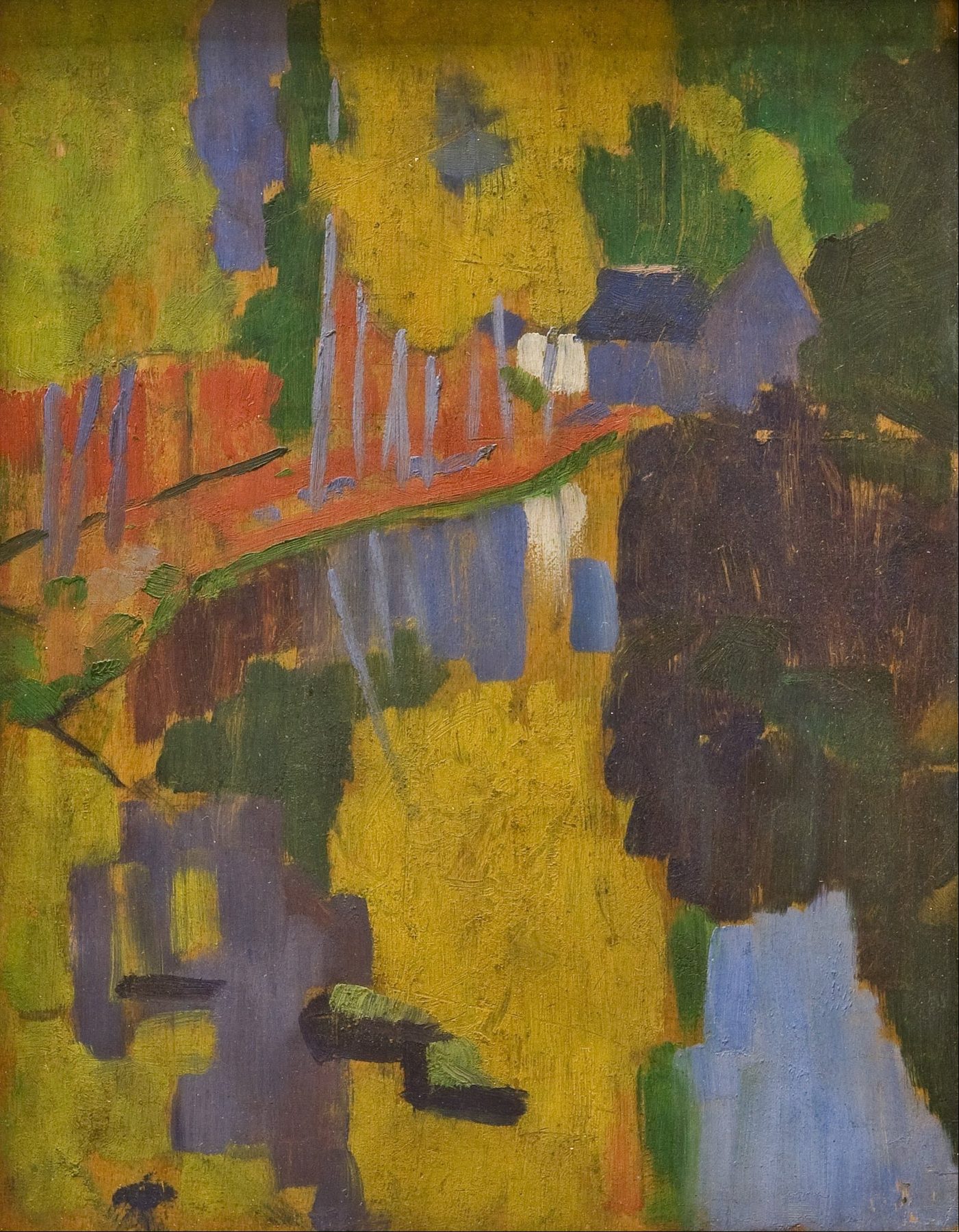
Image reference: Paul Sérusier’s The Talisman.
At a Glance
- Core period1888–c. 1900
- Principal centreParis, with crucial activity in Brittany and international members
- Namefrom the Hebrew word for “prophet”
- Major mediapainting, decorative panels, prints, posters, books, screens, theatre design and tapestry
- Leading membersSérusier, Denis, Bonnard, Vuillard, Ranson, Roussel, Ibels, Vallotton, Verkade and Rippl-Rónai
- Key ideasSynthetist colour, subjective experience, flatness, symbolism, decoration and art integrated with daily life
- Important networksAcadémie Julian, La Revue blanche, Ambroise Vollard and Symbolist theatre
Contents
- Where it fits
- A brotherhood forms
- Flat surface and meaning
- Four stages
- Artists to know
- Decoration
- Prints and publishers
- How to look
- Essential works
- Artist directory
Where Les Nabis fit
Paul Sérusier
Principal Nabi phaseMaurice Denis
Principal Nabi phasePierre Bonnard
Principal Nabi phaseÉdouard Vuillard
Principal Nabi phasePaul Ranson
Principal Nabi phaseFélix Vallotton
Principal Nabi phaseJózsef Rippl-Rónai
Principal Nabi phaseAristide Maillol
Principal Nabi phaseLes Nabis were a small brotherhood with an unusually large idea of art. Formed among young artists in Paris in 1888–89, they wanted painting to move beyond the imitation of visible appearances. They worked on canvases, but also on walls, folding screens, posters, books, prints, theatre programmes, scenery, furniture and tapestry. Their art could be spiritual or comic, public or private, intensely patterned or nearly empty.
The name Nabi comes from the Hebrew word for prophet. Paul Sérusier, Maurice Denis, Pierre Bonnard, Édouard Vuillard, Paul Ranson, Ker-Xavier Roussel and Henri-Gabriel Ibels formed the central group. Félix Vallotton, Jan Verkade and József Rippl-Rónai extended its Swiss, Dutch and Hungarian connections, while Georges Lacombe and Aristide Maillol belonged to a broader circle. The Musée d'Orsay dates the group's most coherent phase from 1888 to about 1900.[1]
Their “prophecy” was never one style. Denis made Catholic icons and ordered mythologies. Bonnard turned Parisian advertising and family life into arabesque. Vuillard dissolved rooms and figures into fabrics and shadow. Vallotton cut bourgeois intimacy into unforgiving black and white. What bound them together was the conviction that colour, line and surface could construct experience rather than merely copy it—and that art should enter the places where modern life happened.
A brotherhood at the Académie Julian
Several future Nabis met at the Académie Julian, a private Parisian school whose atmosphere was less rigid than the École des Beaux-Arts. Their friendships also reached back to the Lycée Condorcet, where Vuillard knew Roussel and the future theatre director Aurélien Lugné-Poe. They shared the impatience of a generation that had learned from Impressionism but did not wish to repeat its preoccupation with immediate optical sensation.
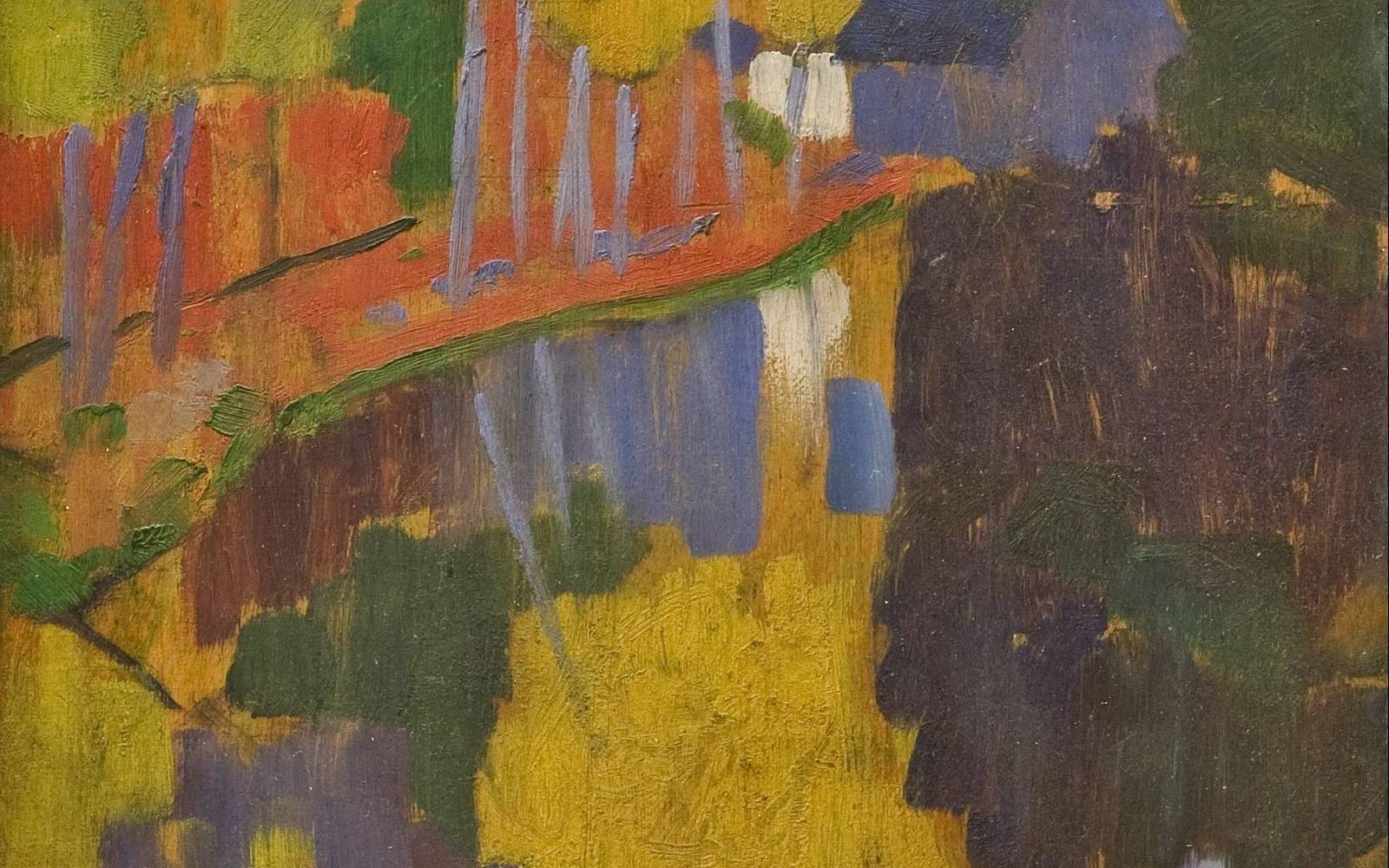
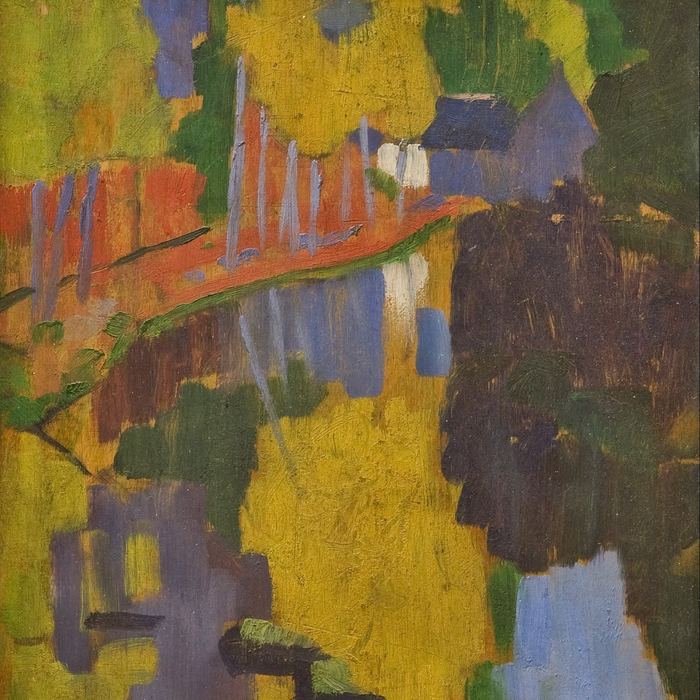
The decisive story begins in Brittany. In October 1888, Sérusier worked at Pont-Aven with Paul Gauguin. The small landscape he brought back to Paris became known as The Talisman. His friends treated it as proof that a painter could translate nature into emotionally charged colour instead of modelling it through conventional perspective.
The story is true, but it is also a story made after the event. Maurice Denis owned the panel, named it and repeatedly described its origin. His accounts helped turn an experimental landscape into a founding relic. Modern technical research has corrected one attractive detail: the support was not simply the lid of a cigar box, as Denis suggested. Analysis of the wood and pigments makes the object more materially precise while revealing how memory produced the group's mythology.[2]
This distinction matters because art movements often look inevitable in retrospect. A later masterpiece seems to announce everything that followed. In 1888, however, Sérusier and his friends were still students trying ideas, adopting private nicknames and debating spiritual, formal and social possibilities. The Talisman became powerful through their use of it as much as through its painted surface.
The Talisman: landscape, lesson and later myth
The panel measures only about 27 by 21.5 centimetres. It is oil on wood, and an inscription on the back records that it was made at Pont-Aven under Gauguin's direction. The scale encourages intimate inspection rather than public spectacle.[3]
At first the scene may look almost abstract. Yellow, green, vermilion, blue and brown spread in irregular zones; modelling is slight and distance is compressed. Yet the landscape has not disappeared. A band of path crosses the scene. Trees mass at the upper left, while river, reflections and a mill can be reconstructed. Sérusier replaced the illusion of natural depth with what the Orsay describes as a coloured equivalent.
That translation has two effects. First, each colour acquires a physical presence. Yellow does not merely describe light on a tree; it is a yellow shape placed beside other shapes. Second, the observed site becomes inseparable from memory and emotion. The viewer sees a place and the painter's ordering of sensation at once.
The panel did not issue a finished programme. It supplied a portable question: if colour could be selected for expressive force, what else could be rebuilt? Portraiture, religion, the city, the home, the book and the theatre became answers. The Académie Julian friendships and Denis's critical writing gave those experiments a collective vocabulary.[4]
What Denis meant by a flat surface
In 1890, the twenty-year-old Maurice Denis published his “Definition of Neo-Traditionalism.” Its most famous sentence asks the reader to remember that a picture, before depicting a horse, nude or anecdote, is a flat surface covered with colours arranged in an order. The remark now sounds like a prophecy of abstraction, but that reading is incomplete.
Denis did not argue that subject should vanish. He argued that representation depends on an organised material surface. A religious procession, domestic encounter or landscape gains meaning through intervals, contours, repetition and colour. His own work remained full of narrative, faith, memory and love. Flatness was not the end of content; it was the means by which content became pictorial.
The same idea allowed different temperaments. Sérusier simplified landscape into emblematic colour. Denis organised figures into rhythmic processions. Bonnard used discontinuous pattern and comic observation. Vuillard made people difficult to separate from their rooms. Vallotton favoured severe contour and graphic confrontation. A German museum account usefully defines the shared problem as a close relation between form and emotion, pursued across media rather than through one look.[8]
The group belongs within Post-Impressionism, but that retrospective label is broad. Synthetism supplied a method of joining perception, memory and symbolic meaning. Symbolism encouraged suggestion and the belief that visible things could carry invisible states. Japonisme offered flat shapes, cropping, asymmetry and unfamiliar formats. Art Nouveau overlapped through organic line and the reform of applied art. None of these terms is interchangeable with Les Nabis.
Post-Impressionism is especially liable to create a false family resemblance. Vincent van Gogh used heightened colour and emphatic contour, but he did not share the Nabi brotherhood, its Paris meetings or its decorative commissions. Cézanne's constructed brushwork, Seurat's division of tone and Gauguin's Synthetism all offered alternatives to Impressionism, yet they did not amount to one agreed successor style. The Nabis should be located within that plural field rather than made to represent its inevitable next stage.
Dutch museum scholarship stresses the distinction from Impressionism: the Nabis often painted from a remembered experience rather than directly before the motif, making colour purer and imagination more active.[9] That does not mean every work is mystical. It means observation is only one ingredient in a constructed image.
Follow Les Nabis through four stages
–1890
A brotherhood forms around The Talisman
Sérusier carries Gauguin's Pont-Aven lesson back to the Académie Julian, where private ritual and Denis's writing turn experiment into a shared cause.
–1894
Posters, exhibitions and decoration expand the field
The Nabis exhibit, design screens and posters, and test how modern streets, rooms, faith and family can be rebuilt through flat colour and pattern.
–1899
Rooms, prints and La Revue blanche mature
Natanson commissions, Vollard editions, theatre and specialist printers connect intimate decoration to publishing and metropolitan cultural networks.
The brotherhood disperses but its questions continue
Different patrons, beliefs and careers loosen the group while decoration, books, teaching and the problem of art in daily life remain active.
Brotherhood, ritual and disagreement
The group's private culture made serious ambition sociable. Members met in studios, argued about exhibitions and assigned one another playful names that emphasised temperament or special interest. Sérusier could function as theorist and transmitter; Bonnard's relation to Japanese art became part of his nickname; Ranson's studio served as a meeting place. Such rituals helped young artists believe that their experiments formed a common cause before institutions recognised them.
Brotherhood also created exclusions. The prophetic language could suggest access to knowledge unavailable to ordinary viewers, even while the artists spoke of bringing art into life. Their inner circle was male, and its remembered anecdotes centre male revelation and debate. The later critical task is not to dismiss that camaraderie but to see how it distributed authority: Sérusier brought the “lesson,” Denis wrote the history, patrons supplied rooms and women often entered the record through portraits rather than speech.
The Nabis did exhibit together, notably in 1891, but they were never controlled by a binding manifesto. Their unity was made from overlapping loyalties—school friendship, shared admiration, journals, theatres, printers and patrons. That loose structure enabled rapid invention and made eventual divergence likely.
Decoration as a modern ambition
“Decorative” can sound like a polite word for secondary ornament. For the Nabis it carried a larger challenge. A painting could acknowledge that it was a flat surface, answer the proportions of a wall and participate in a room. Art would no longer pretend to be a window cut into architecture; it would help organise the place where people lived.
Japanese prints mattered because they demonstrated how unmodelled shapes, emphatic contours and shallow space could sustain complete worlds. The members adapted those lessons rather than following a preset doctrine. Their decorative works use bright or muted colour, curving or rigid line, large panels or tiny prints. The common ambition was to break the institutional wall between fine and applied art.[5]
The cry attributed to the group—“walls, walls to decorate”—was both practical and utopian. It led to multi-panel commissions, ceilings, screens and staged interiors. These works were avant-garde in conception even when they served wealthy private patrons. The contradiction was built in: art was supposed to re-enter life, but only some clients could afford a purpose-made room.[6]
Decoration also changed viewing. A Salon painting competed on a crowded wall and sought concentrated attention. A domestic ensemble surrounded a person over time. Someone might glimpse one panel through a doorway, sit beneath another, or see a screen fold differently from day to day. Meaning depended on location and use.
Nabi artists to know
Paul Sérusier
Sérusier carried Gauguin's Pont-Aven lesson back to Paris and gave the group a portable experiment in emotionally ordered colour.
Maurice Denis
Denis joined flat colour to Catholic belief, love and modern mythology while his criticism gave the brotherhood a durable account of its aims.
Pierre Bonnard
Bonnard adapted Japanese-derived cropping and pattern to Parisian advertising, family scenes, books and domestic decoration.
Édouard Vuillard
Vuillard made figures difficult to separate from fabrics, workrooms and shadow, turning intimacy into a formally and socially complex space.
Félix Vallotton
Vallotton used severe contour and black-white contrast to expose tension in streets, crowds and private interiors.
Paul Ranson
Ranson's studio hosted the group, while his paintings, prints and theatre designs joined emblematic form to organic pattern.
Denis: icon, love and ordered monumentality
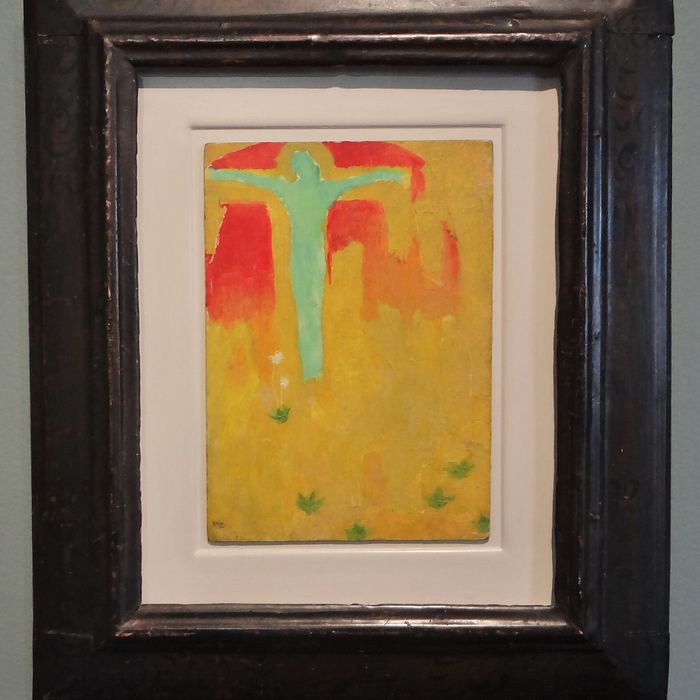
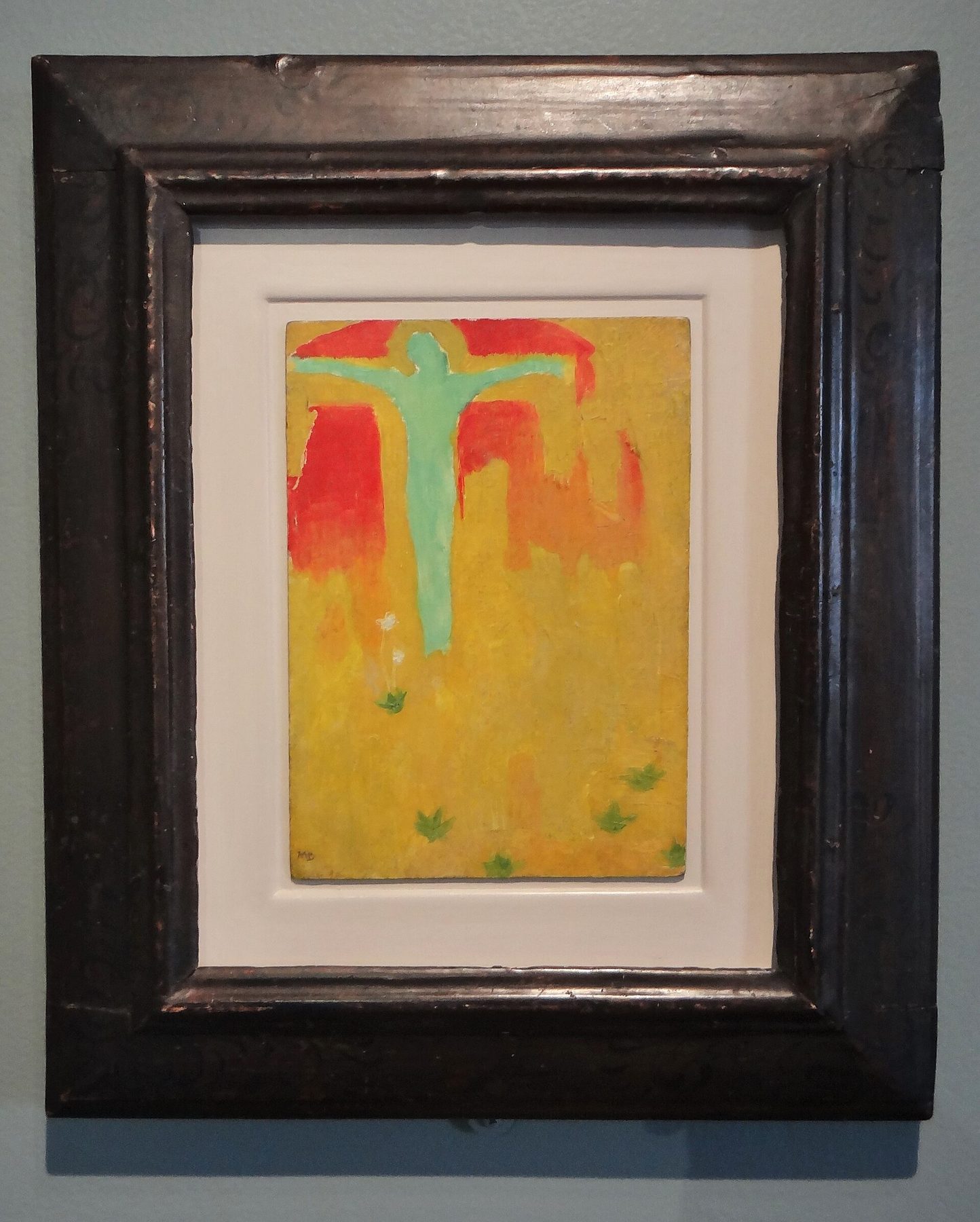
Denis combined formal experiment with Catholic faith. His early work treats natural things as possible signs of spiritual presence. The Green Christ of 1890 is startling precisely because devotion and radical colour are not opposites. The unnatural green body turns a familiar subject into an icon that refuses ordinary flesh, joining his desire to sanctify nature with a bold surface statement.[12]
His famous theory can obscure the variety of his Nabi decade. Small, bright works reject realistic depth; religious processions transform contemporary figures; intimate paintings of Marthe Meurier join courtship to sacred imagery. Later he pursued classical renewal and monumental public decoration. The change did not simply cancel his youthful experiment. Both phases searched for a disciplined order capable of carrying belief.[10]
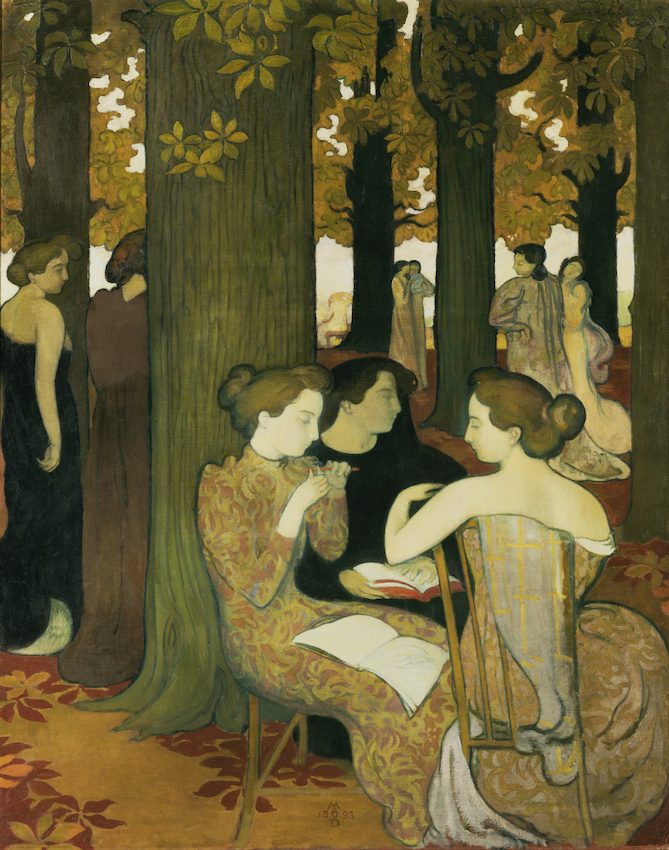
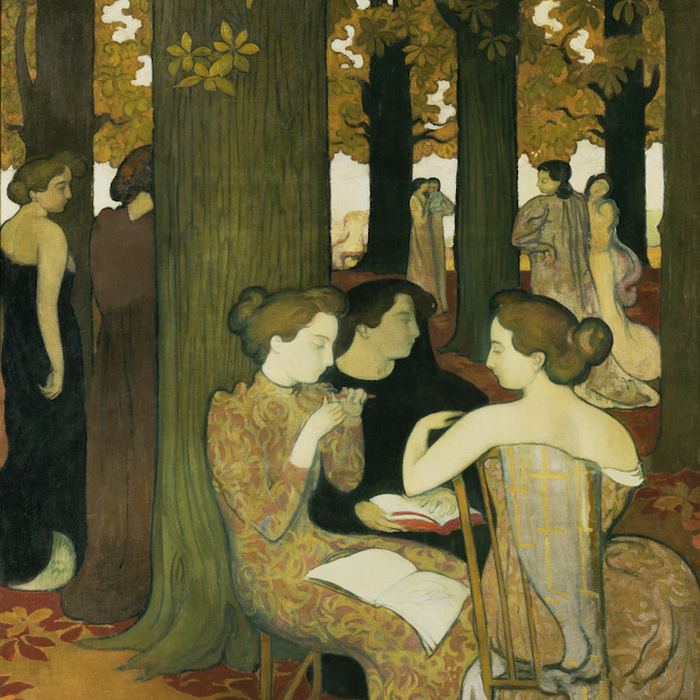
Les Muses of 1893 offers the clearest synthesis. Denis relocates the classical protectors of arts and knowledge to the terrace at Saint-Germain-en-Laye. The women wear contemporary dresses and lack their usual attributes. Marthe, whom he married that year, appears more than once. Their identities are less important than their rhythm across the surface.
The chestnut trunks create a sequence of verticals. Branches, fallen leaves, dress patterns and curved bodies weave against them. Autumn colours are flat and deliberately unreal. The grove has almost no conventional depth, yet it feels ceremonial. At the rear, a tenth woman raises an arm toward light although mythology traditionally provides nine muses. Her presence prevents the scene from resolving into illustration; modern life becomes the threshold of revelation.[11]
Denis's women are idealised through his faith and private mythology. Recognising Marthe does not make the scene transparent biography. The painting turns a partner's body into repeated emblem, which invites both admiration for its pictorial invention and questions about how women entered male-authored spiritual programmes.
Bonnard: the “very Japanese Nabi”
Pierre Bonnard brought legal training, sharp observation and graphic wit into the group. His shallow spaces, interlocking patterns and vertical formats earned the nickname “the very Japanese Nabi.” The phrase identifies a visible affinity, but not a complete explanation. Bonnard joined Japanese design to modern Paris, family comedy, advertising and decoration.[13]
The art of Hokusai and other Japanese printmakers offered European artists a complex visual culture, not a kit of modernist devices. Bonnard selected cropping, silhouette and the activation of empty space, then redirected them through French print technology and urban commodities. Influence was an unequal nineteenth-century encounter, but also an act of specific transformation.
Women in the Garden
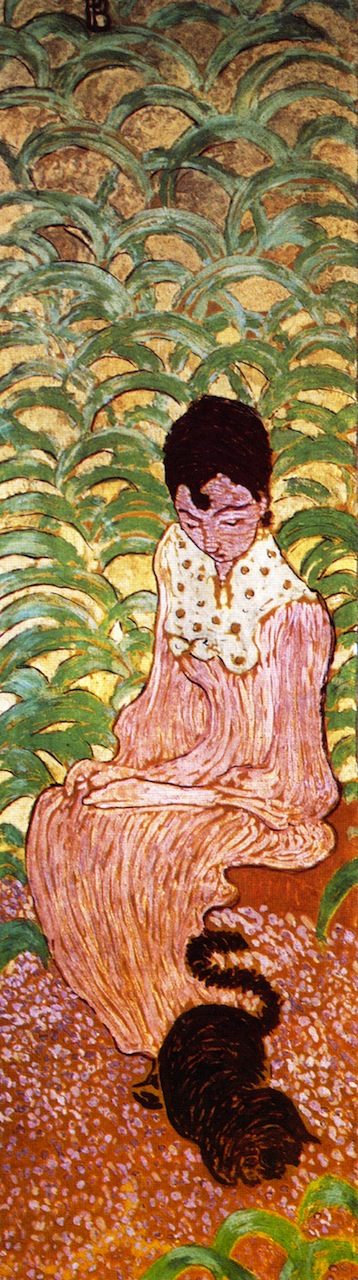
In 1891 Bonnard planned four tall garden panels as a folding screen. Shortly before showing them at the Salon des Indépendants, he separated them and presented them as individual decorative works. This instability between furniture and painting is part of their meaning.
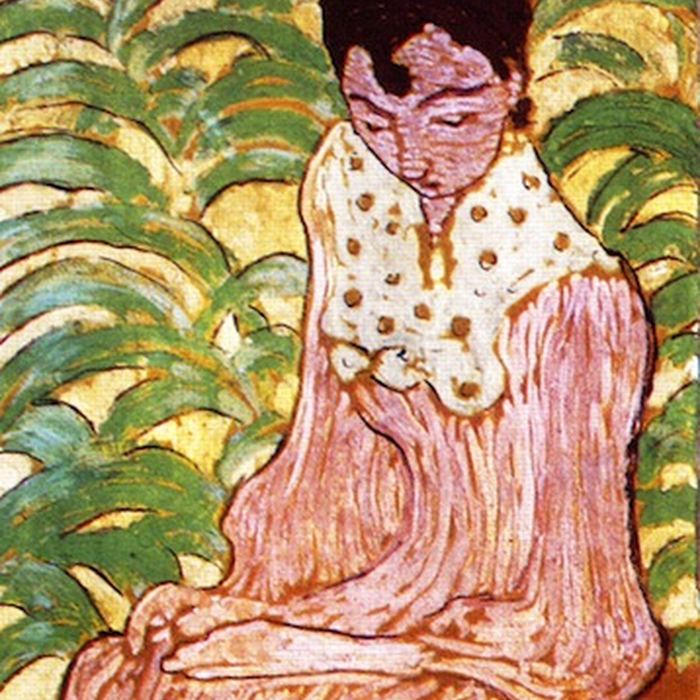
In the panel with a checked dress, the figure is almost consumed by pattern. Fabric does not wrap a modelled body convincingly; squares declare the flatness of the support. Narrow format, scattered leaves and interrupted silhouettes make the garden a vertical fabric rather than a view into distance. The matte distemper reinforces that textile-like surface.[14]
The four women neither enact a common climax nor submit to one perspective. They are moments distributed across an ensemble. Whether joined as a screen or spaced along a wall, the viewer must assemble relations by moving. The decorative object makes looking temporal.
France-Champagne
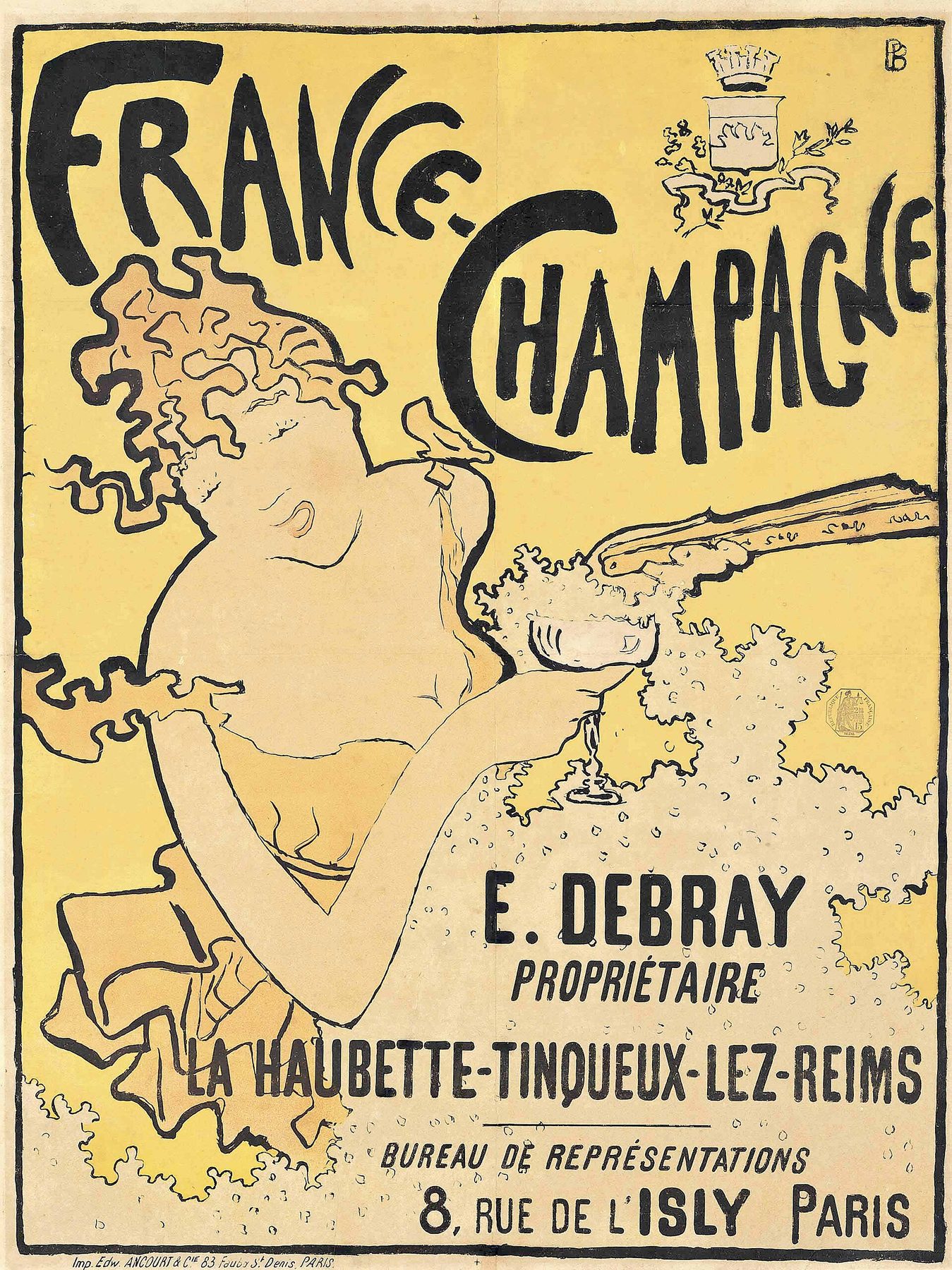
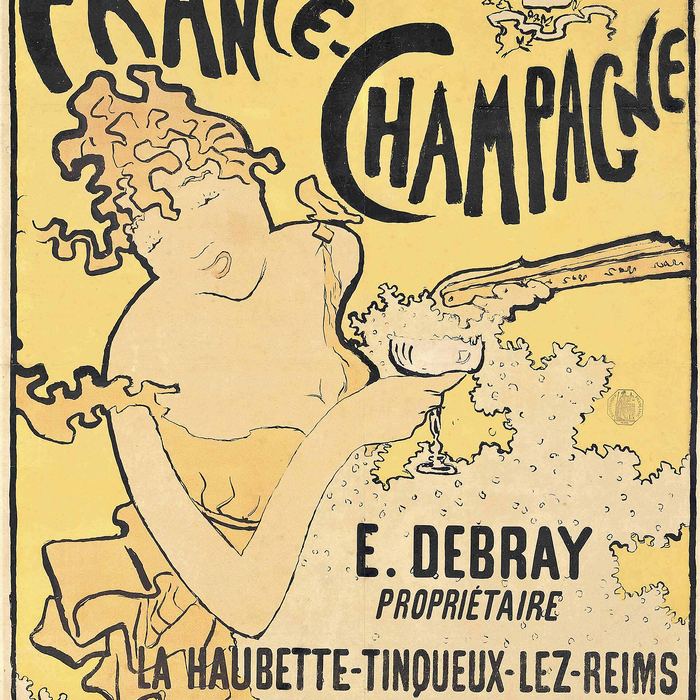
Bonnard's 1891 France-Champagne was his first lithograph and one of the posters that helped make the Paris street a site of avant-garde form. A woman drinks while foam, hair, fan and letters curve into one energetic field. The typography does not sit outside the image as information; it tips and sways with the figure.[15]
The poster advertises alcohol, but it also demonstrates a new artistic economy. Large flat colours had to read from a distance. Repetition carried the work across the city. Commercial commission and experimentation were not separate events. When Henri de Toulouse-Lautrec pursued poster design, he entered the same field in which public attention, lithographic colour and commodity identity met.
The modern poster altered pace. A book invited handling and return, while the street image competed with traffic, shop signs and other bills. Its lettering needed immediate force, and an incomplete glimpse had to be enough. A MoMA study of Parisian prints shows Vuillard applying avant-garde diagonal space to an advertisement for Bécane, where cyclists and the product name collide in a message about speed and winning.[47] Nabi graphic invention was shaped not only by Japanese composition but by the timed demands of metropolitan commerce.
BnF research shows the extraordinary range of Nabi print practice: colour lithographs, woodcuts, posters, magazine illustrations, books, theatre programmes, music covers, screens, wallpapers and fans.[16] Such media were not peripheral exercises after painting. They were places where the group's ideas about surface and use became literal.
Screen and artist's book
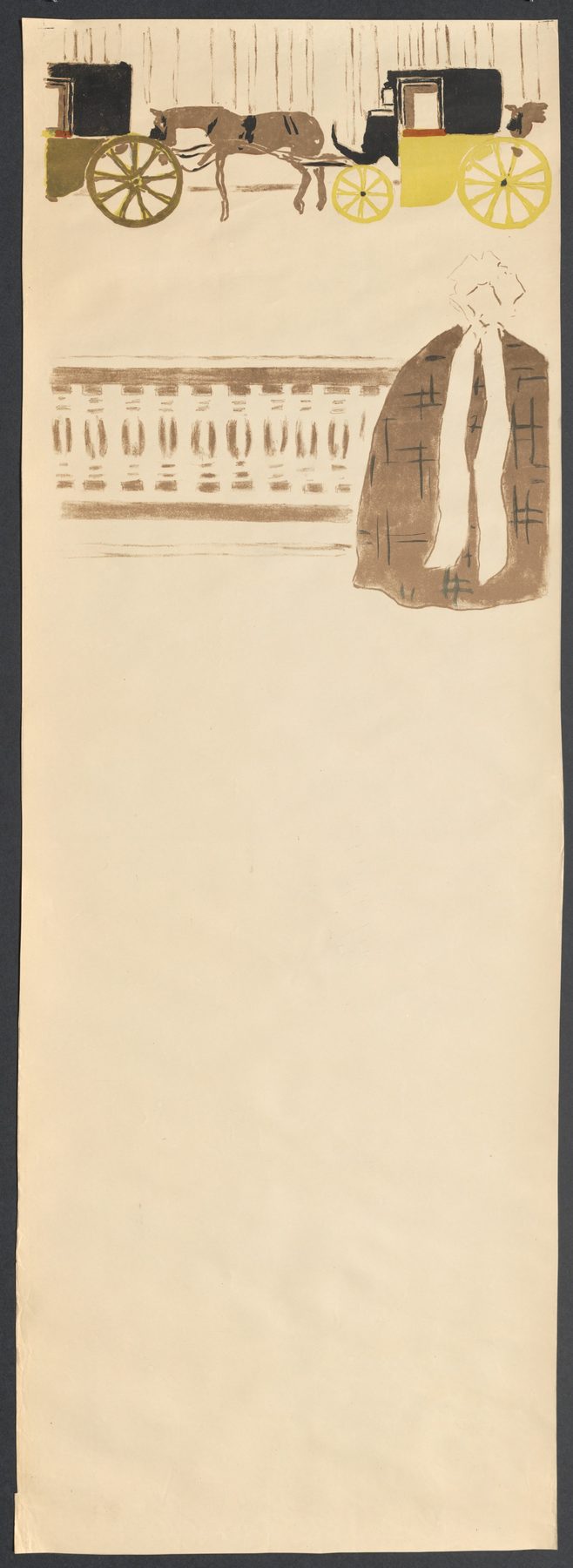
The four-part Promenade des Nourrices, Frise des Fiacres of 1899 turns colour lithography into a folding screen. Because it was printed in an edition, the same design could inhabit more than one room. Each narrow panel slices nurses, children, carriages and street into a frieze whose pauses depend on the hinges.[18]
In Parallèlement, published in 1900, Bonnard placed 109 lithographs around poems by Paul Verlaine. Figures and rose-coloured marks slide through margins instead of behaving as framed illustrations. The book is an important livre de peintre, joining text, image, paper, printing and sequence.[17] It also exposes a limit of democratic print rhetoric: multiplicity can broaden access, while a deluxe artist's book remains a collector's object.
Vuillard: figures inside pattern
Édouard Vuillard began from close observation of family and friends but made the familiar strangely resistant. His mother was a corset maker, and the household's fabrics, dresses and workrooms supplied a visual education in pattern. A face can emerge only slowly from wallpaper; a striped blouse competes with a screen; furniture blocks the viewer's path.
These interiors have often been called intimate, but intimacy does not guarantee comfort. Family histories, marriages and concealed attachments create tensions the painting rarely explains. A Cleveland Museum study describes the domestic works as beautiful, enigmatic and paradoxical, asking viewers to construct what remains unspoken.[7]
The problem appears intensely in The Grand Interior with Six Figures. The figures may refer to a crisis in the marriage of Vuillard's sister Marie and Ker-Xavier Roussel. Yet the painting does not narrate accusation or confession. Bodies enter a dense textile field; pattern holds the family together and prevents clear access. A German Kunsthaus Zürich analysis shows how Vallotton later quoted the image in his own interiors but hardened its contours, translating Vuillard's atmospheric uncertainty into a cooler narrative language.[24]
Public Gardens
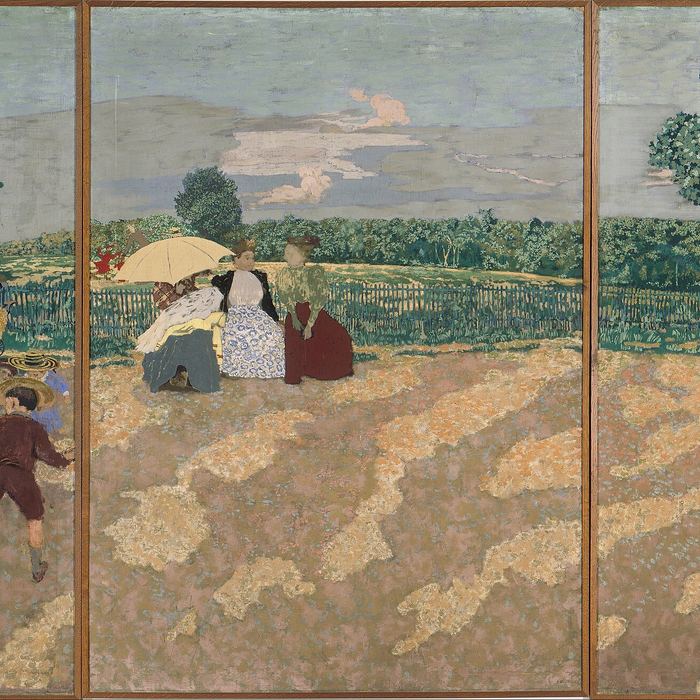
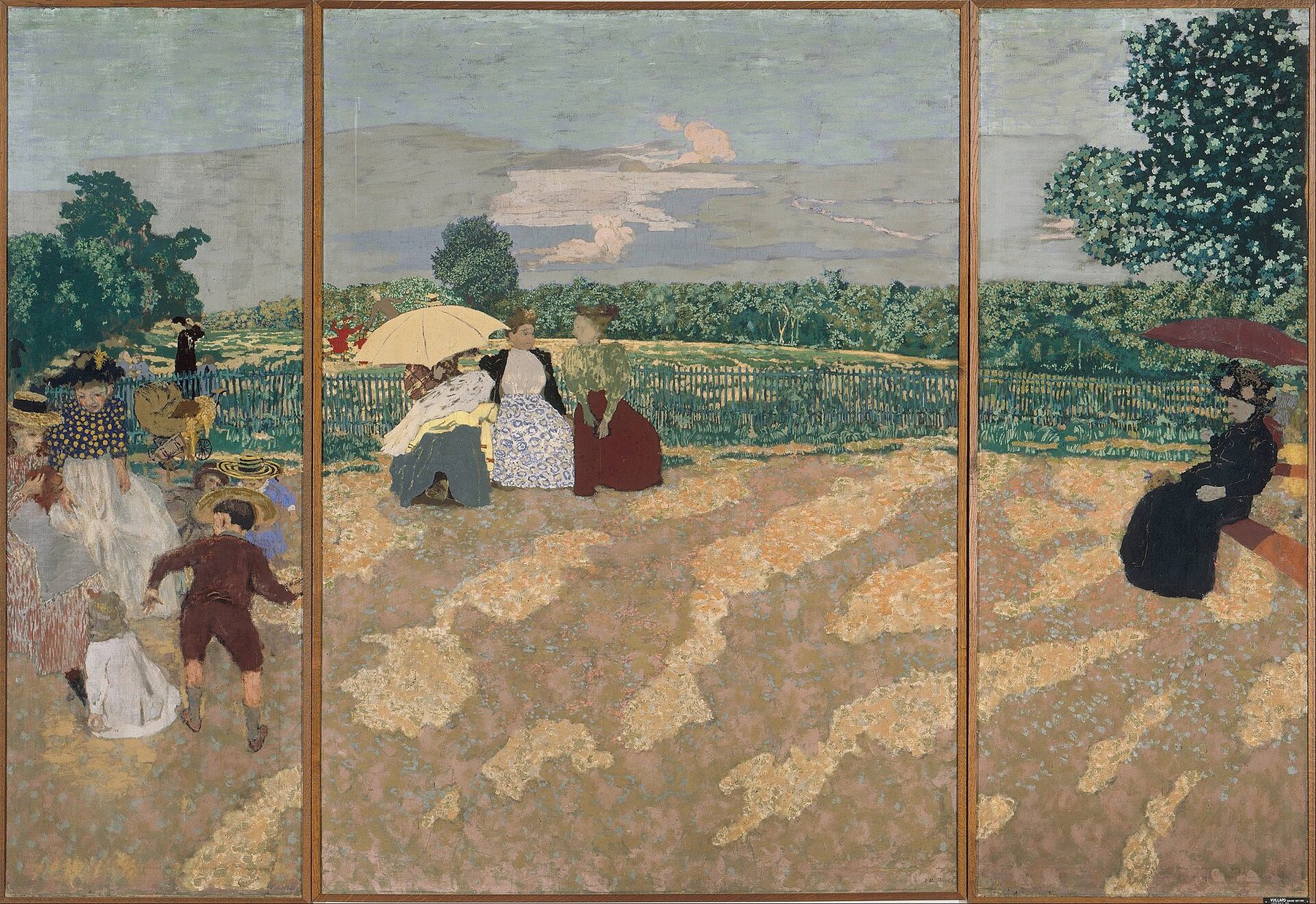
In 1894 Alexandre Natanson commissioned a cycle of nine panels for his Paris residence. Public Gardens treats children, nurses, paths, trees and parasols as a dispersed social rhythm. The panels were not nine independent windows. Their unequal shapes answered a particular interior, and figures recur across a field the viewer encounters bodily.
Vuillard used glue paint, producing a dry matte surface often compared with fresco. In The Conversation, the Nurses, the Red Parasol, adults and children are partially hidden by vegetation and by one another. The parasol is not merely an accessory; its red circular accent anchors a composition without making one event dominant.[20]
The commission brought Vuillard public attention and led to further decorative work. Its later dispersal among collections changed the cycle. A museum may show one segment as a complete painting, but its scale, edge and unresolved action remember the absent room.
The Album and the Natanson apartment
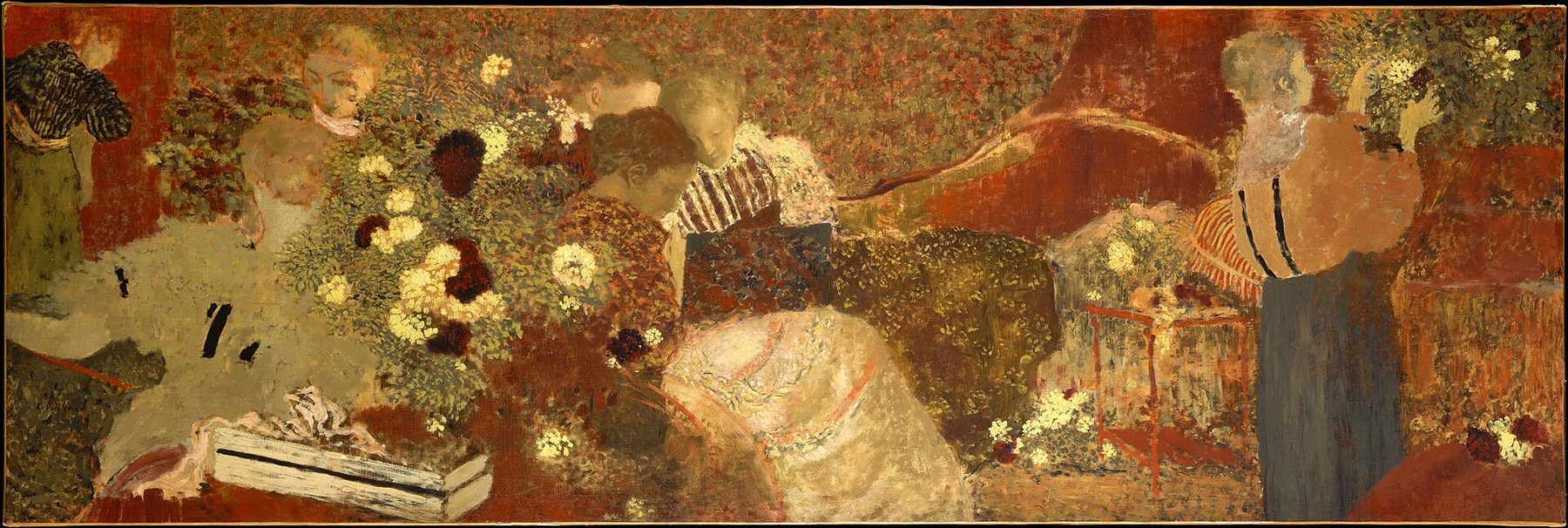
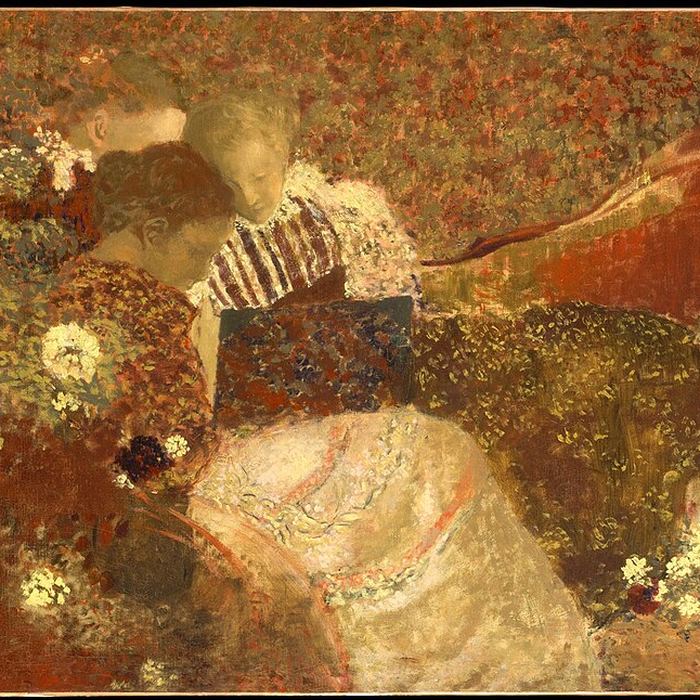
In 1894–95, Thadée and Misia Natanson commissioned five panels collectively called The Album. Their apartment combined a large open area with smaller alcoves and reflected Misia's interest in the English Arts and Crafts movement. It also functioned as an informal workplace for La Revue blanche, bringing writers, artists and composers into the domestic interior.[21]
Vuillard's long central panel submerges women, flowers, furniture and an album in close browns, yellows and burgundies. The figures appear suspended within the room rather than standing before it. The painting does not separate subject from décor because the Natanson social world itself depended on conversation, music, journals and designed surroundings.
William Morris offered an important model for treating interior, object and labour as a connected field. The French patrons' version was not the same as British Arts and Crafts politics, but the exchange helps explain why an avant-garde journal's annex could also be a deliberately unconventional home.
Vuillard continued decorative work long after the brotherhood dispersed. His 1911 Place Vintimille is a five-panel screen based partly on the view from his apartment and on photographs he took. A sweeping pavement curve crosses the folds; cropped trees and fragments of activity recall Japanese prints. Photography did not make him more mechanically objective. It supplied another memory device for building a room-sized Parisian surface.[22]
His career also warns against making 1900 a wall. The theatre collaborations of the 1890s affected his sense of staging, while later dealers, sitters and decorative clients changed the social world he painted. He remained close to Bonnard and to members of the Natanson circle but entered new relationships with Bernheim-Jeune, Jos and Lucy Hessel, actors and boulevard theatre. Retrospective scholarship follows these transitions rather than treating the radical early interiors as his only achievement.[19]
Photography belongs within that continuity. Vuillard used a handheld camera among friends and family, recording accidental crops, uneven light and bodies partly hidden by furniture. He did not simply copy snapshots into paint. The camera contributed fragments that memory and surface could reorganise, much as a theatre rehearsal supplied gestures without determining the final scene.
Theatre, threshold and staged intimacy
Vuillard's friendship with Lugné-Poe drew him into the Théâtre de l'Œuvre, where he worked on scenery and programmes for plays by Ibsen, Strindberg and Maeterlinck. Other Nabis contributed to Paul Fort's Théâtre d'Art and to the same Symbolist theatrical circle.[38]
The stage offered a model different from academic illusion. Reduced scenery, silhouette, threshold, lighting and carefully placed gesture could suggest a psychological condition without spelling it out. In Vuillard's interiors, doors and screens divide space like wings; figures seem to enter, wait or overhear. Painting and theatre developed through practical collaboration, not vague literary “influence.”
Spanish museum research records Bonnard's participation in scenery and costume, including work around Alfred Jarry's Ubu roi in 1896, alongside designs for glass, furniture, fabric, magazines and books.[39] The range makes the group's claim to total art concrete.
Vallotton: black woodcut and bourgeois unease
Félix Vallotton joined the circle without surrendering his distance. Born in Lausanne, he brought a graphic severity unlike Bonnard's buoyant line or Vuillard's mottled paint. His woodcuts revived a medium capable of strong black-white opposition and cheap multiplication.
In A Tight Corner of 1893, a crowd becomes a compressed mass. Hats, backs and faces press against the edges while white gaps cut through the darkness. The city is not spacious spectacle but bodily friction.[29] The brutal economy of means turns an ordinary congestion into a social mechanism.
His gouache Street Scene in Paris looks momentary but is meticulously ordered. Small people, dogs and vehicles occupy a tipped plane whose unstable perspective keeps the viewer outside and above. Flat pattern and Japanese-derived asymmetry support a sharp account of bourgeois circulation.[27]
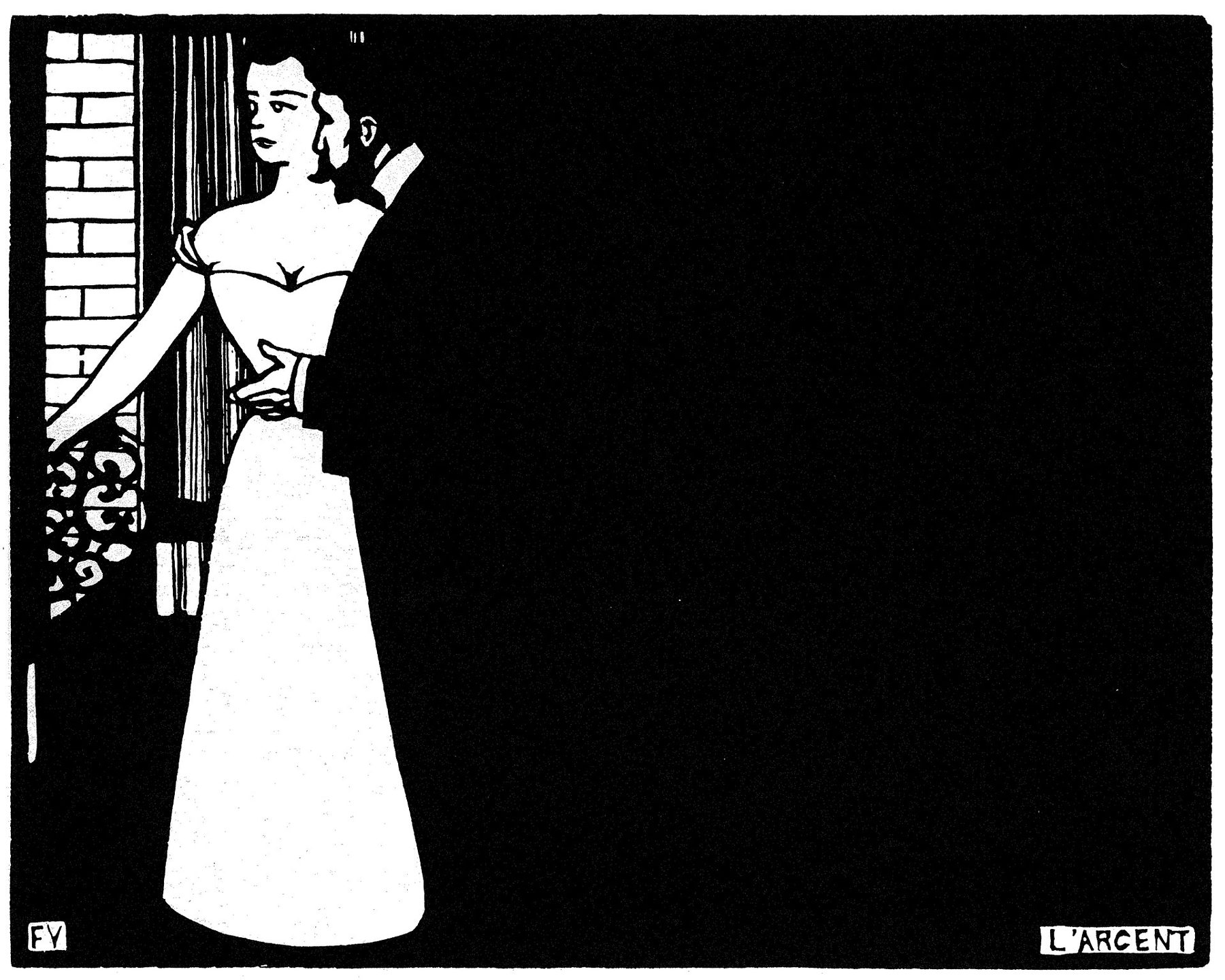
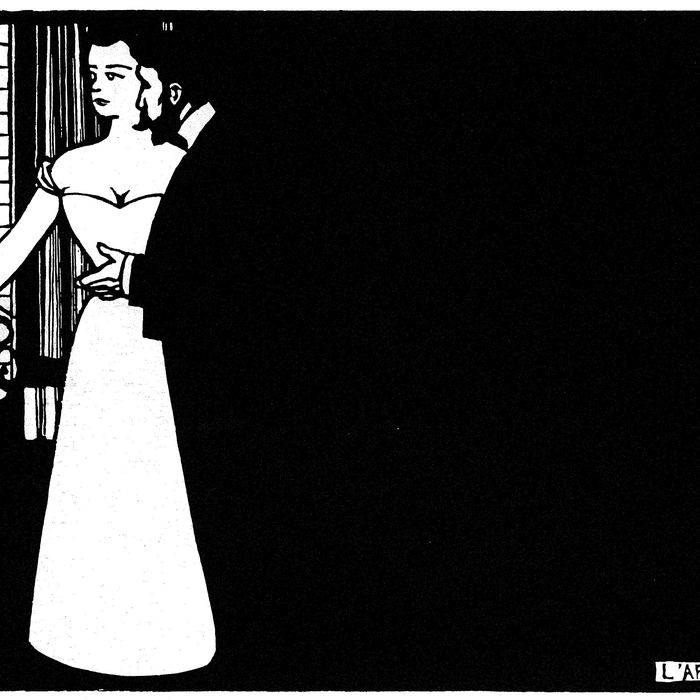
The ten woodcuts of Intimités move indoors. In Money, a woman in light dress confronts a man absorbed into blackness. Furniture and shadow do not describe a cosy home; they stage negotiation. The title makes sex, affection and financial power inseparable. Published by La Revue blanche in an edition of thirty, the work addressed a collecting audience through a deliberately stark medium.[28]
Vallotton's Misia at Her Dressing Table is quieter but equally calculated. The sitter's curved body and dress confront hard diagonals of furniture and frame. An unseen light creates abrupt contrast. A print by Vallotton hangs inside the painted room, turning the portrait into a document of the network that supported it.[30]
Prints, publishers and printers
The Nabis participated in a major renewal of French printmaking. Bonnard, Vuillard, Denis and Roussel explored colour lithography; Vallotton and Maillol used woodcut. Ambroise Vollard acted as publisher, while specialist printers such as Auguste Clot translated artists' designs through multiple stones and inks.[41]
Vuillard received a major commission from Vollard for Paysages et intérieurs. His colour lithographs turn streets and rooms into compressed fields; subtle variations depended on collaboration at the press.[25] National Gallery records make that network visible by naming artist, publisher and printer together rather than treating the print as a direct emanation from one hand.[26]
The peintre-graveur—the artist who conceived original prints rather than reproducing paintings—acquired new prestige. Yet prestige and accessibility pulled in different directions. A poster could meet thousands of pedestrians; an album in a small edition could be expensive from its first appearance. BnF collections show Nabi multiples pursuing an ideal of art in daily life while also serving the market for rare books and impressions.[42]
Advertising intensified the contradiction. Bonnard sold champagne through modern line. Denis designed a poster for La Dépêche de Toulouse in which a newspaper reader, crowd and telegraph wires linked public appetite to rapid information.[40] Avant-garde form did not stand outside commodity culture; it helped make modern products and media desirable.
La Revue blanche, music and the Natanson network
The Natanson brothers founded La Revue blanche, which became a platform for new writing, criticism, politics and art. Bonnard, Vuillard and Vallotton contributed regularly. Its network connected Stéphane Mallarmé, André Gide, Claude Debussy, Léon Blum and many others, allowing visual art to operate beside arguments about theatre and society.
The journal was more than a vehicle for reproducing pictures. Its white cover and shifting graphic identity gave artists a public surface; its offices and domestic “annex” connected editorial work to meals, music and conversation. A contribution could move an artist between printed page, poster, theatre and private commission. The same network that encouraged experiment also concentrated cultural power within friendship, attraction and access to patronage.
That setting helps explain why Nabi art often feels both radical and socially enclosed. The artists rejected academic hierarchy, yet their most adventurous rooms were made for an educated metropolitan circle. They pursued public posters and political journals while accepting intimate commissions from friends. Rather than choosing between avant-garde ideal and bourgeois dependence, their work records how the two supported each other.
Misia Natanson was central to this world. Trained as a pianist, she hosted artists and writers, performed music, shaped interiors and helped direct patronage. Her apartment and country houses were not passive backdrops. They were social technologies where a journal could be discussed, a commission imagined and a reputation built.[31]
Vuillard's small Misia at the Piano withholds the public brilliance of a concert portrait. Cardboard support, compressed square scale and absorbed pose turn music into close attention.[32] The picture belongs to friendship and patronage, but also to Misia's own practice as a skilled performer.
Calling her a muse captures how frequently artists represented her but can conceal agency. The same danger surrounds Marthe Denis, Marthe Bonnard, Madame Vuillard and Marie Roussel. Museum accounts often organise these women as presences in male biographies.[33] A fuller history asks what they hosted, performed, managed, sewed, modelled, commissioned or endured.
Women, labour and the domestic interior
Les Nabis were a male brotherhood. Their accounts of prophecy and artistic meetings centred masculine camaraderie, while much of their imagery centred women. That imbalance is historical evidence, not a reason to remove women from the movement's history.
Vuillard's rooms often contain sewing, dressmaking, childcare and waiting. Denis represented Marthe as beloved, Madonna, muse and mother. Bonnard repeatedly painted his family and later Marthe de Méligny. These works can be tender and formally radical while still converting labour or a partner's body into material for an artist's career.
Domestic pattern is therefore social as well as visual. A patterned dress might dissolve into wallpaper, but someone made, fitted, cleaned and wore it. A purpose-designed interior required money and maintenance. A painter could treat the home as an inexhaustible studio because other people kept it functioning.
The difference between visibility and authority is important. Misia may dominate a portrait and still be discussed chiefly through the artist who painted her. Madame Vuillard's dressmaking may structure the visual world of an interior while remaining secondary in its title. Maillol's employees may determine the quality of a tapestry without receiving individual credit. Close looking cannot recover every undocumented contribution, but it can prevent the pictured woman or unnamed worker from being mistaken for inert material.
Recent study of Nabi private life emphasises unpaid work, children, marriage, secrets and family strain rather than presenting intimacy as uniformly cosy.[23] This approach does not reduce art to biography. It explains why a room can feel both protective and airless, and why pattern can be beautiful while making a figure difficult to read.
Maillol, tapestry and workshop labour
Aristide Maillol shared the Nabi desire to abolish the hierarchy that placed painting above applied art. Before sculpture defined his reputation, he explored tapestry, drawing on medieval millefleurs hangings and the English Arts and Crafts movement.[36]
At Banyuls he established a workshop and employed women to execute embroidered and woven designs. The workshop complicates the romantic image of one artist returning to craft. Maillol designed and experimented, but skilled employees materialised the object. Nabi total art depended on organised labour.[34]
The Enchanted Garden combines wool with silk, cotton and metal thread. Plants and figures occupy a shallow field enclosed by a border; the textile does not imitate a painting but uses density, thread and ornamental repetition as its own structure.[35] The work makes “decoration” architectural: hung in a room, it changes colour, texture and sound as well as supplying an image.
International prophets and internal fault lines
The group was Parisian but not nationally sealed. Vallotton was Swiss, Verkade Dutch and Rippl-Rónai Hungarian. These memberships mattered because Paris functioned as a point of encounter from which artists carried practices elsewhere.
A Dutch account of the movement describes artists taking an experience of nature back into the studio, where memory intensified colour and spiritual meaning. It also stresses their work in tapestry, posters, stage sets and costume.[45] Seen from outside France, the Nabis appear less as a neat Parisian style than as a method that could be adapted across media and national careers.
Rippl-Rónai's Parisian “black period” differs sharply from the stereotype of bright Nabi colour. In A Park at Night, pale tree trunks hover against dark ground while distant lights only suggest an urban location. Pastel, rubbing and a curved support produce a nocturnal anxiety related to Symbolist atmosphere.[43] His work across painting, pastel, print, ceramics, poster and decoration further demonstrates the group's expanded field.[50]
Italian museum research notes that the Orsay's important Nabi pastel collection contains many works by Vuillard, several entering through his bequest. Pastel suited suggestion because it could produce both powdery uncertainty and abrupt colour.[44] Collection history also shapes our picture of a movement: gifts and legacies make some artists and media more visible than others.[48]
The members never concealed all disagreement. In 1899 Denis divided them into two tendencies, using “Latin” for the clearer symbolic drawing of himself, Sérusier and Ranson and “Semitic” for the darker complexity of Bonnard and Vuillard.[46] Those racialised categories belong to the prejudice of the period and cannot serve as neutral art history. The diary remains evidence of a real formal divide, but the language must be criticised rather than inherited.
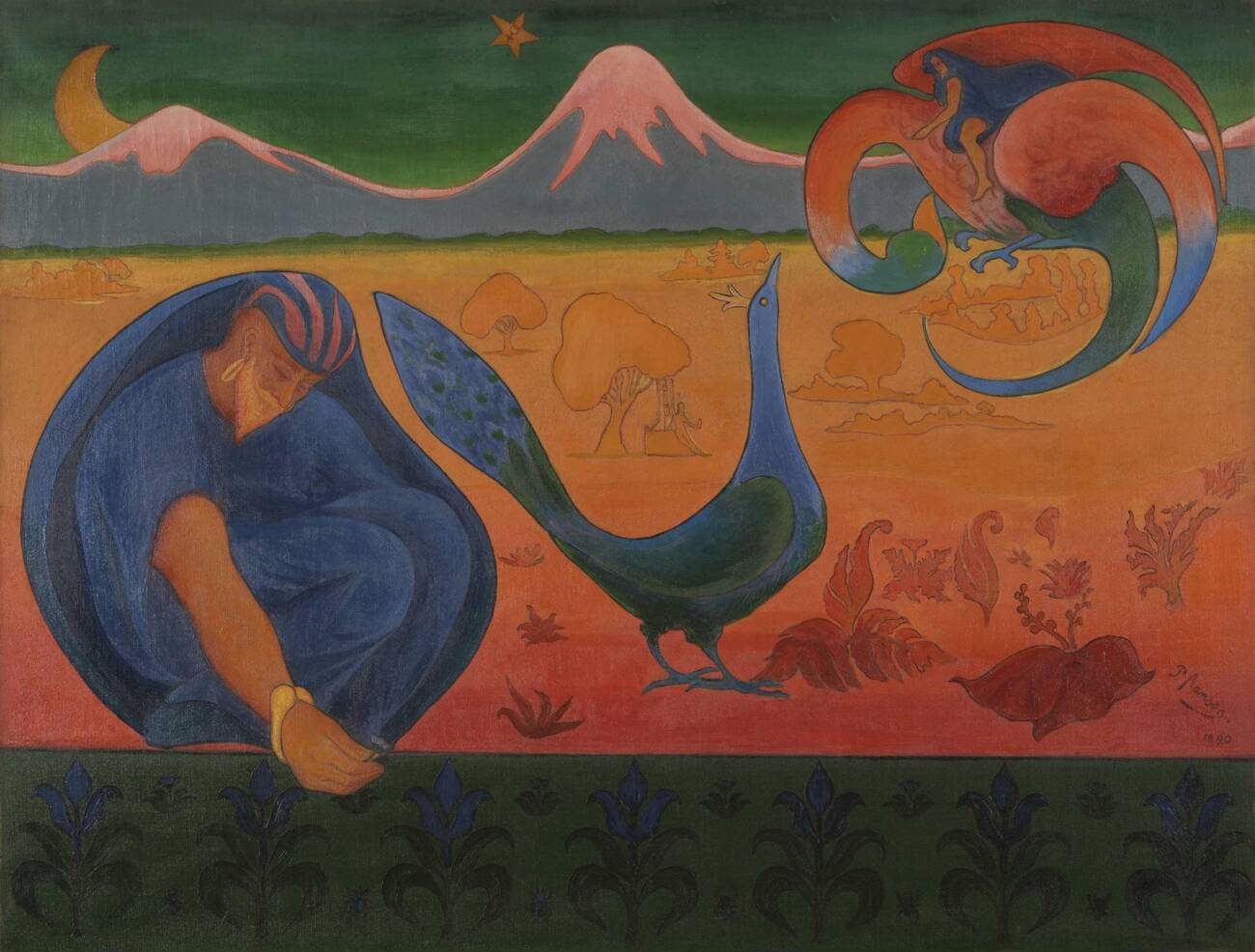
Ranson joined emblematic figures, organic pattern, print and Symbolist theatre. His designs for La Cloche engloutie and reclining readers show fantasy entering programme and domestic image.[37] He later founded the Académie Ranson, continuing the group's interest in teaching. Such individual trajectories explain why a single Nabi style is impossible.
Why the brotherhood dispersed
There was no dramatic manifesto of dissolution. By about 1900, shared meetings and exhibitions had lost urgency. Artists developed different patrons, dealers, beliefs and ambitions. La Revue blanche eventually ceased publication; the theatrical field changed; marriages and careers reorganised friendships.
Bonnard and Vuillard continued intimate and decorative painting. Denis pursued classical order and large religious or civic commissions. Sérusier deepened his theories and taught. Ranson established an academy. Maillol moved increasingly toward sculpture. Vallotton maintained both friendship and critical distance. The end of the brotherhood was therefore a divergence, not the disappearance of its problems.
Art Nouveau shared their interest in applied media and the refusal of academic hierarchy, but its international architecture and organic design cannot be collapsed into Nabi history.[49] Fauvism and abstraction later made flat colour more visibly radical, yet the Nabis were not simply imperfect precursors. Their distinctive achievement was to make surface, subject, object and setting negotiate with one another.
The movement's afterlife lies as much in artist's books, print portfolios, domestic ensembles and stage design as in modern painting. It also lies in a difficult question: can art enter daily life without becoming a luxury service for the wealthy? The Nabis never solved that contradiction. They made it productive.
Their later reputation has moved unevenly. Bonnard and Vuillard were sometimes detached from the brotherhood and appreciated as painters of colour or intimate life. Denis's Catholic and classical work could seem conservative beside histories that privileged formal rupture. Prints, theatre materials and decorations were difficult to display as a unified achievement, especially when ensembles had been divided among collections.
Reconstruction changes the judgment. When separated panels are reunited, when a woodcut is placed beside the journal that published it, or when a theatre programme is connected to performance, the movement's ambition becomes clearer. The Nabis did not merely flatten pictures on the way to abstraction. They asked how an image behaves when it shares a wall, room, page, street or stage with other forms of life.
How to look at Nabi art
Begin with the object's intended place. Was it designed for an easel, a wall, a ceiling, a folding screen, a page, a theatre or the street? A fragment in a museum may once have belonged to a coordinated ensemble.
Study colour as construction. Ask whether it describes local appearance or replaces it with an emotional equivalent. In The Talisman, colour still maps a landscape while asserting itself as paint.
Watch figure and pattern exchange roles. A dress may become a grid; wallpaper may engulf a face; trees may organise bodies like architecture. This instability often carries psychological meaning.
Test the space. Nabi pictures can be shallow, folded, tipped or discontinuous. Cropping and high viewpoints may draw from Japanese print design, but identify what the artist does with them in a French room, poster or book.
Look for sequence. Screens change at their hinges, albums unfold across sheets, decorative cycles require movement and theatre programmes anticipate performance. One image may be only part of a timed experience.
Identify collaboration. Patrons supplied rooms, publishers financed editions, printers separated colours, performers inhabited costumes and workshop employees produced textiles. Authorship is real but not solitary.
Read domestic intimacy critically. Who works, waits, hosts or cares for children? Does pattern protect privacy, conceal conflict or turn a person into décor?
Finally, distinguish the group from its afterlife. A Bonnard or Vuillard made in 1911 can continue Nabi concerns without proving that the brotherhood still operated unchanged.
Essential works of Les Nabis
The Talisman
Paul Sérusier · 1888 · Expressive colour remains tied to a remembered landscape while declaring the painted surface as an independent construction.
The Green Christ
Maurice Denis · 1890 · Unnatural colour joins Catholic devotion to a radical icon-like simplification of form.
Les Muses
Maurice Denis · 1893 · Repeated figures, tree trunks and autumn pattern turn contemporary women into an ordered modern mythology.
Women in the Garden
Pierre Bonnard · 1891 · Tall format and checked fabric make the figure and garden behave like a folding decorative screen.
France-Champagne
Pierre Bonnard · 1891 · Typography, bubbles, fan and figure become one energetic public image made for the Paris street.
Nursemaids' Promenade, Frieze of Carriages
Pierre Bonnard · 1897–1899 · Four lithographic panels translate a modern city promenade into a portable domestic screen.
Public Gardens
Édouard Vuillard · 1894 · Unequal panels, matte colour and recurring figures organise a commissioned room rather than imitate a window view.
The Album
Édouard Vuillard · 1895 · Women, flowers, furniture and the album merge in a long decorative field designed for the Natanson apartment.
Money, from Intimités
Félix Vallotton · 1898 · Large black and white shapes turn a bourgeois interior into a terse drama of intimacy and financial power.
Nabi Landscape
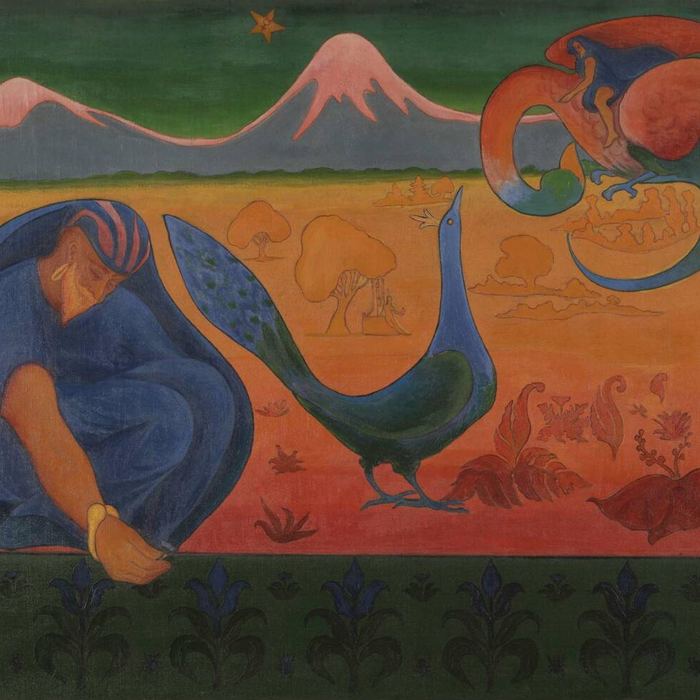
Paul Ranson · 1890 · Simplified landscape and emblematic colour demonstrate how the brotherhood could share an aim without sharing one style.
Where to see Les Nabis
Musée d'Orsay, Paris. The most comprehensive public starting point, with The Talisman, Denis, Bonnard, Vuillard, Rippl-Rónai and an important pastel collection.
Musée départemental Maurice Denis, Saint-Germain-en-Laye. Denis's former home offers paintings and decorations in a setting closely connected to his life and religious ambitions.
Bibliothèque nationale de France, Paris. Essential for posters, woodcuts, lithographs, illustrated books, music and theatre ephemera that reveal the movement beyond easel painting.
Musée Bonnard, Le Cannet. Focuses on Bonnard's long career and helps separate his Nabi decade from the later colour and light for which he is equally celebrated.
Musée Maillol, Paris. Valuable for Maillol's early decorative practice, tapestry and the transition toward sculpture.
Cleveland Museum of Art. Holds strong works by Bonnard, Denis, Vuillard and Vallotton and has developed major research on home and family in Nabi art.
National Gallery of Art, Washington. Especially rich in Nabi prints and screens, including Bonnard, Vuillard, Denis and Ranson.
Kunsthaus Zürich. Important for Bonnard, Vuillard and Vallotton, including works that illuminate friendship, quotation and the Swiss dimension.
Works on paper are light-sensitive and decorative cycles are frequently dispersed. Check current displays before visiting, and use digital catalogues to reconstruct ensembles that no single gallery can keep permanently assembled.
Where to see Les Nabis
Works on paper are light-sensitive and decorative cycles are often dispersed. Check current displays before travelling.
- 01
Musée d'Orsay
Paris, France
The strongest public starting point for The Talisman, Denis, Bonnard, Vuillard, Rippl-Rónai and Nabi pastel.
The Talisman and the central groupVisit collection website - 02
Musée départemental Maurice Denis
Saint-Germain-en-Laye, France
Denis's former home places paintings and decorations in a setting bound to his life and religious ambition.
Maurice Denis in contextVisit collection website - 03
Bibliothèque nationale de France
Paris, France
Posters, prints, books, music and theatre ephemera reveal how Nabi ideas moved beyond easel painting.
Print, publishing and performanceVisit collection website - 04
Musée Bonnard
Le Cannet, France
A focused route through Bonnard's long career that clarifies the place of his Nabi decade.
Bonnard before and after Les NabisVisit collection website - 05
Musée Maillol
Paris, France
Early tapestry and decorative work help explain Maillol's place in the broader Nabi circle before sculpture dominated his reputation.
Tapestry and applied artVisit collection website - 06
Cleveland Museum of Art
Cleveland, USA
Strong Bonnard, Denis, Vuillard and Vallotton holdings support close study of home, family and commissioned decoration.
Domestic life and decorative panelsVisit collection website - 07
National Gallery of Art
Washington, D.C., USA
Prints and screens by Bonnard, Vuillard, Denis and Ranson make artist, publisher and printer visible together.
Prints, screens and collaborationVisit collection website - 08
Kunsthaus Zürich
Zürich, Switzerland
Bonnard, Vuillard and Vallotton holdings illuminate friendship, quotation and the movement's Swiss dimension.
Vallotton and international connectionsVisit collection website
Suggested books
Claire Frèches-Thory and Ursula Perucchi-Petri, The Nabis: Bonnard, Vuillard and Their Circle. A foundational group survey with broad membership and visual coverage.
Gloria Groom, Beyond the Easel: Decorative Painting by Bonnard, Vuillard, Denis, and Roussel, 1890–1930. The key study for panels, rooms, patronage and the continuation of decoration after 1900.
Mary Weaver Chapin and Heather Lemonedes Brown, Private Lives: Home and Family in the Art of the Nabis, Paris, 1889–1900. A focused reassessment of domestic subjects, emotional ambiguity, gender and family.
Patricia Eckert Boyer, Artists and the Avant-Garde Theater in Paris, 1887–1900. Useful for understanding the practical relations among painters, programmes, scenery and Symbolist performance.
Isabelle Cahn and Guy Cogeval, The Nabis and the Parisian Avant-Garde. A readable route through the group's works and cultural setting.
Major artists associated with Les Nabis
| Name | Nationality | Key Works |
|---|---|---|
| Aristide Maillol | French | The Enchanted Garden · early tapestries and woodcuts |
| Félix Vallotton | Swiss | Money from Intimités · The Demonstration |
| Georges Lacombe | French | The Red-Bearded Nabi · carved decorative work |
| Henri de Toulouse-Lautrec | French | Moulin Rouge: La Goulue · La Revue blanche circle |
| Henri-Gabriel Ibels | French | The Circus · theatre programmes and posters |
| Jan Verkade | Dutch | decorative painting · Symbolist landscapes |
| József Rippl-Rónai | Hungarian | A Park at Night · decorative interiors |
| Ker-Xavier Roussel | French | The Seasons of Life · decorative landscapes |
| Maurice Denis | French | The Green Christ · Les Muses |
| Odilon Redon | French | Symbolist elder and exhibiting ally |
| Paul Gauguin | French | Vision after the Sermon · catalyst at Pont-Aven |
| Paul Ranson | French | Nabi Landscape · theatre and decorative designs |
| Paul Sérusier | French | The Talisman · Portrait of Paul Ranson in Nabi Costume |
| Pierre Bonnard | French | Women in the Garden · France-Champagne · Nannies' Promenade |
| Édouard Vuillard | French | Public Gardens · The Album · Landscapes and Interiors |
| Émile Bernard | French | Breton Women in a Meadow · Synthetist context |
Frequently Asked Questions
It comes from the Hebrew word for prophet. The young artists adopted it to express their belief that they were renewing art. The name also suited their mixture of private brotherhood, humour and spiritual ambition.
Their coherent group phase runs from 1888–89 to about 1900. Individual artists continued related decorative, print and domestic practices for decades, so the date marks the dispersal of the brotherhood rather than an abrupt stylistic stop.
No. Gauguin was the crucial elder whose Synthetist example, transmitted through Sérusier and The Talisman, helped catalyse the group. He did not belong to the brotherhood.
Not entirely. Its colour patches and shallow surface anticipate later abstraction, but trees, path, water and mill remain legible. It is better understood as a radical translation of landscape than a complete rejection of subject.
It identifies painting as an ordered material surface before it is a represented subject. Denis did not advocate subjectless art; his own pictures used flat colour to carry religion, love, memory and mythology.
Both descriptions can be useful. Post-Impressionism is the wider historical umbrella; Symbolism describes their interest in suggestion, subjectivity and invisible meaning. “Nabis” remains the precise name for the brotherhood.
They offered flat shapes, strong contour, cropping, high viewpoints, asymmetry and formats such as vertical panels. Nabi artists adapted these features to French posters, rooms, books and domestic subjects rather than copying one Japanese style.
They wanted art to belong to buildings, objects and daily routines rather than remain isolated in framed easel pictures. Decoration meant organising a surface for a particular place and use, not merely adding ornament.
It was an influential magazine founded by the Natanson brothers. Its contributors connected visual art to literature, criticism, music, politics and theatre. Misia and Thadée Natanson's homes also became important social and commissioning spaces.
The named brotherhood was male. Women were nevertheless essential as patrons, performers, partners, family members, models, hostesses and workshop workers. Their labour and agency should not disappear behind the label “muse.”
They repeatedly painted interiors, family and everyday acts. The term is useful if intimacy includes uncertainty, work and conflict; it becomes misleading when it makes every domestic image cosy or apolitical.
Its members developed different beliefs, formal priorities, patrons and careers. By about 1900 the shared brotherhood was no longer necessary, although its concerns continued in their individual work.
Discussion
Which Nabi work most changes when you imagine its original setting: a Bonnard poster on a Paris street, a Vuillard panel surrounding a room, a Vallotton woodcut held in the hand or a Denis painting integrated with architecture? Consider whether the museum frame helps you see its surface—or conceals the life for which it was made.
Reader Insights
Imagine the work as a screen, panel, page, poster or theatre object and ask what the museum frame leaves out.
Watch a dress, wall, tree or shadow exchange roles with the person beside it and consider what that instability suggests.
Identify the patron, publisher, printer, performer or workshop labour that allowed the object to enter modern life.
Join the Conversation
Which Nabi work most changes when you imagine its original room, street, page or stage?
References
- Nabis: Bonnard, Vuillard, Maurice Denis, Vallotton (1888–1900), Musée d'Orsay (French; consulted in French), View Source
- Le Talisman de Sérusier, une prophétie de la couleur, Musée d'Orsay (French; consulted in French), View Source
- Le Talisman, Paysage au Bois d'Amour, Musée d'Orsay (French; consulted in French), View Source
- Après l'impressionnisme, du néo-impressionnisme au fauvisme, Musée d'Orsay (French; consulted in French), View Source
- Les Nabis et le décor, Musée d'Orsay (French; consulted in French), View Source
- Beyond the Easel: Decorative Painting by Bonnard, Vuillard, Denis, and Roussel, Metropolitan Museum of Art, View Source
- Private Lives: Home and Family in the Art of the Nabis, Cleveland Museum of Art, View Source
- Nabis, Städel Museum (German; consulted in German), View Source
- Les Nabis, Kunstmuseum Den Haag, View Source
- Maurice Denis, Musée d'Orsay (French; consulted in French), View Source
- Les Muses, Musée d'Orsay (French; consulted in French), View Source
- Maurice Denis, Le Christ vert, Musée d'Orsay (French; consulted in French), View Source
- Pierre Bonnard: Peindre l'Arcadie, Musée d'Orsay (French; consulted in French), View Source
- Femmes au jardin: femme à la robe quadrillée, Musée d'Orsay (French; consulted in French), View Source
- France-Champagne, Bibliothèque nationale de France (French; consulted in French), View Source
- Impressions nabies, Bibliothèque nationale de France (French; consulted in French), View Source
- Parallèlement (In Parallel), Museum of Modern Art, View Source
- Promenade des Nourrices, Frise des Fiacres, National Gallery of Art, View Source
- Édouard Vuillard (1868–1940), Musée d'Orsay (French; consulted in French), View Source
- Jardins publics: la conversation, les nourrices, l'ombrelle rouge, Musée d'Orsay (French; consulted in French), View Source
- The Album, Metropolitan Museum of Art, View Source
- Place Vintimille, National Gallery of Art, View Source
- Private Lives, Cleveland Museum of Art, View Source
- Le Grand Intérieur aux six personnages, Kunsthaus Zürich (German; consulted in German), View Source
- Édouard Vuillard, Museum of Modern Art, View Source
- Lithographs by Bonnard, Vuillard, and Maurice Denis, National Gallery of Art, View Source
- Street Scene in Paris, Metropolitan Museum of Art, View Source
- Money from Intimacies, Museum of Modern Art, View Source
- A Tight Corner, Museum of Modern Art, View Source
- Misia à sa coiffeuse, Musée d'Orsay (French and English; consulted in French and English), View Source
- Misia, Queen of Paris, Musée d'Orsay, View Source
- Misia at the Piano, Metropolitan Museum of Art, View Source
- The Zeïneb and Jean-Pierre Marcie-Rivière donation, Musée d'Orsay, View Source
- Maillol et les Nabis, Musée Maillol (French; consulted in French), View Source
- Le Jardin enchanté, Musée Maillol (French; consulted in French), View Source
- Maillol et la tapisserie, Musée Maillol (French; consulted in French), View Source
- Paul Ranson, National Gallery of Art, View Source
- Symbolist theatre and the Nabis, Musée d'Orsay (French; consulted in French), View Source
- Pierre Bonnard, Museo Nacional Thyssen-Bornemisza (Spanish; consulted in Spanish), View Source
- Embellir la vie, Bibliothèque nationale de France (French; consulted in French), View Source
- Impressions nabies: press dossier, Bibliothèque nationale de France (French; consulted in French), View Source
- Chroniques 104: Impressions nabies, Bibliothèque nationale de France (French; consulted in French), View Source
- Un parc la nuit, Musée d'Orsay (Italian; consulted in Italian), View Source
- Pastelli, Musée d'Orsay (Italian; consulted in Italian), View Source
- Les Nabis, Kunstmuseum Den Haag (Dutch; consulted in Dutch), View Source
- Beneath the Trees, Museo Nacional Thyssen-Bornemisza, View Source
- Paris, the 1890s, Museum of Modern Art, View Source
- Pastels, Musée d'Orsay (French; consulted in French), View Source
- Art Nouveau, Metropolitan Museum of Art, View Source
- József Rippl-Rónai, Musée d'Orsay (French; consulted in French), View Source
- Les Nabis image records, Wikimedia Commons: The Talisman (Public domain; Musée d'Orsay; Wikimedia Commons), The Green Christ (CC BY-SA 4.0; Ibex73; Wikimedia Commons), Les Muses (Public domain; Musée d'Orsay; Wikimedia Commons), Women in the Garden (Public domain; Wikimedia Commons), France-Champagne (Public domain; Wikimedia Commons), Nursemaids' Promenade, Frieze of Carriages (Public domain; Cleveland Museum of Art; Wikimedia Commons), Public Gardens (Public domain; Musée d'Orsay; Wikimedia Commons), The Album (CC0; Metropolitan Museum of Art; Wikimedia Commons), Money, from Intimités (Public domain; Wikimedia Commons), Nabi Landscape (Public domain; Wikimedia Commons).