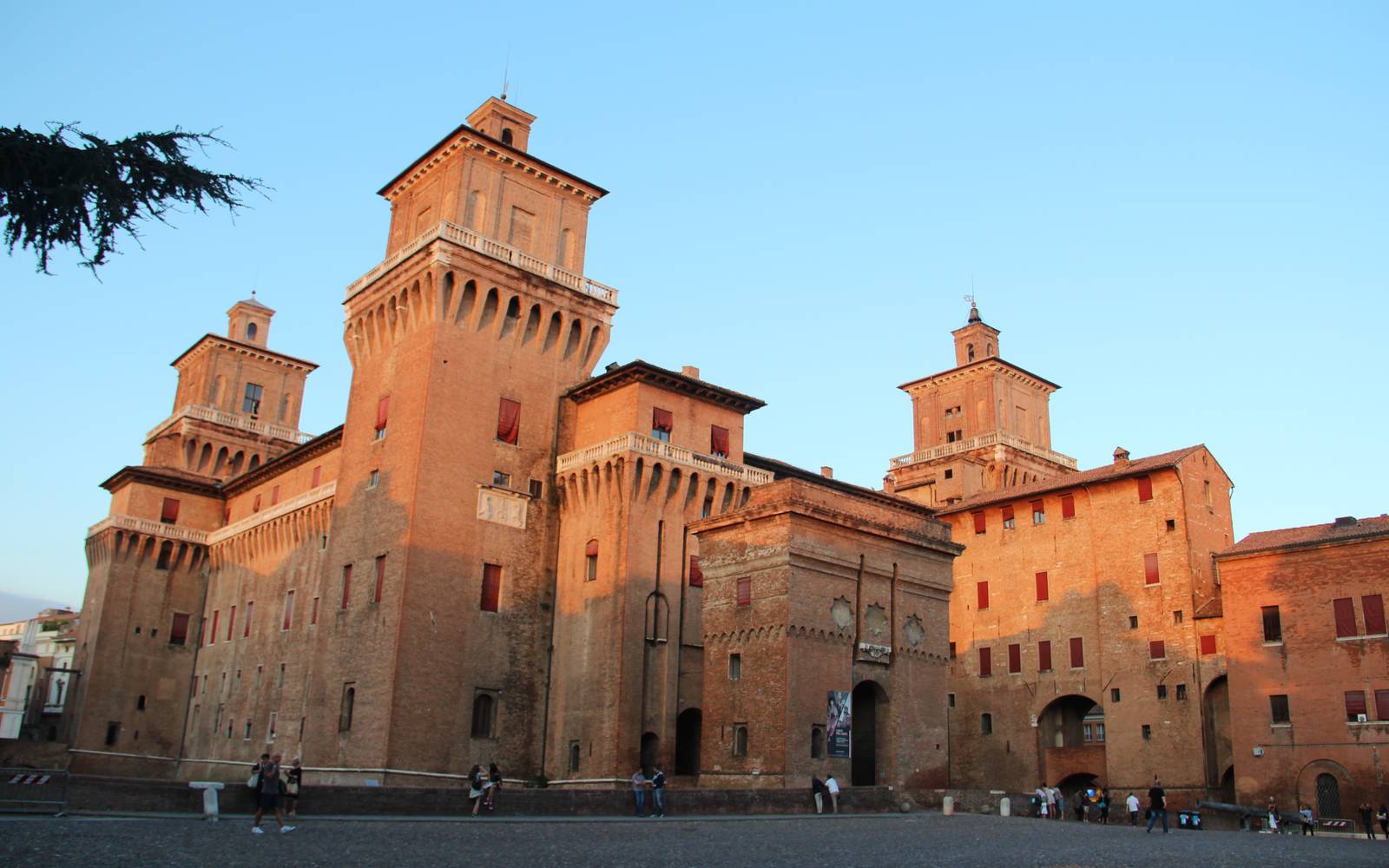
Image reference: Castello Estense, Ferrara.
At a Glance
- Founding visual languagedeveloped by Giorgio de Chirico from approximately 1910–11.
- Shared phaseprincipally Ferrara in 1917–18, with related work continuing to about 1920–21.
- Main artistsGiorgio de Chirico, Carlo Carrà and Giorgio Morandi; Alberto Savinio and Filippo de Pisis were essential intellectual and artistic participants; Mario Sironi made closely related work.
- Principal placesFlorence, Turin and Paris in de Chirico's formation; Ferrara for the wartime circle; Bologna for Morandi; Rome and Milan for publishing and later dissemination.
- Recurring elementsempty piazzas, arcades, towers, trains, statues, clocks, maps, measuring tools, biscuits, fish, mannequins, blackboards and objects placed outside ordinary use.
- What it was nota religious style, one philosophical system, a long-lived organisation, a branch of Surrealism or a synonym for every uncanny figurative painting.
Contents
- Where it fits
- What metaphysical meant
- The first enigma
- Paris
- From piazza to interior
- Ferrara
- Four stages
- Carlo Carrà
- The Metaphysical School
- Dada and Surrealism
Where Metaphysical Painting fits
Giorgio de Chirico
Key career periodCarlo Carrà
Key career periodAlberto Savinio
Key career periodFilippo de Pisis
Key career periodGiorgio Morandi
Key career periodMario Sironi
Key career periodMetaphysical Painting made the ordinary world look as though it had remembered a secret. A deserted square, plaster head, rubber glove, biscuit, map or mannequin remained recognisable, yet its familiar use had been suspended. Architecture obeyed several perspectives at once. A train crossed the horizon without bringing anyone nearer. Shadows lengthened under light that could not quite have cast them. Nothing supernatural needed to happen: uncertainty entered through the precise arrangement of things.
The Italian name, Pittura Metafisica, belongs above all to Giorgio de Chirico and the visual language he developed from about 1910. It became a shared formation only later, when the First World War brought de Chirico, his brother Alberto Savinio and Carlo Carrà into an intense exchange at Ferrara in 1917. Filippo de Pisis supplied a crucial local, literary and interpretive presence. Giorgio Morandi made a brief, independent body of related still lifes in Bologna around 1918–20. By the early 1920s, this already small constellation had separated.
Its influence moved in the opposite direction. Dada artists saw how commercial diagrams could become enigmas. The Surrealists treated de Chirico's early paintings as revelations. Italian painters carried metaphysical stillness into the return to craft and Magic Realism. Later generations inherited an image of the city as empty stage and the object as a familiar thing made suddenly unknowable.
Metaphysical Painting was therefore less a conventional school than a way of seeing, briefly shared and repeatedly reinvented. Its history begins before Ferrara, reaches far beyond Italy and cannot be reduced to de Chirico's biography—but without his founding pictures, there would have been no movement.
What “metaphysical” meant
The word can sound forbiddingly philosophical. De Chirico used it more sensuously. To look metaphysically was to encounter the visible world after habit had loosened its hold. A building or chair did not disappear into abstraction; it appeared more completely, while its normal explanation became less secure. The artist imagined the calm surface of an ocean whose hidden depth disturbs precisely because the top looks so still.[1]
This was not the illustration of a single doctrine. Friedrich Nietzsche, Arthur Schopenhauer and Otto Weininger mattered, as did classical myth and German Romantic art, but de Chirico turned reading into a pictorial method. “Enigma” names the result. It is not a rebus in which every glove, tower and flag has one correct translation. It is the sensation that a known scene has disclosed something without explaining what has been disclosed.
The movement's most characteristic pictures hold two kinds of knowledge in tension. We can name the things and cannot account for their meeting. We recognise a public square and cannot occupy its space. We understand what a clock measures but cannot reconcile its time with the sun. Metaphysical Painting is strongest when description remains precise and interpretation remains open.
From Greece and Munich to the first enigma
De Chirico was born in 1888 at Volos in Greece to Italian parents. His father, Evaristo, was an engineer involved with railway construction; his mother, Gemma, came from Genoa. Classical architecture and myth were not distant school subjects in that childhood, while trains, tracks, tunnels and engineers supplied a parallel modern mythology.
After his father's death, the family moved through Athens, Munich, Milan and Florence. At Munich's Academy of Fine Arts, de Chirico studied within a culture where late Romantic images, philosophy and the antique could still challenge fashionable modernism. Arnold Böcklin's mythic landscapes and Max Klinger's graphic fantasies showed how exact form could carry psychic distance. Nietzsche's Turin writings and Schopenhauer's account of appearance helped shape an art of sudden, unprovable revelation. The Musée de l'Orangerie's reconstruction follows these sources from Munich through Turin, Paris and Ferrara, while restoring Alberto Savinio as a co-creator of the intellectual world.[2]
De Chirico located his first decisive revelation in Florence around 1910. Recovering from intestinal illness, he sat in Piazza Santa Croce and saw the familiar buildings, monument, autumn light and empty space as if they had been transformed. The resulting Enigma of an Autumn Afternoon resembles the place without recording it. The church becomes a compressed temple, the monument an ancient figure, the square a shallow platform before distant sails.
The experience mattered because nothing objectively marvellous occurred. Illness, light, memory and attention made the place appear both itself and another place. Later scholarship connects this “surprise” to de Chirico's reading of Nietzsche: revelation arrives without logical preparation, and the painted scene resembles its cause as a dream resembles a person—recognisably but with a mysterious alteration.[3]
Turin supplied a second urban vocabulary. Its straight streets, arcades, equestrian monuments, clocks and distant Alpine light had been charged for de Chirico by Nietzsche's last lucid months in the city. The Turin piazza could become a stage on which historical time folded: modern civic order, ancient statue and personal memory occupied one suspended afternoon.
The artist's Greek past entered through the repeatedly sleeping Ariadne. In the myth, Ariadne is abandoned by Theseus on Naxos before being found by Dionysus. In de Chirico's piazzas, her reclining statue makes abandonment permanent. The Metropolitan Museum reads its 1913 Ariadne as a return to classical memory, but the modern city does not offer a consoling reunion. Arcades and a distant tower preserve the loneliness around the stone body.[4]
The statue also changes the role of the figure. A public monument usually anchors collective history. De Chirico's Ariadne seems marooned within it. She does not narrate the myth so much as hold the picture in a time that will not advance.
Paris: the modern city becomes an ancient stage
De Chirico reached Paris in 1911 and entered a city already transformed by Cubism, new poetry and competing avant-gardes. He met Guillaume Apollinaire and gained the support of the dealer Paul Guillaume. Apollinaire recognised that these sparse squares were not provincial classicism. He called the work cerebral and inward, unlike the visible trends around it.
Paris did not make de Chirico imitate Cubist fracture. It sharpened his difference. He borrowed modernism's freedom to construct space while keeping walls, towers, statues and trains legible. Several vanishing points could coexist inside a seamless surface. An apparently conventional picture asked the spectator to occupy incompatible positions.
The Enigma of a Day of 1914 expands the piazza to monumental scale. A statue rises behind a wall; arcades converge; small figures gather without clear purpose. The square seems orderly until one tests its perspective. Shallow and steep spatial systems meet, and the scale of figures fails to secure distance. MoMA's object history also records a crucial afterlife: the painting later belonged to André Breton, whose apartment made it part of Surrealism's visual environment.[5]
Perspective here is not a technical error. It is a method of doubt. Renaissance architecture promises rational position, then denies a single viewer the mastery that rational perspective traditionally supplied. The square is coherent enough to enter imaginatively and incoherent enough to prevent arrival.
The Song of Love, also 1914, removes even the expectation of public narrative. A plaster profile of Apollo is fixed beside an oversized red rubber glove. A green ball sits below; a train passes beyond the wall. The cast head belongs to museum antiquity, the glove to a modern shop or workshop, the ball to play, the locomotive to industrial distance. Their meeting seems impossible and visually unquestionable.
MoMA describes the picture as a painterly, pre-modern collage. Unlike a pasted Cubist fragment, each item occupies the same painted air, yet their scales and uses remain irreconcilable. De Chirico anticipated Surrealist juxtaposition without sharing its later psychoanalytic and political programme.[6]
The work teaches a basic metaphysical procedure: preserve the object's identity while removing the relation that makes it ordinary. The glove is not transformed into another object. It becomes strange because it hangs like a displaced body beside a god whose body is absent.
Trains recur at the edge of the early piazzas. They may carry memory of the artist's father, European movement and modern speed, but they should not be decoded as one private symbol. Their formal role is equally important. A tiny locomotive indicates motion behind a wall while the foreground remains frozen. It promises departure without showing a station anyone can reach.
Clocks create a similar contradiction. Their precise faces offer public, measured time while the long shadows suggest an incompatible hour. Metaphysical time is not timelessness in the simple sense. It is the coexistence of several temporal systems: clock, sun, myth, memory, railway schedule and the spectator's delayed looking.
From piazza to interior
When de Chirico returned to Italy during the war, the open square often contracted into the metaphysical interior. Maps, frames, rulers, biscuits, fish, boards and pieces of wood crowd rooms that may barely contain them. The movement from empty exterior to packed interior did not abandon the earlier method. It made spatial contradiction immediate and tactile.
The Jewish Angel of 1916 is built from painted wood-like pieces, a French curve, right angles, measuring sticks and an enormous eye drawn on paper. The structure can suggest an abstract portrait connected to de Chirico's engineer father, but the museum preserves that as an interpretation rather than certainty. The eye looks without a body; drafting instruments measure a space they help destabilise.[7]
The title itself resists easy explanation. De Chirico's names often create an additional object beside the picture rather than a label for what it contains. “Angel” does not transform the apparatus into a theological image. It invites a relation that the visual evidence can neither prove nor dismiss.
In Great Metaphysical Interior of 1917, an easel-like framework carries images within images. Boards, geometric solids and a painted landscape press forward inside a narrow room. The spectator cannot tell which depicted element belongs to the physical chamber and which is a representation propped inside it. MoMA's provenance records its later passage through Mario Broglio, Gala Dalí or Paul Éluard and James Thrall Soby, showing how an object born in wartime Ferrara entered Surrealist and American collections.[8]
The interior converts looking into a chain. We see a painting of a room containing an image of a landscape, perhaps derived from another commercial or remembered image. The ordinary distinction between world, model and artwork becomes unstable without any object ceasing to be itself.
Ferrara: a city enters the paintings
Italy entered the First World War in May 1915. De Chirico and Savinio returned from France and enlisted, then were assigned to the 27th Infantry Regiment at Ferrara. They moved through several addresses while military duties and medical observation structured their lives. The city became more than background. Renaissance planning, the Este castle, the former Jewish ghetto, shops, factories and wide roads entered their language.[9]
Ferrara's emptiness in the paintings should not be mistaken for an untouched old city. Historic towers coexisted with barracks, commerce, workshops and industrial buildings. That mixture allowed de Chirico to place antiquity and modern manufacture within the same compressed field.
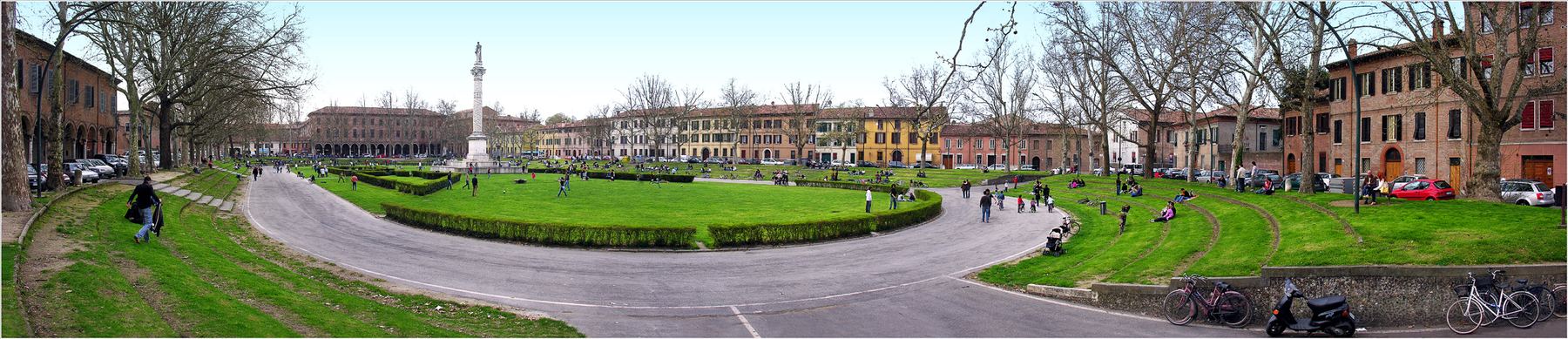
Piazza Ariostea offered a concrete model. In 1917 de Chirico transformed its central column and statue into the towering assemblage of The Great Metaphysician. Wood, rulers, set squares, drapery and geometric pieces form a faceless figure whose unstable construction rises where civic commemoration once stood. MuseoFerrara connects the painted arrangement to the square while preserving Filippo de Pisis's early description of its genesis.[10]
The substitution is revealing. A named Renaissance poet on a column becomes an anonymous modern idol made from studio and engineering debris. The piazza remains recognisable in principle, but public history has been replaced by a figure that looks both monumental and temporary.
The Castello Estense appears behind The Disquieting Muses of 1918. In the foreground, mannequins and sculptural fragments occupy a platform like performers after the audience has left. Factory chimneys join the castle. Fruit-like coloured forms, boxes and a seated figure bring still life, stage and city together. The castle is not a picturesque quotation; it helps contradictory ages stand in one place.[11]
De Chirico returned to this composition repeatedly. Later versions and copies became a major problem for collectors and scholars, but repetition is also part of the image's meaning. The “muses” do not belong to one moment of inspiration. They recur as actors inside the artist's changing account of his own past.
Ferrara's Fratelli Santini factory supplied another direct source. The building appeared on company stationery, and de Chirico probably used the printed image inside Metaphysical Interior with Large Factory. A commercial letterhead becomes a picture within the picture. What looks like private dream turns out to have been assembled from the paper world of local business.[12]
This source does not reduce imagination. It shows how metaphysical seeing worked. The artist did not need to invent a fantastic factory. He detached a printed building from its administrative purpose, placed it inside a cramped room and made representation itself part of the enigma.
Scientific culture entered similarly. De Chirico and Savinio knew the observatory connected with physicist and meteorologist Giuseppe Bongiovanni in the castle tower. Measuring devices, rotating indicators, maps and diagrams belonged to the city's working world. A University of Ferrara project has paired historic instruments with the paintings to show that metaphysical forms often have material antecedents.[13]
Measurement becomes paradoxical in the pictures. Rulers, targets and geometric solids promise rational control, yet the room containing them cannot be measured consistently. Science is not mocked. Its tools are relocated into a visual order where exactness makes uncertainty sharper.
Ferrara's food shops supplied less elevated objects: bread, biscuits, sweets and fish. De Chirico described the city's ghetto streets and confectionery with fascination. In the paintings, edible things become sacred, heraldic or archaeological because they have been removed from appetite and display. A biscuit can look as final as a monument.
The military hospital and the 1917 encounter
The most concentrated shared phase began at Villa del Seminario, a military hospital for nervous disorders outside Ferrara. De Chirico was observed there during 1917; Carrà, serving nearby and suffering insomnia, melancholy and physical decline, was also admitted. They painted in proximity under wartime medical authority.[14]
Later accounts have sometimes turned the villa into a legendary double studio. That romantic image omits the institution. The artists were soldiers assessed through categories of illness and fitness. They had time and space to work, but within a system created by mass war and the need to manage damaged or distressed men.
No modern diagnosis should be imposed retrospectively. What matters is the documented condition: military service, medical observation, disrupted sleep, restricted movement and a city distant from the front yet saturated by war. Metaphysical stillness can be read within that context without becoming a clinical symptom.
Carrà had been a central Futurist. His earlier paintings and manifestos celebrated simultaneity, crowd energy and modern force. The hospital encounter brought him into a language that seemed opposite: immobility, sealed rooms, ancient measure and solitary objects. Palazzo dei Diamanti treats Ferrara as the point where de Chirico began calling his painting metaphysical and where the exchange produced works that later affected Dada, Surrealism and New Objectivity.[15]
The claim needs nuance. De Chirico had used metaphysical ideas and made the founding pictures years earlier. Ferrara did not invent the vision from nothing. It converted a personal and Parisian practice into a named Italian exchange.
Follow Metaphysical Painting through four stages
–15
De Chirico invents the metaphysical piazza
Florence, Turin and Paris turn classical memory, railway modernity, several perspectives and suspended time into a new visual language of enigma.
–18
Ferrara supplies places, objects and wartime pressure
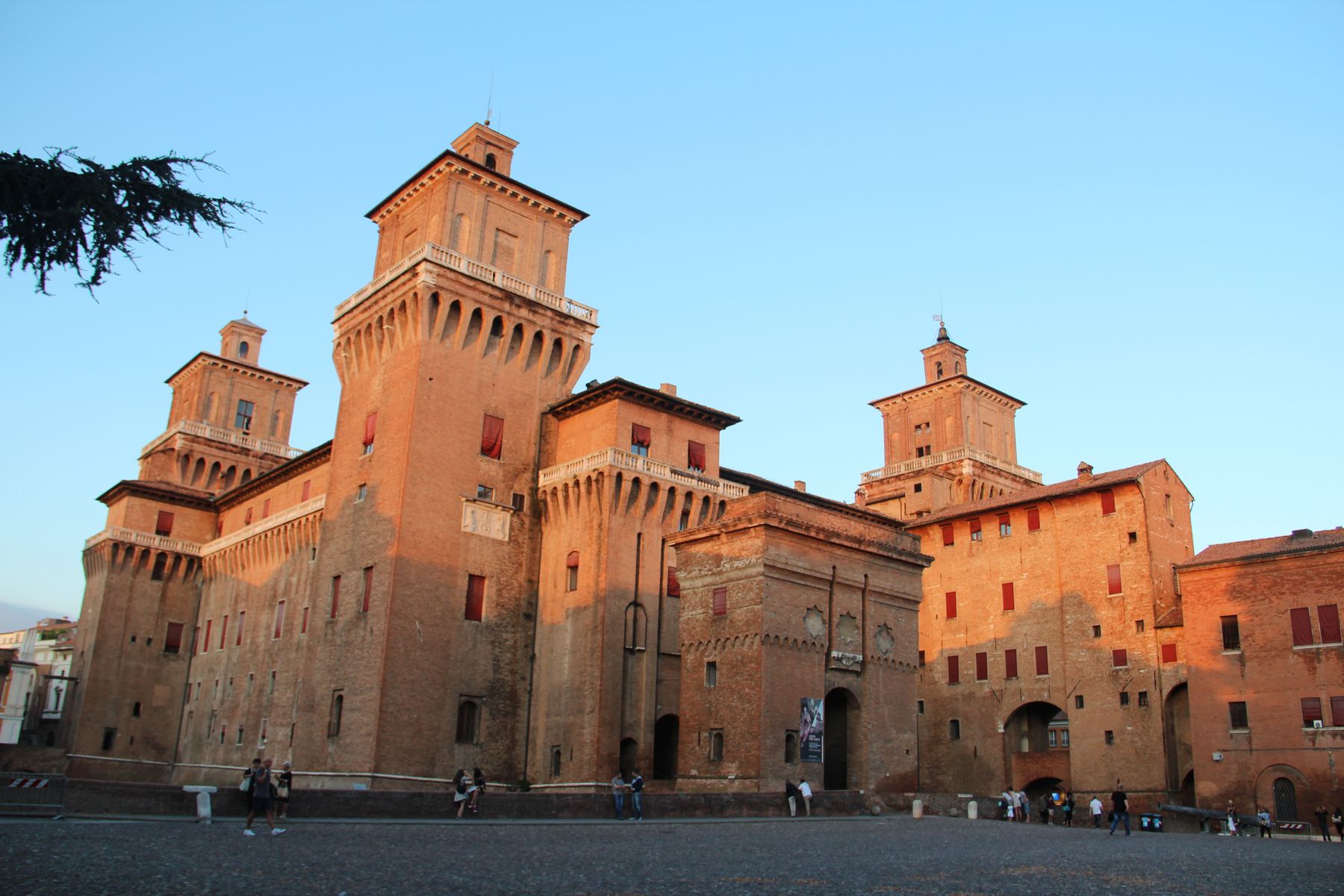
Castello Estense, Piazza Ariostea, factories, shops, instruments and military-medical institutions enter de Chirico's interiors and the intense 1917 exchange with Carrà.
–21
A brief school travels through journals and exhibitions
Carrà, Savinio, de Pisis and Morandi transform separate parts of the language while La Raccolta and Valori Plastici carry it into the return to craft.
–1970s
Dada, Surrealism and de Chirico reopen the archive
Ernst, Magritte and Breton build new movements from metaphysical objects; de Chirico later repeats and revises his own imagery through a Neo-Metaphysical phase.
Carlo Carrà: from movement to the ordinary thing
Carrà absorbed de Chirico's mannequins, maps, fish, measuring instruments, targets and rooms with remarkable speed. Chronology establishes de Chirico's priority, but influence is not the same as passive copying. Carrà made the imagery heavier, more frontal and more concerned with relations among solid forms.
Composizione TA (Natura morta metafisica), dated 1916–18, shows the transition. Its framing and picture-within-a-picture can recall Synthetic Cubist collage, while the bowl, illuminated upright and compressed construction belong to the metaphysical turn. MART notes that the work may have begun before the Ferrara encounter, making it evidence of revision across styles rather than an instant conversion.[16]
Carrà's Futurist experience did not vanish. The habit of building a picture from interlocking planes remained, but velocity had been removed. Objects that once participated in simultaneous motion now press against one another inside an airless system.
The Enchanted Room of 1917 gathers mannequin parts, a fish, toys, frames and measuring devices. De Chirico's irony becomes more austere. Palazzo Citterio describes Carrà's pursuit of new relations among space, volume, colour and plastic structure, leading towards the pure form of ordinary things.[17]
The title calls the room enchanted, yet the paint does not show a spell. Enchantment arises from the disciplined withdrawal of use. The fish cannot be eaten, the measuring tool cannot resolve the perspective and the mannequin cannot act. The room is full of functions made unavailable.
In The Metaphysical Muse, a mannequin-like figure stands among a map, coloured target, box and painted architectural view. The “muse” has no expressive face and offers no graceful inspiration. She is an assembled presence whose surrounding signs seem exact but refuse a common language. Carrà later theorised this phase in his 1919 book Pittura Metafisica.[18]
That publication intensified a dispute over authorship. De Chirico believed Carrà had claimed ideas and images derived from him. Carrà's rapid publication helped secure his own role in Italian criticism. A responsible history can accept de Chirico's earlier invention and Carrà's substantial transformation at the same time.
Conservation makes Carrà's process visible. Beneath Mother and Child, imaging has revealed an earlier composition with a more isolated mannequin, geometric floor, weights and differently organised room. Carrà cancelled and repainted major elements before reaching the final work. The evidence replaces a story of simple borrowing with one of sustained construction and revision.[19]
The title again creates tension. There is no naturalistic mother tenderly holding a child. Faceless forms and hard volumes make kinship into a relation that must be inferred. The picture approaches early Renaissance solemnity while refusing the emotional cues of a devotional image.
The three major 1917 Carrà paintings—The Metaphysical Muse, The Enchanted Room and Mother and Child—entered the Pinacoteca di Brera through the Jesi bequest. The Italian national catalogue confirms The Enchanted Room as a state-owned work, signed and dated 1917. Collection history matters because this compact group has become the principal public evidence through which Carrà's metaphysical phase is taught.[20]
By the early 1920s, Carrà moved towards Giotto, the Quattrocento, landscape and a broader return to Italian tradition. The metaphysical room was brief, but its demand for solid form did not disappear. It became one route out of Futurism and towards a new classicism.
Alberto Savinio: music, myth and the thinking of the group
Alberto Savinio was the pseudonym adopted by Andrea de Chirico, Giorgio's younger brother. Calling him only “the brother” obscures an artist who worked across music, literature, criticism, theatre and later painting. The two shared Greek childhood, Munich formation, Paris networks and Ferrara's wartime displacement. Their ideas developed through continuous exchange.
Savinio's writing gives metaphysical art its comic, multilingual and metamorphic range. Myth is not treated as a noble story safely inherited from antiquity. Gods, heroes, animals, furniture and modern people change identity. Music contributes structures of recurrence and variation that help explain why an image can return without remaining the same.
The correspondence around Giuseppe Raimondi's journal La Raccolta, published in 1918–19, reveals a network rather than a private dialogue between painters. De Chirico, Carrà, Savinio and de Pisis exchanged letters and proposals with a young editor pursuing a European literary project. Journals turned Ferrara's short encounter into reproducible argument.[21]
Savinio began painting substantially later, so pictures such as Le poète of 1931 are not documents of the narrow 1917 school. They demonstrate an afterlife. In that work a human figure joins Ionic columns in a bodily transformation, making poet, architecture and myth occupy one metamorphic form. MART's account preserves Savinio's musical training and his place in elaborating metaphysical theory before his mature painting career.[22]
His role is therefore foundational but not identical to de Chirico's. Giorgio devised the early pictorial language; Savinio helped create the intellectual, musical and literary climate in which its enigmas could operate.
Filippo de Pisis: witness, interpreter and independent painter
Filippo Tibertelli, known as Filippo de Pisis, was a young Ferrarese writer, collector and emerging artist when de Chirico and Savinio arrived. He knew the city's places, objects and literary circles. His 1918 lecture on modern painting was among the earliest attempts to place the Ferrara moment within Italian art history.
De Pisis should not be inflated into a painterly founder equal to de Chirico and Carrà in 1917. His initial importance lay in friendship, writing, local knowledge and interpretation. Later, as he developed a mature painting practice, metaphysical displacement survived within a very different surface.
Still Life with Eggs of 1924 divides pale objects through severe volume and an oblique recess that makes close observation suddenly unstable. Palazzo Citterio connects its steep perspective with de Chirico while locating the work in the wider return to order and Valori Plastici climate.[23]
After moving to Paris in 1925, de Pisis developed a rapid, airy brushwork sometimes compared with stenographic writing. In marine still lifes, fish or birds lie displaced from their environment and surrounded by light, emptiness and fragments. The atmosphere retains abandonment and strangeness without imitating de Chirico's smooth, sealed construction.[24]
This is an important kind of legacy: not the repetition of motifs, but the survival of a relation. An ordinary object, removed from its practical world, carries the memory of another place.
Giorgio Morandi: metaphysical still life in Bologna
Morandi's place requires one firm correction. He was not part of the Ferrara hospital circle and did not work there beside de Chirico and Carrà. He remained in Bologna, encountered relevant images through reproductions and arrived at a related object-world independently around 1918.
His brief metaphysical paintings may include bottles, boxes, a pipe, geometric forms and mannequin-like heads. The arrangement is closed and strangely lucid, but the objects do not function as a fixed symbolic vocabulary. The Metropolitan Museum notes that in a 1918 still life, unrelated items were brought together for their shapes rather than for an allegorical programme.[25]
Morandi's distinction can be felt in the pressure of intervals. De Chirico's glove and Apollo head collide as an event. Morandi's bottle, box and oval head establish weight, spacing and silhouette. The metaphysical effect is quieter because formal relation, not philosophical theatre, dominates.
The phase was short. A sequence of works from 1914, 1916 and 1919 already shows his movement through Cézanne, Paul Klee, Futurism, Metaphysical Painting and early classicism towards the repeated studio arrangements of his mature career. The Met's retrospective gallery makes continuity and change visible rather than turning 1918 into an isolated exception.[26]
MoMA's account of metaphysical still life describes Carrà's bottle, jug, bowl and triangle within a cell-like, monochromatic space of timeless closure. Morandi shared the desire for ideal geometry while making it less nostalgic and less overtly emblematic. “Metaphysical” in his case is most useful when it names an interval of concentrated experiment, not his lifelong identity.[27]
Recent revision has widened the movement beyond the old image of two men in one Ferrara room. A CIMA exhibition built from Brera and other collections brought Morandi, Carrà and Mario Sironi together with a key de Chirico, emphasising different metaphysical practices made from 1916 to 1920. The aim was not to displace de Chirico's priority but to give the genre greater internal variety.[28]
Mario Sironi and an urban metaphysics
Sironi carried metaphysical form towards the modern city's social weight. In The Lamp of 1919, a mannequin undertakes an ordinary task in a nearly empty kitchen. Electric light, table, chair and geometric solid create a room of modest modern life rather than mythic plaza.
The figure's heavy body and high-heeled shoes make artificiality physically awkward. Palazzo Citterio reads the work as a metaphor for urban solitude and unresolved human difficulty. The mannequin is closer to Carrà's massive form than de Chirico's prophetic idol.[29]
Sironi's later commitment to Fascism is relevant to his biography and to the history of Italian monumental art. It does not make this 1919 painting proof that Metaphysical Painting itself was founded as Fascist culture. The core visual language predates Mussolini's seizure of power, and the artists' later politics diverged.
MART's collection classification includes later works by de Chirico, Savinio and others beneath the broad term “Metafisica.” That museum breadth is useful for exploring afterlives, but it should not enlarge the original school indefinitely. A 1930 Savinio or 1926 de Chirico may revise metaphysical premises without belonging to the brief Ferrara formation.[30]
Was there really a Metaphysical School?
The phrase scuola metafisica suggests more organisation than existed. There was no inaugural public manifesto comparable with Futurism, no stable membership and no long sequence of group exhibitions. The most intense collaboration between de Chirico and Carrà lasted only months.
Alberto Savinio later described Metaphysical Painting as a way of seeing rather than a formal school. Historic MoMA scholarship likewise makes de Chirico and Carrà the principal protagonists while giving Morandi an important but independent place. Morandi was never in Ferrara and differed in premise even where his iconography looked related.[31]
The term remains justified because the exchange produced distinguishable works, writing and transmission. A school can exist as a compact historical convergence without pretending that all participants agreed. Its brevity is not a weakness. It helps explain why arguments over origin and ownership emerged so quickly.
A 1949 MoMA presentation called the movement less doctrinaire than Futurism and repeated Savinio's “way of seeing” formulation. It also recognised the paradox of influence: the group had dissolved by the early 1920s, yet its strange objects and unreal settings were becoming more important in Germany, Switzerland and France.[32]
Valori Plastici and the return to craft
Metaphysical Painting travelled through publication. Mario Broglio founded Valori Plastici in Rome in 1918. The journal reproduced and discussed de Chirico, Carrà, Morandi and allied artists while arguing that avant-garde exhaustion should give way to craft, plastic form and dialogue with the Italian museum tradition.
Broglio's publication did not merely report an existing school. It grouped artists, translated positions and made a visual identity exportable. Its 1921 Das junge Italien exhibition toured Germany, exposing artists and critics to Italian work at a moment when Dada, Expressionism and new realisms were searching for alternatives.
Historic scholarship also clarifies the limits of personal exchange. Morandi knew reproductions before he knew de Chirico personally; his metaphysical aims were primarily formal. De Chirico and Carrà fell into open disagreement as Carrà published his version of the history. The journal temporarily held together artists whose practices and claims were already separating.[33]
De Chirico's 1919 essay “The Return to Craft” urged renewed study of technique and older masters. Carrà moved towards Giotto and the Quattrocento. Morandi turned humble vessels into durable architecture. The metaphysical image became one bridge from wartime avant-garde to the European return to order.
That wider classicism was politically unstable. After the First World War, solid form and historical continuity could answer real desires for repair. They could also feed nationalist claims and, later, Fascist cultural programmes. Guggenheim's study of postwar classicism places de Chirico and Carrà within this transition while showing that artists across Europe adopted classical form for incompatible purposes.[34]
Metaphysical Painting itself should not be labelled Fascist. Its founding pictures predate the regime. Nor should the return to craft be treated as politically neutral. The meanings of order, heritage and monument changed as Italy moved from wartime crisis to dictatorship.
Palazzo Citterio's collection sequence makes the transition visible: Futurist rebellion gives way to Metaphysical silence, then to Valori Plastici, Novecento and other interwar formations. This is more accurate than imagining sealed movements. Artists and objects moved between journals, exhibitions and changing public ambitions.[35]
Dada discovers the metaphysical object
Max Ernst encountered reproductions of de Chirico's work in Munich in 1919, a decisive year in his turn towards Cologne Dada. Commercial catalogues, teaching diagrams and printed fragments became material for collage, overpainting and strange machines. Like de Chirico, Ernst could make a familiar source lose its normal explanatory function.
MoMA's survey places the encounter beside Ernst's wartime disillusionment and exposure to other artists. He did not simply copy piazzas. He learned that appropriation and a long title could increase mystery rather than resolve it. His collages then dismantled the integrity of the source image more aggressively than de Chirico's paintings did.[36]
The relationship marks a difference as well as an inheritance. De Chirico painted a commercial image into a constructed room. Ernst cut, combined or overpainted the printed page. Metaphysical estrangement became Dada material sabotage.
Magritte and the shock of The Song of Love
René Magritte saw a reproduction of The Song of Love around 1922–23 and later described the encounter as overwhelming. Here was a painting that did not depend on expressive handling or invented monsters. A glove and antique head, kept perfectly ordinary, could form a new poetic reality.
Centre Pompidou traces how Magritte initially adapted such encounters—jockeys, curtain, baluster forms and other displaced objects—before developing his own image-word problems. The intellectual dignity of painting lay in creating relations that thought could not reduce to illustration.[37]
Magritte's mature method remained distinct. He painted a room-sized comb, a locomotive emerging from a fireplace or an image accompanied by words that contradict ordinary naming. Yet de Chirico's lesson persisted: the visible world already contains enough material for mystery if habit is interrupted.
MoMA's Mystery of the Ordinary describes this effort to make everyday things lose their automatic familiarity. By 1926–38, Magritte was fully within organised Surrealism, using lucid depiction to challenge bourgeois rationality. His work is not late Metaphysical Painting; it is a Surrealist transformation of one of its central discoveries.[38]
Breton, the Surrealists and the early-work canon
André Breton was drawn to de Chirico before publishing the first Surrealist manifesto. He acquired The Child's Brain after seeing it in Paul Guillaume's window and later owned The Enigma of a Day. The paintings surrounded Surrealist activity and became objects of collective interpretation.
The Centre Pompidou's 1983 retrospective explicitly called de Chirico the initiator of Metaphysical Painting and a precursor of Surrealism, while concentrating on the period before 1919. That cut-off reflects a powerful canon: early de Chirico as modern visionary, later de Chirico as an artist who abandoned his discovery.[39]
Collectors helped produce that canon. The Met's group of works formerly owned by E. L. T. Mesens includes The Jewish Angel. Mesens was Magritte's friend, critic, dealer and a key Surrealist mediator. Provenance shows influence moving through possession, display and reproduction as well as formal resemblance.[40]
MoMA's historic checklist records how The Enigma of a Day served as a backdrop in Breton's apartment and how The Song of Love became foundational for Magritte. The Surrealists did not encounter an abstract movement definition. They encountered particular images in magazines, shops, homes and galleries.[41]
The distinction from Surrealism remains firm. Breton's 1924 manifesto promoted psychic automatism and a collective attempt to transform waking life through the unconscious. The movement developed explicit political arguments, exclusions and group discipline. De Chirico's revelations drew on philosophy, classical memory and constructed vision; they were neither produced by automatic method nor committed to Breton's programme.[42]
Max Ernst, Magritte, Yves Tanguy, Salvador Dalí and Joan Miró could all take something different from de Chirico. Empty horizon, found diagram, dislocated scale, long shadow or poetic object became components within practices that no longer belonged to the Italian school.
Later de Chirico and the problem of repetition
De Chirico moved towards old-master technique, classical quotation and a self-conscious return to tradition after 1919. The Surrealists increasingly attacked his later work while elevating his paintings of the 1910s. This conflict shaped market value and art history for decades.
The artist complicated the boundary by returning to early compositions. He painted variants, replicas and differently dated versions, disputed catalogues and denounced works he considered false. These histories require object-by-object scholarship. A later repetition is not automatically a forgery, and an artist's own assertion is not by itself a complete provenance.
In the late 1960s and 1970s, de Chirico developed a consciously Neo-Metaphysical phase. Mannequins, Italian squares, archaeologists, mysterious baths and studio interiors reappeared with brighter colour and altered mood. The Fondazione Giorgio e Isa de Chirico treats this as a renewed period of research and meditation on the artist's earlier visual archive.[43]
These pictures challenge the idea that an artist has only one legitimate relation to an invention. A young de Chirico discovered the piazza as enigma; an elderly de Chirico could treat that discovery as a museum of his own forms. The results are historically different even where motifs match.
A major Milan retrospective presented the full career as repeated invention rather than a rise-and-fall biography. It does not require viewers to value every period equally. It asks them to see how the artist's later mythological, Baroque and Neo-Metaphysical works argue with the modernist demand that he remain the painter he had been before thirty.[44]
The mannequin exemplifies this changing archive. In the Ferrara works it can recall tailor's dummy, theatrical prop, measuring device, wounded body's substitute, ancient idol and faceless modern person. Palazzo dei Diamanti traces material and pictorial sources while resisting a single symbolic definition. Its power lies in being human enough to stage relation and inhuman enough to withhold psychology.[45]
How to look at Metaphysical Painting
Begin with perspective. Select one arcade, wall or floor line and follow it towards a vanishing point. Then test the next architectural system. If they disagree, ask what happens to your imagined position. The painting may look stable because every part is carefully drawn, even while no single body could stand where the viewer seems to stand.
Check the shadows. Which object could have cast each one? Does the clock agree with the angle of light? Is a tiny distant figure accompanied by an enormous shadow from someone outside the frame? Shadow often brings narrative suspense without revealing an event.
Separate the objects by source. A plaster cast may come from a museum or studio, a glove from shop display, a factory from stationery, a map from school, a biscuit from a Ferrara bakery and a set square from engineering. Metaphysical Painting does not hide modern visual culture beneath private symbols. It makes heterogeneous sources inhabit one painted world.
Notice bodies that are absent. The glove, mannequin, statue, eye and shadow can each stand in for a person without supplying individuality. Ask whether the substitution feels comic, mournful, threatening or ceremonial. The answer may change as attention moves across the picture.
Listen to the title without treating it as a solution. The Song of Love, The Enigma of a Day, The Disquieting Muses and The Child's Brain add poetic pressure but do not name everything depicted. Title and image form another inexplicable encounter.
Finally, establish the date and version. An early Paris piazza, a Ferrara interior, a 1920s classical work and a 1970s Neo-Metaphysical return may share motifs while making different historical claims. Repetition is part of de Chirico's art, so chronology belongs to close looking.
Where to see Metaphysical Painting
Displays, loans and access arrangements change. Check current information before travelling.
- 01
Museo Carlo Bilotti
Rome is indispensable for de Chirico's long career and his return to classical and metaphysical imagery. The city also clarifies the role of Valori Plastici and the movement from avant-garde experiment towards the return to craft.
Rome, Italy
Collection and research guideVisit official website - 02
Palazzo Citterio
The Jesi collection holds Carrà's defining 1917 group: The Metaphysical Muse, The Enchanted Room and Mother and Child. De Pisis, Sironi and Morandi allow the visitor to follow the language into distinct interwar practices.
Milan, Italy
Collection and research guideVisit official website - 03
MART
MART's Italian modern collection connects Futurism, Metaphysical Painting, Valori Plastici, Magic Realism and Novecento. Carrà's Composizione TA is especially valuable for seeing transition preserved within one object.
Rovereto, Italy
Collection and research guideVisit official website - 04
Museo Morandi and MAMbo
Bologna is the necessary corrective to a Ferrara-only story. Morandi's paintings and studio history show how metaphysical still life emerged independently and then became a lifelong inquiry into spacing, weight, tone and humble objects.
Bologna, Italy
Collection and research guideVisit official website - 05
Palazzo dei Diamanti and MuseoFerrara
Ferrara itself is an open archive. Piazza Ariostea, Castello Estense, the former ghetto, factory sites, observatory history and Villa del Seminario connect the paintings' strange forms with the city's material and wartime life.
Ferrara, Italy
Collection and research guideVisit official website - 06
Museum of Modern Art
MoMA has one of the strongest groups of de Chirico's early works, including The Song of Love, The Enigma of a Day and Great Metaphysical Interior. Its historic exhibitions also shaped the English-language canon.
New York, United States
Collection and research guideVisit official website - 07
Metropolitan Museum of Art
The Met's Ariadne and The Jewish Angel reveal the shift from open piazza to Ferrara assemblage. Its Morandi scholarship helps distinguish the Bologna painter's formal metaphysics from de Chirico's visual drama.
New York, United States
Collection and research guideVisit official website - 08
Musée de l'Orangerie
The Orangerie is the best place to understand Paul Guillaume's role in presenting de Chirico to Paris. Its research reconnects the work with poets, dealers and collectors rather than treating influence as a purely stylistic transmission.
Paris, France
Collection and research guideVisit official website
Suggested books
Giorgio de Chirico et la peinture métaphysique
Published in connection with the Musée de l'Orangerie exhibition, this French catalogue follows de Chirico from classical childhood and German philosophy through Paris to Ferrara. It is particularly strong on the cultural networks around Apollinaire and Paul Guillaume.[46]
De Chirico a Ferrara: Metafisica e avanguardie
This substantial Italian catalogue reconstructs the movement through place, chronology, archival evidence and close comparison. It is the best focused study of how Ferrara's material world entered the paintings and how those works travelled into European avant-gardes.[47]
Giorgio de Chirico by James Thrall Soby
MoMA's historic monograph remains a foundational illustrated account of the early work, Ferrara and the school's participants. Read it alongside newer research, especially where later scholarship has revised chronology, attribution and the roles assigned to Morandi or Savinio.[48]
Arte contemporanea: Metafisica, Dada, Surrealismo by Elena Pontiggia
This Italian study places the three formations in relation without collapsing them. It is useful for understanding how de Chirico's reclassification of ordinary things became available to Dada's printed fragments and Surrealism's investigation of the unconscious.[49]
Morandi 1890–1964, edited by Maria Cristina Bandera and Renato Miracco
The Metropolitan Museum and MAMbo retrospective catalogue situates Morandi's short metaphysical interval inside his full career. It prevents a few mannequin heads and boxes from overshadowing the long, subtle development of his still lifes, landscapes and prints.[50]
Frequently Asked Questions
Metaphysical Painting is an Italian modern-art tendency that makes familiar objects and places appear enigmatic by detaching them from ordinary use and reconstructing space, scale, shadow and time. Giorgio de Chirico developed its founding language around 1910–11; a short shared phase emerged at Ferrara during the First World War.
The word indicates looking beyond habitual physical appearance, not illustrating supernatural beings or one religious philosophy. De Chirico wanted ordinary reality to disclose an unexplained depth. His images remain concrete even when their relations become impossible.
Giorgio de Chirico created the defining piazzas and object combinations before the First World War. Carlo Carrà helped turn that language into a short shared school at Ferrara in 1917 and developed an important personal version. Alberto Savinio was central to its intellectual formation.
De Chirico's first metaphysical paintings date from about 1910–11. The shared Ferrara phase belongs mainly to 1917–18. Carrà, Morandi and de Chirico moved in different directions from about 1919 to 1921, although metaphysical motifs and influence continued for decades.
De Chirico and Carrà were the principal painters of the Ferrara phase. Morandi made independent related work in Bologna. Savinio and de Pisis were essential writers and later painters, while Sironi produced significant adjacent work. The term should not become an unlimited list of every artist de Chirico influenced.
No. Morandi remained in Bologna and did not work with de Chirico and Carrà at Ferrara. He knew relevant pictures through reproductions and developed a brief metaphysical still-life phase around 1918–20, emphasising shape, weight and interval more than philosophical symbolism.
The city's Renaissance streets, Este castle, former Jewish ghetto, bakeries, factories, observatory instruments, maps and military-medical institutions supplied places and objects. De Chirico did not reproduce Ferrara literally; he detached its material details and recombined them into unstable spaces.
They do not have one fixed meaning. A mannequin can recall tailor's dummy, theatrical actor, modern artificial body, ancient idol, measuring model or person emptied of psychology. Its usefulness comes from holding these possibilities together.
No. It preceded Surrealism and lacked its manifesto-led group, automatism, Freudian programme and political ambition. De Chirico profoundly influenced Breton, Ernst, Magritte, Tanguy and Dalí, but the Surrealists transformed his methods within a different movement.
Metaphysical Painting was an important source for Italian Magic Realism. Both can make precisely depicted reality uncanny, but Metaphysical Painting emerged earlier and often uses more overt spatial contradiction, empty piazzas, mannequins and emblematic object collisions.
No. Its founding works were made before Mussolini took power. Later interests in craft, classicism and Italian tradition entered a culture that Fascism could appropriate, and individual artists made different political choices. Style alone does not establish allegiance.
He treated his imagery as a reusable personal archive and challenged the belief that artistic authenticity requires constant novelty. Some later variants, replicas, dates and attributions remain disputed, but it is inaccurate to call every later repetition a forgery. His Neo-Metaphysical phase consciously reworked earlier motifs.
Discussion
Which metaphysical device changes a painting most for you: incompatible perspective, unexplained shadow, displaced object, faceless mannequin, suspended time or a title that refuses to explain the image? Share the work and the detail that first made its ordinary world feel uncertain.
Reader Insights
Follow two sets of floor or arcade lines and ask whether they permit one stable position for the viewer.
Name the statue, glove, map, biscuit or tool before considering why objects from different worlds have been made to coexist.
Distinguish an early piazza, a Ferrara interior and a later Neo-Metaphysical revision before interpreting repeated motifs.
Join the Conversation
Which metaphysical device changes a painting most for you: incompatible perspective, unexplained shadow, displaced object, faceless mannequin, suspended time or a title that refuses to explain the image?
References
- Giorgio de Chirico, Museum of Modern Art, View Source
- Giorgio de Chirico: La peinture métaphysique, Musée de l'Orangerie (French; consulted in French), View Source
- De Chirico, Museum of Modern Art, View Source
- Ariadne, Metropolitan Museum of Art, View Source
- The Enigma of a Day, Museum of Modern Art, View Source
- Modern Art Despite Modernism: de Chirico, Museum of Modern Art, View Source
- The Jewish Angel, Metropolitan Museum of Art, View Source
- Great Metaphysical Interior, Museum of Modern Art, View Source
- Ferrara Metafisica, MuseoFerrara (Italian; consulted in Italian), View Source
- Piazza Ariostea, MuseoFerrara (Italian; consulted in Italian), View Source
- Castello Estense, MuseoFerrara (Italian; consulted in Italian), View Source
- Fabbrica F.lli Santini, MuseoFerrara (Italian; consulted in Italian), View Source
- Fisica e Metafisica?, MuseoFerrara and University of Ferrara (Italian; consulted in Italian), View Source
- Villa del Seminario, MuseoFerrara (Italian; consulted in Italian), View Source
- De Chirico a Ferrara: Metafisica e avanguardie, Palazzo dei Diamanti / Ferrara Arte (Italian; consulted in Italian), View Source
- Composizione TA: Natura morta metafisica, MART (Italian; consulted in Italian), View Source
- Camera incantata, Palazzo Citterio (Italian; consulted in Italian), View Source
- La musa metafisica, Palazzo Citterio (Italian; consulted in Italian), View Source
- Madre e figlio, Restituzioni / Intesa Sanpaolo and Pinacoteca di Brera (Italian; consulted in Italian), View Source
- La camera incantata, Catalogo Generale dei Beni Culturali (Italian; consulted in Italian), View Source
- Epistolario: La Raccolta Giuseppe Raimondi e gli artisti della metafisica ferrarese, Palazzo dei Diamanti (Italian; consulted in Italian), View Source
- Le poète, MART (Italian; consulted in Italian), View Source
- Natura morta con le uova, Palazzo Citterio (Italian; consulted in Italian), View Source
- I pesci sacri, Palazzo Citterio (Italian; consulted in Italian), View Source
- Modern Master Giorgio Morandi Featured in Retrospective, Metropolitan Museum of Art, View Source
- Giorgio Morandi 1890–1964 photo gallery, Metropolitan Museum of Art, View Source
- Metaphysical Painting: Modern Classicisms and Ideal Geometries, Museum of Modern Art, View Source
- Metaphysical Masterpieces 1916–1920, Pinacoteca di Brera / Center for Italian Modern Art, View Source
- La lampada, Palazzo Citterio (Italian; consulted in Italian), View Source
- Opere e archivi: Metafisica, MART (Italian; consulted in Italian), View Source
- Twentieth-Century Italian Art, Museum of Modern Art, View Source
- Twentieth-Century Italian Art press release, Museum of Modern Art, View Source
- Giorgio de Chirico, Museum of Modern Art, View Source
- Chaos and Classicism teaching materials, Guggenheim Museum, View Source
- Voci da Citterio, Palazzo Citterio (Italian; consulted in Italian), View Source
- Max Ernst: Dada and the Dawn of Surrealism, Museum of Modern Art, View Source
- René Magritte: La trahison des images, Centre Pompidou (French; consulted in French), View Source
- Magritte: The Mystery of the Ordinary 1926–1938, Museum of Modern Art, View Source
- De Chirico, Centre Pompidou (French; consulted in French), View Source
- Met collection works once owned by E. L. T. Mesens, Metropolitan Museum of Art (English and French; consulted in English and French), View Source
- Giorgio de Chirico exhibition master checklist, Museum of Modern Art, View Source
- André Breton, Museum of Modern Art, View Source
- Giorgio de Chirico, Fondazione Giorgio e Isa de Chirico (Italian; consulted in Italian), View Source
- De Chirico press dossier Milan, Fondazione Giorgio e Isa de Chirico / Palazzo Reale (Italian; consulted in Italian), View Source
- De Chirico a Ferrara: Il manichino, Palazzo dei Diamanti (Italian; consulted in Italian), View Source
- Giorgio de Chirico et la peinture métaphysique, Hachette / Hazan (French; consulted in French), View Source
- De Chirico a Ferrara: Metafisica e avanguardie, Fondazione Ferrara Arte / Liberdomus (Italian; consulted in Italian), View Source
- Giorgio de Chirico, James Thrall Soby / Museum of Modern Art, View Source
- Arte contemporanea: metafisica dada surrealismo, Elena Pontiggia / Carocci editore (Italian; consulted in Italian), View Source
- Morandi 1890–1964, Skira / Librinlinea, View Source
- Metaphysical Painting image records, Wikimedia Commons: Castello Estense at sunset (CC BY-SA 4.0; Photograph by Vassalli.chiara, Wikimedia Commons, CC BY-SA 4.0; cropped and compressed.), Piazza Ariostea, Ferrara (CC BY-SA 2.0; Photograph by Sergio Bertolini, Wikimedia Commons, CC BY-SA 2.0; cropped and compressed.).