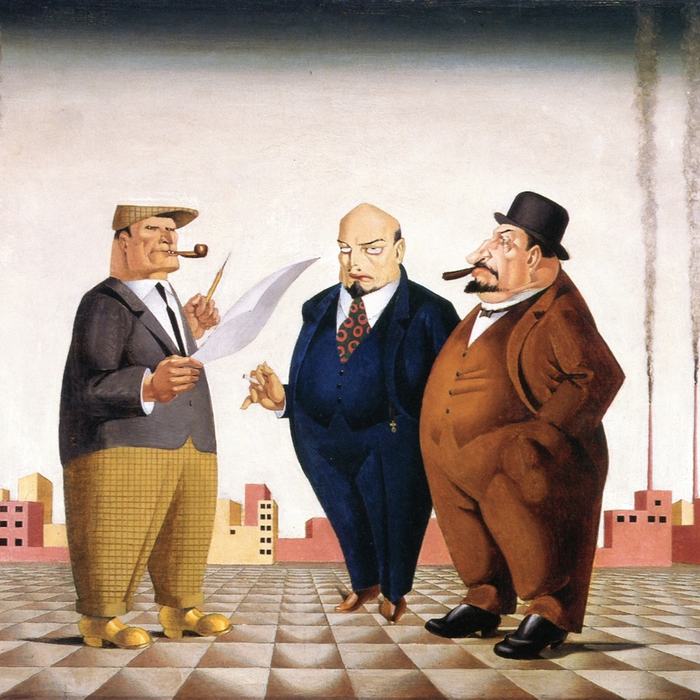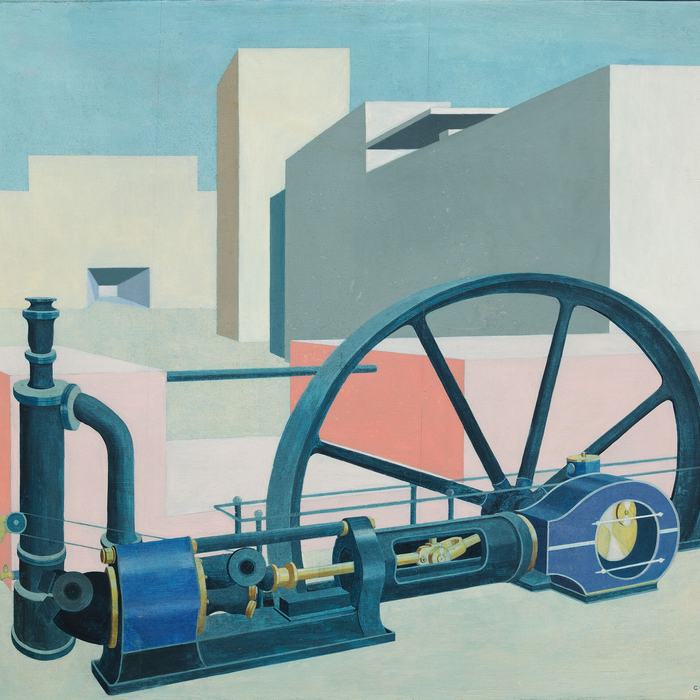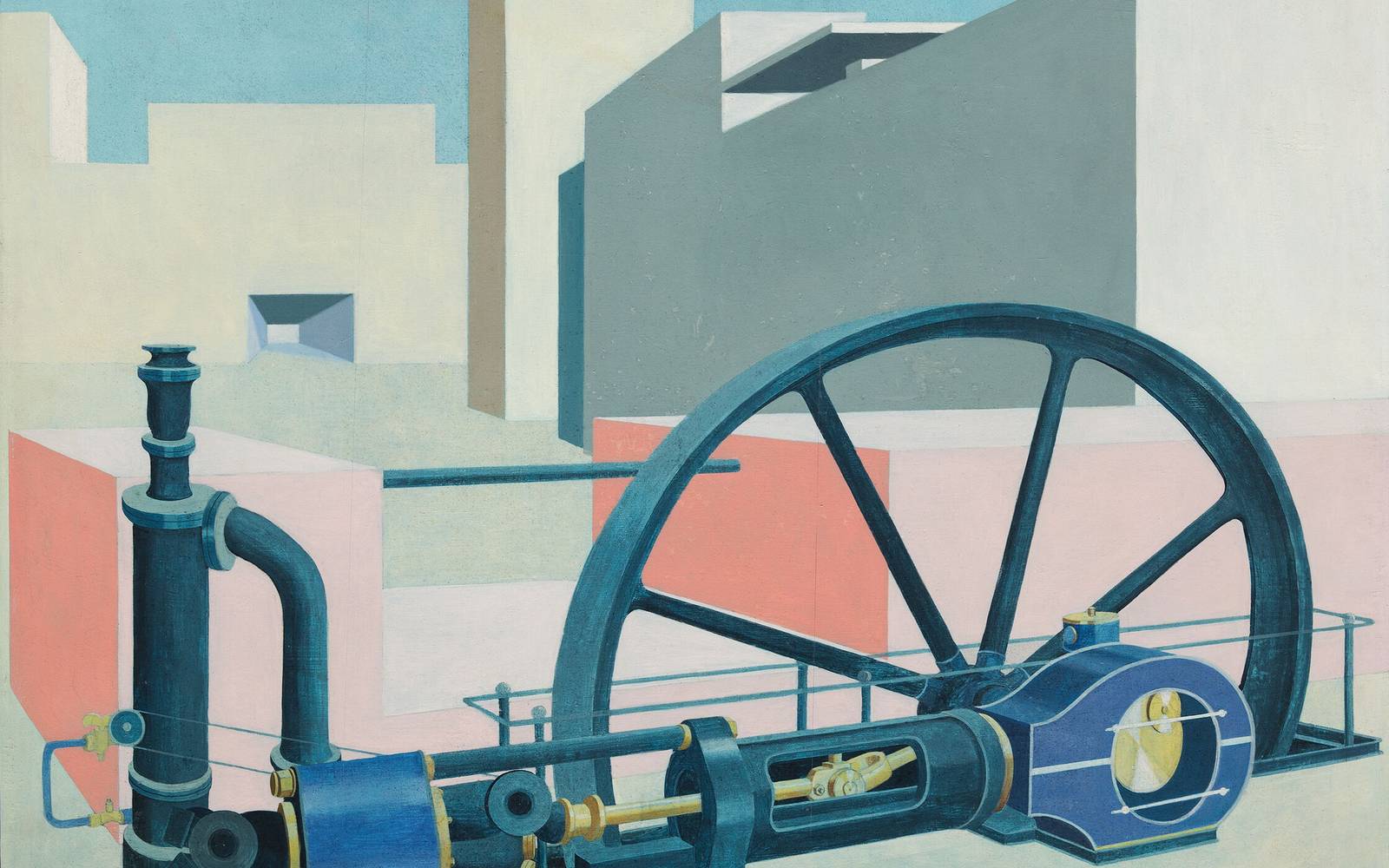
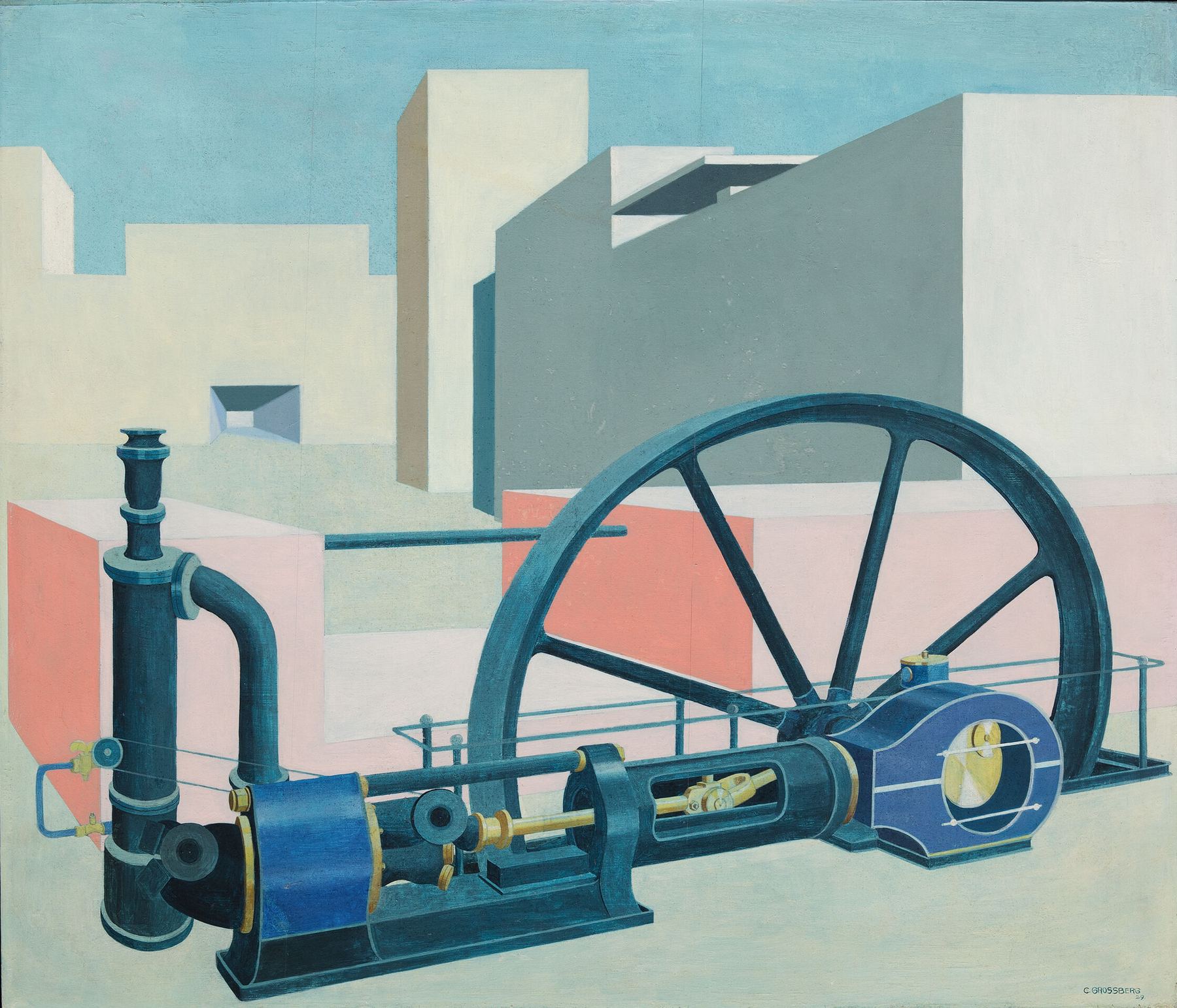
Image reference: Carl Grossberg’s Composition with Turbine.
At a Glance
- Core periodapproximately 1919–1933; named publicly by the Kunsthalle Mannheim exhibition of 1925.
- Principal countryGermany, with related realisms across central Europe and beyond
- Major centresBerlin, Dresden, Düsseldorf, Frankfurt, Karlsruhe, Cologne, Hannover and Munich.
- Key currentssocially critical Verism; classicising and neo-romantic realism; sharply descriptive photography; related rational approaches in architecture and design.
- Common subjectsportraits and social types, war veterans, city life, paid work, entertainment, still life, industrial landscape, plants, machines and modern housing.
- What it was nota single organisation, a politically unified front, neutral photographic copying or another name for every realist work produced in the Weimar Republic.
Contents
- Where it fits
- The 1925 exhibition
- Weimar conditions
- Otto Dix
- Portraiture
- Women and the canon
- The quiet current
- Photography
- Four stages
- Essential works
Where New Objectivity fits
August Sander
Key career periodAlexander Kanoldt
Key career periodMax Beckmann
Key career periodGeorg Schrimpf
Key career periodJeanne Mammen
Key career periodOtto Dix
Key career periodGeorge Grosz
Key career periodLotte Laserstein
Key career periodNew Objectivity was realism after confidence had broken down. Its painters returned to faces, rooms, streets, plants and manufactured things after the emotional intensity of Expressionism, but they did not return to innocence. A sharply painted person might be isolated inside a social role. A still life could feel more uncanny than a dream. A city might resemble an administrative machine. The very clarity of the image made reality difficult to escape.
The German name, Neue Sachlichkeit, carries more than “objectivity.” It also suggests sobriety, factuality and a matter-of-fact attention to things. Yet the artists did not form a group, sign a manifesto or agree politically. The name was supplied by a museum director for an exhibition in 1925, several years after the new realisms had begun. It gathered the ferocious social criticism of Otto Dix and George Grosz beside the suspended stillness of Alexander Kanoldt and Georg Schrimpf. Later writers extended the term into photography, design, architecture, literature and film.
That breadth is useful only if the differences remain visible. New Objectivity is best understood as a contested constellation of practices made during the Weimar Republic: approximately 1919 to 1933, with roots before and consequences after. Its central question was not whether art could copy the world accurately. It was what kind of truth a precise, controlled and often estranging image could extract from a damaged modern society.
A museum exhibition made the name
Gustav Friedrich Hartlaub, the young director of the Kunsthalle Mannheim, had an unusually durable curatorial success. In 1923 he sought artists who had remained faithful—or had returned—to concrete, palpable reality after the apparent exhaustion of Expressionism. His proposed exhibition was delayed, but Die Neue Sachlichkeit. Deutsche Malerei seit dem Expressionismus finally opened in Mannheim on 14 June 1925. A century later, the museum described the title as an epoch-making invention while revising the exclusions on which its authority rested.[1]
The exhibition contained 132 works by 32 artists. Its history is less stable than that number suggests. No installation photographs are known. Researchers have reconstructed the display through the printed catalogue, correspondence, reviews and individual object records; by November 2024 they had securely identified 112 of the paintings, while twenty remained known only by artist and title. What now looks like a settled movement therefore survives through an incomplete and continually interpreted archive.[2]
The checklist itself resists any narrow definition. It included Max Beckmann, Otto Dix, George Grosz, Heinrich Maria Davringhausen, Karl Hubbuch, Alexander Kanoldt, Carlo Mense, Anton Räderscheidt, Rudolf Schlichter, Georg Scholz and Georg Schrimpf, but also many artists far less familiar today. Portraits, still lifes, landscapes, interiors and figure paintings appeared together. Some objects were later destroyed or disappeared; others changed title or attribution. The surviving database exposes how museums turn temporary selections into historical categories—and how much such categories forget.[3]
Hartlaub proposed two broad currents. On one side stood a politically alert, socially critical realism, later commonly called Verism, associated most strongly with Grosz and Dix. On the other was a more classicising and neo-romantic art that looked towards the Renaissance, nineteenth-century German tradition and a stable order of bodies and things. The division was never a membership system. Individual artists moved, contradicted themselves or refused it altogether.
Nor did 1925 mark a clean beginning. Beckmann's postwar change of style, Grosz's Dada-inflected satires and Dix's pictures of damaged veterans were already established. Hartlaub supplied a memorable frame at a moment when the Republic seemed to be entering relative stability. The exhibition then travelled in altered versions, carrying the name beyond Mannheim even as its contents changed.
The centennial history also places German painting within a wider field. Related hard-edged realisms appeared in Austria, Switzerland, the Netherlands, Italy, Britain and the United States. That does not make Georgia O'Keeffe, Edward Hopper, Antonio Donghi or Niklaus Stoecklin members of a German movement. It shows that the postwar turn towards clear figuration had multiple national causes and that New Objectivity became both a precise German history and an elastic international comparison.[4]
One term, incompatible positions
The name succeeded partly because it could hold opposites. The Kunsthalle Mannheim's own collection history describes the label as disputed: it became shorthand for figurative art of the 1920s while covering different concepts. Museum purchases then reinforced the term. A curator's temporary proposition became an acquisition category, a gallery sequence and eventually an art-historical period.[5]
Unlike German Expressionism, whose best-known groups issued programmes and cultivated collective identities, New Objectivity was recognised from outside. The Lenbachhaus stresses that the artists did not select the name for themselves. Its collection places socially critical figures such as Schlichter, Schad and Hubbuch beside Munich painters influenced by the Italian journal Valori Plastici, including Schrimpf and Kanoldt. The shared quality is not ideology but renewed attention to the object, figure and visible world.[6]
Franz Roh complicated the terminology in the same year as Hartlaub's exhibition. His book Nach-Expressionismus: Magischer Realismus surveyed new European figurative painting and proposed “post-Expressionism” and “magic realism” as alternatives. Roh was interested in the mystery that could remain behind exactly rendered things. His geographical field was broader and his divisions differed from Hartlaub's. The two accounts overlap, but neither is simply a translation of the other.[7]
Even the phrase “after Expressionism” can mislead if it implies complete rejection. Dix retained violent distortion; Beckmann continued to compress bodies and space; Grosz's acid line owed much to prewar and wartime experiment. The turn was less a return to academic naturalism than a reassessment of what emotion, abstraction and utopian rhetoric could do after industrialised war and failed revolution.
The Deutsches Historisches Museum places the name's formation between Hartlaub's first use in 1923 and the Mannheim exhibition in 1925. By then Sachlichkeit described more than paintings. It named an attitude admired in writing, building, design and public conduct: sober, functional, anti-sentimental and responsive to immediate material life. Its spread explains the term's power but also its vagueness. An apartment plan and a satirical portrait can both be matter-of-fact without belonging to the same visual language.[8]
A republic between war and collapse
New Objectivity developed within Germany's first parliamentary democracy. The Weimar Republic emerged from military defeat and revolutionary upheaval in 1918–19. Its governments faced political violence from left and right, reparations, occupation, inflation and deep distrust. Stabilisation after 1923 encouraged investment and cultural expansion, but the system remained fragile; the global crash of 1929 intensified unemployment and helped turn radical parties into mass forces.[9]
These conditions entered art as more than subject matter. War-wounded men were present in streets, hospitals, welfare offices and public debate. Inflation destroyed savings and made previously secure identities unstable. Workers endured scarcity while profiteers displayed sudden wealth. Even during the so-called Golden Twenties, deprivation and precarious employment existed beside cinemas, nightclubs, sporting life, advertising and technological enthusiasm. A picture of a café, office or apartment could make incompatible experiences occupy the same room.[10]
Women gained the vote and became more visible in clerical, sales, domestic and industrial work. The “New Woman”—short-haired, employed, mobile, sexually self-aware—offered a compelling image of change. Yet she was neither typical nor fully free. Many women were pushed out of wartime jobs when soldiers returned; professional careers remained rare; wages and class restricted independence. Fashion magazines sold an emancipated appearance more readily than society delivered equal power.[11]
Modern mass culture intensified these contradictions. Illustrated newspapers, radio, film, advertising and urban entertainment circulated recognisable types at unprecedented speed. Germany developed one of the world's largest film industries; millions visited cinemas. The crash then transformed metropolitan confidence into mass anxiety, and cultural conflict sharpened as National Socialism expanded. The seizure of power in 1933 abruptly destroyed the Republic's plural institutional world.[12]
The art should not be treated as a transparent record of this history. A portrait is not a census photograph; a deformed body is not simply documentary evidence; an empty street does not prove universal alienation. New Objectivity artists selected, staged, exaggerated and classified. They made the age visible by remaking it.
Objectivity was an effect, not an absence of style
A major modern survey at LACMA joined painting, drawing, printmaking and photography in five thematic fields: the aftermath of war and life in democracy; city and landscape; still life and commodity; human and machine; and new identities and social types. That structure reveals recurring concerns without pretending that a photograph by August Sander and a painting by Dix operate identically.[13]
The artists shared no manifesto, common politics or single geography. Some attacked class hierarchy; some sought order; some observed without overt judgement; some shifted markedly across the decade. What connected them was a scepticism towards the inherited world and a renewed investment in legible things. “Objectivity” was a stance achieved through decisions about surface, scale, framing, focus, pose and distance.[14]
The period's realism repeatedly oscillates between inventory and judgement. A profiteer's desk can be described with meticulous care while the room's narrowing perspective makes him morally trapped. A worker may be rendered as an individual face and a social category. Industrial machinery can appear efficient, beautiful, indifferent or threatening. LACMA's close thematic account makes that conflict central: artists did not merely show modernity but tested how its new identities and mechanisms reorganised bodies.[15]
Hard edges are only the beginning. Painters revived tempera, glazing and detailed drawing associated with German and northern European old masters. They used those methods for monocles, cigarettes, prosthetic limbs, advertising, factory architecture and fashionable clothes. MoMA's compact history rightly makes portraiture central, yet also shows how precision can support incompatible effects: Beckmann's theatrical self-image, Dix's cutting physiognomy, Grosz's political type, Mammen's lighter urban observation and Kanoldt's classical calm.[16]
Museum taxonomies inevitably simplify. MoMA's current New Objectivity term page presents only a small group of online works by Beckmann, Dix, Grosz, Mammen and Scholz. The selection is useful and recognisable, but it also demonstrates how an enormous, regional and gender-unequal field becomes a few portable icons. Canon formation did not end with Hartlaub. Every collection label continues it.[17]
Works on paper sharpened the movement's critical languages. Drawing and print enabled rapid circulation, strong contrast and exact line; portfolios could address war, hunger and class more directly than expensive commissioned paintings. The Met's Weimar selection emphasises how professionals, performers, street figures and disabled veterans were subjected to an apparently clinical gaze. “Clinical,” however, must describe the artist's visual rhetoric—not the people as specimens.[18]
It is therefore more accurate to think in overlapping modes. Verism names incisive and sometimes savage social realism. The classicising current names stillness, lucid contour and dialogue with earlier art. New Objectivity photography prizes descriptive precision and typology. Magic Realism identifies the uncanniness that can inhabit exact representation. None alone defines the whole field, and the edges remain permeable.[19]
Follow New Objectivity through four stages
–23
Aftermath and competing new realisms
War, revolution and inflation sharpen socially critical images while other painters seek controlled figures, rooms and things after Expressionist utopianism.
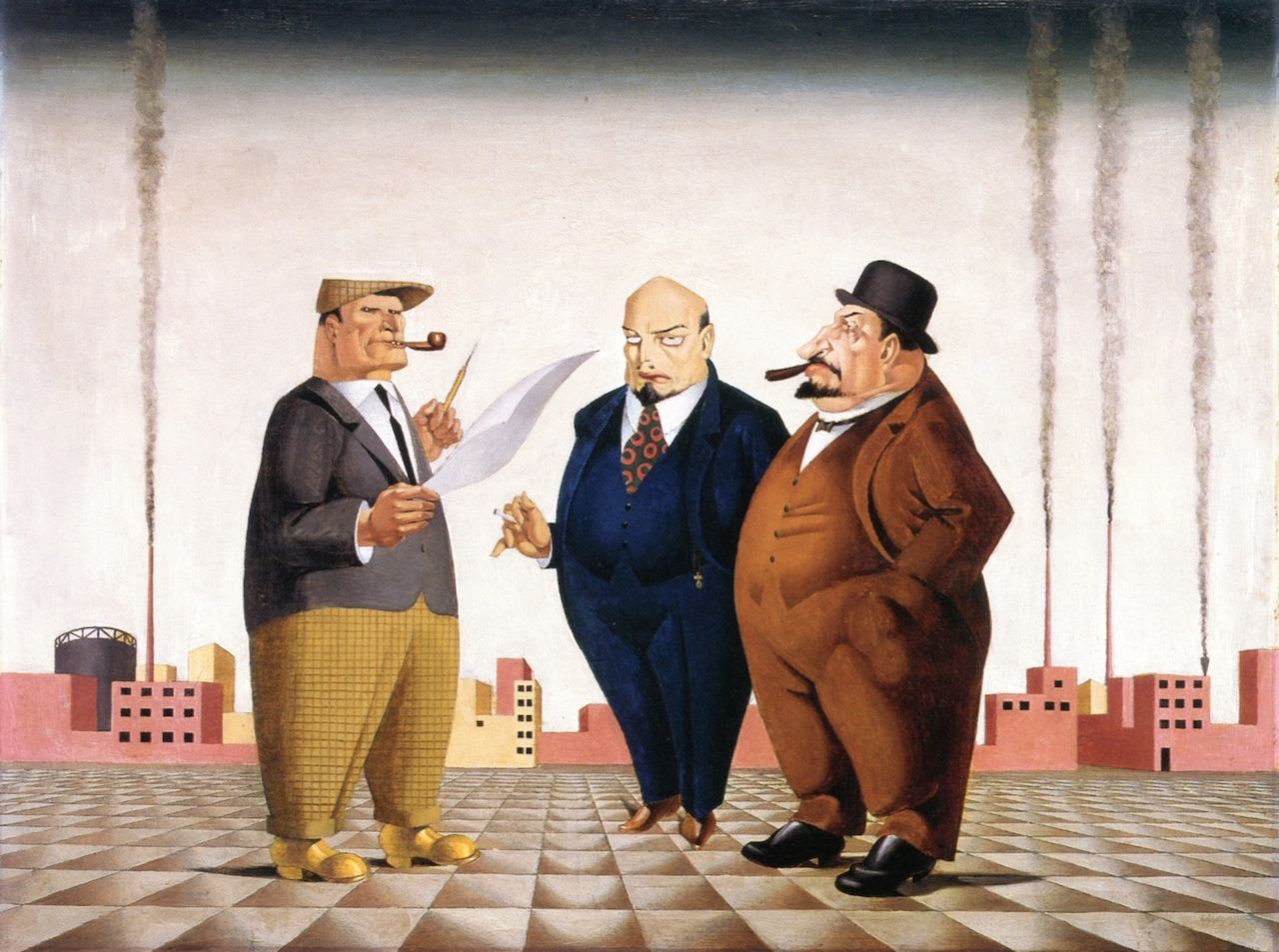
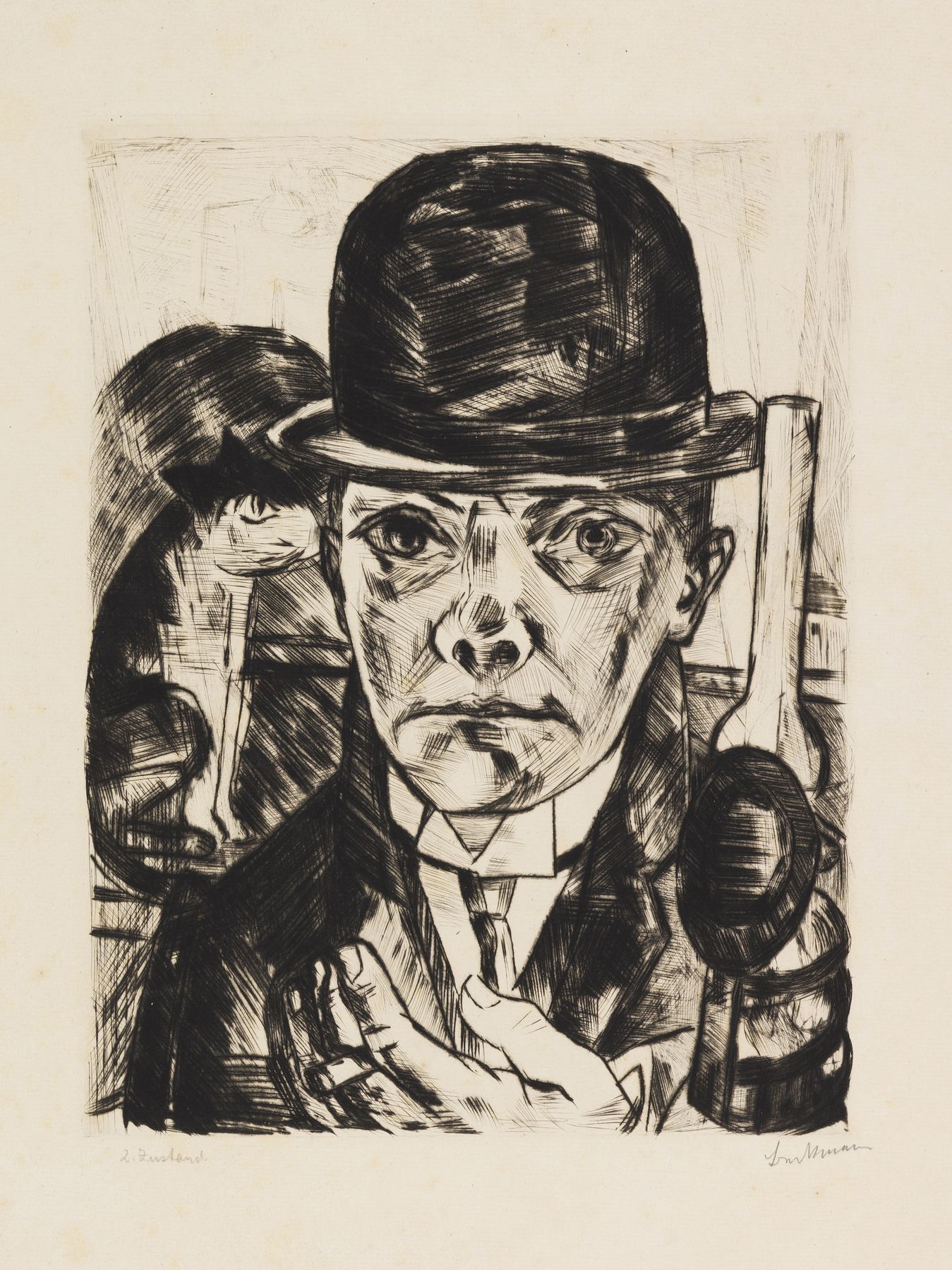
–25
Hartlaub names a divided tendency
The delayed Mannheim exhibition gathers incompatible verist and classicising positions, making a temporary curatorial proposal into a durable historical category.
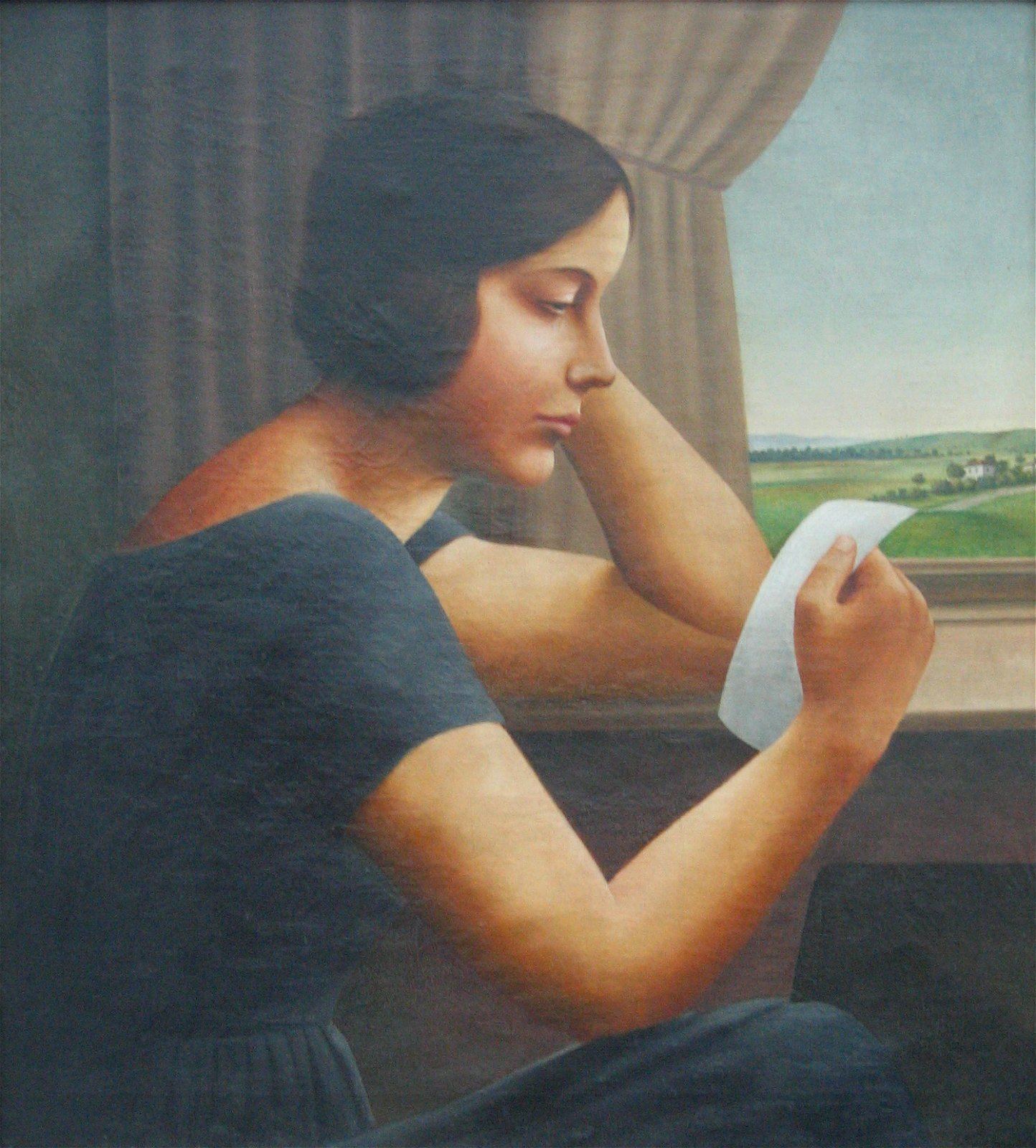
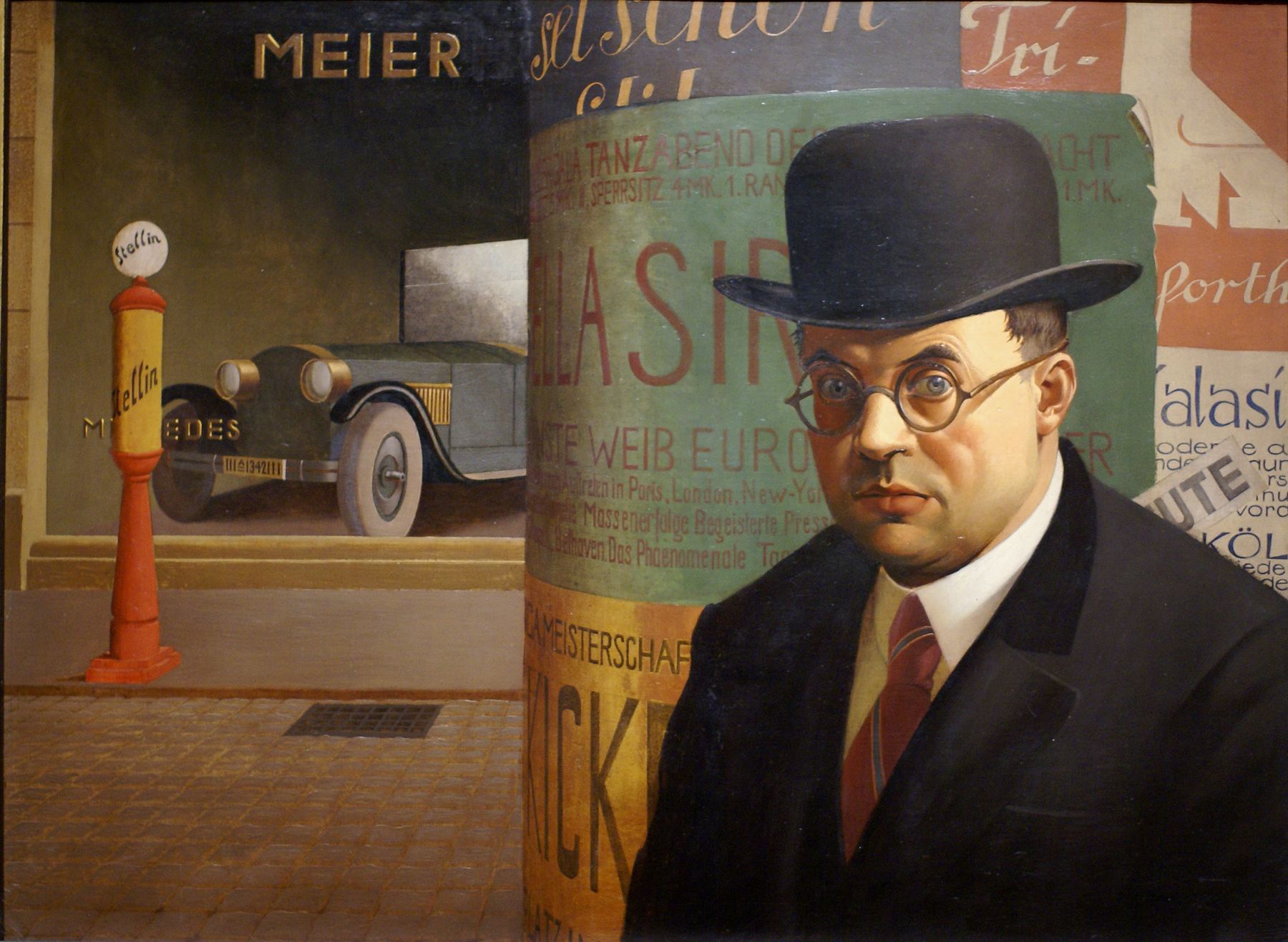
–29
Portrait, object and machine become systems
Portraiture, still life, photography, publishing and rational design expand objectivity into a wider debate about social types, commodities and modern vision.
–33
Crisis and political rupture
Economic collapse and radicalisation intensify the movement's contradictions before National Socialism destroys the plural institutions of Weimar culture.
Dix: the rebuilt body and the incriminating surface
Otto Dix had served as a machine gunner and experienced the Western Front directly. After the war, he did not turn trauma into solemn memorial alone. He combined Dada's attack on respectable culture with an obsessive return to bodies, uniforms, wounds and social display.
The Skat Players of 1920 shows three disabled veterans playing cards in a cramped interior. Their bodies are extended by prosthetic jaws, metal limbs, hearing devices and improvised mechanisms. Dix added real playing cards, newspaper and printed matter to oil paint, making collage correspond to bodies assembled from artificial parts. The alternative historic title uses language now recognised as demeaning; the museum preserves it as evidence but does not require its repetition as neutral description.[20]
The picture is uncomfortable because it does not offer easy pity. The men remain players, competitors and former officers; decorations and newspaper fragments keep military and civic systems present. Yet their bodies are also presented to viewers through extreme invention. The ethical task is to recognise Dix's attack on militarism and social abandonment without turning disability itself into the joke.
Space contributes to the aggression. Limbs and devices overlap the table's edge; faces become profiles of flesh, metal and card; the room gives almost no relief. The café is at once ordinary and impossible. Mass-produced prostheses promise reintegration while making the state's damaged citizens look mechanically replaceable.
His later war works prove that New Objectivity was not a brief escape from memory. The 1924 print portfolio Der Krieg uses etching and drypoint to revisit trenches, corpses, bombed ground and the routines of survival. The great triptych War, completed around 1932, places a devastated battlefield within a format associated with Christian altarpieces. Historic technique and religious structure become means of refusing heroic commemoration.
Grosz: administration as class violence
George Grosz attacked the Republic's officers, industrialists, nationalist politicians and complacent bourgeoisie with a line developed through caricature, Dada and political print culture. He often reduced people to types, but the reduction was purposeful: the businessman, official and worker are roles produced by a system that makes genuine relation nearly impossible.
In Grey Day of 1921, an official responsible for disabled-war-veteran welfare passes a thin veteran, while a worker recedes behind a wall. The painting's original Mannheim catalogue title named the bureaucratic office directly. Grosz renders the foreground figures with knife-like specificity, but the background people become near-automatic types. The brick barrier does not merely illustrate class division; it constructs a world in which administration perpetuates it.[21]
Every relation is blocked. The official looks away. The veteran and worker occupy different spatial systems. Perspective seems plausible until one follows walls and paving into their contradictions. A pipe crosses the composition like an institutional diagram. The grey atmosphere is therefore not weather alone. It is the colour of a society whose procedures recognise suffering while refusing solidarity.
Grosz could be much more explicit. In drawings and portfolios, brothel clients feast while labourers begin work; generals, clerics and politicians become swollen machines of appetite. The rapid reproductive line mattered politically. An image printed in a magazine or portfolio could enter public argument differently from a unique canvas in a collector's room.
Yet satire carries its own violence. Grosz's women—especially sex workers—can be treated as embodiments of corruption rather than people navigating a commercial city. His bodies often disclose the misogyny and sexual anxiety of the culture they attack. Political opposition does not automatically make every representation ethically clear.
Portraits that turn people into roles
Portraiture became New Objectivity's most recognisable genre because the face could carry a contradiction between individual and type. Sitters were named journalists, doctors, dealers, poets, dancers, lawyers and industrialists. The profession, clothing and interior often seem to speak as loudly as physiognomy. A portrait can preserve a likeness while asking how much of a person is already made by social expectation.
Dix's Portrait of the Journalist Sylvia von Harden of 1926 is one of the movement's defining images. Harden sits alone in the Romanische Café, smoking beside a cocktail. Bobbed hair, monocle, angular body and public independence identify a modern intellectual woman. Dix used oil and tempera on wood and drew on Cranach, Holbein and other sixteenth-century masters. The old technique makes the contemporary type unnervingly durable.[22]
Nothing in the image is casual. The checked dress expands into a red geometry; a laddered stocking interrupts the controlled surface; elongated fingers hold cigarette and hip; the small round table isolates glass, matchbox and case like still-life specimens. Harden's body is folded into a shallow corner whose perspective feels invented around her.
The picture has often been celebrated as an image of female emancipation, but its gaze is not simply admiring. Dix said he wanted to paint someone representative of the epoch. That desire turns Harden into evidence. Her intelligence is staged through monocle, cigarette and café; her body is exaggerated and exposed to scrutiny. To see only the New Woman icon is to repeat the typification that makes the work so compelling and uncomfortable.
Dix's lucid portrait manner had been formed through a rapid transition. During his Düsseldorf years, enormous labour and ambition carried him from expressive, Dada-inflected Verism towards the precise style most closely identified with New Objectivity. Thin layers, hard outlines and old-master methods did not soften the judgement. They slowed it down, allowing costume, skin, furniture and gesture to become exact social evidence.[23]
Christian Schad brought a different temperature. After Dada experiments and years in Italy, his portraits acquired an enamel-like surface. Skin, silk, glass, hair and distant architecture are rendered with comparable sharpness, yet proximity rarely produces intimacy. The sitters appear connected by money, desire or encounter while remaining psychologically sealed.[24]
In Count St. Genois d'Anneaucourt, an aristocratic man stands between two feminine-presenting figures. Older accounts used blunt historical labels for gender nonconformity; a current reading should not treat identity as a visual diagnosis. What the painting gives us is an ambiguous triangle. Glances do not meet, hands hover, translucent fabric and distant city view turn social contact into theatrical display. The count's title, clothing and central position do not secure authority.[25]
Schad's Self-Portrait with Model is more explicitly intimate and no less estranged. The artist faces the viewer while a nude model lies behind him. His transparent shirt displays rather than protects; a narcissus and a scar-like facial mark disturb the polished surface. The figures share a bed but not an emotional world. Exactitude makes sexuality colder, because every detail is available while motive remains withheld.[26]
Max Beckmann's place in the category is historically secure and aesthetically unstable. Hartlaub exhibited him, and later museums repeatedly named him a leading figure, but Beckmann never submitted his crowded symbolic art to a doctrine. In Self-Portrait with a Cigarette, he performs bourgeois command in suit and hard frontal pose. A partly hidden clown accessory punctures the authority, turning the self into a role being tried on.[27]
Beckmann preferred an art of compressed tragedy and “transcendent objectivity.” His portraits and interiors can be sharply drawn, but their spaces buckle under metaphor, theatre and myth. The Thyssen's account of Quappi in Pink Jumper rightly calls him an isolated case with affinities to New Objectivity rather than a compliant practitioner. That qualification improves the category: historical inclusion need not erase artistic independence.[28]
Berlin was precise because it was unstable
Berlin supplied cafés, studios, offices, department stores, transport, pressrooms, dance halls and street crowds. It was also a city of housing shortage, poverty, political violence and extreme difference. Artists learned to organise this density through isolation. A figure might be cut away from neighbours by a table edge; an apartment could become a stage; an empty street might feel more socially charged than a crowd.
The Berlinische Galerie calls the capital the “most objective” European metropolis, borrowing critic Paul Westheim's phrase while warning that the art only appeared objective. Proportion and colour were frequently distorted; symbolic backgrounds intensified the message. Behind the cool surfaces of Dix, Grosz, Mammen and Schad stood alienation and crisis. Photography likewise did not simply reproduce the city: it selected new professional, advertising and journalistic realities.[29]
The urban image circulated between fine art and commercial media. Painters saw fashion plates, crime photographs, advertisements and film stills. Illustrators brought the economies of magazine drawing into exhibition art. A single person could be a real sitter, recognisable profession, consumer type and symbol of a political condition.
This is why the movement's emptiness matters. New Objectivity rooms often contain objects too sharply separated to make a home. Streets channel people past one another. Windows display distance rather than escape. Precision does not reconcile the city; it maps the gaps by which metropolitan life continues.
The women Hartlaub did not exhibit
Hartlaub's 1925 exhibition included no women. That absence was not evidence that women failed to produce the period's decisive realisms. It was the result of education, professional access, collecting and curatorial selection. The centennial revision places Lotte Laserstein, Jeanne Mammen, Grethe Jürgens, Kate Diehn-Bitt and Anita Rée near the centre, changing not only the list of artists but the meaning of portraiture and social observation.
Laserstein achieved substantial recognition in late Weimar Berlin. She trained formally, opened a studio and received portrait commissions. Her realism moves between distance and sympathy, exact drawing and sustained bodily presence. National Socialist racial classifications progressively barred her from public artistic life; an exhibition in Stockholm enabled her to leave Germany with important works in 1937. Her later Swedish career continued, but exile fractured the conditions under which the Weimar paintings had flourished.[30]
Traute Rose was Laserstein's model, collaborator and friend. Their long working relationship matters when looking at the female nude. Male New Objectivity painters often made naked women signs of sexual commerce, danger or exposure. Laserstein's nudes do not escape looking, but the studio relation is visible as work. The model's unidealised body, rest and concentration can replace theatrical availability with familiarity between two professional women.[31]
In Evening over Potsdam, five young people gather around a table above a broad landscape. The composition recalls a modern Last Supper without assigning a saviour. Each figure is physically present and emotionally separate; a meal has ended, but no shared conversation seems able to begin. The image anticipates political disaster only from hindsight. In its own moment, uncertainty is already formal: gazes diverge, hands pause and the city lies distant below.
Jeanne Mammen made Berlin's women visible in streets, cafés, cabarets and periodicals. Her watercolours can be witty, tender or severe, attentive to same-sex sociability and economic vulnerability without turning every encounter into Grosz-like caricature. She kept distance from named movements and group ideology. Under National Socialism, commercial possibilities contracted and she developed increasingly private, experimental work rather than preserving one recognisable Weimar style.[32]
The larger portrait history reveals how artists fused physiognomy with social type. The doctor is surrounded by professional instruments; the worker's clothes and posture announce labour; the “New Woman” is built from haircut, cigarette, sport or office fashion. Recent Stuttgart scholarship restores women artists who helped construct and question these types. Their work shows that gender was not a subject added to portraiture. It was one of the systems by which portraiture made individuals socially legible.[33]
Grethe Jürgens developed within Hannover's art and commercial networks. She trained in graphic art and worked as an advertising draughtswoman while painting workers, poor residents, city edges and intimate portraits. Her cool distance differs from both verist accusation and Munich classicism. After 1933 she registered with the official chamber, shifted towards less politically exposed plant and landscape subjects, and later moved between figuration and abstraction. Adaptation cannot be reduced to either resistance or endorsement.[34]
Kate Diehn-Bitt's self-portraits insist on the identity of the working artist. Her career, begun amid the openings of the Republic, was obstructed by a National Socialist ban on painting. Postwar East Germany did not comfortably absorb her into official Socialist Realism, and she became part of a “lost generation” repeatedly marginalised by changing systems. Her recent recovery demonstrates that exclusion can happen more than once.[35]
Anita Rée, Gerta Overbeck, Alice Lex-Nerlinger, Hanna Nagel, Elfriede Lohse-Wächtler and others further unsettle the old canon. They should not be made to share one “female gaze.” Their politics, subjects, training and careers differ. What joins them is that the absence of women from 1925 no longer determines who counts as an author of the period.
Still life, landscape and the quiet current
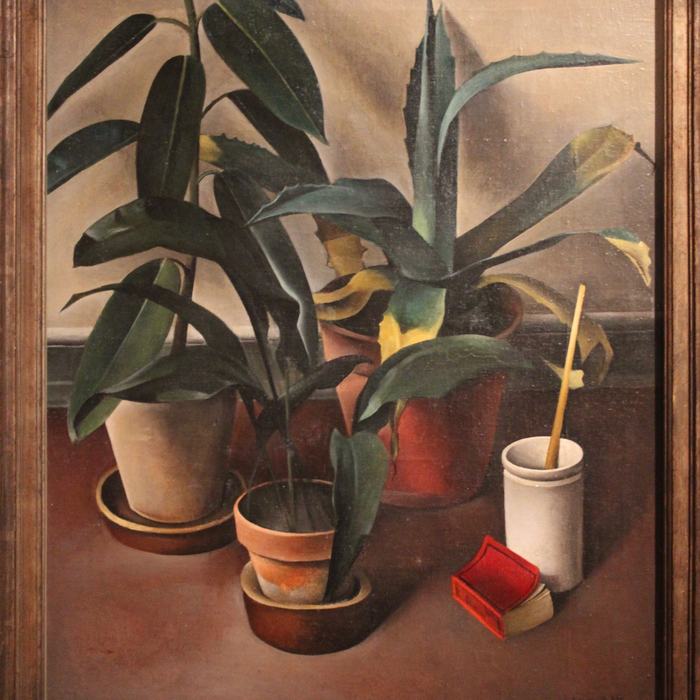
The classicising side of New Objectivity is often described as if it merely avoided politics. That is too simple. After war and revolutionary failure, stillness could offer retreat, discipline, estrangement or a wish for durable order. A cactus, plaster head or southern town might be rendered with such exact separation that the ordinary becomes uncanny.
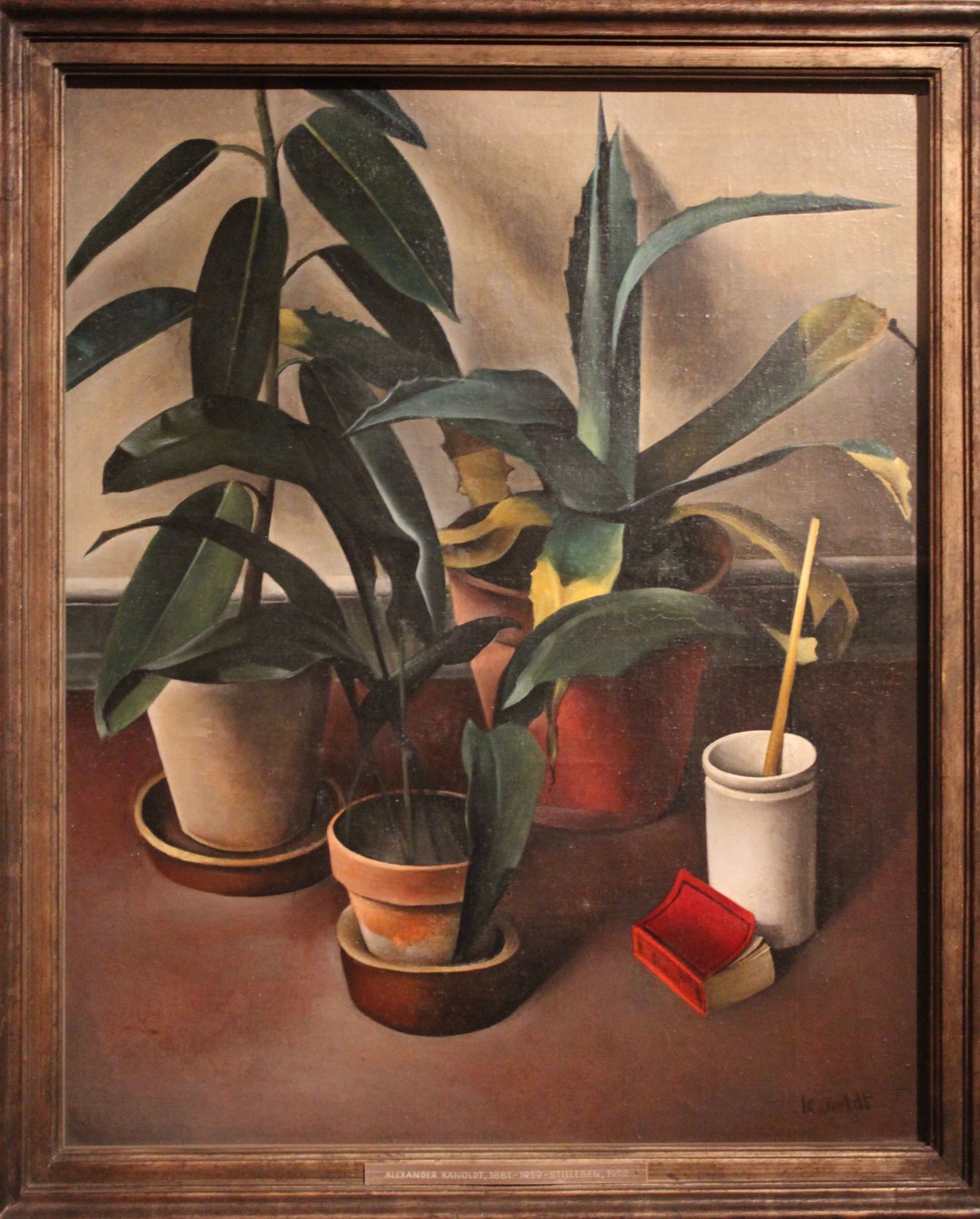
Alexander Kanoldt constructed still lifes from firm contours, shallow tabletops and carefully spaced vessels, plants and boxes. The objects look self-contained, yet their room rarely settles into coherent perspective. Italian landscapes likewise join architectural clarity with suspended time. Influence from early Renaissance painting and Valori Plastici gives modern things an older gravity.
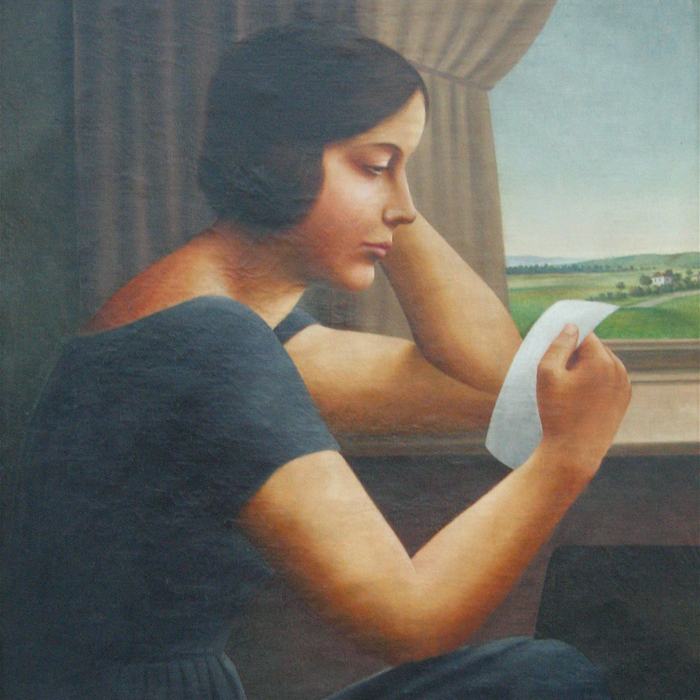
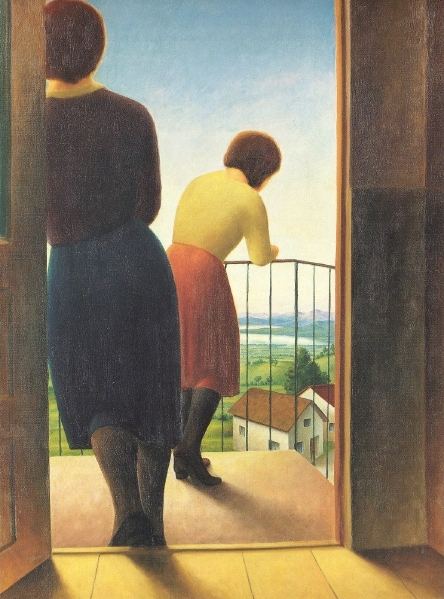
Georg Schrimpf's figures often appear calm, frontal and self-possessed. In Girl Reading at a Window, the absorbed sitter offers no metropolitan scandal and little access to inner life. The Renaissance-derived stability can feel restorative, but also sealed off. Silence is not the absence of historical meaning; it is one response to a period saturated with claims and noise.
The 1925 exhibition's lesser-known works make this range tangible. Iwan Babij's Still Life with Abacus crops almost every object, leaves the centre oddly vacant and uses table, chair and calculating device to build competing linear systems. A scene of plain things becomes spatially elaborate. Its “objectivity” lies not in faithful inventory but in making relation itself visible.
Landscapes by Franz Radziwill, Carl Grossberg and others bring modern infrastructure into fields, ports and towns. Machinery may be painted with crisp admiration while its scale empties the human world. A factory can look like a new cathedral, an alien organism or a precise arrangement of volumes. The movement's politics reside as much in relations of scale and occupancy as in declared satire.
Photography and the desire to classify
Photography seemed ideally suited to an age that valued exact description, but New Objectivity photography was not an automatic truth machine. Lens, distance, focus, lighting, crop, sequence and caption all shape what appears factual.
August Sander conceived People of the Twentieth Century as a comprehensive portrait of German society. He arranged sitters within seven major groups and numerous portfolios: farmer, skilled tradesman, woman, classes and professions, artist, city and “last people.” A pastry cook, secretary, farmer or intellectual appears with a directness that seems egalitarian. Yet the classificatory structure is Sander's interpretation, and captions often replace names with occupational or social types.[36]
The project is powerful because individuals resist the system designed to contain them. Clothes, hands, rooms and expressions support the category while exceeding it. Three young farmers on their way to a dance look like a rural type, but their suits, canes and angled stances create a singular encounter. A radio secretary represents modern clerical work while meeting the lens with a presence no label exhausts.
Albert Renger-Patzsch argued that photography should respect the thing itself. His tightly cropped, sharply focused images of plants, industrial structures and manufactured goods give texture and edge exceptional authority. The Sapling isolates a delicate tree against thawing ground; description becomes an image of regeneration without soft focus or painterly mist.[37]
His 1928 book Die Welt ist schön placed nature, materials, architecture and mass-produced objects in a sequence of visual comparisons. The title can sound complacent beside Weimar suffering, but the project is not simply cheerful. It proposes that a foxglove, iron shoe, machine component and blast furnace deserve the same concentrated attention. Publication and sequence make a philosophy from individual photographs.[38]
Karl Blossfeldt enlarged botanical specimens until stems, seed heads and tendrils resembled towers, ornaments and engineered joints. Urformen der Kunst, also published in 1928, moved teaching photographs into an international visual culture of typology. The plant is documented, but magnification alters its scale and meaning. Objective detail becomes formal astonishment.[39]
Aenne Biermann photographed plants, eggs, household arrangements, children and modern figures with equal care. Her career contradicts histories in which technical photography belongs to men while women supply domestic subject matter. Domestic objects can become exact studies of weight and interval; a child's face can be as rigorously framed as a machine.
New Objectivity photography is often contrasted with Neues Sehen, or New Seeing. The former tends towards frontal description, sharp focus and respect for recognisable objects. The latter favours steep angles, photograms, montage, disorientation and the reinvention of vision. In practice, exhibitions and books placed them together, and artists crossed the line. MoMA's study of the period shows Renger-Patzsch's precision entering debate with Bauhaus experimentation rather than existing in a separate world.[40]
The distinction remains useful because it reveals two ideas of photographic modernity. One trusts the camera to disclose structure already in things; the other uses it to generate sights ordinary vision cannot supply. Both depend on technique and selection. Neither is innocent observation.
Architecture made objectivity inhabitable
The 1925 Mannheim exhibition concerned painting, not architecture. Yet the wider culture of Sachlichkeit became material in Neues Bauen and especially Neues Frankfurt. Under city architect Ernst May, Frankfurt coordinated planning, building, landscape and interior design. Between 1925 and 1930 the programme produced around 12,000 dwellings, replacing dense tenement ideals with light, air, green space and standardised construction.[41]
The achievement was social as well as formal. Municipal authority, architects, engineers and designers treated decent housing as infrastructure. Repeated components reduced cost and accelerated construction. Settlements were planned with transport, gardens and shared facilities. Modern life appeared not as luxury décor but as an administrative project.
Margarete Schütte-Lihotzky's Frankfurt Kitchen condensed domestic work into a small, carefully sequenced room. Storage, preparation and movement were measured to reduce labour. The kitchen remains a landmark of design intelligence, particularly because domestic work—largely performed by women—was treated as a serious spatial problem.
Efficiency also carried discipline. Plans extended into cupboards, gardens, sheds and recommended patterns of use. Residents were expected to inhabit modernity correctly. The Deutsches Architekturmuseum's account makes this ambivalence clear: standardisation answered urgent need while planners imagined themselves as educators of a “new person.” Objectivity could provide freedom from overcrowding and prescribe everyday behaviour at the same time.[42]
The relationship to Paul Klee at the Bauhaus is therefore one of proximity and difference. Bauhaus teaching included abstraction, workshop experiment and theories of perception that exceed functional sobriety. Yet its products, typography and buildings entered the same public argument about rational modern life. New Objectivity was not Bauhaus realism; both belonged to a culture testing how art and design might organise the visible world.
Clothes, magazines and the manufactured modern self
The modern type did not begin on the easel. Fashion magazines, advertisements and illustrated newspapers taught readers how a secretary, sportswoman, gentleman, dancer or intellectual should look. Clothes made new identities portable and legible.
Jeanne Mammen worked for Berlin periodicals and understood this machinery from within. Her fashion illustrations helped create glamorous New Women, while later drawings could expose the exhaustion or failed mobility behind the image. Commercial work was not a lesser activity outside her art. It trained speed, silhouette, gesture and awareness of how viewers consume a social type.[43]
Men were similarly refashioned. The lounge suit, athletic body, cigarette and controlled pose offered alternatives to imperial uniform and patriarchal bulk. Beckmann's self-images, Schad's aristocrats and Dix's professionals all use tailoring as psychological architecture. A jacket can be armour, advertisement or costume.
Objects complete the social performance. Monocle, telephone, radio, cocktail glass, surgical instrument and office machine identify a person before expression does. New Objectivity pictures are crowded with things not because the artists trusted objects more than people, but because modern identity had become inseparable from possession, profession and display.
Magic Realism: exact things, withheld mystery
New Objectivity is sometimes described as the opposite of fantasy. Its most compelling pictures make that division impossible. A cactus rendered leaf by leaf can feel sentient. An empty square becomes ominous because nothing visibly supernatural occurs. A face is so available that the person's inner life disappears.
Roh's “magic realism” named this persistence of mystery behind the world. It should be distinguished from the later literary tradition and from Surrealism. Surrealists often mobilised dream, automatism and startling conjunction; Roh began with precisely visible reality and asked why it remained strange. Artists such as Max Ernst deliberately transformed found imagery into impossible encounters, while a New Objectivity still life could produce unease without breaking the laws of the room.
The terms overlap most strongly in Schrimpf, Kanoldt, Radziwill and other painters whose clarity suspends ordinary time. Hartlaub emphasised an attitude to palpable reality; Roh emphasised the secret that did not dissolve when the thing was described. Keeping both accounts allows the movement's cool surface to retain its metaphysical pressure.
1933: persecution, exile, withdrawal and compromise
The National Socialist seizure of power destroyed the institutions that had allowed the constellation to exist. Hartlaub was dismissed from the Kunsthalle Mannheim. Teachers lost posts; artists classified as Jewish were excluded; left-wing and antiwar work was attacked; museums were purged; books were burned. The public culture in which competing realisms could argue was replaced by coercive racial and political control.
Dix lost his professorship at the Dresden Academy in 1933. The regime condemned his antiwar and socially critical art, and his work appeared in the 1937 “Degenerate Art” campaign. He retreated to Lake Constance and painted landscapes while continuing to work within constrained conditions. That biography should not be romanticised as pure inner emigration, but the institutional punishment is unequivocal.[44]
Grosz anticipated the danger and left for the United States shortly before Hitler took power. His satirical books were among the works burned in 1933. Exile saved him from direct repression but disrupted the audience, political environment and visual language that had made his Berlin art effective. The critic of German militarism had to rebuild a career for American patrons.[45]
Beckmann lost his Frankfurt teaching position and later left Germany for Amsterdam. Laserstein's racial classification forced her from public life and then into Swedish exile. Mammen remained but abandoned much of the realism for which she had been known. Other artists adjusted subjects, joined official organisations, withdrew or found that precise rural and family imagery could coexist with aspects of Nazi taste.
This last point prevents a comforting moral map. The regime rejected New Objectivity as a plural culture, particularly its urban, critical and allegedly “degenerate” forms. Yet it could appropriate hard contour, traditional technique and monumental rural types for blood-and-soil ideology. Style alone does not prove resistance or collaboration. The political history belongs to particular acts, exclusions and accommodations.
The date 1933 is therefore an essential ending and an incomplete one. It ends the Weimar institutional field. It does not make every artist stop painting in the same manner on the same day. Some visual languages survived after their public meaning had been transformed.
How to look at New Objectivity
Begin with the surface. Is the paint thin and glazed, thick and abrasive, mixed with collage, or smoothed until touch seems absent? Old-master technique may intensify a modern cigarette, prosthesis or machine. A photographic print may be sharply focused yet heavily dependent on crop and sequencing.
Then test the space. Follow walls, tabletops and windows rather than accepting the first impression of realism. Does perspective narrow around a profiteer? Does a café corner trap its sitter? Are objects isolated so decisively that the room cannot become comfortable? Distortion is often most powerful where the image appears factual.
Examine the relation between person and type. A portrait may name the sitter while making profession, class, gender or sexuality visually dominant. Ask which details individualise and which classify. Consider whether the person can resist the role being constructed.
Look at things as agents. Clothing, furniture, plant, prosthesis, factory and domestic tool are not background. They arrange bodies and identify social possibilities. In photography, the same attention may place a machine part and botanical specimen within one visual order.
Notice what “coldness” does. Distance can enable criticism, respect, cruelty, desire, concealment or control. Laserstein's restraint is not Schad's, and Mammen's is not Grosz's. Emotional quiet should not be mistaken for emotional absence.
Finally, ask who made the category. Was the artist in Hartlaub's exhibition? Added by later historians? Excluded by gender or geography? Known mainly through a museum purchase or retrospective? New Objectivity is not only a style visible on a canvas. It is a century of exhibitions deciding which forms of realism belong together.
Why New Objectivity still matters
Postwar art history initially privileged abstraction, and many New Objectivity artists became difficult to see. Renewed exhibitions from the 1960s onward restored Dix, Grosz and Schad, sometimes at the cost of narrowing the field around aggressive male portraiture. Later projects have recovered regional schools, photography, architecture and women whose careers were interrupted or omitted.
The movement's photographic legacy is especially durable. Sander's social archive and the exact industrial studies of Renger-Patzsch and Blossfeldt provided important precedents for Bernd and Hilla Becher and the later Düsseldorf School. Typology, seriality and apparent neutrality became central methods of postwar photography, carrying forward the same question: whether classification merely describes a world or imposes an order upon it.
The realism also feels contemporary because it distrusts transparency. We live among profile photographs, occupational labels, data categories, fashion types and images that claim to document. New Objectivity teaches that the harder an image insists on facts, the more carefully we should inspect its frame.
Its best works do not solve the Republic's contradictions. They make those contradictions visible in surfaces that refuse consolation: lucid and theatrical, factual and uncanny, socially exact and ethically unstable. The movement remains valuable not because it offers an objective view of Weimar Germany, but because it shows objectivity being built.
Essential New Objectivity works
Composition with Turbine
Carl Grossberg · 1929 · Grossberg makes industrial machinery monumental and strangely unoccupied, turning precise description into a study of technological scale and power.
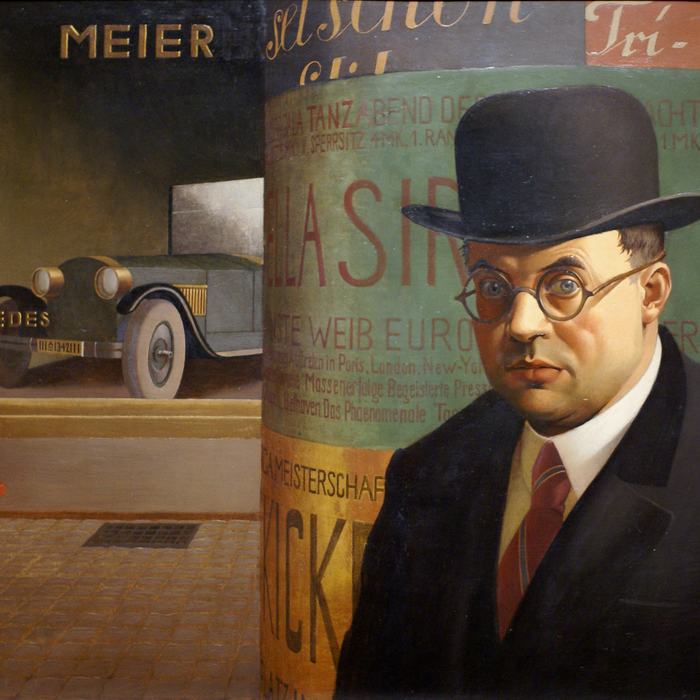
Self-Portrait in Front of an Advertising Column
Georg Scholz · 1926 · Scholz places professional self-fashioning against advertising and urban print culture, making the modern artist another public type.
Of Things to Come
Georg Scholz · 1922 · A controlled, hard-edged interior makes social expectation and technological promise feel both lucid and faintly threatening.
Still Life I
Alexander Kanoldt · 1926 · Kanoldt separates pots, leaves and tabletop so firmly that the objects become overpresent while the shallow room refuses stable perspective.
Martha
Georg Schrimpf · 1925 · Schrimpf uses frontal calm, absorbed reading and Renaissance-derived balance to make quietness an active response to modern noise.
On the Balcony
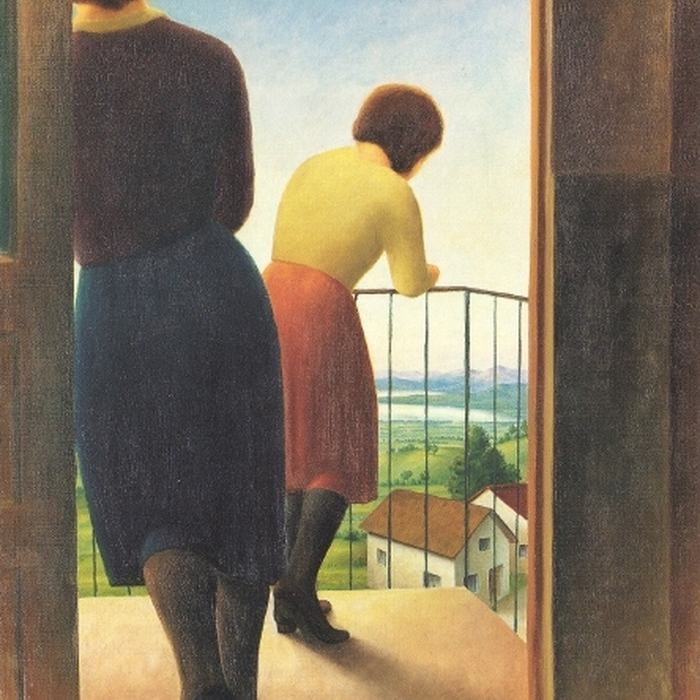
Georg Schrimpf · 1927 · The poised figure, lucid contour and suspended architecture show how the classicising current could make modern life feel deliberately timeless.
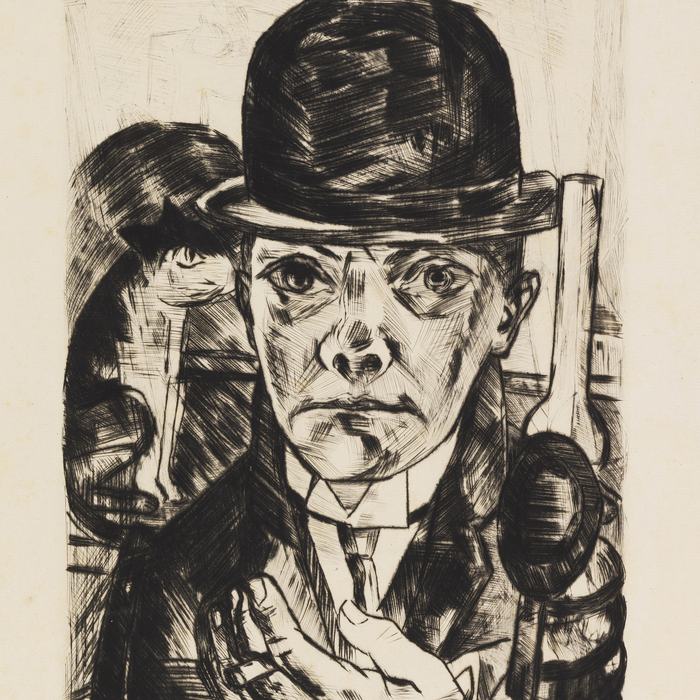
Self-Portrait with Bowler Hat
Max Beckmann · 1921 · Beckmann's commanding pose behaves like a mask, combining exact self-description with theatrical authority and psychological compression.
Where to see New Objectivity
Displays, loans and access arrangements change. Check current information before travelling.
- 01
Kunsthalle Mannheim
the essential starting point for Hartlaub's 1925 exhibition, its digital reconstruction, collection history and centennial revision.
Mannheim, Germany
The defining 1925 exhibition, reconstruction and centennial revisionVisit official website - 02
Neue Nationalgalerie and Berlinische Galerie, Berlin
together they connect Dix and Grosz with Berlin's broader histories of Mammen, Laserstein, photography, fashion and metropolitan culture.
Berlin, Germany
Dix, Grosz, Mammen, Laserstein, photography and metropolitan cultureVisit official website - 03
Kunstmuseum Stuttgart
strong Otto Dix holdings and recent exhibitions that place portraiture, social type, gender and marginalised women in direct conversation.
Stuttgart, Germany
Otto Dix, portraiture, social types and recovered women artistsVisit official website - 04
Lenbachhaus, Munich
especially valuable for Kanoldt, Schrimpf and the classicising current, as well as the boundary between New Objectivity and Magic Realism.
Munich, Germany
Kanoldt, Schrimpf and the classicising / Magic Realist boundaryVisit official website - 05
Museum Folkwang, Essen
an important setting for Renger-Patzsch, interwar photography, graphic design and the debate between objective description and New Seeing.
Essen, Germany
Renger-Patzsch, interwar photography and graphic designVisit official website - 06
Städel Museum, Frankfurt
Beckmann's Frankfurt years and Laserstein's work open different forms of realism, self-fashioning and gendered looking.
Frankfurt, Germany
Beckmann's Frankfurt period and Laserstein's gendered realismVisit official website - 07
Centre Pompidou, Paris
Dix's Portrait of the Journalist Sylvia von Harden and Schad's Count St. Genois d'Anneaucourt allow close comparison of two defining portrait modes.
Paris, France
Dix's Sylvia von Harden and Schad's defining portrait modeVisit official website - 08
Leopold Museum, Vienna
its recent Splendor and Misery project surveys German New Objectivity through painting, works on paper, photography and political history.
Vienna, Austria
A broad New Objectivity survey across media and political historyVisit official website
Suggested books
- Inge Herold and Johan Holten, eds., Die Neue Sachlichkeit / The New Objectivity: Ein Jahrhundertjubiläum / A Centennial. The most current reconstruction of the 1925 exhibition, expanded through women, international parallels, collection history and the movement's afterlife.[46]
- Stephanie Barron and Sabine Eckmann, eds., New Objectivity: Modern German Art in the Weimar Republic, 1919–1933. A substantial English-language survey that brings painting, photography and works on paper into thematic and theoretical dialogue.[47]
- Sabine Rewald, Glitter and Doom: German Portraits from the 1920s. The focused account of Verist portraiture, with object studies that connect named sitters, social types, technique and the metropolitan culture of Weimar Germany.[48]
- Hans-Peter Wipplinger, ed., Splendor and Misery: New Objectivity in Germany. A broad bilingual catalogue attentive to war, politics, gender, pleasure, poverty and the movement's many German regional voices.[49]
- August Sander und die Neue Sachlichkeit der 1920er Jahre. A photography-led handbook that places Sander's social typology beside the broader culture of precise seeing in the 1920s.[50]
Major artists associated with New Objectivity
| Name | Nationality | Key Works |
|---|---|---|
| Otto Dix | German | The Skat Players · Portrait of the Journalist Sylvia von Harden · Der Krieg |
| George Grosz | German | Grey Day · The Pillars of Society |
| Max Beckmann | German | Self-Portrait with a Cigarette · Quappi in Pink Jumper |
| Christian Schad | German | Count St. Genois d'Anneaucourt · Self-Portrait with Model |
| Alexander Kanoldt | German | Still Life I · Cactus Still Life |
| Georg Schrimpf | German | Martha · On the Balcony |
| Georg Scholz | German | Self-Portrait in Front of an Advertising Column · Of Things to Come |
| Karl Hubbuch | German | Double Portrait Hilde II · The Swimmer of Cologne |
| Rudolf Schlichter | German | Margot · Portrait of Bertolt Brecht |
| Anton Räderscheidt | German | House No. 9 · Self-Portrait |
| Heinrich Maria Davringhausen | German | The Profiteer · The Dreamer II |
| Carlo Mense | German | Self-Portrait with Cane · Italian landscapes |
| Franz Radziwill | German | harbour scenes · industrial landscapes |
| Carl Grossberg | German | Composition with Turbine · The Belts |
| Iwan Babij | Ukrainian-German | Still Life with Abacus |
| Lotte Laserstein | German-Swedish | Evening over Potsdam · Self-Portrait with Cat |
| Jeanne Mammen | German | At the Shooting Gallery · Revue Girls |
| Grethe Jürgens | German | workers and unemployed sitters · Hannover city edges |
| Kate Diehn-Bitt | German | Self-Portrait with Hat · professional self-portraits |
| Anita Rée | German | Self-Portrait · White Trees in Positano |
| Gerta Overbeck | German | The Engagement · working-class portraits |
| Alice Lex-Nerlinger | German | Paragraph 218 · Working Women |
| Hanna Nagel | German | An Idea Is Born · self-portraits |
| Elfriede Lohse-Wächtler | German | Lissy · Self-Portrait |
| August Sander | German | Young Farmers · Pastry Cook |
| Albert Renger-Patzsch | German | The Sapling · The World Is Beautiful |
| Karl Blossfeldt | German | Acanthus mollis · Urformen der Kunst |
| Aenne Biermann | German | Eggs · Rubber Plant |
| Heinrich Hoerle | German | Worker · Self-Portrait |
| Franz Wilhelm Seiwert | German | Demonstration · Mass |
Frequently Asked Questions
No. Its artists did not share membership, a manifesto or one political position. Gustav Friedrich Hartlaub created the name while organising a museum exhibition. It is most useful as a historical umbrella for several related but conflicting realist practices.
The new German realisms developed after the First World War, around 1919. Hartlaub proposed the name in 1923 and opened the defining Mannheim exhibition in 1925. The naming event should not be mistaken for the first moment artists changed direction.
The German phrase suggests a new objectivity, sobriety or matter-of-fact attention to things. No English translation captures every shade. The term signalled a turn away from Expressionist inwardness towards palpable reality, but it never meant neutral copying.
Verism is the socially incisive and often satirical current associated with artists such as Dix, Grosz, Hubbuch, Schlichter and Scholz. It uses precise or exaggerated realism to expose class, war, sexuality and hypocrisy. It is one current within New Objectivity, not a synonym for the whole movement.
Hartlaub identified a more classicising or neo-romantic tendency represented by artists such as Kanoldt and Schrimpf. Its still lifes, figures and landscapes often seek order, clarity and suspended time through dialogue with Renaissance and nineteenth-century art.
No, although they overlap. Franz Roh used Magic Realism in 1925 for a broad European post-Expressionist painting in which mystery remains behind precisely rendered things. New Objectivity became the dominant term for Weimar German realism and includes more direct social criticism.
He was included in Hartlaub's 1925 exhibition and is repeatedly associated with the movement. He nevertheless remained independent, using compressed symbolic space and theatrical self-fashioning that exceed its familiar hard-edged formulas. “Associated with” is more accurate than “member of.”
Portraits allowed artists to hold an identifiable person against a social type. Profession, clothing, gender, class and setting could appear as strongly as facial likeness. The tension between individual and category is one of New Objectivity's central achievements.
Yes, although Hartlaub included none in 1925. Laserstein, Mammen, Jürgens, Diehn-Bitt, Rée, Overbeck and others made major contributions. Recent scholarship has shown that their work changes how we understand portraiture, labour, urban life and gendered looking.
No. Sander, Renger-Patzsch, Blossfeldt and Biermann used focus, framing, enlargement, sequence and classification to construct meaning. Their images respect visible detail, but “objectivity” remains an artistic and institutional effect.
New Objectivity photography generally favours sharp focus, recognisable things and descriptive precision. New Seeing favours unusual angles, montage, photograms and perceptual experiment. The approaches overlapped in exhibitions, publications and individual careers, so the boundary is a spectrum.
The Nazi seizure of power destroyed the democratic institutions and plural culture that supported it. Artists were dismissed, persecuted, exiled or forced to adapt. Some precise realist forms continued, but the political and institutional constellation of Weimar New Objectivity no longer existed.
Discussion
Which form of New Objectivity feels least neutral to you: Dix's repaired veterans, Grosz's bureaucratic city, Schad's polished intimacy, Laserstein's collaborative gaze, Sander's social categories or Renger-Patzsch's exact things? Look for the moment when description becomes an argument.
Reader Insights
Ask how glazing, hard contour, collage, focus or enlargement constructs the picture’s apparent factuality.
Notice when clothing, profession, gender, class or setting begins to classify a named sitter.
Identify what the artist, caption, exhibition and later museum category include—and what each leaves outside.
Join the Conversation
Which apparently objective image makes the strongest argument, and which visual decision reveals that argument most clearly?
References
- Die Neue Sachlichkeit: Ein Jahrhundertjubiläum, Kunsthalle Mannheim (German; consulted in German), View Source
- Neue Sachlichkeit 1925, Kunsthalle Mannheim (German; consulted in German), View Source
- Werke aus der Ausstellung, Kunsthalle Mannheim (German; consulted in German), View Source
- The 1920s and the New Objectivity, Kunsthalle Mannheim, View Source
- Fokus Sammlung: Neue Sachlichkeit, Kunsthalle Mannheim (German; consulted in German), View Source
- Neue Sachlichkeit, Lenbachhaus (German; consulted in German), View Source
- After Expressionism, Lenbachhaus, View Source
- Neue Sachlichkeit, Deutsches Historisches Museum LeMO (German; consulted in German), View Source
- Weimarer Republik 1918–1933, Deutsches Historisches Museum (German; consulted in German), View Source
- Alltagsleben, Deutsches Historisches Museum LeMO (German; consulted in German), View Source
- Die Neue Frau, Deutsches Historisches Museum LeMO (German; consulted in German), View Source
- Kunst und Kultur, Deutsches Historisches Museum LeMO (German; consulted in German), View Source
- New Objectivity: Modern German Art in the Weimar Republic 1919–1933, Los Angeles County Museum of Art, View Source
- New Objectivity: An Overview, Stephanie Barron / LACMA, View Source
- New Objectivity media advisory, Los Angeles County Museum of Art, View Source
- German Expressionism Styles: New Objectivity, Museum of Modern Art, View Source
- Neue Sachlichkeit (New Objectivity), Museum of Modern Art, View Source
- German Drawings and Prints from the Weimar Republic, Metropolitan Museum of Art, View Source
- Neue Sachlichkeit (New Objectivity), National Galleries of Scotland, View Source
- Die Skatspieler, Staatliche Museen zu Berlin (German; consulted in German), View Source
- Grauer Tag, Staatliche Museen zu Berlin (German; consulted in German), View Source
- Portrait of the Journalist Sylvia von Harden, Centre Pompidou (French and English; consulted in French and English), View Source
- Otto Dix – Der böse Blick, Kunstsammlung Nordrhein-Westfalen, View Source
- Christian Schad and the Neue Sachlichkeit, Neue Galerie New York, View Source
- Count St. Genois d'Anneaucourt, Centre Pompidou (French and English; consulted in French and English), View Source
- Christian Schad Self-Portrait, Smarthistory, View Source
- Max Beckmann Self-Portrait with a Cigarette, Museum of Modern Art, View Source
- Quappi in Pink Jumper, Museo Nacional Thyssen-Bornemisza, View Source
- Die sachlichste aller Europäischen Großstädte, Berlinische Galerie (German; consulted in German), View Source
- Nachlass Lotte Laserstein, Berlinische Galerie (German; consulted in German), View Source
- Der weibliche Blick, Städel Museum (German; consulted in German), View Source
- Jeanne Mammen: Die Beobachterin, Berlinische Galerie (German; consulted in German), View Source
- Sieh Dir die Menschen an!, Kunstmuseum Stuttgart (German; consulted in German), View Source
- Grethe Jürgens: Retrospektive, Sprengel Museum Hannover (German and English; consulted in German and English), View Source
- Kate Diehn-Bitt: KünstlerinSEIN, Kunsthalle Rostock (German; consulted in German), View Source
- August Sander: People of the Twentieth Century, Metropolitan Museum of Art, View Source
- Albert Renger-Patzsch: The Sapling, Metropolitan Museum of Art, View Source
- Selected works from the exhibition, Museum of Modern Art, View Source
- Karl Blossfeldt: Urformen der Kunst, Metropolitan Museum of Art, View Source
- Modern Photographs: Thomas Walther Collection preview, Museum of Modern Art, View Source
- Neuer Mensch neue Wohnung, Deutsches Architekturmuseum (German; consulted in German), View Source
- Neuer Mensch neue Wohnung press information, Deutsches Architekturmuseum (German; consulted in German), View Source
- Images in Fashion Clothing in Art, Berlinische Galerie, View Source
- Otto Dix, United States Holocaust Memorial Museum, View Source
- Georg Grosz, United States Holocaust Memorial Museum, View Source
- 100 Jahre Neue Sachlichkeit, Deutscher Kunstverlag (German; consulted in German), View Source
- New Objectivity catalogue advisory, Los Angeles County Museum of Art, View Source
- Glitter and Doom: German Portraits from the 1920s, Sabine Rewald / Metropolitan Museum of Art, View Source
- Splendor and Misery: New Objectivity in Germany, Leopold Museum, View Source
- August Sander und die Neue Sachlichkeit der 1920er Jahre, Schirmer/Mosel Verlag (German; consulted in German), View Source
- New Objectivity / Neue Sachlichkeit image records, Wikimedia Commons: Composition with Turbine (Public domain mark / PD-Art; Harvard Art Museums, Busch–Reisinger Museum / Wikimedia Commons), Self-Portrait in Front of an Advertising Column (Public domain mark / PD-Art; Staatliche Kunsthalle Karlsruhe / Wikimedia Commons), Of Things to Come (Public domain mark / PD-Art; Wikimedia Commons), Still Life I (Public domain mark / PD-Art; reproduction released CC0; Neue Nationalgalerie / Wikimedia Commons), Martha (Public domain mark / PD-Art; Pinakothek der Moderne / Wikimedia Commons), On the Balcony (Public domain mark / PD-Art; Kunstmuseum Basel / Wikimedia Commons), Self-Portrait with Bowler Hat (Public domain mark / PD-Art; Wikimedia Commons).