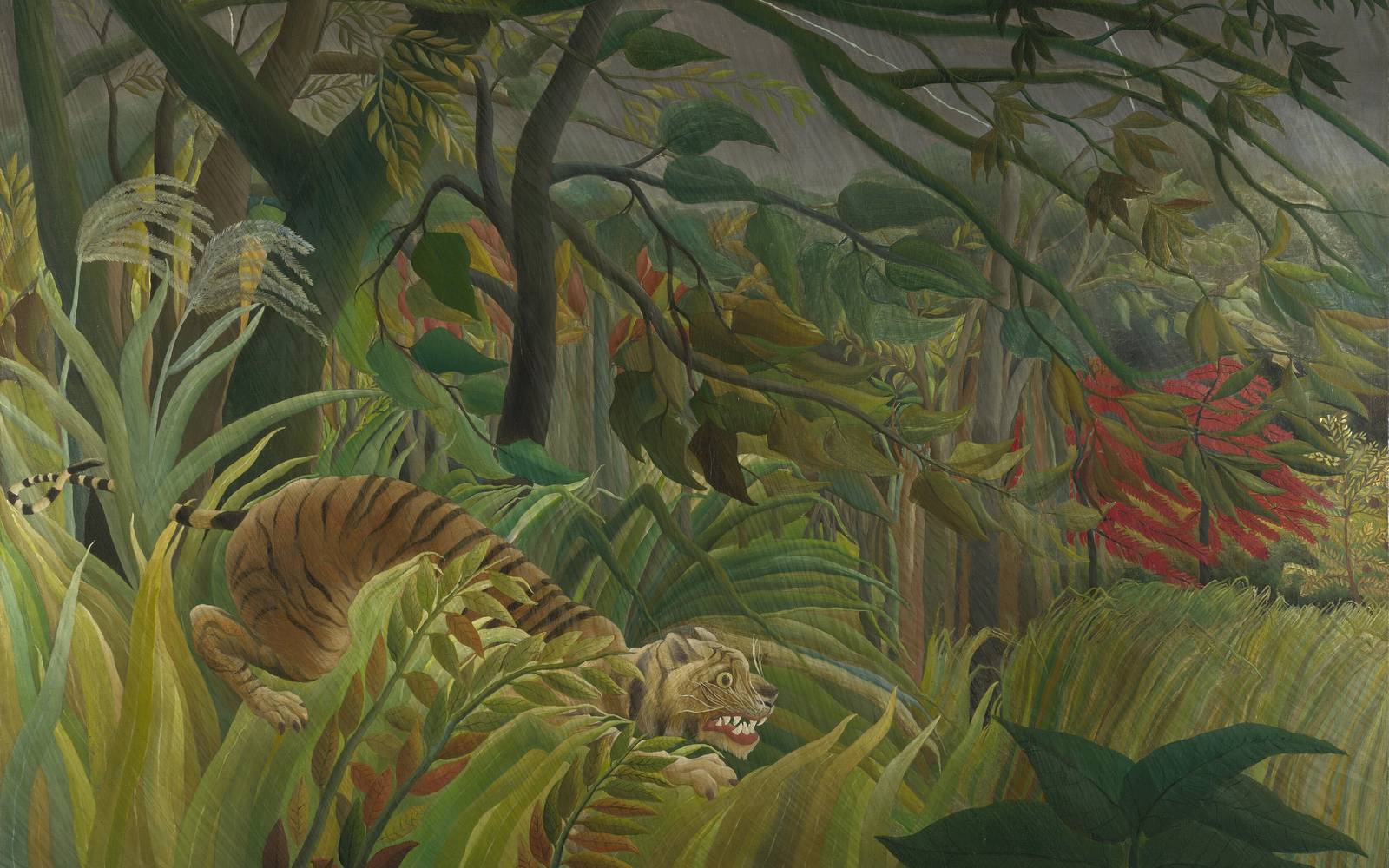
Image reference: Henri Rousseau’s Surprised!.
At a Glance
- What it isa contested international category centred on distinctive artists outside sustained academic or professional art-school training
- Useful periodfrom Rousseau's public emergence in the 1880s through the international institutions of the mid-twentieth century, with living traditions continuing today
- Major centresParis and northern France; Hlebine in Croatia; Kovačica in Serbia; Tbilisi and Kakheti in Georgia; St Ives in Britain; New York and the American Northeast; Port-au-Prince; and important fields across Brazil and Latin America
- Common possibilitiesflattened or tilted space, emphatic contour, patterned surface, narrative scale, unusual supports, memory, local observation, printed imagery and occupational knowledge
- What it is nota synonym for every self-taught artist, folk art, Art Brut, outsider art, children's art or a deliberately naïve-looking style by a trained painter
Contents
- Where it fits
- A contested name
- Self-taught and learning
- Henri Rousseau
- Four stages
- The French constellation
- Hlebine and Kovačica
- Pirosmani and Wallis
- Essential works
- Artist directory
Where Naïve Art fits
Henri Rousseau
Key career periodAlfred Wallis
Key career periodNiko Pirosmani
Key career periodSéraphine Louis
Key career periodGrandma Moses
Key career periodAndré Bauchant
Key career periodCamille Bombois
Key career periodIvan Generalić
Key career periodNaïve Art is easy to recognise until one looks closely. Its paintings are said to have bright colour, flattened space, sharp outlines, crowded detail and uncertain perspective. Its artists are said to be untaught, instinctive and innocent. Yet none of those qualities is universal, and several are actively misleading. The name does not describe an organised movement whose members signed a manifesto or agreed on a style. It records the way museums, dealers and critics grouped distinctive artists who developed outside sustained academic training—and the fascination, condescension and commercial desire that accompanied that grouping.
That history matters because the art is anything but a record of not knowing. A maritime scene by Alfred Wallis compresses decades at sea into the shape of a piece of cardboard. A flower painting by Séraphine Louis accumulates patient strokes until the surface seems to breathe. Niko Pirosmani lets the black of cheap oilcloth become depth, night and outline. Ivan Generalić plans a picture backward on glass. Henri Rousseau transforms the plants, animals and imperial spectacles of Paris into jungles that never existed. Their pictures ask us to see learning wherever it occurred—not only inside an academy.
A useful name that cannot be innocent
When the Museum of Modern Art revisited its own history of “popular painting,” it listed the language once used for artists beyond professional training: naïves, amateurs, self-taught artists, folk or popular artists, Sunday painters and “primitives.” Its earlier director Alfred H. Barr Jr. acknowledged that none was satisfactory. The list reveals less about a single kind of picture than about an art world trying to name people it had placed beyond its normal borders.[1]
The National Gallery of Art has shown how unstable those borders are. Trained avant-garde artists repeatedly admired autodidacts and persuaded museums to exhibit them, yet inclusion often preserved a hierarchy: the modernist remained at the centre, while the maker who supposedly embodied authenticity remained an “outlier.” Terms such as folk, primitive, visionary, naïve and outsider could celebrate difference and quietly qualify importance at the same time.[2]
“Naïve” is retained here because it has a real exhibition, publishing and museum history. It connects Rousseau with the French painters championed between the wars, Croatian Naiva, Haitian painting and specialised collections in Laval, Nice and Zagreb. But it should never be mistaken for a diagnosis. It does not mean childish, mentally simple, culturally untouched or incapable of technical thought.
Even the familiar visual description needs revision. The museum in Laval warns that Naïve Art has been masked by the prejudice that it consists of sweet pictures, good feelings, joy and soft landscapes. Its figurative languages can be geometrically controlled, erotically charged, politically violent, devout, melancholic or uncanny.[3] Bright colour may appear, but so may grey cities, winter earth and black grounds. A tilted table may hold more narrative information than a conventionally receding one. A giant figure may be large because the person's importance, not measurable distance, governs the picture.
Self-taught does not mean without teachers
It helps first to keep neighbouring categories separate. Folk art commonly describes work embedded in inherited community forms, workshops or useful objects, although definitions vary by country and institution. Art Brut has a narrower history. Jean Dubuffet developed the concept after 1945 while collecting work by psychiatric patients, prisoners and other makers he believed resistant to established cultural approval; his collection and claims became the foundation of the Lausanne museum.[4] “Outsider art” began as an English equivalent and later expanded. Neither term is an automatic replacement for Naïve Art.
“Self-taught” is often the least patronising description available, although it names an educational route rather than a style. MoMA's own term record stretches from Rousseau and Bill Traylor to Frida Kahlo, Janet Sobel and Jean-Michel Basquiat—artists no responsible history would turn into one movement.[5] People learn by looking, repeating, repairing, remembering, trading, reading and asking. An academy is only one place where that happens.
Primitivism is different again. It describes strategies by trained modern artists who projected ideas of origin, directness or renewal onto non-Western, prehistoric, folk or self-taught art. A schooled artist can deliberately flatten perspective or imitate a child's drawing; that is better called faux-naïf or primitivising. The difference is not whether the picture looks polished. It is how the artist learned, worked, circulated and understood the practice.
Nor was any maker sealed from culture. Wallis knew ships as tools, risks and moving structures. Morris Hirshfield knew fabric and footwear. Séraphine knew church ornament, domestic interiors and plants. Hlebine painters taught one another. Haitian artists knew Vodou ritual, Catholic images, local craft and national debates. The myth of “no influence” usually means that art history has failed to identify the relevant influences.
When modern artists chose simplicity
The boundary with primitivism is especially important because the same wall can hold pictures that arrived at flatness by very different routes. Paul Gauguin was not naïve in the historical sense. He knew museums, dealers, exhibitions and the arguments of contemporary painters, and he consciously rejected naturalistic modelling in favour of bounded colour, symbolic arrangement and an idea of origins. His simplicity was selected and theorised. The colonial places and peoples onto whom he projected that search cannot be converted into evidence that he had escaped European culture.
The same distinction applies to Cubism. Picasso and Braque reworked Cézanne, Iberian sculpture, African objects and the accumulated problems of European painting. Their fractures of space were made from inside an intensely informed avant-garde network. A face that appears mask-like or a table that refuses one viewpoint does not make a Cubist canvas naïve. Formal resemblance cannot erase formation, power or purpose.
This is why the famous 1908 banquet in Rousseau's honour must be read in both directions. Picasso and his circle genuinely admired a painter whose work enlarged their sense of what modern art could do. They also enjoyed performing the encounter between bohemian sophistication and the older “innocent.” Rousseau was the guest, but younger artists controlled much of the story that survived. His reported response—placing himself and Picasso together as the greatest modern painters—cuts through the joke. He did not understand himself as their charming opposite.
Deliberate faux-naïf practice later became widespread in illustration, theatre design, advertising and painting. It may use blunt contour, emblematic figures, toy-like cities or a supposedly uncorrected line to claim humour, intimacy or resistance to polish. Such work can be compelling. Calling it Naïve Art, however, confuses a chosen aesthetic with the institutional conditions that shaped Rousseau, Séraphine, Pirosmani, Wallis or Generalić.
The distinction is not a purity test. A self-taught artist can study reproductions, accept advice, refine a marketable style and become fully professional without losing the history of the practice. Conversely, an art-school graduate does not become naïve by hiding learned perspective. What matters is not whether influence exists, but how knowledge, access and authority were distributed—and who benefited from describing another artist as naturally free.
Rousseau wanted a place in art history
Rousseau remains the category's essential starting point because his career exposes its contradictions. He began exhibiting publicly in his forties, copied works in the Louvre, admired official painters and pursued recognition through the jury-free Salon des Indépendants. The Musée de l'Orangerie's recent research emphasises not a contented amateur but an ambitious artist who borrowed the prestige of history painting, allegory and official portraiture while developing a practice that many contemporaries mocked as naïve.[6]
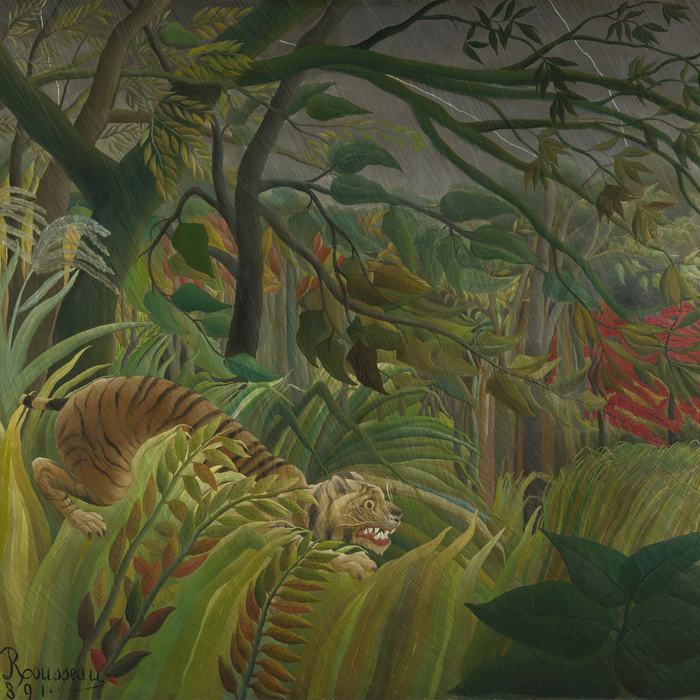
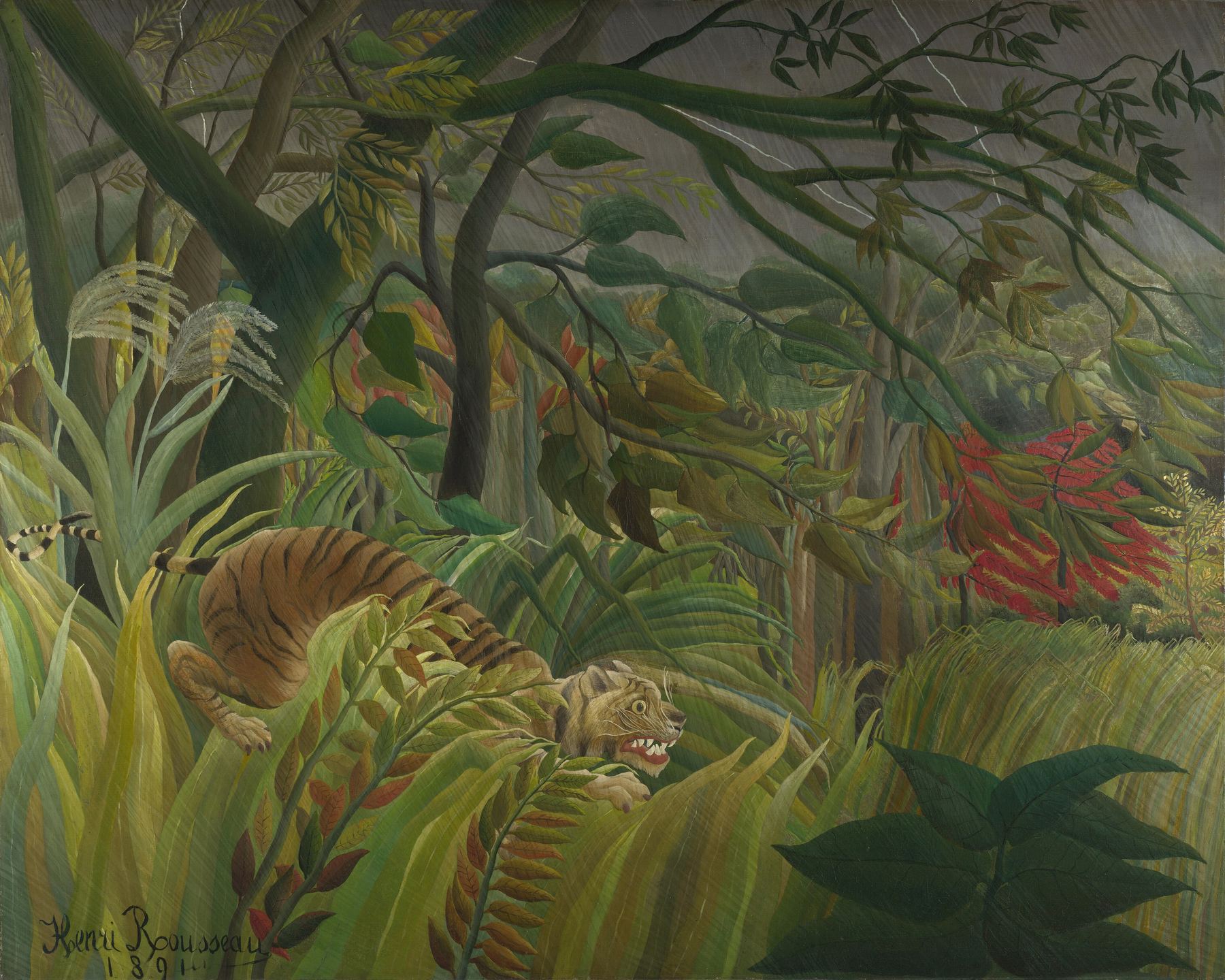
In Surprised!, the first of his sustained jungle paintings, a tiger crouches amid bent grasses, tilted leaves and long streaks of rain. Its body is suspended between concealment and leap. Plant forms overlap like stage flats yet build a suffocating density; pale lightning and silver water give the vegetation its own alarm. Rousseau did not need to have visited a tropical forest. Paris supplied zoological specimens, botanical gardens, illustrated publications and popular spectacle, while the Salon des Indépendants gave an unconventional painter a route to viewers.[7]
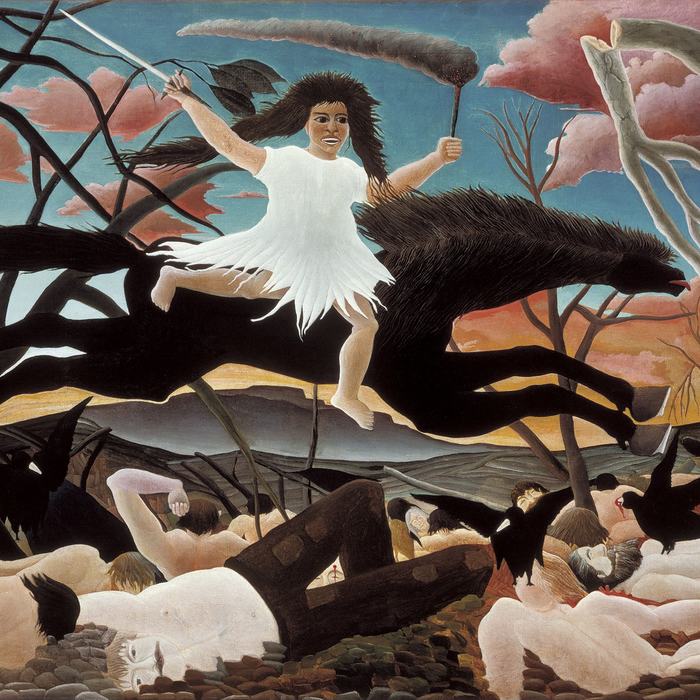
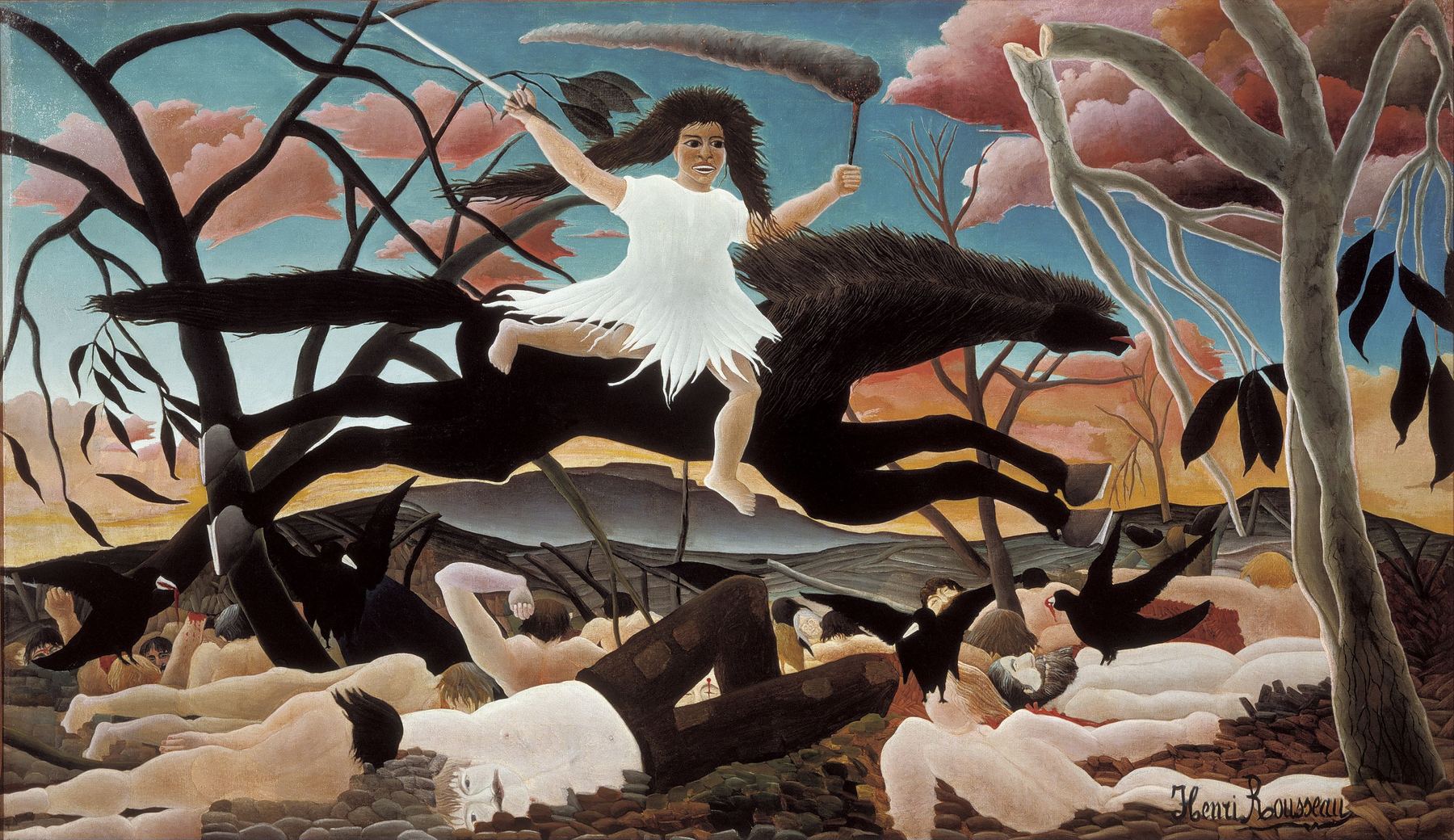
War makes an even stronger case against innocence. A furious figure rides above a field of bodies and scavenging birds, splitting the canvas into bands of desolation and unreal sky. Painted more than two decades after the Franco-Prussian War and the Commune, it turns remembered national violence into allegory. At the 1894 Indépendants it drew sarcasm for apparent awkwardness but also praise for absolute personal independence.[8] Rousseau could admire academic allegory while producing an image no academy would have taught.
The great jungle paintings are inventions, but not culturally empty dreams. World's fairs, colonial exhibitions, magazines and zoos presented distant people, animals and environments as evidence of French imperial reach. MoMA therefore calls Rousseau's exotic paintings “Parisian jungles”: formally radical spaces shaped by metropolitan fantasy and colonial display.[9] Naïveté cannot make those sources neutral.
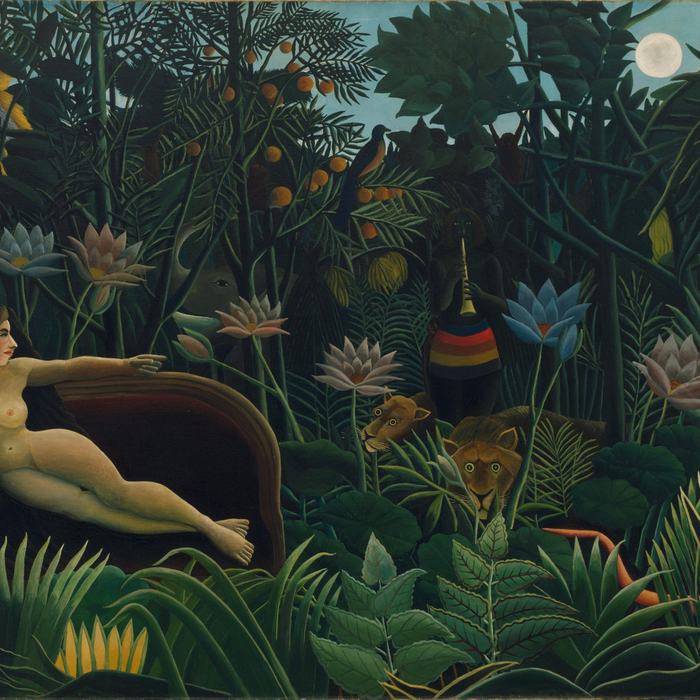
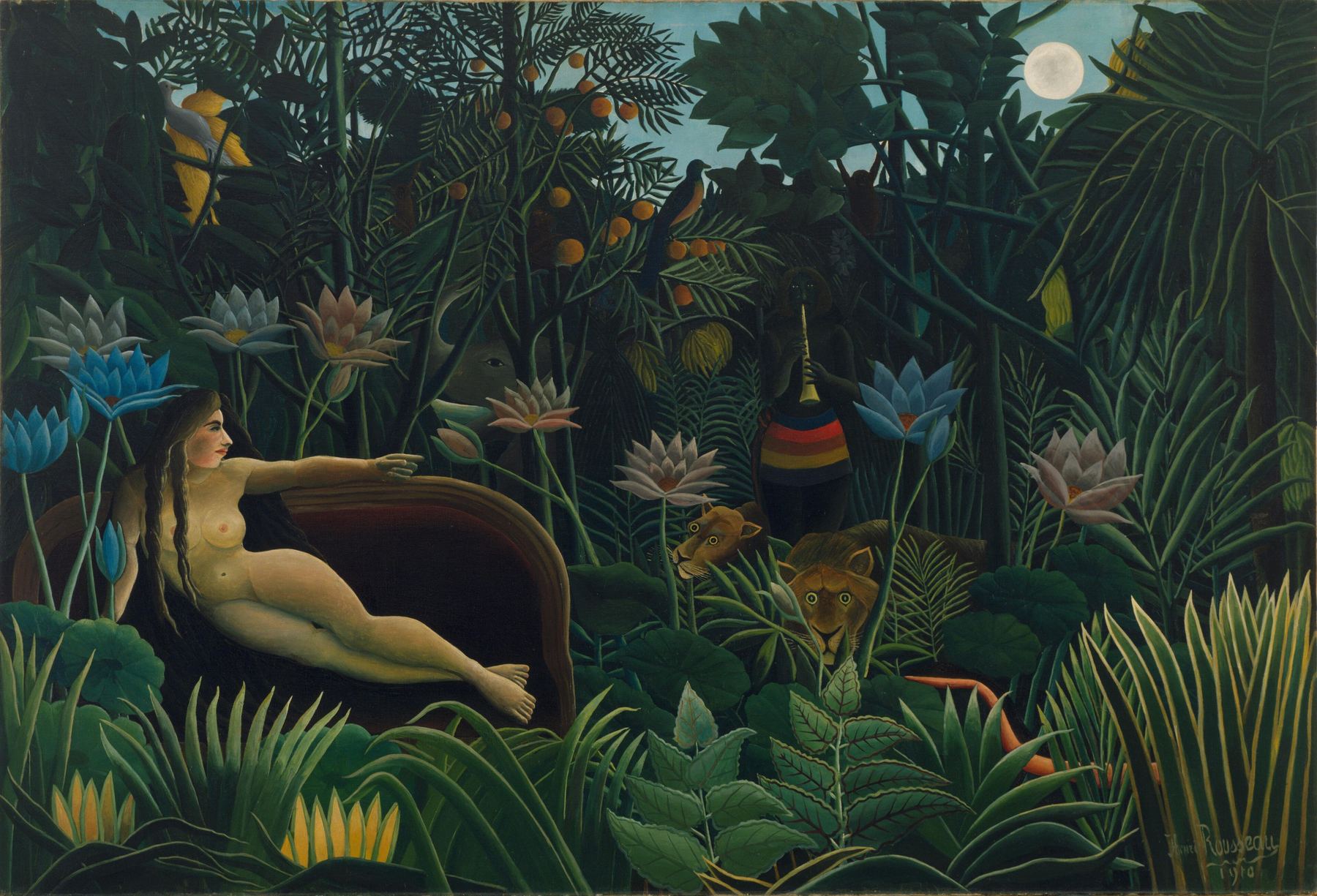
In The Dream, a nude reclines on a red sofa inside an impossible forest while a musician, lions, elephants, birds and snakes appear between layers of leaves. Rousseau explained that the woman dreams the jungle while resting in a Paris room. The strangeness comes precisely from refusing to choose between domestic furniture and tropical spectacle. Exact plant rhythms intensify, rather than resolve, the impossibility.[10]
The Snake Charmer makes the invented jungle almost nocturnal. The silhouetted musician appears less modelled than cut from the blue-green field; eyes, birds and coiling snakes emerge gradually from repeated leaves. The painting's enchantment depends on control of interval and concealment. A seemingly direct image makes the viewer work slowly to distinguish body, sound and vegetation.
The Sleeping Gypsy is quieter and ethically more difficult. The horizontally stretched body, moon, vessel and watchful lion occupy a desert pared almost to colour bands. Their isolation creates enormous poetic pressure. Yet the anonymous “Gypsy,” rendered through a nineteenth-century French fantasy of wandering and North Africa, is not an ethnographic person. The painting's long route through dealers and collections before MoMA acquired it in 1939 also contradicts the fantasy of an image recognised through pure, immediate feeling.[11]
Rousseau's portraits reveal equal calculation. In L'Enfant à la poupée, the child's torso faces us while the legs turn in profile. Modelling almost disappears; white spots fasten the red dress to the surface; smaller flowers and darkening grass supply just enough recession to make the flatness tense. The Orangerie connects these choices with medieval and early Renaissance image-making.[12] The work does not fail to become a conventional portrait. It constructs another kind of presence.
Rousseau was later toasted by Picasso's circle and admired by poets and painters who were overturning academic standards. That embrace helped secure his place within Post-Impressionism and the wider history of modern art. It also encouraged the enduring story of the cultivated avant-garde recognising an innocent genius. His own persistence, ambition and self-definition deserve at least as much weight.
Follow Naïve Art through four stages
–1910
Rousseau and strategic public emergence
Rousseau exhibits, studies museum art and develops an ambitious practice whose unconventional space attracts ridicule, admiration and later avant-garde advocacy.
–38
French masters and a category made by intermediaries
Uhde, dealers, collectors and exhibitions place previously unconnected artists beside Rousseau, turning labour biographies and distinctive mature practices into a marketable French constellation.
–65
International practices and unequal encounters
Hlebine, Kovačica, Tbilisi, St Ives, the United States, Haiti and Latin America enter overlapping museum and market narratives without sharing one training system or visual formula.
–today
Museums, heritage and continuing revision
Specialist museums, national collections and community heritage sustain the category while critical histories expose its hierarchies and living practices continue to change.
Dealers made the French constellation
After Rousseau, the French history is not the story of disciples. Séraphine Louis, André Bauchant, Camille Bombois, Louis Vivin, Dominique Peyronnet, René Rimbert and others did not form a society, share a studio or agree on a doctrine. They became neighbours in art history through critics, dealers, collectors and exhibitions.
The German collector and critic Wilhelm Uhde was central. He organised Peintres du Cœur-Sacré in 1928 and Primitifs modernes in 1932, then promoted five “primitive masters”: Rousseau, Séraphine, Bauchant, Bombois and Vivin. The Musée Maillol's reconstruction shows how these artists often began secretly or late while maintaining modest occupations, and how figures including Jeanne Bucher, Dina Vierny, André Breton, Le Corbusier, Picasso and Kandinsky helped their work circulate.[13]
Recognition was real, but its script had a cost. The humble job became proof of purity. A domestic servant was discovered by an employer; a gardener painted by vocation; a wrestler carried the circus in his body; a postal employee observed the city without professional ambition. Such biographies sold a reassuring contrast to theory-heavy modernism. They turned economic constraint into aesthetic virtue and the intermediary into hero.
A better account asks what each occupation taught. Gardening means observing growth, season, graft and repeated form. Postal work makes a city into routes and façades. Circus labour brings knowledge of weight, costume, anticipation and spectacle. Domestic service exposes the material world of class: polished surfaces, devotional objects, food, flowers and rooms maintained for others. Naïve art was not made outside labour. Labour often furnished its visual intelligence.
Séraphine's plants are built, not poured out
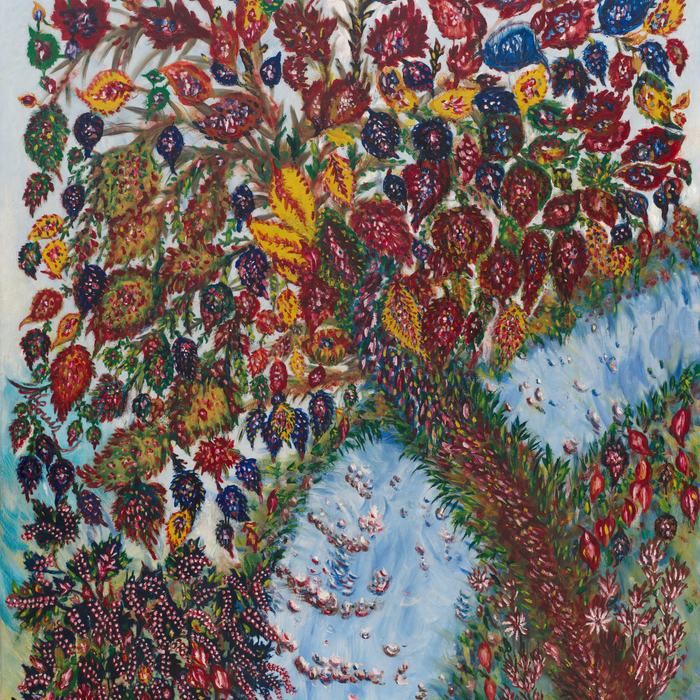
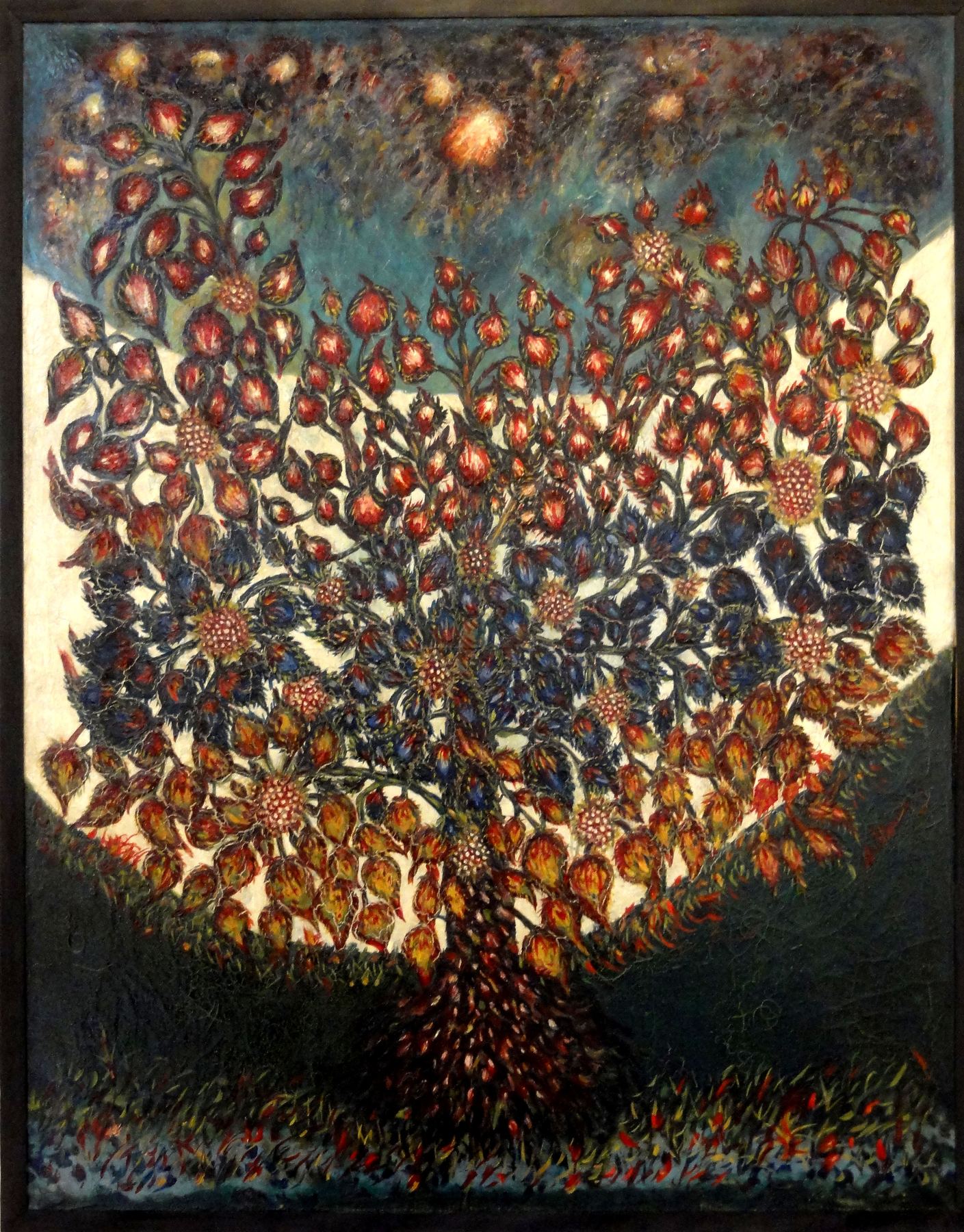
Séraphine Louis worked for decades in convent and domestic service around Senlis. Her mature paintings enlarge leaves, feathers, eyes, fruit and flowers into pulsing organisms. In Arbre rouge, the trunk leans against the rectangle while foliage spreads upward in restless fans. Repetition does not calm the image; each leaf feels charged, and the whole tree seems to press against its edges. The Centre Pompidou records Uhde's encouragement and contract, but also a practice rooted in her long fascination with plant and devotional imagery.[14]
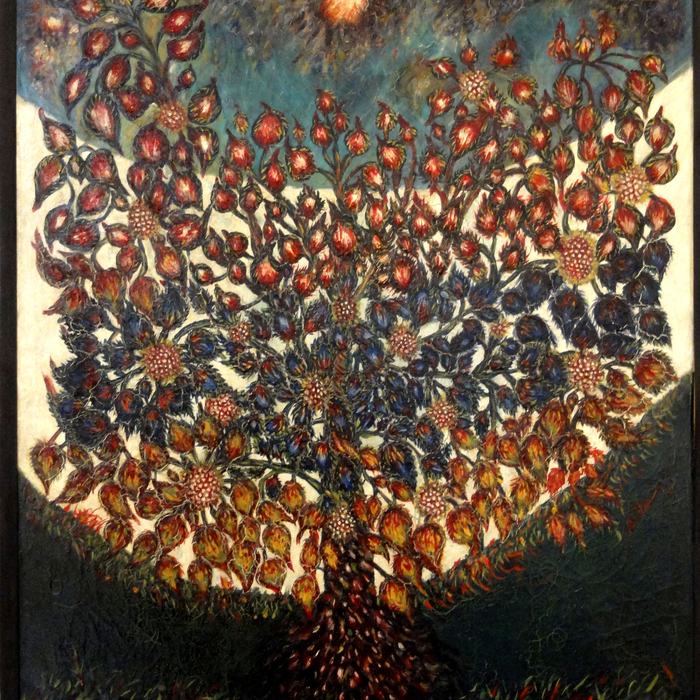
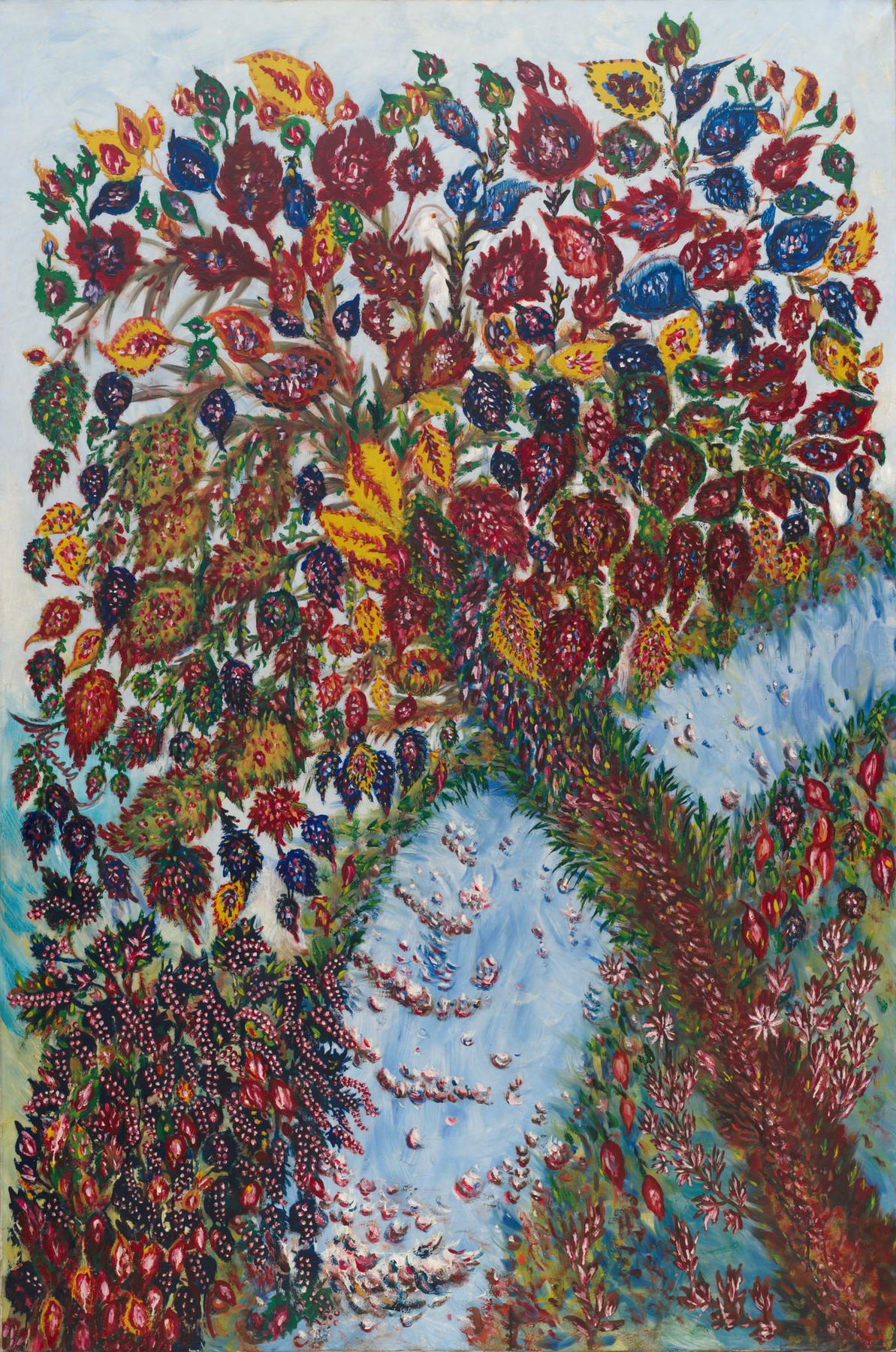
L'Arbre du paradis reaches nearly two metres high. Its accumulated marks and saturated field make “spontaneous” an inadequate word: sustained labour is visible everywhere. Feathers can resemble leaves, eyes or flames; fruit becomes jewel and wound; symmetry approaches order without settling into it. The painting entered France's national modern collection through Anne-Marie Uhde's postwar gift, one of the institutional acts that changed Séraphine from a local curiosity into a major painter.[15]
Her biography has often been made to end in psychiatric illness, as though hospitalisation explained the pictures. It did not. Illness, loss of patronage and wartime deprivation belong to her history, but they are neither source certificates nor metaphors for the surface. The relevant mystery is practical and visual: how a woman with restricted time and means developed such scale, density and rhythm.
Uhde's five-master formula nevertheless remained powerful. A Centre Pompidou record for Vivin still identifies him through that group, demonstrating how a critic's selection can become a lasting art-historical category.[16] The formula helps readers find related work, but it should not make five different careers look like one style.
History, circus and city
André Bauchant claimed subjects that academic hierarchy had reserved for trained history painters: classical mythology, Cleopatra, national foundation, processions and ideal landscapes. MoMA acquired and repeatedly exhibited his work from the 1930s onward.[17] His figures may appear stiff, but they are arranged as emblems inside broad, lucid narratives. The grand subject is not a joke on academic art; it is an assertion that historical imagination belongs to him too.
Camille Bombois had worked as a circus strongman and wrestler. Before Entering the Ring holds performers behind a curtain in the compressed interval before exposure. Bodies, props and animals are close enough to touch, while the glimpse of spectators converts the curtain into a border between labour and spectacle.[18] The picture's knowledge is occupational. It remembers how a performer waits.
Louis Vivin built Paris from small architectural units: windows, masonry, roofs, trees and pavement remain insistently legible. The Pantheon passed through the collection of Sidney and Harriet Janis before entering MoMA.[19] Provenance matters here. The supposedly direct, unmarketed picture arrived in the modern museum through precisely the networks—dealer, collector, donor—that made other modernisms canonical.
The variety is the point. Botanical abundance, history pageant, bodily performance and exact city view cannot be reduced to a common innocence. What joins these painters is a shared historical position: distinctive mature practices made outside a standard professional education and interpreted through an emerging market category.
Exhibitions did not merely find the movement
MoMA's 1938 Masters of Popular Painting: Modern Primitives of Europe and America was decisive. Its catalogue assembled European and American painters through biographies, plates and comparisons, making an international family from people who had never imagined collective membership.[20] Labels such as “popular” and “primitive” promised access to creativity before academic convention, precisely when modern institutions were defining what modern art should be.
Collectors could also be makers of the field. Jules Lefranc painted geometrically controlled cities using photographs, grids, tracing-paper studies and written colour instructions—methods that demolish the myth of unconscious composition. His 1966 donation helped establish Laval's museum the following year.[21] He was artist, collector, donor and theorist of the people he called painters “from the depths of the heart.”
Anatole and Renée Jakovsky's donation founded Nice's international museum in 1982. Its painting, sculpture, drawing and poster collections extend the history across nations and even back before Rousseau.[22] Laval later added arts singuliers to its name. Such changes expose the category as living museum work. Institutions do not simply store Naïve Art; through acquisitions, titles and room arrangements, they decide what it contains.
Hlebine: a school that complicates self-teaching
Croatian Naiva, especially the Hlebine School, is among the most sustained regional histories grouped under the term. The dedicated Hlebine gallery opened in 1968 and later expanded with a sculpture park and an Ivan Generalić museum collection.[23] Its location matters: work associated with a small Drava-region village is preserved not only in a capital-city narrative but in the landscape and community from which it developed.
Ivan Generalić is the foundational figure. Croatian museum documentation identifies him as the first and key personality of both Hlebine and the national Naiva.[24] Yet “self-taught peasant” is not a complete account. As a teenager he encountered the academically trained Krsto Hegedušić, whose socially committed Zemlja, or Earth Group, sought an art attentive to workers and rural life. Encouragement, demonstration and exhibition connected village drawing to Zagreb's modern debates.
Reverse painting on glass is itself a rebuke to the idea of no technique. Because the viewer sees the opposite side from the painter, the usual sequence must be reversed. Highlights, facial details and foreground lines are laid down before the larger colour fields that would conventionally come first. The maker plans through an invisible future surface.
Generalić's winter roads, floods, livestock, peasants and fantastic events move between observation, social criticism and invention. He became an internationally exhibited professional and encouraged younger painters. The Hlebine “school” therefore describes both a place and a chain of learning—not an absence of either.
The second generation changed the image of rural continuity. Josip Generalić moved to Zagreb, encountered urban life and absorbed mass media and popular culture; he painted celebrities such as the Beatles, Janis Joplin and Sophia Loren.[25] His career makes purity impossible. A village tradition survives not by remaining outside modern media but by arguing with them.
Kovačica: painting as minority heritage
Kovačica in Vojvodina developed another, distinct history. Painting among the Slovak minority began in the late 1930s and spread through neighbouring settlements. UNESCO's 2024 inscription describes self-directed painters using oil colour to represent local work, domestic life, history and values, while younger practitioners increasingly introduce contemporary motifs.[26]
Transmission occurs in families, workshops, exhibitions and cultural institutions. That makes the practice communal without making every picture the same. Serbia's heritage register locates it specifically among Slovak communities in Kovačica and other Vojvodina towns.[27] It should not be merged with Croatian Hlebine under an ahistorical “Yugoslav naïve” essence.
Heritage recognition brings opportunity and risk. It can preserve techniques, language and community memory. It can also reward the marketable image of an unchanging village. Women had long decorated furniture, dishes and textiles before gaining recognition as easel painters, a reminder that official beginnings often reflect which medium and maker an institution was prepared to call art.
Pirosmani painted a commercial city
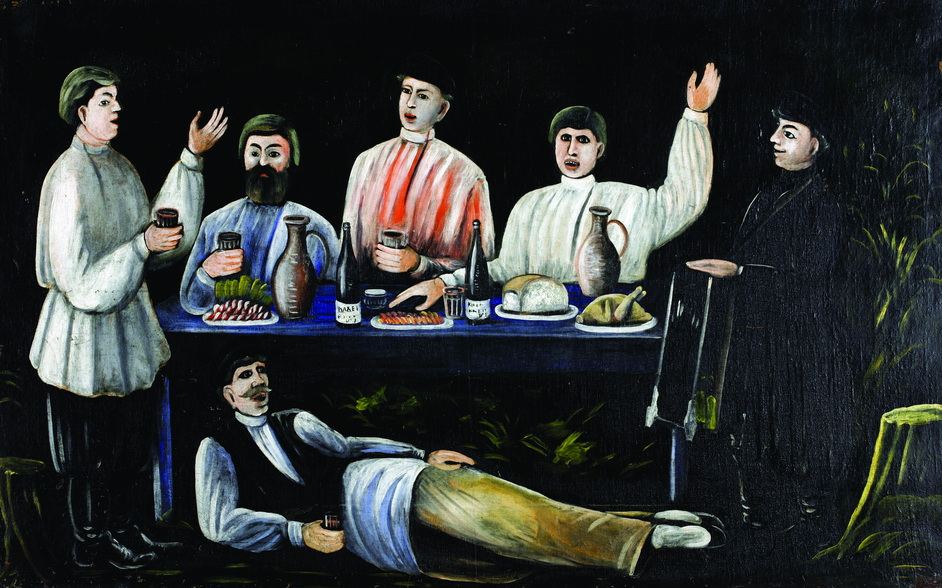
Niko Pirosmani is frequently presented as a starving Georgian loner. The legend contains hardship but obscures the world that made the paintings. Born in Kakheti and orphaned young, he spent most of his life around Tbilisi, working at railway and tavern jobs and painting signs, feasts, shop subjects, animals and portraits. The Georgian National Museum stresses that he had no professional academy education, not that he existed without a social environment.[28]
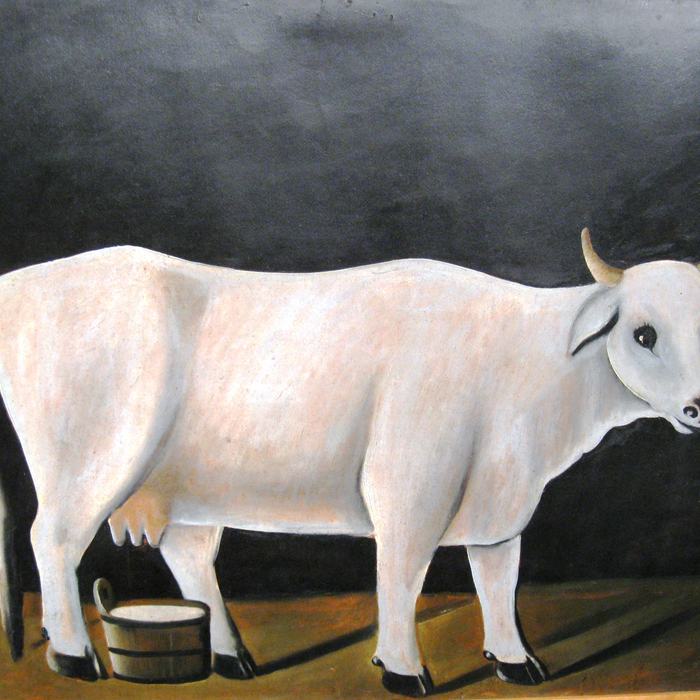
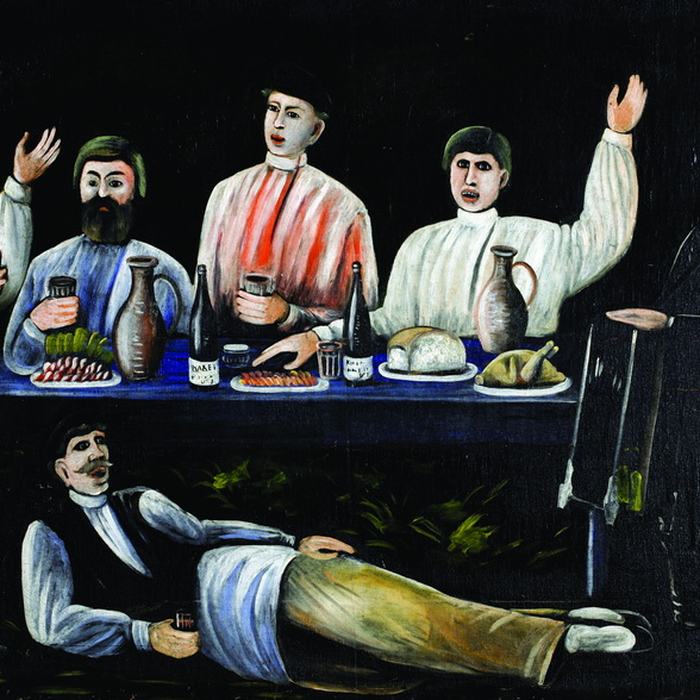
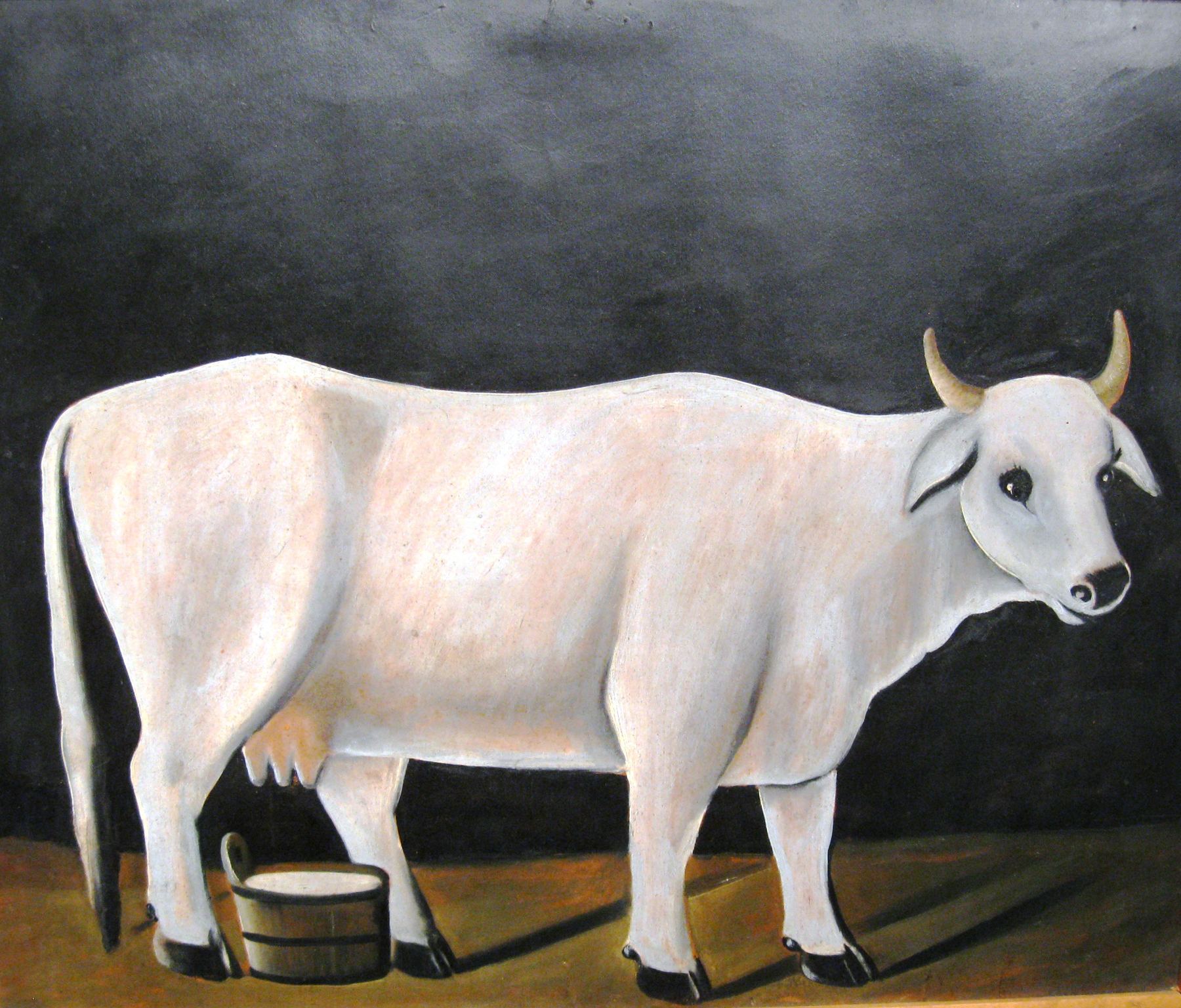
His common support—black oilcloth—does extraordinary work. Colour is often applied sparingly, allowing darkness to become contour, clothing, night and depth. A white animal can emerge like a cut shape; a face can hold the viewer through a few severe intervals; a feast can spread horizontally without dissolving its guests into atmosphere. Fondation Beyeler's exhibition, organised with the Georgian National Museum, emphasises the dignity and stillness he grants people and animals.[29]
Pirosmani's city was multilingual, commercial and modern. Taverns needed signs. Customers wanted portraits, food, animals and celebrations. Railways organised mobility. Georgian avant-garde writers and artists later recognised formal radicality in the work, while museums turned the poor sign painter into a national emblem. The task is not to strip away legend completely but to prevent it from replacing black ground, measured colour, repeated format and the social exchange of a commission.
Wallis made memory into scale
Alfred Wallis began painting in old age after decades as a mariner, fisherman and marine-store dealer in Cornwall. His ships are not generic motifs. They recall changing rigs, harbours, storms and a maritime economy already disappearing. Kettle's Yard traces how Ben Nicholson and Christopher Wood encountered him in St Ives in 1928 and how Jim Ede became a committed collector.[30]
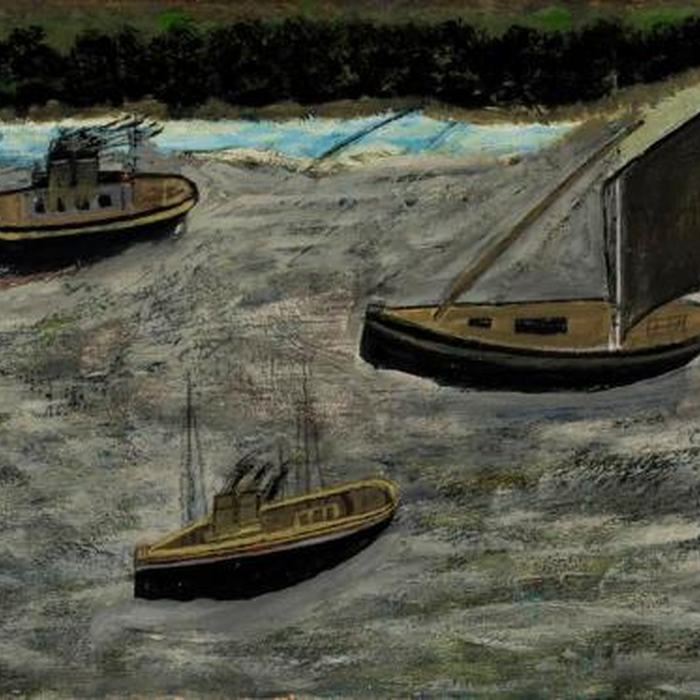
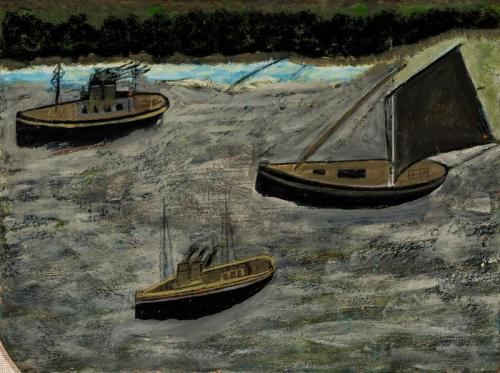
Wallis used what was available: household or ship paint, board, packaging and graphite. In Two Ships on Blue Sea, painted on what may have been a cake-box lid, the rounded irregular edge participates in the event. Heavy black machinery, pencil rigging and exposed cardboard organise pressure and movement.[31] Materials do not apologise for poverty. They determine the picture's physics.
Scale follows memory and importance. A ship can dwarf its harbour; coastline can bend around an event; sea and sky can exchange the support's bare colour. The image behaves partly like a map, partly like recollection and partly like an object found in a working room.
Nicholson, Wood and Ede preserved Wallis's art and learned from it. Tate's account places the 1928 encounter inside the making of St Ives modernism.[32] But the exchange was unequal. Trained artists could translate his forms into a prestigious modernist genealogy, while Wallis remained poor and sold pictures cheaply. Admiration does not remove the economics of who had the power to interpret whom.
American stories of age, pattern and exclusion
Anna Mary Robertson “Grandma” Moses began painting seriously in her late seventies after a life of farm and domestic labour. Her scenes combine remembered work, seasonal light, direct observation and narrative invention. The Smithsonian's reassessment places that labour at the centre and notes how she became both a popular celebrity and a target of critical belittlement.[33]
Cambridge Valley reveals a compositional system. Foreground, middle distance and horizon receive almost equal attention, flattening a broad view into something like a patchwork. The Smithsonian connects this solution to Moses's observation of a landscape condensed in a convex automobile hubcap.[34] That story matters because it replaces lack with experiment: she found a device that allowed many houses, roads, fields and figures to remain active at once.
The “Grandma” persona was not neutral. Age, gender and rural work made the painter newsworthy, while greeting cards, fabric, china and magazine coverage carried her images far beyond galleries. Her popularity rose after the Second World War when nostalgic community scenes could stand for reassuring national continuity.[35] The same marketing that made her one of America's most famous women artists encouraged critics to treat her as a lovable exception rather than a serious painter.
Morris Hirshfield entered the field from another trade. He had built businesses manufacturing women's coats and slippers before painting intensively in retirement. His frontal figures, piled textures, patterned foliage and strange bodies preserve a fabric-maker's attention to surface. Surrealists admired him, Peggy Guggenheim collected him, and MoMA gave him a solo exhibition in 1943.[36]
That visibility did not secure a permanent place. Later modernist histories dismissed or forgot him, only for recent exhibitions to reconstruct the career. New National Gallery acquisitions emphasise how varnish, fabric-like pattern and built paint organise his imaginary portraits.[37] Inclusion is not a one-way march. An artist can enter a major museum, disappear from its story and return under a different category.
Bill Traylor exposes the highest stakes of naming. Born into slavery and working through the Jim Crow South, he made an immense body of drawings late in life. A Smithsonian curator warns that calling him one of America's most important “self-taught artists” can qualify his achievement, keeping it below an unmarked category of important artists.[38] The facts of his life are not detachable atmosphere, and neither are they permission to turn every drawing into illustration. Category, race and institutional authority meet in the language used around the work.
Haiti beyond the discovery myth
Hector Hyppolite was a Vodou priest, artisan and house painter before his concentrated professional career in the 1940s. He joined Le Centre d'Art in Port-au-Prince and produced hundreds of paintings in only a few years. MoMA's biography places his imagery within Haitian culture and religious knowledge rather than presenting it as an unconscious eruption.[39]
The Centre offered materials, exhibition and community, but foreign accounts often turned it into the beginning of Haitian fine art. Archival research at MoMA shows how that myth, promoted by visiting critics and collectors, obscured earlier Haitian Indigenist painting and made foreign recognition look like creation.[40] Artists used the institution; they were not invented by it.
In The Congo Queen, a monumental veiled mother and child can recall a Black Madonna while representing Ezili Dantò, fierce protector of women and children in Vodou. Angels flank her watchful face. Hyppolite produced varied textures with brushes, feathers and fingers, joining enamel, oil and pencil on cardboard.[41] Religious synthesis is not evidence of vagueness. It is structured Haitian meaning.
The Centre also gave some Vodou practitioners room to state identities suppressed elsewhere. Its history includes painters, carpenters and metalworkers who transformed discarded drums into spiritually charged sculpture.[42] A movement page centred only on colourful easel painting would repeat the exclusions it claims to correct.
Brazilian rhythm and Honduran townscape
Brazil developed one of the largest national fields associated with Naïve Art. Fundação Nacional de Artes identifies artists including Heitor dos Prazeres, Djanira, José Antônio da Silva and Cardosinho within a history of rural scenes, urban life, festivities and strongly organised colour.[43] Their practices are not Brazilian versions of Rousseau. Samba, labour, migration, religious life, agriculture and the modern city give the images distinct social rhythms.
The classification is again uneven. Some artists had periods of instruction or moved between institutional worlds. A national survey may use naïf as a broad exhibition category where an artist's own formation was more complicated. Rather than police purity, viewers can ask what the label made visible and what it simplified.
José Antonio Velásquez painted detailed views of San Antonio de Oriente in Honduras. Houses, tile roofs, roads, church, mountains and groups of people form a town that can be surveyed yet never reduced to a single optical viewpoint. His international recognition was encouraged by Cuban critic José Gómez Sicre through the Organization of American States, which interpreted “primitive” spontaneity as popular and national authenticity.[44] The pictures possess their own spatial intelligence; the language surrounding them belongs to mid-century cultural diplomacy.
Ligabue is more than a difficult life
Antonio Ligabue's biography is dramatic: born in Switzerland to an Italian family, displaced to Gualtieri, poor, socially isolated, repeatedly hospitalised and recognised widely only later. The museum devoted to him carefully documents that odyssey and the eventual attention of journalists, critics and dealers.[45]
Biography can open the pictures, but it can also devour them. Ligabue's animal combats are tightly staged encounters in which patterned fur, open jaws, vegetation and unstable ground press toward the surface. His self-portraits return a severe gaze, sometimes surrounded by flies, scarf, motorcycle cap or landscape. They are not automatic symptoms of illness. Nor does suffering authenticate them more than composition does.
The same caution applies across this history. Séraphine is not powerful because she entered a psychiatric hospital. Pirosmani is not Georgian because he died poor. Wallis's cardboard does not become profound through deprivation alone. Traylor's drawings cannot be separated from slavery and segregation, but they are not merely testimony. Ethical looking holds circumstance and artistic decision together.
Essential Naïve Art works
Surprised! (Tiger in a Tropical Storm)
Henri Rousseau · 1891 · Rousseau turns botanical observation, animal spectacle and repeated plant forms into a compressed invented storm rather than an accidental failure of naturalism.
War
Henri Rousseau · 1894 · A severe allegorical rider crosses a field of bodies, demonstrating Rousseau's ambition to claim history painting through a wholly independent visual language.
The Dream
Henri Rousseau · 1910 · A Paris sofa and impossible jungle occupy one deliberate vision, making incompatibility and accumulated foliage the picture's organising principle.
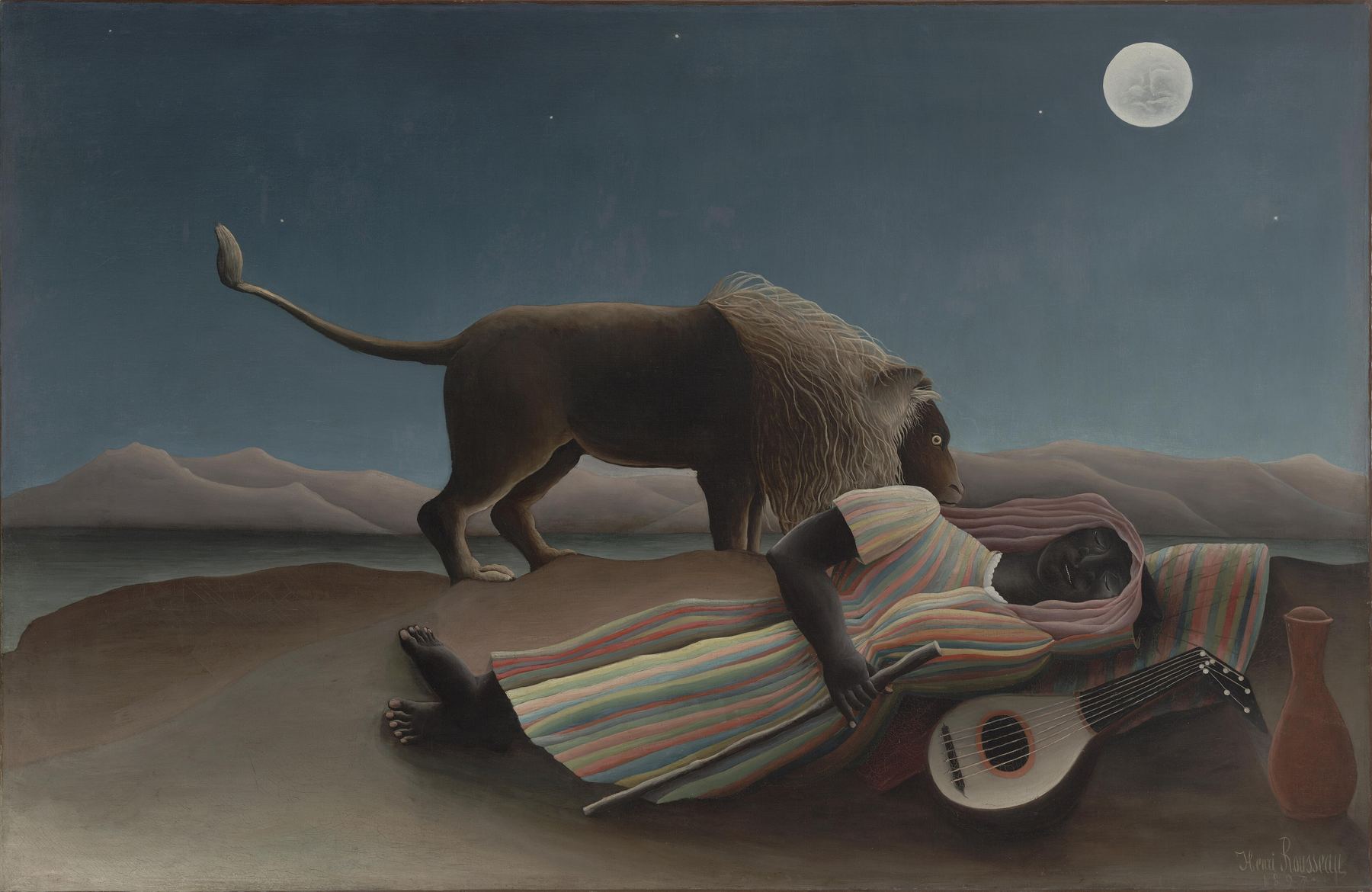
The Sleeping Gypsy
Henri Rousseau · 1897 · The stretched figure, lion, moon and sparse desert create enormous planar pressure while the racialised subject requires historically alert looking.
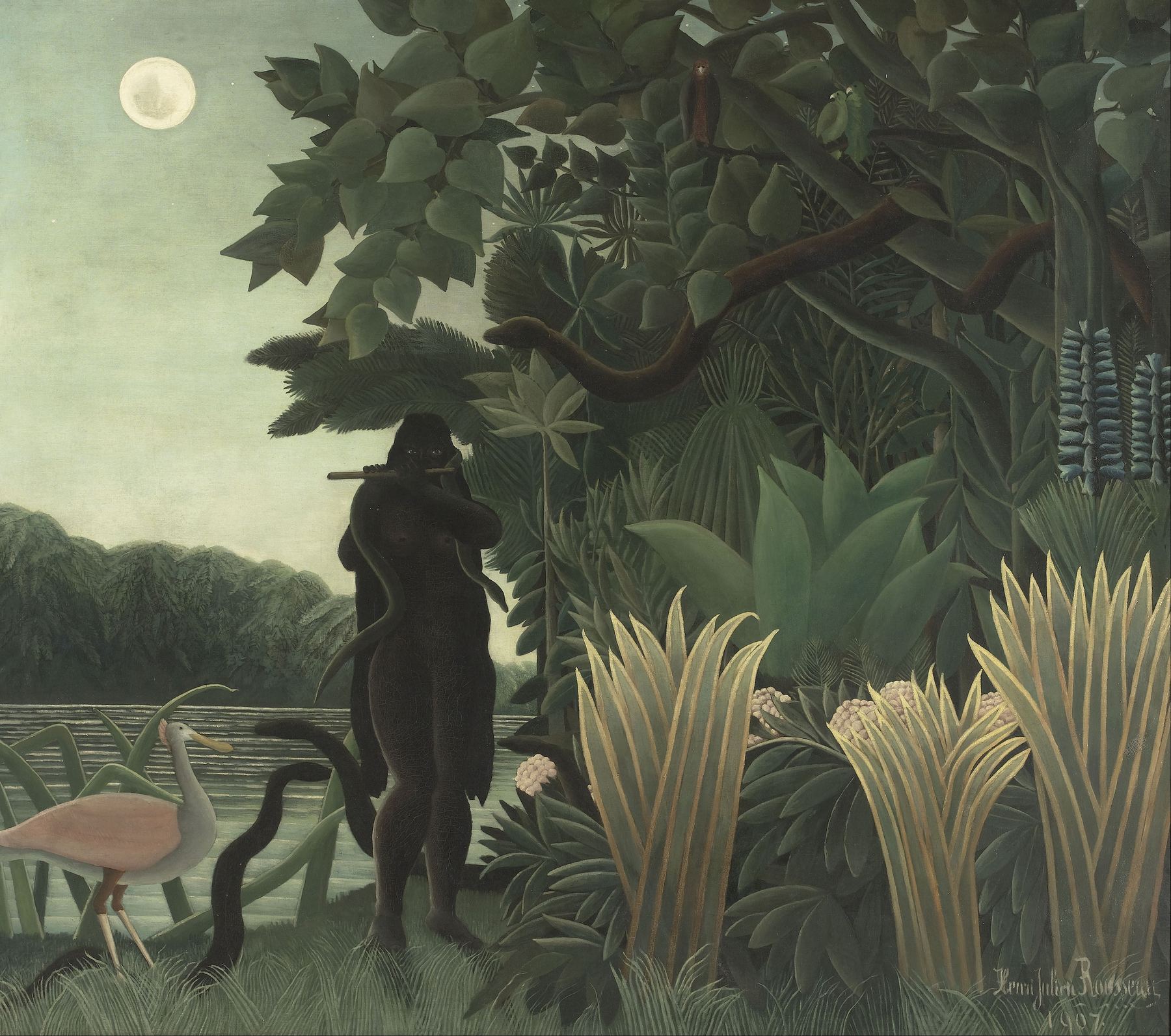
The Snake Charmer
Henri Rousseau · 1907 · Silhouette, repeated leaves and slow concealment make the viewer distinguish body, music and vegetation within an almost nocturnal field.
Tree of Paradise
Séraphine Louis · c. 1928 · Séraphine's nearly total field of leaves, eyes, fruit and flame-like marks reveals sustained material labour rather than effortless spontaneity.
The Tree of Life
Séraphine Louis · 1928 · Repeated botanical forms press upward and outward, turning devotional and plant knowledge into a large, carefully accumulated structure.
White Cow on a Black Background
Niko Pirosmani · 1915 · Pirosmani lets black oilcloth serve as ground, contour and atmosphere so the white animal acquires an iconic stillness with very little applied colour.
Molokani Carousing
Niko Pirosmani · 1905 · A horizontal feast remains legible through repeated figures and reserved darkness, locating Pirosmani inside Tbilisi's commercial social world.
Three Boats Off the Shore
Alfred Wallis · c. 1930s · Wallis makes irregular cardboard, remembered vessel types and emphatic scale active parts of a maritime image rather than signs of pictorial deficiency.
How to recognise—and question—Naïve Art
Begin with the support. Is the image painted on canvas, board, glass, cardboard or oilcloth? Does bare material function as colour or space? In reverse glass painting, could the sequence of layers reveal planning? Material is often the first form of knowledge.
Next follow scale. Instead of measuring figures against mathematical perspective, ask whether size records narrative importance, memory or visual rhythm. Tilted viewpoints may keep streets, fields and tables available to sight. Strong outlines may preserve the identity of every element. Repetition may produce movement more effectively than atmospheric blur.
Look for sources without assuming dependence. A jungle may combine zoo animals, botanical studies, magazines and world-fair display. A historical pageant may grow from postcards or books. A townscape may be recalled, photographed and rearranged. A religious figure may join Vodou and Catholic imagery. Originality is not the absence of sources; it is what the artist makes them do.
Then consider work knowledge. Can a sailor's memory explain the relation of ship and coast? Does textile manufacture sharpen pattern? Does gardening inform growth? Does sign painting favour iconic silhouettes? Does farm labour govern the timing of a seasonal scene? Academy technique is not the only expertise visible in a picture.
Finally look at circulation. Who first bought, named and exhibited the artist? Which details of the life story were repeated? Did a dealer group unrelated people? Did a museum place the work beside modernism, folk art or Art Brut? Did reproduction create popular fame? The category becomes most revealing when the picture and the machinery of recognition remain in view together.
Why the category persists
Naïve Art survives because it names a real historical encounter. Artists developed exceptional practices beyond standard training; modernists sought renewal in their work; collectors created markets; museums built rooms and specialist institutions; communities turned painting into heritage. Removing the name entirely would hide that history.
It therefore has no convincing single end date. The French interwar constellation weakened as its artists died and postwar abstraction changed institutional priorities, but Croatian Naiva gained international force, Haitian and Latin American fields expanded, and Kovačica developed through further generations. Specialist museums founded from the 1950s to the 1980s gave the category a durable public life. Contemporary painters may inherit a family technique, find the term through a gallery or choose it as an alternative to academic culture. Those routes are not identical, and continuity should not be mistaken for an unchanged style. The chronology belongs to overlapping careers, communities and acts of recognition rather than one rise-and-fall curve.
But the best use of the term weakens its hierarchy. A viewer should be able to move from Rousseau to Séraphine, Generalić, Pirosmani, Wallis, Moses, Hirshfield, Hyppolite or Velásquez without imagining a ladder on which the trained artist stands above them. The category is a door, not a verdict. Once inside, each practice needs its own materials, places, knowledge and ambitions.
Where to see Naïve Art
Displays, loans and access arrangements change. Check current information before travelling.
- 01
Musée de l'Orangerie and Musée d'Orsay, Paris
complementary Rousseau holdings make it possible to compare portraits, city landscapes, jungle invention and the monumental allegory of La Guerre.
Paris, France
Rousseau portraits, jungles and WarVisit official website - 02
MANAS, Laval
France's long-standing Musée d'Art Naïf et d'Arts Singuliers is especially useful for seeing beyond the sentimental stereotype and understanding Jules Lefranc's role as painter, collector and donor.
Laval, France
French and international Naïve Art and arts singuliersVisit official website - 03
Musée International d'Art Naïf Anatole Jakovsky, Nice
a broad international collection formed around the Jakovsky donation, with painting, sculpture, drawing and graphic work.
Nice, France
International painting, sculpture and graphic workVisit official website - 04
Croatian Museum of Naïve Art, Zagreb, and Galerija naivne umjetnosti, Hlebine
together they connect the national canon with the village landscape, reverse-glass technique and intergenerational Hlebine history.
Zagreb and Hlebine, Croatia
Croatian Naiva and reverse-glass traditionsVisit official website - 05
Gallery of Naïve Art, Kovačica
the appropriate starting point for the living painting practice of Serbia's Slovak minority and its family and community transmission.
Kovačica, Serbia
Living Slovak-minority painting practiceVisit official website - 06
Sighnaghi Museum, Georgian National Museum
a major Pirosmani collection seen within Kakheti, the region of his birth, and Georgian rather than purely Western interpretive frames.
Sighnaghi, Georgia
Pirosmani within Georgian collections and contextVisit official website - 07
Kettle's Yard, Cambridge
the largest institutional holding of Alfred Wallis, displayed within Jim Ede's domestic collection and its account of British modernism.
Cambridge, England
The largest institutional Alfred Wallis holdingVisit official website - 08
MoMA, New York, and Smithsonian American Art Museum, Washington
MoMA's Rousseau, Séraphine, Hirshfield and Hyppolite histories can be compared with the Smithsonian's deep study of American folk and self-taught art.
New York and Washington, USA
Modernist, folk and self-taught institutional historiesVisit official website
Suggested books
- Jeanne-Bathilde Lacourt and Àlex Susanna, eds., Du Douanier Rousseau à Séraphine: Les grands maîtres naïfs. The strongest recent visual introduction to the French constellation and the networks around Uhde.[46]
- Lynne Cooke, Outliers and American Vanguard Art. An essential critical history of the fluctuating relationship between trained modernists, self-taught makers, exhibitions and institutions.[47]
- Leslie Umberger and Randall R. Griffey, eds., Grandma Moses: A Good Day's Work. Reframes a familiar public figure through labour, age, memory, landscape, race, media and the market.[48]
- Svjetlana Sumpor, A Little Guide to the Croatian Museum of Naive Art. A concise English-language route into Croatian Naiva, its major artists and the Zagreb collection.[49]
- Sam Keller and Daniel Baumann, eds., Niko Pirosmani. Combines Georgian scholarship, historical texts and close reproductions that make the black oilcloth and sparse colour newly legible.[50]
Major artists associated with Naïve Art
| Name | Nationality | Key Works |
|---|---|---|
| Henri Rousseau | French | Surprised! · War · The Sleeping Gypsy |
| Séraphine Louis | French | Red Tree · Tree of Paradise |
| André Bauchant | French | Cleopatra's Barge · myth and history paintings |
| Camille Bombois | French | Before Entering the Ring · circus subjects |
| Louis Vivin | French | The Pantheon · Paris city views |
| Dominique Peyronnet | French | landscapes and architectural scenes |
| René Rimbert | French | cityscapes and still lifes |
| Jules Lefranc | French | geometrically planned cities · photographic studies |
| Ivan Generalić | Croatian | reverse-glass rural scenes · floods, snow and labour |
| Franjo Mraz | Croatian | rural labour and social subjects |
| Josip Generalić | Croatian | celebrity portraits · village and mass-media subjects |
| Niko Pirosmani | Georgian | White Cow on a Black Background · Molokani Carousing |
| Alfred Wallis | British | Two Ships on Blue Sea · Three Boats Off the Shore |
| Grandma Moses | American | Cambridge Valley · seasonal landscapes |
| Morris Hirshfield | American | Girl with Pigeons · patterned imaginary portraits |
| Bill Traylor | American | figure and animal drawings · constructed scenes |
| Hector Hyppolite | Haitian | The Congo Queen · Vodou sacred figures |
| Heitor dos Prazeres | Brazilian | samba and urban community scenes |
| Djanira da Motta e Silva | Brazilian | labour, festivals and religious subjects |
| José Antônio da Silva | Brazilian | farms, harvests and rural landscapes |
| Cardosinho | Brazilian | urban and imaginative scenes |
| José Antonio Velásquez | Honduran | San Antonio de Oriente townscapes |
| Antonio Ligabue | Italian | animal combats · self-portraits |
Frequently Asked Questions
Not in the usual organisational sense. Its artists did not share a manifesto, membership or single centre. It is best understood as a historical category created through the meeting of distinctive non-academic practices with modernist artists, dealers, exhibitions, museums and markets.
Historically, it has usually identified artists working without sustained academic or professional art-school training. The word can be patronising because it also suggests innocence or lack of knowledge. It should describe an inherited art-historical category, never a person's intelligence.
No. Self-taught artists work in abstraction, conceptual art, design, performance, graffiti, assemblage and many other forms. Self-teaching is a route of formation. Naïve Art is a narrower and historically specific grouping, usually centred on figurative work and its institutional reception.
No, although they overlap. Folk art often grows through community tradition, workshop practice or useful objects. Naïve Art usually refers to individual fine-art practices formed outside academic education. Kovačica shows how an individual painting practice can become communal heritage, so the border is permeable rather than absolute.
No. Art Brut was theorised by Jean Dubuffet after 1945 around work he considered radically detached from cultural institutions and approval. Outsider art began as an English equivalent and later broadened. Many artists called naïve actively sought exhibitions, patrons and public recognition.
He became the most famous self-taught painter embraced by the Parisian avant-garde, and later histories treated him as the archetypal naïve master. His ambitious public career and sophisticated pictorial inventions also reveal why the stereotype of innocent instinct is inadequate.
No. His tropical scenes combine Parisian botanical gardens, zoos, illustrated publications, exhibitions and imagination. Their artificiality is central to their power, while their sources also connect them to French colonial spectacle.
Because many artists organise space by narrative importance, memory, pattern or the need to keep each object legible. A tilted table or enlarged ship may solve a pictorial problem more effectively than a single fixed viewpoint. Unconventional space is not automatically failed space.
Rarely in an absolute sense. They learned through occupations, family, worship, printed images, museums, customers, neighbours and other artists. Hlebine and Kovačica are explicit teaching networks, while Rousseau, Pirosmani and Wallis all worked within active visual and commercial environments.
They supplied materials, purchases, exhibitions, publicity and categories. Uhde's French group, Ede's collection of Wallis, Kallir's promotion of Moses and foreign interest in Haitian painting all affected survival and reputation. Their support could enable artists while also controlling the story told about them.
A trained artist can adopt faux-naïf flatness, awkwardness or childlike drawing as a deliberate style. That is different from the historical category developed around makers outside sustained academic formation. Appearance alone cannot settle the question.
Yes. Kovačica remains a living community practice, specialist museums collect contemporary work, and artists around the world continue to identify with the term. Its boundaries and power relations remain debated, which is one reason the category still demands careful use.
Discussion
Which work most changes your idea of what “self-taught” can mean: Rousseau's invented jungle, Séraphine's growing surface, Pirosmani's black ground, Wallis's remembered ships, Generalić's reverse-painted glass or Hyppolite's sacred figures? Consider not only what the image depicts, but what kind of knowledge it makes visible.
Reader Insights
Ask what maritime, textile, agricultural, devotional, commercial or community experience the image makes visible.
Notice how oilcloth, cardboard, reverse glass, house paint or exposed support determines the picture’s space and rhythm.
Identify who first named, bought, exhibited and reproduced the artist—and what their chosen biography made easier to see or sell.
Join the Conversation
Which work most changes your idea of what self-taught can mean, and what kind of knowledge becomes visible in it?
References
- Masters of Popular Painting, Museum of Modern Art, View Source
- Outliers and American Vanguard Art, National Gallery of Art, View Source
- Le singulier de l'art naïf, MANAS Musée d'Art Naïf et d'Arts Singuliers (French; consulted in French), View Source
- History of Art Brut, Collection de l'Art Brut Lausanne, View Source
- Self-taught artist, Museum of Modern Art, View Source
- Henri Rousseau: A Painter's Ambition, Musée de l'Orangerie, View Source
- Henri Rousseau: Surprised!, National Gallery London, View Source
- La Guerre, Musée d'Orsay (French; consulted in French), View Source
- Henri Rousseau, Museum of Modern Art, View Source
- Henri Rousseau: The Dream, Museum of Modern Art, View Source
- Henri Rousseau: The Sleeping Gypsy, Museum of Modern Art, View Source
- L'Enfant à la poupée, Musée de l'Orangerie (French; consulted in French), View Source
- Du Douanier Rousseau à Séraphine: dossier de presse, Musée Maillol (French; consulted in French), View Source
- Arbre rouge, Centre Pompidou (French and English; consulted in French and English), View Source
- L'Arbre du paradis, Centre Pompidou (French and English; consulted in French and English), View Source
- La chasse, Centre Pompidou (French; consulted in French), View Source
- André Bauchant, Museum of Modern Art, View Source
- Camille Bombois: Before Entering the Ring, Museum of Modern Art, View Source
- Louis Vivin: The Pantheon, Museum of Modern Art, View Source
- Masters of Popular Painting: Modern Primitives of Europe and America, Museum of Modern Art, View Source
- Jules Lefranc, MANAS Musée d'Art Naïf et d'Arts Singuliers (French; consulted in French), View Source
- Musée International d'Art Naïf Anatole Jakovsky, Ville de Nice (French; consulted in French), View Source
- Galerija naivne umjetnosti Hlebine, Muzej grada Koprivnice (Croatian; consulted in Croatian), View Source
- Hrvatski muzej naivne umjetnosti, Muzejski dokumentacijski centar (Croatian; consulted in Croatian), View Source
- Josip Generalić, Croatian Museum of Naïve Art, View Source
- Naïve painting practices of Kovačica, UNESCO Intangible Cultural Heritage, View Source
- Slovak naïve art painting, National Register of Intangible Cultural Heritage of Serbia, View Source
- Niko Pirosmani, Georgian National Museum (Georgian and English; consulted in Georgian and English), View Source
- Niko Pirosmani, Fondation Beyeler, View Source
- Five Ships – Mount's Bay, Kettle's Yard, View Source
- Alfred Wallis: Two Ships on Blue Sea, British Museum, View Source
- Making Art Modern, Tate St Ives, View Source
- Grandma Moses: A Good Day's Work, Smithsonian American Art Museum, View Source
- Cambridge Valley, Smithsonian American Art Museum, View Source
- Grandma Moses' Folk Art Took Her from the Farm to Fame, Smithsonian American Women's History Museum, View Source
- Morris Hirshfield Rediscovered, American Folk Art Museum, View Source
- Works from the Estate of Maria and Conrad Janis, National Gallery of Art, View Source
- Qualification Exclusion and the Art of Bill Traylor, Smithsonian American Art Museum, View Source
- Hector Hyppolite, Museum of Modern Art, View Source
- MoMA and the Internationalization of Haitian Painting 1942–1948, Museum of Modern Art post, View Source
- Hector Hyppolite: The Congo Queen, Museum of Modern Art, View Source
- The Silence of Sanctuary, Museum of Modern Art post, View Source
- Vamos conhecer a arte naïf?, Fundação Nacional de Artes Brazil (Portuguese; consulted in Portuguese), View Source
- Art of the Americas collection: José Antonio Velásquez, Art Museum of the Americas OAS (English and Spanish; consulted in English and Spanish), View Source
- Antonio Ligabue, Fondazione Museo Antonio Ligabue (Italian; consulted in Italian), View Source
- Du Douanier Rousseau à Séraphine, Musée Maillol (French; consulted in French), View Source
- Outliers and American Vanguard Art, Lynne Cooke and National Gallery of Art, View Source
- Grandma Moses: A Good Day's Work, Leslie Umberger Randall Griffey and Smithsonian American Art Museum, View Source
- A Little Guide to the Croatian Museum of Naive Art, Svjetlana Sumpor and Museum Documentation Center (Croatian and English; consulted in Croatian and English), View Source
- Niko Pirosmani exhibition catalogue, Fondation Beyeler (English and German; consulted in English and German), View Source
- Naïve Art image records, Wikimedia Commons: Surprised! (Tiger in a Tropical Storm) (Public domain mark / PD-Art; National Gallery, London / Wikimedia Commons), War (Public domain mark / PD-Art; Musée d'Orsay / Wikimedia Commons), The Dream (Public domain mark / PD-Art; Museum of Modern Art / Google Art Project / Wikimedia Commons), The Sleeping Gypsy (Public domain mark / PD-Art; Museum of Modern Art / Google Art Project / Wikimedia Commons), The Snake Charmer (Public domain mark / PD-Art; Musée d'Orsay / Google Art Project / Wikimedia Commons), Tree of Paradise (Public domain mark / PD-Art; Museum of Modern Art / Wikimedia Commons), The Tree of Life (Public domain mark / PD-Art; Musée d'art et d'archéologie de Senlis / Wikimedia Commons), White Cow on a Black Background (Public domain mark / PD-Art; Wikimedia Commons), Molokani Carousing (Public domain mark / PD-Art; Wikimedia Commons), Three Boats Off the Shore (CC0 1.0 / public domain dedication; Aberdeen City Council Archives, Gallery and Museums / Wikimedia Commons).