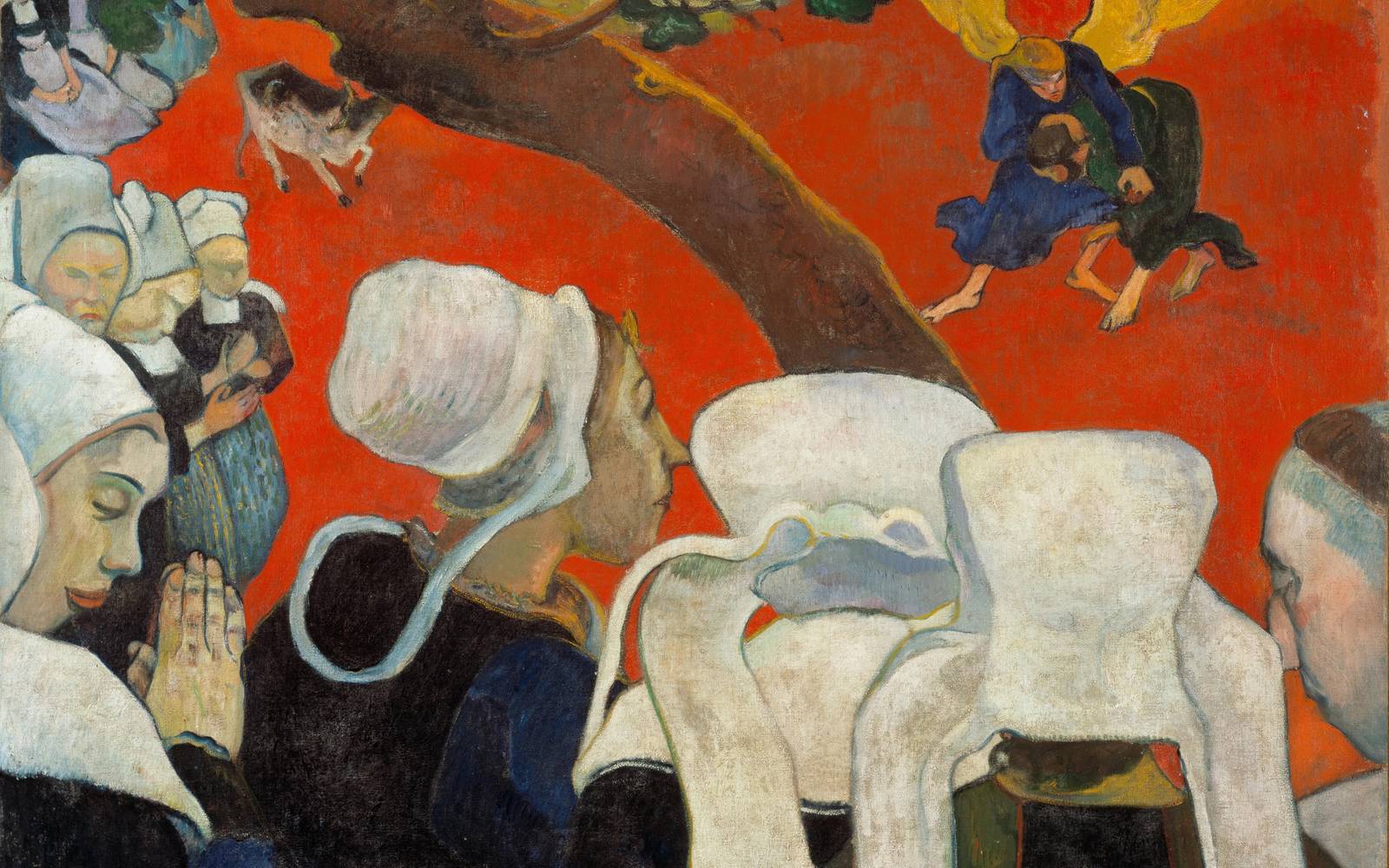
Image reference: Paul Gauguin’s Vision After the Sermon.
At a Glance
- Core periodinternational colony from the 1860s; experimental network principally 1888–94
- Main placesPont-Aven and nearby Le Pouldu in southern Brittany, with links to Paris, Arles and European art centres
- Leading artistsPaul Gauguin, Émile Bernard, Paul Sérusier, Charles Filiger, Meijer de Haan, Armand Seguin, Roderic O'Conor, Władysław Ślewiński, Maxime Maufra and Henry Moret
- Known forsimplified forms, strong contours, flat or organised colour, work from memory, religious and rural Breton subjects, printmaking and decorative experiment
- Related termsSynthetism, Cloisonnism, Symbolism and Post-Impressionism
- Important distinctionPont-Aven School is a later umbrella term, not a formal organisation or a single style
Contents
- Where it fits
- The artists’ colony
- Gauguin and Bernard
- Changing how pictures work
- Four stages
- Beyond the heroic pair
- Essential works
- How to look
- Where to see
- Artist directory
Where the Pont-Aven School fits
Paul Gauguin
Key career periodÉmile Bernard
Key career periodPaul Sérusier
Key career periodCharles Filiger
Key career periodMeijer de Haan
Key career periodRoderic O'Conor
Key career periodWładysław Ślewiński
Key career periodHenry Moret
Key career periodThe Pont-Aven School was not a school in the ordinary sense. It had no building, fixed membership, entrance rules or agreed manifesto. The name was applied retrospectively to a varied company of painters and printmakers who worked in and around a small Breton town during the late nineteenth century. Some came for a season and moved on. Others returned for years. A smaller circle, brought together by Paul Gauguin and Émile Bernard in the later 1880s, transformed those encounters into one of the decisive experiments of early modern art. The label is useful only when it preserves that diversity rather than hiding it.[1]
Two overlapping histories therefore run through this movement. The first is the international artists' colony established before Gauguin arrived: American painters were followed by British, Scandinavian, Dutch, Irish and French visitors attracted by landscape, relatively modest costs and a working community. The second is the radical network of approximately 1888–94, when artists debated how memory, feeling, line and colour might replace literal imitation. The breakthrough belonged neither to a solitary genius nor to every visitor who carried an easel beside the Aven. It grew through collaboration, rivalry and movement between places.[2]
A place made for an artists' colony
Pont-Aven lies where a river, mills, roads, fields and a busy harbour met. Its attraction cannot be reduced to an allegedly untouched countryside. The town offered compressed variety: wooded paths around the Bois d'Amour, moving water and mill wheels, streets and inns, farms inland, chapels and calvaries, and coastal terrain within reach. A museum guide emphasises the harbour's connection between agricultural and maritime worlds. This continual movement helps explain why the place could support landscape, figure painting and scenes of work without requiring artists to travel far each day.[3]
Modern infrastructure made the apparent retreat from modernity possible. Rail connections brought Brittany closer to Paris; lodgings supplied rooms, meals and sociability; local people worked as models; and some establishments provided or helped arrange studios. Julia Guillou's hotel and Marie-Jeanne Gloanec's pension became durable artistic institutions because their proprietors understood the unusual rhythms and finances of visiting painters. The colony was not simply discovered in nature. It was made through transport, hospitality, local labour and repeated recommendation from one artist to another.[4]
Foreign artists were established at Pont-Aven by 1866, and a local historical route estimates that around a hundred artists could be present during the summer by the time Gauguin first came in 1886. That scale matters. It means that his arrival did not found the colony; he entered a recognised destination with customs, rivalries and an existing visual economy. The later fame of his circle has compressed this larger population into a prologue, yet academic naturalists and plein-air painters helped create the conditions in which the experiment of 1888 could occur.[5]
Nor was the colony confined to oil paintings now reproduced as masterpieces. Artists drew continuously, testing simplified silhouettes and broad contour as portable, inexpensive means of study. A Musée d'Orsay exhibition on Pont-Aven drawings identified a network active between 1886 and 1896 that included Bernard, Sérusier, Filiger, Mogens Ballin, Maufra, Jan Verkade, Claude-Émile Schuffenecker and others. Their works on paper show individual temperaments, but also a shared pressure toward lines that clarify and condense rather than imitate every visible incident.[6]
Gauguin, Bernard and the disputed change of 1888
Gauguin first stayed at Pont-Aven in 1886, still carrying an Impressionism shaped interest in direct observation and broken handling. He returned after travel to Panama and Martinique with a stronger determination to organise pictures rather than record optical appearances. Bernard, considerably younger, arrived again in August 1888. Their close exchange was productive because their paths had been different. Bernard and Louis Anquetin had already developed paintings in which large colour zones and emphatic boundaries reduced modelling, perspective and atmospheric continuity.
The term Cloisonnism described that method by analogy with cloisonné enamel or stained glass: areas are contained by dark outlines as if separated by metal strips or leading. It is a visual procedure rather than a complete philosophy. The historical sequence also complicates the familiar master-and-disciple story. French museum scholarship places Bernard and Anquetin's experiments before Bernard's intensive work with Gauguin in Brittany, and records the later dispute over who deserved credit for the new direction.[7]
Synthetism named a broader ambition. The artist would synthesise three things: the outward appearance of a subject, the feeling or idea it awakened, and the autonomous order of the picture's lines and colours. A landscape could begin in observation but be reconstructed from memory; a red field could carry spiritual or emotional force without behaving like natural light; a figure could be simplified until it became both a person and a strong decorative shape. Cloisonnist contour could serve this purpose, but not every Synthetist painting looks alike, and not every outlined picture is a complete statement of Synthetism.
It is more accurate to understand 1888 as an intense laboratory than as the date when one man handed down a finished doctrine. Bernard supplied daring simplifications, existing experiments and intellectual energy. Gauguin contributed experience, ambition, a powerful instinct for synthesis and a growing authority among younger artists. They looked at one another's work, argued, borrowed, exchanged portraits and competed for recognition. Their relationship made new pictures possible, but it also produced incompatible memories of who had led whom.
Pictures that changed the terms of seeing
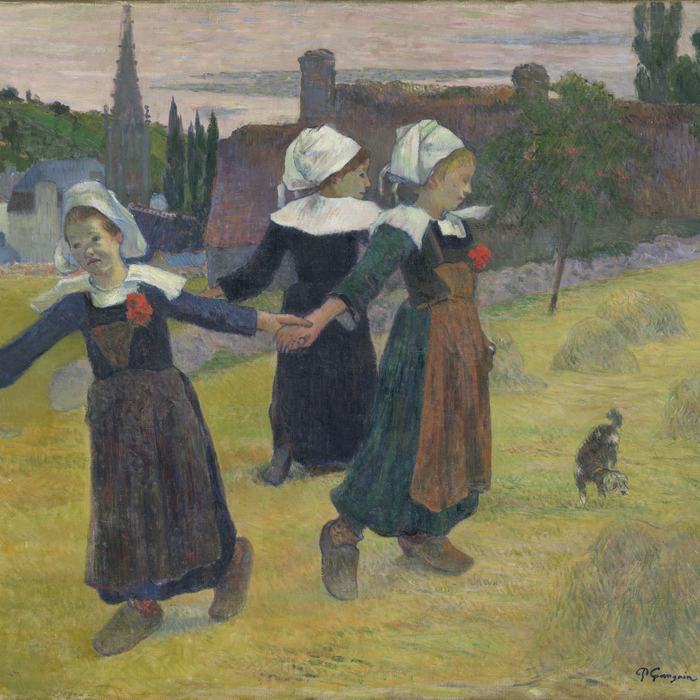
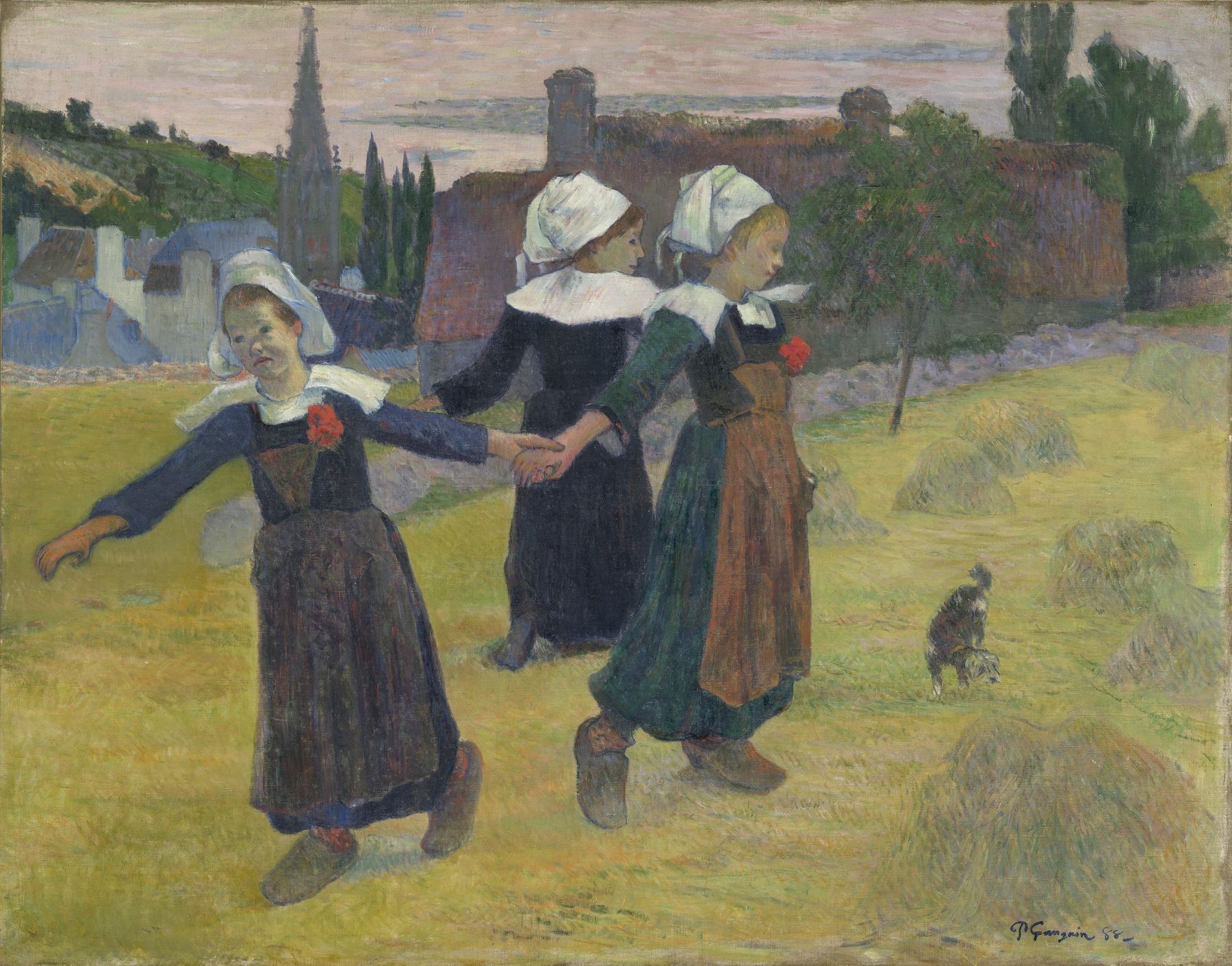
Gauguin's Breton Girls Dancing, Pont-Aven still contains a legible town, field, stone wall and familiar costume. Yet its three girls loom unusually large, their linked arms creating a zigzag chain across shallow space. Patches of green, blue, dark cloth and white collars build a pattern more forceful than an anecdote about village recreation. A National Gallery of Art record identifies the 1888 canvas and its local subject, while its detailed visual description makes clear how contour and colour organise the figures against the distant settlement.[8]
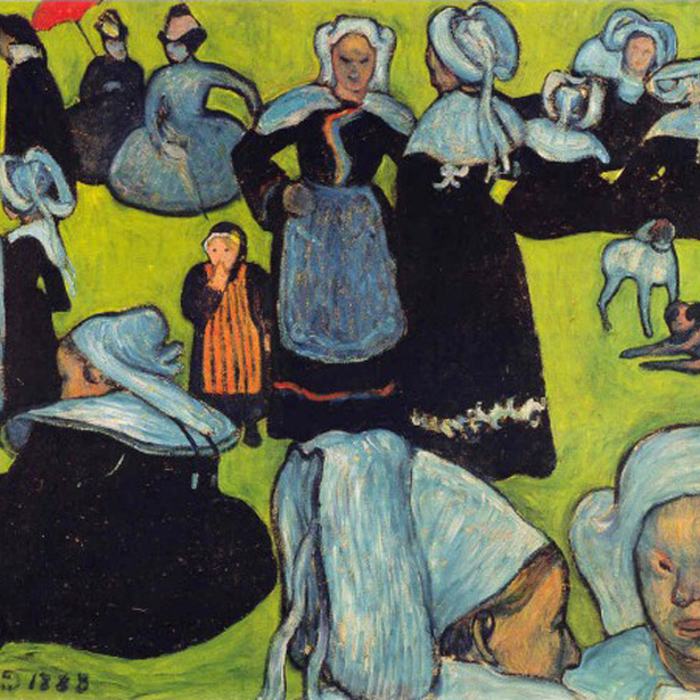
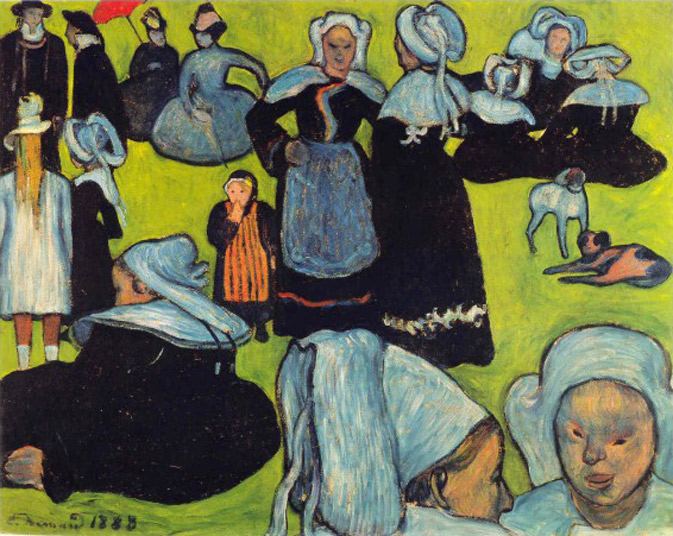
Bernard's Breton Women in a Green Meadow, also known as Breton Women in the Meadow, pushes farther. Repeated profiles and white caps are set against broad green, with scale and spacing answering the picture surface more than Renaissance perspective. The women become a rhythm without ceasing to signify recognisable local dress. Later reproductions and exhibitions made the canvas a touchstone in arguments about priority, but its importance does not depend on crowning Bernard sole inventor. It demonstrates how a communal subject could become an anti-naturalistic arrangement.[9]
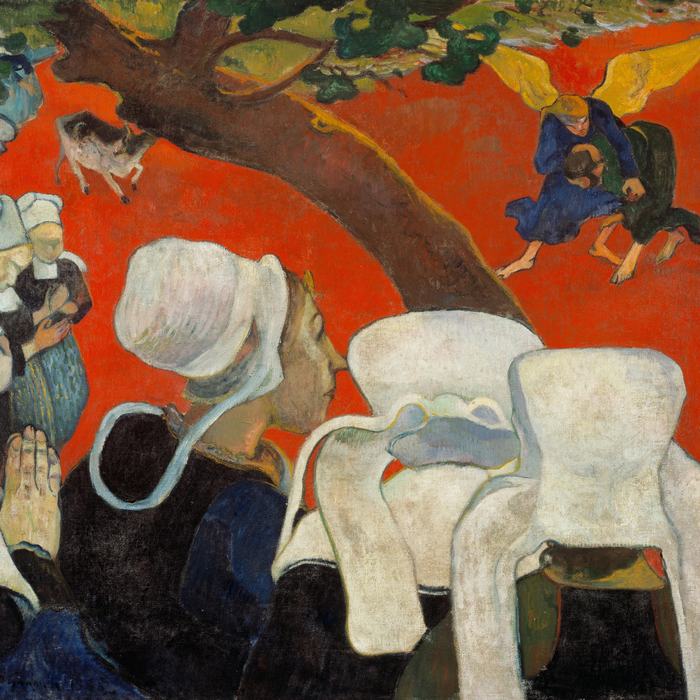
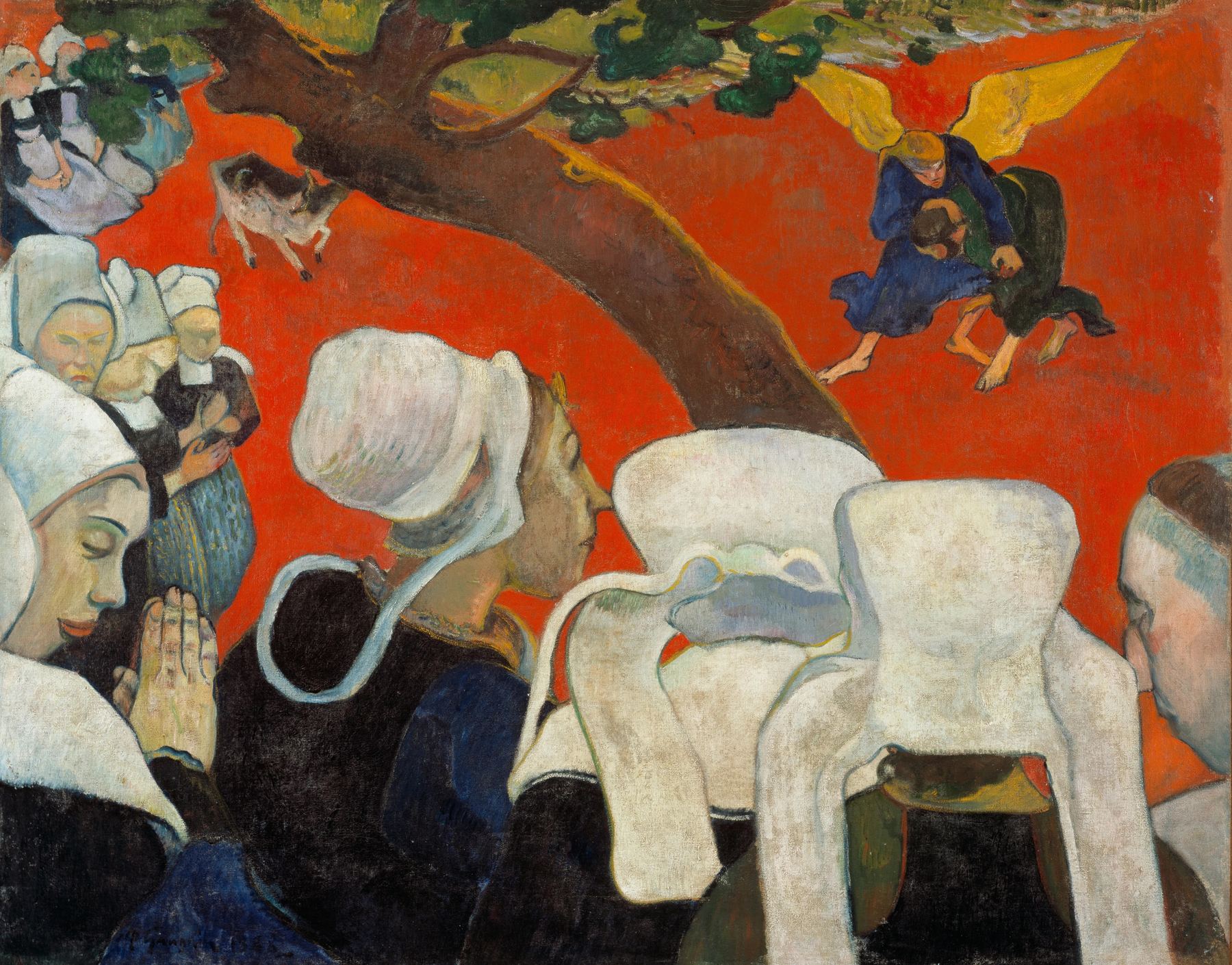
Gauguin's Vision After the Sermon makes the break unmistakable. Breton women occupy the foreground after hearing the biblical story of Jacob wrestling an angel. A diagonal apple-tree trunk divides their material presence from the struggle imagined beyond it. The red ground is neither an accurately observed field nor conventional heavenly space; it is the pictorial condition that lets belief become visible. Gauguin explained that the fight existed in the worshippers' imagination. The National Galleries of Scotland consequently describes the painting as a manifesto for an art of ideas and expressive distortion, and records that local churches refused his attempts to give it to them.[10]
The women are not passive spectators within the composition. Their caps create a repeated white architecture, and their cropped bodies place the viewer among rather than above the congregation. Yet the painting remains a visiting artist's construction of Breton faith. It does not prove that a real group collectively saw this vision, nor does its purposeful severity provide transparent ethnography. Its achievement lies in turning the tension between observed costume and invented event into the picture's structure.
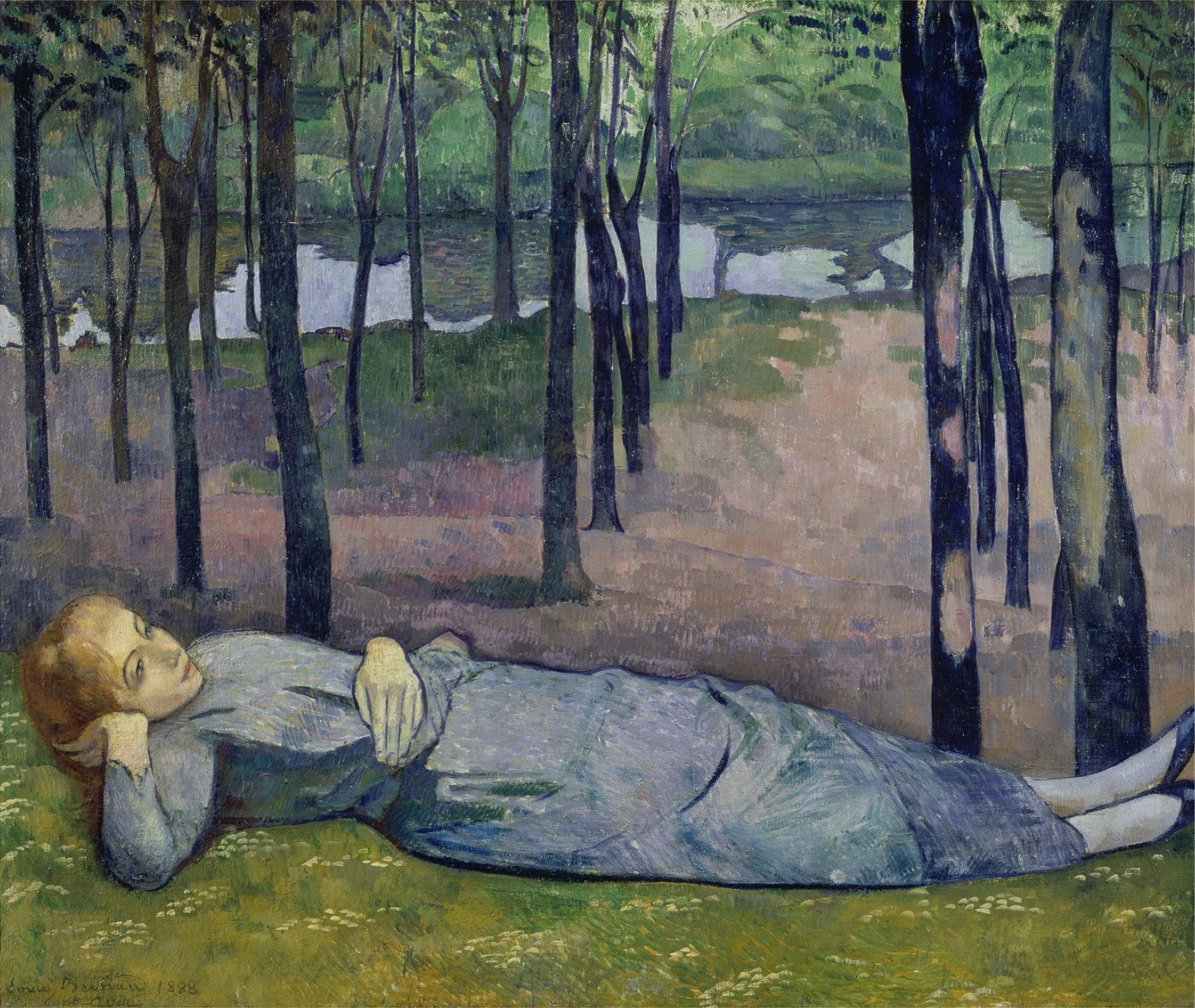
Bernard's Madeleine in the Bois d'Amour offers a different experiment. His seventeen-year-old sister lies across the foreground at nearly life size, her dark dress forming a long horizontal barrier. Behind her, the Aven curves through trees. Musée d'Orsay research notes that the figure and landscape were developed in the studio from work made separately, and that their calculated parallels do not entirely merge. That lack of seamlessness is revealing: Synthetism was not a formula that automatically reconciled figure, memory and place, but a difficult attempt to construct their relationship.[11]
The Talisman and the making of an origin story
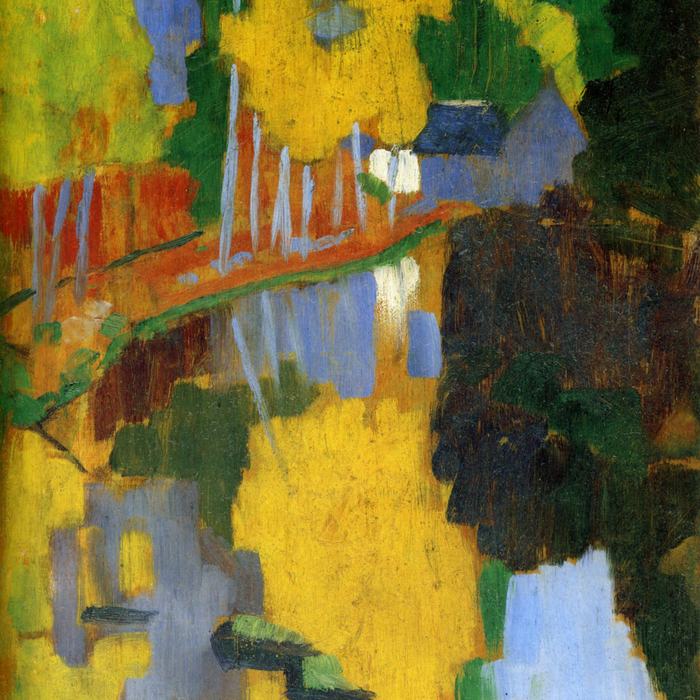
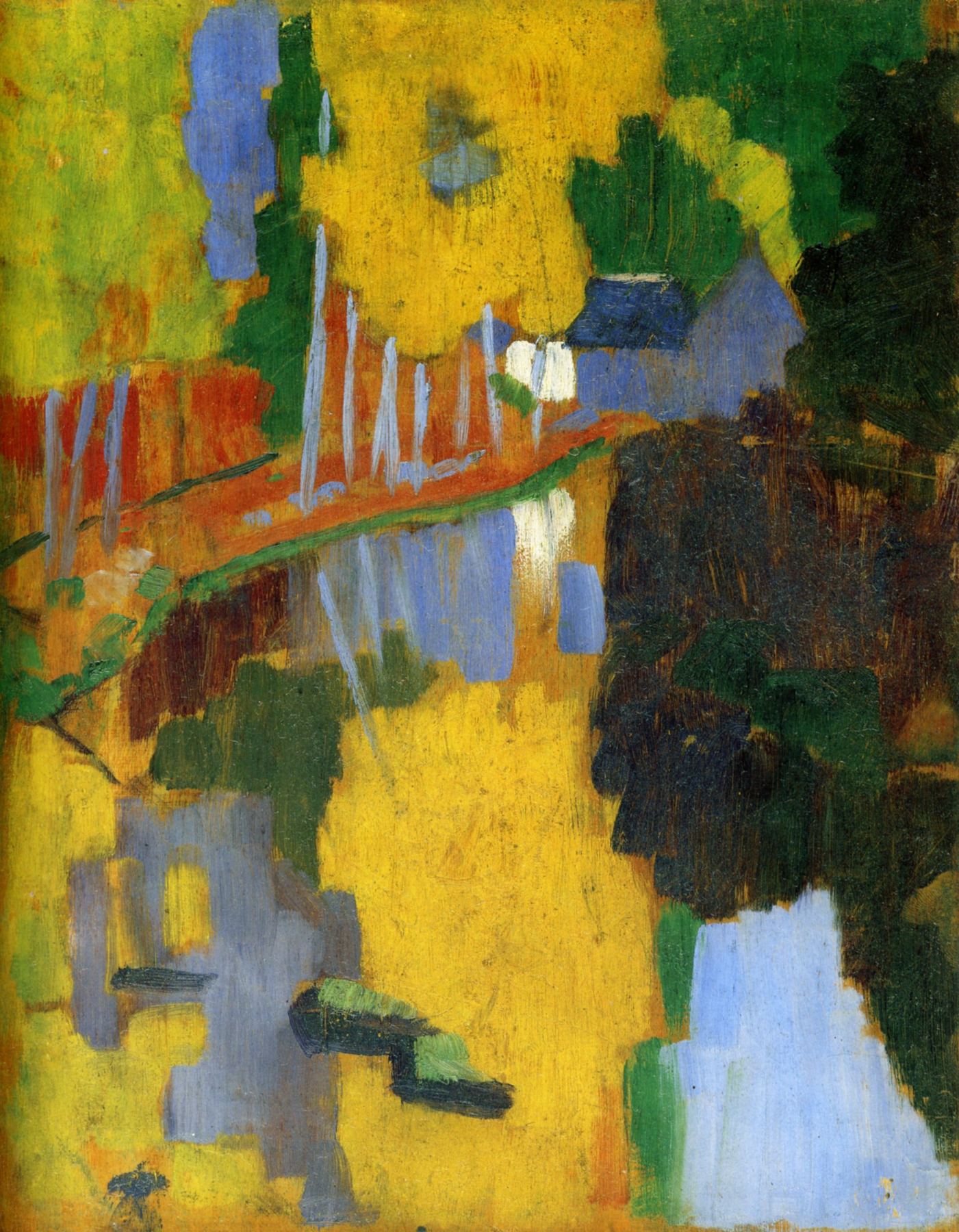
In October 1888 Paul Sérusier painted a small view of the Aven at the Bois d'Amour on a wooden panel. An inscription on its reverse says it was made under Gauguin's direction. Back in Paris, Sérusier showed the work to fellow students at the Académie Julian; it later acquired the title The Talisman and became an emblem for the Nabis. Pure or heightened patches of yellow, green, blue and reddish brown appear to hover between landscape description and autonomous colour.
Its influence is real, but so is its mythology. Musée d'Orsay has stressed that the panel is now often viewed for its legendary role rather than its own qualities. The familiar tale—a master gives a single liberating lesson and a new movement is born—was consolidated after the event. Looking closely restores the uncertainty: traces of riverbank and trees remain, the support is small and provisional, and the painting is both an experiment made outdoors and an object repeatedly reinterpreted by its later owners and admirers.[12]
Sérusier did not merely transmit Gauguin. In paintings such as Breton Wrestling, he made local custom into a strongly compressed stage. Two boys grapple while spectators, especially women in traditional caps, form an enclosing pattern. The shallow space, forthright colour and emphatic boundaries connect the picture with Pont-Aven experiment and Japanese art, but its compact, almost emblematic human action is Sérusier's own. He would later become a theorist who sought measure and spiritual order rather than simply repeating the spontaneity attributed to The Talisman.[13]
Religion, portraiture and the invented image of Brittany
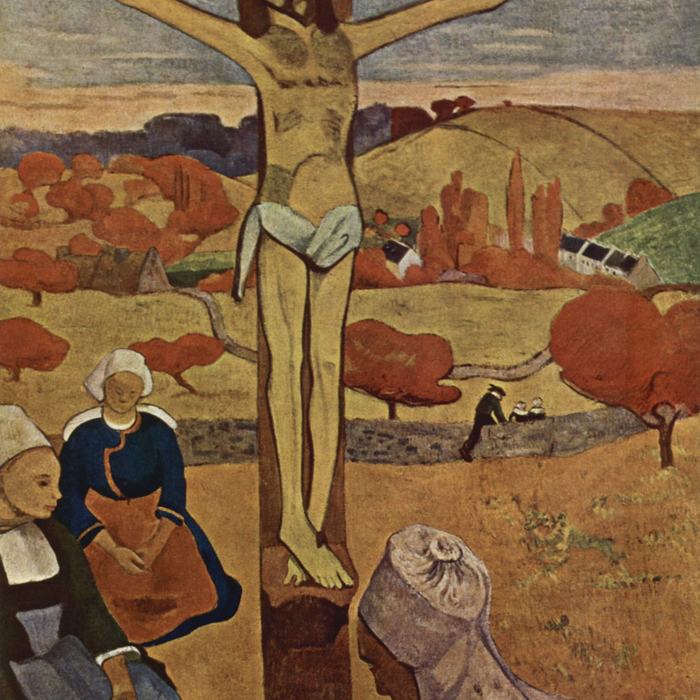
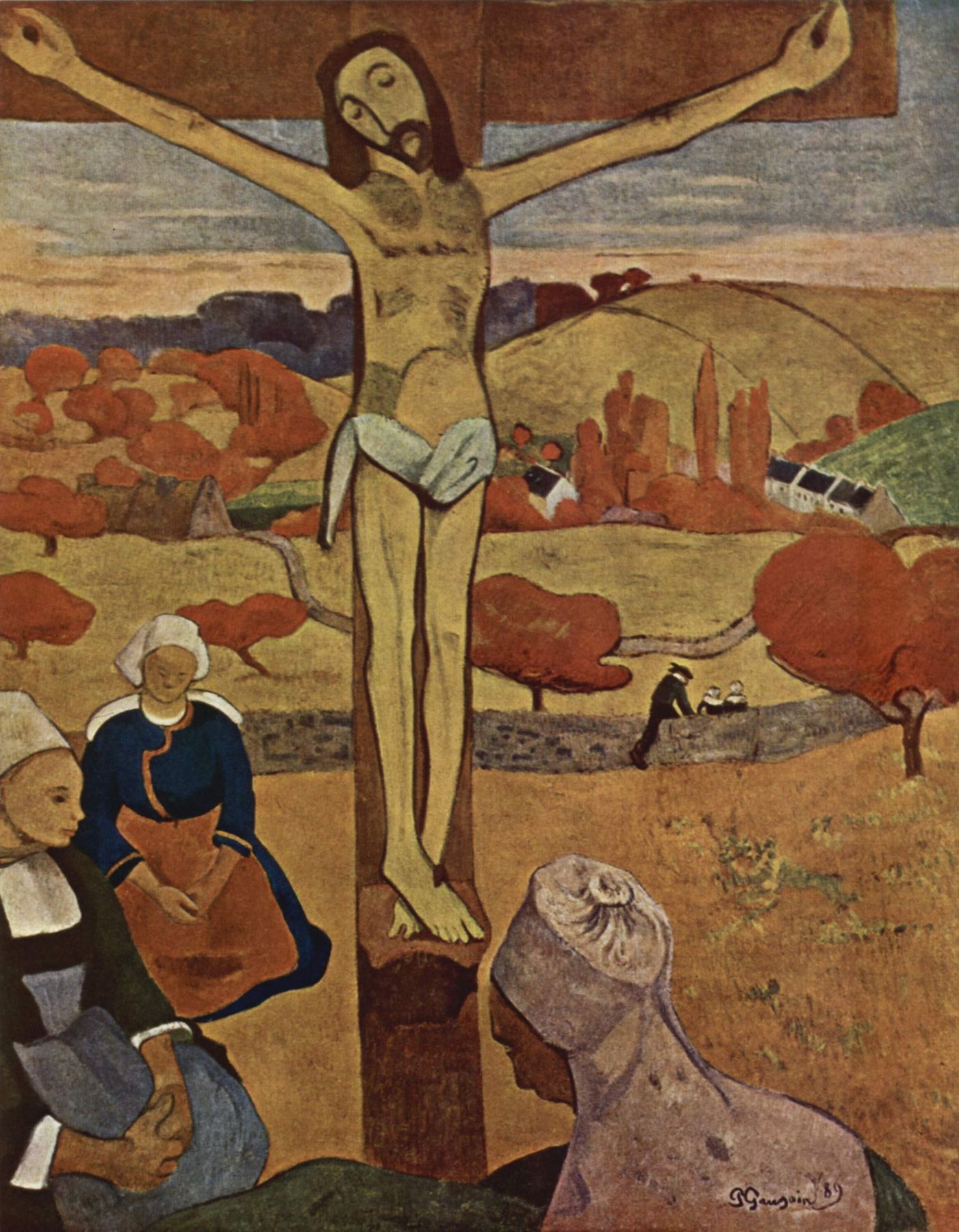
Religious subjects allowed the circle to join local visible culture to inward experience. Calvaries, chapels, pardons and distinctive worship practices supplied motifs, yet the resulting pictures are imaginative constructions. The Yellow Christ of 1889 places a mustard-yellow crucified figure above women in Breton dress within an autumn landscape. The source was connected to a local polychrome crucifix, but Gauguin's colour and spatial compression detach the image from ordinary church setting. The canvas now in Buffalo belongs to the Pont-Aven period's most concentrated union of folk reference, personal symbolism and decorative order.[14]
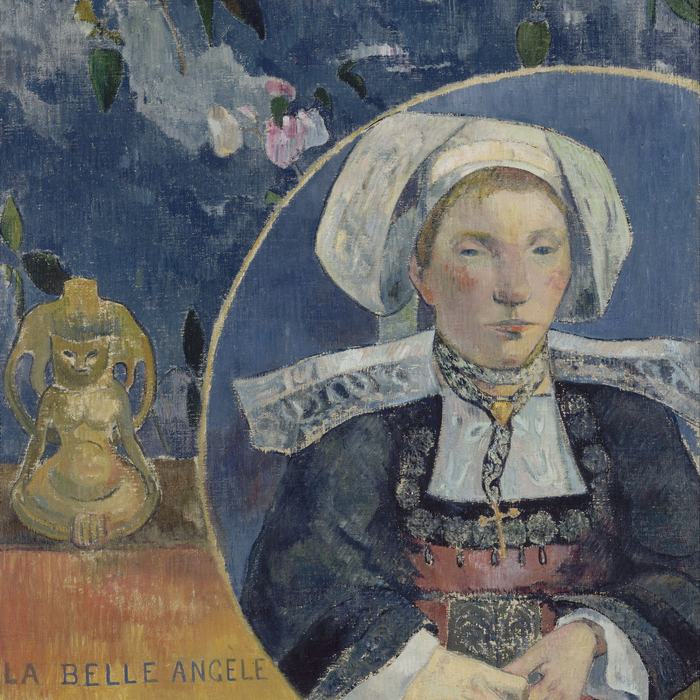
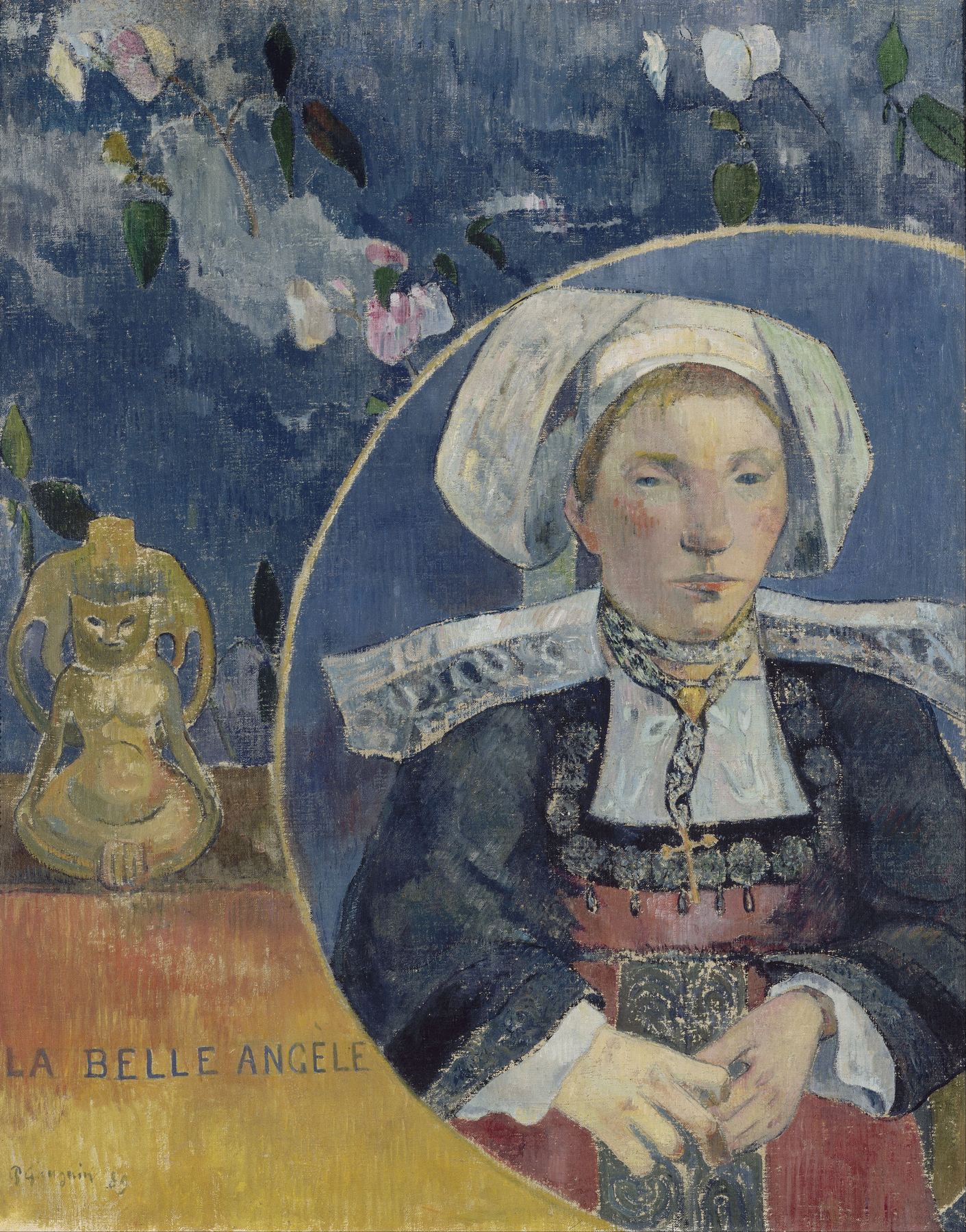
La Belle Angèle approaches a living sitter with comparable strangeness. Angélique-Marie Satre, associated with an inn at Pont-Aven and admired locally, appears within an inscribed circular field. Decorative foliage and an anthropomorphic ceramic object occupy the surrounding space, preventing the portrait from settling into a conventional room. Grand Palais analysis connects this construction to multiple symbolic and decorative sources: identity is presented through an arrangement of signs rather than the illusion of an encounter in continuous depth.[15]
Satre disliked the picture and refused it. That response deserves more than a colourful footnote. The sitter was capable of judging how a visiting artist had represented her, and the painting's modern reputation does not cancel her refusal. Its later provenance—through Edgar Degas, Ambroise Vollard and eventually the French national collection—shows how dealer and museum histories converted a rejected likeness into a canonical work.[16]
Bernard also made Breton religious gatherings and women in regional dress central to his new painting. A museum account of his development identifies an 1888 landscape as part of the experimentation that soon produced Breton Women in a Green Meadow, pairing it historically with Gauguin's Vision. The point is not that the two canvases are interchangeable, but that the decisive formal turn arose through parallel works in active dialogue.[17]
By 1891, critic Albert Aurier used Gauguin to define a Symbolist painting that would be ideational, symbolic, synthetic, subjective and decorative. His formulation clarified how far the Breton experiments could travel beyond a local school. It also helped make Gauguin the movement's exemplary figure after the collaborative moment. The critical category followed paintings, letters and exchanges already underway; it did not create them from nothing.[18]
Within wider Symbolism, Vision of the Sermon became powerful because it converts an inner event into a public composition without relying on conventional allegory. Symbolist artists across Europe shifted attention from direct natural description toward dreams, spiritual states, myths and unstable perception. Pont-Aven supplied one route into that larger field, not the field in its entirety.[19]
Pont-Aven and Le Pouldu
The two places should not be merged. Pont-Aven was an established colony with multiple inns, long seasonal traffic and a growing artistic reputation. Le Pouldu was a smaller coastal settlement several miles away, where Gauguin and companions sought a tighter, less crowded working environment. Movement between them connected the histories, but their social character and chronology differed.
In October 1889 Gauguin and Meijer de Haan moved into the Buvette de la Plage run by Marie Henry. Sérusier and Filiger joined them for periods, and other artists visited. The dining room gradually became a collaborative interior: walls, doors and ceiling received paintings and decoration. De Haan painted Maternity, showing Marie Henry nursing her daughter Marie-Léa, as well as still lifes whose tilted planes and colour relationships reveal a rapid transformation. He financially supported Gauguin for a time in exchange for instruction, but the surviving work shows negotiation rather than mechanical obedience.[20]
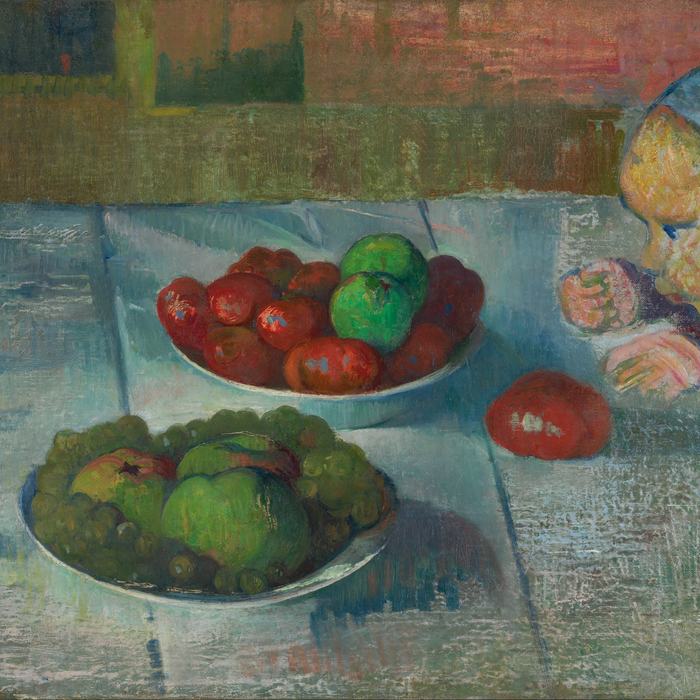
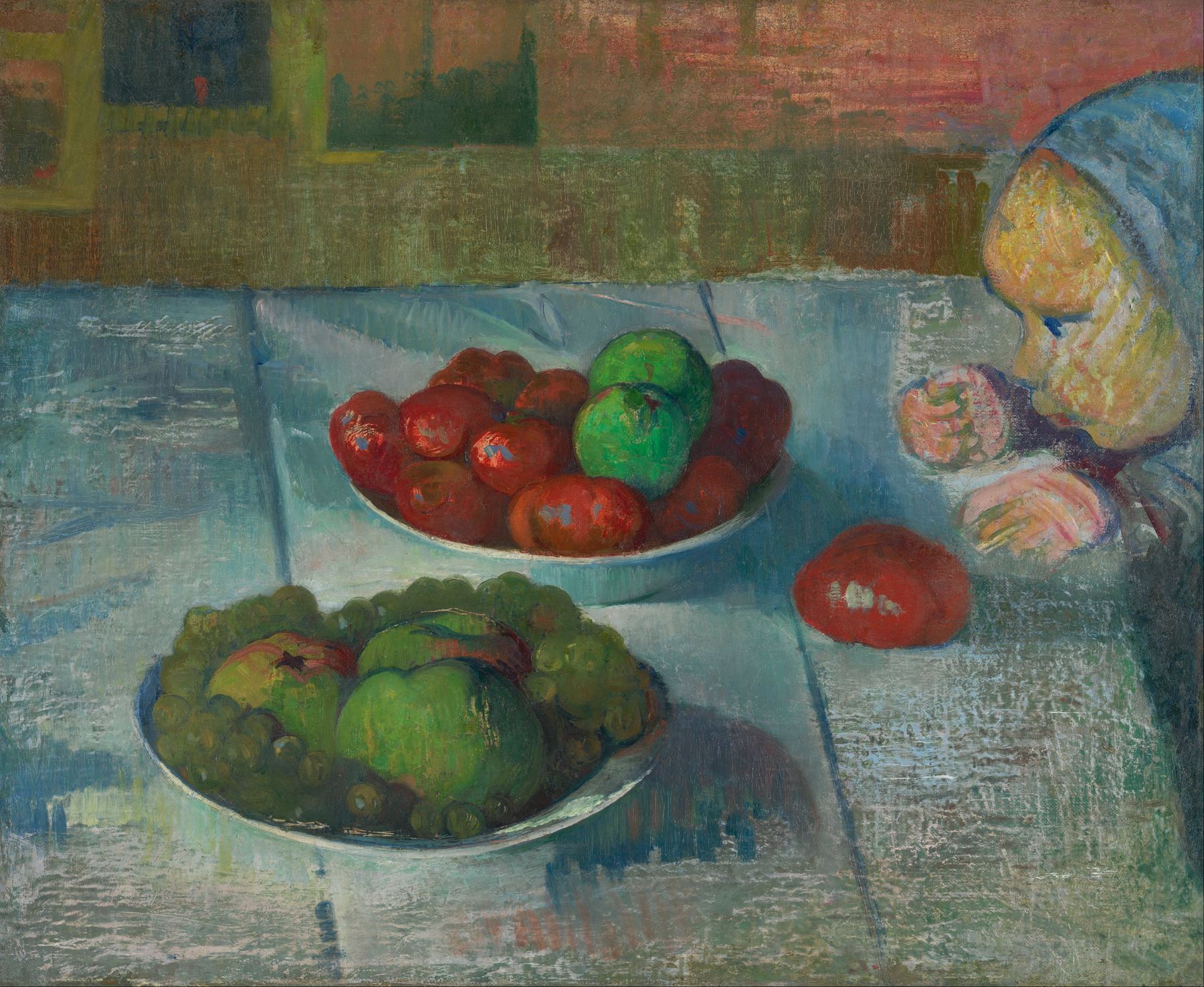
Dutch interpretation at the Van Gogh Museum describes de Haan's style as changing radically under Gauguin's influence, especially in Still Life with a Profile of Mimi. The cropped child, vivid colour and forward-tilting table connect him with the group's experiments while remaining a highly particular domestic image. The same Dutch gallery account places the portrait exchange among Gauguin, Bernard, Charles Laval and Vincent van Gogh within a network that crossed Brittany, Arles and Paris through letters and pictures.[21]
Marie Henry made this environment possible. She was the inn's proprietor, later identified by Musée d'Orsay as a collector, and she retained works left in the building after the artists departed. The record of her receipts and correspondence gives her a material place in the history of collection and survival. She was also de Haan's partner and the mother of their daughter Ida. These facts belong to the story, but not as romance attached to male achievement: they show a household in which artistic labour, care, business, intimacy and ownership were inseparable.[22]
The painted dining room was more than an eccentric backdrop. By moving art onto cupboards, doors and ceiling, its makers challenged the separation between easel picture and daily environment. It anticipated the Nabis' later work in screens, panels, illustration and domestic decoration. What survives in museums should be imagined as fragments of an inhabited ensemble in which conversation, meals, music and work occurred together.
Painting beyond the heroic pair
The Pont-Aven network is diminished when every artist becomes a satellite of Gauguin. The local museum instead describes a group sharing ideas outside official teaching, not a master encircled by obedient pupils. Artists worked together and learned from one another, but retained personal aesthetics and could depart from the new manner. This model accounts better for the variety visible in their later careers.[23]
Charles Filiger settled at Le Pouldu in 1889 after training at the Académie Colarossi. He painted and made prints, played music, and developed small religious heads, landscapes and later “chromatic notations.” Their hieratic symmetry and concentrated geometry can resemble icons or private devotional objects more than Gauguin's large narrative canvases. His long, difficult Breton career also warns against treating participation in an avant-garde network as a guarantee of stable recognition or livelihood.[24]
Armand Seguin pursued painting, etching and other graphic processes with a spare linear intelligence. His portrait Gabrielle Vien has travelled through exhibitions devoted to the Independents, Pont-Aven, Gauguin and international Post-Impressionism, evidence that his work has repeatedly been framed through larger group stories. Yet a close look at his prints—the pressure of a contour, the controlled interval of untouched paper—reveals decisions that cannot be described adequately as diluted Gauguin.[25]
Roderic O'Conor arrived with Irish education and experience in Antwerp, Paris and other artists' colonies. He experimented with Impressionism, Neo-Impressionism and Pointillism before coming into contact with Gauguin's circle. He later exhibited with Gauguin, Bonnard, Sérusier and Symbolist artists in Paris. This mobile career makes him an agent of transmission rather than a national add-on to a French narrative.[26]
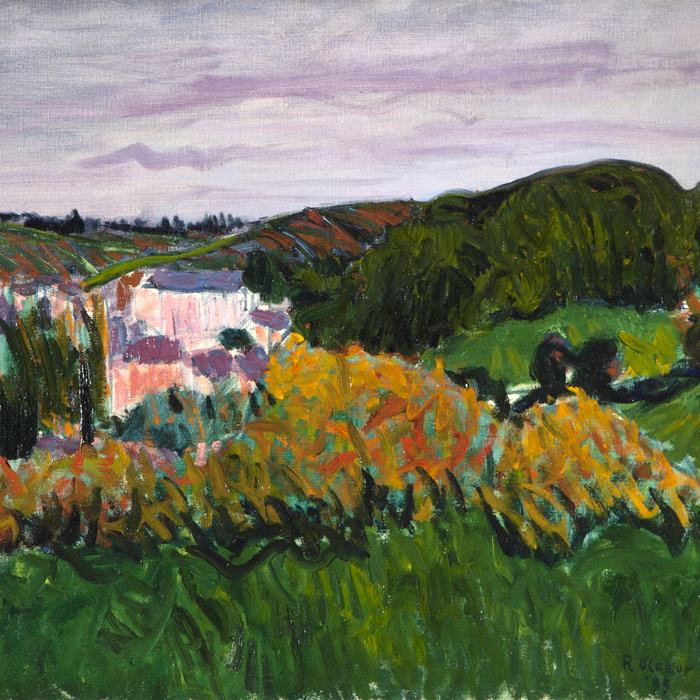
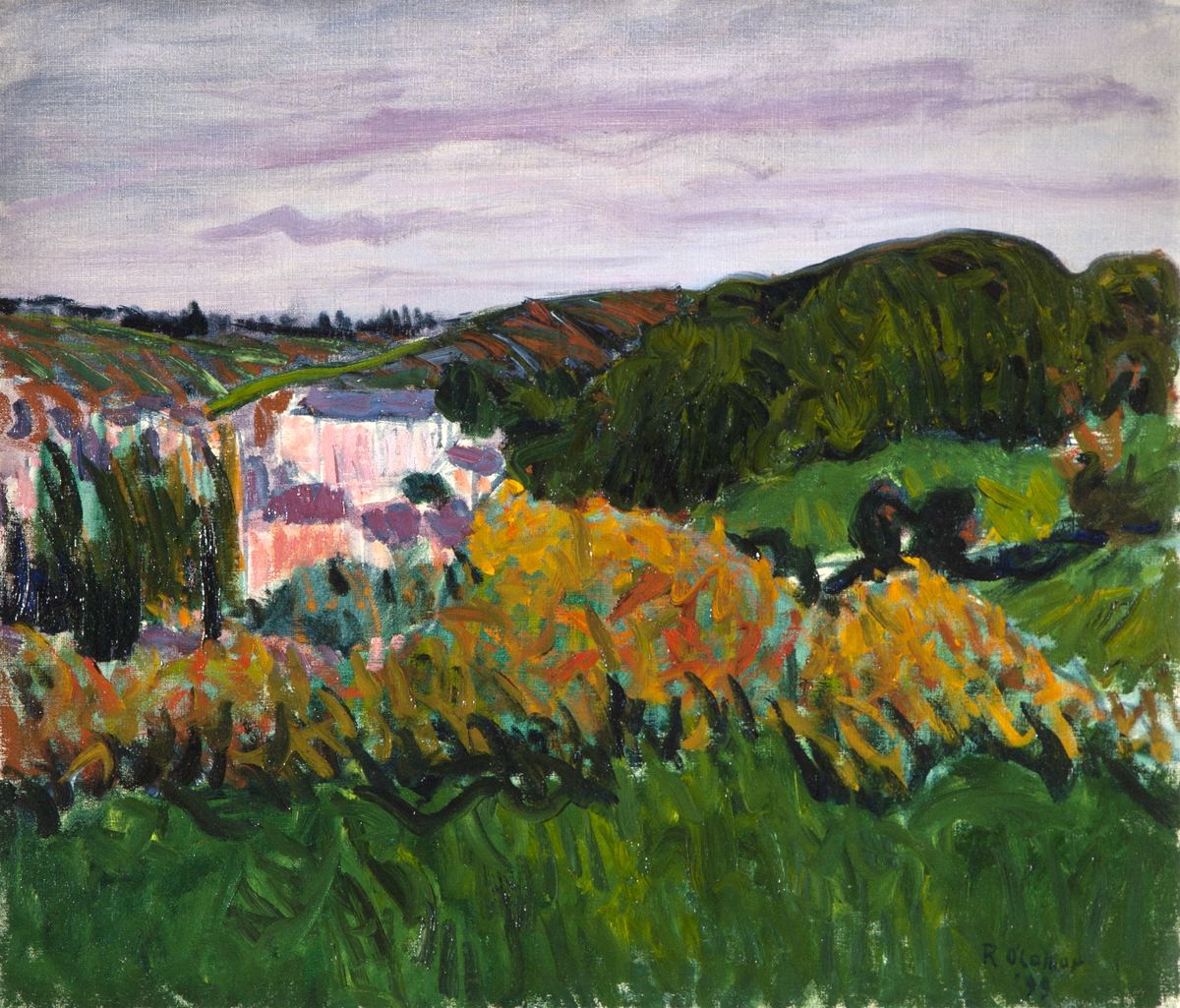
O'Conor returned to Pont-Aven in 1891 and remained in the region for more than a decade. In his Breton landscapes, parallel bands, forceful colour and increasingly thick paint turn fields, buildings and coast into rhythmic surfaces without abandoning weather or terrain. The extended stay matters: Pont-Aven was not merely a dramatic 1888 encounter for every artist, but for some a working base through which change accumulated slowly.[27]
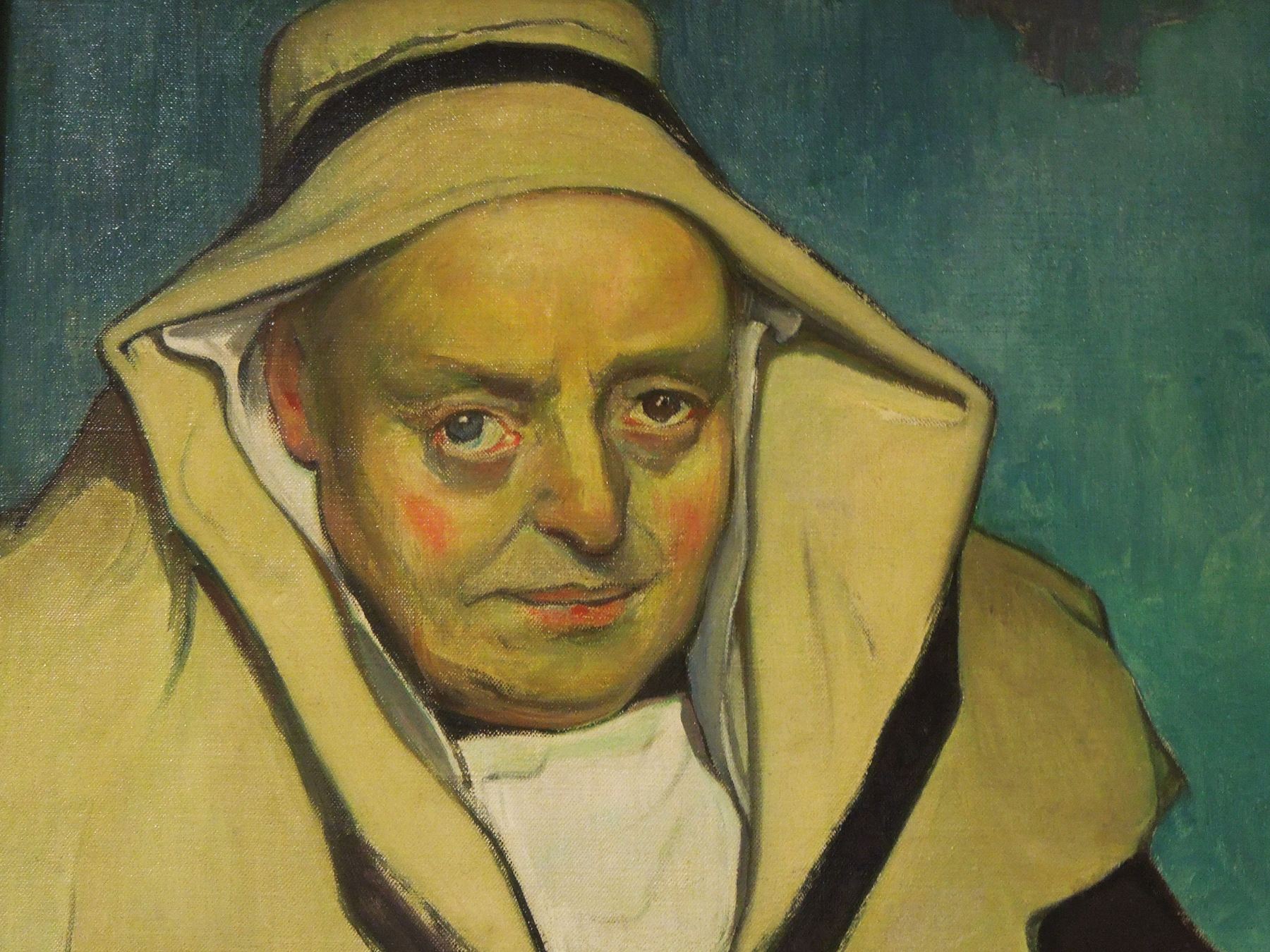
The Polish painter Władysław Ślewiński also made Brittany a sustained centre of life and work. In Old Breton Woman, a lowered head, reduced setting and muted harmonies create concentration without turning the sitter into colourful spectacle. Polish museum scholarship records that he went to Brittany from 1889, first with the Pont-Aven circle and later to his own home near Le Pouldu. His restraint differs sharply from the most saturated Gauguins.[28]
Ślewiński carried this experience into Polish modernism. Woman Combing Her Hair uses a broad contour and economical setting, yet its subdued palette and intimate tempo are his own. The National Museum in Kraków places his development in relation to French Synthetism and the Pont-Aven circle while identifying him as one of the Polish artists who redirected study from Munich toward Paris. Influence here became translation across subject, nation and institutional culture.[29]
Maxime Maufra and Henry Moret demonstrate another kind of independence. Both could use simplification and heightened colour, yet they continued to study Atlantic atmosphere, coastal weather and moving light. After Gauguin's departure, artists associated with Pont-Aven dispersed, and some returned deliberately to plein-air methods and the vibrating surfaces linked with Claude Monet. The local museum's exhibition on “Impressionism after Pont-Aven” makes this plurality explicit: flat colour did not permanently replace observed atmosphere for the entire circle.[30]
Prints, furniture and the portable movement
Paintings made Pont-Aven famous, but prints helped the new ideas travel. Gauguin's 1889 Volpini suite comprised zincographs drawn in black on striking yellow paper. A museum object record identifies Breton Women beside a Fence as part of that portfolio. Translation into zincography reduced colour while sharpening silhouette, mark and tonal mass; the medium did not simply reproduce a painting but rethought it.[31]
The Café Volpini exhibition, mounted near the Exposition Universelle in Paris, presented the “Groupe impressionniste et synthétiste.” Participants included Gauguin, Bernard, Schuffenecker, Charles Laval, Louis Anquetin, Léon Fauché, Louis Roy and Daniel de Monfreid. The accompanying albums of Gauguin lithographs and Bernard zincographs sought a wider audience. Attendance and sales did not amount to an immediate conquest, but the event gave a loose network a public name and a reproducible visual identity.[32]
The graphic circle extended well beyond the two best-known painters. A later Museum of Modern Art exhibition brought together prints by Sérusier, O'Conor, Cuno Amiet, Henri Delavallée, Bernard, Gauguin and others. That list shows artists carrying Breton encounters into Irish, Swiss and other European contexts while using etching, lithography, zincography and woodcut in different ways.[33]
Print scholarship also corrects the fantasy of an isolated rural refuge. Artists selected churches, costumes, coastline and peasant labour while often ignoring signs of industrialisation and prosperity that complicated their desired Brittany. The portable print could intensify that selection by condensing a place into repeated motifs. It circulated not Brittany itself, but a constructed image of it.[34]
Gauguin and Bernard's painted cabinet Earthly Paradise makes shared invention unusually tangible. Made in 1888, it combines carved and painted furniture with non-illusionistic space, flat colour and heavy outline. The Art Institute of Chicago describes it as the product of both collaboration and competition. A useful history of Pont-Aven should keep both nouns: the artists could work together on an object while contesting authorship and authority.[35]
Gauguin's broader practice included ceramics, carved wood, drawing, prints, painting and decorated furniture. These were not hobbies surrounding the serious canvases. Changes of material encouraged different types of simplification, touch and scale. His move across media helped make the Pont-Aven experiment decorative in the strongest sense: line and colour could organise an object or room rather than simulate a window onto depth.[36]
Japanese woodblock prints were part of this material world. They were reportedly hung in Gauguin's Pont-Aven studio and again in the large workroom at Le Pouldu. Cropping, flat colour, patterned surfaces and unexpectedly tilted or emptied spaces entered French art through a broad Japoniste culture; no single borrowed motif explains Pont-Aven. The presence of prints by artists such as Hokusai and Utamaro nevertheless reminds us that the supposed recovery of local Breton authenticity was shaped by objects circulating globally.[37]
Printmaking could intensify an artist's thought. Drawing directly on a zinc plate compelled Gauguin to reduce compositions and find expressive equivalents in tonal contrast. A Metropolitan Museum publication places these experiments within the larger revival of French printmaking during the eras of Impressionism and Symbolism. The portfolio was thus both personal advertisement and participation in a changing culture of reproducible art.[38]
Women in the colony and in its images
The colony's earlier history includes women artists who do not fit neatly inside the Gauguin-centred narrative. Marie Luplau belonged to the Scandinavian community, while Finnish painters including Helene Schjerfbeck, Amélie Lundahl, Maria Wiik and Elin Danielson-Gambogi came to the region in the early 1880s. A Musée de Pont-Aven collection essay notes that many travelled during summer closures of Paris academies. Their presence proves that international professional mobility preceded the later experimental “school.”[39]
Artists' colonies across Europe could operate as decentralised networks rather than formal institutions, and comparative research has shown that women formed significant portions of several colonies. Pont-Aven offered companionship and access to landscape, yet opportunity was still shaped by gendered training, travel, lodging and exhibition conditions. Restoring women to the colony does not require claiming that all embraced Synthetism; it requires recognising that the town's artistic life was larger than the style later canonised.[40]
Women are everywhere in the canonical images: dancing girls, washerwomen, worshippers, workers, mothers and sitters in regional dress. The repetition can make “the Breton woman” seem like a timeless type. A better reading asks what specific work, age, costume and setting are shown, who selected them, and which parts of modern life were excluded. It also asks how a design turns people into recurring shapes without assuming that formal beauty removes social distance.
Julia Guillou, Gloanec and Marie Henry belonged to the colony as organisers of its daily possibility. Their businesses were not neutral containers for male creativity. They evaluated guests, managed credit and rooms, sustained communal spaces, and in Henry's case retained and later negotiated works. Madeleine Bernard and Angélique Satre likewise cannot be reduced to surfaces: one participated in a family and artistic network; the other rejected the portrait now celebrated under her name.
Brittany, tourism and the problem of “primitivism”
Visiting artists often described Brittany as remote, simple, spiritual or “primitive.” Such language expressed dissatisfaction with Parisian commerce and industrial modernity, but it also transformed living Breton communities into a remedy for metropolitan anxieties. Railway travellers could admire signs of supposed timelessness precisely because modern transport, guidebooks and seasonal services delivered those signs to them.
Research on cultural tourism and academic painting shows that Breton identity was formulated through repeated images before the Pont-Aven avant-garde. Pardons, costumes, shorelines and rural labour were already legible to Salon audiences. Gauguin and Bernard radically changed the formal treatment of such motifs, but they did not invent the market's desire for them.[41]
The iconography also changed within the political and cultural conditions of the Third Republic. Features once treated as evidence of backwardness could be recoded as sources of spiritual or national authenticity for urban viewers. Scholarly work on community and nation in French painting demonstrates how the market rewarded a selective “Bretagne bretonnante.” Pont-Aven participated in that process even when its artists believed they were resisting metropolitan values.[42]
For this reason, primitivism should name the artists' strategy, not the people they represented. It describes a modern search for renewal in cultures imagined as earlier, less corrupted or closer to origins. The search could generate major formal innovations while simplifying real lives and unequal relations. A contemporary overview of Pont-Aven and Synthetism usefully joins the group's anti-naturalistic style to this backward-looking desire; readers should hold the achievement and the distortion together.[43]
Gauguin would carry the search farther, eventually to French Polynesia, where colonial power, sexual exploitation and self-mythology make the ethical stakes still sharper. Those later years are not the subject of the Pont-Aven School, but Brittany was not an innocent prelude. Here he practised presenting another community as material for a modern artist's renewal. The difference in colonial situation is substantial; the recurring structure of desire still deserves notice.
Exhibitions, dispersal and afterlives
Volpini supplied visibility but not unity. Its participants differed in style, and the exhibition's location beside rather than within the official Exposition Universelle made its independence both strategic and marginal. A 1987 MoMA press release records eighty-five later-gathered zincographs, etchings, lithographs and woodcuts by the circle. That abundance shows how subsequent collections and exhibitions constructed a coherent print movement from works originally dispersed among artists and places.[44]
Sérusier's return to Paris connected Pont-Aven with the Nabis. Maurice Denis, Pierre Bonnard, Édouard Vuillard and their colleagues did not copy Breton subjects as a rule; they drew consequences for colour, surface, domestic decoration, illustration and the status of the picture. Symbolists found in Gauguin an example of subjective, idea-led art. Other artists pursued Art Nouveau design, religious renewal or national modernisms. O'Conor, Ślewiński and Amiet carried the exchange across borders.
The movement also has quieter afterlives in archives and collection building. The Van Gogh Museum's English gallery texts present Sérusier's Farm in Brittany as a deliberately simplified search for timelessness and de Haan's Still Life with a Profile of Mimi as a distinct experimental composition. Such displays widen recognition beyond the heroic pair while showing how museums still negotiate the period's own pastoral language.[45]
De Haan's modern visibility depends partly on institutional recovery. A Dutch annual report describing the acquisition of Still Life with a Profile of Mimi emphasised both the rarity of his surviving paintings and the opportunity to strengthen the museum's Pont-Aven holdings. Scarcity is not proof of lesser importance; it reflects a short career, dispersal, loss and the collecting histories that decide which artists remain continuously visible.[46]
The Musée de Pont-Aven itself was founded only in 1985 and built a collection devoted both to the early American colony and the better-known later aesthetic. The French Ministry of Culture describes its remit as research and public presentation of artistic life from the 1860s onward. The museum therefore embodies the retrospective act behind the “school”: it gathers different generations so their relationships can be studied without pretending that they once formed one classroom.[47]
Follow the Pont-Aven School through four stages
The movement becomes easier to understand when its overlapping history is divided into four stages, provided the divisions are treated as a guide rather than rigid boundaries.
–mid-1880s
The international colony
First came the international colony, from the 1860s to the mid-1880s. Travelling painters established Pont-Aven as a practical summer centre. They worked outdoors, exchanged information about lodging and subjects, and made landscapes and scenes of Breton life in academic, naturalist and increasingly plein-air manners. Americans, British painters and artists from northern Europe were particularly important. Women participated in this stage in substantial numbers. Its legacy was an infrastructure: the town had already learned how to accommodate artists before its name became attached to a radical style.
–88
Convergence
The second stage, from 1886 to 1888, was one of convergence. Gauguin's first visit placed him inside the colony; Bernard, Laval, Delavallée, Schuffenecker and others brought experiments formed elsewhere. The crucial summer of 1888 did not erase their different beginnings. Instead, concentrated exchange revealed that outline, flattened colour, memory and subjective reconstruction could reinforce one another. The canonical canvases emerged at remarkable speed because ideas had arrived from several routes and were tested against shared places and subjects.
–91
Public and expanded media
The third stage, from 1889 to roughly 1891, made the experiment public and expanded its media. The Volpini exhibition carried a loose identity back to Paris. Print portfolios condensed the new language for circulation. Pont-Aven remained important, while Le Pouldu fostered a smaller household in which paintings, furniture, carvings and architectural decoration met. Sérusier transmitted the implications to the emerging Nabis; de Haan, Filiger and others pushed them toward individual forms. Gauguin's departure for Oceania in 1891 altered the network but did not bring every Breton practice to an end.
Dispersal and translation
The fourth stage, from the early 1890s onward, was dispersal and translation. Some artists stayed in Brittany; others returned to Paris or carried what they had learned to Ireland, Poland, Switzerland, the Netherlands and elsewhere. One painter strengthened contour, another revived atmospheric handling, and another converted colour into religious or decorative order. Dealers, critics, collectors and later museums selected certain works as origins of modernism. The “Pont-Aven School” that readers now encounter is partly the product of this afterlife: a useful map drawn across relationships that were never governed by one centre.
This four-stage view prevents two common errors. It stops Gauguin's arrival from swallowing the established colony, and it stops the celebrated year 1888 from becoming an isolated miracle. It also makes room for consequences that do not look like Gauguin. A coastal canvas by Moret, a muted Ślewiński still life, an O'Conor stripe painting or a Filiger sacred head can belong to the history without sharing one surface recipe.
Essential Pont-Aven School works
Vision After the Sermon
Paul Gauguin · 1888 · Gauguin divides worshippers from their imagined biblical struggle, using red ground, cropped figures and a diagonal tree to make belief visible without conventional naturalism.
Breton Girls Dancing, Pont-Aven
Paul Gauguin · 1888 · Large linked figures and shallow patterned space turn a local dance into an argument about contour, scale and organised colour.
Breton Women in a Green Meadow
Émile Bernard · 1888 · Bernard repeats caps and profiles across broad green, making recognisable Breton dress answer the flat order of the picture surface.
The Talisman
Paul Sérusier · 1888 · Sérusier's tiny panel hovers between a remembered landscape and autonomous patches of colour; its later origin legend is part of the work's history.
The Yellow Christ
Paul Gauguin · 1889 · A local crucifix, Breton worshippers and mustard-yellow colour combine in a religious image that is at once regional, personal and decorative.
La Belle Angèle
Paul Gauguin · 1889 · Gauguin encloses Angélique-Marie Satre within a circular field of signs, refusing the continuous room and easy intimacy of conventional portraiture.
Madeleine in the Bois d'Amour
Émile Bernard · 1888 · Bernard constructs a nearly life-size reclining figure and river landscape from separate studies, preserving the difficulty of synthesising person, memory and place.
Still Life with a Profile of Mimi
Meijer de Haan · 1889–90 · De Haan's cropped child, vivid colour and tilted tabletop translate the group's experiments into a specific domestic still life.
View of Pont-Aven
Roderic O'Conor · 1899 · O'Conor treats the town as a sustained working landscape rather than a single 1888 revelation, keeping terrain and atmosphere within a rhythmic surface.
Old Breton Woman
Władysław Ślewiński · c. 1896 · Ślewiński's lowered head, reduced setting and muted harmonies create concentration without turning the sitter into picturesque spectacle.
How to look at a Pont-Aven picture
Begin by separating subject from structure. Identify the person, ritual, field, river or coast, then notice how the picture refuses ordinary description. Does contour isolate forms? Are colours plausible records of light or independent forces? Does scale change unexpectedly? Is depth flattened, stacked or divided into zones? A familiar Breton cap may function simultaneously as clothing, social sign and repeated white shape.
Next ask where the image places memory and imagination. Vision of the Sermon announces the distinction, but less dramatic landscapes also rearrange observed places. A tilted table, compressed hill or banded coast may tell you how an artist rebuilt experience after looking. “From memory” does not mean without observation; it means that observation has been reorganised rather than transcribed.
Look at the support and medium. The roughness of a zincograph, the grain of a wood panel, a painted cupboard or decorated door changes what line and colour can do. The small size of The Talisman is part of its meaning, as is the repeated portability of a print. A movement usually represented by large colour reproductions becomes more experimental when encountered through objects.
Finally, look for the absent modern world. How did the artist reach Brittany? Who provided the room, meal, studio and model? What labour is depicted, and what labour supports the image but remains outside it? Which customs are selected as timeless, and which signs of tourism or industry disappear? These questions do not cancel aesthetic pleasure. They make the work's modernity more, rather than less, visible.
Where to see the Pont-Aven School
Displays, works on paper and loans change. Check current galleries before travelling.
- 01
Musée de Pont-Aven, Pont-Aven
the essential place for the long colony, its inns, local geography, lesser-known artists and the retrospective history of the school.
Pont-Aven, France
Long colony, inns and local geographyVisit official website - 02
Musée d'Orsay, Paris
major works by Gauguin, Bernard and Sérusier, alongside drawings, archives and deep exhibition research.
Paris, France
Gauguin, Bernard, Sérusier and researchVisit official website - 03
National Galleries of Scotland, Edinburgh
Vision of the Sermon, a foundational picture best understood at its actual scale and surface.
Edinburgh, Scotland
Vision After the SermonVisit official website - 04
Buffalo AKG Art Museum, Buffalo
The Yellow Christ, central to the movement's religious and colour experiments.
Buffalo, USA
The Yellow ChristVisit official website - 05
Art Institute of Chicago, Chicago
the painted Earthly Paradise cabinet, indispensable for seeing collaboration and applied art together.
Chicago, USA
Earthly Paradise cabinetVisit official website - 06
Van Gogh Museum, Amsterdam
paintings and prints that reconnect Gauguin, Bernard, Sérusier, de Haan and the Van Gogh correspondence network.
Amsterdam, Netherlands
Paintings, prints and correspondence networkVisit official website - 07
National Gallery of Ireland, Dublin
Roderic O'Conor and the international life of the Breton colony.
Dublin, Ireland
Roderic O'Conor and international exchangeVisit official website - 08
Indianapolis Museum of Art at Newfields, Indianapolis
important holdings from the Samuel Josefowitz collection of Pont-Aven School works.
Indianapolis, USA
Samuel Josefowitz Pont-Aven holdingsVisit official website
Suggested books
- Władysława Jaworska, Gauguin and the Pont-Aven School. A foundational, richly documented study whose attribution arguments should be read alongside later scholarship. The Rijksmuseum library record confirms the continuing research value of the French original and its bibliographic identity.[48]
- Caroline Boyle-Turner, The Prints of the Pont-Aven School: Gauguin and His Circle in Brittany. The best focused route into a movement too often reduced to paintings. Its catalogue maps artists, techniques and the geography of Brittany in unusual depth.
- Claire Bernardi and Estelle Guille des Buttes-Fresneau, eds., The Talisman of Paul Sérusier: A Prophecy of Colour. A careful reconsideration of the small panel, its material history and the origin story built around it. The French national-library bibliography situates it among specialist catalogues on Finnish artists, line and Pont-Aven's changing legacy.[49]
- Gloria Groom, ed., Gauguin: Artist as Alchemist. Particularly valuable for ceramics, carving, furniture and work on paper, expanding the artist beyond a sequence of famous canvases. Yale's account emphasises craftsmanship as integral to his creative process.[50]
- Sophie Kervran, Leïla Jarbouai and Philippe Le Stum, École de Pont-Aven: Variations sur la ligne. A more recent, specialist route into drawing, contour and the line's many functions across the school.
Major artists associated with the Pont-Aven School
| Name | Nationality | Key Works |
|---|---|---|
| Paul Gauguin | French | Vision After the Sermon · The Yellow Christ · La Belle Angèle |
| Émile Bernard | French | Breton Women in a Green Meadow · Madeleine in the Bois d'Amour |
| Paul Sérusier | French | The Talisman · Breton Wrestling |
| Charles Filiger | French | Guardian Angel with a Garland · chromatic notations |
| Meijer de Haan | Dutch | Still Life with a Profile of Mimi · Maternity |
| Armand Seguin | French | Gabrielle Vien · etchings and woodcuts |
| Roderic O'Conor | Irish | Farm at Lezaven · View of Pont-Aven |
| Władysław Ślewiński | Polish | Old Breton Woman · Woman Combing Her Hair |
| Maxime Maufra | French | Port of Pont-Aven · Breton coast paintings |
| Henry Moret | French | Port Manech · Breton coastal landscapes |
| Louis Anquetin | French | Avenue de Clichy · Cloisonnist paintings |
| Charles Laval | French | Self-Portrait · Martinique landscapes |
| Claude-Émile Schuffenecker | French | The Square at Luxembourg · Breton landscapes |
| Henri Delavallée | French | Breton genre scenes · etchings |
| Cuno Amiet | Swiss | Breton paintings · Snow landscapes |
| Jan Verkade | Dutch | decorative panels · Breton landscapes |
| Mogens Ballin | Danish | Breton figures · decorative design |
| Daniel de Monfreid | French | Portrait of Paul Gauguin · paintings and correspondence |
| Léon Fauché | French | Breton landscapes · works on paper |
| Louis Roy | French | Breton figures · prints |
| Marie Luplau | Danish | Breton landscapes · figure paintings |
| Helene Schjerfbeck | Finnish | The Convalescent · Breton paintings |
| Amélie Lundahl | Finnish | Breton Girl · portraits |
| Maria Wiik | Finnish | Out into the World · Breton studies |
| Elin Danielson-Gambogi | Finnish | Breton studies · After Breakfast |
Frequently Asked Questions
Not in the institutional sense. There was no common building, official membership or continuous programme of instruction. The name was applied later to artists connected by place, exchange and overlapping experiments. It is best used as a historical umbrella.
The artists' colony began in the 1860s, with foreign painters established by 1866. The radical phase associated with Gauguin, Bernard and Synthetism developed in 1888 and remained especially active into the mid-1890s. Different answers reflect which of these histories is being discussed.
No. Pont-Aven was already a busy international artists' destination when Gauguin arrived in 1886. His importance lies in helping transform one network within the colony, not in creating the entire artistic community.
The question has produced a long priority dispute. Bernard and Anquetin made crucial earlier Cloisonnist experiments; Bernard and Gauguin then worked in exceptionally close dialogue in 1888. “Co-produced through exchange and rivalry” is more historically convincing than assigning a complete invention to either artist alone.
Cloisonnism refers most precisely to a method of broad, relatively flat colour areas bounded by strong contours. Synthetism is a larger proposition: synthesising observed subject, artistic feeling and the independent formal order of the picture. A work may use Cloisonnist means in a Synthetist project, but the words are not identical.
They found varied landscape, distinctive local traditions, relatively affordable living and a strong colony infrastructure. Some also projected an anti-modern dream of spiritual or “primitive” life onto the region. That dream should be recognised as a metropolitan construction rather than accepted as a neutral account of Breton people.
Inns supplied meals, rooms, credit, contacts, models, workspaces and communal life. Julia Guillou, Gloanec and Marie Henry were active hosts and businesswomen. At Le Pouldu, Marie Henry's inn became a decorated collective environment and later a crucial site of preservation.
Yes, in the historical label, but it is not the same place. Gauguin, de Haan, Filiger and Sérusier worked there during an important later phase. Keeping the locations distinct clarifies why the tighter Le Pouldu household differed from the larger Pont-Aven colony.
Yes. Scandinavian and Finnish women were especially visible in the earlier international colony, although they did not all share the later Synthetist style. Women also sustained the colony as innkeepers and collectors and acted as sitters who could judge or refuse the images made of them.
It carried the Pont-Aven experiment back to young artists in Paris who became the Nabis. Its pure colour and simplified forms were liberating, but its later fame also produced an overly neat origin legend. It should still be seen as a small, material landscape study.
No. Some used outline and flat colour intensely, others mixed them with broken brushwork, modelling or atmospheric observation, and still others returned toward Impressionist coastal painting. The school contains a spectrum, not a compulsory style.
It established that a modern picture could reorganise nature through memory, feeling, line and colour without abandoning meaningful subjects. Through Sérusier, print portfolios and travelling artists, that proposition fed the Nabis, Symbolism, decorative art and multiple national modernisms. Its equally important critical legacy is the need to examine how modern artists invented images of cultural “others.”
Discussion
Which Pont-Aven work best holds observation and invention together for you? Consider not only the famous paintings, but also a print, drawing, cabinet or decorated interior. Does knowing how the colony depended on inns, tourism and local labour change what you see in its claims to simplicity and distance from modern life?
Reader Insights
Ask whether a work belongs to the long international colony, the narrower experimental circle or a later museum construction of the school.
Compare letters, portraits, prints and shared subjects before assigning a breakthrough to one isolated artist.
Look for the inn, railway, model, host, collector and local labour that made the supposed retreat from modernity possible.
Join the Conversation
Which Pont-Aven work best holds observation and invention together for you?
References
- Musée de Pont-Aven: discover the Pont-Aven School, Musée de Pont-Aven (French; consulted in French), View Source
- Histoire du musée et de l'école de Pont-Aven, Musée de Pont-Aven (French; consulted in French), View Source
- Museum Guide, Musée de Pont-Aven, View Source
- To visit, Musée de Pont-Aven, View Source
- Pont-Aven in situ route, Musée de Pont-Aven (French; consulted in French), View Source
- Dessins de l'École de Pont-Aven, Musée d'Orsay (French; consulted in French), View Source
- Le cloisonnisme, Grand Palais RMN (French; consulted in French), View Source
- Breton Girls Dancing, Pont-Aven, National Gallery of Art, View Source
- Bretonnes, Musée d'Orsay (French; consulted in French), View Source
- Vision of the Sermon, National Galleries of Scotland, View Source
- Madeleine au Bois d'Amour, Musée d'Orsay (French; consulted in French), View Source
- Le Talisman de Sérusier, une prophétie de la couleur, Musée d'Orsay (French; consulted in French), View Source
- La Lutte bretonne, Musée d'Orsay (French; consulted in French), View Source
- Le Christ jaune, Buffalo AKG Art Museum, View Source
- La belle Angèle: un portrait tout en symboles, Grand Palais RMN (French; consulted in French), View Source
- La Belle Angèle, Musée d'Orsay, View Source
- Émile Bernard, Musée Léon-Dierx, View Source
- Gauguin, le symbolisme à l'état sauvage, Grand Palais RMN (French; consulted in French), View Source
- Symbolism, National Galleries of Scotland, View Source
- Meijer de Haan, le maître caché, Musée d'Orsay (French; consulted in French), View Source
- Zaalteksten tweede verdieping vaste collectie, Van Gogh Museum (Dutch; consulted in Dutch), View Source
- Marie Henry 1859–1945, Musée d'Orsay (French; consulted in French), View Source
- Parcours de visite pas à pas, Musée de Pont-Aven (French; consulted in French), View Source
- Charles Filiger, Musée d'Orsay (French; consulted in French), View Source
- Gabrielle Vien, Musée d'Orsay (French; consulted in French), View Source
- Roderic O'Conor 1860–1940, National Gallery of Ireland, View Source
- Farm at Lezaven, Finistère, National Gallery of Ireland, View Source
- Stara Bretonka, Muzeum Narodowe w Poznaniu (Polish; consulted in Polish), View Source
- Czesząca się, Muzeum Narodowe w Krakowie (Polish; consulted in Polish), View Source
- L'impressionnisme d'après Pont-Aven, Musée de Pont-Aven (French; consulted in French), View Source
- Bretonnes à la Barrière from the Volpini Suite, Metropolitan Museum of Art, View Source
- Gauguin et l'école de Pont-Aven, Bibliothèque nationale de France (French; consulted in French), View Source
- Gauguin and His Circle in Brittany, Museum of Modern Art, View Source
- The Prints of the Pont-Aven School, Caroline Boyle-Turner / MoMA, View Source
- Earthly Paradise, Art Institute of Chicago, View Source
- Paul Gauguin 1848–1903, Metropolitan Museum of Art, View Source
- The Great Wave: Japanese Woodcuts and French Prints, Metropolitan Museum of Art, View Source
- French Prints in the Era of Impressionism and Symbolism, Metropolitan Museum of Art, View Source
- Chefs-d'oeuvre du musée, Musée de Pont-Aven (French; consulted in French), View Source
- European Revivals and Artists' Colonies, Finnish National Gallery Research, View Source
- Cultural Tourism, Academic Painting and Breton Identity, M. Elizabeth Boone / UMBC, View Source
- Community and Nation: Brittany in French Painting, Anne Cowe / University of Edinburgh, View Source
- The Pont-Aven School and Synthetism, Smarthistory, View Source
- Gauguin and His Circle in Brittany press release, Museum of Modern Art, View Source
- Gallery texts permanent collection, Van Gogh Museum, View Source
- Jaarverslag 2005, Van Gogh Museum (Dutch; consulted in Dutch), View Source
- Musée de Pont-Aven, French Ministry of Culture POP (French; consulted in French), View Source
- Gauguin et l'École de Pont-Aven, Rijksmuseum Research Library (French; consulted in French), View Source
- Pont-Aven bibliography catalogue results, Bibliothèque nationale de France (French; consulted in French), View Source
- Gauguin: Artist as Alchemist, Yale University Press, View Source
- Pont-Aven School image records, Wikimedia Commons: Vision After the Sermon (Public domain mark; National Galleries of Scotland / Wikimedia Commons), Breton Girls Dancing, Pont-Aven (CC0 1.0; National Gallery of Art / Wikimedia Commons), Breton Women in a Green Meadow (Public domain; Musée d'Orsay / Wikimedia Commons), The Talisman (Public domain; Musée d'Orsay / Wikimedia Commons), The Yellow Christ (Public domain mark; Buffalo AKG Art Museum / Wikimedia Commons), La Belle Angèle (Public domain reproduction; Musée d'Orsay / Wikimedia Commons), Madeleine in the Bois d'Amour (Public domain mark; Musée d'Orsay / Wikimedia Commons), Still Life with a Profile of Mimi (Public domain reproduction; Van Gogh Museum / Wikimedia Commons), View of Pont-Aven (Public domain; National Museums Northern Ireland / Wikimedia Commons), Old Breton Woman (Public domain; National Museum in Poznań / Wikimedia Commons).