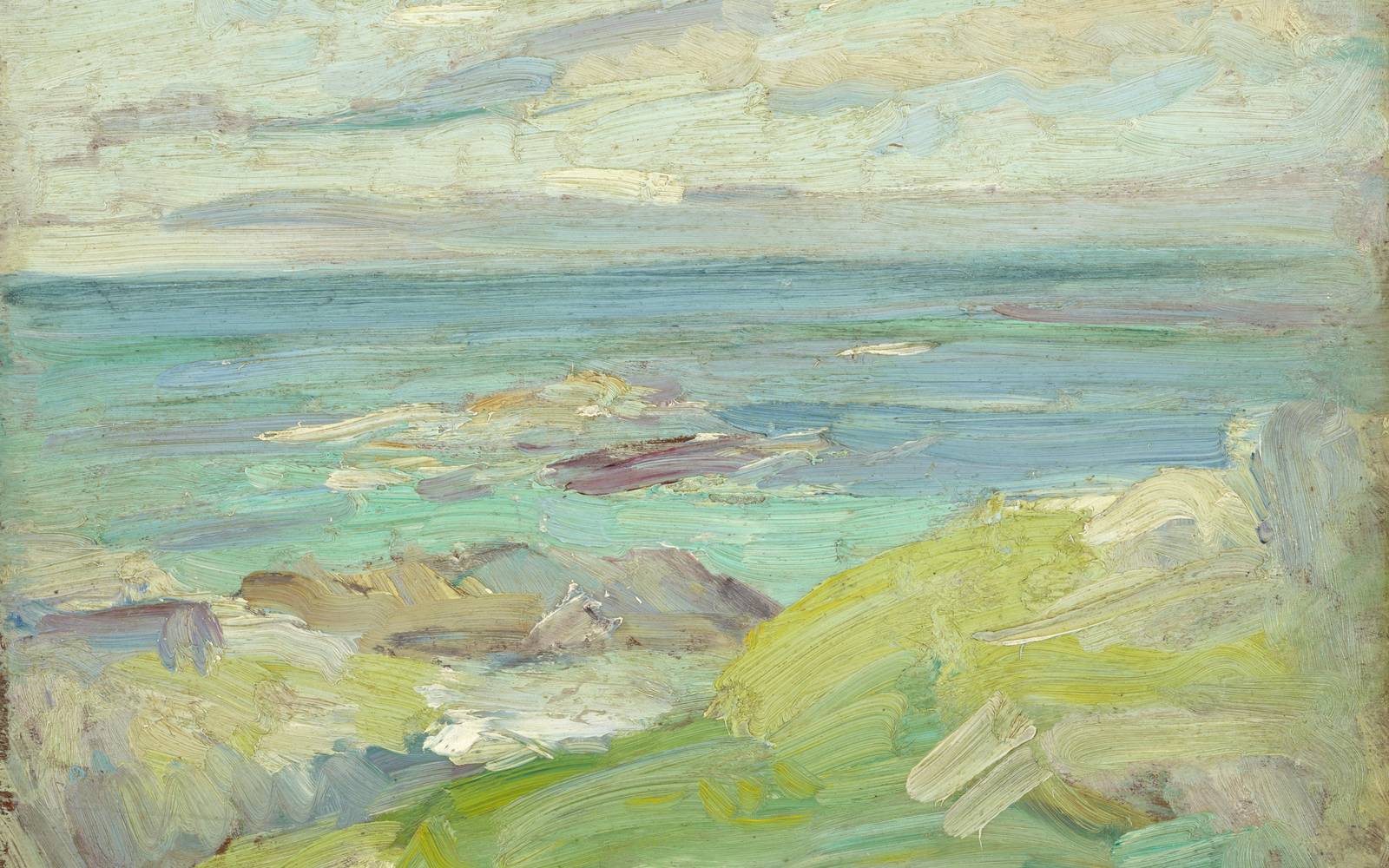
Image reference: Iona Study by Samuel John Peploe.
At a Glance
- Core artistsS. J. Peploe, J. D. Fergusson, F. C. B. Cadell and G. L. Hunter
- Main periodApproximately 1900–35, with Fergusson active until 1961
- Important centresEdinburgh, Glasgow, Paris, Iona and the south of France
- Known forVivid colour, assertive brushwork, still life, portraiture, interiors and landscape
- French connectionsManet, Impressionism, Fauvism, Cézanne and the Paris avant-garde
- Group statusA retrospective category rather than a formal movement
- First quartet exhibitionGalerie Barbazanges, Paris, 1924
- Key London exhibitionLeicester Galleries, 1925
- Later canonInitially three artists in 1950; the standard quartet emerged later
Contents
- Where it fits
- How the quartet formed
- Scottish inheritances
- S. J. Peploe
- J. D. Fergusson
- F. C. B. Cadell
- G. L. Hunter
- France and modernism
- How colour works
- Where to see them
Where the Scottish Colourists fit
S. J. Peploe
Key career periodJ. D. Fergusson
Key career periodF. C. B. Cadell
Key career periodG. L. Hunter
Key career periodA vase, a fan, several pieces of fruit and a patterned cloth: the materials of a Scottish Colourist still life can sound almost stubbornly conventional. Nothing in that list announces revolution. The modernity arrives through relationships. A black contour hardens the edge of a bowl; a white ground pushes red roses forward; a tilted tabletop refuses settled depth; one blue answers another across the canvas. Colour is not spread as cheerful decoration. It is tested, balanced and made structural.
“The Scottish Colourists” names four painters: Samuel John Peploe, John Duncan Fergusson, Francis Campbell Boileau Cadell and George Leslie Hunter. Each was born in Scotland, encountered modern French art directly and developed a strong reputation for colour. Yet they were not a close society, issued no joint manifesto and worked together only intermittently. The familiar quartet is partly a later art-historical construction. T. J. Honeyman’s Three Scottish Colourists of 1950 grouped Peploe, Cadell and Hunter; Fergusson became standard within the category by the 1980s.[1]
That retrospective construction does not make the term useless. The four artists had real friendships, shared dealers and collectors, appeared in a small number of exhibitions together and pursued related questions about how European modernism could operate within Scottish painting. But the label works best as a comparative frame, not as proof of one programme. Peploe’s disciplined still lifes, Fergusson’s rhythmic figures and sculpture, Cadell’s angular Edinburgh interiors and Hunter’s fluctuating landscapes cannot be collapsed into one bright palette.
The distinction affects how the pictures should be displayed and read. A group room can make recurring flowers, shorelines and high-keyed colour immediately visible, but it can also suppress the dark works, drawings and sculptures that complicate the name. An individual retrospective does the reverse: it reveals changes of method while making shared markets and exhibitions harder to see. The richest account moves between those scales. It asks what the quartet explains, then notices what becomes invisible whenever the label is treated as a style.
How four individuals became a group
The exhibition history is more precise than the mythology. The four first exhibited together as a quartet at the Galerie Barbazanges in Paris in 1924. In January 1925 they appeared at the Leicester Galleries in London, where Peploe showed ten works, Hunter ten, Cadell twelve and Fergusson eleven, including three sculptures. Walter Sickert wrote the preface. Critics recognised both common colour and pronounced individuality. They met again within broader exhibitions in Paris in 1931 and London in 1932, but Hunter had died before the latter opened.[2]
The 1925 exhibition was therefore not the public launch of a pre-existing brotherhood. It was an act of presentation, strengthened by the Glasgow dealers Alexander Reid and his son A. J. McNeill Reid. Hanging the four together encouraged viewers to interpret separate careers as a national modern formation. Peploe’s friendships connected the quartet, but dealers, catalogues and criticism gave that connection durable shape.
The numbers in the Leicester Galleries catalogue make the curatorial argument visible. No artist dominated the display numerically, while Fergusson’s three sculptures challenged the idea that the category belonged only to easel painting. Sickert’s preface gave the exhibition the endorsement of a senior British modernist, but the works themselves refused a simple family likeness. Contemporary reviewers could admire shared chromatic daring and still distinguish Cadell’s hardness from Peploe’s more sensuous paint. “Scottish Colourists” consequently describes a productive comparison that the exhibition created, not a contract the artists had signed.
Their chronology also resists a single rise and fall. Peploe died in 1935 and Hunter in 1931, fixing much of the group’s public image around the interwar decade. Cadell’s health and finances deteriorated before his death in 1937. Fergusson, by contrast, lived until 1961, returned to Scotland during the Second World War and participated in a later culture of artistic organisation. A movement timeline ending in 1935 is useful for the quartet’s most concentrated period but misleading for Fergusson’s sculpture, teaching networks and institutional afterlife.
This history places the Colourists at the front of Scottish modern painting without making them its only origin. National Galleries of Scotland describes their subject matter—especially still life and landscape—as largely traditional, while their colour, simplification and European engagement were progressive.[3] Their achievement was not to replace Scottish art with Parisian style. It was to demonstrate that familiar genres could become laboratories for modern form.
Scottish inheritances before Paris
The Colourists inherited an already international Scottish art world. The Glasgow Boys had challenged academic narrative through rural naturalism, painterly handling, Japanese design and exposure to France. Glasgow’s industrial collectors and dealers supported new art, while artists travelled to Paris, Japan, Spain and North Africa.[4] Peploe and Fergusson initially learned from tonal portraiture and James McNeill Whistler as well as from French painting; Cadell absorbed Edinburgh elegance and Munich training; Hunter began as an illustrator in California.
Continuity should not erase difference. The Glasgow Boys often organised identity through shared places and generational association. The Colourists were more dispersed and were not known collectively by their present name while their central innovations were occurring. Glasgow Museums now holds all four across oils, drawings, watercolours and sculpture, revealing a broader range than the label’s association with luminous canvases suggests.[5]
The national adjective also needs care. “Scottish” describes birthplace, chosen identity, subjects, markets and reception, but not confinement. Fergusson spent much of his career in Paris and London; Hunter’s formative years were Californian; all four worked in France. Scotland was one active node in an international network.
Scottish Colourist artists to know
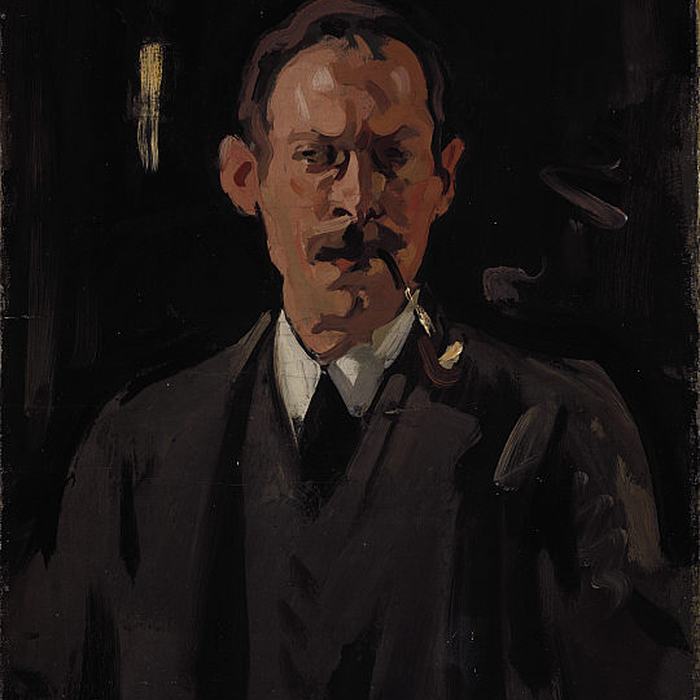
S. J. Peploe
Peploe moved from dark tonal mastery through radical Paris colour to highly revised still-life systems, while his small outdoor panels retained the pressure of weather and speed.
J. D. Fergusson
Fergusson’s Paris networks, editorial work, sculpture, partnership with Margaret Morris and later Glasgow institutions make him the quartet’s longest and least easily contained career.
F. C. B. Cadell
Cadell made Edinburgh architecture, furniture, clothing and social pose into hard-edged spatial design, then used rapid decisions to map Iona’s known shores and weather.
G. L. Hunter
Hunter connected Californian illustration, works on paper, dealer support, France, Fife and Loch Lomond through a deliberately changeable handling responsive to subject and medium.
Peploe: colour under discipline
Samuel John Peploe was the oldest and ultimately the most commercially secure of the four. Born in Edinburgh in 1871, he trained there and in Paris, painted repeatedly on the French coast and lived in Paris from 1910 to 1912. His work remained representational, but tight organisation, strong colour and assured handling gave it increasing formal intensity.[6]
Peploe’s career is best understood in phases. Early paintings could be dark and sonorous; the pre-war Paris years brought radical colour and flattening; post-war still lifes became more methodical and architectural; later works loosened again. His landscapes followed another tempo, often painted quickly outdoors on small panels. The National Galleries retrospective joined these parallel practices rather than treating the flower paintings as his entire achievement.[7]
Dark beginnings and the move towards light
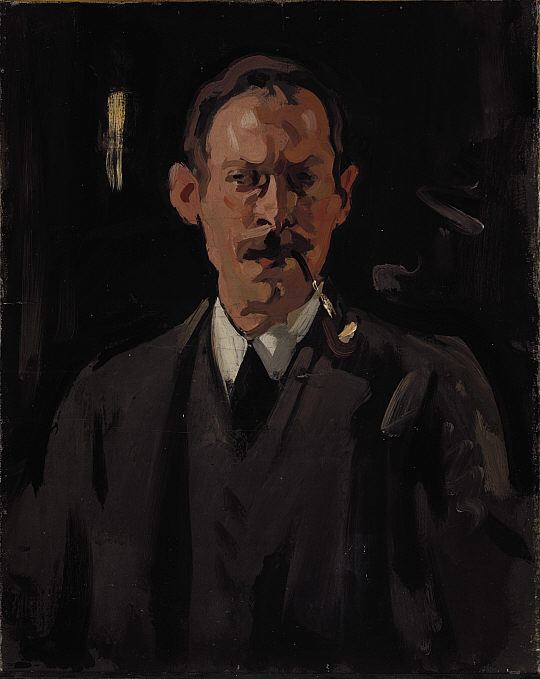
Peploe’s self-portrait of about 1911 retains a restricted palette associated with Frans Hals and Édouard Manet. Fluid handling animates the dark surface, while the face emerges through tonal contrast.[8] This early sophistication matters because the later brightness was not an escape from incompetence or provincial gloom. It was a deliberate revision of an already controlled method.
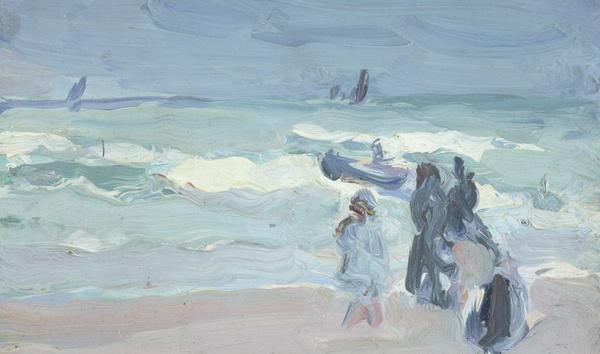
From 1904 Peploe and Fergusson worked on the northern French coast. On the French Coast uses a portable panel and long, creamy strokes to seize beach, weather and light with few colours. The work belongs to an Impressionism of direct outdoor response, but its broad marks are already selective rather than descriptive.[9] Painting beside Fergusson made artistic development social even when no formal group existed.
Paris intensified the break. Peploe moved there in 1910, entering Anglo-American circles that included Anne Estelle Rice, Jessica Dismorr and Marguerite Thompson. In Flowers and Fruit, black outlines, flattened volume and strong colour reveal awareness of Cloisonnism and Synthetism practiced within that circle.[10] The usual narrative of four Scottish men receiving French innovation is therefore incomplete: women artists working in Paris were part of the visual exchange.
Still life as a testing system
Peploe repeatedly arranged flowers, fans, fruit, books, bowls and Chinese porcelain. Repetition did not signal exhausted imagination. It controlled variables. When one vase or fan returns, changes in background, colour interval, angle and paint become visible. Still life functioned almost like a sequence of experiments.
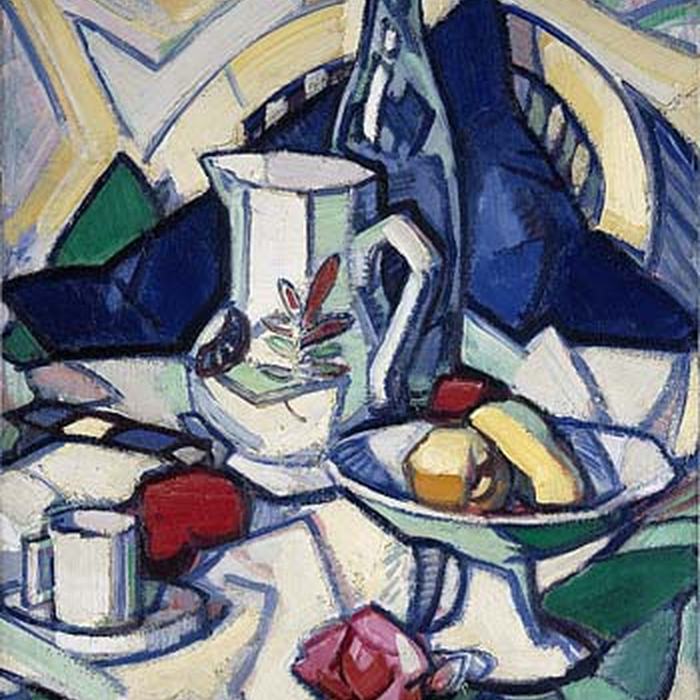
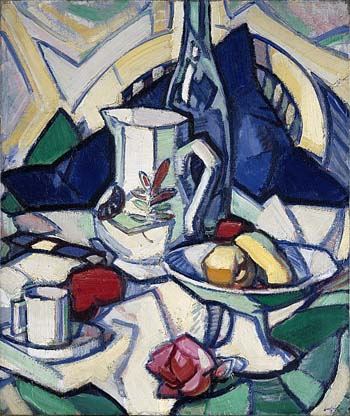
In a work of about 1913, faceted background strokes and compressed depth show the impact of Cubist construction. Yet objects are not displayed from multiple viewpoints; the scene remains anchored to observation.[11] Peploe could learn from Cubism without joining it. He retained the sensuous identity of fruit, ceramic and fabric while making the tabletop an arena of competing planes.
Look closely at how little space Peploe grants the viewer. Tabletops often tilt upwards and backgrounds press forwards, so fruit, vase, fan and cloth occupy a shallow, resistant zone. White is rarely empty: it separates silhouettes, sharpens a red or yellow, and makes an interval between objects as active as the objects themselves. Black line can acknowledge contour while also declaring that the picture is a designed surface. These devices keep still life poised between sensory abundance and formal restraint.
After the First World War, his method became particularly concentrated. Roses or tulips rise from Chinese vases; a fan opens diagonally; fruit carries colour across the lower edge. Every prop has visual work to perform. By about 1930, still lifes such as Pears and Grapes combine acid colour, tighter handling and near-geometric structure under the influence of Paul Cézanne.[12] “Influence” here means a problem of relation—how objects occupy and stabilise space—not a borrowed appearance.
Landscape at another speed
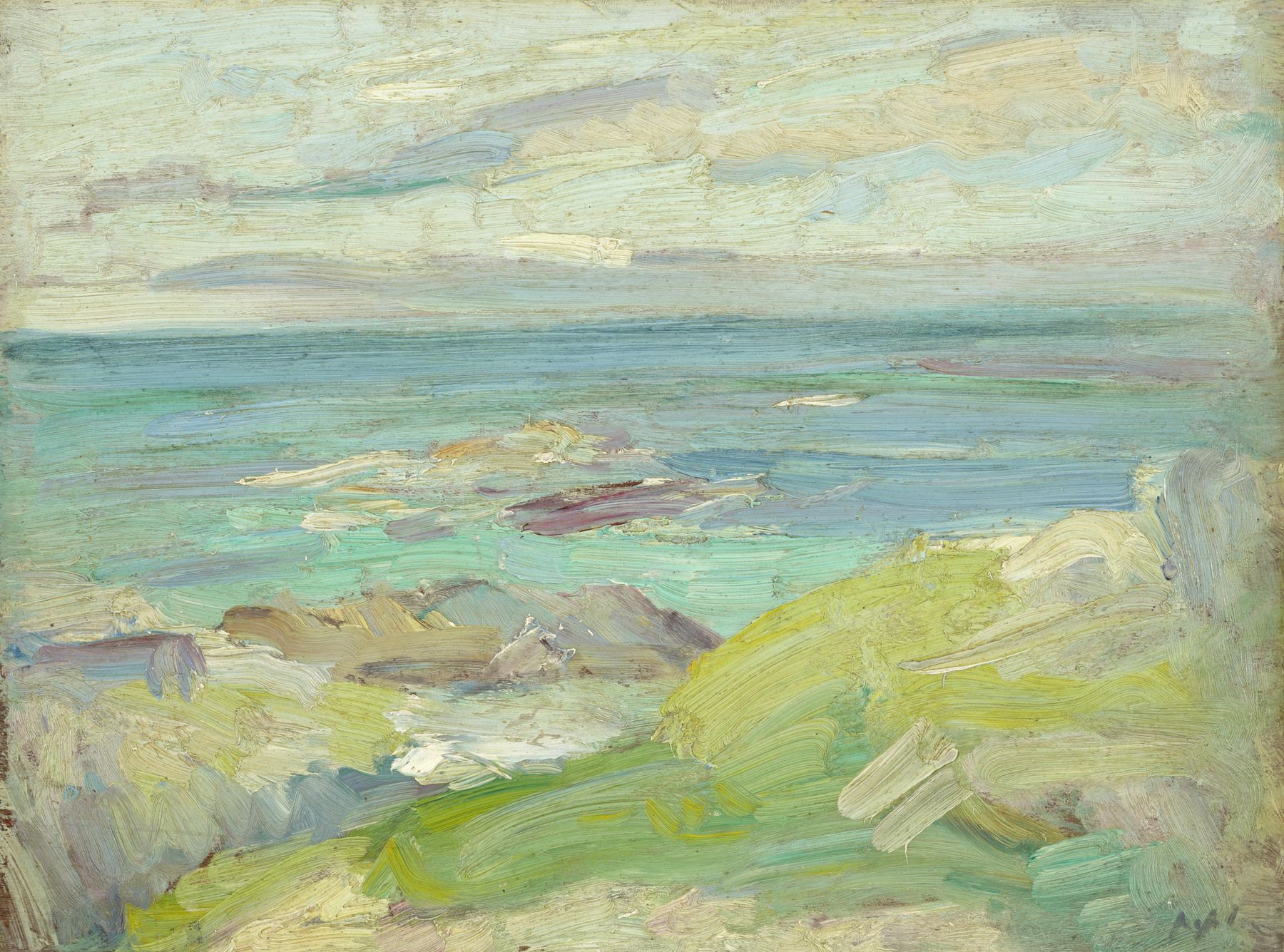
Peploe’s outdoor panels behave differently from his studio constructions. Barra was painted wet into wet in 1903, with broad motions compressing grass, beach and sea onto a small wooden support.[13] The paint does not catalogue the Outer Hebrides. It records the pressure of weather and time.
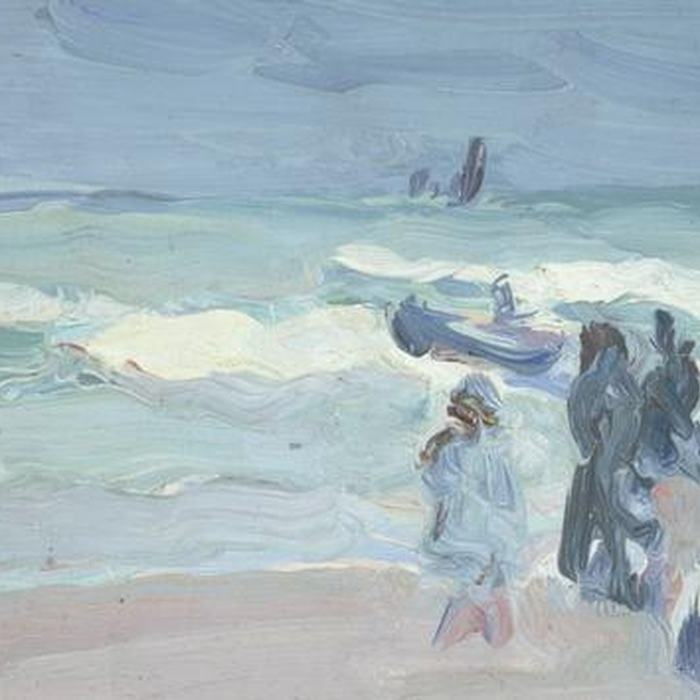
Later, Iona offered dazzling sand, rock, water and rapidly changing light. Introduced to the island by Cadell in 1920, Peploe returned for more than a decade. He and Cadell sometimes painted near one another, but their landscapes remain distinguishable: Peploe tends to build weight through colour planes, while Cadell often converts the island into brisk, high-keyed pattern.
Dealers, reputation and work
Peploe’s first solo exhibition at The Scottish Gallery in 1903 sold strongly. The gallery’s history places his career within an Edinburgh market for contemporary Scottish painting rather than a story of heroic neglect.[14] Support was not continuous: his radical Paris work disturbed an earlier dealer. From the early 1920s, however, The Scottish Gallery and Alexander Reid jointly purchased work directly, giving Peploe economic room to concentrate on Iona and still life.[15]
Commercial success did not make the paintings easy. It depended on controlled production, repeated exhibitions and the recognisable authority of a mature style. The image of spontaneous colour conceals hours of arranging, scraping, repainting and judging intervals.
Nor did repeated motifs mean identical pictures. The same Chinese vase could appear against a cool or warm field; a fan might stabilise one composition and rupture another; roses could be dense masses or isolated notes. This is why comparison within Peploe’s oeuvre is more revealing than selecting one “typical” still life. The series records decisions, revisions and changing encounters with modern art.
Fergusson: rhythm across painting, sculpture and dance
John Duncan Fergusson fits the category least comfortably and makes it most interesting. Born in Leith in 1874 and largely self-directed, he lived more internationally than the others, moved to Paris in 1907, made sculpture from 1908, became art editor of Rhythm and collaborated for decades with the dancer and educator Margaret Morris. A retrospective of more than one hundred paintings, sculptures, works on paper and archives demonstrated how little “colourist painter” contains his practice.[16]
Paris as an artistic system
Fergusson did not merely visit French exhibitions. In Paris he entered studios, salons, cafés and multilingual artistic circles. He encountered Fauvism at close range and developed bright, rhythmic contours. Portraits, hats, café terraces and female figures replaced the tonal reserve of his earlier Edinburgh work. National Galleries of Scotland identifies him as the most internationally recognised of the four and traces his connections to Anne Estelle Rice, Rhythm, the Ballets Russes and sculpture.[17]
His earlier art had shared Whistlerian and Glasgow Boys tonalities. The later transition should not be simplified into darkness becoming colour. Fergusson’s structural concern shifted: line grew more elastic, colour separated more strongly from description, and bodies became systems of movement.[18]
Anne Estelle Rice: sitter and artist
Fergusson’s Portrait of Anne Estelle Rice of 1908 shows that transformation through bold outline and contrasting colour. Rice was an American painter and illustrator who moved to Paris in 1906, not merely Fergusson’s model. The museum’s comparison with his 1905 nocturne makes the scale of change clear.[19] Naming her professional work also changes the portrait: it records exchange between artists, not passive inspiration delivered by a sitter.
Rice and other Anglo-American colleagues participated in the circle around Rhythm, the magazine Fergusson helped shape from 1911. Its title corresponded with his interest in bodily movement and compositional pulse. Figures are often built from repeated arcs and swelling volumes rather than anatomical transcription.
The magazine connected painting to literature, illustration and performance. Its internationalism matters: Fergusson’s Paris was not a sealed French school but a meeting place in which Scottish, English, American and continental participants produced modern culture together. His editorial role required selection, correspondence and public positioning as well as image-making. It helps explain why his later career repeatedly crossed the border between solitary practice and collective organisation.
Margaret Morris and collaboration
Fergusson met Margaret Morris in 1913. She had already rejected classical ballet’s constraints, developed her own movement method and opened a school. Their partnership joined visual art, performance, education and design. Morris’s students became models, but she also painted, designed and collaborated on productions. After settling in Glasgow in 1939, she established the Celtic Ballet Club and later the Scottish National Ballet.[20]
It is tempting to cast Fergusson as creator and Morris as muse. The archives contradict that hierarchy. Their practices interacted through summer schools, costumes, choreography, paintings, sculptures and institutions. Culture Perth and Kinross preserves major collections and archives of both, allowing their legacies to be studied together rather than dividing “fine art” from dance.[21]
Rhythm, the nude and artist-led culture
Paris offered freer life classes and exhibition possibilities than conservative Edinburgh structures. National Galleries’ documentary research places Fergusson and Peploe among the Rhythmists, an artist-writer circle producing a modern journal rather than simply consuming French culture.[22] Fergusson’s nudes from 1910–13 joined erotic charge to condensed, curving form. They were among the most original British paintings of their moment, but they also invite questions about how “feminine rhythm” was projected onto women’s bodies.
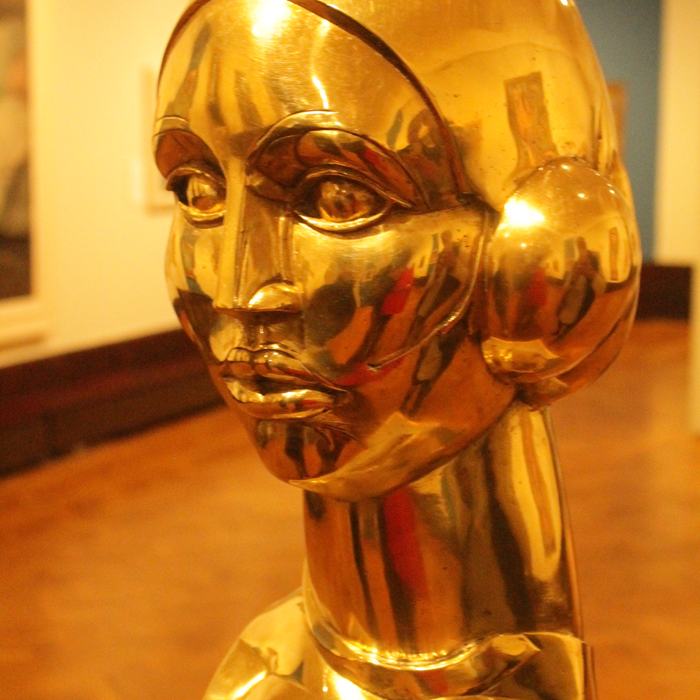
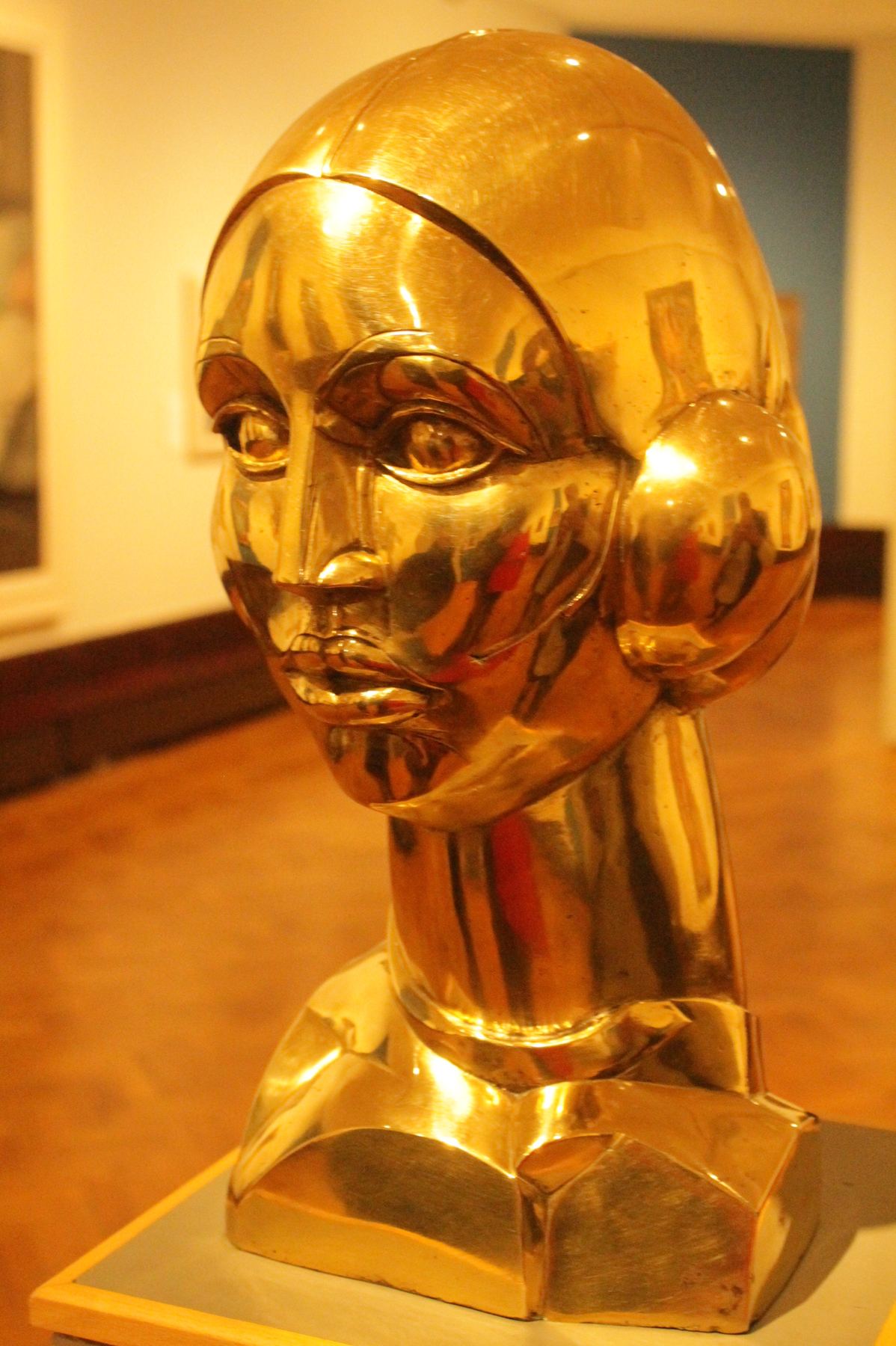
During the First World War, Fergusson placed greater emphasis on sculpture, using wood, stone and metal. Sculpture made volume literal and extended his concern with bodily motion. His press dossier follows this practice through Eástre and later figures while recognising the sensual self-possession of portraits such as Le Manteau Chinois.[23]
Sculpture also tests what “colourist” excludes. A carved or modelled body may have little chromatic brilliance, yet its compact curves continue the rhythmic construction of Fergusson’s paintings. Seen together, the two media show that his underlying subject was vitality: how mass can appear poised, turning or expanding. Colour was one means of producing that sensation, not the limit of his modernism.
Return to Glasgow
Fergusson went back to Paris in 1929, then left at the outbreak of the Second World War and settled in Glasgow with Morris. There he helped found the New Art Club and New Scottish Group, supporting younger artists and arguing for a living national modernism. The museum partnership behind his retrospective treated this late institutional work as part of his art, not an epilogue.[24]
His Celtic claims require scrutiny. Fergusson sometimes imagined national spirit as vigorous, feminine and ancient. Such language could energise an alternative to English cultural dominance, but it could also turn complex histories into timeless essence. His strongest Scottish identity was practical: returning, exhibiting, organising and encouraging new work.
Cadell: the designed life
Francis Campbell Boileau Cadell was the youngest Colourist. Born in Edinburgh in 1883, he studied in Paris and Munich, worked in Venice, served during the First World War and built a distinctive visual world around Edinburgh’s New Town and Iona. The museum retrospective describes him as elegant, but elegance in Cadell is not effortless polish. It is an arrangement of architecture, clothing, furniture, reflective surfaces and social pose.[25]
Training, Venice and war
Cadell entered the Académie Julian at sixteen, later attended the Munich academy and returned to Edinburgh by 1908. A 1910 Venetian journey released a brighter palette and looser handling. He first visited Iona in 1912. When war began, he volunteered, initially failed the medical test, trained physically, then served in the Royal Scots and Argyll and Sutherland Highlanders. He was wounded twice.[26]
Before reaching the trenches, Cadell made witty ink and watercolour drawings of military life, later exhibited and published as Jack and Tommy. They reveal rapid observation and social comedy rather than the brilliant blocks of his later oils. His service interrupts any narrative in which colour progresses smoothly from Paris to post-war style.
Ainslie Place as studio and subject
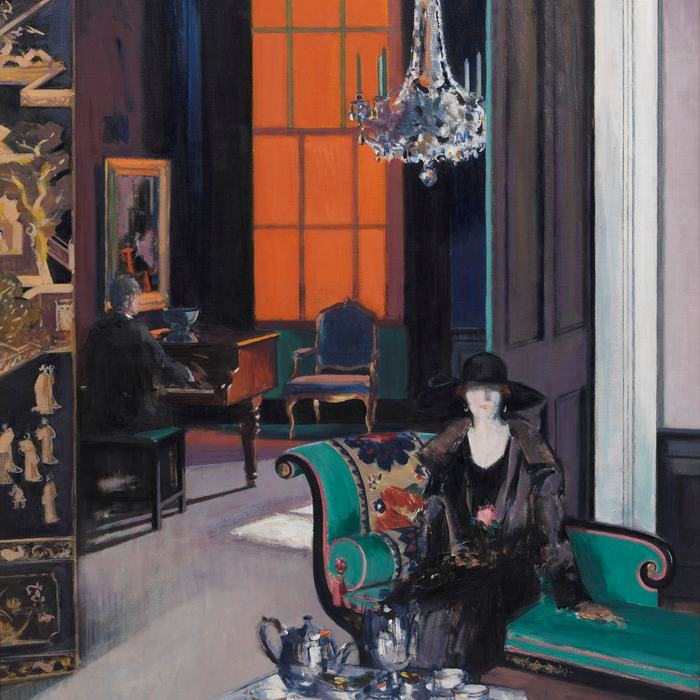
After demobilisation, Cadell moved to 6 Ainslie Place. He designed his quarters with strong contrasts, polished floors, black furniture, screens, flowers and carefully placed objects. The home became studio, stage and brand. Paintings crop interiors at angles; doors and mirrors multiply frames; women in dark dresses become vertical accents within white or lilac rooms.
The Rose and the Lacquer Screen exemplifies this conjunction of still life and interior. The National Galleries’ acquisition keeps Cadell’s individual work visible inside the broader Colourist category.[27] A rose is not isolated from lifestyle: screen, table, reflection and room make taste into pictorial structure.
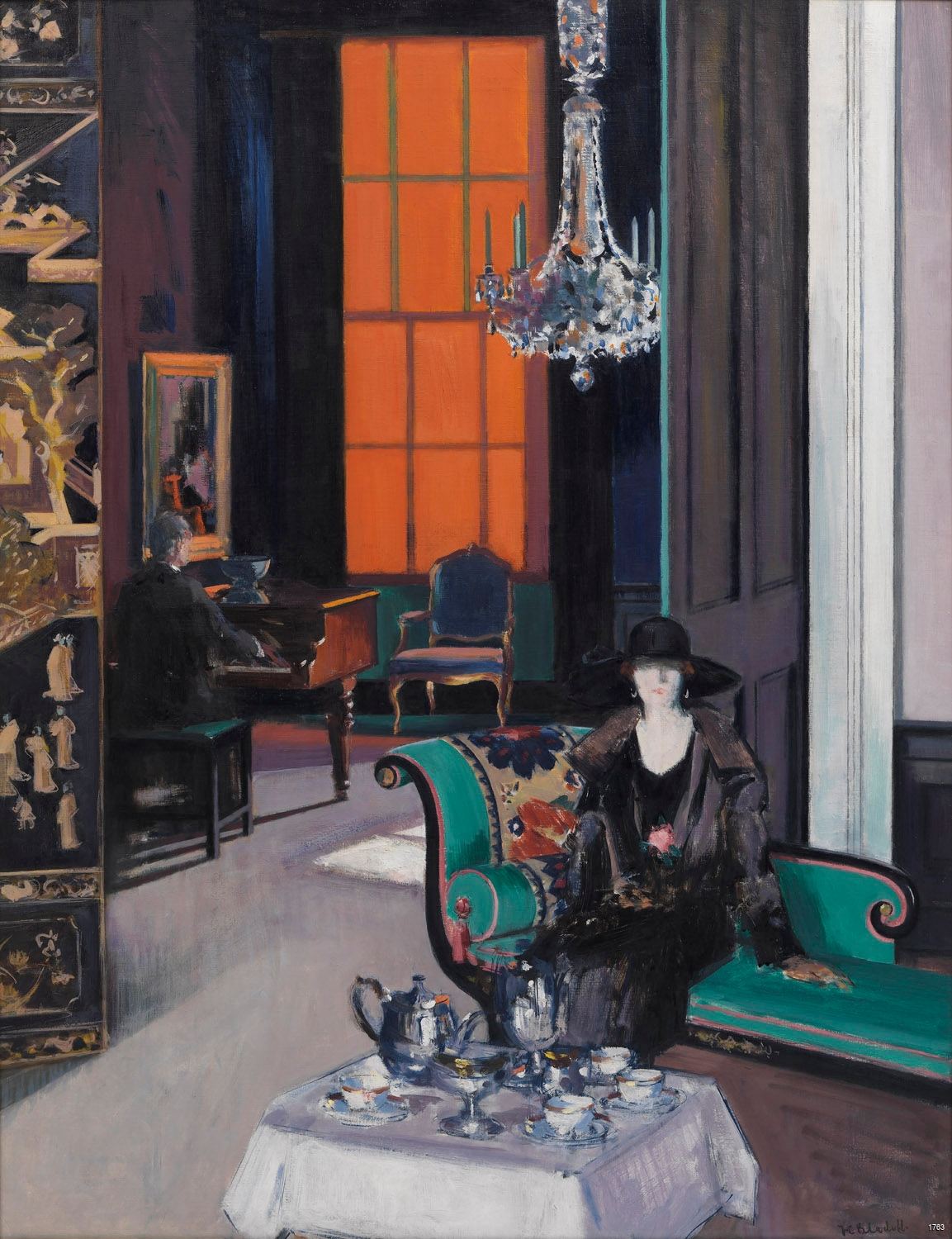
His post-war paintings suppress conventional depth and shadow. Broad, barely modulated areas make a black dress or orange blind architectonic. Cadell’s “hardness,” praised in 1925, is the clarity with which colour boundaries organise a room.
That clarity is inseparable from the New Town setting. Tall doors, pale walls, chimneypieces and polished boards impose an inherited geometry; Cadell activates it with screens, flowers, tilted rugs and cropped figures. Mirrors confuse the border between adjoining rooms and reflected ones. A sitter’s hat or dress may seem socially descriptive, but it also becomes a hard-edged form that locks the composition together. The room is simultaneously home, studio, display environment and painted construction.
Iona, weather and repetition
Cadell returned to Iona almost every summer. The island’s low profile, surrounding sea, pale beaches, coloured rock and fast weather suited direct work. Scottish landscape had long contributed to national identity, but modern painters could respond to continental abstraction without surrendering specific topography.[28]
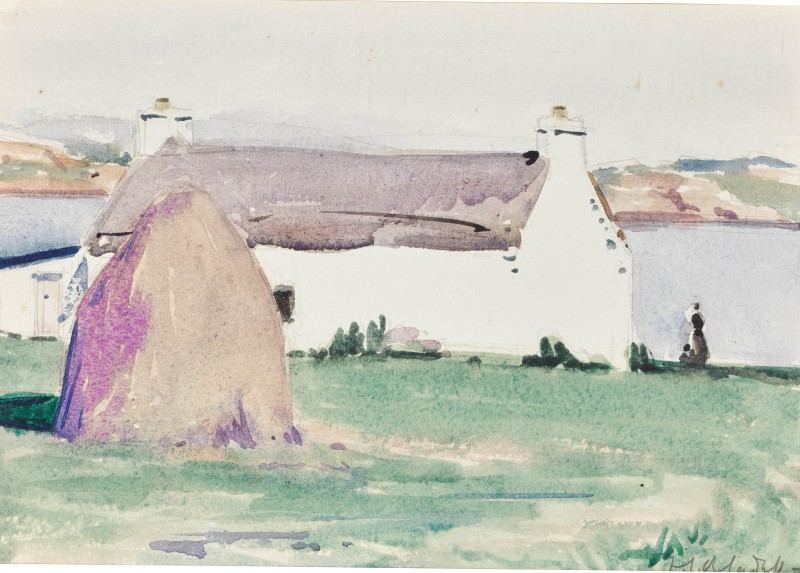
Cadell mapped locations and returned to views. Speed was essential as light changed. White reserve, turquoise water, green pasture and pink-grey stone are arranged in compact, legible units. These pictures can be mistaken for effortless holiday impressions; in fact they rely on intimate geographical knowledge and repeated decisions about what can be omitted.
He also sold work directly on the island. The Scottish Gallery records that his manservant Charles Oliver acted as sales agent to summer visitors and that Cadell used the artist-run Society of Eight for exhibitions.[29] Iona was subject, community and marketplace.
Class, performance and decline
Cadell’s elegant women and New Town rooms depict a privileged social world. That specificity is valuable, but the pictures should not be treated as neutral records of Scottish life. They stage one class’s fabrics, leisure and architectural inheritance. The artist’s own taste, wit and self-presentation participate in the performance.
The contradiction is central to their appeal. A radical simplification of depth can occur within a conservative domestic world; a painting can make modern design from inherited wealth and Georgian architecture. Cadell therefore complicates any assumption that modern form automatically carries social rebellion. His rooms are innovative pictures of exclusivity, and both parts of that description should remain visible.
The art market weakened after the late 1920s. Debt, illness and repeated moves reduced Cadell’s circumstances even as official recognition grew. The Kelvingrove display of Interior: The Orange Blind now places his Edinburgh room inside a museum where French and Scottish modern art can be viewed in proximity.[30] Institutional adjacency makes the cross-Channel conversation visible, but it also turns a designed private world into national heritage.
Hunter: a career rebuilt after loss
George Leslie Hunter’s route was different from the others’. Born on Bute in 1877, he emigrated with his family to California in 1892 and earned money as an illustrator. Much of his early art was destroyed in the 1906 San Francisco earthquake. He returned to Scotland and became established through Glasgow dealers, later working in Fife, Loch Lomond and France.[31]
The earthquake is an unavoidable break, but it should not become a romantic origin myth in which loss instantly creates a painter. Hunter had already drawn professionally and travelled to Paris. What vanished was evidence as well as property, making his formation harder to reconstruct. The surviving career retains illustration’s quick line alongside oils, watercolours and ink.
Still life and uneven experiment
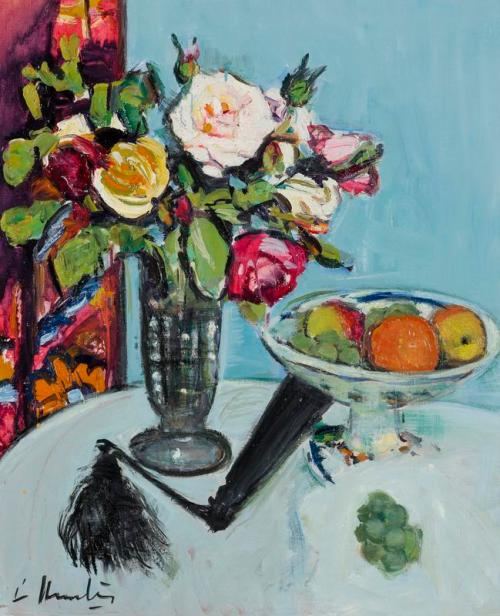
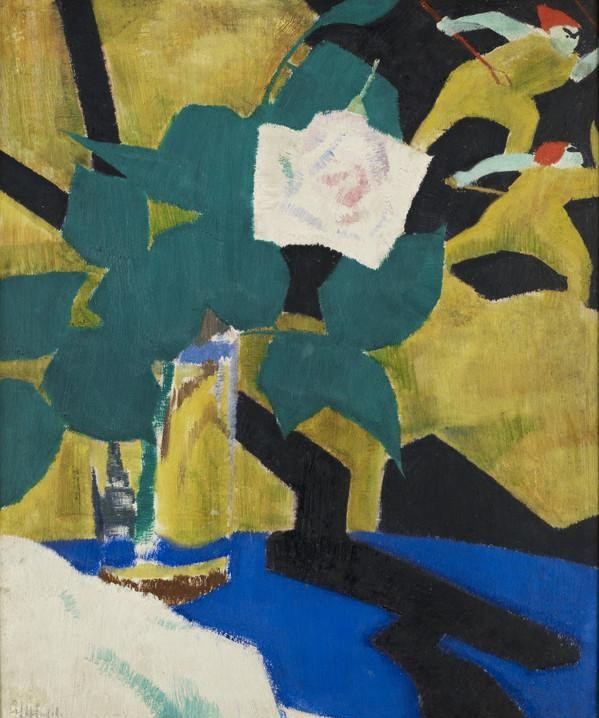
Hunter’s style changes markedly. Some still lifes are thick and dark; others use floating colour and incomplete contour. Fruit, vessels and flowers can seem less architecturally fixed than Peploe’s. Space flickers around them. This variability has sometimes made Hunter look inconsistent, but it also reveals sustained testing across media.
Alexander Reid was crucial. He organised Hunter’s first Glasgow solo exhibition in 1915, supported travel and helped produce international exposure. The Scottish Gallery’s works-on-paper history traces contracts, exhibitions and reviews that placed Hunter among “les écossais modernes.”[32] Dealers did not merely distribute a completed identity; their groupings and claims helped manufacture it.
Works on paper are particularly important because Hunter did not treat drawing as a subordinate preparation for oil. Watercolour, ink and crayon could preserve rapid shifts of contour and open areas of support. They reveal an artist less dependent on the thick chromatic surface by which the quartet is usually advertised. Illustration, drawing and painting overlap rather than forming a ladder from commercial beginnings to autonomous art.
Fife, France and Loch Lomond
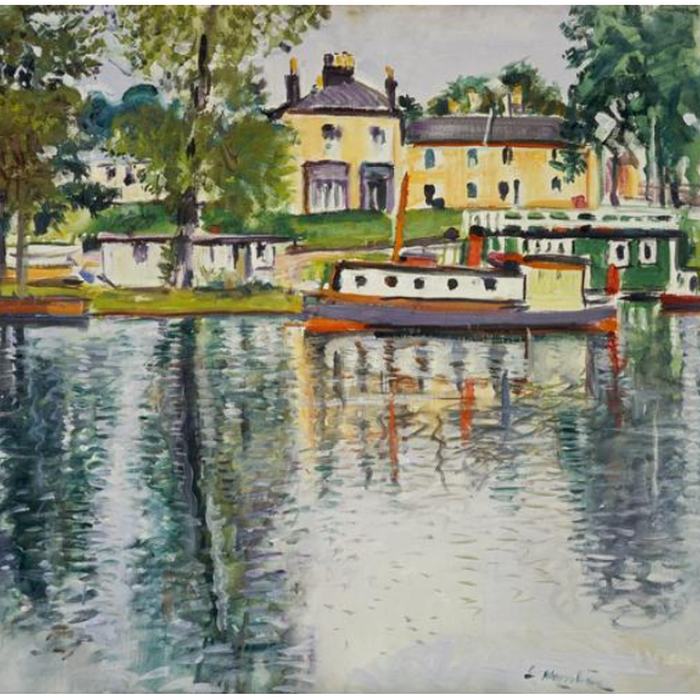
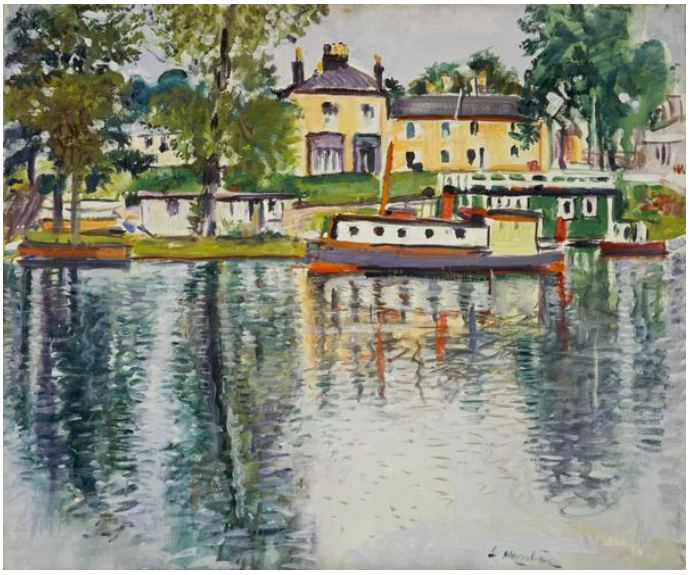
Hunter worked in Fife fishing villages, on Loch Lomond and in the south of France. In Reflections, Balloch, water and mirrored light dominate. After Mediterranean experience, his palette became lighter and the brushwork more fluent; the composition is clear without becoming rigid.[33] Scottish weather is seen through lessons learned elsewhere.
Reflections make a fitting subject for Hunter because they prevent landscape from settling. Trees and banks retain enough shape to locate the scene, while their doubles fracture into strokes on the water. Bright patches need not describe a single local colour; they can register light, movement and the memory of Mediterranean painting. Compared with Cadell’s sharply divided Iona views, Hunter’s landscape is less like a map and more like an atmosphere held provisionally together.
The specialist biography emphasises his lack of formal art-school training, Californian Bohemian context, varied media and the destruction of early work.[34] These differences keep Hunter from being treated as a Glasgow version of Peploe.
His irregular formation affected later criticism. A changeable technique could be read as weakness when consistency was the measure of artistic identity. Yet Hunter’s alternation between dense still life, open watercolour and fluid landscape may be understood as responsiveness to medium and subject. The very quality that makes his career difficult to summarise also makes it resistant to the neatest version of the Colourist brand.
The Balloch series of 1929–30 returned to a place he had painted in 1924. Its collection record anchors the work in the Scottish National Gallery of Modern Art.[35] Repetition here, as in Peploe’s props and Cadell’s Iona views, enables change to be measured.
Hunter died in Glasgow in December 1931. His early death helped freeze the mature 1920s as his representative period. Yet drawings and watercolours show that “colourist” was never limited to oil or to full chromatic saturation.
Follow the Scottish Colourists through four stages
–1906
Four international formations before the label
Edinburgh and Glasgow tonal painting, Paris training, California illustration, northern French work and Cadell’s early studies create four unequal starting points rather than one national origin story.
–14
Paris, Venice and new pictorial structures
Fergusson settles in Paris, Peploe revises colour and depth, Cadell’s Venice journey changes his palette and transnational networks join painting to magazines, models and performance.
–31
Independent careers become a quartet in exhibition
War interrupts travel; Iona, Edinburgh, Glasgow, France and sculpture sustain different practices while dealers assemble the 1924 Paris and 1925 London presentations that make comparison public.
–2025
A retrospective canon is built and questioned
Deaths, collections, Honeyman’s three-artist category, the later addition of Fergusson, separate retrospectives, archives and centenary research strengthen the brand while restoring difference.
What did France mean to the Colourists?
France meant different things at different times: academies, museums, coastal light, cheap studios, salons, colleagues, dealers and the possibility of living outside Scottish convention. The Musée d’Orsay maintains a documentary file on Peploe as a British painter, evidence that his career belongs within French archival as well as Scottish collection history.[36] Its list of foreign-school files places both Peploe and Fergusson among documented Scottish artists in France.[37]
The label “Fauvist” must remain comparative. The Musée d’Orsay describes Fauvism as a loose gathering rather than a theory-bound movement, joined by pure colour and expressive, anti-illusionistic force.[38] Peploe, Cadell, Hunter and Fergusson were not members of the 1905 Salon group. Fergusson came closest to sustained Fauvist dialogue; the others used high colour selectively and often later.
Fauvism itself was brief. Matisse, Derain and their peers separated colour from natural description through vivid pigment and exposed touch before many turned towards Cézanne’s structural order by 1908.[39] The Colourists’ careers likewise cannot be described as a permanent triumph of brightness. Dark grounds, black outlines, neutral interiors and restrained late palettes all matter.
The Collioure partnership of Henri Matisse and Derain offers a helpful comparison. They painted beside one another and shared experiments, yet their styles remained distinct; models, especially Amélie Matisse, were indispensable to the work.[40] The same principle applies in Scotland: exchange does not erase individual method, and artistic networks include labour often hidden by a list of male names.
By crossing Post-Impressionism, Fauvism and Cézanne, the Colourists also expose the limitations of movement labels. These terms name particular French debates and exhibition histories; they should not become a menu of styles applied equally to all four Scots. The useful question is narrower: which pictorial problem did an artist encounter, and what changed when it entered a different studio, landscape or market?
Colour is not one thing
“Colourist” can imply that hue is added after drawing or form. In these paintings colour frequently makes the form. Peploe’s red and blue intervals balance a still life. Fergusson’s contours carry bodily rhythm. Cadell’s black, white and orange divide architectural space. Hunter’s broken touches make water reflect and dissolve.
Black deserves special attention. The category is associated with brilliance, yet black anchors all four careers: Peploe’s early portraits, Cadell’s dresses and furniture, Fergusson’s outlines, Hunter’s darker still lifes. Refusal of dinginess is not refusal of darkness. A black shape can make surrounding colours appear more intense.
Touch also differs. Peploe can smear a wet landscape or labour over a still life. Cadell works rapidly outdoors and with flat decisiveness inside. Hunter alternates broken, liquid and loaded marks. Fergusson’s brushwork often follows the curve of a body. The movement is better recognised through comparisons than a checklist.
Compare one motif across four methods
A bouquet makes the differences concrete. Peploe may use flowers to measure intervals around a vase and stabilise a compressed tabletop. Cadell can set the arrangement against a screen or room, allowing furnishing and architecture to sharpen it. Hunter may let blossoms and surrounding air mingle through broken handling. Fergusson can treat the bouquet as a burst of curved energy continuous with a figure or interior. Subject alone does not define a common style; it creates a controlled comparison among four kinds of pictorial intelligence.
Landscape provides a second test. Peploe’s small wet panels retain weight and weather. Cadell divides Iona into clear strips and facets. Hunter loosens reflected scenery into atmosphere. Fergusson tends to make natural forms participate in bodily rhythm. Bright colour is present, but organisation, edge and pace tell the viewer whose modernism is at work.
Still life, landscape and the politics of tradition
Still life and landscape were academically less prestigious than history painting, yet by 1900 they carried a century of modern experiment. The Colourists used their apparent familiarity to test colour without abandoning recognizable objects or places. A vase could support radical compression precisely because viewers already understood what it was.
Landscape joined aesthetic experiment to national representation. Iona, Fife and Loch Lomond could signify Scotland, but the paintings do not disclose a single authentic national essence. Islands included residents, religious histories, tourism and summer art markets. To describe only empty light and rock can erase inhabited places.
The Colourists belong within a wider Scottish modernism that included women, abstraction, Surrealism and new artist organisations. National Galleries’ A New Era places Peploe and Fergusson beside William Gillies, Stanley Cursiter and later innovators, showing European movements being reinterpreted rather than copied.[41] The quartet is a gateway, not the whole national story.
The Parisian adventure of Peploe and Fergusson became one early chapter in continuing Scottish-European exchange.[42] Later artists could value their independence while rejecting their favoured genres or social worlds.
Women, models and the wider circle
Anne Estelle Rice and Margaret Morris demonstrate why the standard quartet should be opened without being dissolved. Rice painted, illustrated, designed and participated in Parisian modernism. Morris created a movement system, schools, performances and art. Their work influenced how Fergusson represented modern women, rhythm and bodily agency.
Peploe’s Paris circle included Rice, Dismorr and Thompson. Cadell’s interiors depend on models whose clothing and pose organise the picture; Fergusson’s work repeatedly turns partners and dancers into signs of vitality. A critical history should identify women when possible and separate collaboration from the language of “muse.”
Gender also shaped access to training, life classes, travel and exhibitions. The four men’s mobility was enabled by middle-class resources, professional contacts and social freedoms not equally available to every artist. Their internationalism was real, but it was not universally accessible.
Markets, museums and the making of a canon
The Colourist category was made through exhibition and commerce before it was made through textbooks. Reid and McNeill Reid arranged group shows; The Scottish Gallery sustained solo careers; collectors bought the repeated motifs now considered canonical. Peploe’s vases and Cadell’s interiors were both formal investigations and market-recognisable products.
This does not reduce artistic achievement to sales. It explains why certain objects and views became legible as a coherent body. Dealers advanced money, selected works, organised transport, arranged hangs, commissioned catalogues and introduced buyers. Artists responded by offering continuity without simple repetition. The market rewarded a recognisable signature, while each painter still needed enough variation to keep that signature alive.
Later museums consolidated the quartet. National Galleries of Scotland defines Scottish art broadly by heritage, subject and association, and its collection places the Colourists among much longer histories.[43] Retrospectives restored neglected phases, while acquisitions and displays gave certain works exemplary status.
The centenary of the 1925 London exhibition renewed attention to how reputation had risen, declined and revived. Museum talks now explicitly acknowledge the retrospective name and the rarity of lifetime group exhibitions.[44] This is healthier than presenting the quartet as an eternal fact.
Archives make further revision possible. Letters, catalogues, photographs, dealer files and records of exhibitions allow curators to recover models, sales, dates and networks. Research into the Scottish Colourist Series demonstrates how archival evidence shaped modern retrospectives.[45] Canon formation is therefore not the end of research; it is an object of research.
The retrospective series also altered the scale at which the four could be understood. Separate exhibitions restored dark beginnings, drawings, sculpture, wartime interruptions and late changes that a single colourful group display tends to flatten. The paradox is useful: institutional promotion strengthened the collective brand while careful scholarship made its internal differences harder to ignore.
How to look at a Scottish Colourist painting
Identify the phase before the label
Ask when the work was made. A dark Peploe portrait, a Paris Fergusson nude, a post-war Cadell interior and a late Hunter landscape solve different problems. “Colourist” should not replace chronology.
Find the colour structure
Choose the strongest hue and trace where it recurs. Then look for its complement, neutral or black anchor. Colour often moves the eye and balances weight more than it imitates local appearance.
Examine the edge
Is an object surrounded by black line, lost into adjacent paint or defined by the meeting of two flat colours? Edges reveal whether form is being drawn, built or dissolved.
Compare touch across the canvas
Paint may be thick on flowers and thin in the background, or one energetic touch may describe everything. Differences in handling separate the four artists more reliably than subject.
Test the space
Follow table edges, floorboards, windows and shorelines. Does perspective recede normally, tilt upward or collapse into pattern? Compression is often where French modernism becomes visible.
Ask how the scene was produced
Was it painted outdoors on a portable panel, repeatedly rearranged in a studio, staged in a designed room or developed through drawings? Apparent spontaneity may be the result of long preparation.
Name the network
Look beyond the signature. Who modelled, danced, hosted, sold, collected, framed or preserved the work? Artistic individuality and social production coexist.
Essential Scottish Colourist works
Self-Portrait
Samuel John Peploe · c. 1911 · Tonal control, dark ground and fluid handling preserve the sophistication from which Peploe’s later chromatic experiments developed.
On the French Coast
Samuel John Peploe · 1907 · A portable panel, restricted palette and broad creamy touch turn shared work on the Channel coast into a direct experiment in weather and light.
Still Life
Samuel John Peploe · 1913 · Faceted strokes and compressed depth acknowledge Cubist structure while fruit, vase and tabletop remain firmly tied to observation.
Iona Study
Samuel John Peploe · 1920s · Wet paint, pale rock, turquoise water and rapid weather give Peploe’s landscape a different tempo from his revised studio still lifes.
Interior: The Orange Blind
F. C. B. Cadell · c. 1927 · Black, white and orange divide an Edinburgh room into hard-edged planes while furniture, sitter and reflection preserve its specific social world.
The Rose and the Lacquer Screen
F. C. B. Cadell · c. 1920s · Rose, table, screen and reflection make taste and furnishing into a compressed pictorial construction rather than a neutral domestic record.
The White Cottage, Iona
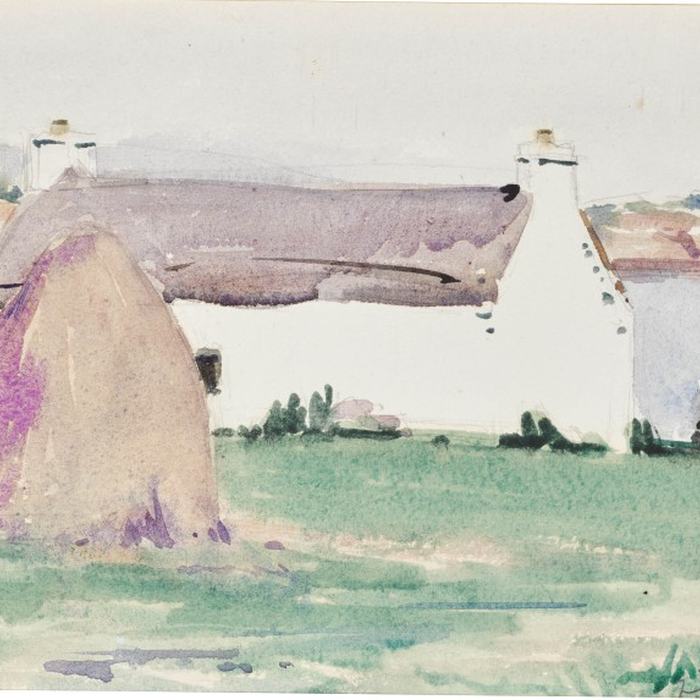
F. C. B. Cadell · c. 1920s · Cadell converts a known island view into compact high-keyed units without erasing cottage, pasture, shore and the geography he repeatedly studied.
Reflections, Balloch
George Leslie Hunter · c. 1929–30 · Fluid brushwork lets Scottish topography and mirrored water remain recognisable while Mediterranean colour and atmospheric instability transform the scene.
Still Life: Roses and a Black Fan
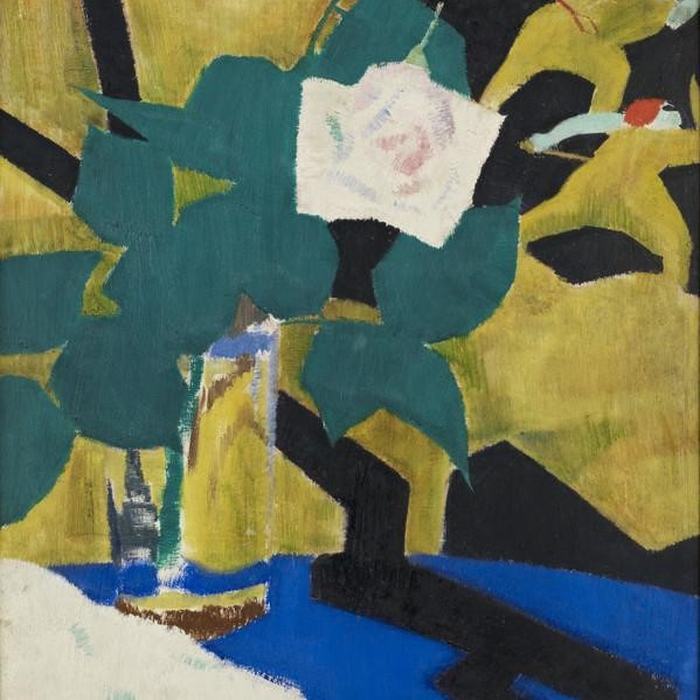
George Leslie Hunter · c. 1920s · Broken contour and open handling distinguish Hunter’s shifting still-life method from Peploe’s more architectural arrangements.
Eástre, Hymn to the Sun
J. D. Fergusson · 1924 · Fergusson’s sculpture makes bodily rhythm and compact turning mass literal, proving that colour was only one instrument in his modernism.
Where to see the Scottish Colourists
Displays, loans, archive access and gallery opening arrangements change. Check current information before travelling.
- 01
Scottish National Gallery of Modern Art
The central public collection for comparing all four artists, with major still lifes, portraits, landscapes and sculpture as well as the scholarship behind the dedicated retrospective series.
Edinburgh, Scotland
Collection and research guideVisit official resource - 02
Kelvingrove Art Gallery and Museum
Its Scottish Colourists gallery and extensive Glasgow Museums holdings include Cadell’s Interior: The Orange Blind, Peploe still lifes, Fergusson figures and work by Hunter.
Glasgow, Scotland
Collection and research guideVisit official resource - 03
Perth Art Gallery and the Fergusson collections
Perth holds the major body of Fergusson’s art and archive alongside material relating to Margaret Morris, making it indispensable for sculpture, dance and collaboration.
Perth, Scotland
Collection and research guideVisit official resource - 04
The Hunterian
The collection provides Fergusson’s Paris-period work and wider Scottish modernist context, including art connected to Rhythm.
Glasgow, Scotland
Collection and research guideVisit official resource - 05
Kirkcaldy Galleries
Its strong Scottish art collection is particularly useful for Hunter and for locating the Colourists beside Fife subjects and later twentieth-century painters.
Kirkcaldy, Scotland
Collection and research guideVisit official resource - 06
The McManus
Modern Scottish holdings allow the quartet to be compared with contemporaries beyond Edinburgh and Glasgow.
Dundee, Scotland
Collection and research guideVisit official resource - 07
Aberdeen Art Gallery
The collection broadens the story through Scottish modern painting, decorative art and the national circulation of Colourist work.
Aberdeen, Scotland
Collection and research guideVisit official resource - 08
Iona and west-coast collections
No gallery substitutes for the island’s changing light and geography. Local and regional displays can return Cadell and Peploe’s celebrated views to an inhabited landscape rather than a timeless motif.
Inner Hebrides, Scotland
Collection and research guideVisit official resource
Landmark Scottish Colourist exhibitions
Five displays that presented, consolidated or critically reassessed the retrospective quartet.
The first quartet exhibition
Galerie Barbazanges, Paris
The first four-artist presentation joined already distinct careers and made the national comparison visible in Paris.
Les Peintres de l’Écosse Moderne
Leicester Galleries, London
Balanced catalogue numbers, Fergusson’s sculpture and Walter Sickert’s preface turned selection, hang and criticism into instruments of canon formation.
A broader reunion in Paris
Galerie Georges Petit, Paris
The quartet appeared within a wider display shortly before Hunter’s death, proving that their shared exhibition history remained intermittent.
The Scottish Colourists 1900–1930
Edinburgh and London
The National Galleries of Scotland and Royal Academy survey renewed international attention while the catalogue placed the four careers within a comparative frame.
A Century of the Scottish Colourists
National Galleries of Scotland
The Leicester centenary made the category’s construction, reception and uneven chronology explicit rather than treating the quartet as an eternal movement.
Suggested books
The Scottish Colourists 1900–1930 — Philip Long with Elizabeth Cumming
The best illustrated overview of all four careers, with essays on Paris, individual development and international exhibitions. The revised edition also supplies an updated bibliography.[46]
S. J. Peploe — Alice Strang, Frances Fowle and Elizabeth Cumming
A phase-by-phase study that gives equal seriousness to still life, figure painting and landscape, while examining France and Peploe’s posthumous reputation.[47]
F. C. B. Cadell — Alice Strang
An accessible monograph built around the major retrospective, with strong treatment of Edinburgh interiors, post-war simplification, Iona and previously unpublished works.[48]
J. D. Fergusson — Alice Strang, Elizabeth Cumming and Sheila McGregor
The essential route beyond painting: Paris, Rhythm, sculpture, Margaret Morris, southern France and Fergusson’s late role in Glasgow are treated as one long modernist practice.[49]
Hunter Revisited: The Life and Art of Leslie Hunter — Bill Smith and Jill Marriner
A substantial reconstruction of the least securely documented Colourist, including California, illustration, the earthquake, travel, dealers and the range of his surviving work.[50]
Frequently Asked Questions
Peploe, Fergusson, Cadell and Hunter: four Scottish-born modern artists linked by colour, French experience, friendship, dealers and later exhibitions.
No. They had no shared manifesto or membership organisation and exhibited together only occasionally. The familiar group was consolidated retrospectively.
The quartet first shared a bill at Paris’s Galerie Barbazanges in 1924. Their important London exhibition followed at the Leicester Galleries in January 1925.
T. J. Honeyman’s 1950 book Three Scottish Colourists grouped Peploe, Cadell and Hunter. Fergusson became part of the standard four-artist category later.
No. They encountered Fauvist painting and sometimes used pure colour and bold contour, especially Fergusson, but they were not members of the original French movement and developed distinct practices.
Repeated objects allowed relationships of colour, edge, depth and balance to be tested systematically. Familiar motifs made formal change easier to see.
Its pale beaches, coloured rocks, surrounding water and fast-changing weather offered Cadell and Peploe intense light and compact views. It was also an inhabited community, artists’ colony and summer market.
Fergusson. He worked in wood, stone and metal and exhibited sculpture for decades, extending his interest in bodily movement and rhythm.
Morris was a pioneering dancer, teacher, choreographer and artist. Her partnership with Fergusson connected painting and sculpture to movement, performance, education and cultural organisation.
Cadell served and was wounded; Fergusson increasingly explored sculpture in London; Peploe remained in Scotland and worked at Kirkcudbright; international networks and markets were disrupted.
Dealers Alexander Reid, A. J. McNeill Reid and The Scottish Gallery were central, alongside collectors, artist-led societies and museums. Their group exhibitions actively shaped the category.
They demonstrated that Scottish painting could engage directly with European modernism while retaining specific places, objects and identities. Their differences also show how national art is constructed through networks rather than one style.
Discussion
Reader Insights
Start with date and career stage before applying the retrospective label; early tonal works, Paris experiments and later Scottish pictures solve different problems.
Follow hue, black anchors, white intervals, contour, touch and perspective to see how colour builds form instead of merely decorating it.
Dealers, artists, models, dancers, collectors, archives and institutions helped produce both the individual works and the quartet’s later visibility.
Join the Conversation
Which definition is most useful: four painters united by brilliant colour, four separate careers joined by exhibitions and dealers, or a later national canon that helps us compare Scottish routes through European modernism?
References
- Scottish Colourists, National Galleries of Scotland, View Source
- A Century of the Scottish Colourists, Alice Strang / National Galleries of Scotland, View Source
- Movements in Scottish Art, National Galleries of Scotland, View Source
- The Glasgow Boys, National Galleries of Scotland, View Source
- Scottish Art collection summary, Glasgow Museums, View Source
- Samuel John Peploe, National Galleries of Scotland, View Source
- The Scottish Colourist Series SJ Peploe, National Galleries of Scotland, View Source
- Samuel John Peploe self-portrait, National Galleries of Scotland, View Source
- On the French Coast, National Galleries of Scotland, View Source
- Flowers and Fruit, National Galleries of Scotland, View Source
- Still Life about 1913, National Galleries of Scotland, View Source
- Still Life Pears and Grapes, National Galleries of Scotland, View Source
- Barra, National Galleries of Scotland, View Source
- Gallery History, The Scottish Gallery, View Source
- A Legacy in Colour The Peploe Family, The Scottish Gallery, View Source
- The Scottish Colourist Series JD Fergusson, National Galleries of Scotland, View Source
- John Duncan Fergusson, National Galleries of Scotland, View Source
- John Duncan Fergusson artist record, National Galleries of Scotland, View Source
- Portrait of Anne Estelle Rice, National Galleries of Scotland, View Source
- Margaret Morris, National Galleries of Scotland, View Source
- John Duncan Fergusson and Margaret Morris collections, Culture Perth and Kinross, View Source
- The Work of Art Artist-Run Spaces transcript, National Galleries of Scotland, View Source
- JD Fergusson retrospective press release, National Galleries of Scotland, View Source
- National Galleries annual review 2013-14, National Galleries of Scotland, View Source
- The Scottish Colourist Series FCB Cadell, National Galleries of Scotland, View Source
- FCB Cadell, National Galleries of Scotland, View Source
- Francis Campbell Boileau Cadell, National Galleries of Scotland, View Source
- Landscape, National Galleries of Scotland, View Source
- The Scottish Colourists and Wider Circle, The Scottish Gallery, View Source
- Kelvingrove floor plan and Scottish Colourists gallery, Glasgow Life, View Source
- George Leslie Hunter, National Galleries of Scotland, View Source
- The Scottish Colourists Works on Paper, The Scottish Gallery, View Source
- Reflections Balloch, National Galleries of Scotland, View Source
- Hunter artist biography, The Scottish Colourists research site, View Source
- Reflections Balloch collection record, National Galleries Scotland via Google Arts & Culture, View Source
- Samuel John Peploe, Musée d'Orsay (French; consulted in French), View Source
- Liste Ecole étrangère Scottish artist files, Musée d'Orsay (French; consulted in French), View Source
- Après l'impressionnisme du néo-impressionnisme au fauvisme, Musée d'Orsay (French; consulted in French), View Source
- Fauvism, Metropolitan Museum of Art, View Source
- Vertigo of Color Matisse Derain and the Origins of Fauvism, Metropolitan Museum of Art, View Source
- A New Era Scottish Modern Art 1900-1950, National Galleries of Scotland, View Source
- Scottish Modernism press release, National Galleries of Scotland, View Source
- Featured Scottish Art, National Galleries of Scotland, View Source
- Talks and Lectures A Century of the Scottish Colourists, National Galleries of Scotland, View Source
- Scottish archives and the Scottish Colourist Series, Kirstie Meehan and Alice Strang / Scottish Records Association, View Source
- The Scottish Colourists 1900-1930, Philip Long and Elizabeth Cumming / Books from Scotland, View Source
- Samuel John Peploe, Alice Strang Frances Fowle Elizabeth Cumming / National Galleries of Scotland, View Source
- FCB Cadell, Alice Strang / National Galleries of Scotland, View Source
- JD Fergusson, Alice Strang Elizabeth Cumming Sheila McGregor / ACC Art Books, View Source
- Hunter Revisited The Life and Art of Leslie Hunter, Bill Smith and Jill Marriner / Open British National Bibliography, View Source
- Scottish Colourists image records, Wikimedia Commons: Self-Portrait (Public domain; Samuel John Peploe, Self-Portrait, c. 1911; National Galleries of Scotland via Wikimedia Commons, public domain; cropped and compressed.), On the French Coast (Public domain; Samuel John Peploe, On the French Coast, 1907; National Galleries of Scotland via Wikimedia Commons, public domain; cropped and compressed.), Still Life (Public domain; Samuel John Peploe, Still Life, 1913; Wikimedia Commons public-domain reproduction; cropped and compressed.), Iona Study (Public domain; Samuel John Peploe, Iona Study, 1920s; National Galleries Scotland via Wikimedia Commons, public domain; cropped and compressed.), Interior: The Orange Blind (Public domain; F. C. B. Cadell, Interior: The Orange Blind, c. 1927; Kelvingrove Art Gallery and Museum via Wikimedia Commons, public domain; cropped and compressed.), The Rose and the Lacquer Screen (Public domain; F. C. B. Cadell, The Rose and the Lacquer Screen, c. 1920s; National Galleries of Scotland via Wikimedia Commons, public domain; cropped and compressed.), The White Cottage, Iona (Public domain; F. C. B. Cadell, The White Cottage, Iona, c. 1920s; Wikimedia Commons public-domain reproduction; cropped and compressed.), Reflections, Balloch (Public domain; George Leslie Hunter, Reflections, Balloch, c. 1929–30; National Galleries of Scotland via Wikimedia Commons, public domain; cropped and compressed.), Still Life: Roses and a Black Fan (Public domain; George Leslie Hunter, Still Life: Roses and a Black Fan, c. 1920s; Aberdeen Archives, Gallery and Museums via Wikimedia Commons, public domain; cropped and compressed.), Eástre, Hymn to the Sun (CC BY-SA 4.0; J. D. Fergusson, Eástre, Hymn to the Sun, 1924; photograph by Stephen C. Dickson, Wikimedia Commons, CC BY-SA 4.0; cropped and compressed under UK freedom of panorama.).