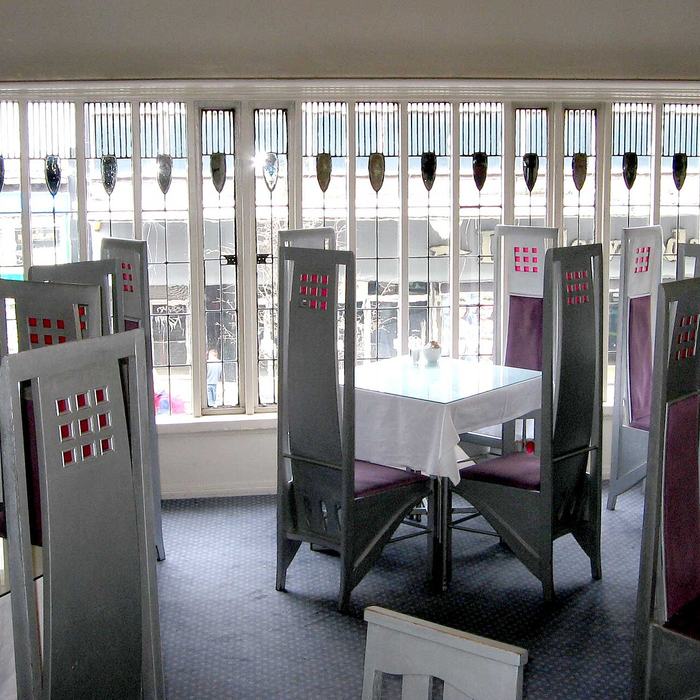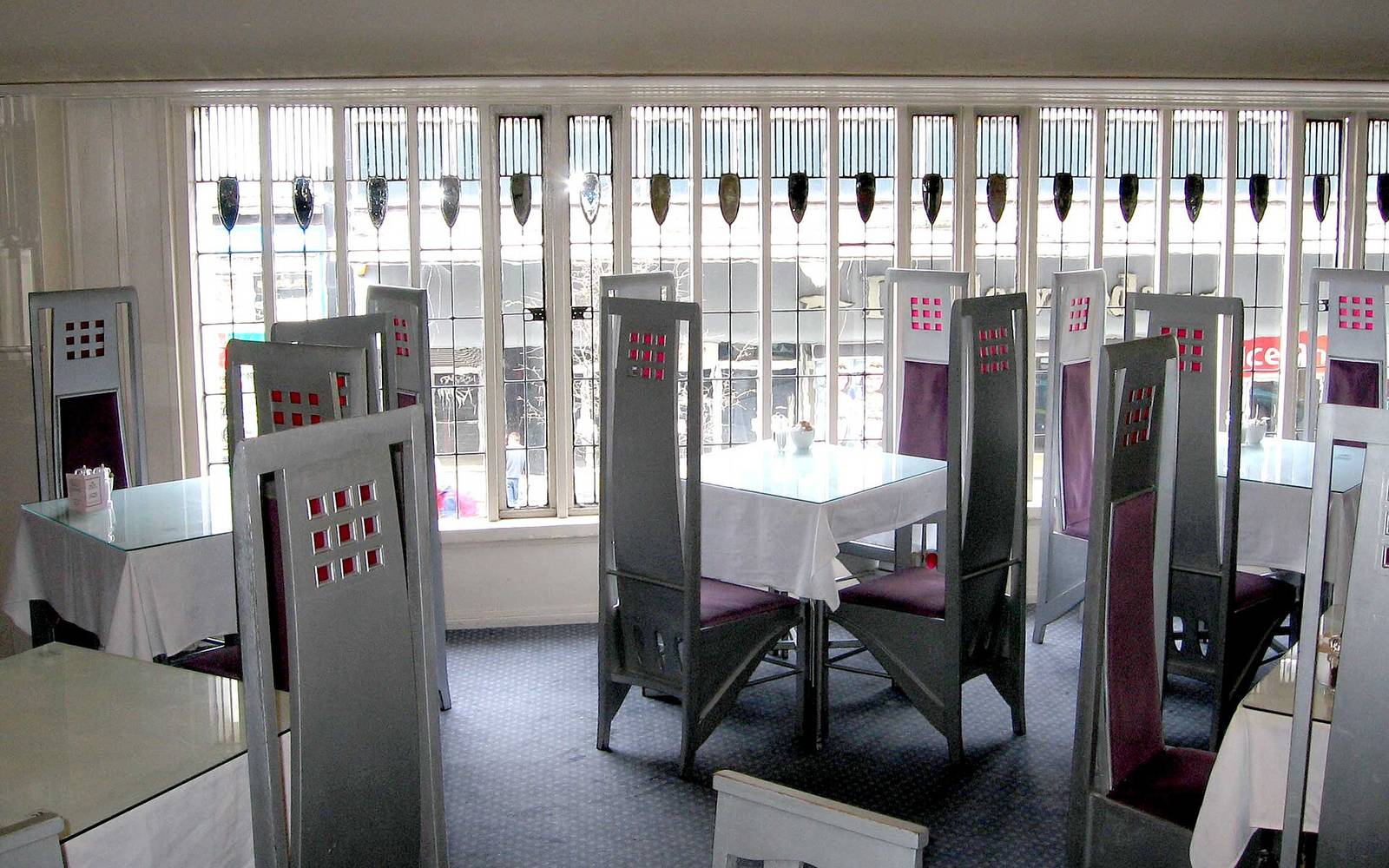
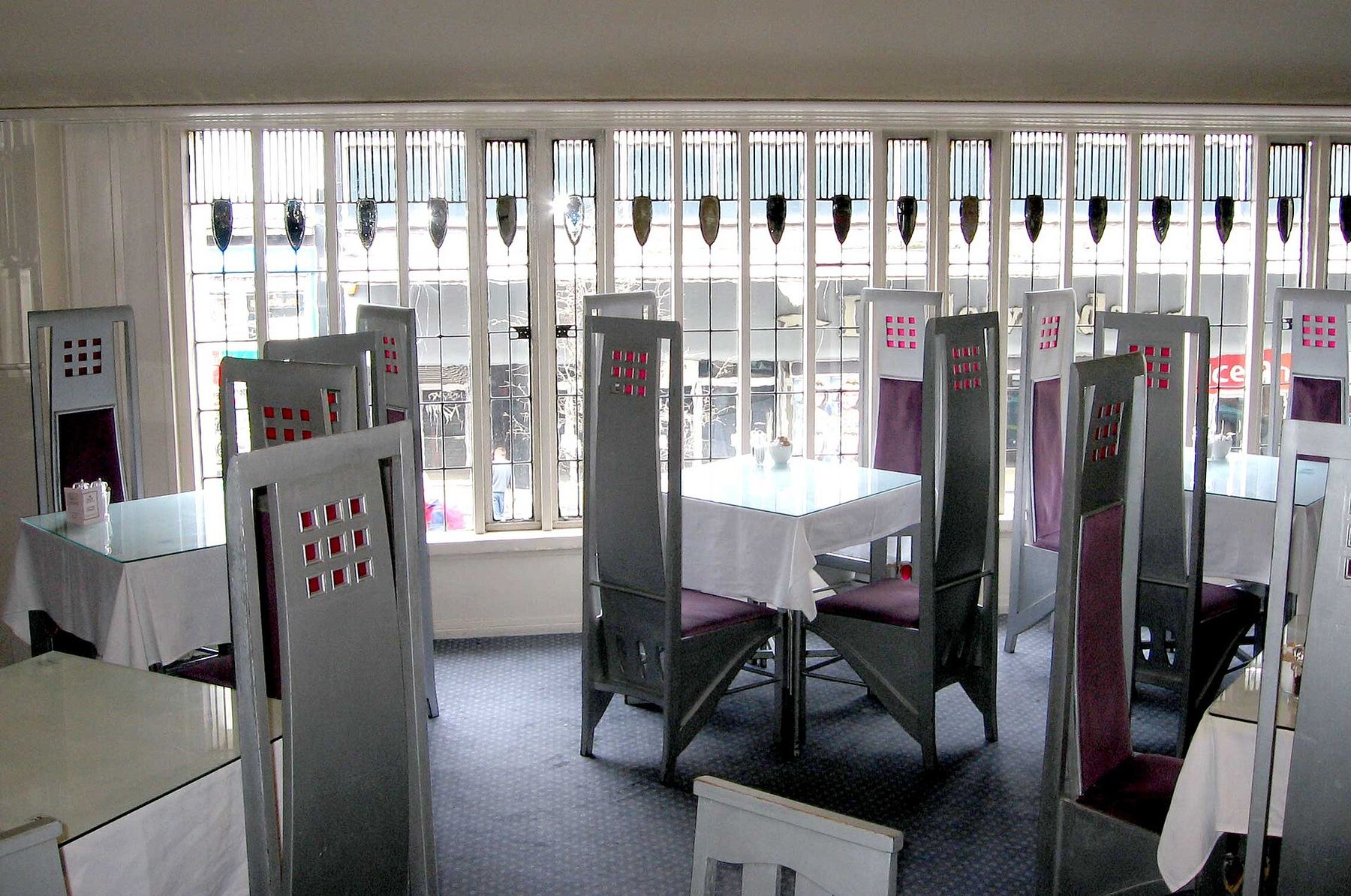
Image reference: the Room de Luxe at the Willow Tea Rooms.
At a Glance
- Central periodapproximately 1890–1914, within a wider development from the 1880s to about 1920.
- Primary placeGlasgow, with important work and reception in Liverpool, London, Vienna, Turin, Berlin, Dresden, Paris and other European centres.
- Institutional centrethe Glasgow School of Art under Francis Newbery.
- Principal early groupCharles Rennie Mackintosh, Margaret Macdonald, Frances Macdonald and James Herbert McNair, known as “The Four.”
- Wider designersJessie Newbery, Ann Macbeth, Jessie M. King, Talwin Morris, George Walton, Annie French, Helen Paxton Brown, De Courcy Lewthwaite Dewar, Dorothy Carleton Smyth and many others.
- Typical formsattenuated figures, plant-derived curves, vertical stems, hearts, seeds, tears, squares, grids, severe furniture silhouettes, stylised lettering and active empty space.
- Important mediaarchitecture, complete interiors, furniture, gesso, embroidery, metalwork, stained glass, books, posters, jewellery, ceramics and watercolour.
- Key contextsindustrial wealth, design education, women's professional networks, commercial publishing, artistic dress, temperance tearooms and international exhibitions.
- What it was nota Mackintosh company, the Glasgow Boys, a single women’s group, or a Scottish copy of continental Art Nouveau.
Contents
- Where it fits
- Names and networks
- City and art school
- The Four
- Margaret Macdonald
- Frances Macdonald
- Textiles and print
- Buildings and rooms
- Vienna and Turin
- Where to study it
Where Glasgow Style fits
Charles Rennie Mackintosh
Key career periodMargaret Macdonald
Key career periodFrances Macdonald
Key career periodJames Herbert McNair
Key career periodJessie M. King
Key career periodJessie Newbery
Key career periodAnn Macbeth
Key career periodGeorge Walton
Key career periodImagine entering a Glasgow tearoom around 1903. The street outside is loud with carts, shoppers and an industrial city's smoke. Inside, a tall dark chair turns the person sitting in it into part of a vertical pattern. Pale walls carry thin plant lines; squares restrain curves; coloured glass breaks the light; an elongated woman in relief seems to grow out of willow, thread and silver. Architecture, furniture, menu, clothing and conversation occupy one composed field.
That field is the Glasgow Style. Developed around the Glasgow School of Art during the late nineteenth and early twentieth centuries, it joined architecture, interiors, furniture, metalwork, embroidery, stained glass, illustration, jewellery, ceramics, painting and typography. It was not a society with rules and membership. It was a network of artists, designers, teachers, clients, firms and makers who shared places, opportunities and an increasingly recognisable visual language.[1]
The movement is often reduced to Charles Rennie Mackintosh and one pink rose. Glasgow Museums' collection tells a much larger story. Its holdings cover approximately 4,500 objects associated with work made between about 1890 and 1920, from surviving tearoom fittings to paper, glass, textile and metal. Mackintosh is central, but he is one participant in a material culture spread across many hands.[2]
Even the dates need flexibility. V&A Dundee traces the Scottish interpretation of international Art Nouveau from the 1880s into the 1920s. The most concentrated period falls between the early 1890s and the First World War, when school friendships, studio partnerships, commissions and exhibitions brought unusual coherence. Earlier teaching made it possible; later careers prolonged and transformed it.[3]
At its strongest, Glasgow Style holds opposites together. A body becomes a thin stem while a chair becomes a dark tower. A hand-modelled gesso panel belongs inside a commercially operated tearoom. Scottish towers meet Japanese intervals; medieval story meets metropolitan publishing; pale emptiness depends on emphatic black line. A major touring exhibition has accordingly presented the movement through books, ceramics, furniture, posters, textiles, watercolours and architectural drawings rather than through one medium or master.[4]
Glasgow Style, Glasgow School, Glasgow Boys and Glasgow Girls
The names overlap, but they should not be exchanged casually. “Glasgow School” can refer broadly to artists and designers connected to the city and its School of Art. It may include painters, architects and craftspeople who never used the Style's spectral figures or rigid grids.
The Glasgow Boys were a loose painting formation associated principally with the 1880s and 1890s. James Guthrie, John Lavery, Edward Atkinson Hornel, George Henry and others challenged academic Scottish painting through naturalism, rural subjects, decorative colour and international sources. They helped make the city receptive to artistic innovation, but they were not another name for Glasgow Style.
“The Four” identifies a much smaller relationship: Mackintosh, Herbert McNair and the sisters Margaret and Frances Macdonald. They met through the School, exhibited together and produced the designs that hostile critics called the “Spook School.” Their imagery gave the early Style a memorable experimental edge, but hundreds of Glasgow objects were made outside their circle.
“Glasgow Girls” is a later recovery term for women artists and designers active around the city and School. It is indispensable because older histories made women disappear behind the Boys or behind Mackintosh. It is also retrospective. The women did not all share a manifesto, medium, address or style, and some pursued substantial careers elsewhere. Used carefully, the name reveals networks without inventing membership.
The industrial city and the art school
Glasgow Style did not bloom outside modern industry. By 1900 Glasgow was an engineering, shipbuilding, commercial and publishing centre tied to the British Empire. Wealth funded schools, villas, restaurants, exhibitions and art collections. The same economy produced severe crowding, polluted air, dangerous labour and dramatic inequality. A pale room could feel like release precisely because the city beyond it was materially dense.
Design education had practical origins. The institution founded in 1845 trained people for industries that required drawing, pattern and technical competence. This relationship is easy to erase when the finished chair enters a museum and becomes “art.” Glasgow's painters and designers learned within a local economy where carpet, textile, ship, print, glass, furnishing and building trades interpenetrated.
Francis Henry Newbery, appointed headmaster in 1885, created conditions in which experimentation could grow. Research on his thirty-three-year tenure describes a pupil-centred educator who brought craft studios into the School, encouraged individual ability and promoted work internationally. He did not hand students a Glasgow Style formula. His achievement was to make an institutional culture where different formulas could be tested.[5]
Newbery made the School socially active. Clubs brought day and evening students together; exhibitions provided deadlines and audiences; invited lecturers connected Glasgow to British design debate; working artists joined the staff. Among the figures he brought into the School's orbit were Walter Crane, C. F. A. Voysey and William Morris, while teachers from Scotland and continental Europe complicated any purely national story.[6]
This openness did not make the institution equal in every respect. Students entered with different resources, women remained vulnerable to the classification of their work as minor or domestic, and professional architecture was still structured by apprenticeship and male offices. Yet the School made decorative practice unusually visible. It allowed embroidery, metal and book design to become laboratories for a modern language.
The Four and the “Spook School”
Mackintosh and McNair attended evening classes while working in architecture. Margaret and Frances Macdonald were full-time students. Newbery and colleagues recognised shared interests and encouraged contact. By the middle of the 1890s, the four were producing graphics, watercolours, posters, metalwork, furniture, glass and textiles that looked unlike conventional British design.
The student-produced Magazine was one site of experiment. Frances Macdonald's 1896 Nativity uses watercolour, gold and silver on brown tracing paper. Sacred narrative becomes a compressed arrangement of elongated bodies, pattern and symbolic colour. Work of this kind helped provoke the “Spook School” label. The nickname registers unease with bodies that looked too thin, too strange and insufficiently healthy or classical; it should not become a neutral name for everything they did.[7]
Their sources were wide. Continental Symbolism offered images whose meanings remained suggestive rather than fully narrated. Maurice Maeterlinck supplied theatre of suspension, silence and death. Dante Gabriel Rossetti supplied poetry in which women, trees and water become mutually charged. The Aesthetic culture associated with James McNeill Whistler had already demonstrated that arrangement and atmosphere could displace conventional moral narrative. Aubrey Beardsley demonstrated how black line and white paper could generate erotic unease. Japanese design offered asymmetry, cropping and interval. Imagined Celtic and medieval material offered story without academic classicism.
None of these sources works like a recipe. Glasgow designers did not add one measure of Japan to one of Celtic revival. They learned that a blank area could be active, that a body could become pattern and that lettering could belong to an image. The Style emerged from selection and recombination.
Glasgow Style artists and designers to know
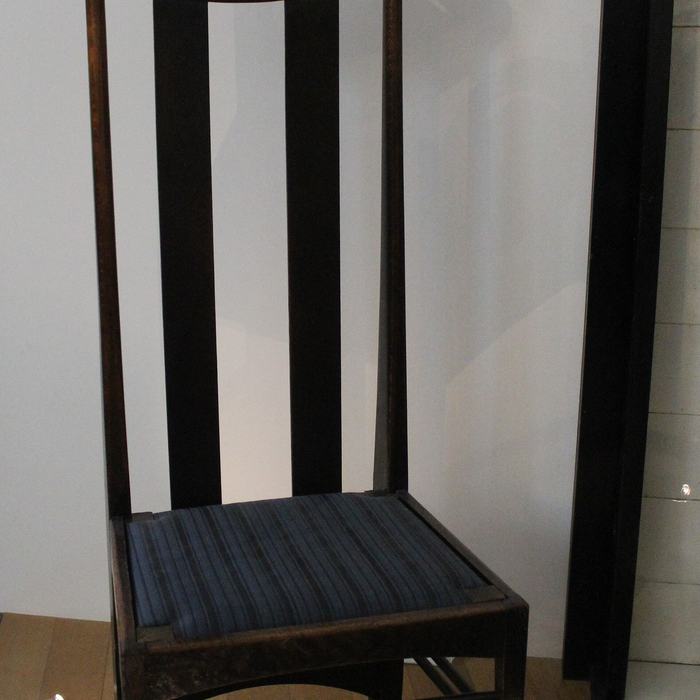
Charles Rennie Mackintosh
Mackintosh joined architectural training, Scottish building traditions, Arts and Crafts construction and Art Nouveau freedom. His importance is exceptional, but the movement remains larger than his office and reputation.
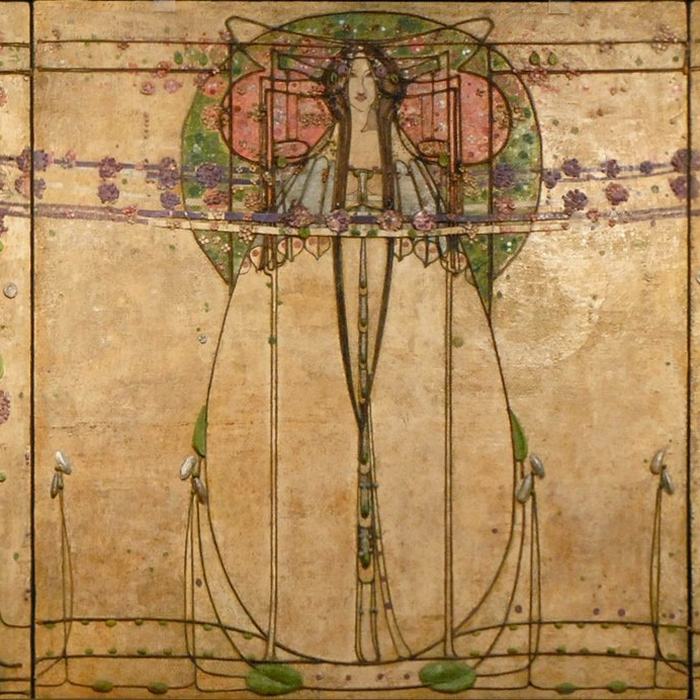
Margaret Macdonald
Macdonald's relief panels give collaborative interiors their tactile and emotional centres. Her signed work requires direct attribution rather than the diminishing language of muse or inspiration.
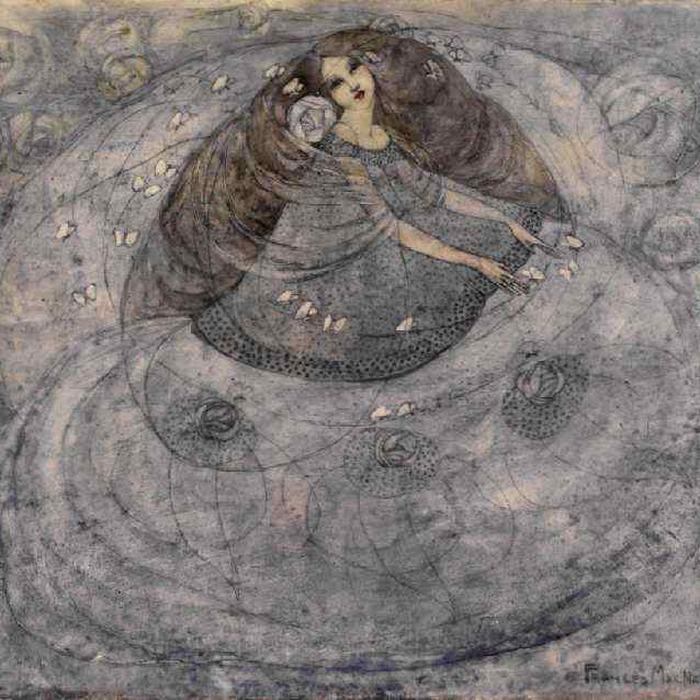
Frances Macdonald
Frances developed a psychologically distinct language of change, maternity, marriage and confinement. Her Glasgow and Liverpool work belongs to an independent career despite severe losses from the surviving corpus.
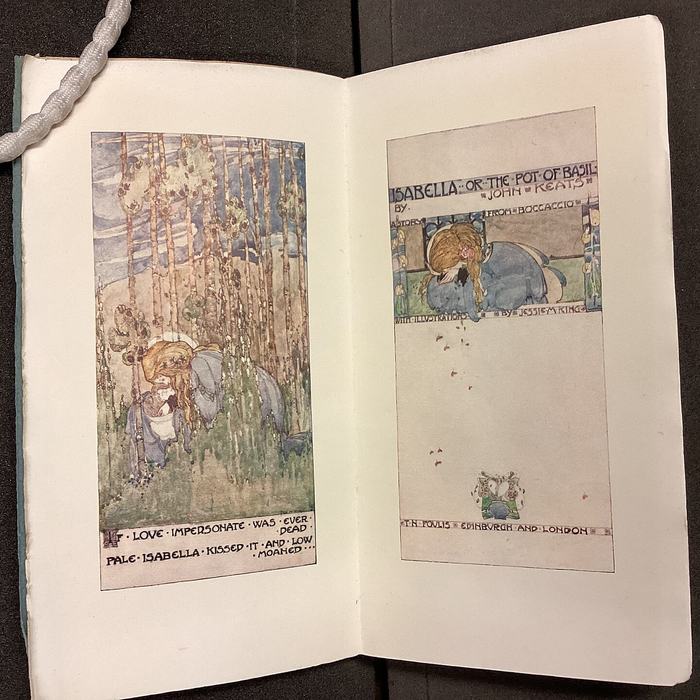
Jessie M. King
King's nervous line, fantasy imagery, lettering and broad commercial practice carried Glasgow design through books, textiles, wallpaper, silver, ceramics and teaching.
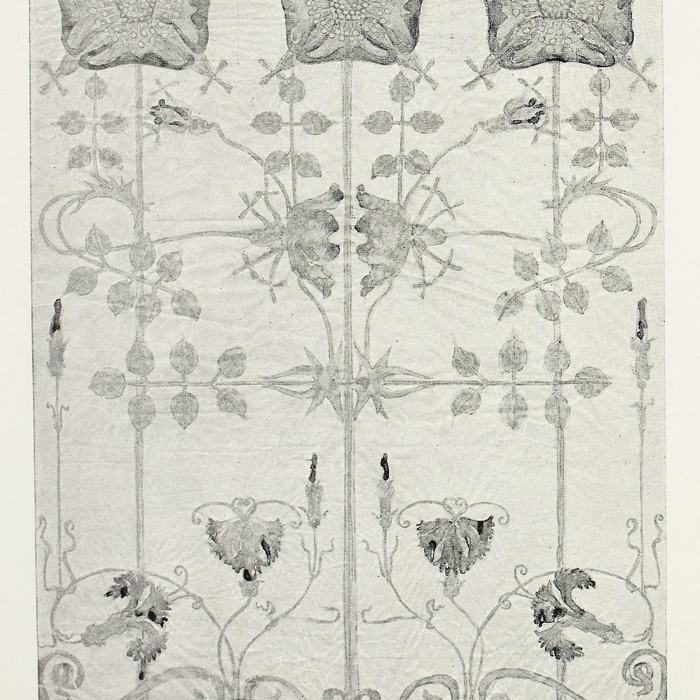
Jessie Newbery
Newbery's 1894 embroidery department made stitch, appliqué, clothing and economical materials central to modern design education, professional opportunity and the migration of the Glasgow rose.
Ann Macbeth
Macbeth extended Glasgow's needlework pedagogy through design, published instruction and leadership, joining embroidery to architectural surfaces and suffrage-era professional life.
Margaret Macdonald: the room's symbolic centre
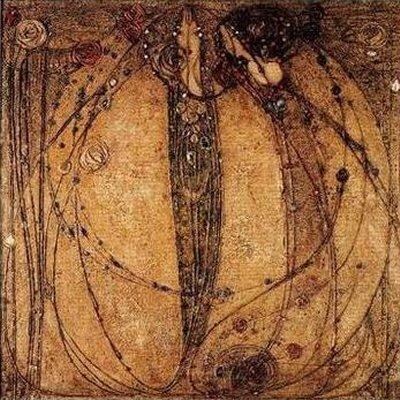
Margaret Macdonald was an artist across media before and after her marriage. She worked in repoussé metal, embroidery, graphics, watercolour and gesso. Her collaboration with Mackintosh became exceptionally close, but calling her his “inspiration” is inadequate. Specific panels, embroideries and designs bear her authorship and determine how important shared rooms feel.[8]
The Four's shared outlook came through objects rather than doctrine. A Hunterian account describes their early combination of Arts and Crafts, continental Symbolism and Japanese art, visible in distorted figures and intensely stylised nature. McNair married Frances in 1899; Mackintosh married Margaret in 1900. Marriage reorganised the working pairs, but it did not retroactively make the sisters' earlier studio work the property of their husbands.[9]
Gesso was particularly suited to Margaret's imagination. A relief could be modelled over textile support, painted and inset with thread, beads, shell, coloured glass or metal leaf. Its irregular surface catches changing light. Unlike a framed painting added after the room is complete, a long panel can establish a wall's proportions and symbolic temperature.
In The May Queen of 1900, made for the Ladies' Luncheon Room at Miss Cranston's Ingram Street tearooms, a frontal procession of women, flowers and vertical lines occupies a shallow, shimmering field. Faces repeat without becoming portraits. Dresses and stems merge. The work can seem ceremonial, but the ceremony does not disclose one settled doctrine. Its authority comes from the tension between collective rhythm and individual, pale faces.
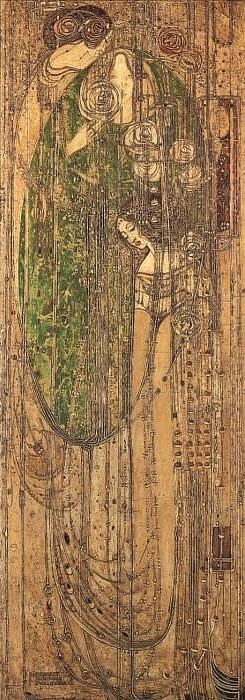
For the Willow Tea Rooms in 1903, Margaret made O ye, all ye that walk in Willowwood, after Rossetti. Willow branches, sorrowing lovers and inlaid surface bind literary melancholy to a fashionable public room. The panel did not “soften” an otherwise architectural interior. It supplied the emotional argument around which furniture, light and colour operated.
Frances Macdonald: anxiety beneath delicacy
Frances Macdonald's surviving work is scarcer. A Hunterian acquisition study notes that only forty-two watercolours had been traced for a major 2006 exhibition. Loss matters to reputation: McNair destroyed a quantity of work after her death, and her move away from Glasgow reduced her place in a city-centred story.[10]
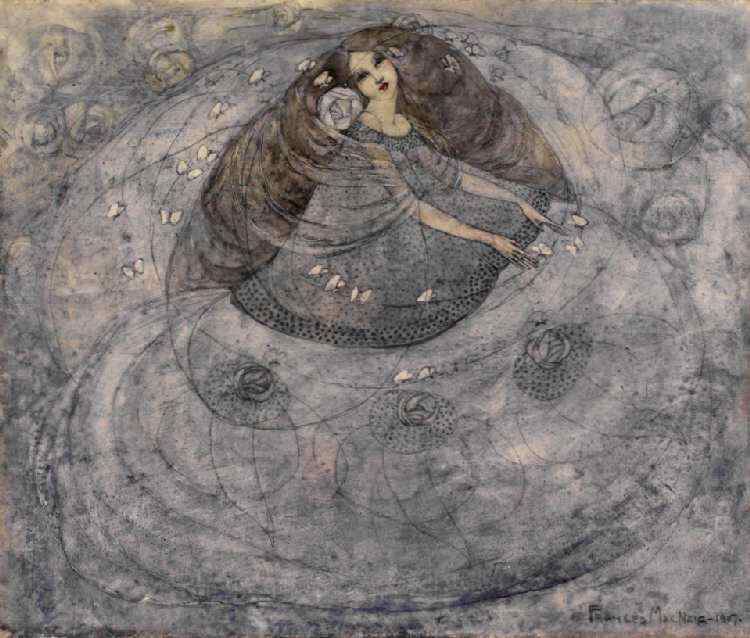
Her watercolours reward separation from Margaret's. Girl with Butterflies places an elongated figure amid creatures associated with change, beauty and instability. Later works address marriage, maternity, sleep and confinement through bodies that fold, float or become trapped within ornament. The surfaces may be fine, but their psychological content is not dainty.
Frances and McNair moved to Liverpool, where he taught and both continued designing. Their 1902 Turin writing room and later watercolours belong to an independent partnership, not a failed copy of the Mackintoshes. The first exhibition devoted to them as a couple explicitly challenged their treatment as an adjunct and reconstructed the Liverpool decade as a distinct creative period.[11]
The destruction and dispersal of Frances's work complicate certainty. A missing object cannot support unlimited speculation. What survives nonetheless demonstrates that the Glasgow Style included a darker inquiry into the choices available to women, not only a repertoire of roses and pale rooms.
Glasgow Girls: a useful recovery, not a membership card
The Glasgow Girls include painters and designers as different as Bessie MacNicol, Stansmore Dean, Jessie M. King, Annie French, Helen Paxton Brown, Margaret and Frances Macdonald and Jessie Newbery. National Galleries of Scotland explains that the term was coined in 1968 as a counterpart to the Glasgow Boys. Their strongest bond was not one look but connected experience: study, friendship, shared studios, exhibition, professional ambition and mutual support.[12]
Glasgow's prosperity created work while its social structures restricted access. Women formed the Glasgow Society of Lady Artists in 1882, rented studios and made places where patrons, artists and writers could meet. Jessie M. King and Helen Paxton Brown's studio at 141 Bath Street became one such hub. These rooms were professional infrastructure, not picturesque evidence of feminine companionship.
The category also changes how media are valued. If art history begins with large oil paintings and buildings, the women appear peripheral. If it begins with the surfaces through which people encountered modern design—dress, book, menu, curtain, jewellery, screen and embroidered panel—the hierarchy shifts.
Jessie Newbery and embroidery as modern design
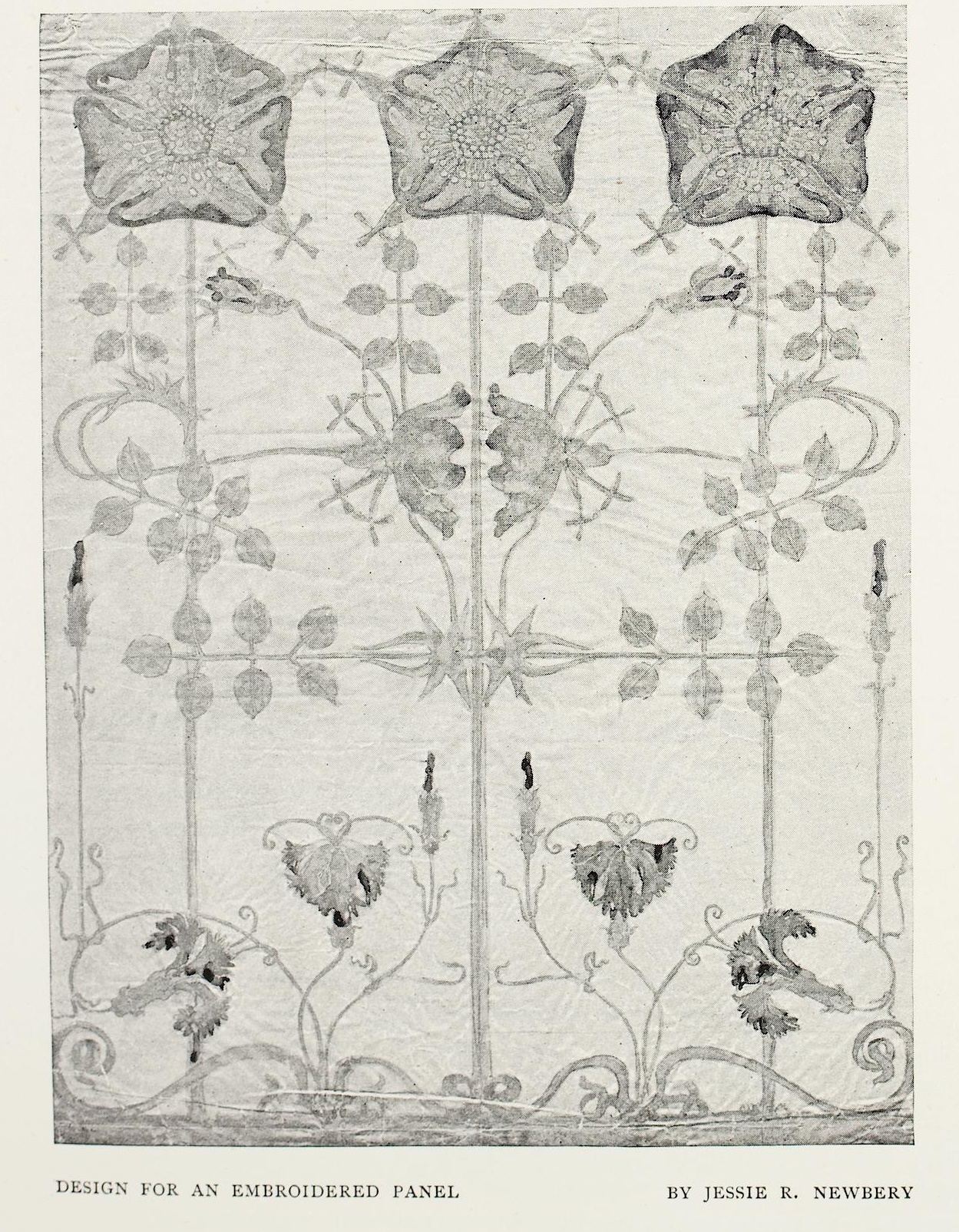
Embroidery had been coded as domestic accomplishment, but that history made it politically and aesthetically important. In 1894 Jessie Newbery established a department at the School intended to teach embroidery in a modern way for modern garments. The course treated pattern, material, construction and use as design problems rather than asking students to copy historical motifs mechanically.[13]
Newbery used appliqué to make economical areas of colour and stitch. The Glasgow rose may have developed partly from her circles of pink linen, cut freehand and marked with satin stitch to suggest folded petals. That origin matters because it locates a supposedly universal Mackintosh emblem in textile method and a woman's teaching. Her clothes balanced artistic distinctiveness with practical wear.[14]
The “rose” is therefore a process as well as a sign. Curves can be tightened into a spiral, repeated down a stem, enclosed by a square or translated into metal and glass. It becomes recognisable because it can change medium without becoming a naturalistic flower.
Ann Macbeth carried textile education forward. A student from 1897, she became an assistant in needlework and appliqué in 1902 and later led the section. Her practice joined making, published instruction, educational reform and women's suffrage. A fire screen attributed to her shows how embroidery could become an architectural surface rather than a small private pastime.[15]
Jessie M. King and the portable Glasgow line
Jessie M. King demonstrates the Style's ability to travel. She designed book covers and illustrations, fabrics, wallpapers, costumes, interiors, ceramics and silver for Liberty. She taught at the School, worked with British and German publishers, moved to Paris and later helped build an artistic community at Kirkcudbright.[16]
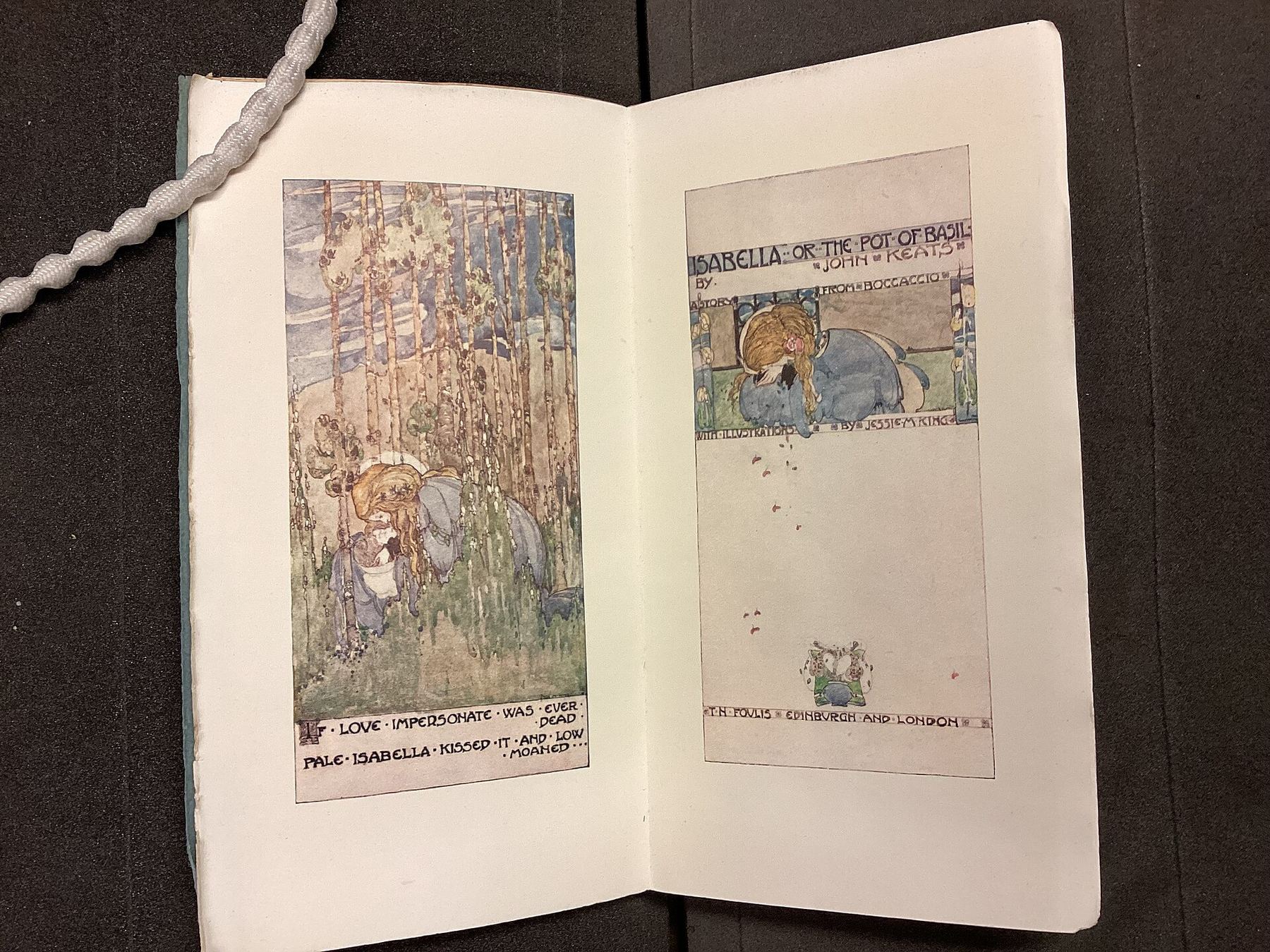
Her early line is nervous and minute. Long figures inhabit grids overgrown by dots, petals, birds, sails and hair. Lettering is not printed beneath the picture; it participates in the border and rhythm. GSA records connect her to Beardsley, Jan Toorop and the late Edward Burne-Jones, while prizes in national competition and at Turin demonstrate that the manner was professionally legible abroad.[17]
King's independence prevents a misleading equation between Glasgow Style and The Four. Her fantasy can be lighter and more narrative; her pages are reproducible and portable; her commercial range is unusually broad. She could make a mass-circulated cover carry the density of a unique drawing.
Books, metal and the city's manufacturers
Printed design brought the Style into hands and homes that would never commission a complete interior. GSA's special collections preserve bindings by King, Mackintosh and Talwin Morris alongside the design library of a Glasgow carpet manufacturer. Such holdings expose the junction between art school experiment and industrial application.[18]
Morris worked as an art director for the Glasgow publisher Blackie & Son. A cover could repeat across an edition, coordinate series identity and compete in a shop. Thin stems, compact hearts, asymmetric panels and integrated title lettering translated successfully to stamped cloth. Modern design here was not opposed to multiplication.
Jewellery moved at the opposite physical scale. A round enamel brooch attributed to Frances Macdonald concentrates metal, colour and line into an object worn on the body. The attribution remains qualified, which is itself instructive: workshops, unsigned objects, shared motifs and later sales can make certainty impossible. The Met situates such pieces within the Four's practice across jewellery, metal, textiles and interiors.[19]
Objects depended on execution. Cabinetmakers, embroiderers, metalworkers, glassmakers, printers and building trades converted designs into surfaces capable of use. The phrase “total work of art” can hide these people if it implies that one author made the whole room alone.
Material, atmosphere and the total room
The Hunterian describes Margaret Macdonald's achievement in gesso as unmatched in Britain and holds one of the great paired collections of her and Mackintosh. Their rooms show why an object list is insufficient. Proportion, distance, sequence, light and atmosphere determine whether a chair reads as furniture, screen, figure or architecture.[20]
A total interior does not make everything visually busy. Glasgow rooms often use emptiness as a material. A pale wall allows one panel to carry emotional weight. A black chair makes air visible between its rails. A coloured glass square slows a field of white. Repetition makes a small motif architectural.
The total room also sets terms for bodies. Tall backs control sightlines; narrow furniture encourages posture; the route between dark hall and white bedroom turns movement into narrative. Designers were not simply decorating rooms. They were proposing how modern people might enter, sit, converse, read and withdraw.
Follow Glasgow Style through four stages
–94
An art school and industrial city create the network
Francis Newbery's teaching culture, clubs, exhibitions and working designers bring architecture, drawing, embroidery and commercial industry into productive contact.
–99
The Four and their peers make a recognisable language
Symbolist figures, severe geometry, plant line, active emptiness and new lettering appear across student work, furniture, graphics, metal and textile while critics invent the hostile Spook School label.
–09
Rooms, patrons and exhibitions carry Glasgow abroad
Cranston's tearooms, the Hill House, Vienna 1900, Turin 1902 and Waerndorfer's salon turn collaborative rooms into an international language of contrast and total design.
–2020s
Dispersal, recovery and reconstruction reshape the field
War, changing patronage and separate careers loosen the network before exhibitions, scholarship, conservation and catastrophic fire reconstruct its makers, rooms and contested civic memory.
The Glasgow School of Art: a building for making
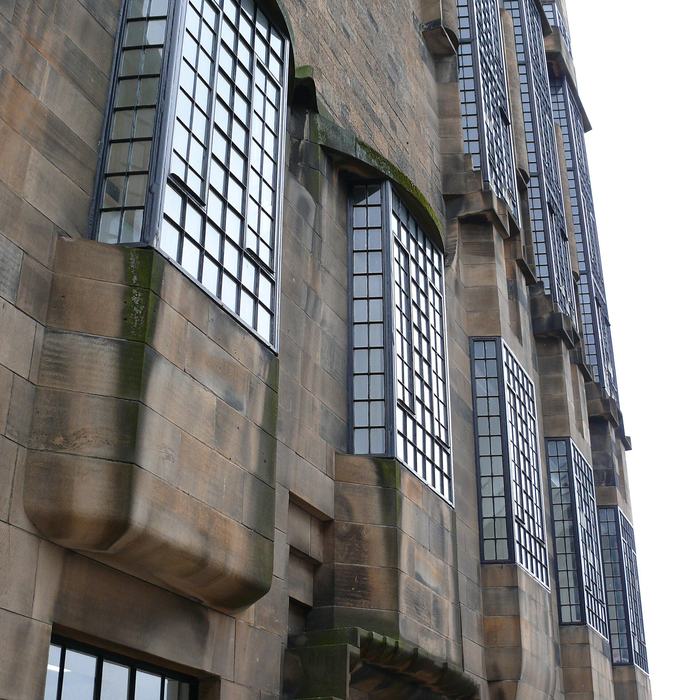
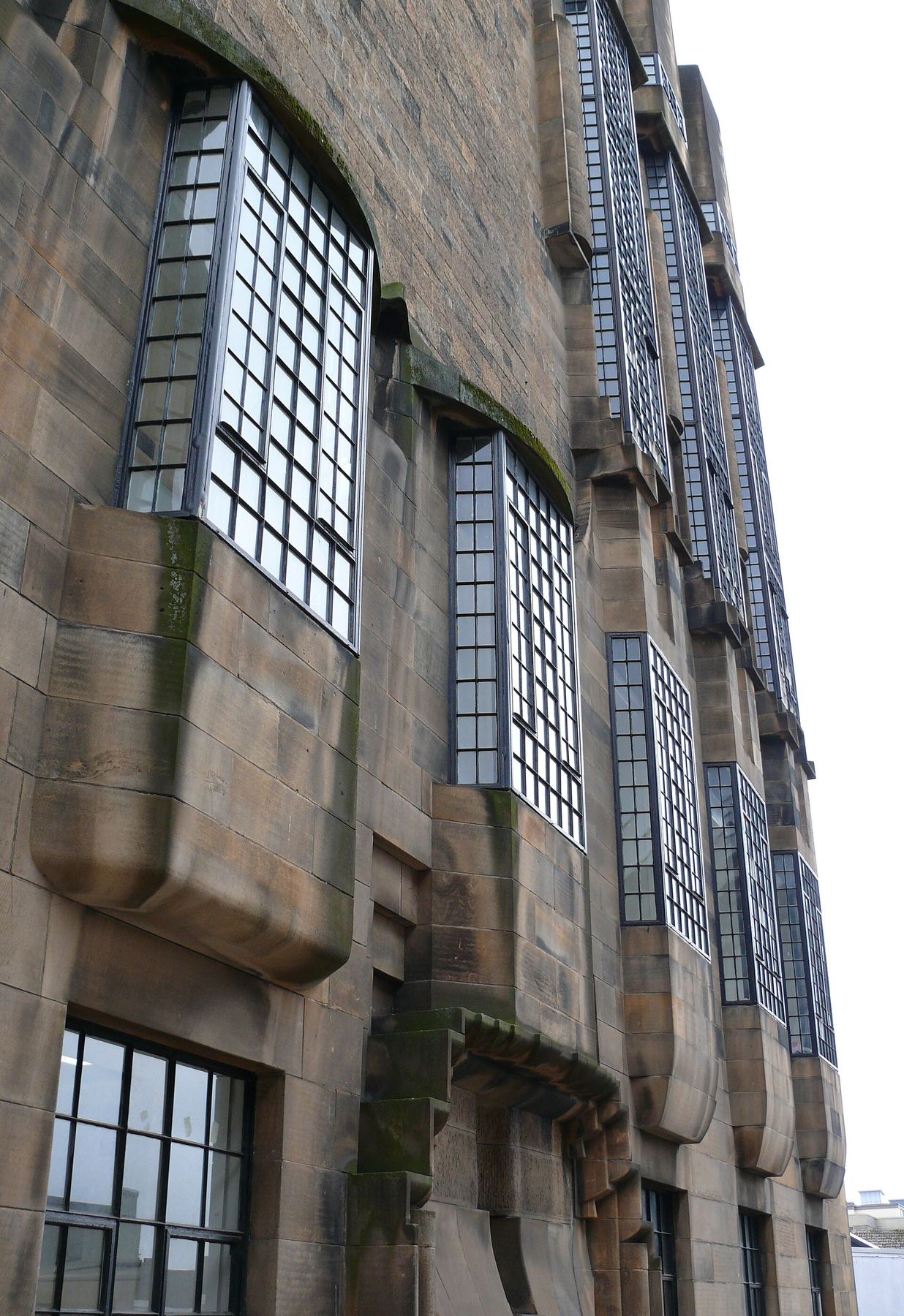
The Glasgow School of Art building is often treated as Mackintosh's isolated masterpiece. Its programme returns it to the movement. Built principally in two phases, 1897–99 and 1907–09, it contained north-lit studios, workshops, a museum, library, offices and teaching spaces. Light, storage, circulation and durable working surfaces were as important as facade.[21]
The north elevation uses great studio windows within a disciplined masonry wall. Iron brackets, drainpipes and window guards act as practical systems and animated drawing. The later west wing becomes more dramatic: projecting windows and the library's dark timber structure turn Scottish tower and workshop references into an interior of vertical suspension.
Authorship was institutional. Newbery and the governors fought for suitable accommodation, negotiated finance and evaluated proposals. The office of Honeyman & Keppie carried the commission; contemporary records did not initially give Mackintosh the public credit later history assumes. Research into the governing process shows a building produced through client requirements and professional negotiation as well as individual imagination.[22]
The two phases are sometimes narrated as Victorian east versus modern west. The contrast is real but incomplete. Both serve one school, and later work develops problems already present in the first. Modernity arrives through revision, limited funds and use—not through a clean stylistic conversion.
The Hill House: family life under design
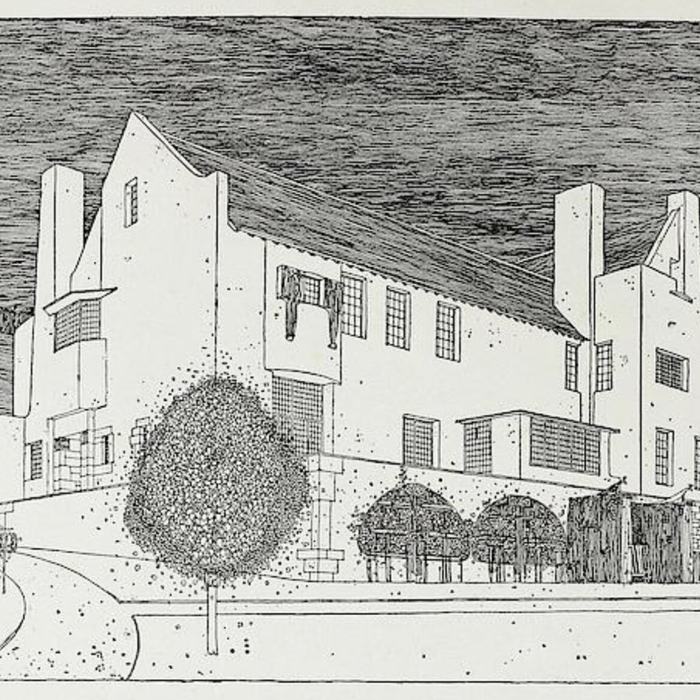
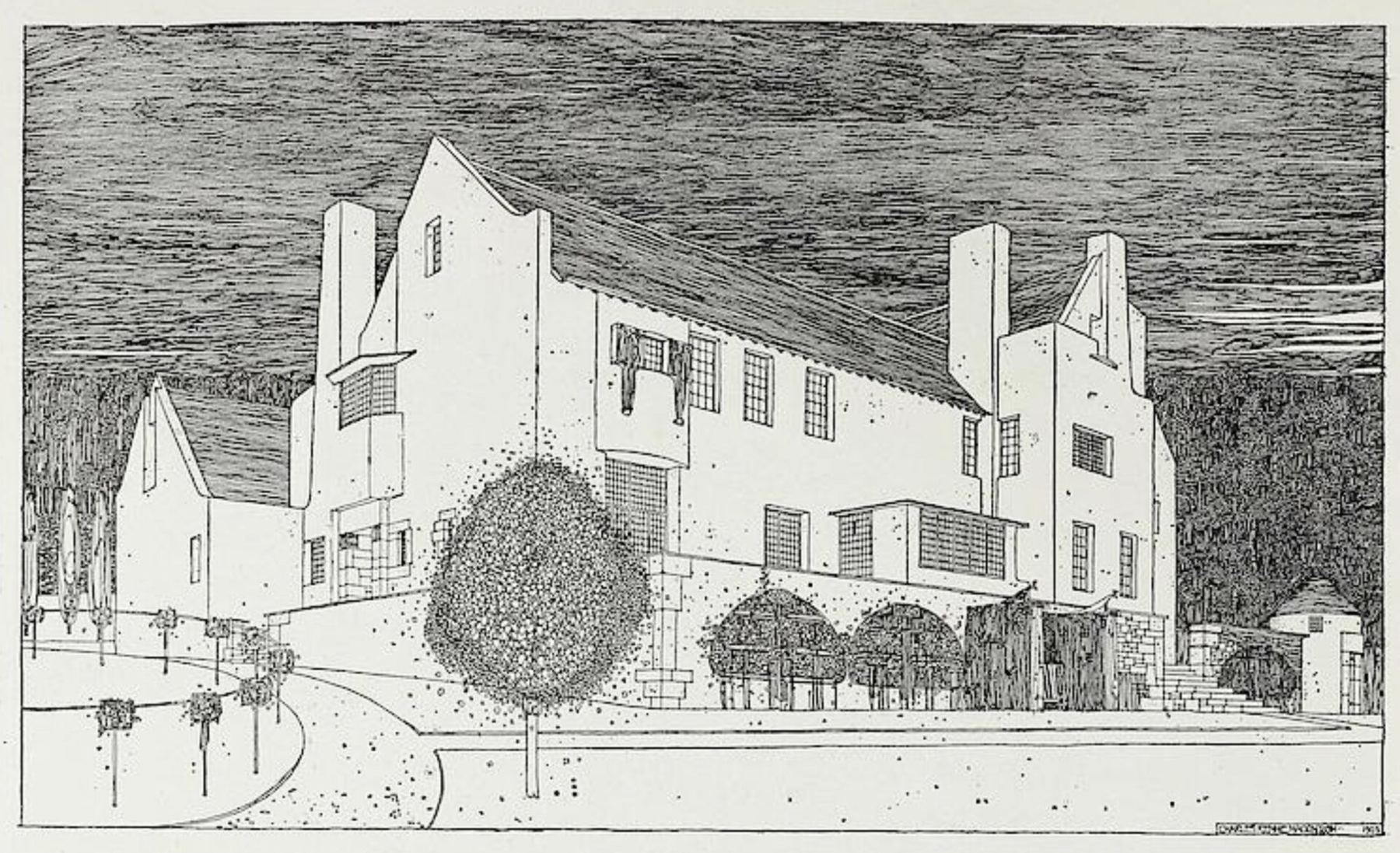
The Hill House at Helensburgh was built from 1902 to 1904 for the publisher Walter Blackie. Set high above the Clyde, it was Mackintosh's most important domestic commission. Roughcast walls, irregular massing and deep openings adapt Scottish vernacular forms without reproducing a historical style.[23]
Inside, dark hall and dining spaces contrast with pale bedrooms. Long axes are interrupted by screens and furniture. Margaret's panels and embroidered elements join symbolic figures to Mackintosh's grids. The house responds carefully to family needs, yet its coherence also disciplines daily life: beds, wardrobes, chairs, fireplaces and light are assigned precise positions within an encompassing aesthetic.
Blackie's publishing wealth links the retreat to industry. The house is not an anti-modern cottage handmade outside capitalism. It is a sophisticated commission for a successful client in a railway suburb, made possible by the city and set apart from it.
Catherine Cranston and the tearoom as public modernity
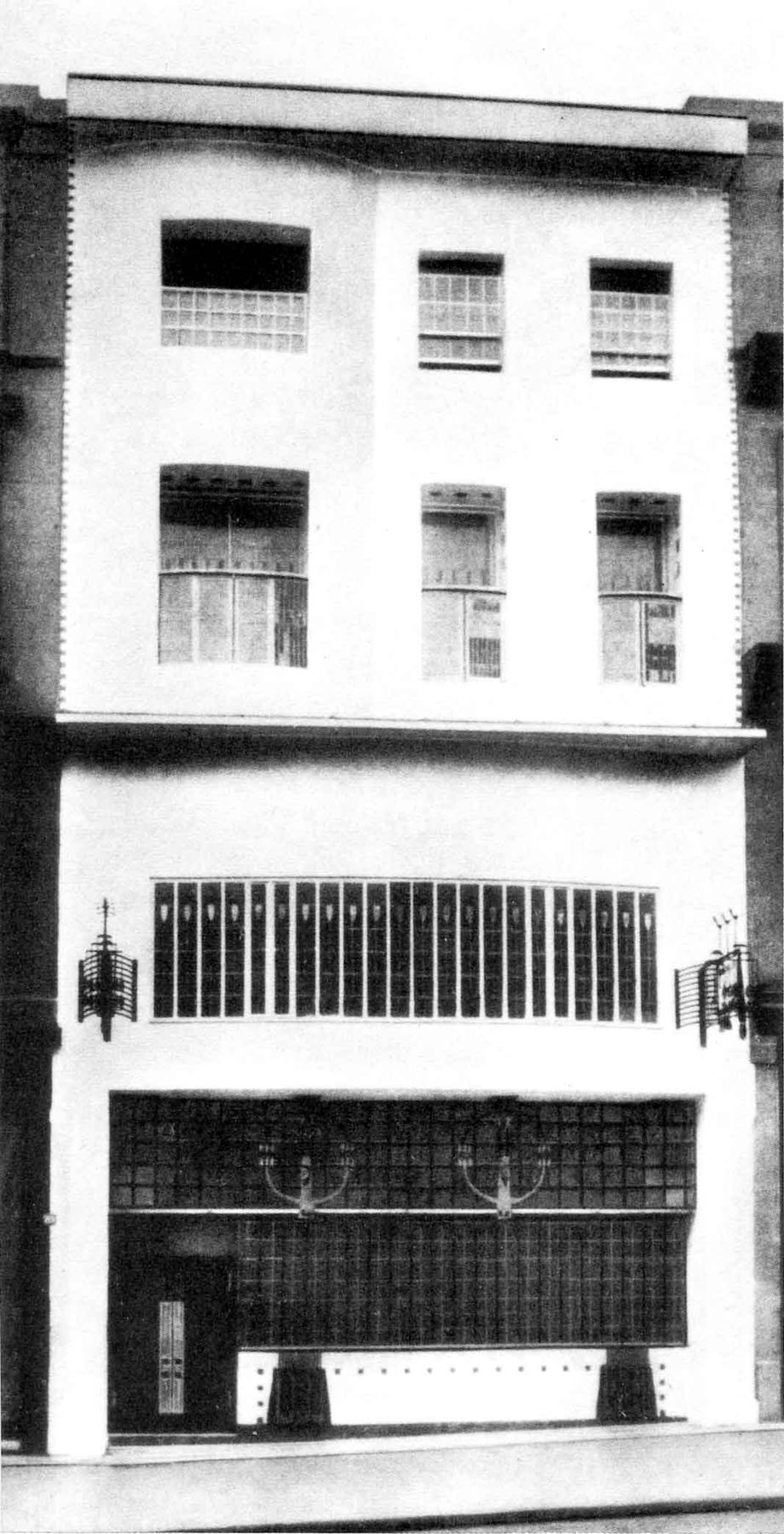
Catherine Cranston was the movement's decisive commercial patron. She developed a group of Glasgow lunch and tea establishments and commissioned designers including George Walton and Mackintosh. At the Willow Tea Rooms on Sauchiehall Street, opened in 1903, Mackintosh controlled the facade as well as room arrangement and decoration. Willow forms referred to the street's name, derived from an alley or meadow of willows.[24]
The ground floor's connected spaces were differentiated through structure, colour and ornament. Upstairs, the Room de Luxe concentrated silver-painted high-backed chairs, purple velvet, glass, a crystal light and Margaret's Willowwood panel. The room was luxurious without relying on conventional carved abundance.
Tearooms mattered socially. They offered a modern alternative to male, alcohol-centred pubs and clubs and increased respectable public space for women. Cranston's temperance sympathies, entrepreneurial judgement and desire for novelty shaped the commissions. A National Gallery teaching study notes that total design extended to lights, furniture, decoration, table settings, menu cards and staff uniforms.[25]
This was public art encountered through purchase. A customer did not need to own a villa to sit in an advanced room. Yet access was still structured by price, respectability, service labour and rules of gender. The tearoom widened public life without becoming a socially neutral utopia.
Surviving, reassembled and reconstructed rooms
Glasgow Style is unusually dependent on rooms that no longer occupy their first sites. This makes present experience valuable and complicated. A visitor can enter an apparent total work without standing inside an untouched original.
The Oak Room from the Ingram Street tearooms was designed in 1907 and expanded through later work. When the premises changed use, Glasgow Museums documented and removed interiors in 1971. Hundreds of stored pieces were conserved and reassembled at V&A Dundee nearly half a century later. It is an extraordinary survival, but survival here means planned salvage, research, repair and new installation.[26]
The Mackintosh House at the Hunterian presents the principal interiors of the couple's Glasgow home. The original house was demolished, but its fixtures and furniture had passed with the property and were eventually preserved by the University. The rooms were carefully reassembled beside the Hunterian Art Gallery. They reveal the couple's disciplined austerity and concept of the room as art while declaring a changed architectural shell.[27]
Reconstruction is not deception when its status is clear. It can restore scale, sequence and relation that isolated museum objects lose. The ethical task is to distinguish original material, later repair, replica and new container. A high-backed chair behind glass and the same chair defining a room answer different questions.
Collaboration without blurred authorship
Glasgow Style depended on collaboration, but collaboration is not a licence to assign every line equally to a couple or group. An embroidered panel in GSA's collection corresponds to work Margaret Macdonald showed through international exhibitions. Object records connect her directly to symbolic textile and interior design, while acknowledging continuing uncertainty around particular schemes.[28]
Useful attribution works in layers. Mackintosh may design a room's proportions and furniture. Margaret may design and execute its central panel. An office draughtsperson may prepare a submission drawing. A cabinetmaker, plaster worker, embroiderer and glazier realise different elements. Cranston decides what her business requires and pays for it. Each kind of authorship matters without becoming identical.
Mackintosh wrote late in life that Margaret had been half or even three-quarters of his architectural efforts. The statement is moving evidence of esteem, but it does not document her practical input into every building. Equally, the absence of her name from an architectural job book does not turn a signed gesso inside that building into Mackintosh's work. Responsible history resists both erasure and romantic overcorrection.
Vienna: Glasgow enters the Secession
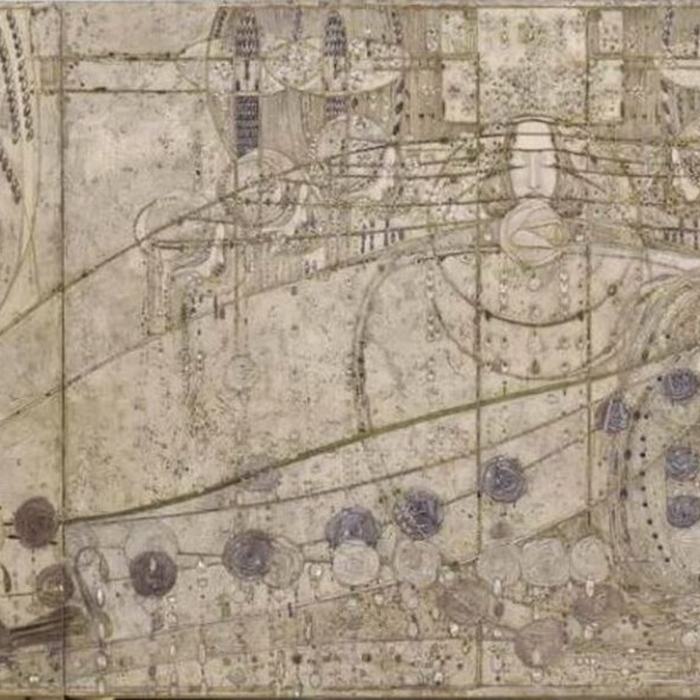
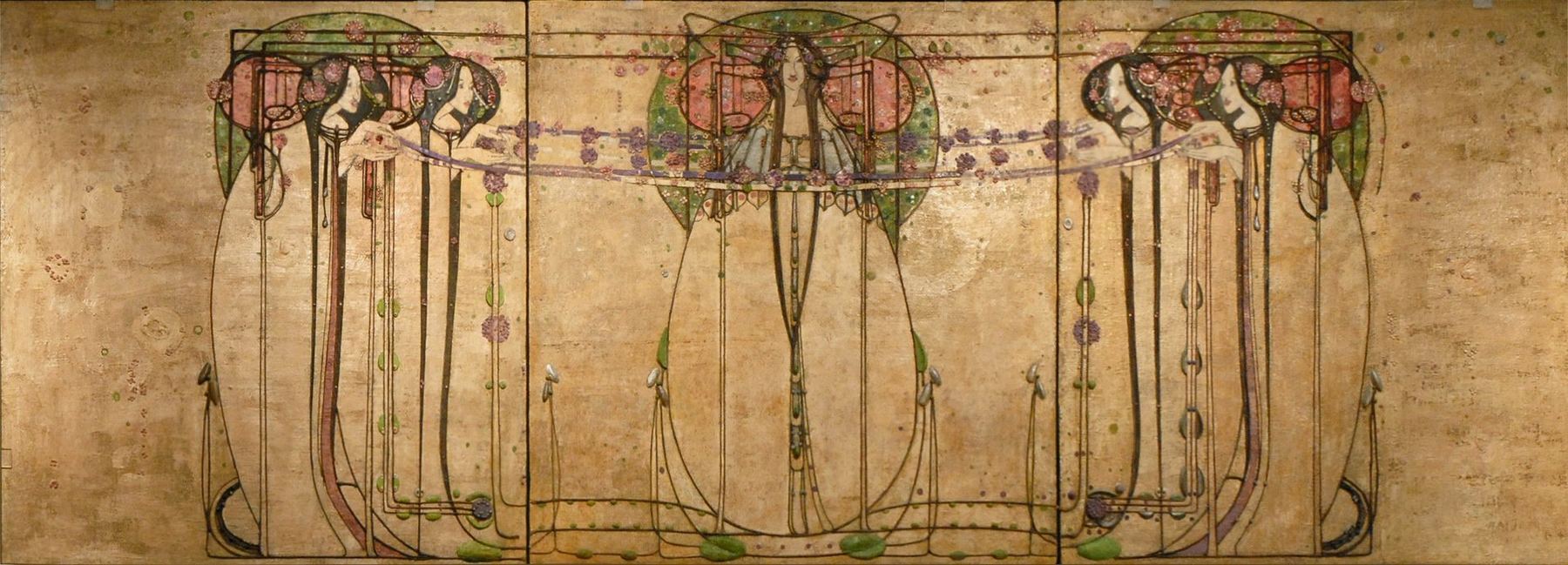
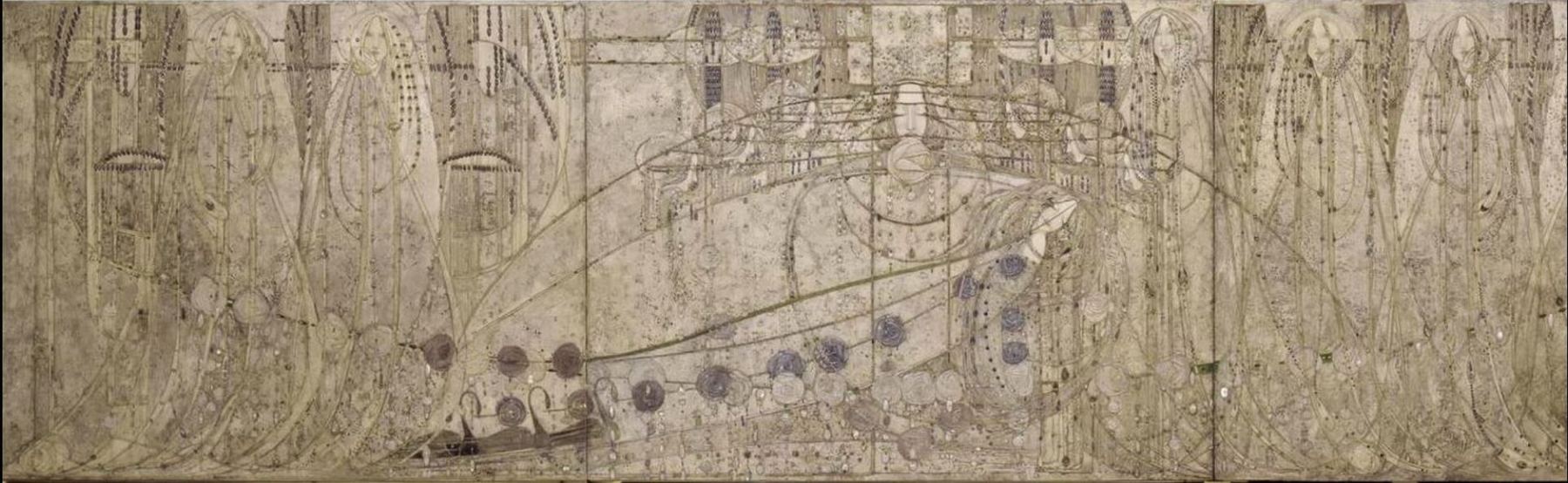
The international story becomes concrete in Vienna. In 1902, the patron Fritz Waerndorfer commissioned Mackintosh to design a music salon for his villa. Margaret designed the monumental frieze The Seven Princesses, completed in 1906 and installed later. MAK Vienna identifies the Mackintoshes, Frances and McNair as leading protagonists of the Scottish Modern Style and connects the commission to their Austrian breakthrough.[29]
That breakthrough began publicly at the Eighth Vienna Secession exhibition in 1900. The Four showed a tearoom interior with furniture and a decorative frieze by Margaret. Wien Museum's German-language study records the impression the ensemble made, including on Gustav Klimt, within Carl Moll's effort to elevate applied art and the designed room.[30]
The relationship should not be drawn as one arrow from Glasgow to Vienna. Josef Hoffmann, Koloman Moser and the Secessionists were developing their own geometric rooms and objects. Mackintosh's later work also absorbed continental elements. Patrons, journals, exhibitions and personal visits made exchange reciprocal, even when one participant described another as revelation.
The Seven Princesses shows what was at stake. Based on Maeterlinck's play, the nearly six-metre frieze arranges waiting sisters around death and suspended arrival. Pale, immobile profiles barely separate from the ground. Stylised tears extend from enormous eyes; shell, glass, imitation jewels and raised gesso make grief tactile. A German-language MAK study connects the work to Ludwig Hevesi's contemporary response to the Waerndorfer salon and to the literary culture of the fin de siècle.[31]
The work is Scottish, Belgian in literary source and Viennese in commission and destination. National style here was produced internationally.
A chair between business, home and exhibition
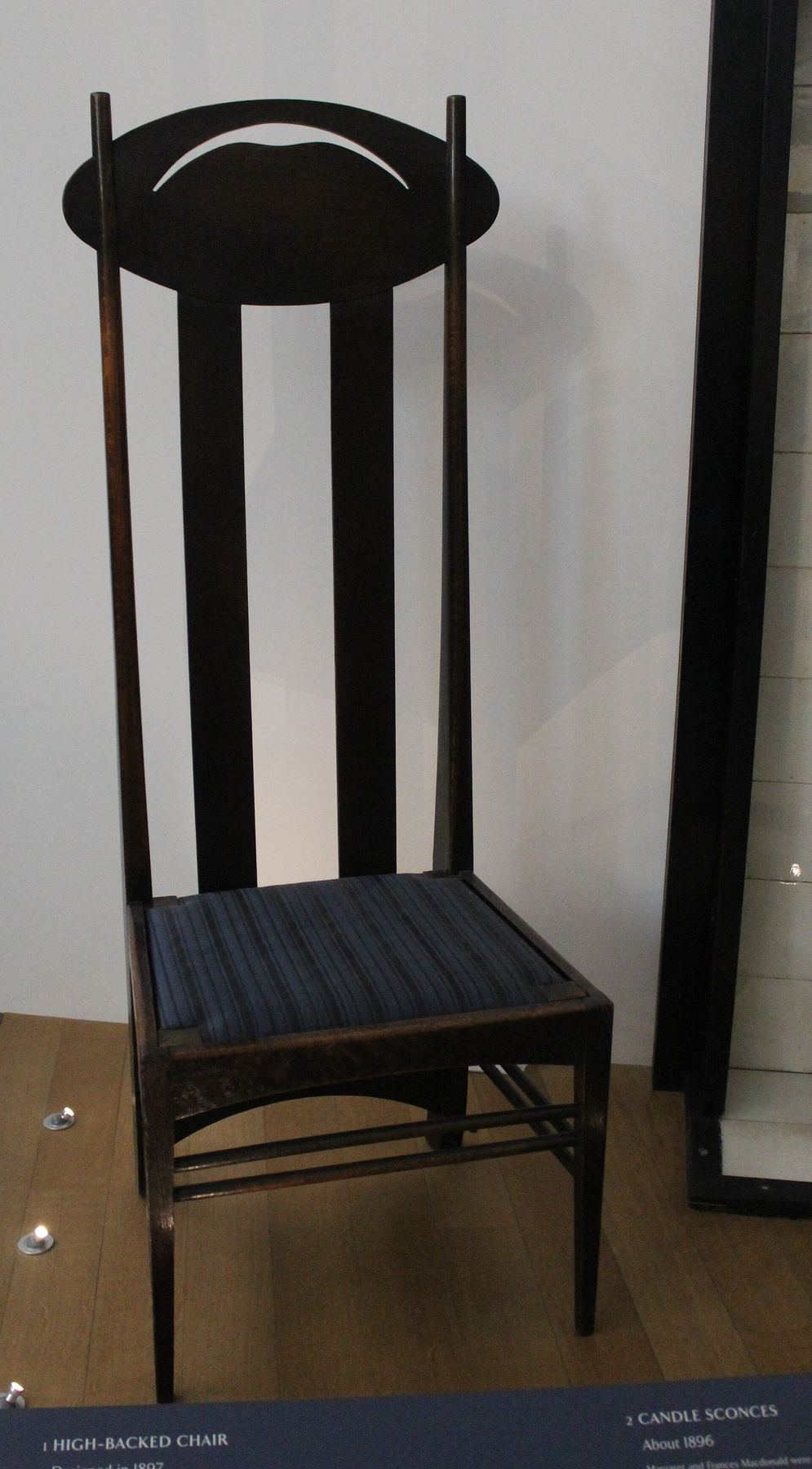
One Mackintosh chair designed in 1897 moved through three kinds of space: Cranston's tearoom, the Mackintoshes' home and the Vienna Secession display. Its high back and dark oval headrest could frame a fashionable hat, give privacy at a table and read as a graphic silhouette against a wall.
MoMA's object history preserves both social function and hostility. A critic attacking “Scotto-Continental New Art” in 1902 described extravagance, topsy-turvydom and novelty pursued at the expense of comfort. The insult reveals that severe geometry did not originally look like tasteful heritage. The chair challenged expectations of furniture, gendered space and sensible Scottish design.[32]
Its construction was not technologically revolutionary. Its conceptual use of scale was. A chair became a small enclosure and a repeated architectural rhythm. When several surround a table, the empty spaces between their rails belong to the design as much as the oak.
Turin 1902: a Scottish room on an international stage
The First International Exhibition of Modern Decorative Art in Turin gave Glasgow a broader platform. Mackintosh designed a three-room Scottish section. One area contained the Rose Boudoir made with Margaret; Frances and McNair created a writing room; a mixed display presented furniture, glass, textiles, metal and books by a wider field of Scottish designers.
University of Glasgow research notes that contemporary English-language reviews repeatedly praised the section's austerity and coherence while highlighting women's contribution. A substantial group of works was bought by Waerndorfer and sent to Vienna. The exhibition therefore generated criticism, sales, patronage and the movement of actual objects, not merely abstract “influence.”[33]
Newbery selected the Scottish contribution and made Mackintosh responsible for the rooms. Margaret's gesso and embroidered panels appeared beside glass and furniture. GSA's exhibition history also records that European enthusiasm cooled in following years, a warning against telling Turin as the first step of inevitable triumph.[34]
The Rose Boudoir depended on contrast: Mackintosh's rectilinear furniture met Margaret's The White Rose and the Red Rose, where female bodies and flowers inhabit a textured symbolic field. Frances and McNair's writing room proposed another model of cultivated interior. The “Scottish section” was unified by installation while preserving differences between makers.
Journals, advocates and two-way influence
Most Europeans never visited Glasgow or Turin. Illustrated journals made the Style portable. The Studio, Dekorative Kunst and Innendekoration reproduced rooms and objects, while the German architect and writer Hermann Muthesius promoted progressive British design. Exhibitions in Vienna, Turin, Berlin and Dresden brought sequences of direct encounter.[35]
Reproduction changed what audiences saw. A black-and-white photograph emphasised silhouette and grid while muting pale pink, purple, silver, green and the material irregularity of gesso. It could make Mackintosh appear more purely geometric and Margaret more graphic than their rooms were in person.
International approval also exposed a local paradox. Mackintosh could be celebrated abroad while struggling to secure enough architectural work at home. European prestige did not erase office economics, client caution or changing fashion.
Is Glasgow Style Art Nouveau or Arts and Crafts?
It is both connected to those fields and distinct from either. The V&A describes Mackintosh as joining Arts and Crafts attention to natural materials, construction, regional tradition and pared-back form with Art Nouveau's creative freedom. His geometry differs from the continuously whipping line commonly associated with Belgian or French work.[36]
Glasgow designers shared the Arts and Crafts desire to overcome separation between fine and applied art. Bespoke furniture, visible material and the coordinated room belong to that reform. Yet Glasgow also embraced commercial publishing, urban hospitality and manufacturers. It cannot be reduced to a rural workshop ideal.
The V&A describes the Mackintoshes' collaboration through the encounter between severe, rectilinear furniture and Margaret's organic graphic forms. This productive opposition matters more than deciding whether a rose is Arts and Crafts or Art Nouveau. The room turns different systems into one atmosphere.[37]
Morris remains a vital precedent across wallpaper, textile, furniture, publishing, interiors and social argument. Glasgow inherited the conviction that ordinary surroundings mattered. It did not inherit one Morris style. Its attenuated figures, spectral symbolism and empty white rooms frequently oppose the dense vegetal abundance now associated with his designs.[38]
The modern city inside the “dear green place”
The name Glasgow is often translated through its supposed meaning, the “dear green place.” Designers made flowers, trees and children emblems of renewal in a city transformed by industry. A MoMA study of design and childhood sets collaborative Mackintosh and Macdonald projects against school-building reform, slums and the spectacular growth of an imperial industrial centre.[39]
Nature imagery could therefore be restorative and selective. Willow and rose offered forms of life inside polluted streets, but ornament did not clean the air or redistribute industrial wealth. Artistic escape depended on servants, waitresses, builders, factory workers and the profits of publishers and merchants.
The material object often joins those worlds. A 1904 washstand for Cranston's Hous'hill residence combines oak, ceramic tile, mirror and coloured leaded glass. The Met places it within a commission where Mackintosh designed across architecture and small furnishing. Wood, industrial glass, plumbing function and abstract colour meet in one practical station.[40]
“Total design” should thus be read materially. Ask who supplied the oak, cut the glass, stitched the panel, cleaned the mirror and used the room. The answers do not diminish aesthetic unity. They show how much coordination it required.
Individual careers beyond the house style
Jessie M. King's illustrations show how an artist could belong to the Glasgow field without surrendering to a house manner. Her imagery of Guenevere, fairy tale, flower and ship develops a personal fantasy. V&A Dundee describes her as deeply influenced by Glasgow's Art Nouveau while emphasising a distinctive narrative sensibility.[41]
King's studio partnership with Helen Paxton Brown gives professional friendship physical form. National Galleries records that they studied together, remained lifelong friends and shared a studio from around 1898 to 1907. Brown's portrait of King preserves one artist looking at another rather than presenting a generic Glasgow Girl.[42]
Annie French's minute ink drawings, Dorothy Carleton Smyth's theatre designs, De Courcy Lewthwaite Dewar's metalwork, George Walton's interiors and Talwin Morris's books further resist uniformity. The movement is strongest when treated as an ecology of related choices.
Limits, dispersal and the First World War
Mackintosh's later reputation can make his success look inevitable. It was not. He worked inside architectural practices, received fewer major commissions than his fame suggests and left his Glasgow partnership in 1914. University research distinguishes documented work from later attribution and notes the context of his 1927 letter crediting Margaret. His career was shaped by opportunity, office relations and failure as well as brilliance.[43]
The network had already dispersed. Frances and McNair had moved to Liverpool; King developed work elsewhere; teaching careers continued along different paths. Taste changed, patrons disappeared and the Style's vocabulary could harden into marketable rose decoration.
War altered the School and the meaning of art. Students and staff served, died or redirected labour; material shortages affected teaching; international exchange contracted. A GSA study uses Newbery's 1916 lament that bright art seemed out of place in wartime to capture the pressure on an institution built around artistic community.[44]
The First World War is therefore a meaningful boundary, but not an off switch. Macbeth continued teaching, King continued designing, Mackintosh painted and later artists absorbed the Style. A movement ends unevenly as its enabling network ceases to act with the same density.
Recovery, brand and contested inheritance
British critics had often been indifferent or hostile while Vienna and Turin responded enthusiastically. Mid-century scholarship and exhibitions reconstructed Mackintosh as a precursor of modern design. MoMA's archive records the Four's media, poor London reception and continental success as part of that recovery.[45]
Recovery created new distortions. Mackintosh souvenirs can turn a radical system into an endlessly repeated rose. Calling Margaret a muse can obscure authorship; calling every geometry proto-modernist can remove Symbolism; calling every associated woman a Glasgow Girl can flatten careers.
The 1990 Glasgow Girls exhibition transformed the canon by recovering work long stored, dispersed or misattributed. Recent object research continues to revise authorship and survival. The fires at the Glasgow School of Art in 2014 and 2018 added urgent questions about documentation, reconstruction, institutional responsibility and whether a total work can be remade after catastrophic loss.
Glasgow Style now exists through buildings, fragments, archives, reconstructed rooms, books, reproductions and civic memory. That fractured survival is not an obstacle outside its history. It is the form in which the history reaches us.
How to look at Glasgow Style
Begin with structure, not the rose. Identify the strong verticals and horizontals: chair backs, window mullions, borders, stems, lettering and room axes. Then ask where a curve interrupts them. Glasgow Style often derives energy from constraint rather than continuous flow.
Next, inspect the empty areas. White wall, undecorated cloth and open paper are not unfinished. They give a small glass square, a black line or a pale face room to act. In a reproduced image, determine whether missing colour has made this emptiness look more absolute than it was.
Look at the human figure. Is it a portrait, character, emblem or repeating unit? Margaret's frontal women, Frances's compressed bodies and King's fairy figures use elongation differently. “Spooky” appearance is an invitation to interpret form, not an explanation.
Identify material and maker. Gesso is raised and inset, embroidery stitched, metal hammered, glass leaded, furniture joined, a book cover reproduced. A similar motif changes meaning when it moves from a private panel to an edition of thousands.
Finally, reconstruct the system of use. Who commissioned the object? Where was it placed? Who built, bought, served, read, wore or conserved it? A chair in a tearoom, a chair at Vienna and the same chair in a museum occupy three different histories.
Essential Glasgow Style works and spaces
The May Queen
Margaret Macdonald · 1900 · A ceremonial procession of repeated pale faces, flowers and vertical lines turns gesso relief into the symbolic centre of a public tearoom.
The Seven Princesses
Margaret Macdonald · 1906–07 · Nearly six metres of suspended figures, tears, shell, glass and raised surface translate Maeterlinck for a Viennese music salon.
Girl with Butterflies
Frances Macdonald · 1907 · Frances Macdonald's compressed figure and circling butterflies join transformation and beauty to psychological uncertainty.
The White Rose and the Red Rose
Margaret Macdonald · 1902 · Bodies, roses and tactile relief animate the Rose Boudoir and show Margaret's authorship inside the collaborative Turin rooms.
O ye, all ye that walk in Willowwood
Margaret Macdonald · 1903 · Rossetti's lovers and willow branches bind melancholy, material surface and a fashionable commercial interior.
Binding for Isabella, or the Pot of Basil
Jessie M. King · 1907 · King's minute pattern, integrated lettering and reproductive surface show how Glasgow design travelled through commercially published books.
High-backed chair for the Argyle Street Tearooms
Charles Rennie Mackintosh · designed 1897; made c. 1900 · Scale, silhouette and a small oval headrest turn ordinary seating into privacy screen, repeated room rhythm and international exhibition object.
Glasgow School of Art, Mackintosh Building
Charles Rennie Mackintosh with Honeyman & Keppie · 1897–99 and 1907–09 · Great studio windows, masonry, ironwork and phased construction make the School both a working institution and an integrated design.
The Hill House
Charles Rennie Mackintosh and Margaret Macdonald · 1902–04; published 1907 · Scottish massing, family programme, pale rooms and dark furniture join client needs to a highly disciplined domestic system.
Design for an embroidered panel
Jessie Newbery · published 1898 · Newbery's published design treats stitch, plant rhythm and useful cloth as modern design rather than genteel historical copying.
Where to see and study Glasgow Style
Displays, loans, conservation work and archive access change. Check current information before travelling.
- 01
Kelvingrove Art Gallery and Museum
Glasgow Museums holds the movement's broadest civic collection, including Mackintosh and Macdonald tearoom material, furniture, gesso, glass, metalwork, textiles, books and work by the wider Glasgow field.
Glasgow, Scotland
Collection, building and research guideVisit official website - 02
The Hunterian and Mackintosh House
The Hunterian's holdings are essential for Mackintosh and Margaret Macdonald. The reassembled house restores scale and sequence while its documented history allows visitors to distinguish surviving interiors from their new setting.
Glasgow, Scotland
Collection, building and research guideVisit official website - 03
Glasgow School of Art Archives and Collections
The archive preserves The Magazine, student work, embroidery, books, drawings and records by many designers whom a Mackintosh-only display overlooks. Access conditions should be checked in advance.
Glasgow, Scotland
Collection, building and research guideVisit official website - 04
V&A Dundee
The restored Oak Room from Cranston's Ingram Street tearooms is the centrepiece. Its conservation history makes it a particularly strong place to think about total interiors, salvage and reassembly.
Dundee, Scotland
Collection, building and research guideVisit official website - 05
MAK, Vienna
Margaret Macdonald's The Seven Princesses retains the scale, material and Viennese destination that reproduction often removes. It anchors the Glasgow–Vienna relationship in a surviving commissioned object.
Vienna, Austria
Collection, building and research guideVisit official website - 06
The Hill House
The house allows architecture, furniture, colour, family programme and symbolic panels to be considered together. Its continuing conservation also exposes the material risks of experimental construction.
Helensburgh, Scotland
Collection, building and research guideVisit official website - 07
Mackintosh at the Willow
The restored Willow Tea Rooms make room sequence, chair scale and Cranston's commercial context accessible. Visitors should use interpretation to separate surviving elements, reconstruction and replica.
Glasgow, Scotland
Collection, building and research guideVisit official website - 08
National Galleries of Scotland
Works by Jessie M. King, Helen Paxton Brown and other Glasgow Girls broaden the story through painting, illustration and professional networks beyond complete Mackintosh interiors.
Edinburgh, Scotland
Collection, building and research guideVisit official website
Landmark Glasgow Style exhibitions
Four displays that materially shaped the movement’s international reception, recovery or modern definition.
Eighth Vienna Secession exhibition
Vienna Secession, Vienna
The Four's tearoom ensemble and Margaret Macdonald's frieze made Glasgow's geometry, figures and integrated room visible to Viennese designers, including Gustav Klimt.
First International Exhibition of Modern Decorative Art
Turin, Italy
The three-room Scottish section joined the Rose Boudoir, the MacNairs' writing room and work by a wider field of women and men, generating reviews, purchases and movement of actual objects.
Glasgow Girls: Women in Art and Design, 1880–1920
Glasgow School of Art
The recovery exhibition transformed the canon by bringing dispersed or neglected women artists, designers, teachers, studios and media back into the history of modern Glasgow.
Designing the New: Charles Rennie Mackintosh and the Glasgow Style
Glasgow Museums touring exhibition
The international survey used furniture, books, ceramics, textiles, watercolours and architectural material to make the movement visibly broader than Mackintosh alone.
Suggested books
Designing the New: Charles Rennie Mackintosh and the Glasgow Style by Alison Brown
This richly illustrated exhibition catalogue is the strongest current single-volume introduction to the whole movement. It keeps Mackintosh central while situating him among craftspeople, women designers, publishers, manufacturers, patrons and the full range of Glasgow media.[46]
Glasgow Girls: Women in Art and Design, 1880–1920, edited by Jude Burkhauser
The foundational recovery study remains essential. Its many contributors reconstruct artists, studios, teaching and media that Mackintosh- and Glasgow Boys-centred histories had marginalised, while demonstrating the real diversity concealed by one collective label.[47]
The Mack: Charles Rennie Mackintosh and the Glasgow School of Art by Robyne Calvert
Calvert provides the most current account of the School building, its users, international significance, 2014 and 2018 fires and contested future. It is especially valuable for understanding a masterpiece as an inhabited institution rather than a timeless monument.[48]
The Arts and Crafts Movement in Scotland: A History by Annette Carruthers
Carruthers places Glasgow within the wider Scottish history of art schools, craft associations, architecture, rural industries, textiles, glass and metal. It corrects the assumption that Scottish Arts and Crafts can be represented by Mackintosh alone.[49]
Doves and Dreams: The Art of Frances Macdonald and J. Herbert McNair, edited by Pamela Robertson
This focused study gives the MacNairs their own artistic and biographical space. It is the best corrective to treating their Liverpool work, symbolic watercolours and interior designs as a minor appendix to Charles and Margaret.[50]
Major Glasgow Style artists and designers
This contextual directory maps overlapping educational, professional and exhibition networks. It is not a formal membership list, and the retrospective Glasgow Girls category does not imply one uniform style.
| Name | Nationality | Key Works |
|---|---|---|
| Charles Rennie Mackintosh | Scottish | Glasgow School of Art · Hill House · Willow Tea Rooms · High-backed chair |
| Margaret Macdonald | British | The May Queen · Willowwood · The Seven Princesses · The White Rose and the Red Rose |
| Frances Macdonald | British | The Nativity · Girl with Butterflies · The Sleeping Princess |
| James Herbert McNair | Scottish | A Lady in Black · Turin writing room · Princess of Sleeping |
| Jessie M. King | Scottish | Isabella, or the Pot of Basil · The Grey City of the North · The Little White Town of Never-Weary |
| Jessie Newbery | Scottish | Design for an embroidered panel · Artistic dress and appliqué |
| Ann Macbeth | Scottish | The Huntress · Embroidered fire screen |
| Talwin Morris | English | Blackie & Son bookbindings · The Red Letter Library covers |
| George Walton | Scottish | Miss Cranston's Buchanan Street Tearooms · Elm Bank interiors |
| De Courcy Lewthwaite Dewar | Scottish | Repoussé metalwork · Enamelled boxes and jewellery |
| Annie French | Scottish | Sir Bors and a Maiden · Illustrations and watercolours |
| Helen Paxton Brown | Scottish | Portrait of Jessie M. King · Textile and graphic designs |
| Dorothy Carleton Smyth | Scottish | Costume and theatre designs · The Seven Ages of Woman |
| Bessie MacNicol | Scottish | The Fur Coat · Under the Apple Tree |
| Mary Newbery Sturrock | Scottish | Embroidered panels · Botanical studies |
| Janet Aitken | Scottish | Landscape and figure paintings · The Immortals group |
| Jessie Keppie | Scottish | Watercolours and metalwork · Glasgow School designs |
| Katharine Cameron | Scottish | Book illustration · Fairy-tale watercolours |
Frequently Asked Questions
It was a broad field of art, design and architecture developed around Glasgow, especially the Glasgow School of Art, from roughly 1890 to 1920. It joined severe geometry, stylised nature, Symbolist figures and integrated material design across buildings, rooms, books, textiles, furniture and objects.
Mackintosh was its most famous architect and one of its greatest designers, but no person formally founded it. The School's teaching, the Macdonald sisters, McNair, women textile and graphic designers, clients, firms and skilled makers all shaped the movement.
They were Charles Rennie Mackintosh, James Herbert McNair, Margaret Macdonald and Frances Macdonald. They met through the Glasgow School of Art and exhibited experimental work together before forming two married working partnerships.
No. Glasgow School is a broader term that can encompass different artists, generations and approaches connected with the city. Glasgow Style refers more specifically to the distinctive turn-of-the-century design language and networks described here.
They belonged to the same transforming artistic city and some personal networks overlapped, but the Glasgow Boys are principally a modern painting formation. Their naturalist and decorative canvases should not be relabelled automatically as Glasgow Style.
The name was coined retrospectively for women artists and designers active around Glasgow in the late nineteenth and early twentieth centuries. They shared education and professional networks but were not one organised group or stylistic school.
It is a highly stylised flower built from spiralling or folded curves, often joined to a vertical stem or geometric frame. It could move between embroidery, glass, metal, gesso, print and furniture. It is one useful motif, not a definition of the movement.
Elongation converted the body into rhythm and symbol. Continental Symbolism, Beardsley's graphics, Japanese composition, medieval story and artists' individual inventions all contributed. Critics who called the figures “spooks” were reacting to their refusal of healthy classical proportion.
They gave modern design a public, commercial setting and expanded respectable urban space available to women. Catherine Cranston's patronage allowed furniture, glass, graphics, uniforms, rooms and hospitality to work together.
Yes, especially through the Four's 1900 Secession display, publications and Waerndorfer's commissions. But exchange was reciprocal: Glasgow designers also encountered and absorbed Viennese developments. Simple one-way influence understates the relationship.
She was a major independent artist and an essential collaborator in important interiors, with clearly attributable panels and designs. Evidence does not establish her as undocumented co-architect of every Mackintosh building. Credit should be assigned element by element.
Its most coherent network weakened before and during the First World War as people moved, commissions declined and exchange changed. Related work continued through the 1920s and beyond, so 1914 is a historical turning point rather than an official closing date.
Discussion
Reader Insights
Find chair backs, window mullions, borders, stems and room axes before using the rose as a shortcut for the whole movement.
Ask whether the surface is gesso, stitch, metal, glass, joined furniture or reproducible print—and who designed, executed and used it.
Follow patronage, manufacture, service labour, exhibition, salvage and reassembly so total design does not collapse into one famous name.
Join the Conversation
Which encounter best explains Glasgow Style to you: a spectral figure, a book cover dense with line, a black chair against a white wall, a stitched rose, or an entire room? Share the object—and the maker, material or user you noticed once you looked beyond Mackintosh's name.
References
- The Glasgow Style, Glasgow School of Art Archives & Collections, View Source
- Scottish Decorative Arts & Design: Charles Rennie Mackintosh and the Glasgow Style, Glasgow Museums, View Source
- The Glasgow Style, V&A Dundee, View Source
- Designing the New: Charles Rennie Mackintosh and the Glasgow Style, Frist Art Museum, View Source
- Francis Henry Newbery and The Glasgow School of Art, George Manson Rawson / Glasgow School of Art RADAR, View Source
- Accession of Papers related to Francis Newbery, Glasgow School of Art Archives & Collections, View Source
- The Nativity, Glasgow School of Art Archives & Collections, View Source
- Margaret Macdonald, Glasgow School of Art Archives & Collections, View Source
- Charles Rennie Mackintosh and the Four, The Hunterian University of Glasgow, View Source
- The Hunterian receives Girl with Butterflies, The Hunterian University of Glasgow, View Source
- Doves and Dreams exhibition archive, University of Glasgow, View Source
- Glasgow Girls, National Galleries of Scotland, View Source
- How Arts and Crafts influenced fashion, Victoria and Albert Museum, View Source
- Newbery Jessie Wylie, Glasgow School of Art Archives & Collections, View Source
- Glasgow Girl Ann Macbeth and a Recent Acquisition, Glasgow School of Art Archives & Collections, View Source
- Jessie M. King, National Galleries of Scotland, View Source
- King Jessie Marion, Glasgow School of Art Archives & Collections, View Source
- GSA Library Special Collections blog relaunch, Glasgow School of Art Archives & Collections, View Source
- Round brooch with green enamel, Metropolitan Museum of Art, View Source
- Hunterian Art Gallery collections guide, The Hunterian University of Glasgow, View Source
- The Glasgow School of Art M134, Mackintosh Architecture University of Glasgow, View Source
- The Revolution will Be Painted, Johnny Rodger / Glasgow School of Art RADAR, View Source
- The Hill House M207, Mackintosh Architecture University of Glasgow, View Source
- Willow Tea Rooms M221, Mackintosh Architecture University of Glasgow, View Source
- Art Nouveau 1890-1914, National Gallery of Art Washington, View Source
- Conserving Mackintosh's Oak Room, V&A Dundee, View Source
- The Mackintosh House, The Hunterian University of Glasgow, View Source
- Embroidered panel by Margaret Macdonald, Glasgow School of Art Archives & Collections, View Source
- Der Waerndorfer-Fries in der MAK-Schausammlung Wien 1900, MAK Vienna (German; consulted in German), View Source
- Carl Molls Beitrag zum Mythos Klimt, Wien Museum (German; consulted in German), View Source
- Die sieben Prinzessinnen, MAK Vienna (German; consulted in German), View Source
- Side chair 1897, Museum of Modern Art, View Source
- Scottish section for Turin M201, Mackintosh Architecture University of Glasgow, View Source
- The First International Exhibition of Decorative Art, Glasgow School of Art Archives & Collections, View Source
- Charles Rennie Mackintosh, Design Museum, View Source
- Art Nouveau an international style, Victoria and Albert Museum, View Source
- Arts and Crafts design for the home, Victoria and Albert Museum, View Source
- William Morris, Victoria and Albert Museum, View Source
- Century of the Child Growing by Design 1900-2000, Museum of Modern Art, View Source
- Washstand 1904, Metropolitan Museum of Art, View Source
- Scottish Design Icons Jessie M King, V&A Dundee, View Source
- Portrait of Jessie M. King by Helen Paxton Brown, National Galleries of Scotland, View Source
- Charles Rennie Mackintosh biography, Mackintosh Architecture University of Glasgow, View Source
- From the service of Venus to the worship of Mars, Glasgow School of Art RADAR, View Source
- MoMA Charles Rennie Mackintosh exhibition press release, Museum of Modern Art, View Source
- Designing the New Charles Rennie Mackintosh and the Glasgow Style, Alison Brown / Prestel, View Source
- Glasgow Girls Women in Art and Design 1880-1920, Jude Burkhauser / Books from Scotland, View Source
- The Mack Charles Rennie Mackintosh and the Glasgow School of Art, Robyne Calvert / Yale University Press, View Source
- The Arts and Crafts Movement in Scotland A History, Annette Carruthers / Yale University Press, View Source
- Doves and Dreams, Pamela Robertson / Open Library, View Source
- Glasgow Style image records, Wikimedia Commons: Room de Luxe, Willow Tea Rooms (CC BY-SA 2.5; Room de Luxe at the Willow Tea Rooms, designed by Charles Rennie Mackintosh with Margaret Macdonald's panel; photograph by Dave Souza, Wikimedia Commons, CC BY-SA 2.5; cropped and compressed.), The May Queen (CC BY 2.0; Margaret Macdonald, The May Queen, 1900; photograph by Jean-Pierre Dalbéra, Wikimedia Commons, CC BY 2.0; cropped and compressed.), The Seven Princesses (Public domain; Margaret Macdonald, The Seven Princesses, 1906–07; MAK Vienna / Wikimedia Commons public-domain reproduction; cropped and compressed.), Girl with Butterflies (Public domain; Frances Macdonald, Girl with Butterflies, 1907; Wikimedia Commons public-domain reproduction; cropped and compressed.), The White Rose and the Red Rose (Public domain; Margaret Macdonald, The White Rose and the Red Rose, 1902; Wikimedia Commons public-domain reproduction; cropped and compressed.), O ye, all ye that walk in Willowwood (Public domain; Margaret Macdonald, O ye, all ye that walk in Willowwood, 1903; Wikimedia Commons public-domain reproduction; cropped and compressed.), Binding for Isabella, or the Pot of Basil (CC0 1.0; Jessie M. King, binding for Isabella, or the Pot of Basil, 1907; photograph by Southwold1966, British Library object / Wikimedia Commons, CC0 1.0; cropped and compressed.), High-backed chair for the Argyle Street Tearooms (CC0 1.0; Charles Rennie Mackintosh, high-backed chair, designed 1897 and made c. 1900; photograph by 14GTR, V&A object / Wikimedia Commons, CC0 1.0; cropped and compressed.), Glasgow School of Art, Mackintosh Building (CC BY-SA 3.0; Glasgow School of Art Mackintosh Building; photograph by Ad Meskens, Wikimedia Commons, CC BY-SA 3.0; cropped and compressed.), The Hill House (Public domain; The Hill House, designed by Charles Rennie Mackintosh with interiors including Margaret Macdonald's work, published in The Studio Yearbook of Decorative Art, 1907; Wikimedia Commons public-domain reproduction; cropped and compressed.), Willow Tea Rooms (Public domain; Willow Tea Rooms, designed by Charles Rennie Mackintosh, c. 1903; photograph by J. Craig Annan / Wikimedia Commons public-domain reproduction; cropped and compressed.), Design for an embroidered panel (CC BY-SA 3.0; Jessie Newbery, design for an embroidered panel, published in The Studio, 1898; digitised by Heidelberg University Library and shared via Wikimedia Commons, CC BY-SA 3.0; cropped and compressed.).