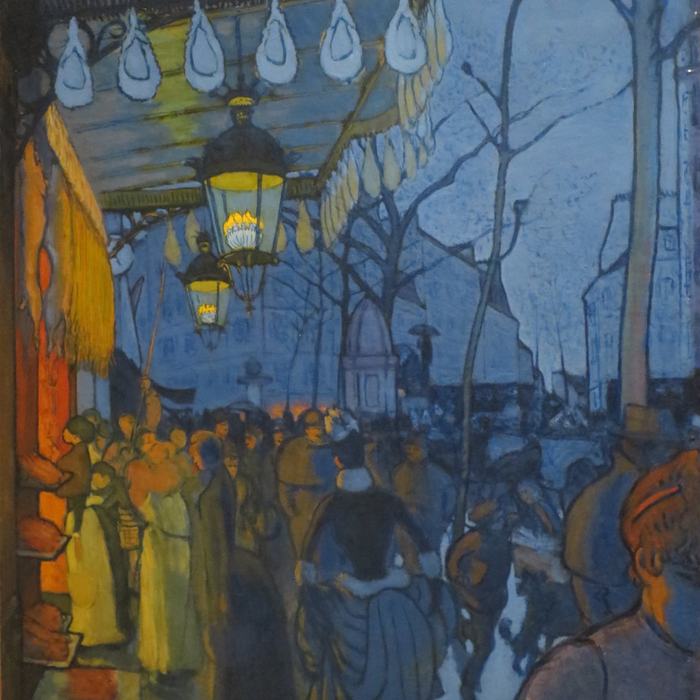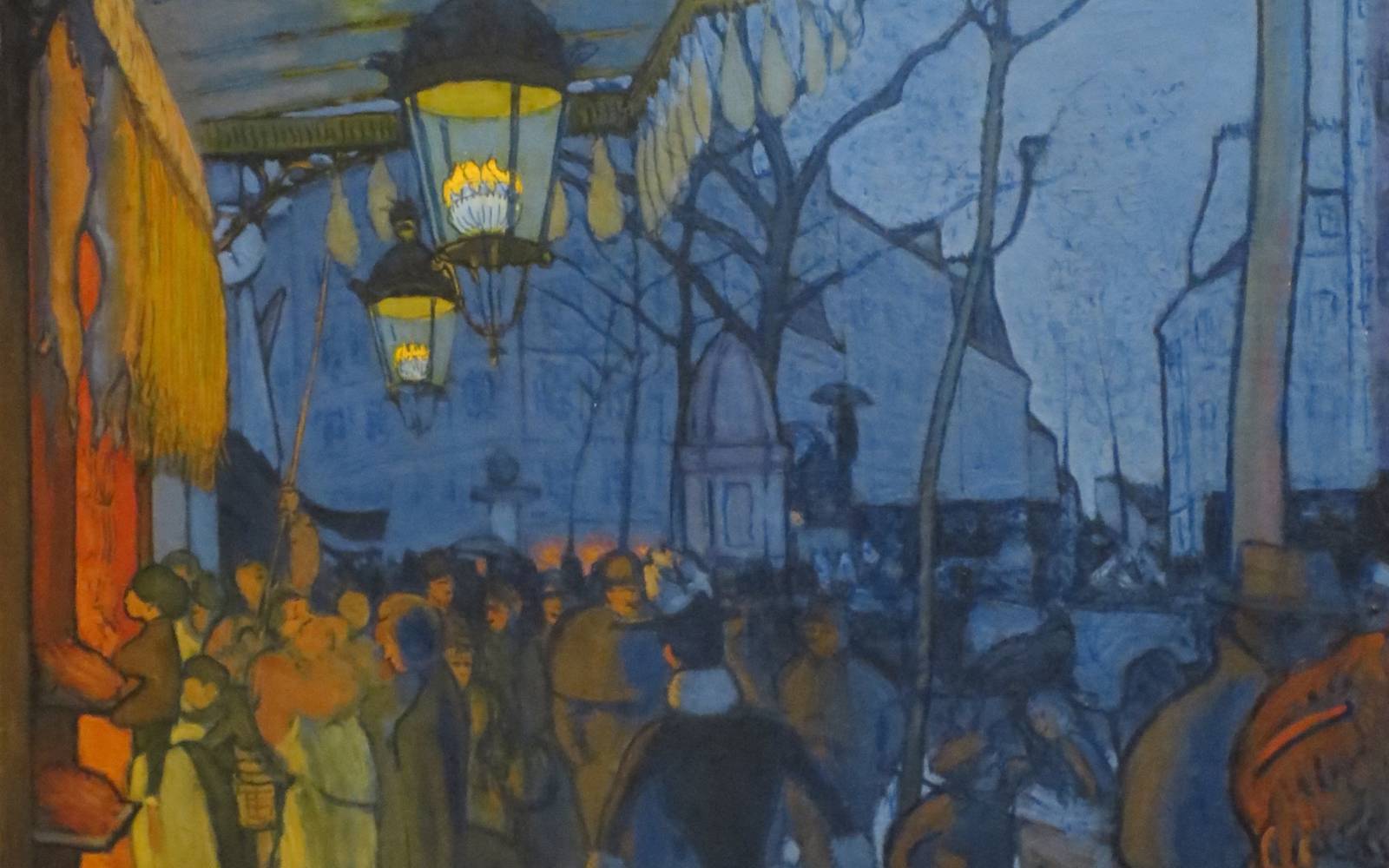
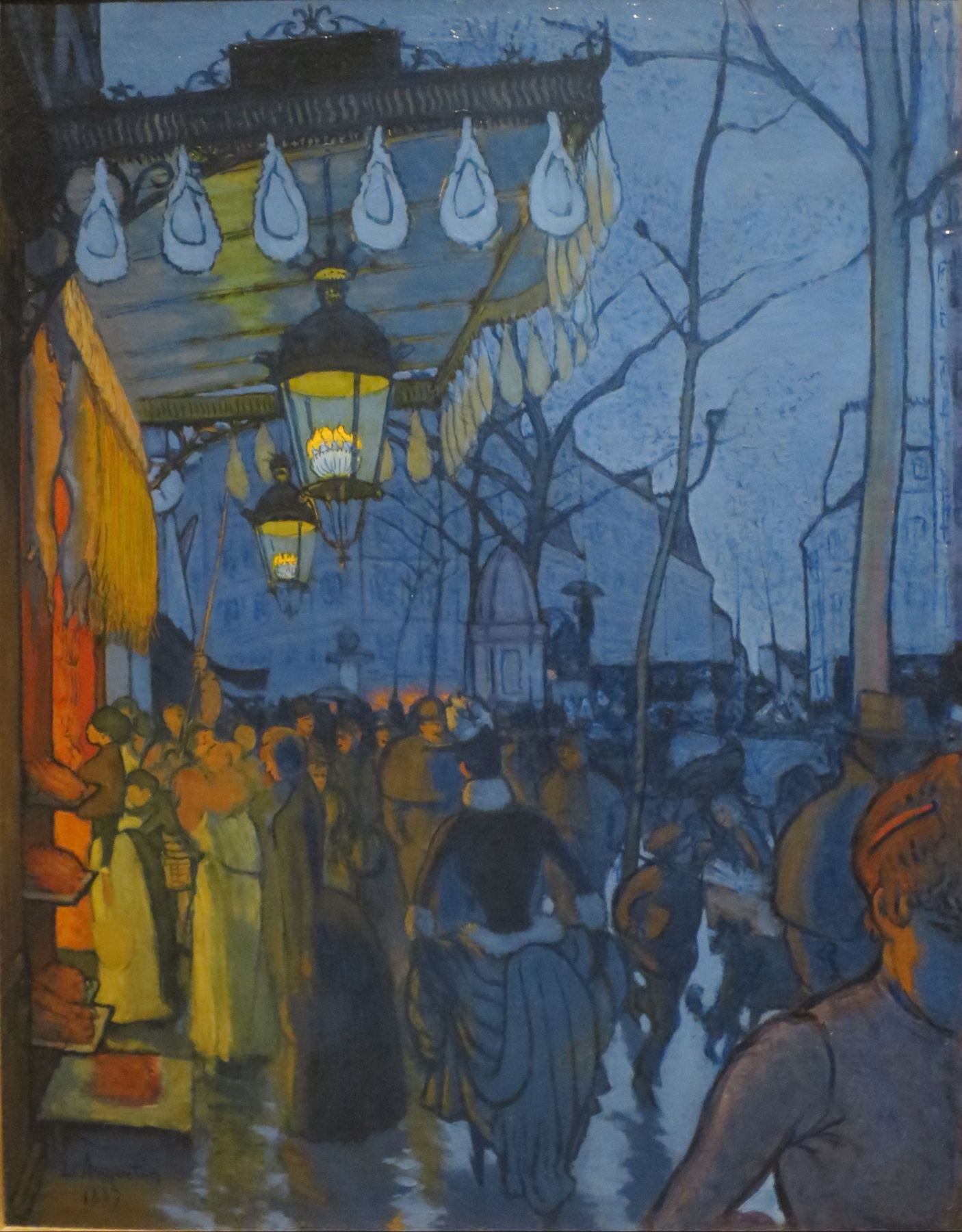
Image reference: Louis Anquetin’s Avenue de Clichy.
At a Glance
- Core periodapproximately 1886–94, with important later adaptations
- Originsthe Paris/Asnières circle around Émile Bernard and Louis Anquetin; transformation at Pont-Aven through Bernard and Gauguin
- Leading artistsBernard, Anquetin, Gauguin and Paul Sérusier, with Charles Laval, Émile Schuffenecker, Meijer de Haan, Charles Filiger, Armand Seguin and others in related networks
- Cloisonnismsimplified colour compartments structured by pronounced outlines
- Synthetismsynthesis of subject, artistic response or memory, and autonomous pictorial organisation
- Major sourcesJapanese prints, stained glass, cloisonné enamel, popular prints, medieval imagery, photography and contemporary painting
- Major afterlivesSymbolism, the Nabis, decorative art, international colour experiments and some paths toward Fauvism and Expressionism
- Important warningneither term names a formal club, a compulsory style or every work made at Pont-Aven
Contents
- Where it fits
- Two terms, not one formula
- Japanese print to Paris street
- Method to argument
- Visible thought
- Four stages
- Essential works
- A rewritten history
- How to recognise the style
- Artist directory
Where Synthetism and Cloisonnism fit
Louis Anquetin
Key career periodÉmile Bernard
Key career periodPaul Gauguin
Key career periodPaul Sérusier
Key career periodMaurice Denis
Key career periodPierre Bonnard
Key career periodÉdouard Vuillard
Key career periodJens Ferdinand Willumsen
Key career periodSynthetism and Cloisonnism are often paired because the same late nineteenth-century pictures can display both. They are not, however, alternative spellings for one movement. Cloisonnism most clearly describes a method: forms are simplified into colour areas divided and strengthened by contour. Synthetism describes a wider artistic operation: a painter reconstructs the visible subject through memory or feeling and through the independent demands of line, colour and surface. The first can help produce the second, but neither requires a fixed recipe.[1]
The distinction restores a more interesting history. Cloisonnist experiments developed among young artists in Paris and Asnières before the famous summer of 1888 at Pont-Aven. There, Émile Bernard and Paul Gauguin brought different experiences into a concentrated exchange that enlarged compartmental colour into a theory of imaginative creation. Prints, exhibitions and criticism then gave the new work public names. By the early 1890s, the Nabis and artists across Europe were already translating its lessons beyond the people and places that had produced them.
Two terms, not one formula
The strongest Cloisonnist pictures replace conventional modelling with adjacent zones. A contour may bind the edge of a coat, face, street or field; colour may sit within that boundary without smoothly turning around an illusion of volume. Bernard moved toward this language after experimenting with Impressionist and Neo-Impressionist touch. Grand Palais research stresses his collaboration with Louis Anquetin and his opposition to a method that divided light into numerous small strokes. Larger units made colour denser and the whole image more deliberately built.[2]
The critic Édouard Dujardin supplied the memorable label. Writing in La Revue indépendante in 1888 about work Anquetin had shown in the orbit of the Brussels group Les XX, he compared the new art with painting in compartments, like cloisonné. His formulation made drawing and colour reciprocal: outline asserts the coloured zone, while colour gives the outline force. The analogy was perceptive, but these artists did not manufacture enamel. “Cloisonnism” is a way of describing pictorial relationships, not a claim about literal materials.[3]
Anquetin consequently belongs near the beginning rather than in a footnote about Gauguin's influence. He trained in Paris with Léon Bonnat and Fernand Cormon and moved through the same young avant-garde that included Bernard, Henri de Toulouse-Lautrec and Vincent van Gogh. Musée d'Orsay identifies him as a co-theorist of the Cloisonnist aesthetic. His urban scenes show why the method should not be treated as inherently Breton, rural or devotional: artificial street light, hats, traffic and café life can be organised through the same hard boundaries.[4]
Bernard was also more than the precocious messenger who delivered a ready-made style to an older master. He painted, printed, wrote criticism, composed poetry and repeatedly revised his account of modern art. The Musée de l'Orangerie's retrospective located his Cloisonnist initiative at the end of the 1880s, followed by a bitter controversy with Gauguin and then an extended turn toward old-master tradition. That later reversal makes a useful point: an artist can help create a modern method without signing a lifelong contract to repeat it.[5]
The Orangerie's Spanish account gives the same career a valuable independent emphasis. It calls Bernard a major contributor to modern art, recognises the influence of his Cloisonnist work on Gauguin, Van Gogh and the Nabis, and follows his later reconsideration of schematic Symbolist primitivism in Cairo. This longer view prevents the 1888 breakthrough from becoming his complete identity.[6]
From Japanese print to Paris street
Japanese colour woodcuts mattered because they demonstrated alternatives to European academic recession: strong edge, cropped figure, unexpected interval, high viewpoint and colour that could clarify design rather than model a body. Artists such as Hokusai were encountered through sheets, albums, dealers, exhibitions and reproductions whose European circulation detached them from many of their original viewing practices. Van Gogh collected and displayed Japanese prints, and Bernard saw his exhibition of them in Paris. The scholarly notes to Van Gogh's correspondence identify Japanese graphic art as a major influence on the style Bernard and Anquetin were then developing.[7]
Influence did not mean identical use. In a letter written from Arles, Van Gogh referred to an article that presented Anquetin as the leader of a tendency in which Japonisme was especially pronounced, yet he thought Bernard had gone farther. The critical notes observe that Van Gogh's own early Arles work could relate to Cloisonnism while retaining outdoor painting and impasto. A shared source therefore produced several practices rather than a school marching in formation.[8]
Stained glass supplied another analogy: coloured sections are held together by lead, and light animates the whole without conventional modelling. Popular Épinal prints and medieval woodcuts offered bold communication and compressed storytelling. Cloisonné enamel suggested a related relation of boundary and filled area. Photographs, reproductions and contemporary paintings completed a much less tidy visual archive. A painting might evoke several of these at once without copying any one object.
Calling all of this “influence” can hide the labour of choice. An artist had to decide which properties of a source could enter an oil painting, which could be exaggerated and which would be ignored. The high viewpoint of a print might be combined with the dark divisions associated with stained glass; a medieval figure's hieratic stillness might be placed in a landscape organised by a modern photograph. The resulting image was not Japanese, medieval or photographic. It was a new European construction that made those sources visible only through transformation.
That construction also had asymmetries. Japanese prints reached Paris through expanding trade and collecting systems, and European artists often celebrated their formal novelty while knowing little about the individual makers, genres or cultural settings involved. The lesson is not to remove Japanese art from the story. It is to name the difference between sustained knowledge and selective appropriation. Japonisme gave these painters real pictorial possibilities, but their synthesis frequently compressed a diverse visual culture into the category of a useful alternative to Europe.
The same caution applies to craft analogies. Enamel and stained glass were sometimes invoked as if their makers belonged to a timeless collective world untouched by modern self-consciousness. In reality, each medium has its own materials, institutions and histories. Cloisonnist painting borrowed the visual idea of separation and binding; it did not inherit the social conditions of a medieval workshop. The comparison illuminates the paintings only when it remains a comparison.
From Cloisonnist method to Synthetist argument
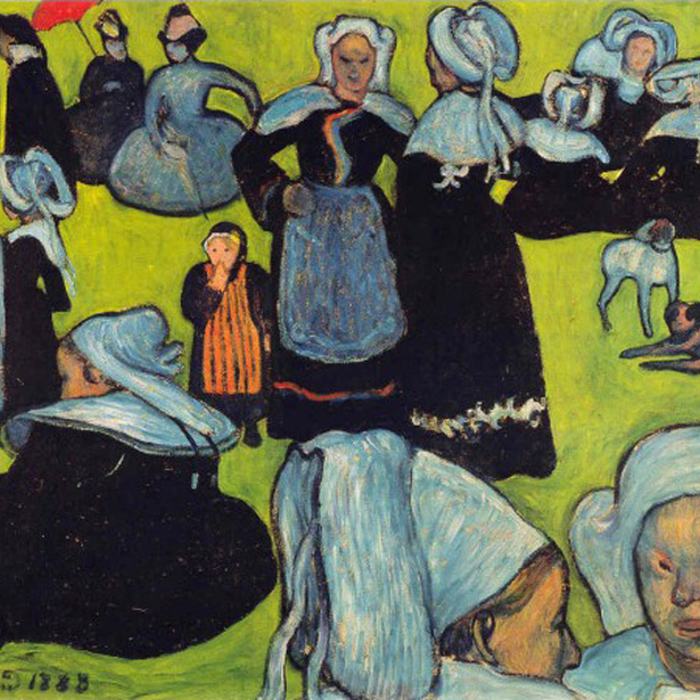
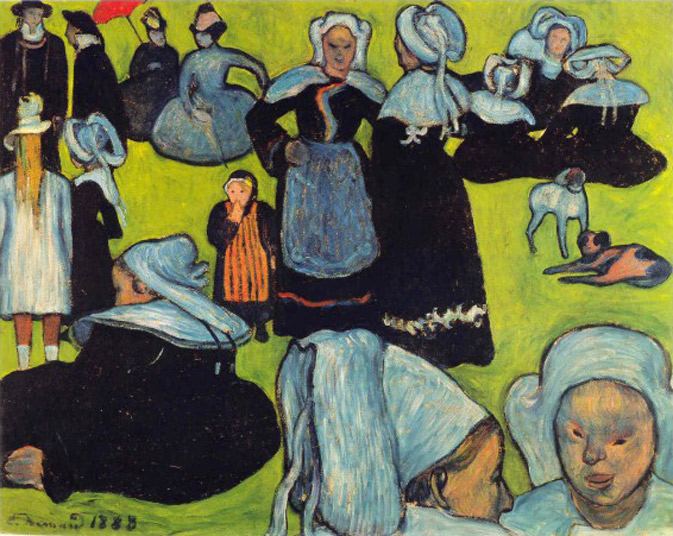
The chronology at Pont-Aven is unusually helpful. The local museum places Bernard and Anquetin's development of Cloisonnism in 1887, before Bernard returned to work beside Gauguin in August 1888. It then describes Synthetism as the product of their exchange and identifies Bernard's Breton Women in a Green Meadow and Gauguin's Vision of the Sermon as emblematic results. In the same season, Sérusier painted the small landscape later called The Talisman.[9]
That sequence avoids two opposing myths. Gauguin did not invent the outlined colour method from nothing after seeing Brittany. Bernard did not arrive with every implication already solved. An accessible French guide to the Musée de Pont-Aven describes reciprocal advance: Bernard's recent Breton Women pushed Gauguin toward the audacity of Vision, while shared discussion sharpened an approach in which forms, colour and depth were purposefully reorganised.[10]
The word synthesis can sound as though artists mechanically added three ingredients. In practice it is closer to an act of compression and transformation. A subject is observed; memory and emotion alter what matters; the painting imposes its own balance. Colour relationships, repeated curves or a dominant diagonal may carry more weight than local light. The result remains about a field, sitter or sermon, but it no longer claims that faithful transcription is its highest task.
This position was partly a response to the recent achievement of Impressionism. The younger artists did not simply deny what Impressionist painters had learned about modern vision. They objected to allowing transient light, divided touch and the optical instant to determine the picture's final structure. A Synthetist canvas could begin before a motif, but it expected selection and recollection to turn that encounter into something more concentrated. In that respect, the argument belongs within Post-Impressionism: not a single successor style, but several attempts to decide what painting might do after Impressionism had transformed the terms of observation.
The shift can be tested by imagining three treatments of the same field. One might record the changing light across it; another might analyse optical colour into small marks; a Synthetist painter might remember the field as two large bands interrupted by workers, then alter their scale and repeat their curves until labour, place and rhythm become inseparable. The third treatment need not be less responsive to experience. It locates fidelity in the remembered force of the encounter rather than in the accumulation of observed effects.
Nor did synthesis eliminate accident. Brush pressure, the resistance of a support and the imprecision of a transferred design could disturb the intended scheme. The most convincing pictures preserve a tension between plan and making. Their large shapes feel decided, but their surfaces remain painted, drawn or printed. This is why reproduction can make Cloisonnism look more diagrammatic than it is. At full scale, an apparently uniform red or green may contain revisions, scumbles, changes in saturation and small encounters between edge and ground.
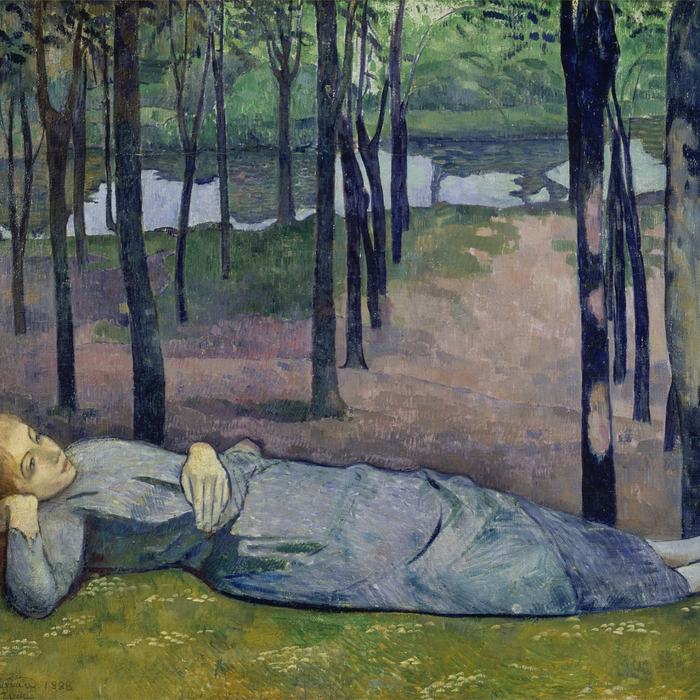
Bernard's Madeleine in the Bois d'Amour shows the process without pretending it was effortless. His sister stretches almost the full width of the canvas, dividing foreground from the Aven landscape beyond. Musée d'Orsay notes that figure and setting were constructed in the studio from separate studies. Their visual parallel—the body echoing the river's horizontal flow—is calculated, yet the two zones retain a disjunction. Synthesis can expose the problem of assembling experience rather than magically fuse it.[11]
Bernard's route through Saint-Briac also matters. A Musée Léon-Dierx study identifies an 1888 landscape as a formal experiment that preceded Breton Women in a Green Meadow. His simplification did not emerge only when Gauguin stood beside him; it was developing across travel, Neo-Impressionist dissatisfaction and work with Anquetin. Pont-Aven concentrated that development and gave it a new symbolic reach.[12]
Drawing reveals how much the method depends on selection. Bernard's Breton Peasant Women in a Field, preserved through the Louvre's graphic-arts collections, translates figures and landscape into a network of decisive edges without the attraction of saturated oil colour. A line can join bodies into a rhythm, separate a cap from a field or make empty paper function as space. Cloisonnist thinking therefore exists beyond black borders around painted patches.[13]
The painting as visible thought
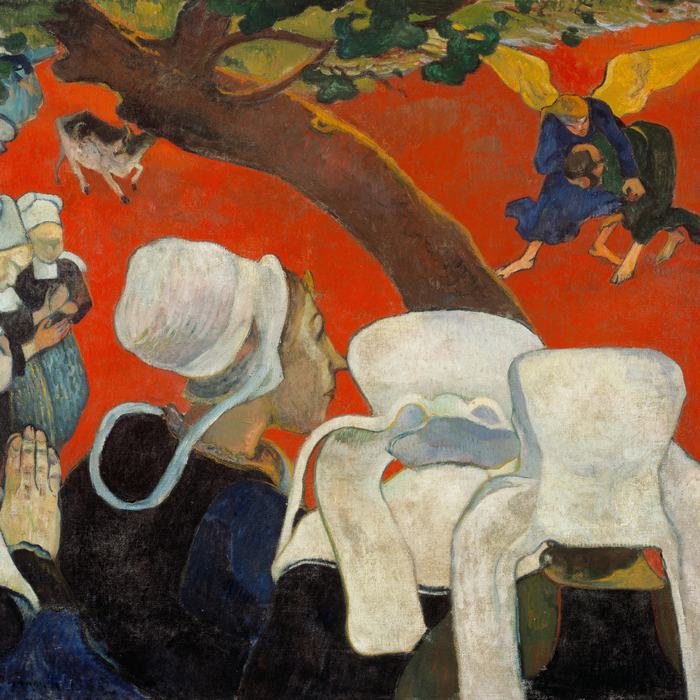
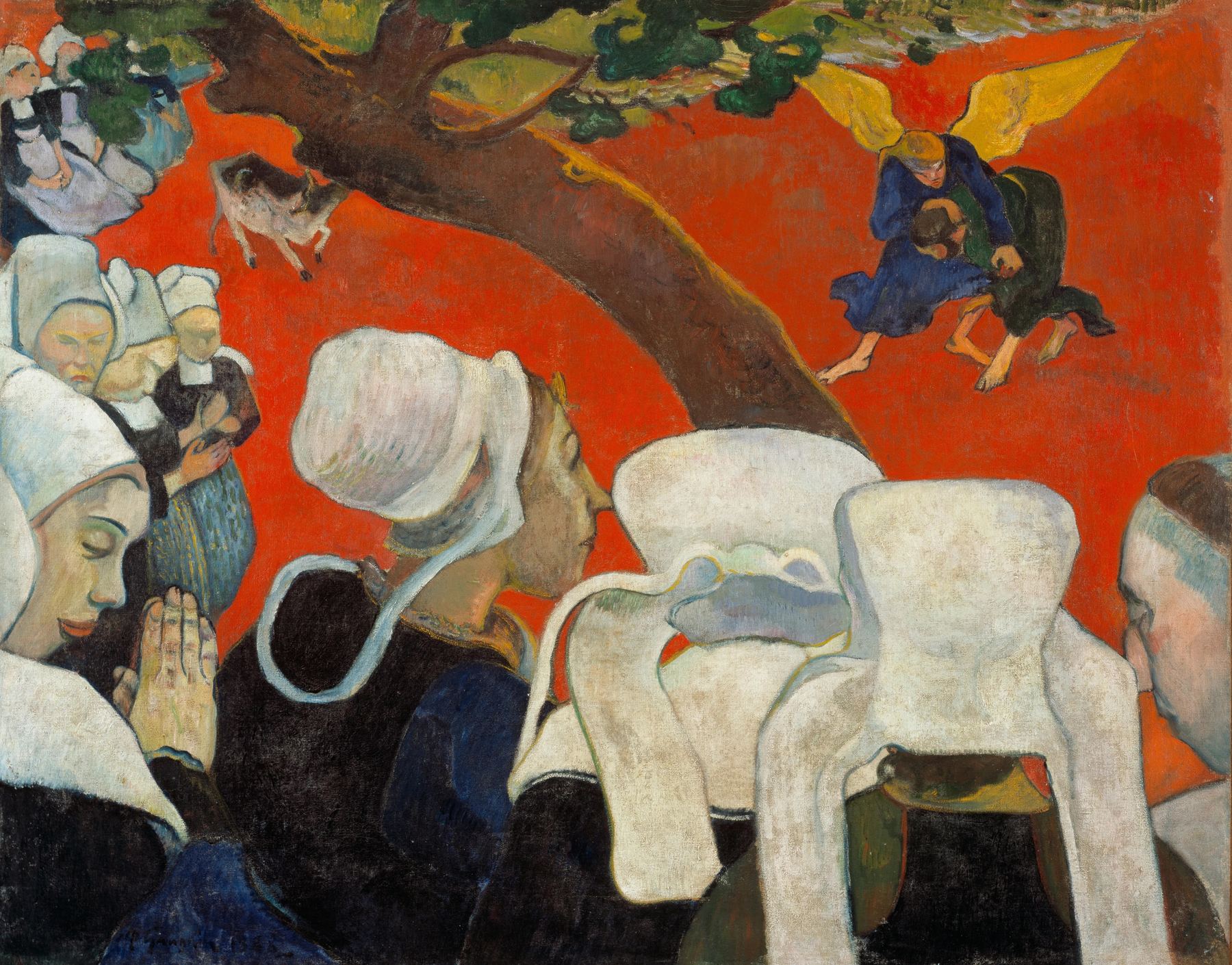
Gauguin's Vision After the Sermon remains the clearest public demonstration of synthetic reconstruction. Women in Breton dress occupy the near zone after listening to the story of Jacob wrestling an angel. A diagonal tree trunk marks a threshold; the struggle takes place across a startling red field. Gauguin wrote that the landscape and fight existed in the worshippers' imagination. The composition does not illustrate a scene anyone could have observed whole. It converts mental experience into organised colour and shape.[14]
The familiar definition offered by the National Gallery of Art gives Synthetism three active terms: outward appearance, the artist's feelings before the subject, and the aesthetic order of colour and form. None cancels the others. The worshippers remain recognisable, their costume retains cultural meaning, and the biblical event is legible. Yet scale, red ground, cropping and rhythm belong to the canvas's constructed intelligence. The image is neither optical report nor non-objective abstraction.[15]
This helps explain why “flatness” should be used carefully. The red field in Vision refuses atmospheric depth, but overlapping women still create layers; contours vary; brushwork remains visible. Flat colour is a relative challenge to modelled recession, not a physically perfect industrial coating. Synthetist pictures often move between surface declaration and residual depth, and that instability gives them energy.
The viewer is made to oscillate. One moment the red is a field within an imagined episode; the next it is a large coloured shape pressing toward the eye. The tree may divide sacred vision from worshippers, act like a compositional bar, or perform both roles at once. Synthetism does not require the viewer to choose between story and design. It makes the movement between them part of the meaning.
Scale is equally active. The distant wrestlers are far smaller than the foreground women, yet the unusual ground and abbreviated setting weaken an ordinary measure of distance. The biblical pair can therefore read like an image within the women's thought, a sign placed on the canvas, or an event receding in space. The picture's achievement lies not in offering one stable answer but in making those readings reinforce one another.
This is why the term “decorative” was more ambitious in the period than its later use as a synonym for merely pleasing ornament. To organise a surface decoratively was to make every interval, repetition and colour relation participate in the whole. A cap, sleeve or tree trunk could remain part of a represented world while also functioning as a shaped unit. The decorative and the symbolic were capable of being the same operation.
The Talisman and the risk of a perfect origin
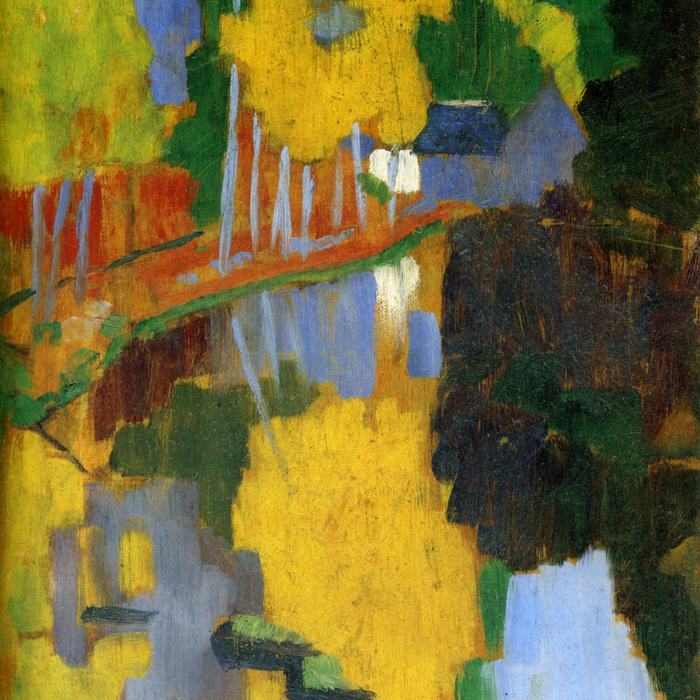
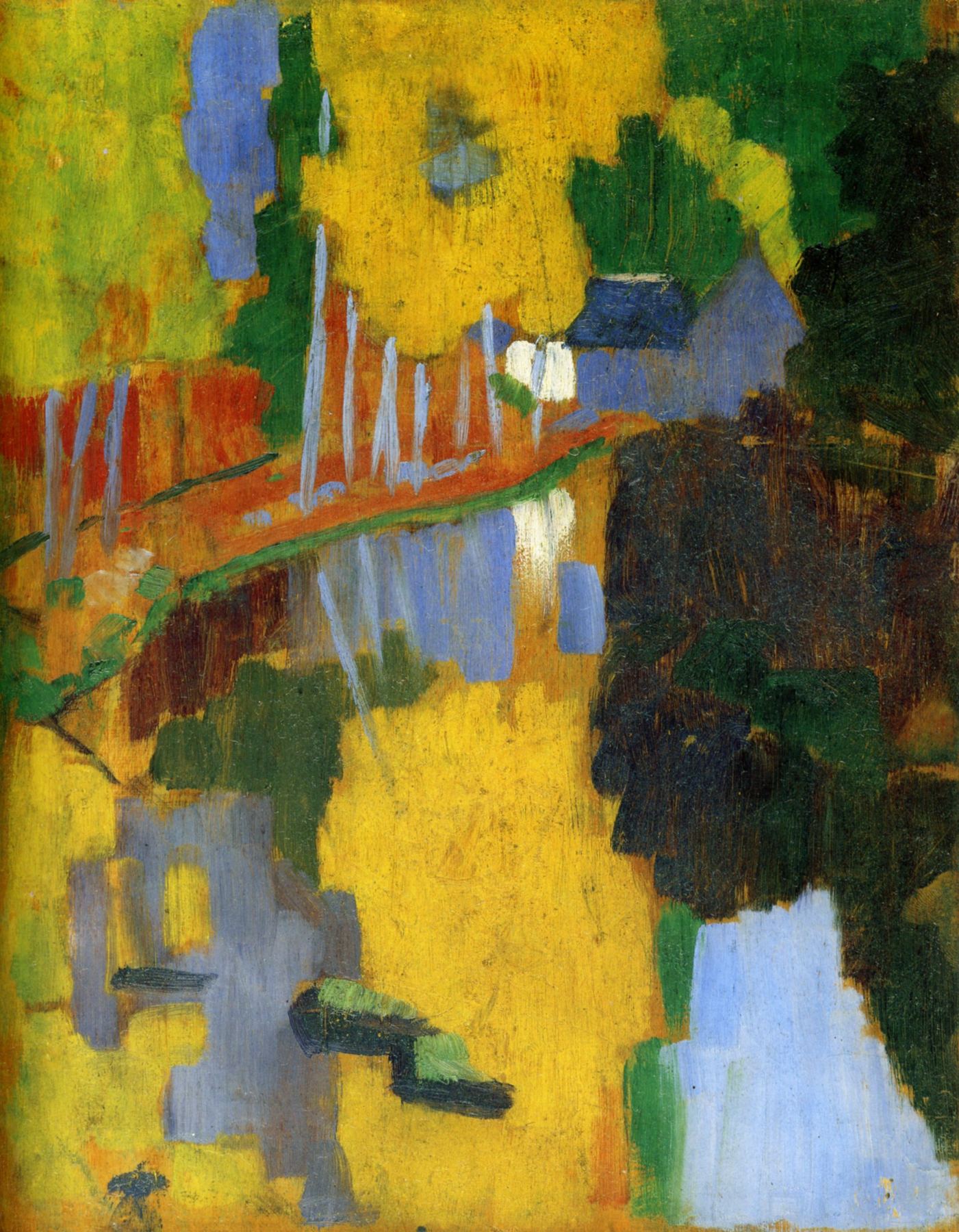
In autumn 1888, Sérusier painted a small landscape on a wood panel at the Bois d'Amour, under Gauguin's guidance. He showed it to his Paris friends, who later treated it as a relic and called it The Talisman. Its strong yellow, green, blue and red-brown areas seem to approach pure colour while retaining riverbank, trees and reflection. Musée d'Orsay's material and historical study cautions that the object's emblematic afterlife can overpower what it actually is: a modest painted support whose surface records a particular experiment.[16]
The associated exhibition dossier reconstructs a dense field around the panel—works by Bernard, Gauguin, Laval and Sérusier rather than one miraculous lesson delivered in isolation. Sérusier carried the experience to a younger generation, but transmission required retelling, ownership and repeated display. The origin story was itself a synthesis: a complicated network became a memorable encounter between master, student and landscape.[17]
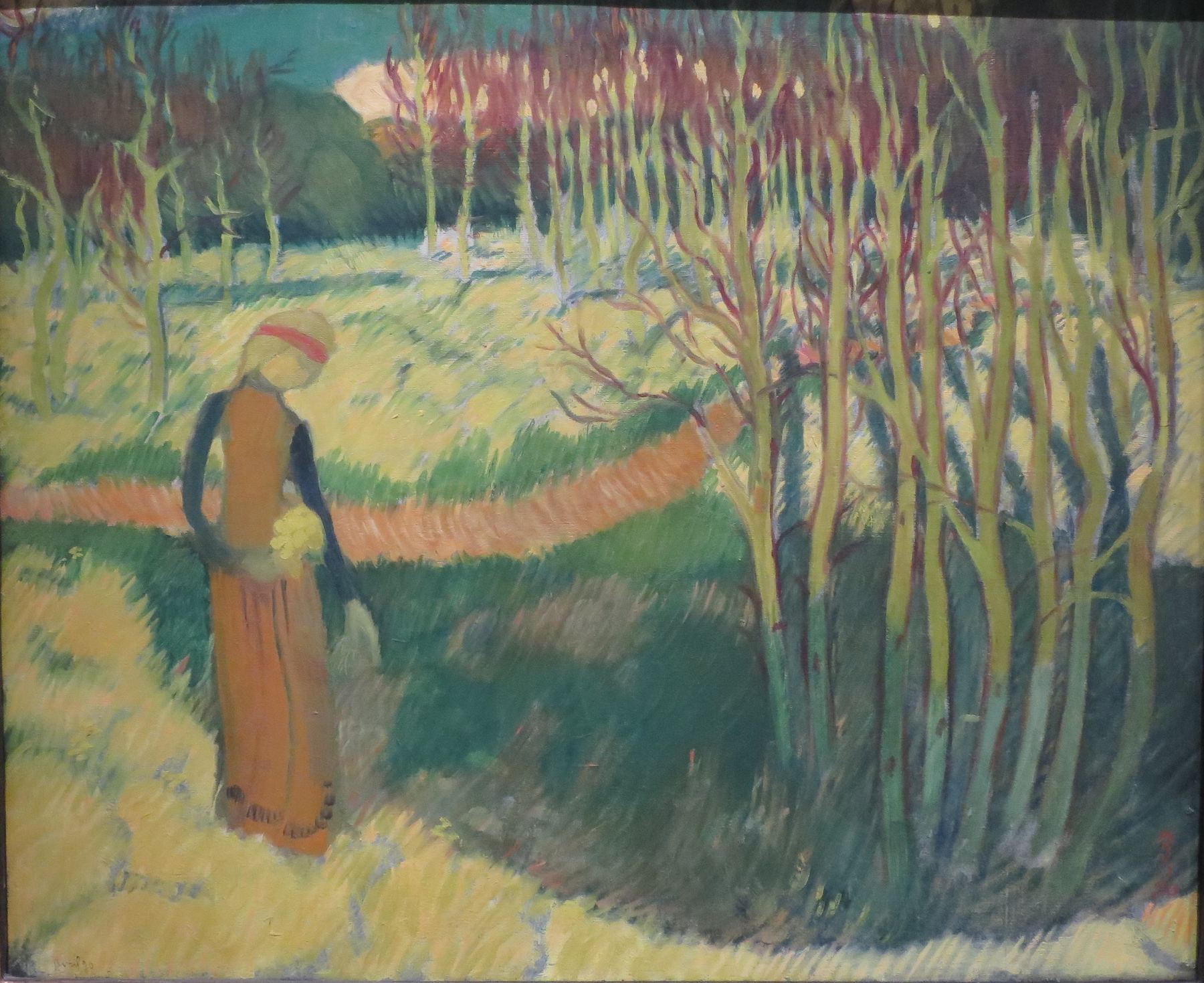
Sérusier's later contribution was intellectual as well as visual. He investigated correspondences, proportion, sacred meaning and decorative order. His pictures can use soft curves and compartmental colour without the severe dark boundaries commonly associated with Bernard. That variation proves why a description based on a single outline style is inadequate.
Bernard after 1888
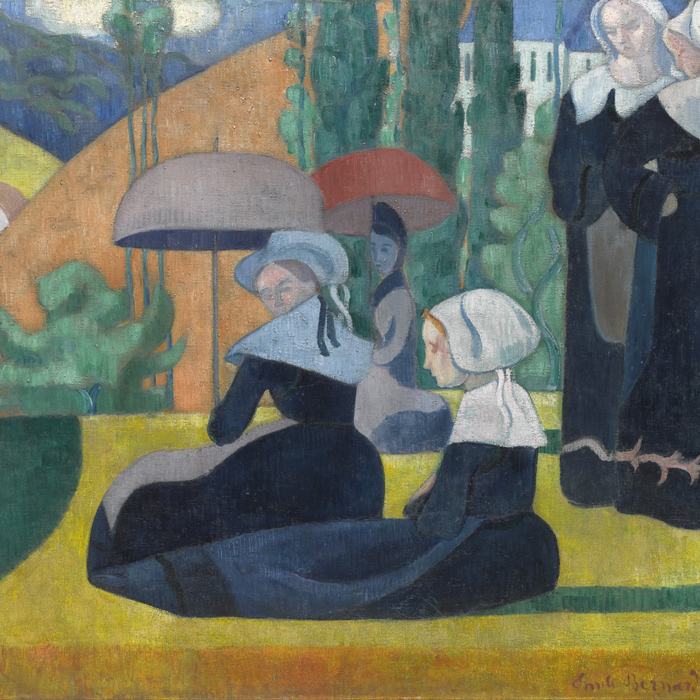
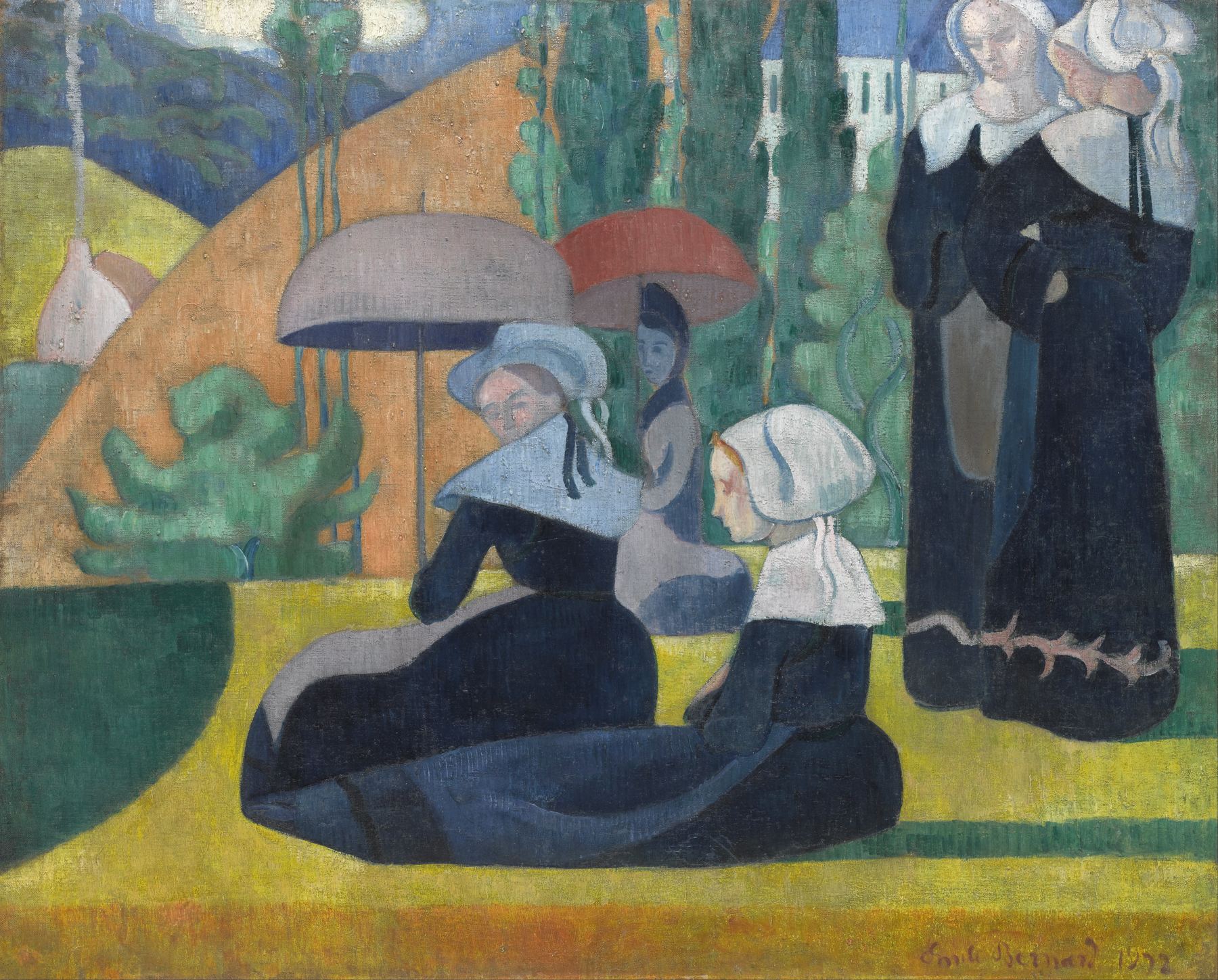
In Breton Women with Parasols of 1892, Bernard arranged umbrellas, distant hills, vertical trunks and standing bodies into visual echoes. Musée d'Orsay describes a shallow, artificially lit space close to a theatrical set. The women appear silent and hieratic, yet the picture's primary action occurs among curves and uprights. The date is significant: Bernard continued Synthetist inquiry after Gauguin left for Tahiti, even though he would soon move toward very different historical models.[18]
His rare colour monotype Young Breton Woman shows the vocabulary working through another process. Blue outlines contain simplified fields; a lily lends Christian association; brush and ink make each impression materially singular. The Metropolitan Museum connects the work to stained glass, Japanese woodcuts and Épinal imagery while identifying it as a Synthetist style developed with Gauguin. Print does not merely reproduce painting here. It tests how an image can be both bounded and fluid.[19]
The recurring Breton woman raises a second question. Formal repetition can turn caps, profiles and dresses into persuasive pattern, but it can also reduce sitters to cultural types. The artists' search for spiritual authenticity selected costumes, rituals and rural labour while excluding many signs of tourism and modern change. Synthesis gave painters freedom to reorganise a subject; it did not guarantee a complete or equal account of the people represented.
Sérusier and artificial unity
Sérusier's Breton Wrestling makes two grappling boys the centre of a compressed human design. Spectators—especially women in regional caps—close around them, and strong boundaries suppress ordinary depth. Musée d'Orsay relates the painting to both Gauguin's wrestling subjects and Vision of the Sermon. Its force nevertheless lies in Sérusier's particular union of physical action, decorative enclosure and selected local tradition.[20]
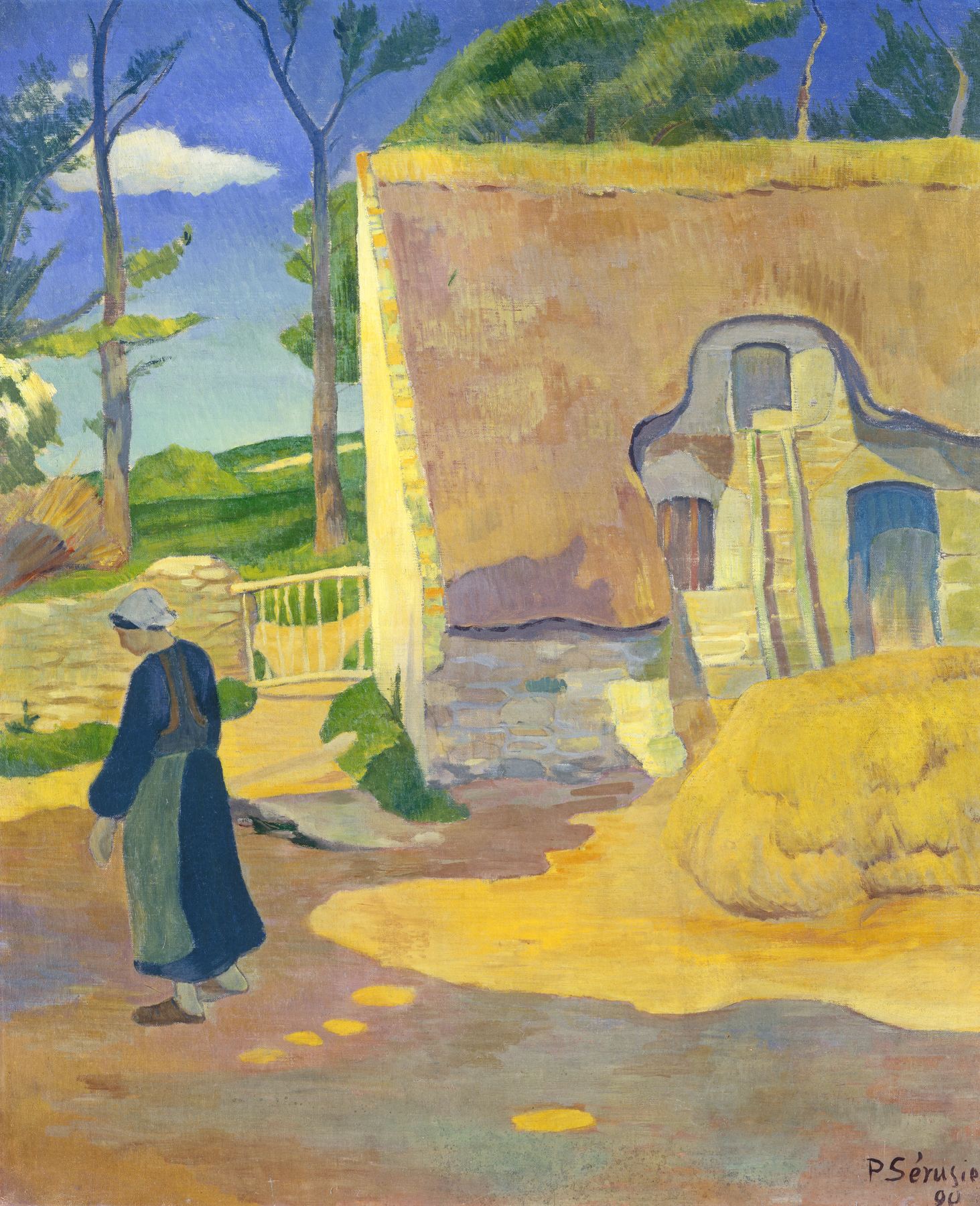
Farmhouse at Le Pouldu approaches unity through landscape. Curves of ground, cloud and tree are reduced and joined across the surface. The National Gallery of Art explains that the Nabis sometimes used “Synthetism” for an artificial pictorial unity separating art from mere natural appearance. Artificial does not mean false in a simple sense; it identifies something purposefully made, whose internal order deserves attention apart from factual resemblance.[21]
Van Gogh Museum gallery texts give Sérusier's farm the character of a bright patchwork rather than a faithful site record. The same display places de Haan's tilted table and vivid colour within the experimental Pont-Aven network and reconstructs the 1888 self-portrait exchange among Gauguin, Bernard, Laval and Van Gogh. The movement appears here as a chain of distinct acts linked by pictures, letters and comparison.[22]
A history artists later rewrote
Bernard had painted Breton figures before the 1888 synthesis. A Van Gogh Museum catalogue of Breton Woman with Child reconstructs his 1886 attention to figure and identifies later writings in which he recounted the Pont-Aven School. Those recollections are indispensable evidence, but they were written after friendship had turned into dispute. They reveal memory and self-positioning as well as chronology.[23]
The Art Institute of Chicago's archive for Van Gogh and Gauguin: The Studio of the South sets paintings beside letters and dates. Bernard's Breton Women, Gauguin's dancers and wrestlers, Vision, exchanged portraits and later Le Pouldu works form a sequence extending between Brittany, Arles, Amsterdam and Paris. The record resists the tidy idea that one painting caused every other; information arrived through originals, sketches, descriptions and reproductions at different times.[24]
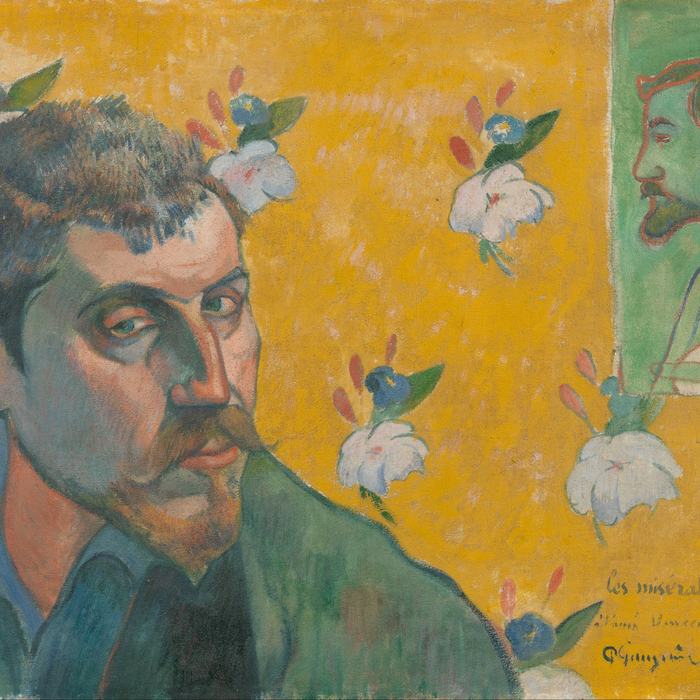
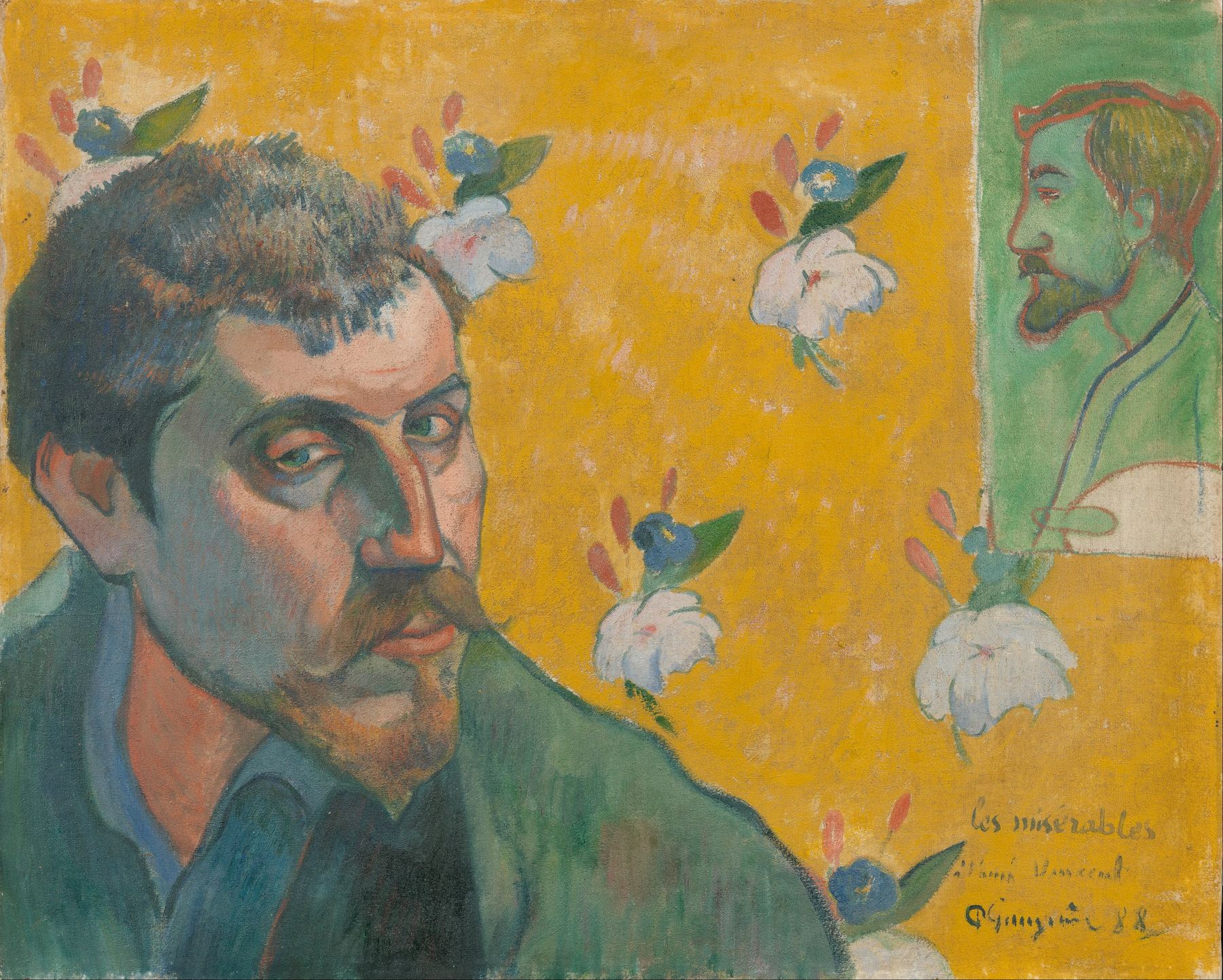
The self-portraits sent to Van Gogh show synthesis applied to artistic identity. Gauguin cast himself as Jean Valjean, simultaneously outcast and morally charged, while placing Bernard's likeness behind him. Bernard answered with his own constructed image of the artistic self. Gauguin's accompanying letter elaborated contrasts of warm and cool colour and good and evil. Portraiture became a symbolic proposition rather than a neutral record of features.[25]
Van Gogh understood the attraction of such work but did not surrender his independence. In correspondence with Gauguin, he allowed that others might possess greater lucidity for “abstract studies,” then set that possibility beside his own practice. His canvases could use violent complementaries, strong outlines and Japanese cropping while maintaining thick touch and direct work before motifs. Adjacent visual languages are not evidence of formal membership.[26]
The disagreement between later recollections is not just an obstacle to be cleared away. It exposes how modern artistic authorship was manufactured. Bernard could point to dated experiments and images that preceded Vision of the Sermon; Gauguin's defenders could emphasise his power to transform a method into an encompassing symbolic art. Critics and exhibitions then amplified one account more effectively than another. Priority depended on evidence, but also on which kind of innovation the historian valued: first use of a device, formulation of a theory, creation of a canonical work or success in gathering a public identity.
Anquetin's subsequent marginalisation belongs to this process. If the history begins at Pont-Aven with Gauguin, his Paris street scenes appear peripheral. If it begins with the collaborative rejection of divided colour, they become central evidence. Restoring him does not require replacing one solitary inventor with another. It changes the shape of the question from “who originated the movement?” to “which exchanges allowed a method to acquire new functions?”
Letters are especially important because they show artists describing works that their correspondents could not always see directly. A colour relation might travel as a verbal claim before the canvas arrived; a sketch or self-portrait might stand for a larger programme. Misunderstanding, persuasion and self-presentation therefore belong inside the network. The movement developed not only through painters looking at paintings but through artists explaining to one another what their pictures were supposed to mean.
From Synthetism to Symbolism
Synthetism described how a picture might be made; Symbolism increasingly described what kind of artistic truth it sought. Albert Aurier's 1891 essay presented the exemplary work as ideist, symbolist, synthetic, subjective and decorative. The Metropolitan Museum explains how he used Gauguin and Vision of the Sermon to oppose objective natural description and to connect simplified non-naturalistic form with emotional or spiritual experience.[27]
Aurier's authority was not invented by later textbooks: his autograph manuscript for “Le Symbolisme en peinture—Paul Gauguin” survives in French national collections with the date 9 February 1891. The document matters because criticism did more than report a movement. By making Gauguin its singular example, it reordered the collaborative history and helped establish which artist future audiences would remember as leader.[28]
Not every response welcomed the new art. The critic Alphonse Germain attacked the deliberate simplification of the “deformers,” arguing that modern artists had no right to imitate limitations that earlier religious makers had possessed involuntarily. INHA scholarship places this objection in direct dialogue with Denis, Aurier, Gauguin and Van Gogh. Such criticism reveals what contemporaries thought was at stake: intentional distortion could appear either as renewed pictorial syntax or as its abandonment.[29]
The conflict cannot be settled by assuming that modernism was destined to win. Severe contour could clarify a picture or become mannerism; synthetic simplification could intensify an idea or stereotype a subject. The method's historical importance lies partly in exposing those choices as choices.
It also reveals how criticism can convert a dispersed practice into a movement. Aurier's five-part definition offered later historians a remarkably portable structure, but it privileged works that could be made to satisfy the structure. Urban Cloisonnism, tentative studies, prints and pictures that mixed atmospheric and synthetic effects became harder to place. Theory clarified one trajectory while casting a shadow over others.
The word “subjective” deserves particular care. It did not mean that the external subject ceased to matter or that an artist's private emotion automatically guaranteed value. It proposed that experience passed through a selecting consciousness. That claim could oppose Naturalist neutrality, yet it also intensified responsibility. Once alteration was openly purposeful, a painter could no longer defend every simplification as innocent transcription. Choices about costume, gender, faith and cultural identity became parts of the artist's construction.
Contemporary hostility therefore supplies more than a comic record of conservative incomprehension. Germain's objection identified intentional deformation as the disputed act. He and the Synthetists disagreed about whether inherited distortions could be chosen in modernity and still possess conviction. Their argument helps a present-day viewer see the contours as historical decisions rather than as a style whose later importance was self-evident.
Maurice Denis and the Nabis
Maurice Denis translated the argument into the most remembered sentence of Nabi theory: before a painting represents a horse, nude or anecdote, it is a flat surface covered with colours assembled in a particular order. Musée d'Orsay situates the 1890 formulation beside his radical “Nabi icons,” the influence of Sérusier and The Talisman, and a growing desire for panels, ceilings and walls. Representation remains, but it is no longer allowed to conceal the organised object.[30]
The sentence should not swallow Denis's career any more than The Talisman should swallow Sérusier's. The Musée départemental Maurice Denis notes that he wrote more than two hundred texts and several books. His theoretical practice kept changing as he addressed religion, tradition, decoration and classicism. Synthetist inheritance became an argument he continued to revise.[31]
The Nabis chose a group name and developed an unusually broad field of application. Bonnard, Denis, Vuillard, Ker-Xavier Roussel, Paul Ranson and Félix Vallotton shared a desire to renew art but did not share one style. Musée d'Orsay identifies Synthetism, Symbolism and Japonisme as strong common stimuli. Screens, fans, posters, books, theatre programmes and domestic panels made surface unity practical across media.[32]
Pierre Bonnard carried bold pattern and expressive colour through a long career without becoming a permanent Gauguin imitator. The Metropolitan Museum's study of his interiors connects the Nabi interest in decoration to an extended search for the right pictorial expression. An early doctrine became a flexible resource for rooms, tables, bodies, mirrors and windows whose spatial ambiguities differ greatly from Breton religious pictures.[33]
Denis's Romanesque Motif gives the early transition an object. LACMA identifies the 1890 work and the artist's role as the writer of “Definition of Neo-Traditionalism.” The title itself suggests how innovation and revival could coexist. The Nabis did not simply move forward from old art; they used Romanesque, medieval and early Renaissance examples to imagine a modern decorative order.[34]
International translations
The Danish artist Jens Ferdinand Willumsen shows how quickly the language could become local. After Naturalist beginnings, he encountered Parisian avant-gardes and used firm simplified drawing, flexible arrangement and decorative rhythm. Musée d'Orsay follows his work from Symbolism toward a more distinctly Nordic expression. Influence becomes meaningful here because it is transformed, not because French form conquers a passive recipient.[35]
Within Brittany, change also ran in more than one direction. Musée de Pont-Aven research shows that the influence of Cloisonnism and Synthetism could be visible but temporary. Schuffenecker, Maufra, Moret and others could return toward atmospheric or Impressionist coastal painting rather than keep flat patches as an oath. No movement history should make later divergence look like failure.[36]
Follow Synthetism and Cloisonnism through four stages
–87
Paris and Asnières: a compartmental method
Bernard and Anquetin move beyond divided touch towards broader colour compartments and pronounced outlines, drawing on Japanese prints, popular imagery and the rhythms of modern Paris.
Pont-Aven: method becomes synthetic argument
At Pont-Aven, Bernard and Gauguin transform a visible method into competing accounts of synthesis: remembered experience, emotion and the autonomous organisation of colour and line.
–91
Volpini, print and critical identity
The Volpini exhibition and a surge of prints make synthesis portable and public. A wider circle adapts its flat colour, contour and decorative logic without submitting to one formula.
–94
Nabi translation and divergent paths
Sérusier, Denis and the Nabis recast the lesson as an argument for artificial unity and decorative order, while Bernard, Gauguin and their associates continue along increasingly separate paths.
Volpini: when synthesis became a public label
The 1889 exhibition at the Café des Arts, owned by a man named Volpini and positioned near the Exposition Universelle, turned a network into printed public identity. The National Gallery of Art preserves its catalogue as a bound volume with eight zinc illustrations and an invitation. Named contributors included Gauguin, Bernard, Schuffenecker, Louis Roy, Léon Fauché, Daniel de Monfreid and Ludovic Némo.[37]
The poster announced the Groupe impressionniste et synthétiste and also listed Charles Laval and Anquetin. Its hybrid wording is revealing. The exhibitors did not present Synthetism as a clean chronological replacement that made every association with Impressionism unspeakable. “Impressionist” still offered recognisable independence from official institutions, while “Synthetist” claimed a newer direction.[38]
The event had to manufacture attention. Gauguin, Bernard and Schuffenecker organised publicity; catalogue images circulated a specimen from each exhibitor; print albums could be viewed or purchased. MoMA's Pont-Aven print catalogue shows poster, cover and front page together, demonstrating how typography, list, image and portable object constructed the appearance of a coherent group.[39]
Commercial results were poor, but later influence should not be described as failure reversed by destiny. A MoMA account emphasises surface pattern, repeated form and colour, arabesque and simplified detail as defining features of the prints. Artists and critics encountered those propositions through a modest, unofficial display whose historical stature grew later.[40]
What printmaking changed
Gauguin's Bathers in Brittany was drawn on zinc and printed on brilliant yellow paper. The surrounding shoreline becomes a sequence of abstract, flowing forms, while discarded clogs identify a Breton setting. The Metropolitan Museum calls the suite a souvenir of Brittany, Martinique and Arles, but “souvenir” understates its transformation: places and bodies are recalled through condensed marks rather than reproduced as views.[41]
Bernard's album Les Bretonneries used hand-coloured zincographs. The Harvesters could therefore join a strong printed skeleton to colour applied after impression. The album was offered at the Volpini exhibition, giving rural subject and experimental process a portable, potentially repeatable form. Variation between impressions makes the edition a field of related objects rather than identical copies.[42]
Gauguin's first print campaign further simplified recent paintings and recollections. The Metropolitan Museum explains that drawing in black crayon directly on zinc pushed him toward form and tonal contrast; he also promoted the suite as a résumé of his work since the last Impressionist exhibition. Printmaking was both a laboratory and a bid to be known.[43]
MoMA's later Gauguin: Metamorphoses research places the choice of zinc against conventional limestone lithography. The less prestigious, more commercial matrix was a provocative decision, and repetition allowed figures and motifs to migrate among print, drawing, sculpture and painting. Synthesis worked not only inside one composition but across versions and materials.[44]
An older Art Institute catalogue records the unresolved authorship debate: Bernard claimed precedence, critics increasingly acclaimed Gauguin, and friendship became accusation. Its historical language is itself evidence of canon formation. More usefully, the catalogue also sets Japanese prints beside popular imagery, Breton carving and European reproductions in Gauguin's room. “Primitive” simplicity was produced through a sophisticated, cosmopolitan archive.[45]
Limits, ethics and later departure
The painters' rejection of metropolitan naturalism often depended on an imagined Brittany of unbroken faith and rural simplicity. Cloisonnist form did not cause this primitivism, but its strong types and compressed scenes could make the image unusually persuasive. Readers should distinguish the artists' desire for origins from Breton people's varied modern lives.
The region was not outside modernity waiting to be discovered. Rail travel, seasonal lodging, markets for pictures and the circulation of reproductions helped make the artistic encounter possible. Painters could exclude those infrastructures from a canvas while relying on them in daily life. A simplified procession or field scene may therefore be both a powerful arrangement and a selective modern fantasy about escape from the modern world.
Women in regional dress became especially available to this fantasy. Their caps and garments offered immediately legible silhouettes; repeated profiles could create rhythm; Catholic observance could be presented as communal continuity. Yet visual prominence did not necessarily grant individual identity. Looking closely means asking when a figure acts, looks back or occupies a distinct social position, and when she has been converted into a sign for “Brittany.”
Gauguin later carried synthetic construction to French Polynesia, where his art cannot be separated from colonial power, appropriation and sexual exploitation. The formal method proved portable because it did not belong inherently to Brittany. That portability also means it could carry the artist's projections into very unequal encounters.
Bernard and Anquetin eventually sought authority in old masters; Sérusier developed a measured spiritual theory; Bonnard and Vuillard made domestic decoration; Van Gogh pursued direct encounter and impasto; many Pont-Aven painters revived atmosphere. These departures are not evidence that Synthetism was unreal. They show that it was an argument artists could adopt, revise or reject.
Essential Synthetist and Cloisonnist works
Avenue de Clichy: Five O’Clock in the Evening
Louis Anquetin · 1887 · Anquetin makes an artificial Paris night from dark divisions and glowing colour zones, proving that Cloisonnism was urban before it became inseparable from Breton subjects.
Breton Women in a Green Meadow
Émile Bernard · 1888 · Bernard repeats caps and figures against broad green, turning cultural dress into a surface rhythm while keeping the priority debate visibly collaborative.
Vision After the Sermon
Paul Gauguin · 1888 · Gauguin converts observed worshippers and an imagined biblical struggle into one synthetic structure of red ground, cropped bodies and diagonal division.
The Talisman
Paul Sérusier · 1888 · Sérusier's tiny panel hovers between landscape and autonomous colour; its material modesty resists the later legend of a complete movement born in one instant.
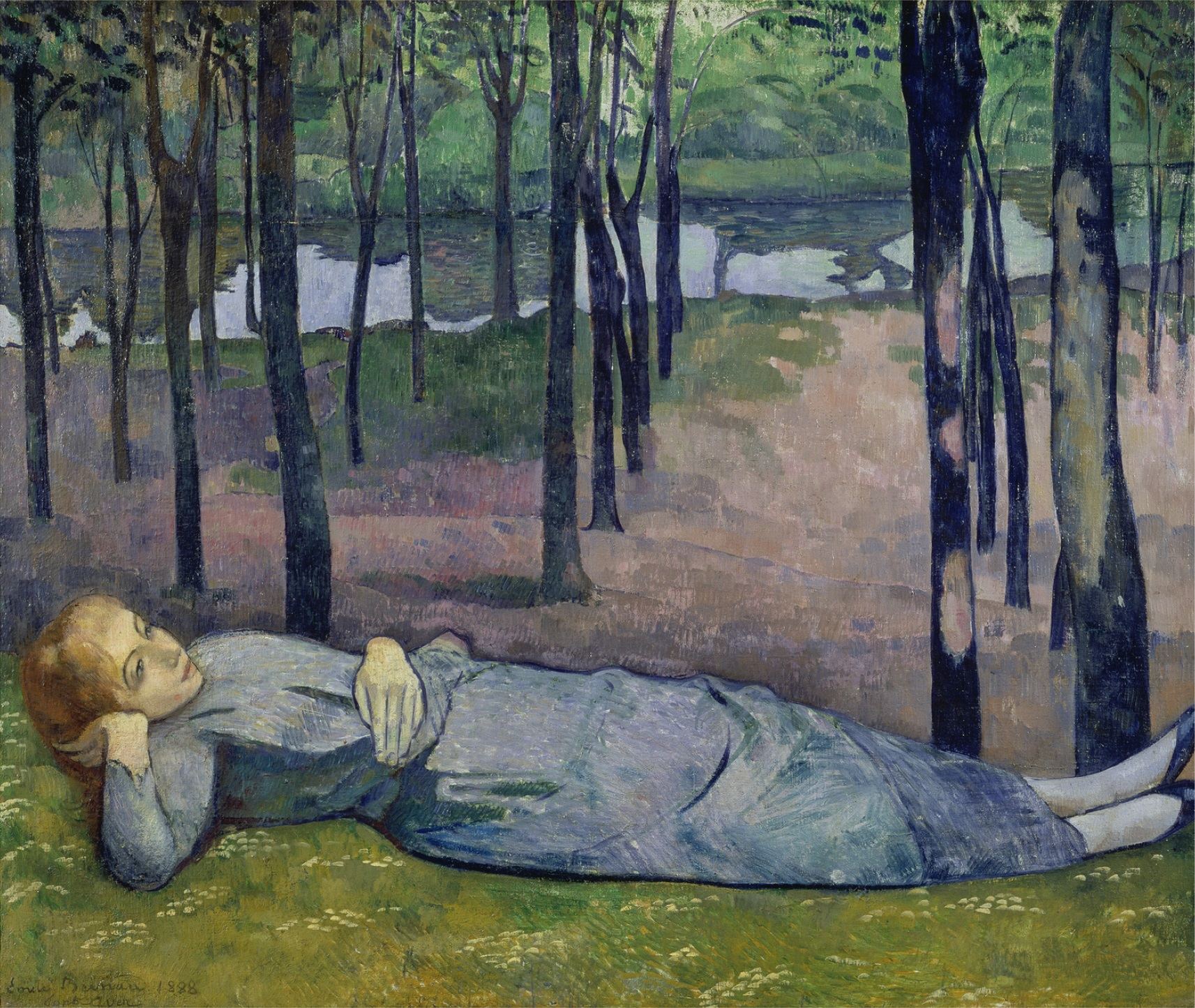
Madeleine in the Bois d'Amour
Émile Bernard · 1888 · Bernard assembles figure and river landscape from separate studies, letting the disjunction reveal synthesis as a difficult construction rather than a formula.
Breton Women with Parasols
Émile Bernard · 1892 · Curved umbrellas, distant hills, upright trunks and silent figures become formal correspondences within Bernard's shallow theatrical space.
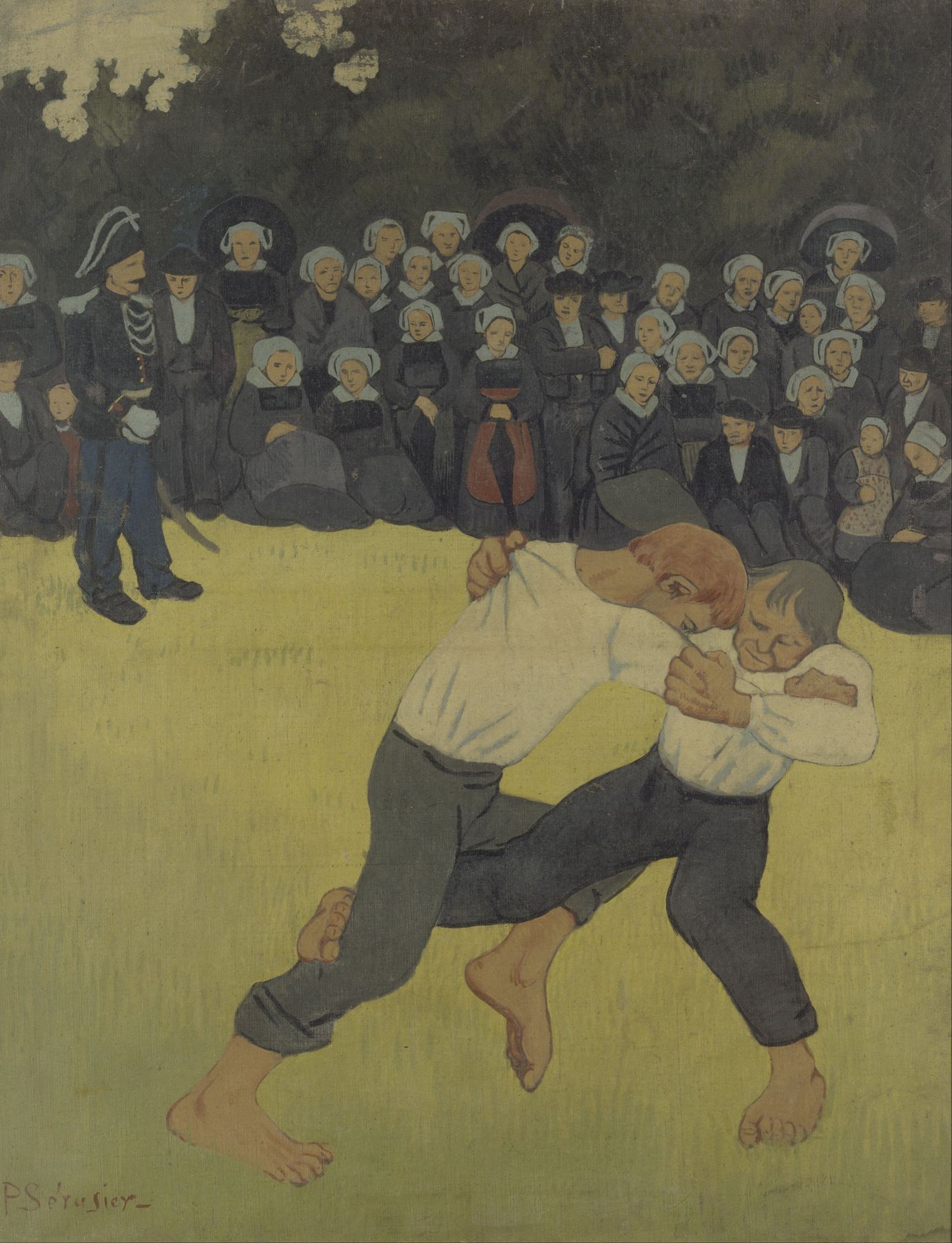
Breton Wrestling
Paul Sérusier · 1890–91 · Sérusier compresses physical action and spectators into a decorative enclosure without merely repeating Gauguin's surface manner.
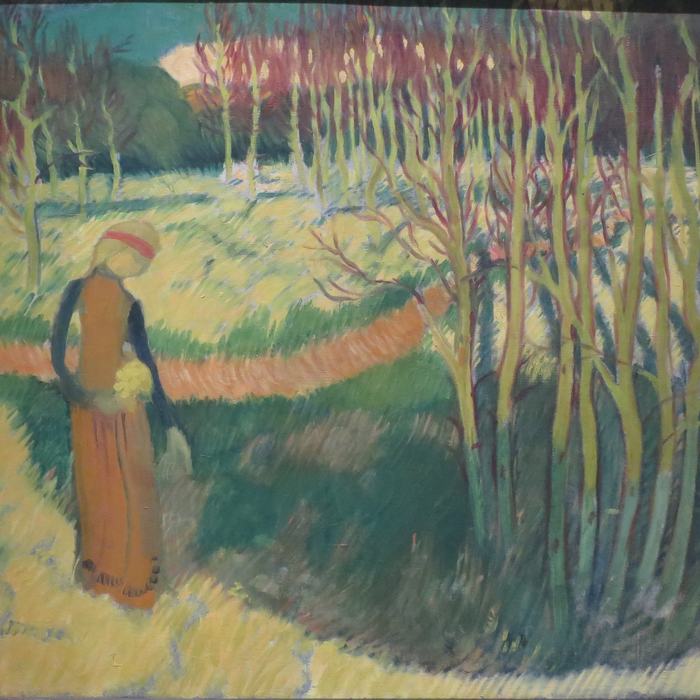
Farmhouse at Le Pouldu
Paul Sérusier · 1890 · Simplified curves and bright patches produce the artificial unity that the Nabis derived from Synthetist experiment.
Self-Portrait with Portrait of Bernard (‘Les Misérables’)
Paul Gauguin · 1888 · Gauguin uses exchanged portraiture to construct symbolic artistic identity, making colour and self-presentation part of the movement's network.
Motif Romanesque
Maurice Denis · 1890 · Denis translates synthetic surface and revived medieval form into an early Nabi proposition in which innovation and tradition coexist.
How to recognise—and question—the style
Start with boundaries. Are forms separated by a dark line, a colour contrast or simply an abrupt edge? Does the boundary flatten a body, bind the picture together or create a decorative rhythm? Then inspect the colour inside it. “Flat” may still contain brushwork, changes of density or a faint tonal turn.
Next test space. Is a middle distance missing? Do forms stack vertically, tilt forward or change scale without ordinary perspective? Cropping may place the viewer too near, while a high viewpoint turns ground into surface. These decisions often matter more than whether every form carries a black contour.
Ask what has been synthesised. Which details establish the subject, and which have been discarded? Where does memory or imagination interrupt observation? What does the picture's internal order contribute that a factual view would not? The answer may be spiritual intensity, comic compression, decorative calm or unsettling artificiality.
Finally, question the cultural selection. If costume, ritual or rural work signals authenticity, what modern systems made the encounter possible? Whose point of view determines what is essential? Formal economy is never socially neutral, even when it creates extraordinary painting.
Where to see Synthetism and Cloisonnism
Displays, works on paper and loans change. Check current galleries before travelling.
- 01
Musée d'Orsay, Paris
the richest single destination for Bernard, Sérusier, Gauguin, drawings, documentary archives and the surrounding Symbolist/Nabi field.
Paris, France
Movement terms, artists and defining objectsVisit official website - 02
Musée de l'Orangerie, Paris
essential for the career-wide correction that restores Bernard before and after his modernist breakthrough.
Paris, France
Émile Bernard and the development of his careerVisit official website - 03
Musée de Pont-Aven, Pont-Aven
connects terminology to place, artist exchange, printed work and the diversity that exceeded either label.
Pont-Aven, France
Place, exchange and the Pont-Aven networkVisit official website - 04
National Galleries of Scotland, Edinburgh
Vision of the Sermon allows the movement's most famous synthetic construction to be studied at its real scale.
Edinburgh, Scotland
Gauguin’s Vision After the SermonVisit official website - 05
National Gallery of Art, Washington
Gauguin, Sérusier and Volpini graphic material reveal painting, landscape and public identity together.
Washington, DC, USA
Volpini prints and works by SérusierVisit official website - 06
Van Gogh Museum, Amsterdam
Bernard, Anquetin, Sérusier, de Haan, Japanese prints and correspondence clarify the Paris–Brittany–Arles network.
Amsterdam, Netherlands
Paintings, prints and correspondenceVisit official website - 07
Metropolitan Museum of Art, New York
prints and monotypes show how contour, colour and synthesis changed across processes.
New York, USA
Prints and illustrated synthesisVisit official website - 08
Musée départemental Maurice Denis, Saint-Germain-en-Laye
the strongest setting for understanding how the Nabis converted synthetic ideas into theory and decoration.
Saint-Germain-en-Laye, France
Nabi theory and decorative afterlivesVisit official website
Suggested books
- Caroline Boyle-Turner, The Prints of the Pont-Aven School. The best focused account of zincography, etching, lithography and woodcut across the circle. It also places these experiments within the wider revival of French printmaking during the Impressionist and Symbolist eras.[46]
- G.-Albert Aurier, The Symbolism in Painting: Van Gogh, Gauguin and Others. Read these canonical critical essays both for their insight and for the hierarchy they helped build. The BnF record provides the modern collected edition, bibliography and index.[47]
- Fred Leeman, Rodolphe Rapetti and Marie-Paule Vial, eds., Émile Bernard 1868–1941. A career-wide corrective that gives the young innovator, later traditionalist and prolific writer equal attention. The French national-library record identifies the exhibition publication and its supporting scholarship.[48]
- Bogomila Welsh-Ovcharov, Vincent van Gogh and the Birth of Cloisonism. Particularly useful for the Paris network and for separating shared visual sources from claims of formal membership.
- Gloria Groom, ed., Gauguin: Artist as Alchemist. A necessary expansion from famous canvases into ceramics, carving, prints and furniture. Yale's publication account presents craftsmanship as central to Gauguin's synthetic thinking.[49]
For an accessible recent bridge back to the larger network, The Pont-Aven School: Cradle of the Modern Sensibility stresses shared ideas without erasing the artists' individuality.[50]
Major Synthetist and Cloisonnist artists
| Name | Nationality | Key Works |
|---|---|---|
| Émile Bernard | French | Breton Women in a Green Meadow · Madeleine in the Bois d'Amour · Breton Women with Parasols |
| Louis Anquetin | French | Avenue de Clichy: Five O’Clock in the Evening · Woman at the Champs-Élysées by Night |
| Paul Gauguin | French | Vision After the Sermon · Self-Portrait with Portrait of Bernard · Bathers in Brittany |
| Paul Sérusier | French | The Talisman · Breton Wrestling · Farmhouse at Le Pouldu |
| Charles Laval | French | Self-Portrait · Martinique landscapes |
| Claude-Émile Schuffenecker | French | The Square at Luxembourg · Volpini works |
| Meijer de Haan | Dutch | Still Life with a Profile of Mimi · Maternity |
| Charles Filiger | French | Guardian Angel with a Garland · chromatic notations |
| Armand Seguin | French | Gabrielle Vien · prints and paintings |
| Maurice Denis | French | Motif Romanesque · Sunlight on the Terrace |
| Pierre Bonnard | French | The Checkered Blouse · France-Champagne |
| Édouard Vuillard | French | The Flowered Dress · Public Gardens |
| Ker-Xavier Roussel | French | The Seasons of Life · pastoral panels |
| Paul Ranson | French | Christ and Buddha · decorative panels |
| Félix Vallotton | Swiss-French | The Bath · woodcuts and interiors |
| Jens Ferdinand Willumsen | Danish | Jotunheim · simplified figure paintings |
| Louis Roy | French | Volpini prints · Breton subjects |
| Léon Fauché | French | Volpini works · works on paper |
| Daniel de Monfreid | French | Portrait of Paul Gauguin · paintings and correspondence |
| Ludovic Némo | French | Volpini catalogue contribution · graphic work |
Frequently Asked Questions
No. Cloisonnism identifies a method based on simplified, bounded colour zones. Synthetism is a broader reconstruction of subject through feeling or memory and pictorial design. One often serves the other, which explains the confusion.
Émile Bernard and Louis Anquetin developed it together in the Paris/Asnières avant-garde. Édouard Dujardin coined the critical label in 1888 while discussing Anquetin. Because collaboration and criticism shaped the method, sole-inventor language is misleading.
Bernard and Gauguin's exchange at Pont-Aven in 1888 was decisive, building on Bernard and Anquetin's prior experiments and Gauguin's separate search. Later disputes awarded or reclaimed priority. The strongest evidence supports collaborative transformation rather than one moment of solitary invention.
Strong outlines can resemble lead strips dividing coloured glass, while broad colour areas suppress gradual modelling. The comparison is an analogy for structure. Most Cloisonnist paintings were not made by copying particular windows or using stained-glass technique.
They were a major source for cropping, contour, asymmetry and flat colour, but not the only one. Enamel, stained glass, popular Épinal prints, medieval art, photography and European painting also contributed. Artists combined these through selective, sometimes appropriative looking.
Usually not. Its pictures retain figures, landscapes, rituals and objects. They abstract from observation by reorganising and simplifying it, but do not generally abandon recognisable subject matter.
He was a close correspondent and an independent participant in the same experimental culture. He knew Bernard, Anquetin and Gauguin and used Japanese-derived contour and colour, yet his impasto, outdoor practice and critical responses remained distinct. Calling him a formal member obscures that difference.
It was an unofficial 1889 show at the Café des Arts near the Paris Exposition Universelle. Its poster used the name “Groupe impressionniste et synthétiste.” Paintings, catalogues and print albums gave a loose network public visibility, although sales were poor.
It makes Synthetism exceptionally legible. Observed Breton worshippers, an imagined biblical struggle and a bold formal design are joined without pretending to be one natural view. The red field and diagonal tree make thought itself part of the composition.
Sérusier took its colour experiment back to Paris, where it became emblematic for the Nabis. Its historical influence is real, but the later relic story can make a small landscape study look like a complete manifesto created in one instant.
Its concentrated phase was brief. By the 1890s, Bernard, Anquetin, Gauguin, Sérusier and other connected artists were already taking different paths. Its principles lived much longer through Symbolism, the Nabis, decorative art and international colour practices.
Look for a structural partnership between line and colour. In Cloisonnism, boundaries divide and organise the whole image, while colour zones assert the surface. A dark edge added around otherwise conventional modelling is not enough by itself.
Discussion
When does simplification make a picture more expressive, and when does it turn a person or culture into a type? Compare a Paris street by Anquetin, a Breton figure by Bernard and a religious canvas by Gauguin. Their shared boundaries may be obvious, but the different purposes of those boundaries reveal why Cloisonnism and Synthetism should never be reduced to one label.
Reader Insights
Separate the visible Cloisonnist method of bounded colour from the broader Synthetist argument about memory, feeling and pictorial organisation.
Compare letters, prints, exhibitions and later recollections before turning a shared experiment into a single artist’s invention.
Ask what artists borrowed from Japanese, popular, medieval and Breton sources—and what their simplifying language left out.
Join the Conversation
When does simplification make a picture more expressive—and when does it turn a person or culture into a type?
References
- Après l'impressionnisme: Cloisonnisme et synthétisme, Musée d'Orsay (French; consulted in French), View Source
- Le cloisonnisme, Grand Palais RMN (French; consulted in French), View Source
- Cloisonnisme, Larousse Dictionnaire de la peinture (French; consulted in French), View Source
- Louis Anquetin, Musée d'Orsay (French; consulted in French), View Source
- Émile Bernard 1868–1941, Musée de l'Orangerie (French; consulted in French), View Source
- Exposición Émile Bernard 1868–1941, Musée de l'Orangerie (Spanish; consulted in Spanish), View Source
- Letter 640 notes, Van Gogh Letters / Van Gogh Museum, View Source
- Letter 620 with notes, Van Gogh Letters / Van Gogh Museum (French and English; consulted in French and English), View Source
- Histoire du musée et de l'école de Pont-Aven, Musée de Pont-Aven (French; consulted in French), View Source
- Guide accessible: cloisonnisme et synthétisme, Musée de Pont-Aven (French; consulted in French), View Source
- Madeleine au Bois d'Amour, Musée d'Orsay (French; consulted in French), View Source
- Émile Bernard, Musée Léon-Dierx, View Source
- Paysannes bretonnes dans un champ, Louvre Department of Prints and Drawings (French; consulted in French), View Source
- Vision of the Sermon, National Galleries of Scotland, View Source
- Picturing France 1830–1900, National Gallery of Art, View Source
- Sérusier's The Talisman, a prophecy of colour, Musée d'Orsay, View Source
- Le Talisman exhibition dossier, Musée d'Orsay (French; consulted in French), View Source
- Les Bretonnes aux ombrelles, Musée d'Orsay (French; consulted in French), View Source
- Young Breton Woman, Metropolitan Museum of Art, View Source
- La Lutte bretonne, Musée d'Orsay (French; consulted in French), View Source
- Farmhouse at Le Pouldu, National Gallery of Art, View Source
- Gallery texts permanent collection, Van Gogh Museum, View Source
- Breton Woman with Child, Van Gogh Museum, View Source
- Van Gogh and Gauguin: Studio of the South work list, Art Institute of Chicago, View Source
- Gauguin to Van Gogh letter 692, Van Gogh Letters (French and English; consulted in French and English), View Source
- Van Gogh to Gauguin letter 698, Van Gogh Letters (French and English; consulted in French and English), View Source
- Symbolism, Metropolitan Museum of Art, View Source
- G.-Albert Aurier manuscripts, Bibliothèque nationale de France CCFr (French; consulted in French), View Source
- Alphonse Germain, Institut national d'histoire de l'art (French; consulted in French), View Source
- Maurice Denis, Musée d'Orsay, View Source
- Denis écrivain d'art, Musée départemental Maurice Denis (French; consulted in French), View Source
- Nabis: Bonnard Vuillard Maurice Denis Vallotton 1888–1900, Musée d'Orsay (French; consulted in French), View Source
- Pierre Bonnard: The Late Interiors, Metropolitan Museum of Art, View Source
- Maurice Denis, Motif Romanesque, Los Angeles County Museum of Art, View Source
- Willumsen: du symbolisme à l'expressionnisme, Musée d'Orsay (French; consulted in French), View Source
- L'impressionnisme d'après Pont-Aven, Musée de Pont-Aven (French; consulted in French), View Source
- Volpini exhibition catalogue, National Gallery of Art (English and French; consulted in English and French), View Source
- Poster for the Groupe Impressionniste et Synthétiste, National Gallery of Art (French; consulted in French), View Source
- The Prints of the Pont-Aven School, Caroline Boyle-Turner / MoMA, View Source
- Gauguin and His Circle in Brittany press release, Museum of Modern Art, View Source
- Bathers in Brittany from the Volpini Suite, Metropolitan Museum of Art, View Source
- The Harvesters from Les Bretonneries, Metropolitan Museum of Art, View Source
- Paul Gauguin 1848–1903, Metropolitan Museum of Art, View Source
- Gauguin: Metamorphoses, Museum of Modern Art, View Source
- Gauguin Paintings Drawings Prints, Art Institute of Chicago, View Source
- French Prints in the Era of Impressionism and Symbolism, Metropolitan Museum of Art, View Source
- Le symbolisme en peinture: Van Gogh Gauguin et quelques autres, Bibliothèque nationale de France (French; consulted in French), View Source
- Émile Bernard 1868–1941, Bibliothèque nationale de France (French; consulted in French), View Source
- Gauguin: Artist as Alchemist, Yale University Press, View Source
- The Pont-Aven School: Cradle of the Modern Sensibility, 5 Continents Editions, View Source
- Synthetism and Cloisonnism image records, Wikimedia Commons: Avenue de Clichy: Five O’Clock in the Evening (Public domain mark; Wadsworth Atheneum / Wikimedia Commons), Breton Women in a Green Meadow (Public domain; Musée d'Orsay / Wikimedia Commons), Vision After the Sermon (Public domain mark; National Galleries of Scotland / Wikimedia Commons), The Talisman (Public domain; Musée d'Orsay / Wikimedia Commons), Madeleine in the Bois d'Amour (Public domain mark; Musée d'Orsay / Wikimedia Commons), Breton Women with Parasols (Public domain mark; Musée d'Orsay / Wikimedia Commons), Breton Wrestling (Public domain mark; Musée d'Orsay / Wikimedia Commons), Farmhouse at Le Pouldu (CC0 1.0; National Gallery of Art / Wikimedia Commons), Self-Portrait with Portrait of Bernard (‘Les Misérables’) (Public domain reproduction; Van Gogh Museum / Wikimedia Commons), Motif Romanesque (Public domain mark; LACMA / Wikimedia Commons).