by Tom Gurney
Tom Gurney BSc (Hons) is an art history expert with over 20 years experience
Email: tomgurney1@gmail.com / Phone: +44 7429 011000
El Greco's Apostolates: Introduction
In the Prado’s Christ the Saviour, two hands answer each other across a red tunic. One rises to bless. The other rests on the curve of a globe. The face, framed by a diamond of light, holds steady above them. In two other paintings from the series, a man in blue opens his palm, and another turns his head sharply as he raises his fingers. Put the three pictures side by side and the hands begin to look like contributions to a conversation. The Saviour, whose gaze meets ours, gives the group its centre. [1] [2] [3]
An Apostolate, or Apostolado in Spanish, is a series of paintings of the apostles. In the complete ensembles made by El Greco and his workshop, the twelve figures accompany Christ in thirteen separate canvases. The workshop revisited the subjects during the painter’s late years in Toledo, changing the scale, costumes, attributes and finish. Four of the Prado paintings discussed here come from the church of Almadrones in Guadalajara. A fifth canvas in Madrid, An Apostle, belongs to a different collection history and shows how difficult it can be to put a name to a face when familiar clothing and gestures recur. [1] [3] [4]
At a Glance
- FormatA complete set comprises Christ the Saviour and twelve apostles in individual paintings. [1] [2]
- ArtistsEl Greco (Doménikos Theotokópoulos) and his workshop, with credits varying by canvas and collection. [1] [3] [4]
- Almadrones seriesNine known survivors. The four Prado canvases are dated 1608–1614, oil on canvas, each 72 × 55 cm. [1] [3] [4]
- Indianapolis comparatorsSaint Luke, 2008.273, Saint Matthew, 2007.53, and Saint Simon, 2008.274. [1]
- Museo del Greco seriesA distinct complete set at the Museo del Greco, Toledo, CE00001–CE00013. [2] [5]
- Separate Prado paintingAn Apostle, P000814, 1608–1614, oil on canvas, 70 × 56 cm, workshop of El Greco. [3]
Contents
- Thirteen canvases in conversation
- Apostle
- Christ the Saviour
- Saint James the Elder
- Saint Paul
- Saint Thomas
- Almadrones to Madrid and Indianapolis
- What the hands and edges reveal
Thirteen canvases in conversation
In the complete set at the Museo del Greco, Christ looks out from the centre and groups of six apostles flank him. A turn of the shoulders and a glance to the side give each figure a direction beyond his own canvas. Because the backgrounds contain so little setting, colour also helps establish the rhythm. A stretch of bright fabric catches the eye before a book or a hand draws it closer. Viewed individually, these paintings can seem absorbed in a thought, a page or a gesture. In company, the turns and pauses suggest that one figure may be listening or replying to another. The present arrangement in Toledo illustrates the principle. The precise initial order of all the Almadrones paintings remains uncertain. [1] [2]
The subject had a history in Toledo. The Museo del Greco points to the lower tier of the altarpiece of San Andrés, where Juan de Borgoña and Antonio de Comontes painted half-length apostles against gold. They already appeared to converse. In El Greco’s late ensembles, each figure has a separate canvas and one neutral field in which to move. That change lets a single turn of the head or an extended hand suggest a relationship over the space between frames. The scale could change from set to set. At the Prado the four Almadrones paintings are 72 centimetres high. The Museo del Greco’s Saviour is just over a metre high on the canvas itself, and the artist could show more of the figure and its clothes. [2] [3] [4] [5]
The Newfields catalogue identifies three complete sets at Toledo Cathedral, the Museo del Greco and the Museo de Bellas Artes de Asturias in Oviedo. It also identifies three incomplete groups known as Almadrones, Arteche and Henke. The choice of apostles varies. The Museo del Greco set has Paul and Bartholomew, whereas the Cathedral and Almadrones include Luke. Luke’s presence offers an example of the freedom available within the repeated format. In the Cathedral painting he displays a portrait of Mary. In the Almadrones series he is an older man dressed in a cloak and tunic like his companions. As the Newfields curator María Cruz de Carlos Varona explains, Luke’s association with painting the Virgin gave him particular significance as the patron saint of artists. [1] [2]
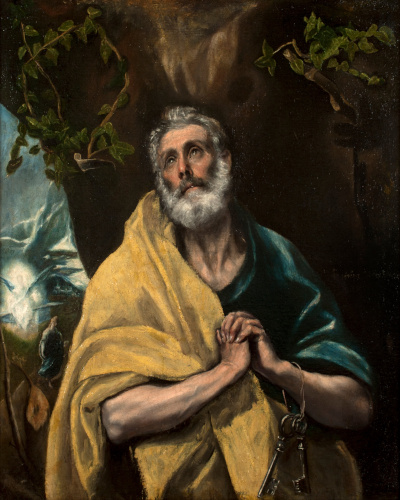
The Museo del Greco displays its set near The Tears of Saint Peter. The two subjects give Peter different tasks. In the ensemble he takes part in an assembly gathered around the Saviour. In the separate scene of repentance, his clasped hands and raised eyes convey an episode in which he must answer for his own conduct. The museum’s account places both among subjects the workshop revisited. Its thirteen canvases define one complete group, formally listed under their own consecutive inventory numbers in the state’s 2009 exhibition schedule. [2] [5] [6]
The Toledo set has a history of its own. According to the museum’s collection record, the priest Manuel Marceliano Rodríguez gave the canvases to the San Sebastián poorhouse in 1837, when the institution occupied the Hospital de Santiago. The paintings moved with it to San Pedro Mártir and were deposited in the Provincial Museum at San Juan de los Reyes in 1898. They were shown at the Academia de San Fernando in 1909 before entering the museum established by the Marqués de la Vega Inclán. The hospital is a documented stop in their later history. The original destination remains open. [2]
Apostle
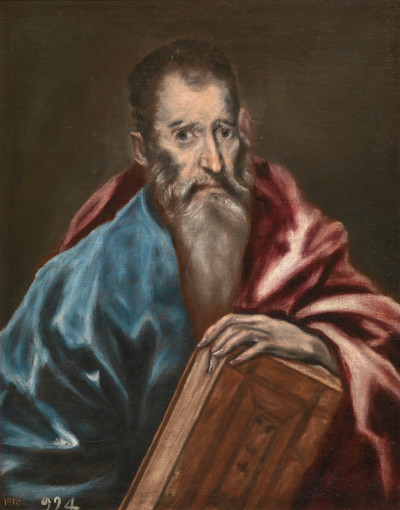
The Prado’s An Apostle (Un apóstol, P000814) is catalogued as a work of El Greco’s workshop. The grey beard comes to a point just above an oversized, closed volume held at a steep angle. Dark lines on the cover and the gleam of the page edges give weight to the book. The man’s hand lies across the top and one finger slips between the leaves. It looks as though he has saved his place while turning his attention elsewhere. His eyes are directed towards the viewer, and the dark setting leaves room for that look to register. A blue tunic and a rose-red mantle lead in from the two sides of the canvas. [3]
The book tells us something about the role of the figure. It has proved harder to name him. Pedro de Madrazo called him Saint Paul in the Prado’s 1854 catalogue, and a comparison with a figure from the Henke group later prompted a suggestion of Bartholomew. Leticia Ruiz Gómez found a better visual fit in the older Matthew type, which combines a similar beard, blue and red clothing and a volume. In the large Toledo versions Matthew has a pen as well as a book. Other variations in the workshop’s repertoire, including a close repetition of this composition in a group with a differently configured Matthew, leave identification open. The Prado’s title retains the uncertainty. [1] [3]
A radiograph reproduced by Ruiz Gómez suggests that the middle finger was adjusted and lengthened as the workshop painted the figure. That small alteration gives us one documented choice in a picture based on a familiar model. The book, hand and change of attention work together even when the saint’s name is uncertain. The painting has its own recorded history in the Spanish royal collections. An inventory of the Alcázar in 1668 described a philosopher with a book. After the 1734 fire it was listed as an apostle, and it is documented at the Prado in 1834. Its proximity in scale and date to the four Almadrones works helps us compare the types. The record follows this canvas independently of their history in the village church. [3]
Christ the Saviour
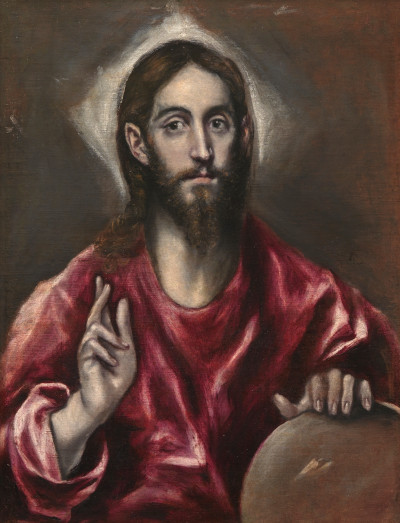
The Prado’s El Salvador (P002889) is the central subject of the Almadrones series and is credited to El Greco and workshop. The blessing hand rises beside the front of the tunic, its long fingers bent together against the deep red. Two of them stretch noticeably higher than the others. The left hand steadies the sphere just where the lower edge of the canvas cuts across it. A small highlight turns its curved surface into something more tangible. The straight, pale strokes around Christ’s head fan out into a diamond-shaped halo. Inside it, the face has a slight turn, though the gaze still addresses the viewer directly. [3] [4]
The Museo del Greco’s signed Saviour (CE00001) has the same division of attention between blessing hand, face and globe. Its painted surface measures 100.4 by 80.2 centimetres according to the national museum network’s object record. Its extra length allows the blue mantle to drop over the red tunic, and more of the body remains visible below the hands. The shared gesture keeps the two pictures close as versions of one subject. In the compact Prado picture, the halo and the curve of the globe have an especially clear role in counterbalancing the raised hand. [2] [3]
Ruiz Gómez describes how a 2004 treatment removed overpaint from the Prado canvas and recovered transparency in the globe, detail around the mouth and ear, and the painted initials. She also points out the abrupt transitions in the drapery. The visible sphere and the account of its treatment give two kinds of information about the well-known gesture. We can see the hand resting on a symbol of the world and, in a detail that had to be recovered, how the painter gave that symbol the effect of a transparent surface. The catalogue retains the joint credit for the whole picture. [3] [4]
Saint James the Elder
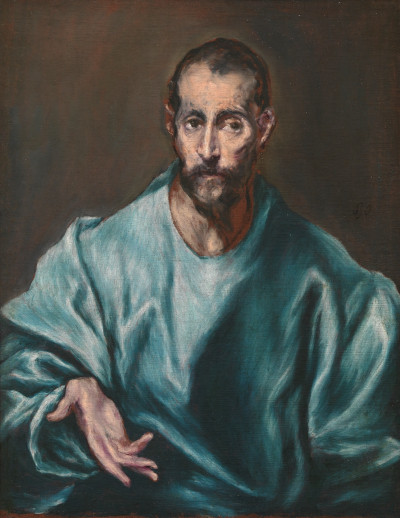
The Almadrones canvas P002890 is titled Santiago, or Saint James, by the Prado. It entered the museum without a distinction between James the Elder and James the Lesser. The Elder was the identification proposed by August L. Mayer in 1926 and adopted in earlier Prado catalogues. José Álvarez Lopera saw a closer relation to the figure called James the Lesser in the two Toledo ensembles. The Almadrones figure has an open hand, with no pilgrim’s staff of the Elder or fuller's club of the Lesser. The gesture is so well defined that it can tell us how the figure is addressing someone even as it leaves his precise identity open. [3] [4]
His face is narrow above a great expanse of blue. In the lower left of the picture, a sleeve rolls back around the wrist and lets the palm turn upwards. Each finger catches a different angle. A much smaller shift takes place near the forehead, where the receding hairline and uneven emphasis of the eyes give the head its air of concentration. The face gathers our attention and the hand seems to pass it on. The Museo del Greco’s Saint James the Lesser (CE00012) makes a similar conversational movement with the right hand, while the left retains a closed book. That comparison explains the appeal of the proposed identification. In the Prado painting the hand has to carry more of the expression on its own. [3] [7]
Ruiz Gómez describes the face in P002890 as probably unfinished, with the base colour and a few deft strokes doing work that might otherwise have been done by final touches. The rough transitions in the face are worth comparing with the sweep of blue across the shoulder and chest. The broad, bright lengths of paint on the cloth suggest the lift and fall of fabric with relatively few marks. The economy is part of what makes the painted James so striking among the four Prado figures. It also illustrates why an unfinished passage cannot be taken as a simple measure of a picture’s quality. [3]
Saint Paul
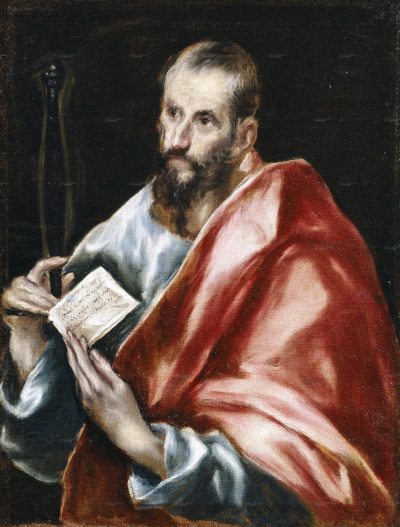
In San Pablo (P002892), Paul holds a pale piece of writing in front of his chest. The right hand keeps hold of a sword, its dark blade rising close to the left edge of the image. A glint at the top and the narrow lights along its edges distinguish it from the shadow behind the figure. Paul’s other hand holds the letter at a diagonal, making a small patch of brightness against the cool tunic and the larger red mantle. His eyes travel past the writing, so the letter appears to command our attention even as Paul looks elsewhere. The Prado lists the canvas as El Greco and workshop. [3] [4]
The sword refers to Paul’s death by beheading in Christian tradition. The Greek writing is addressed to Titus, whom the inscription calls the first bishop of the church of the Cretans. Ruiz Gómez notes that this reference appears in several of El Greco’s paintings of Paul and has been read as a reminder of the painter’s own Cretan origins. The exact attribute matters here. The unnamed Prado Apostle has a large bound book whose cover catches the light. Paul presents a much smaller piece of writing, with the sword and the address to Titus keeping his identity clear. [3]
The Prado’s catalogue also shows that the sword and the dark background were left at a relatively early stage of finish. The dark field gives Paul’s head less of a sense of surrounding space than in the versions where light gathers around it. In the separate Barcelona picture of Saint Peter and Saint Paul, Paul still carries the sword and wears a prominent red mantle. There he has Peter beside him, and the two figures’ hands cross in the space between them. The Museu Nacional d’Art de Catalunya reads that gesture as a tentative reconciliation. In the Almadrones canvas, the sword holds to the edge of Paul’s solitary figure and the letter supplies the most intimate detail. [3] [8]
Saint Thomas
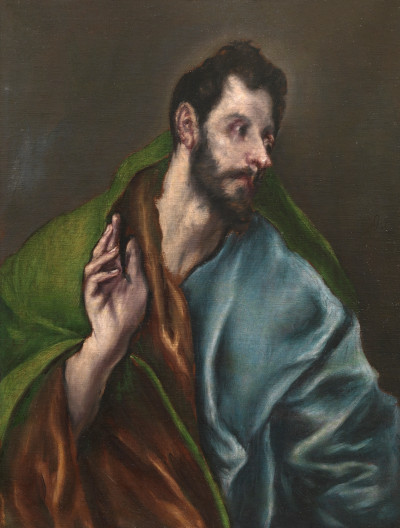
The Prado’s Santo Tomás (P002891), credited to El Greco and workshop, has a change of direction at its centre. Thomas is painted with his head turned towards the right of the picture. His raised right hand, visible on the opposite side, catches the light along the fingers and thumb. The coat opens to show a gold-brown lining against the blue, and a strip of green angles up towards the head. The move from the turn of the face to the lifted fingers is easy to follow, even though the gesture is made with very little space around the hand. [3] [4]
The Prado version omits the left hand and the object it carries in the larger Toledo figures. The Museo del Greco’s Saint Thomas (CE00010) shows the left hand gripping a slender shaft, understood as the spear of his martyrdom. In the Cathedral version, Ruiz Gómez identifies a set square, which refers to the tradition that Thomas built a palace in heaven. Comparison with these paintings supports the Prado title, particularly the construction of the head and the characteristic raised right hand. Ruiz Gómez records a reading of the gesture as Thomas’s recognition of Christ after his initial doubt about the Resurrection. The Almadrones painter could suggest that moment through the movement of an empty hand. [3] [9]
Colour offers another clue to the way the workshop adapted the model. The Museo del Greco Thomas wears orange and blue. In Madrid the blue of the tunic is set beside a green mantle with warm lining. The hue changes while the raised fingers and the youth’s angular face remain recognisable. During the Prado’s 2004 treatment, the conservator removed oxidised varnish and old overpaint, exposing losses in the surface, especially near the eye. Ruiz Gómez distinguishes these later injuries from the handling of the face and fingers, where traces of crimson and rubbed colour help create the cooler, violet-toned flesh. [3] [9]
Almadrones to Madrid and Indianapolis
Nine of the paintings hung in the church of the Assumption at Almadrones before the Spanish Civil War. The original commission and the full order are unconfirmed. During the war the group was moved to the fort at Guadalajara, a former Franciscan convent. The archival material cited by Newfields describes the discovery there of nine canvases rolled up and a rudimentary effort to restore them. The Prado received them in 1942 for conservation after a transfer arranged the previous year. Newfields places their return to ecclesiastical authorities in 1945. The Spanish state acquired the four now in the Prado in 1946. [1] [3]
The rest of the group took other paths. George H. A. Clowes bought Saint Luke, Saint Matthew and Saint Simon from the Newhouse Galleries in New York on 6 November 1952, according to the purchase invoice cited by the Newfields catalogue. The paintings were on long-term loan to the Indianapolis Museum of Art from 1971 and entered its collection in 2007 and 2008. Newfields identifies Saint John the Evangelist with the Schorr Collection and Saint Andrew with the Los Angeles County Museum of Art. The latter museum credits its Apostle St. Andrew (52.16) to the school of El Greco. Its diagonal cross gives another example of how an attribute could define a figure within the narrow canvas. [1] [10]
The 2014 exhibition El Greco: Arte y Oficio at the Museo de Santa Cruz in Toledo brought the four Prado pictures and the three Newfields paintings into the same exhibition again. The state loan schedule lists the seven individually. Six decades after the Newhouse sale, a visitor there could move directly from the book of the Indianapolis Matthew to the letter of the Prado Paul. The records preserve the different accession numbers and collections even where the paintings share a history and an exhibition. [1] [4]
What the hands and edges reveal
The Newfields Saint Luke, Saint Matthew and Saint Simon are each credited to El Greco and workshop and dated about 1610–1614. Three works in one group can contain markedly different kinds of detail. Book and face are the focus in Matthew. Simon looks down at an open volume, the book and his yellow and blue clothes giving us the direction of his attention before we reach his eyes. Luke’s portrait also shows how looking beneath the surface can make the work of painting visible. Fiona Beckett’s examination recorded dark preparatory brushwork in infrared and small adjustments to the hand, the beard and the drapery. The technical report documents the changes it could see. The individual who made each of those changes remains uncertain. [1] [11]
In Saint Matthew, the examination found that the flesh and drapery overlap cleanly and generally cover the reddish preparation. The brightest strokes of white catch on the folds of blue and red, and the transitions have been worked enough to soften the edge around the head. Saint Simon exposes more of the reddish layer, including around his neck and along his blue robe. The gaps between some areas of flesh and cloth prompted the conservator to raise the possibility of separate hands. Those findings offer a way into El Greco’s style and technique through very small parts of the picture. The reddish paint at an edge might be a colour intentionally left visible. An overlapping edge, by comparison, can tell us which strokes came later and how far the painter developed the transition. [12] [13]
The Museo del Greco Matthew provides a third comparison. The Newfields study points to black contours around the hand holding the book and in parts of the beard, with the warm preparation visible in the passage into the clothes. Those traces are especially useful in the Toledo set because some of its paintings remained unfinished. The three Indianapolis works all carry Greek initials connected with the artist. María Cruz de Carlos Varona suggests that the marks could indicate work made in the studio under El Greco’s supervision. The initials, the repeated design and the evidence of the paint together support a closer account of the workshop, where the amount and kind of finish could vary even across paintings intended to hang side by side. [1] [6] [11] [12] [13]
Browse the artworks
Browse the paintings covered in this collection and related works in museum catalogues. Some are by El Greco’s workshop or were formerly attributed to him.
| Name | Date | Medium |
|---|---|---|
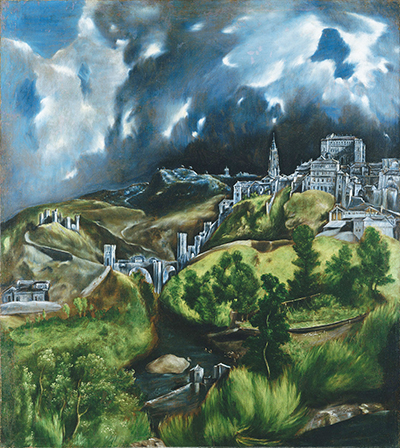
| View of Toledo | Around 1599–1600 | Oil on canvas |
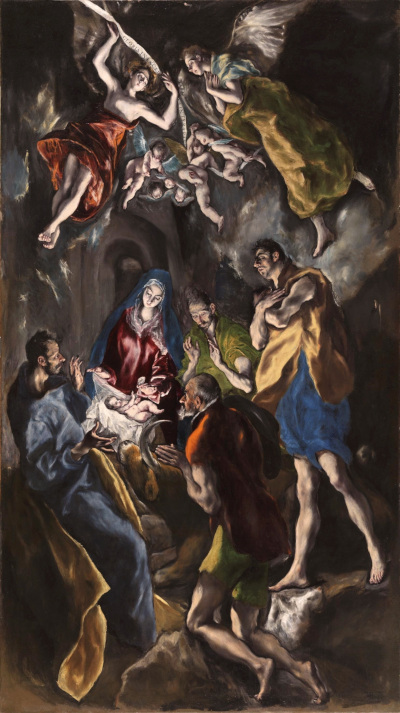
| Adoration of the Shepherds | 1612–14 | Oil on canvas |
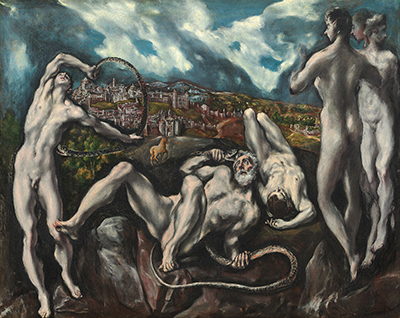
| Laocoön | About 1610–14 | Oil on canvas |
| The Tears of Saint Peter | 1587–96, Museo del Greco dating | Oil on canvas |
| The Holy Family with Saint Anne | About 1595 | Oil on canvas |
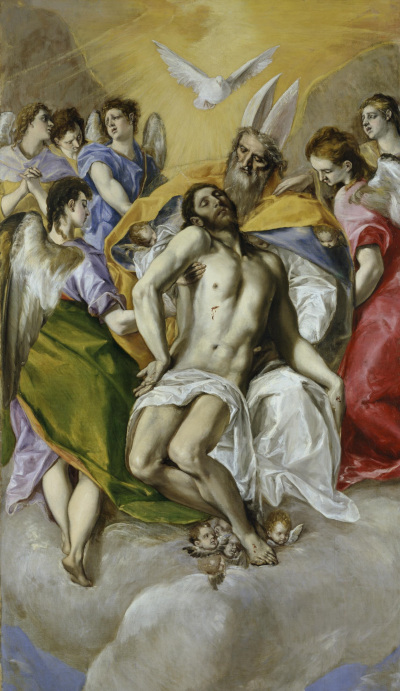
| The Holy Trinity | 1577–79 | Oil on canvas |
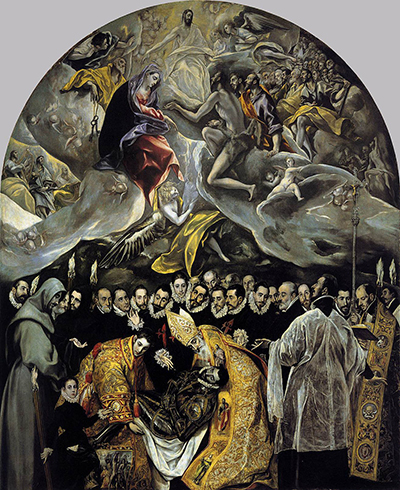
| The Burial of the Count of Orgaz | 1586–88, the conventional range | Oil on canvas |
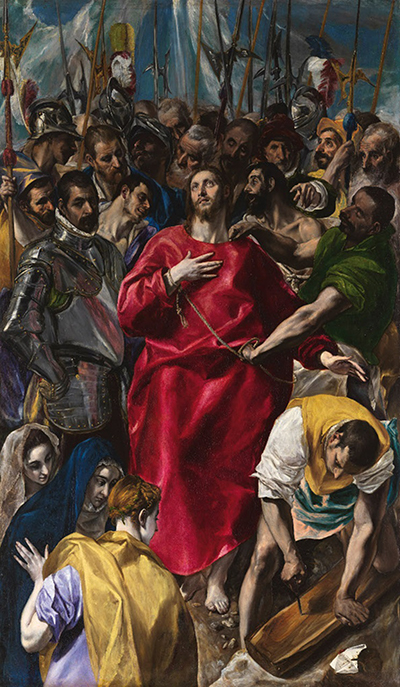
| Disrobing of Christ | 1577–79 | Oil on canvas |
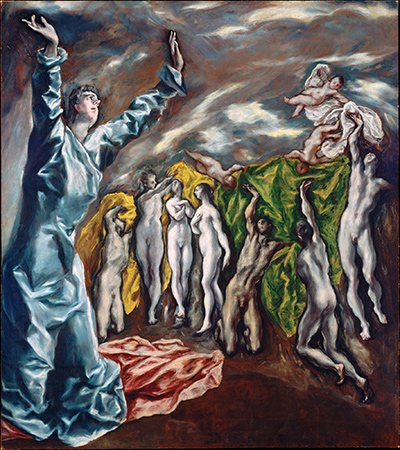
| Opening of the Fifth Seal | About 1608–14 | Oil on canvas |
| Saint Martin and the Beggar | 1597–99 | Oil on canvas |
| Martyrdom of Saint Maurice | 1580–82 | Oil on canvas |
| Adoration of the Name of Jesus | 1577–79 | Oil on canvas |
| Saint Peter in Penitence (Bowes Museum) | 1580s | Oil on canvas |
| Christ Carrying the Cross | Around 1577–87 | Oil on canvas |
| Crucifixion | 1597–1600 | Oil on canvas |
| Resurrection | 1597–1600 | Oil on canvas |
| Immaculate Conception | About 1608–13 | Oil on canvas |
| Annunciation | 1597–1600 | Oil on canvas |
| Coronation of the Virgin | 1591–92 | Oil on canvas |
| Lady in a Fur Wrap | About 1580–88 | Oil on canvas |
| Baptism of Christ | Around 1608–14, with further work in the early 1620s according to Walter Liedtke. The foundation dates the painting to around 1614. | Oil on canvas |
| Portrait of an Old Man (Possible Self-Portrait) | About 1595–1600 | Oil on canvas |
| Adoration of the Kings | 1565–67, Benaki Museum dating | Tempera on wood |
| Mary Magdalene in Penitence | About 1585–90, tentatively dated by the Museu del Cau Ferrat | Oil on canvas |
| Saint Sebastian | About 1577 in the cathedral centenary catalogue | Oil on canvas |
| Portrait of Cardinal Fernando Nino de Guevara | About 1600 | Oil on canvas |
| Penitent Magdalene | About 1576–77 | Oil on canvas |
| The Nobleman with his Hand on his Chest | About 1580 | Oil on canvas |
| Saint Peter and Saint Paul | 1590–1600 | Oil on canvas |
| Pentecost | Circa 1600 | Oil on canvas |
| The Fable | About 1580 | Oil on canvas |
| Pietà | 1580–90 | Oil on canvas |
| View and Plan of Toledo | 1610–1614, according to the Museo del Greco | Oil on canvas |
| Assumption of the Virgin | 1577–79, with 1577 in the Greek inscription | Oil on canvas |
| The Annunciation (1609) | Late Tavera period. The owner dates the canvas to 1614. Factum gives 1608–1613 in its initial recording account. | Oil on canvas |
| The Agony in the Garden of Gethsemane | 1590s | Oil on canvas |
| Portrait of Jorge Manuel Theotocópuli | Circa 1600–05 | Oil on canvas |
| Dormition of the Virgin | About 1565–66, according to the National Gallery of Greece | Tempera on wood |
| Saint Louis | 1585–90 | Oil on canvas |
| Ecstasy of St Francis of Assisi (1580) | About 1577–80 in the Vatican Museums’ account. The Diocesan Museum gives 1575–80. | Oil on canvas |
| Saint Francis of Assisi in Ecstasy, after El Greco | Seventeenth century | Oil on canvas |
| Christ Driving the Money Changers from the Temple | Probably before 1570 | Oil on wood |
| The Entombment of Christ | Circa 1568–70, Venice | Mixed technique on wood |
| Nativity | 1603–05 | Oil on canvas |
| Portrait of a Gentleman | About 1586 | Oil on canvas |
| Coronation of the Virgin (Illescas) | 1603–05 | Oil on canvas |
| A Boy Blowing on an Ember to Light a Candle (El Soplón) | About 1570–72 | Oil on canvas |
| The Feast in the House of Simon | About 1608–14 | Oil on canvas |
| Concert of Angels | About 1608–14 | Oil on canvas |
| Healing of the Man Born Blind | Around 1570 in Dresden’s printed collection guide | Mixed technique on wood |
| Fray Hortensio Félix Paravicino | 1609 | Oil on canvas |
| Purification of the Temple | Circa 1600 | Oil on canvas |
| Portrait of Vincenzo Anastagi | Circa 1575 | Oil on canvas |
| Saint Paul (Almadrones) | 1608–14 | Oil on canvas |
| Head of Christ | About 1579–86 | Oil on canvas |
| Last Supper | About 1567–68, Venice | Tempera on wood |
| Saint John the Evangelist (Prado Museum, Madrid) | About 1605 | Oil on canvas |
| Disrobing of Christ (Lyon, Half Painting Version) | About 1581–86 | Oil on canvas |
| The Dream of Philip II | 1577–79 | Oil on canvas |
| Portrait of a Sculptor | About 1577–80, 2019 exhibition dating | Oil on canvas |
| Saint Bernard | 1577–79 | Oil on canvas |
| Saint Benedict | 1577–79 | Oil on canvas |
| Portrait of Jerónimo de Cevallos | 1613, as catalogued by the Prado | Oil on canvas |
| The Flight into Egypt | About 1570 | Oil on wood |
| Saint Anthony of Padua | About 1580 | Oil on canvas |
| Portrait of a Doctor | 1582–85 | Oil on canvas |
| The Veil of Saint Veronica | 1586–95 | Oil on canvas |
| An Elderly Gentleman | About 1587–1600 | Oil on canvas |
| Saints Andrew and Francis | About 1595 | Oil on canvas |
| The Holy Family with Saint Anne and the Infant Saint John | Around 1600 in the Prado catalogue. The Balaguer record gives 1595–1600. | Oil on canvas |
| The Virgin Mary | 1595–1600 | Oil on canvas |
| Portrait of a Gentleman (1600-1605) | About 1600–05 | Oil on canvas |
| Portrait of a Young Gentleman | 1600–05 | Oil on canvas |
| John the Baptist and Saint John the Evangelist | 1600–10 | Oil on canvas |
| Portrait of a Friar | 1600–50 | Oil on canvas |
| Saint Thomas (Almadrones) | 1608–14 | Oil on canvas |
| Christ the Saviour (Almadrones) | 1608–14 | Oil on canvas |
| An Apostle (Prado P000814) | 1608–14 | Oil on canvas |
| Saint James (Almadrones) | 1608–14 | Oil on canvas |
| Julián Romero and his Patron Saint | 1612–18 | Oil on canvas |
| Allegory of the Camaldolese Order | Around 1600, Instituto Valencia de Don Juan dating | Oil on canvas |
| Saint Joseph and the Christ Child | 1597–99 | Oil on canvas |
| Saint Ildefonsus | Around 1600 according to the Prado's proposal, 1603–05 in Hadjinicolaou and Ficonofue | Oil on canvas |
| Saint Augustine | About 1585–1602, as listed in the 2014 exhibition study | Oil on canvas |
| Portrait of Diego de Covarrubias y Leyva | Circa 1600 | Oil on canvas |
| Saint Bernardino of Siena | 1603 in the Prado catalogue. The Museo del Greco object page lists 1602. | Oil on canvas |
| Portrait of Cardinal Tavera | About 1609 in the foundation's account, circa 1610 in its image heading | Oil on canvas |
| Visitation | About 1610–14 | Oil on canvas |
| Portrait of Francisco de Pisa | Circa 1610–14 | Oil on canvas |
| Saint Lawrence's Vision of the Madonna and Child (Apparition of the Virgin to St. Lawrence) | 1578–80 in the 2021 heritage decree | Oil on canvas |
| Christ on the Cross | Probably 1570s, assigned to El Greco’s Italian period in the sale literature | Oil on canvas |
| Portrait of Charles de Guise | 1572, as dated in the painted book | Oil on canvas |
| Portrait of Giulio Clovio | 1571–72, according to Capodimonte | Oil on canvas |
| Mount Sinai | About 1570–72 | Mixed technique on wood |
| Modena Triptych | 1567–1568, as dated by the Galleria Estense and the national catalogue | Tempera on wood |
| Saint Luke Painting the Virgin | 1560–67, Benaki Museum dating | Mixed technique on wood |
| Saint Ildefonso (Washington) | 1603–14 | Oil on canvas |
| Saint Martin and the Beggar (smaller Washington version) | 1600–14 | Oil on canvas |
| The Holy Family with Saint Anne and the Infant John the Baptist (Washington) | About 1595–1600 | Oil on canvas |
| The Adoration of the Name of Jesus (London panel) | Late 1570s | Oil on wood |
| Christ Driving the Traders from the Temple (London) | About 1600 | Oil on canvas |
| Saint Francis Receiving the Stigmata (Baltimore) | 1585–90 | Oil on canvas |
| Saint Luke (Almadrones, Indianapolis) | About 1610–14 | Oil on canvas |
| Saint Matthew (Almadrones, Indianapolis) | About 1610–14 | Oil on canvas |
| Saint Simon (Almadrones, Indianapolis) | About 1610–14 | Oil on canvas |
| The Tears of Saint Peter (Hospital de Tavera) | About 1605 | Oil on canvas Catalogue. |
Discussion
Look again at the images and ideas explored in El Greco's Apostolates. These editorial prompts invite your observations.
Reader Insights
Compare how the Prado pictures of Saint James and Saint Thomas present an open hand. Which part of each pose helps you distinguish the figures?
Follow one attribute across paintings of related saints. What changes when the painter leaves the object outside the frame?
Join the Conversation
Share a detail, comparison or question about El Greco's Apostolates below.
References
- María Cruz de Carlos Varona, St. Luke, St. Matthew, St. Simon, Masterpieces from the Clowes Collection, Indianapolis Museum of Art at Newfields View source.
- CERES, Museo del Greco, El Salvador, CE00001, full collection record (in Spanish) View source.
- Leticia Ruiz Gómez, El Greco en el Museo Nacional del Prado. Catálogo razonado, 2007, pp. 148–167 and 233–237, nos. 22–25 and 39 (in Spanish) View source.
- Boletín Oficial del Estado, El Greco: Arte y Oficio exhibition schedule, 2014, nos. 24–27 and 65–67 (in Spanish) View source.
- Boletín Oficial del Estado, El Greco: Toledo 1900 exhibition agreement, 2009, annex, Museo del Greco works CE00001–CE00013 (in Spanish) View source.
- Museo del Greco, Orientarse en el Museo, teaching guide, pp. 10 and 14–18 (in Spanish) View source.
- CERES, Museo del Greco, Santiago el Menor, CE00012, full collection record (in Spanish) View source.
- Museu Nacional d’Art de Catalunya, Saint Peter and Saint Paul, 005083-000, collection record View source.
- CERES, Museo del Greco, Santo Tomás, CE00010, full collection record (in Spanish) View source.
- Los Angeles County Museum of Art, The Apostle St. Andrew, 52.16, collection record View source.
- Fiona Beckett, St. Luke, 2008.273, Newfields technical examination report View source.
- Newfields, St. Matthew, 2007.53, technical examination report View source.
- Newfields, St. Simon, 2008.274, technical examination report View source.