by Tom Gurney
Tom Gurney BSc (Hons) is an art history expert with over 20 years experience
Email: tomgurney1@gmail.com / Phone: +44 7429 011000
El Greco’s Style and Technique: Introduction
In the Benaki Museum’s Saint Luke Painting the Virgin, the saint’s brush reaches toward a painted figure small enough to fit inside an icon just over forty centimetres high. In The Assumption of the Virgin, a canvas more than four metres high, the sweep of an apostle’s arm directs the eye from an open tomb to Mary rising among clouds. One gesture rewards a close look at the tip of a brush. The other stays legible from the floor of a church. El Greco made the two works on different supports, for different ways of seeing. [1] [2]
The surfaces hold evidence of decisions that a view of the finished picture can miss. A wash can let the preparation beneath it help set the colour of a shadow. A grid can bring a separately drawn map onto a canvas. A face can be worked up, then adjusted before the painting leaves the studio. And a second version may follow the final arrangement of an altarpiece while leaving a different sequence of layers for conservators to read.
At a Glance
- Early formatsThe Cretan Saint Luke Painting the Virgin and the portable Modena Triptych reward viewing at close range.
- Large canvasesThe Assumption was designed for the central section of a church altarpiece, with another painting above it.
- Paint layersTechnical studies identify white grounds, coloured priming and changes in how El Greco established and modelled figures.
- Drawing and revisionInfrared examination reveals the grid used to transfer the Toledo map. Radiography records earlier work on the Virgin’s face in the Tavera Holy Family.
- Repeated subjectsThe Washington Saint Martin canvases retain evidence of which design came first.
Contents
- From an icon painter’s easel to a church retable
- What lies under the colour
- Transferring a map and revising a face
- The cut canvas from Hospital de Tavera
- How a smaller Saint Martin follows the finished design
- Why Glasgow credits the Lady in a Fur Wrap to Sánchez Coello
- How El Greco varied the proportions of his figures
From an icon painter’s easel to a church retable
The Benaki dates its signed Saint Luke Painting the Virgin to 1560–67. The Virgin in the picture on Luke’s easel presents the Child according to the Byzantine Hodegetria type. Luke occupies the space beside it, with a turn in his body and bright creases in his clothes. The Benaki associates the play of light on the robes and the angel crowning him with contemporary Italian painting. The tempera and gold are on canvas attached to a pine panel. The picture makes room for both kinds of representation. The Virgin’s gesture belongs to the image Luke is making. The changing light on his robes belongs to the room in which he makes it. [1] [3]
The scale of the Modena Triptych places another demand on the painter. The Italian national catalogue records a wooden portable altar about 37 centimetres high when closed, with movable wings and scenes on both faces, painted in tempera grassa, or oil-rich tempera. In the central scene of the open triptych, the Christian knight and the figures above him occupy a space barely wider than a hand. The wings can carry the Adoration of the Shepherds and the Baptism of Christ beside that scene because each has its own boundary. On the reverse, Mount Sinai, the Annunciation and the story of Adam and Eve occupy a different sequence of panels. Turning or folding the object changes which groups are available to the eye. [4]
Carmen Garrido reported two approaches to underdrawing in the triptych and related its translucent colour and finish to techniques practised by Venetian painters. The fine drawing and thin colour make sense at the scale of a portable object. Look at the Baptism, where the illuminated body and the strip of lighter sky can be picked out before the smaller forms of the surrounding landscape. The paint gives a clear point of attention within a scene that offers some of its information only at close range. [5]
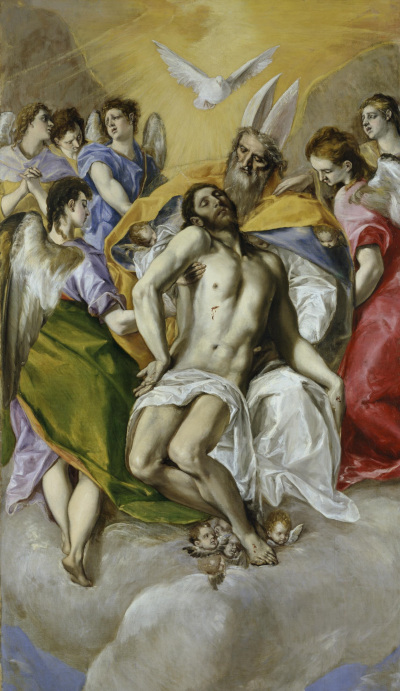
In the Assumption of the Virgin, the reach of an apostle’s arm occupies roughly the kind of space an entire portable picture would take up. The canvas measures 403.2 × 211.8 centimetres and occupied the lower central part of the main retable at Santo Domingo el Antiguo in Toledo. It had to register as a single composition and as part of a vertical arrangement. The open tomb directs the eye into the crowd, the men’s heads and raised hands lead upward, and the moon beneath Mary helps mark out her position amid the clouds. Above this canvas was The Holy Trinity, where angels carry the body of Christ. Leaving room around the ascending Virgin helps the ascent read across a broad field and within the larger architecture. [2]
Canvas could take a large painted field within a wooden structure. At Santo Domingo el Antiguo, Griswold describes three surviving works in the church with their fabric mounted on strainers and backed with pine. In this arrangement the canvas carries the paint while the wood supports and protects it from behind. Size also changes how a pictorial detail works. The bent elbow and splayed hand of an apostle help distribute movement across a large part of the Assumption. In a small panel, the position of a single finger can be enough to guide the viewer across the scene. [2] [6]
What lies under the colour
A painter lays a ground over the support to give the paint a prepared surface. El Greco could then add a coloured priming layer, or imprimatura. Its tone gives the painter something against which to judge light and dark as the picture takes shape. In the two Washington versions of Saint Martin and the Beggar, Susanna P. Griswold reports a white ground containing mostly gypsum with some lead white and a red priming layer above it. Four paintings examined for their priming, including both Saint Martin canvases, contained iron oxides, red lake, black and lead white in varying amounts. The ingredients agree across those samples. The changing proportions and tones give a better idea of what the painter saw at the start than a single description of the layer as red. [6]
The ground can take on a different appearance after centuries or under different kinds of lighting. Some of the white ground in the cross sections looks brownish when viewed with light passing through it. Griswold considers the yellowing of glue and the possibility of staining by layers below. The article also records that differences in the published colour photographs of the ground were due to the photographic process. Even a close photograph of a sample has to be read alongside the observations made at the microscope. [6]
A coloured surface is a useful middle tone for a painter working with both dark lines and light strokes. In late paintings that survive unfinished, Griswold describes a black brush sketch laid out over red priming. She discusses the sketch in Washington’s Saint Jerome and the unfinished Apostles in the Museo del Greco. Working with a brush and paint allows the painter to put down a contour with a change of pressure or to shade a form with a wider sweep. In finished works a dark preliminary mark can be difficult to pick up with infrared reflectography because of low contrast between the mark and the layer beneath. A faint infrared image gives limited evidence about how much preliminary drawing was present. Griswold also examined earlier examples, including the small Disrobing at Upton House, where she reports more readily legible drawing and changes on a white preparation. [6]
Paint can build light in the layers above the drawing. One of Griswold’s samples came from a dark fold of the Virgin’s blue mantle in Madonna and Child with Saint Martina and Saint Agnes, the companion to the large Saint Martin in the Chapel of San José. The sample showed azurite and some lead white below a glaze of ultramarine. A glaze is a thin, translucent film that changes the appearance of the colour seen through it. In a dark fold it can carry blue across a deep shadow, letting the underlayer contribute to the resulting colour. In a highlight from the large Saint Martin’s blue saddlecloth, the analysis found a different treatment. Azurite with white and red lake gave a purplish blue, with a lighter blue stroke above. The mantle and saddlecloth illustrate two ways of varying colour within a single blue passage. [6]
Each cross section is a tiny piece of paint mounted to show its layers edge-on. It records how a particular intersection of colours was built. Existing losses and other suitable places limit where samples can be taken. Griswold notes that the samples from the two Saint Martin canvases could rarely be taken at exactly equivalent spots and that there was no suitable place to sample the blue saddlecloth or the green landscape in the smaller painting. In the sample from the Virgin’s mantle, even the white ground is absent from the fragment. The paint sequence is useful precisely because it can be tied to a fold, a highlight or a piece of harness. Looking for the same number of layers throughout a canvas would lose the differences between those passages. [6]
Transferring a map and revising a face
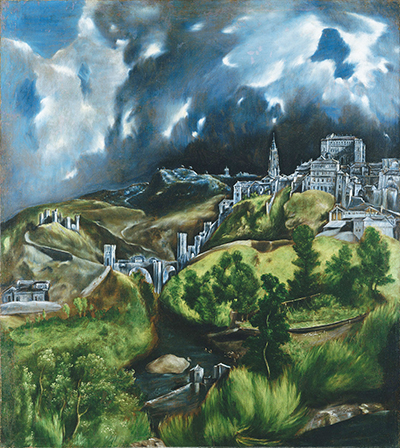
The young man at the right of View and Plan of Toledo holds what looks like a sheet of parchment. The artist had to fit the lines of a separately drawn map into that part of the canvas. Garrido’s examination shows a square grid, clearer in infrared reflectography than in ordinary light. A grid divides the drawing into smaller areas so that the painter can judge where a line enters and leaves each square as it is copied. With a network of streets, an error in one area could displace the connections in the next. The grid offers a way to keep relationships in place across the whole diagram. It establishes how the map was transferred while leaving open who supplied the separate drawing. [7]
The map is one of several kinds of information in the painting. Garrido describes intersecting brush marks that bring the buildings of the panorama together and thin strokes of lead white that pick out the lit edges of roofs and walls. The reddish preparation shows through between buildings and among the green strokes in the young man’s clothes. On the map, sepia lines and a list of buildings provide a different order of detail. The text in the lower part of the sheet explains why the Hospital de Tavera, at the centre in the form of a model on a cloud, was brought forward so the Puerta de Bisagra could be seen. The description records the painter’s decision about what to put where. The map retains the building’s position in relation to the city. [7]
El Greco on video
Watch TheHistoryOfArt’s painting survey, then explore El Greco’s work with museum curators.
El Greco's Most Famous Paintings
A short survey of El Greco’s paintings, including View of Toledo.
Watch on YouTubeThe painting’s X-radiograph supplies evidence about the timing of that decision. Garrido identified areas left for the foreground figures, the map, the cloud and the hospital. The landscape could then be painted around those shapes, with small adjustments where their edges met. Some lead-white lights are clearer on the radiograph because they were softened by subsequent paint. The evidence gives the painting two kinds of order. The painter had set aside space for the objects from the outset and could still adjust their edges and contrasts later. [7]
Radiography shows a different sort of work in the Tavera Holy Family with Saint Anne, dated to about 1595 by the Fundación Casa Ducal de Medinaceli. The foundation identifies earlier work on the Virgin’s face beneath the finished one. In the visible picture her head inclines over the child. Anne is at one end of his body and Joseph at the other, with his hand at the child’s foot. The face belongs to that network of looks and touches. Its underlying version gives the viewer a chance to see how the appearance of the Virgin was worked out on the canvas. The foundation interprets the revision as a movement from a likeness towards an ideal. The radiograph establishes an earlier version of the face, with the painter’s reasons for changing it a matter of interpretation. [8]
The cut canvas from Hospital de Tavera
A line can enter a picture much later in its history. The late Annunciation at the Fundación Banco Santander once extended upwards into the Concert of the Angels, now in the National Gallery in Athens. El Greco began the painting for a side altar at the Hospital de Tavera. The Santander catalogue reports that the canvas was divided in the late nineteenth century and that a later lining involved cutting and shifting Gabriel’s legs. The later alteration made the angel appear to stand on the floor. Factum Foundation’s 2026 recording after conservation documents the return of the legs to the position that current research suggests they once occupied. The Athens fragment preserves the company of angels above, with instruments and sheets of music spread among them. [9] [10] [11]
The two sections are now in different collections. In the Banco Santander painting, the meeting between the Virgin and Gabriel ends in a burst of light at the top of the surviving piece. In Athens, the angelic musicians form a composition with a lower edge of its own. If the two are imagined as one tall work, the light in the lower section draws the eye on towards the concert. Factum Foundation recorded the surface and colour of both fragments to enable digital reunification. That approach permits the sections to be compared at scale while their physical histories remain legible. The cut and the repositioned legs belong to the history of the object. The earlier face in the Holy Family belongs to the process of painting it. [8] [9] [10] [11]
How a smaller Saint Martin follows the finished design
The National Gallery of Art in Washington holds two oil paintings of Saint Martin and the Beggar. The canvas made for Toledo’s Chapel of San José, 1942.9.25, measures 193.5 × 10³ centimetres and is dated 1597–99. The original painted area of the smaller version, 1937.1.84, is just under a metre high, with later extensions on all four sides. The horse turns its head toward us in both. Martin looks down, and the dividing line of the green cloak ties him to the man standing beside the horse. With the same main forms visible in both, it is reasonable to ask whether the smaller work might have been a study for the larger one. [12] [13]
Griswold’s most telling evidence comes from the horse’s chest. The radiograph of the altarpiece shows a higher position for its neck strap. Traces of white paint displaced by the brush suggest that El Greco moved the strap while the white was still wet. The raised index finger of Martin’s left hand also began in a lower position. The smaller painting begins its strap at the position reached after the change on the altarpiece. Griswold found no equivalent adjustments in its X-radiograph. Following a feature as particular as the finished position of the strap points to a ricordo, a repetition of an already worked-out design. A modello would be a preparatory version used to develop or present a design before execution at full scale. [6]
Where the rein meets the bit below the horse’s jaw, the two canvases offer a comparison of similar details in section. In the altarpiece the sample contains as many as ten distinguishable layers, including the preparation, with traces that Griswold associates with early outlining, sky, green fabric, the horse and the bridle. In the smaller version, the comparable passage needed two layers above the priming, white and grey. They give the harness a similar place and appearance from the front. The difference below the surface records how each image was built. [6]
The examination answers the question of sequence with more confidence than that of authorship. Griswold described the smaller version’s handling as tighter and associated it with the workshop, while allowing for the possibility that El Greco had a hand in finishing it. The National Gallery’s current catalogue gives the painter as “Greek 16th Century”, dates the work 1600–14 and lists El Greco as a related artist. A few remnants of lettering survive in the smaller work and provide too little evidence for a secure signature. The two paintings share much of their palette, as one would expect when the aim was to reproduce an established colour arrangement. Shared materials alone give little purchase on who applied a finishing stroke. [6] [13]
Why Glasgow credits the Lady in a Fur Wrap to Sánchez Coello
Glasgow Museums’ Lady in a Fur Wrap is now credited to Alonso Sánchez Coello. When it was shown in Louis-Philippe’s Spanish Gallery at the Louvre from 1838 to 1848, the picture was attributed to El Greco. It helped establish his reputation abroad, and that old label can still accompany reproductions. The picture’s materials give a way to evaluate a claim inherited through exhibitions and publications. [14] [15]
In a joint investigation involving the Museo del Prado, Glasgow Museums and the University of Glasgow, researchers found a light grey priming in the portrait. It differed from the reddish-brown priming they had examined in works securely given to El Greco. Infrared reflectography also revealed drawn lines of a different character from his brushier preliminary work. Together the base colour and the drawing suggested a different route to the surface we see. The team considered the dress and jewellery as well as related portraits, including a less formal image of an unknown young woman at the Prado, in making the case for Sánchez Coello. The identification of the painter leaves the sitter’s name open. [14] [15]
The drawing beneath the fur also preserves a design the painter set aside. Glasgow Museums describes the trace of a geometric collar below the wrap. At the surface, the soft spread of fur draws attention away from the line at the throat and makes the edges of the sheer veil easier to pick out. The buried collar shows how much the texture that now gives the painting its name depends on a change made during its execution. [14]
A comparison within the Museo del Greco gives a more direct way to look at the two painters’ handling. Both painted Diego de Covarrubias. In El Greco’s portrait of Covarrubias, Ximo Company draws attention to the stroke of light running down from between the brows and the small touches of red near the eyes, mouth and ear. Further diluted strokes around the head soften its meeting with the background. The bright mark on the nose gives the profile definition, while the surrounding marks let the light fall away gradually. Looking at these passages alongside Sánchez Coello’s Covarrubias gives the eye a way into their respective treatment of the same face. The comparison concerns what the painters did with the edge of a form, something harder to judge when two portraits depict different sitters. [16]
How El Greco varied the proportions of his figures
The larger Saint Martin offers two figures whose proportions can be compared within a single canvas. Martin’s body is enclosed by armour and steadied by the saddle. The beggar stands alongside the horse and his exposed torso and legs look markedly long and slender. The lowered horizon gives both figures height in relation to the landscape. Stretching the beggar’s body carries the eye along the line that links his face, the shared cloak and the bare leg. The National Gallery reads the attenuated figure as a hint of the Christian story in which the beggar is revealed as Christ. That reading depends on a distinction between the two people that El Greco sustained within the same picture. [12]
In the early twentieth century the ophthalmologist Germán Beritens proposed that astigmatism explained El Greco’s elongations. The historian of perception Chaz Firestone traces the proposal to pamphlets published in 1913 and 1914 and notes that Beritens knew the principal objection. A uniform stretching of what a painter sees would affect both the subject and the canvas. The painter could still match one to the other. The hypothesis has a further difficulty as an account of the paintings. The degree of elongation changes from picture to picture and can vary between figures who share the same scene. [12] [17]
One way to see what the elongation does is to follow the bright edge of the cloak where it drops from the rider’s hand. It turns across the beggar’s hips, bringing the two men into contact across the white flank of the horse. The length of the standing body lets that strip of green sit high in the composition while there is still room below for the beggar’s feet and the exposed ground. Seen from a distance, the strip of colour makes the gesture of sharing readable before the eye can find the fingers or the sword. [12]
Browse the artworks
Browse the paintings covered in this collection and related works in museum catalogues. Some are by El Greco’s workshop or were formerly attributed to him.
| Name | Date | Medium |
|---|---|---|
| View of Toledo | Around 1599–1600 | Oil on canvas |
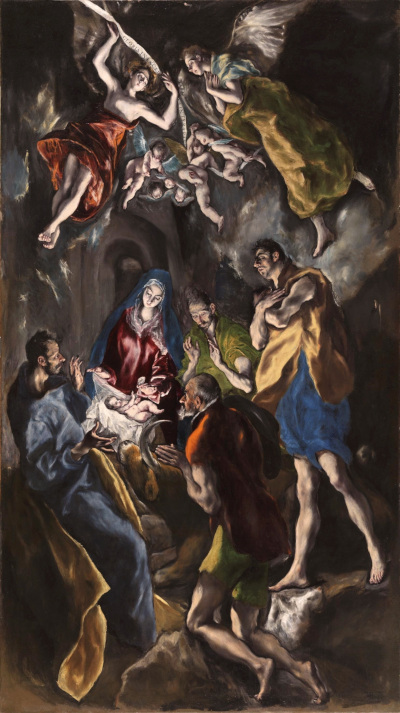
| Adoration of the Shepherds | 1612–14 | Oil on canvas |
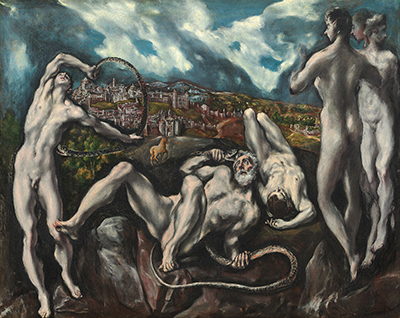
| Laocoön | About 1610–14 | Oil on canvas |
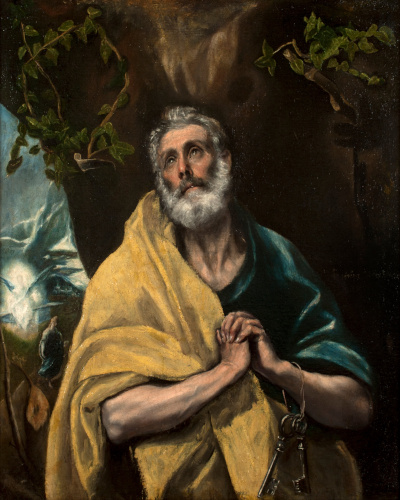
| The Tears of Saint Peter | 1587–96, Museo del Greco dating | Oil on canvas |
| The Holy Family with Saint Anne | About 1595 | Oil on canvas |
| The Holy Trinity | 1577–79 | Oil on canvas |
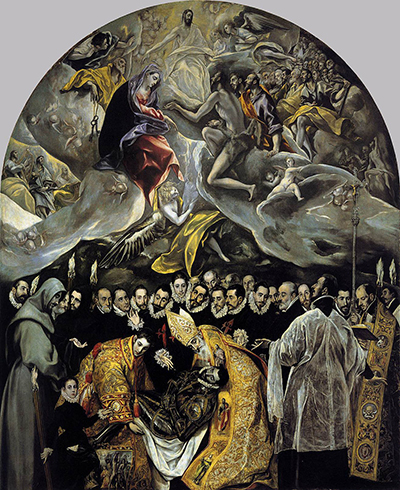
| The Burial of the Count of Orgaz | 1586–88, the conventional range | Oil on canvas |
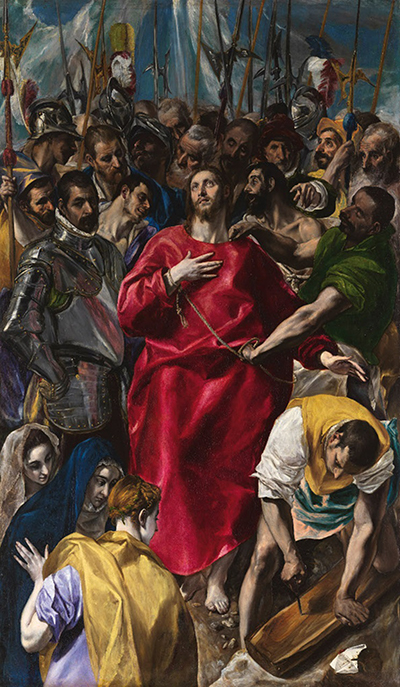
| Disrobing of Christ | 1577–79 | Oil on canvas |
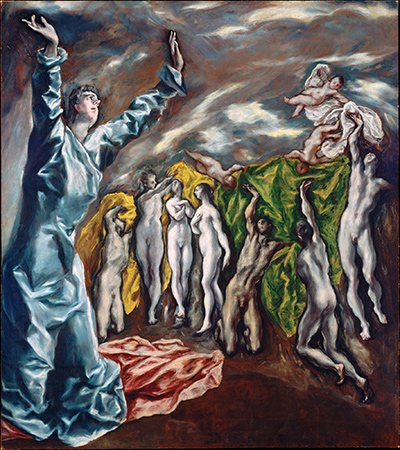
| Opening of the Fifth Seal | About 1608–14 | Oil on canvas |
| Saint Martin and the Beggar | 1597–99 | Oil on canvas |
| Martyrdom of Saint Maurice | 1580–82 | Oil on canvas |
| Adoration of the Name of Jesus | 1577–79 | Oil on canvas |
| Saint Peter in Penitence (Bowes Museum) | 1580s | Oil on canvas |
| Christ Carrying the Cross | Around 1577–87 | Oil on canvas |
| Crucifixion | 1597–1600 | Oil on canvas |
| Resurrection | 1597–1600 | Oil on canvas |
| Immaculate Conception | About 1608–13 | Oil on canvas |
| Annunciation | 1597–1600 | Oil on canvas |
| Coronation of the Virgin | 1591–92 | Oil on canvas |
| Lady in a Fur Wrap | About 1580–88 | Oil on canvas |
| Baptism of Christ | Around 1608–14, with further work in the early 1620s according to Walter Liedtke. The foundation dates the painting to around 1614. | Oil on canvas |
| Portrait of an Old Man (Possible Self-Portrait) | About 1595–1600 | Oil on canvas |
| Adoration of the Kings | 1565–67, Benaki Museum dating | Tempera on wood |
| Mary Magdalene in Penitence | About 1585–90, tentatively dated by the Museu del Cau Ferrat | Oil on canvas |
| Saint Sebastian | About 1577 in the cathedral centenary catalogue | Oil on canvas |
| Portrait of Cardinal Fernando Nino de Guevara | About 1600 | Oil on canvas |
| Penitent Magdalene | About 1576–77 | Oil on canvas |
| The Nobleman with his Hand on his Chest | About 1580 | Oil on canvas |
| Saint Peter and Saint Paul | 1590–1600 | Oil on canvas |
| Pentecost | Circa 1600 | Oil on canvas |
| The Fable | About 1580 | Oil on canvas |
| Pietà | 1580–90 | Oil on canvas |
| View and Plan of Toledo | 1610–1614, according to the Museo del Greco | Oil on canvas |
| Assumption of the Virgin | 1577–79, with 1577 in the Greek inscription | Oil on canvas |
| The Annunciation (1609) | Late Tavera period. The owner dates the canvas to 1614. Factum gives 1608–1613 in its initial recording account. | Oil on canvas |
| The Agony in the Garden of Gethsemane | 1590s | Oil on canvas |
| Portrait of Jorge Manuel Theotocópuli | Circa 1600–05 | Oil on canvas |
| Dormition of the Virgin | About 1565–66, according to the National Gallery of Greece | Tempera on wood |
| Saint Louis | 1585–90 | Oil on canvas |
| Ecstasy of St Francis of Assisi (1580) | About 1577–80 in the Vatican Museums’ account. The Diocesan Museum gives 1575–80. | Oil on canvas |
| Saint Francis of Assisi in Ecstasy, after El Greco | Seventeenth century | Oil on canvas |
| Christ Driving the Money Changers from the Temple | Probably before 1570 | Oil on wood |
| The Entombment of Christ | Circa 1568–70, Venice | Mixed technique on wood |
| Nativity | 1603–05 | Oil on canvas |
| Portrait of a Gentleman | About 1586 | Oil on canvas |
| Coronation of the Virgin (Illescas) | 1603–05 | Oil on canvas |
| A Boy Blowing on an Ember to Light a Candle (El Soplón) | About 1570–72 | Oil on canvas |
| The Feast in the House of Simon | About 1608–14 | Oil on canvas |
| Concert of Angels | About 1608–14 | Oil on canvas |
| Healing of the Man Born Blind | Around 1570 in Dresden’s printed collection guide | Mixed technique on wood |
| Fray Hortensio Félix Paravicino | 1609 | Oil on canvas |
| Purification of the Temple | Circa 1600 | Oil on canvas |
| Portrait of Vincenzo Anastagi | Circa 1575 | Oil on canvas |
| Saint Paul (Almadrones) | 1608–14 | Oil on canvas |
| Head of Christ | About 1579–86 | Oil on canvas |
| Last Supper | About 1567–68, Venice | Tempera on wood |
| Saint John the Evangelist (Prado Museum, Madrid) | About 1605 | Oil on canvas |
| Disrobing of Christ (Lyon, Half Painting Version) | About 1581–86 | Oil on canvas |
| The Dream of Philip II | 1577–79 | Oil on canvas |
| Portrait of a Sculptor | About 1577–80, 2019 exhibition dating | Oil on canvas |
| Saint Bernard | 1577–79 | Oil on canvas |
| Saint Benedict | 1577–79 | Oil on canvas |
| Portrait of Jerónimo de Cevallos | 1613, as catalogued by the Prado | Oil on canvas |
| The Flight into Egypt | About 1570 | Oil on wood |
| Saint Anthony of Padua | About 1580 | Oil on canvas |
| Portrait of a Doctor | 1582–85 | Oil on canvas |
| The Veil of Saint Veronica | 1586–95 | Oil on canvas |
| An Elderly Gentleman | About 1587–1600 | Oil on canvas |
| Saints Andrew and Francis | About 1595 | Oil on canvas |
| The Holy Family with Saint Anne and the Infant Saint John | Around 1600 in the Prado catalogue. The Balaguer record gives 1595–1600. | Oil on canvas |
| The Virgin Mary | 1595–1600 | Oil on canvas |
| Portrait of a Gentleman (1600-1605) | About 1600–05 | Oil on canvas |
| Portrait of a Young Gentleman | 1600–05 | Oil on canvas |
| John the Baptist and Saint John the Evangelist | 1600–10 | Oil on canvas |
| Portrait of a Friar | 1600–50 | Oil on canvas |
| Saint Thomas (Almadrones) | 1608–14 | Oil on canvas |
| Christ the Saviour (Almadrones) | 1608–14 | Oil on canvas |
| An Apostle (Prado P000814) | 1608–14 | Oil on canvas |
| Saint James (Almadrones) | 1608–14 | Oil on canvas |
| Julián Romero and his Patron Saint | 1612–18 | Oil on canvas |
| Allegory of the Camaldolese Order | Around 1600, Instituto Valencia de Don Juan dating | Oil on canvas |
| Saint Joseph and the Christ Child | 1597–99 | Oil on canvas |
| Saint Ildefonsus | Around 1600 according to the Prado's proposal, 1603–05 in Hadjinicolaou and Ficonofue | Oil on canvas |
| Saint Augustine | About 1585–1602, as listed in the 2014 exhibition study | Oil on canvas |
| Portrait of Diego de Covarrubias y Leyva | Circa 1600 | Oil on canvas |
| Saint Bernardino of Siena | 1603 in the Prado catalogue. The Museo del Greco object page lists 1602. | Oil on canvas |
| Portrait of Cardinal Tavera | About 1609 in the foundation's account, circa 1610 in its image heading | Oil on canvas |
| Visitation | About 1610–14 | Oil on canvas |
| Portrait of Francisco de Pisa | Circa 1610–14 | Oil on canvas |
| Saint Lawrence's Vision of the Madonna and Child (Apparition of the Virgin to St. Lawrence) | 1578–80 in the 2021 heritage decree | Oil on canvas |
| Christ on the Cross | Probably 1570s, assigned to El Greco’s Italian period in the sale literature | Oil on canvas |
| Portrait of Charles de Guise | 1572, as dated in the painted book | Oil on canvas |
| Portrait of Giulio Clovio | 1571–72, according to Capodimonte | Oil on canvas |
| Mount Sinai | About 1570–72 | Mixed technique on wood |
| Modena Triptych | 1567–1568, as dated by the Galleria Estense and the national catalogue | Tempera on wood |
| Saint Luke Painting the Virgin | 1560–67, Benaki Museum dating | Mixed technique on wood |
| Saint Ildefonso (Washington) | 1603–14 | Oil on canvas |
| Saint Martin and the Beggar (smaller Washington version) | 1600–14 | Oil on canvas |
| The Holy Family with Saint Anne and the Infant John the Baptist (Washington) | About 1595–1600 | Oil on canvas |
| The Adoration of the Name of Jesus (London panel) | Late 1570s | Oil on wood |
| Christ Driving the Traders from the Temple (London) | About 1600 | Oil on canvas |
| Saint Francis Receiving the Stigmata (Baltimore) | 1585–90 | Oil on canvas |
| Saint Luke (Almadrones, Indianapolis) | About 1610–14 | Oil on canvas |
| Saint Matthew (Almadrones, Indianapolis) | About 1610–14 | Oil on canvas |
| Saint Simon (Almadrones, Indianapolis) | About 1610–14 | Oil on canvas |
| The Tears of Saint Peter (Hospital de Tavera) | About 1605 | Oil on canvas Catalogue. |
Discussion
Look again at the images and ideas explored in El Greco’s Style and Technique. These editorial prompts invite your observations.
Reader Insights
Compare the painted surface of the Saint Luke panel with the Assumption. What details would be visible to someone standing close to each work?
Which difference between the two Saint Martin paintings would be hardest to discover without looking beneath the paint?
Join the Conversation
Share a detail, comparison or question about El Greco’s Style and Technique below.
References
- Benaki Museum, St Luke Painting the Virgin, ΓΕ 11296 View source.
- Art Institute of Chicago, The Assumption of the Virgin, 1906.99 View source.
- Dave Williams, El Greco: Well Connected, Art Institute of Chicago, 2020, p. 2 View source.
- Catalogo generale dei Beni Culturali, Trittico di Modena, 0800675920 View source.
- Carmen Garrido, The Modena Triptych between East and West, Historical Museum of Crete conference summaries, pp. 45–46 View source.
- Susanna P. Griswold, Two Paintings by El Greco, Conservation Research, Studies in the History of Art 41 (1993), pp. 132–155 View source.
- Carmen Garrido, Vista y plano de Toledo del Museo del Greco, Cuadernos de Arte de la Universidad de Granada 40 (2009), pp. 53–62 View source.
- Fundación Casa Ducal de Medinaceli, La Sagrada Familia con Santa Ana View source.
- Fundación Banco Santander, The Annunciation View source.
- National Gallery, Athens, The Concert of the Angels, Π.152 View source.
- Factum Foundation, El Greco’s Annunciation, recording and reconstruction View source.
- National Gallery of Art, Saint Martin and the Beggar, 1942.9.25 View source.
- National Gallery of Art, Saint Martin and the Beggar, 1937.1.84 View source.
- Glasgow Museums, Lady in a Fur Wrap, PC.18 View source.
- University of Glasgow, Results of research on Spanish masterpiece Lady in a Fur Wrap announced, 2019 View source.
- Ximo Company, La luz y el color en la pintura de El Greco, Arbor 191 (2015), a275 View source.
- Chaz Firestone, On the origin and status of the ‘El Greco fallacy’, Perception 42 (2013), pp. 672–674 View source.