in Detail Fra Angelico.jpg)
 by Tom Gurney
Tom Gurney BSc (Hons) is an art history expert with over 20 years experience
Published on November 6, 2026 / Updated on November 6, 2026
Email: tomgurney1@gmail.com / Phone: +44 7429 011000
Introduction
Fra Angelico’s technical achievement is easily obscured by his spiritual reputation. For centuries, the image of the holy friar-painter encouraged viewers to treat beauty as the natural expression of devotion. Modern technical study reveals something more demanding. Angelico’s art depends upon sophisticated workshop preparation, panel construction, tempera technique, gold, fresco organisation, perspective, underdrawing, manuscript illumination, expensive pigments and careful adaptation of material to function. The Museo del Prado’s technical research into the Annunciation and its predella has been especially important. The Museo di San Marco’s restoration programmes have added evidence from the Last Judgement, Deposition, San Marco Altarpiece, frescoes and illuminated manuscripts.
Together these studies demonstrate that Angelico was not simply a painter with one recognisable surface style. He worked across multiple media. Tempera on panel. Gold ground. Oil-enriched techniques. Fresco. Manuscript illumination. Complex mixed-media tabernacles. Painted furnishings. His visual language changes because materials and functions change. A gold-ground altarpiece needs one kind of beauty. A friar’s cell fresco needs another. A tiny predella needs another. A papal chapel requires yet another. Technical adaptability is therefore one of the best definitions of his mature style. [4]
At a Glance
- Early formationmanuscript illumination [7]
- Principal panel mediumtempera on wood [2]
- Common supportpoplar [2]
- Precious materialgold leaf / gilded surface [2]
- Major wall mediumfresco [4]
- Other techniquesoil-enriched panel painting, mixed-media architectural objects [4]
- Key technical strengthscolour, drawing, small-scale narrative, perspective, architectural clarity and workshop organisation [4]
- Important pigment evidenceultramarine, vermilion and red lakes among rich materials identified in conservation research [6]
- Key illumination evidenceSan Domenico gradual, c. 1424–30 [7]
- Workshoplarge and organised by the early 1430s [4]
- Technical principlematerial and style change according to function [4]
Contents
- Introduction
- Manuscript Beginnings
- Panel Construction
- Perspective Planning
- Tempera
- Gold
- Fresco
- San Marco Cell Frescoes
- Restoration and Technique
- Why Fra Angelico’s Technique Matters
Manuscript Beginnings
Guido di Pietro’s early formation included manuscript illumination. The Prado connects him with a manuscript workshop after his move to Florence with his brother Benedetto. Benedetto trained as a copyist. Guido trained as an illuminator. This origin is fundamental. Illumination teaches discipline. Small fields. Expensive colour. Precise line. Integration of text and image. Controlled gold. Angelico carried these skills into panel painting. [7]
The Museo di San Marco preserves an important gradual associated with Fra Angelico. The museum dates it around 1424–30 and describes it as one of the earliest and most important witnesses to his activity as an illuminator. This overlaps with his early Fiesole panel paintings. He was not an illuminator first and panel painter later in a simple sequence. The two activities coexisted. [7]
Illuminated manuscripts trained artists to think about the relationship between words and pictures. This becomes especially important in Angelico’s Annunciations and late Armadio degli Argenti. Painted inscriptions do not feel added. Text is structurally integrated. The page-trained artist understands words as visual material. [8]
Predellas show the direct benefit of illumination. Tiny scenes remain readable. Figures have clear silhouettes. Architecture divides action. Colour differentiates protagonists. This is why the Prado predella can hold complex Marian narratives within very small fields. The museum’s later restoration emphasised the extraordinary richness of minute technical detail. [3]
Panel Construction
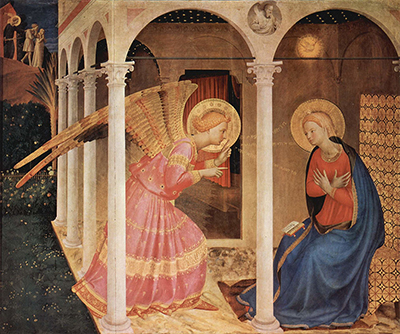
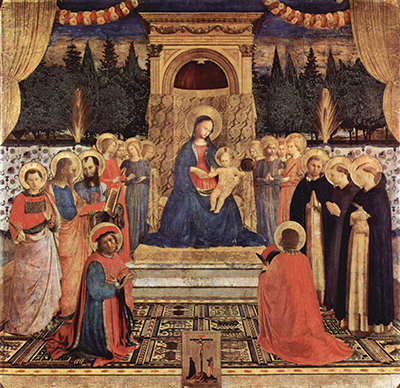
A Renaissance panel painting begins with carpentry. Boards are selected, joined and prepared. Poplar was commonly used in central Italy. The Prado Annunciation is painted on poplar. Large altarpieces required complex wooden frameworks before painting began. The San Marco Altarpiece, with at least twenty-six painted components, makes this material reality impossible to ignore. [2]
Wooden surfaces were typically prepared with layers of ground. A smooth white surface allowed luminous colour and precise drawing. Gold areas required additional preparation. The technical system supported Angelico’s characteristic clarity. Surface brilliance begins before pigment. [1]
Preparatory drawing organised figures, architecture and ornament. Technical imaging can reveal these hidden stages. The Prado’s documentation department has used modern methods to study Angelico’s process. Underdrawing demonstrates planning. The apparent ease of finished compositions is constructed. [1]
Perspective Planning
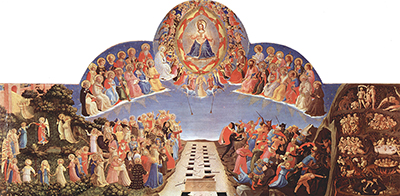
Architectural perspective requires especially rigorous preparation. Columns must align. Floor planes must recede. Vaults must make structural sense. The Prado Annunciation’s innovations therefore depend upon geometry before colour. The Last Judgement’s central graves likewise reveal careful spatial planning. [2]
Tempera
Egg tempera was one of Angelico’s central panel techniques. Pigments mixed with binding medium are applied in controlled layers. The medium dries quickly. It supports crisp detail. It rewards planning. This is exceptionally compatible with Angelico’s precision. [2]
Tempera does not blend like later oil painting. Modelling is often built through successive strokes and tonal layers. Angelico turns this apparent limitation into clarity. Bodies remain cleanly articulated. Colour retains brilliance. [2]
Some mature works include oil alongside tempera. The Guidalotti Polyptych is catalogued with tempera and oil. Such mixed practice demonstrates technical flexibility. The history of fifteenth-century Italian painting is not a simple switch from tempera to oil. Artists could combine binders according to desired effect. [4]
Gold
Gold is central to Angelico’s artistic identity. Halos. Backgrounds. Decorative details. Frames. Gold creates actual reflected light. This distinguishes it from painted illusion. The surface responds to real illumination and viewer movement. [2]
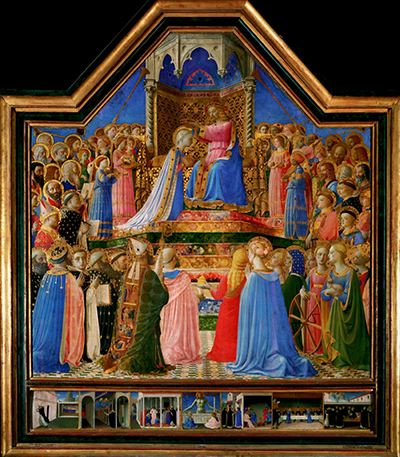
One of the most important technical interpretive points is that gold does not prove conservatism. Angelico retains it after mastering perspective. The Uffizi Glorification of Mary creates spatial recession inside a gold-ground heaven. The Guidalotti Polyptych uses gold late because the patron wanted traditional splendour. Material choice follows function. [2]
Gilded surfaces could be decorated through incised lines and punched ornament. Halos acquire texture. Borders catch light. Such work connects painting with goldsmith-like precision. Angelico’s illuminator background made him particularly sensitive to these effects. [2]
Pigments
Modern conservation has identified rich pigments in major works. Research around the Last Judgement highlights ultramarine, vermilion and insect-derived red lakes. These materials were expensive. Colour was economic as well as aesthetic. Patrons paid for material splendour. [6]
Ultramarine came from lapis lazuli. It was among the most prestigious blues available. Its use gave Marian robes and sacred passages extraordinary depth. The pigment itself carried value. A brilliant blue could function almost like precious stone. [6]
Vermilion supplied intense red. It could be used for drapery and accents requiring high saturation. Combined with lakes, it created complex warm colour relationships. [6]
Organic red lakes could create translucent, saturated colour. They were technically delicate. Their survival can be affected by light and aging. Conservation therefore changes how modern viewers understand original chromatic intensity. [6]
Fresco
Fresco required another working system entirely. Pigment applied to fresh plaster becomes chemically bound as the wall dries. The artist works against time. Only manageable sections can be painted while plaster remains suitable. Large cycles therefore demand organisation. [4]
The Italian term giornata refers to the amount of fresh plaster prepared for a day’s work. Complex frescoes can reveal these divisions. Planning the sequence of giornate helps coordinate figures and architecture. A large project such as San Marco or the Niccoline Chapel required disciplined workflow. [4]
Large compositions were prepared through drawings and transfer methods. Cartoons or related designs helped move images onto walls. Incision, pouncing or tracing techniques could establish forms. The master’s design could therefore be distributed to assistants. [4]
Fresco makes workshop collaboration almost unavoidable at scale. One group prepares plaster. Others transfer designs. Different painters execute sections. The master supervises coherence. Angelico’s San Marco programme demonstrates this organisational mastery. [4]
San Marco Cell Frescoes
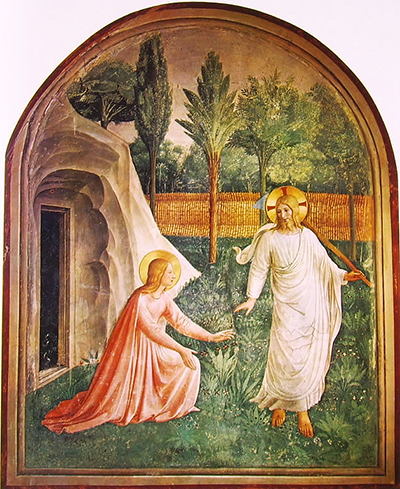
The cell frescoes show how technique and function interact. The walls are pale. Figures are relatively few. Architecture is restrained. This reduces unnecessary complexity while supporting meditative purpose. Material economy becomes spiritual economy. [4]
The Chapter House Crucifixion requires another fresco mode. Large scale. Many saints. Communal viewing. Angelico can expand visual density because the room and audience demand it. Same medium. Different function. Different solution. [4]
In Rome, fresco becomes monumental history painting. Classical architecture. Crowds. Public rhetoric. Heroic figures. The mature technique demonstrates that San Marco simplicity was deliberate rather than a limit of ability. [4]
Panel can be moved. Fresco belongs to wall. Panel supports gold, fine detail and controlled studio work. Fresco integrates image with architecture. Angelico understands both. His career is unusually valuable for comparing them. [4]
The Linaioli Tabernacle adds another category. Angelico’s painting sits inside a marble architectural frame designed by Ghiberti. Painting, sculpture and gilding interact. The object demonstrates how Renaissance media boundaries can mislead modern viewers. [4]
The Armadio degli Argenti extends painting into furniture. The painted scenes belonged to a treasury cabinet. Doors could open and close. Narrative therefore had a physical mechanism. Angelico’s art was not limited to flat pictures. [8]
Drawing
Although the surviving drawing corpus is complex and attribution-sensitive, drawing was essential to every major project. Perspective. Figure placement. Workshop transmission. Cartoons. Illumination. The finished surface depends upon preparatory thought. [4]
Angelico’s line retains exceptional clarity throughout his career. This may be one of the strongest continuities with illumination. Contours organise figures. Drapery remains readable. Gesture is precise. Even crowded scenes rarely dissolve into confusion. [4]
Colour changes according to purpose. Gold-ground panels can be jewel-like. San Marco cells can be restrained. The Vatican chapel can be rich and civic. Angelico does not possess one palette independent of setting. He calibrates colour. [4]
The Prado has emphasised that Angelico’s handling of light has often been overshadowed by his theological reputation. Light gives bodies volume. Defines architecture. Creates atmosphere. In sacred subjects, it can also carry metaphysical meaning. Technical and devotional light therefore overlap. [4]
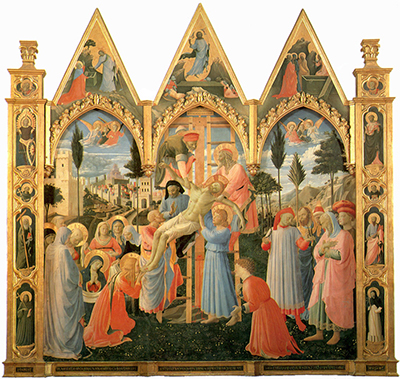
The Prado Annunciation’s flowers demonstrate minute natural observation. The restored Deposition recovered a landscape of remarkable depth and sensitivity. Nature is not incidental ornament. Angelico studies it closely. This challenges the stereotype of a painter concerned only with abstract spirituality. [5]
Restoration and Technique
Modern restoration is essential to understanding Angelico. Old varnishes can flatten volume. Dirt can suppress light. Abrasion can remove thin glazes. Structural problems can distort panels. Conservation restores evidence as well as appearance. [4]
The 2025 Deposition restoration recovered transparency, luminosity, perspective and landscape depth. The museum explicitly notes that old varnishes had flattened the work visually. This demonstrates how strongly later condition can distort art-historical interpretation. [5]
The 2018–19 restoration similarly recovered light and the spectacular perspective of the open graves. The treatment also addressed wooden structure. Again, technical history and formal interpretation are inseparable. [6]
Modern imaging can reveal hidden layers without removing paint. Infrared techniques. X-radiography. Microscopy. Pigment analysis. These methods allow scholars to study decisions below the surface. Angelico’s workshop process becomes increasingly reconstructable. [1]
The Prado stresses the existence of a large, well-organised workshop by the early 1430s. This is one of the most important technical facts in his career. A style is not merely the result of one hand. It can be a production system. [4]
Master Design and Assistant Execution
A composition may be by Angelico intellectually while containing substantial assistant execution. This is especially relevant to San Marco and large altarpieces. Modern attribution should therefore distinguish invention, design, supervision and hand. [4]
Named collaborators such as Benozzo Gozzoli and Zanobi Strozzi demonstrate workshop depth. They were not interchangeable labourers. They had skills and developing identities. Angelico’s production system could absorb individual talent while maintaining coherence. [4]
Angelico’s technical choices consistently serve purpose. Gold creates sacred preciousness. Perspective makes theology spatial. Fresco turns a cell wall into permanent meditation. Miniature narrative trains close reading. Text interacts with image. Workshop organisation makes institutional programmes possible. Technique is therefore never separate from meaning. [4]
This is why Angelico’s “style” should not be defined by one appearance. His true stylistic consistency lies in disciplined adaptation. Clear hierarchy. Luminous colour. Controlled narrative. Precise gesture. Purposeful space. These principles survive even when the material surface changes radically. [4]
Why Fra Angelico’s Technique Matters
Fra Angelico’s technique matters because it reveals the labour behind apparent spiritual ease. The paintings are calm because they are organised. They are luminous because materials are chosen carefully. They are clear because drawing and perspective are disciplined. They are coherent across enormous projects because workshops are managed effectively. The illuminator never disappears. Small-scale precision remains visible in predellas and late narrative panels. The Renaissance painter equally never disappears. Bodies gain volume.
Architecture gains depth. Frescoes occupy real space. Angelico’s technical achievement lies in joining these worlds. He turns manuscript precision into monumental art without losing delicacy. He turns Renaissance perspective towards theology without turning painting into geometry for its own sake. He uses gold after mastering illusion because material light still serves sacred function. This breadth is one of the strongest reasons to treat him as a principal technical innovator of the Early Renaissance. [4]
Frequently Asked Questions
Discussion
Which technical choice most clearly shows Fra Angelico adapting material process to devotional, institutional or architectural purpose?
Reader Insights
How do real gold and painted light create different kinds of sacred visibility?
What changes when an illuminator’s precision is transferred to an altarpiece, convent wall or papal chapel?
How should design, supervision and assistant execution be distinguished in Angelico’s largest projects?
Join the Conversation
Share your reading of Fra Angelico’s style and technique below.
References
- Museo Nacional del Prado, Technique and Artistic Process of Fra Angelico’s Annunciation. Museo Nacional del Prado Technique and Artistic Process of the Annunciation.
- Museo Nacional del Prado, The Annunciation, 1425–26. Museo Nacional del Prado The Annunciation.
- Museo Nacional del Prado, restoration of the Annunciation predella. Museo Nacional del Prado Restoration of the Annunciation Predella.
- Museo Nacional del Prado, Fra Angelico and the Rise of the Florentine Renaissance. Museo Nacional del Prado Fra Angelico and the Rise of the Florentine Renaissance.
- Direzione regionale Musei nazionali Toscana, restoration of the Santa Trinita Deposition. Direzione regionale Musei nazionali Toscana Santa Trinita Deposition Restoration.
- Direzione regionale Musei nazionali Toscana, restoration of the Last Judgement. Direzione regionale Musei nazionali Toscana Last Judgement Restoration.
- Direzione regionale Musei nazionali Toscana, Michelozzo Library and Fra Angelico illuminated manuscripts. Direzione regionale Musei nazionali Toscana San Domenico Missal and Illuminated Manuscripts.
- Museo di San Marco, Armadio degli Argenti and late illumination research. Museo di San Marco Fra Angelico as Painter and Illuminator.
.jpg)
 Fra Angelico.jpg)