 by Tom Gurney
Tom Gurney BSc (Hons) is an art history expert with over 20 years experience
/
Email: tomgurney1@gmail.com / Phone: +44 7429 011000
George Bellows and New York City: Introduction
George Bellows pictured New York as a place where people, machines, weather and architecture continually pressed against one another. His streets teem, his riverbanks become improvised playgrounds, and his construction sites expose the labour beneath metropolitan progress. These paintings feel immediate, yet Bellows often selected, compressed and combined what he saw. Their value lies not in offering a neutral inventory of the city, but in making its physical and social pressures visible.
At a Glance
- ArtistGeorge Bellows (1882–1925)
- New York periodFrom his arrival in 1904 until his death in the city in 1925
- Recurring settingsTenement streets, riverfronts, parks, excavation pits and crowded commercial districts
- Urban subjectsLabour, transport, demolition, leisure, winter weather and public crowds
- Artistic contextRealism shaped by Robert Henri and close association with the Ashcan circle
- Essential city worksForty-two Kids, Pennsylvania Station Excavation, The Lone Tenement, New York and Cliff Dwellers
Contents
- Introduction
- Learning to See the Modern City
- River Edges: Work, Escape and Improvised Leisure
- Excavating Pennsylvania Station
- The Bridge and the Building Left Behind
- Traffic, Crowds and the Composite City
- Lower East Side Proximity
- How Documentary Are Bellows’s City Scenes?
Learning to See the Modern City
Bellows left Columbus, Ohio, for New York in 1904 and studied with Robert Henri at the New York School of Art. Within a few years he had built a reputation on subjects that genteel art could overlook: street children, prizefights, excavations and crowds. The National Gallery of Art records how quickly that recognition arrived; in 1909, he became an associate member of the National Academy of Design while still in his twenties.[1]
Henri encouraged artists to take contemporary experience seriously. That connection places Bellows near the Ashcan painters, whose dark tonalities and ordinary urban subjects challenged academic convention. It needs one qualification: Bellows did not participate in the 1908 exhibition of The Eight. The Smithsonian describes him as sympathetic to their style and content, and especially gifted at conveying the movement of crowds.[2] “Ashcan” therefore names an important context for his early city pictures, not a rigid formula that explains every work.
New York offered Bellows more than a list of recognisable landmarks. It gave him changing relations between bodies and space. A street might become a moving current; a bridge might bear down on a surviving tenement; a vast pit might reduce workers to flecks. The Metropolitan Museum of Art notes that he usually favoured Manhattan’s edges over its commercial centre.[3] Those margins—river, park, cleared lot and worksite—are where his city most often reveals how it functions.
River Edges: Work, Escape and Improvised Leisure
The East River in Forty-two Kids (1907) is neither a picturesque waterfront nor a calm recreational facility. Boys dive, sprawl, smoke and balance on a dilapidated wharf. Painted in August, the scene turns a working river’s rough infrastructure into a summer gathering place. The National Gallery identifies the boys as nude or partly clothed and notes that Bellows rendered varied ethnic backgrounds with vigorous economy.[4] Their bodies do not form an orderly procession; they occupy the pier in clusters, making collective activity the painting’s structure.
Leisure in Bellows’s city is rarely separate from industry or class. The boys have claimed a damaged pier rather than an officially maintained bathing place. At Coney Island, he found another dense, socially mixed crowd seeking relief from summer heat. Along Riverside Park and the Hudson, meanwhile, designed green space shared the field of vision with steamships and shoreline trains. The Met’s account emphasises this coexistence of recreation, transport and commerce.[3] Bellows’s river margins are therefore thresholds: escapes from crowded streets that remain visibly connected to the systems sustaining the city.
Even the season changes that relationship. In Blue Snow, The Battery (1910), the southern tip of Manhattan appears almost rural beneath fresh snow, with only a few pedestrians and distant tugboats. Elsewhere municipal workers shovel streets and traffic struggles through winter. Bellows could make New York feel empty or congested without leaving its public spaces. Snow simplifies the ground into broad colour, but it also makes movement, outdoor labour and access newly difficult.
Excavating Pennsylvania Station
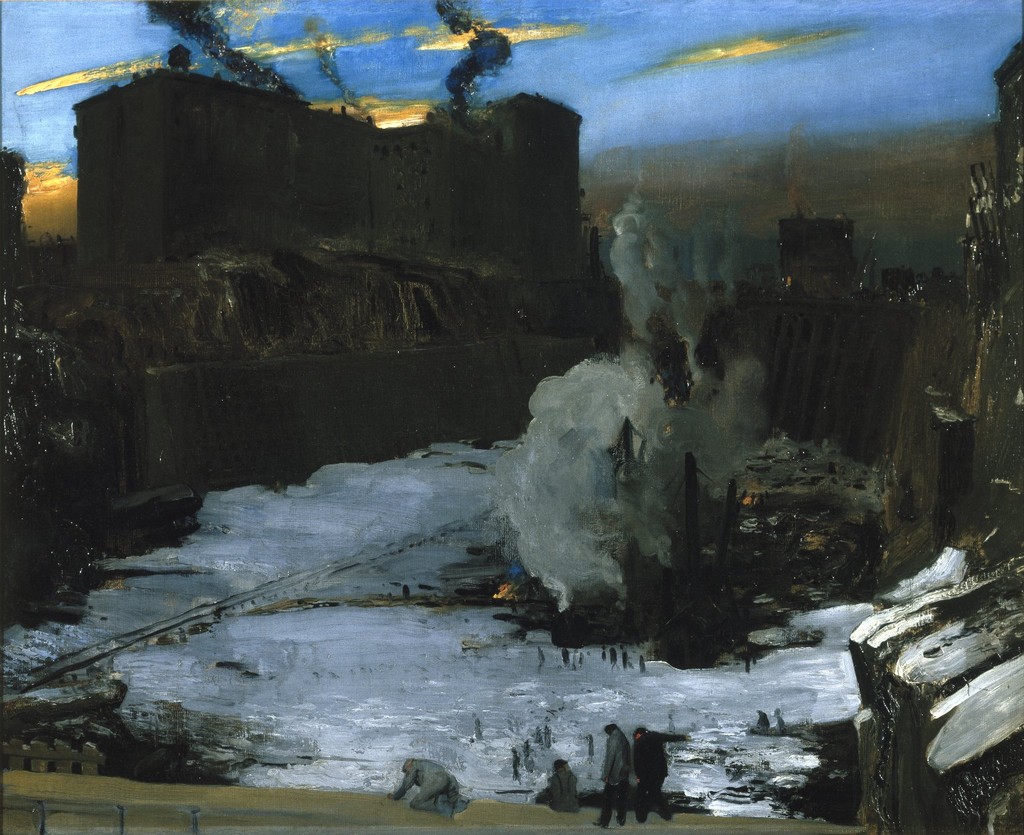
No subject exposed transformation more literally than the building of Pennsylvania Station. Between 1907 and 1909 Bellows completed four canvases devoted to the excavation. The exact Brooklyn Museum painting Pennsylvania Station Excavation is dated about 1907–1908 and carries accession number 67.205.1.[5] It should be understood as one work within that four-canvas context, not as a title for the series as a whole.
The station project cleared two blocks between Seventh and Eighth Avenues and Thirty-first and Thirty-third Streets. In the Brooklyn canvas, an elevated viewpoint opens the ground into a dark winter chasm. Labourers stand near its margins, visually diminished by the earth they have removed; smoke and steam blur the separation between atmosphere and machinery. The museum reads this contrast as an ambivalent image of a city destroying its old fabric in order to rebuild.[5]
That ambivalence is social as well as visual. The site had not been empty: demolition displaced residents of the Tenderloin, including African American and immigrant communities. A curatorial discussion by the Brooklyn Museum and Smarthistory also explains that Bellows worked from memory and drew inspiration from contemporary photographs and written accounts.[6] The painting is thus evidence of how the project could be imagined and understood, but it is not a measured record of a single shift at the excavation. Scale, viewpoint and weather organise an argument about modern change.
The splendid Beaux-Arts terminal that eventually rose there is absent. Bellows concentrates on the dangerous, unfinished condition before architecture concealed the work below. Cranes, retaining walls, figures and excavated ground make progress look laborious rather than automatic. The deeper reading of the four related canvases belongs with Pennsylvania Station Excavation itself; in the wider city story, the series marks Bellows’s sustained interest in New York while it was being unmade.
The Bridge and the Building Left Behind
The Lone Tenement (1909) approaches urban change from the opposite direction. Instead of looking into an enormous worksite, Bellows fixes on a narrow six-storey building isolated in a cleared area beneath the nearly completed Blackwell’s Island Bridge, now the Ed Koch Queensboro Bridge. Small figures gather near the building and around a fire, while a bridge support rises at the right.[7]
The bridge was an engineering achievement linking Manhattan and Queens, but Bellows gives the surviving tenement greater emotional weight. Its isolation makes clearance legible: the old neighbourhood has largely disappeared even though one inhabited structure remains. The National Gallery interprets the figures and abandoned-looking building in relation to the precarious position of residents displaced by development.[7] Warm oranges and golds keep the work from becoming a monochrome lament, yet the structure’s exposed position makes “improvement” look unevenly experienced.
Together, the bridge picture and the excavation paintings prevent a simple equation between Bellows and celebration of urban technology. He was fascinated by infrastructure—its spans, pits, smoke and traffic—but just as attentive to the people working around it or moved aside by it. Modern New York appears as a process whose gains and costs occupy the same field.
Traffic, Crowds and the Composite City
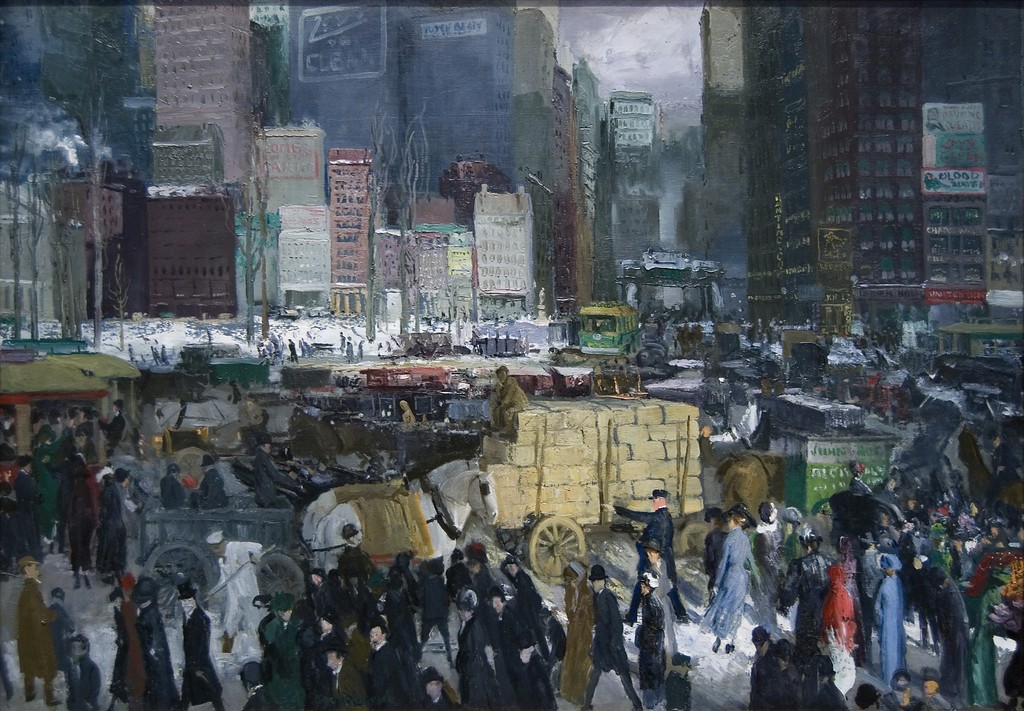
Bellows rarely painted Manhattan’s commercial core, which makes New York (1911) especially important. The National Gallery’s oil, accession number 1986.72.1, looks uptown towards Madison Square from the vicinity of Broadway and Twenty-third Street. Yet it does not reproduce one possible view. Bellows combined features from several busy districts into an imaginary composite intended to intensify the city’s pace.[8]
The canvas packs pedestrians, streetcars, horse-drawn vehicles, signs, smoke and tall buildings into a broad horizontal space. Older and newer forms of transport compete rather than line up as a tidy sequence of progress. Buildings close off most of the sky, and loosely defined figures deny the eye a single protagonist. Small bright accents puncture the greys and dark reds, directing attention without resolving the congestion.
This construction matters because the picture can look like spontaneous street reporting. Bellows instead designed an experience of overload. A composite can convey a general truth—the conflicting speeds and social proximity of city life—while remaining topographically impossible. The painting asks what it felt like to enter the crowd, not whether every track, façade and vehicle could have occupied those exact coordinates together.
Lower East Side Proximity
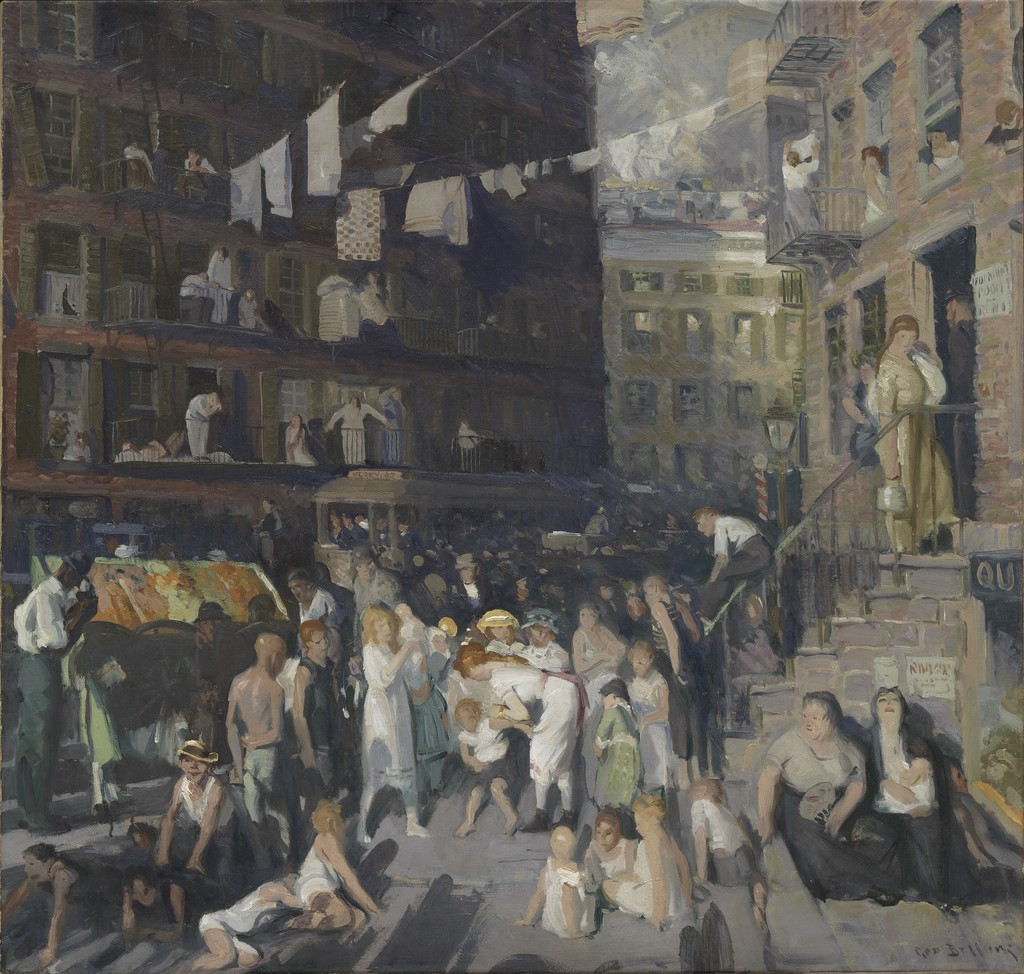
In Cliff Dwellers (1913), the crowd is no longer passing through a commercial intersection. Residents fill a Lower East Side street beneath tall tenements; children quarrel and play, laundry moves overhead, a market cart adds colour, and a streetcar presses into the scene. LACMA’s record identifies the exact work as Cliff Dwellers—without a leading “The”—completed in May 1913 and accessioned as 16.4.[9]
The site can be narrowed but not pinned down as a literal address. LACMA notes that the street angles and the streetcar’s “Vesey Street” destination suggest an area between the Bowery and Catherine Slip, below Chatham Square.[9] That cautious “suggest” is useful. Bellows gathered signs of a neighbourhood into a highly organised composition, just as he assembled the business district in New York.
Nor does crowding yield one automatic political meaning. The painting has often been read as social criticism, partly because of its relationship to a drawing Bellows made for the socialist magazine The Masses. LACMA distinguishes the sharper editorial context of such illustrations from the painting’s emphasis on sunlight, activity and the vitality of working-class residents.[9] Hardship is present in the packed housing and limited private space, but the people are not reduced to passive symbols. Social proximity produces friction, play, work and mutual visibility at once.
How Documentary Are Bellows’s City Scenes?
Bellows observed contemporary New York closely, and his paintings preserve historically specific forms of dress, transport, labour and recreation. They are indispensable visual interpretations of the period. They are not photographs. New York combines districts; Pennsylvania Station Excavation depends partly on memory and circulating accounts; Cliff Dwellers suggests rather than certifies a location. Even a recognisable bridge or riverbank is transformed through cropping, colour and the placement of figures.
This is not a defect in their realism. Bellows used invention to make relationships graspable: labour against immense scale, leisure beside industry, a remnant building beneath new infrastructure, or individuals absorbed into a crowd. When looking, begin with what is verifiable—the exact object, date, setting and surviving urban clues—then ask what the composition intensifies. The richest historical reading keeps observed detail and artistic construction in view together.
Researched works directory
This searchable evidence census was assembled from public museum records and a reproducible Wikidata snapshot. It is not a catalogue raisonné, not a claim to complete oeuvre coverage, and not a substitute for the published catalogue literature, which was not used to claim absolute completeness.
| Name | Date | Medium |
|---|---|---|
| A Cloudy Day / Hudson River: Coming Squall | 1908 | Painting |
| A Day in June | 1913 | Painting |
| A Fresh Breeze | 1913 | Painting |
| A Grandmother | 1914 | Painting |
| A Knockout | 1921 | |
| A Morning Snow--Hudson River | 1910 | Painting |
| A Stag at Sharkey's | 1917 | |
| A Winter Day - Under the Elevated near Brooklyn Bridge | 1907 | Painting |
| Allan Donn Puts to Sea | 1923 | |
| An Irish Girl | 1922 | Drawing |
| Anne | 1915 | Painting |
| Anne 1921 | 1923 | |
| Anne and Her Mother | 1917 | Drawing |
| Anne in Black Velvet | 1917 | Painting |
| Anne in White | 1920 | Painting |
| Anne with a Japanese Parasol | 1917 | Painting |
| Approach of Rain | 1913 | Painting |
| Approach to the Bridge at Night | 1913 | Painting |
| Arms of a Boxer | 1916 | Drawing |
| Artists' Evening | 1916 | |
| August Lundberg (No 2) | 1907 | Painting |
| Aunt Fanny | 1920 | Painting |
| Barnyard and Chickens | 1924 | Painting |
| Bethesda Fountain (Fountain in Central Park) | 1905 | Painting |
| Between Rounds, large, first stone | 1916 | |
| Between Rounds, small, second stone | 1923 | |
| Blue Morning | 1909 | Painting |
| Blue Snow, the Battery | 1910 | Painting |
| Both Members of This Club | 1909 | Painting |
| Boy in a Blue Coat | 1915 | Painting |
| Boy with Eton Collar (Portrait of Meredith Hare) | 1921 | Painting |
| Breaking Sky, Monhegan | 1916 | Painting |
| Bridge, Blackwell’s Island | 1909 | Painting |
| Builders of Ship | 1916 | Painting |
| California Headlands | 1917 | Painting |
| Caricature of Adam and Eve and Two Female Portrait Sketches | Date unknown | Drawing |
| Central Park | 1905 | Painting |
| Chester Dale | 1922 | Painting |
| Children Playing in a Park | 1905 | Drawing |
| Cleaning Fish | 1913 | Painting |
| Cliff Dwellers | 1913 | Painting |
| Cliffs | Date unknown | Painting |
| Club Night | 1907 | Painting |
| Coming Storm | 1914 | Painting |
| Coopers Lake, Woodstock | 1924 | Painting |
| Counted Out, first stone | 1921 | |
| Counted Out, second stone | 1921 | |
| Criehaven Wharf | 1916 | Painting |
| Cross-Eyed Boy | Date unknown | Painting |
| Dance in a Madhouse | 1917 | |
| Dancing Town (The Top of the World) | 1922 | Drawing |
| Dempsey and Firpo | 1923 | |
| Dempsey and Firpo | 1924 | Painting |
| Dempsey through the Ropes | 1923 | |
| Dempsey Through the Ropes | Date unknown | Painting |
| Deserted Factory | 1924 | Painting |
| Dock Builders | 1916 | Painting |
| Edge of the Pasture - Glow of the Sun | 1916 | Painting |
| Edith Cavell | 1918 | Painting |
| Elinor, Jean and Anna | 1920 | Painting |
| Elsie, Emma and Marjorie, First Stone | 1921 | |
| Elsie, Emma and Marjorie, second stone | 1921 | |
| Elsie Reading to Emma, First Stone | 1921 | |
| Elsie Reading to Emma, Second Stone | 1921 | |
| Elsie Speicher [verso] | 1920 | Drawing |
| Emma and Her Children | 1923 | Painting |
| Emma at the Piano | 1914 | Painting |
| Emma at the Window | 1920 | Painting |
| Emma, Elsie and Gene | 1921 | |
| Emma in a Purple Dress | 1920 | Painting |
| Emma in the Black Print | 1919 | Painting |
| Emma in the Purple Dress | 1919 | Painting |
| Evening Blue | 1916 | Painting |
| Evening Swell | 1911 | Painting |
| Excavation at Night | 1908 | Painting |
| Family in a Surrey | 1921 | Drawing |
| Fern Woods | Date unknown | Painting |
| Five Cows | 1919 | Painting |
| Floating Ice | 1910 | Painting |
| Florence Davey | 1914 | Painting |
| Fog Breakers | 1913 | Painting |
| Forty-two Kids | 1907 | Painting |
| Frankie, the Organ Boy | 1907 | Painting |
| Garaldine Lee, No. 2 | 1914 | Painting |
| Gardiner's Bay from Sag Harbor | 1899 | Painting |
| Ghost of Sergeant Pelly | 1918 | Drawing |
| Golf Course, California | 1917 | Painting |
| Gorge and Sea | 1911 | Painting |
| Grandma Bellows | 1919 | Painting |
| Gray Sea | 1913 | Painting |
| Harbor of Monhegan, Fish Boats | 1911 | Painting |
| Haystacks and Barn | 1909 | Painting |
| Head of Boy (aka Gray Boy) | 1905 | Painting |
| Hungry Dogs, second stone | 1916 | |
| Hunter and Mountains | 1920 | Painting |
| In a Rowboat | 1916 | Painting |
| In an Elevator | 1916 | |
| In the Park, Dark | 1916 | |
| Introducing Georges Carpentier | 1921 | |
| Introducing John L. Sullivan | 1916 | |
| Introducing John L. Sullivan | 1923 | Painting |
| Introducing the Champion | 1916 | |
| Introductions | 1921 | |
| Jackie (Jacqueline Hudson) | 1914 | Painting |
| Jean 1923 | 1923 | |
| Jean in a Black Hat | 1923 | |
| Jean with Blue Book and Apple | 1916 | Painting |
| Jim Twadell's Place | 1924 | Painting |
| Julie Hudson | 1914 | Painting |
| Katherine Rosen | 1921 | Painting |
| Kids | 1906 | Painting |
| Lady Jean | 1924 | Painting |
| Lady of 1860 - The Actress | 1922 | Drawing |
| Lady with a Fan | 1921 | |
| Launching | 1913 | Painting |
| Little Girl in White (Queenie Burnett) | 1907 | Painting |
| Love of Winter | 1914 | Painting |
| Lychnis and Her Sons | 1923 | |
| Madeline Davis | 1914 | Painting |
| Man and Dog | 1905 | Painting |
| Matinicus | 1916 | |
| Maud Dale | 1919 | Painting |
| May Day in Central Park | 1905 | Painting |
| Men of the Docks | 1912 | Painting |
| Mill Dam | 1924 | Painting |
| Miss Bentham | 1906 | Painting |
| Monhegan Island | 1913 | Painting |
| Mother and Children | 1916 | |
| Mother and Children, Second State | 1916 | |
| Mountain Farm | 1922 | Painting |
| Mr. and Mrs. Phillip Wase | 1924 | Painting |
| Mrs. Chester Dale | 1919 | Painting |
| Mrs. T. in Cream Silk, No.1 | 1919 | Painting |
| Mrs. T. in Cream Silk, No.2 | 1920 | Painting |
| Mrs. Walter H. Richter | 1922 | Painting |
| Murder of Edith Cavell | 1918 | |
| My Family | 1916 | Painting |
| My Mother | 1921 | Painting |
| New York | 1911 | Painting |
| North River | 1908 | Painting |
| Nude Girl, Miss Leslie Hall | 1909 | Painting |
| Nude Girl Reclining | 1919 | Drawing |
| Nude Study, Girl Standing on One Foot | 1923 | |
| Nude with Fan | 1920 | Painting |
| Nude with Hexagonal Quilt | 1924 | Painting |
| Nude with Parrot | 1915 | Painting |
| Nude with Red Hair | 1920 | Painting |
| Old Barn, Grey Day | 1920 | Painting |
| Old Fisherman | 1904 | Painting |
| Ox Team, Wharf at Matinicus | 1916 | Painting |
| Paddy Flannigan | 1908 | Painting |
| Padre | 1917 | Painting |
| Paradise Point | 1919 | Painting |
| Pennsylvania Station Excavation | c. 1907–1908 | Painting |
| Pigs and Donkey | 1920 | Painting |
| Polo at Lakewood | 1910 | Painting |
| Portrait of a Boy | 1921 | Painting |
| Portrait of a Laughing Boy | 1907 | Painting |
| Portrait of Florence Budd | 1914 | Painting |
| Portrait of Florence Pierce | 1914 | Painting |
| Portrait of Geraldine Lee, No. 1 | 1914 | Painting |
| Portrait of My Mother No. 1 | 1921 | Painting |
| Portrait of Prosper Invernizzi | 1907 | Painting |
| Portrait of Walter Littlefield | 1915 | Painting |
| Porträt der Anne | 1915 | Painting |
| Porträt der Laura | 1922 | Painting |
| Prayer Meeting, second stone | 1916 | |
| Preliminaries | 1916 | |
| Preliminaries | Date unknown | |
| Pueblo Tesuque, No. 2 | 1917 | Painting |
| Rain on the River | 1908 | Painting |
| Return of the Useless | 1918 | Painting |
| River Front No. 1 | 1914 | Painting |
| Rock Bound | 1913 | Painting |
| Rock Reef, Maine | 1913 | Painting |
| Rock Ridge Farm | Date unknown | Painting |
| Rocks and Coast | 1911 | Painting |
| Rolling Breakers | 1913 | Painting |
| Romance of Autumn | 1916 | Painting |
| Romance of Criehaven | 1916 | Painting |
| Roumanian Girl | 1921 | Painting |
| Samuel Knopf | 1922 | Painting |
| Santuario de Chimata | 1917 | Painting |
| Seated Female Nude (Emma Story Bellows) | Date unknown | Drawing |
| Seated Nude | 1910 | Painting |
| Self-Portrait | 1921 | |
| Shipyard Society | 1916 | Painting |
| Sixteen East Gay Street | 1923 | |
| Sketches of Heads, Including One of Chester Dale | Date unknown | Drawing |
| Sketches of Three Female Heads [recto] | Date unknown | Drawing |
| Snow-Capped River | 1911 | Painting |
| Snow Dumpers | 1911 | Painting |
| Society Ball [verso] | 1907 | Drawing |
| Splinter Beach | 1916 | |
| Stag at Sharkey's | 1909 | Painting |
| Steaming Streets | 1908 | Painting |
| Storm Sea | 1913 | Painting |
| Street Fight [recto] | 1907 | Drawing |
| Studies of Jean | 1920 | Drawing |
| Study for "Mr. and Mrs. Philip Wase | 1924 | Drawing |
| Study for Nude with Hexagonal Quilt | 1924 | Drawing |
| Study for "Riverfront No. 1 | 1915 | Drawing |
| Study of Emma and the Children | 1917 | Painting |
| Summer City | 1909 | Painting |
| Summer Fantasy | 1924 | Painting |
| Summer Night, Riverside Drive | 1909 | Painting |
| Sun Glow | 1913 | Painting |
| Sun Shadows (Rocks at Monhegan) | 1913 | Painting |
| Sunday 1897 | 1921 | |
| Sunlit surf | 1913 | Painting |
| Swans in Central Park | 1906 | Painting |
| Tennis | 1920 | |
| Tennis at Newport | 1919 | Painting |
| Tennis at Newport | 1920 | Painting |
| Tennis Tournament | 1920 | Painting |
| The Barricade | 1918 | Painting |
| The Beach, Newport (In the Sand) | 1919 | Painting |
| The Big Dory | 1913 | Painting |
| The Black Derby / Head of a man with a red nose | 1905 | Painting |
| The Brook | Date unknown | Painting |
| The Charge | 1918 | |
| The Cigarette | 1918 | |
| The Coming Storm | 1916 | Painting |
| The Dock | 1913 | Painting |
| The Donkey Cart | 1922 | Drawing |
| The Fish Wharf, Matinicus Island | 1916 | Painting |
| The Fisherman | 1917 | Painting |
| The Germans Arrive | 1918 | Painting |
| The Grove — Monhegan | 1911 | Painting |
| The Gulls, Monhegan | 1911 | Painting |
| The Harbor, Monhegan Coast, Maine | 1913 | Painting |
| The Kindliness Came Not from Her | 1922 | Drawing |
| The Launching | Date unknown | Painting |
| The Law Is Too Slow | 1923 | |
| The Lone Tenement | 1909 | Painting |
| The Newsboy | 1908 | Painting |
| The Novitiate | 1916 | |
| The Palisades | 1909 | Painting |
| The Red Vine, Matinicus Island, Maine | 1916 | Painting |
| The Sand Cart | 1917 | Painting |
| The Sea | 1911 | Painting |
| The Shower-Bath | 1917 | |
| The Studio | 1919 | Painting |
| The Teamster | 1916 | Painting |
| The Tournament | 1920 | |
| The Village Houses | 1920 | Painting |
| The Warships | 1909 | Painting |
| The White Hope | 1921 | |
| The White Horse | 1922 | Painting |
| The Widow | 1917 | Painting |
| Three Children | 1919 | Painting |
| Three Pigs and a Mountain | 1922 | Painting |
| Three Rollers | 1911 | Painting |
| Through the Trees, Monhegan Island, Maine | 1913 | Painting |
| Tumble of Waters | 1913 | Painting |
| Two Girls | 1917 | |
| Two Women | 1924 | Painting |
| Up the Gorge | 1913 | Painting |
| Up the Hudson | 1908 | Painting |
| Village on the Hill | 1916 | Painting |
| Vine Clad Shore--Monhegan Island | 1913 | Painting |
| Waldo Peirce | 1920 | Painting |
| War Series | 1918 | Painting |
| West Wind | 1913 | Painting |
| Willard in Training Quarters | 1916 | |
| Winter Afternoon, Riverside Park | 1909 | Painting |
| Winter Road | 1912 | Painting |
| Woodstock Road, Woodstock, New York | 1924 | Drawing |
Frequently Asked Questions
Bellows painted the East River, Coney Island, Riverside Park and the Hudson, Battery Park, the Pennsylvania Station excavation, the Queensboro Bridge area and Lower East Side streets. Some settings are exact, while New York combines elements from several commercial districts around a view associated with Madison Square.[3][8]
They document how an artist interpreted early twentieth-century New York, but they should not be treated as literal transcripts. Bellows could work from memory, consult contemporary media, alter scale or combine locations. A museum identification of a bridge or district remains valuable, while the arrangement within the canvas is an artistic construction.[6][8]
Bellows studied with Robert Henri and shared the Ashcan painters’ interest in ordinary urban experience, dark tonalities and direct handling. He did not exhibit with The Eight in 1908, so he is best understood as a younger associate rather than one of that exhibition’s original participants.[2]
Worksites made the city’s transformation visible. The Pennsylvania Station pit revealed labour, danger and the destruction preceding a major terminal; The Lone Tenement showed an inhabited remnant beside new bridge infrastructure. Bellows could engage technology while keeping workers and displaced residents within the story.[5][7]
Start with Forty-two Kids (1907), Pennsylvania Station Excavation (about 1907–1908), The Lone Tenement (1909), Blue Snow, The Battery (1910), New York (1911) and Cliff Dwellers (1913). Together they span river leisure, excavation, clearance, winter, transport and tenement-street crowds.
Discussion
Use this evidence-led guide as a starting point for close looking rather than a final verdict.
Share an observation about George Bellows and New York City or a source that adds useful context.
Reader Insights
Which work most clearly complicates the familiar image of Bellows as a strictly literal realist?
Where do New York, exhibition culture, printmaking, family or place most productively alter your reading?
Which source or surviving object would you investigate next?
Join the Conversation
Add your reading below, keeping observations specific and evidence clear.
References
- National Gallery of Art, “George Bellows”, accessed 31 August 2026.
- Smithsonian American Art Museum, “George Bellows”, accessed 31 August 2026.
- The Metropolitan Museum of Art, “George Bellows”, accessed 31 August 2026.
- National Gallery of Art, “Forty-two Kids”, accessed 31 August 2026.
- Brooklyn Museum, “Pennsylvania Station Excavation”, accessed 31 August 2026.
- Smarthistory with the Brooklyn Museum, “George Bellows, Pennsylvania Station Excavation”, accessed 31 August 2026.
- National Gallery of Art, “The Lone Tenement”, accessed 31 August 2026.
- National Gallery of Art, “New York”, accessed 31 August 2026.
- Los Angeles County Museum of Art, “George Bellows, Cliff Dwellers, 1913”, accessed 31 August 2026.