 by Tom Gurney
Tom Gurney BSc (Hons) is an art history expert with over 20 years experience
/
Email: tomgurney1@gmail.com / Phone: +44 7429 011000
George Bellows War Work: Introduction
George Bellows’s war pictures are among the most violent and contested works of his career. Made in 1918, they imagine shootings, assaults and civilian suffering in wartime Europe. Their urgency is inseparable from a crucial limit: Bellows had not witnessed the events. He tried to enlist, but did not see combat overseas. His scenes were constructed in New York from reports, photographs, illustrations and stories that reached him through the wartime media.[1][2]
That distance does not make the images historically irrelevant. It changes the questions they ask. Bellows turned mediated accounts into lithographs, drawings and monumental paintings at a moment when atrocity reporting, moral outrage and organised propaganda overlapped. The result is a body of work with enormous emotional force and uncertain documentary authority.
At a Glance
- Main periodSpring to autumn 1918, during the final year of the First World War.
- MediaDrawings, lithographs and large oil paintings.
- Source materialPress coverage, the Bryce Committee Report, photographs, illustrations and soldiers’ stories.
- Eyewitness statusBellows tried to enlist but did not serve in Europe or witness combat there.
- Principal subjectsReported violence against Belgian civilians, soldiers under fire and the execution of Edith Cavell.
- Central cautionThese are constructed wartime images, not documentary records of scenes Bellows observed.
Contents
- Introduction
- Politics Before the War Cycle
- Imagining Events He Did Not See
- Drawing, Lithography and Monumental Painting
- Three Prints, Three Impressions
- Atrocity, Propaganda and Public Circulation
- Bellows and Goya
- How to Look at the War Work
Politics Before the War Cycle
Bellows was accustomed to bringing politics into graphic art. The National Gallery of Art describes his views as leftist and records his contributions to the socialist magazine The Masses between 1912 and 1917.[1] Yet that history does not lead neatly to one fixed position on the war. The Metropolitan Museum of Art notes that he was initially ambivalent about the United States entering the conflict in April 1917. He later responded intensely to accounts of German violence in Belgium, while remaining a civilian.[2]
It is therefore misleading to reduce the 1918 cycle to either a sudden abandonment of his earlier politics or a simple extension of them. Bellows’s anger focused on reported crimes against civilians. The Met records his insistence that his hostility was directed at the people responsible for atrocities, not at Germans as a whole.[2] At the same time, the pictures entered patriotic channels: they were used as propaganda and in the sale of war bonds.[2] Personal conviction, public information and national mobilisation met in the same images.
The wider George Bellows biography places this episode within his work for magazines, artist organisations and teaching. The war cycle is a concentrated political turn, not a complete definition of the artist.
Imagining Events He Did Not See
Bellows’s early New York subjects often depended on close contact with the places he painted. The war works break that pattern. He never travelled to Europe, and the Met’s record for Sniped states plainly that he tried to enlist but did not see combat. It identifies his materials as newspaper accounts and other published reports, photographs, illustrations and soldiers’ stories.[3]
The most important written source was the British government’s 1915 Bryce Committee Report on alleged atrocities during the invasion of Belgium. Bellows spent much of 1918 turning such material into horrifying episodes.[2] A modern viewer should keep two propositions together. German forces did commit grave violence against Belgian civilians, but Bellows did not verify the particular moments he staged. Moreover, the Met notes that doubts about the report’s accuracy later affected the reception of the most graphic works.[2]
Words such as “reported,” “imagined” and “constructed” are consequently essential. They do not drain the pictures of moral meaning. They mark the boundary between evidence about wartime violence and the painter’s visual invention.
Drawing, Lithography and Monumental Painting
Bellows had begun lithography in 1916, and the medium quickly became central to his practice.[1] Drawing on stone allowed dense blacks, rubbed greys and sharp white interruptions to carry a scene without colour. It also made multiple impressions possible. His prints and lithographs were individual museum objects drawn from an edition, not interchangeable reproductions of paintings.
Institutional summaries count the 1918 production differently. A chronology in the National Gallery’s directly accessible study Bellows: The Boxing Pictures records eighteen lithographs and four oils made in the spring.[6] The Met’s retrospective overview describes many drawings and lithographs together with five monumental oils produced between spring and autumn.[2] The difference cautions against treating “the War Series” as a perfectly uniform set. The boundaries depend on period, medium and cataloguing choice.
Bellows also moved ideas between media. The lithographs compress violent encounters into black-and-white designs, while the large canvases enlarge them into the tradition of public history painting. The Met connects their staged appearance to Jay Hambidge’s system of dynamic symmetry: figures seem arrested within brightly lit tableaux even when the subject is chaotic.[2] This calculated structure is part of their disturbing effect.
Three Prints, Three Impressions
Sniped from War Series (1918) centres on soldiers gathered around a fallen comrade in a trench. A pale marksman at the upper right reinforces the threat from outside the huddled group. The image does not disclose whether the casualty has been wounded or killed. The Met’s particular lithograph is object 1973.589.8, acquired through the Bell Fund; the design was also published in Collier’s on 13 July 1918 alongside Donal Hamilton Haines’s combat story “Something.”[3]
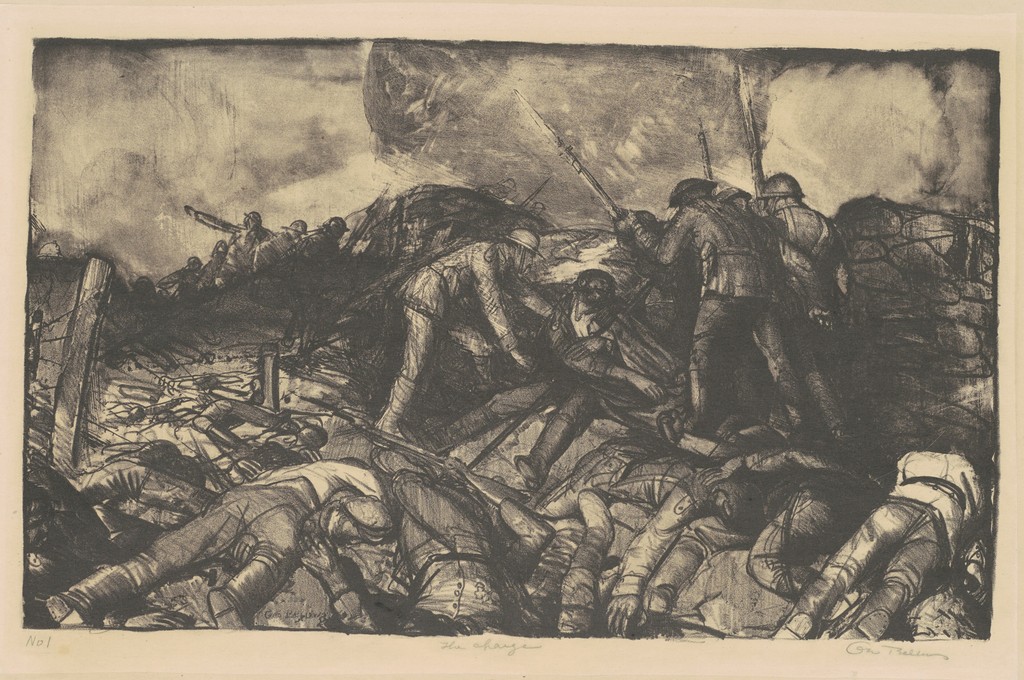
The National Gallery’s The Charge (1918) is a separate lithographic impression: black ink with chine collé on wove paper, accession 2015.19.2929, catalogued as Mason no. 63. Its graphite inscriptions include the title and “No 1.”[4] Soldiers, rifles, bayonets and fallen bodies are compressed into a shallow field. The scene communicates momentum and collision, but its object record does not turn it into an eyewitness account.
The Gallery’s Murder of Edith Cavell (1918) at accession 2015.19.529 is another distinct sheet. Printed by George C. Miller, it is a black lithograph on wove paper mounted on paperboard and is catalogued as Mason no. 53.[5] Bellows staged the execution of the British nurse through cavernous architecture, severe darkness and concentrated pools of light. The sheet’s own collection history and physical support distinguish it from other impressions of the same design. Title, design and edition relationship do not collapse several surviving prints into one object.
Atrocity, Propaganda and Public Circulation
The war images reached viewers through several systems at once. Prints could circulate in editions and periodicals; paintings carried the scale and prestige of exhibition art. The National Gallery chronology records that Bellows’s war prints were deposited at Frederick Keppel’s gallery, where illustrator Charles Dana Gibson saw them and sent them to the US Committee on Public Information.[6] The Met records their use to promote war bonds and their wide publication and exhibition during 1919.[2]
Calling them propaganda identifies a historical function, not a complete visual analysis. Bellows sought to provoke horror, compassion for victims and anger at perpetrators. Those aims aligned with a government information campaign that needed emotionally decisive images. His exaggerated villains, exposed victims and theatrical lighting leave little room for neutrality. They ask for a moral response before they invite detached scrutiny.
Reception changed when the Bryce Report’s reliability came under challenge. According to the Met, the most explicitly violent pictures were thereafter rarely, if ever, exhibited.[2] Their declining visibility shows how strongly their public force depended on confidence in the information from which they had been made.
Bellows and Goya
The comparison with Francisco de Goya’s Disasters of War is historically grounded but should not become an automatic compliment. The Met notes that Goya’s prints were displayed in New York and that Bellows would have known them.[2] Both artists use graphic sequences to confront the violation of bodies. Yet Goya developed his images in relation to the Peninsular War of his own time, while Bellows worked a century later from material transmitted across the Atlantic.
Later criticism has been divided about what Bellows achieved through that inheritance. The National Gallery publication says that his atrocity series attempted, unsuccessfully in its author’s judgement, to emulate Goya’s shock.[6] That assessment helps sharpen the contrast: Bellows’s arranged tableaux can appear declarative where Goya’s plates remain bitterly unstable. The reference to Goya explains an ambition and a visual lineage; it does not settle the quality or ethics of Bellows’s response.
How to Look at the War Work
Begin by identifying the medium and the exact object. A lithographic impression has a sheet, ink, support, accession and catalogue history; a related painting makes a different claim through colour and scale. Then follow how light directs sympathy. Bellows often isolates vulnerable bodies against deep black or makes a group’s gestures carry the story.
Next ask where the scene came from. The correct answer is not Bellows’s battlefield memory. It is a chain of reports, testimony, photographs, illustrations and editorial circulation. Finally, consider where the image went: gallery, magazine, exhibition or propaganda campaign. Looking across these stages makes the war work neither transparent truth nor disposable falsehood. It reveals how an artist transformed contested information into public emotion. That concern with designed impact also connects the cycle to Bellows’s paintings and to the compressed spectatorship of his boxing pictures, even though their evidentiary foundations differ.
Researched works directory
This searchable evidence census was assembled from public museum records and a reproducible Wikidata snapshot. It is not a catalogue raisonné, not a claim to complete oeuvre coverage, and not a substitute for the published catalogue literature, which was not used to claim absolute completeness.
| Name | Date | Medium |
|---|---|---|
| A Cloudy Day / Hudson River: Coming Squall | 1908 | Painting |
| A Day in June | 1913 | Painting |
| A Fresh Breeze | 1913 | Painting |
| A Grandmother | 1914 | Painting |
| A Knockout | 1921 | |
| A Morning Snow--Hudson River | 1910 | Painting |
| A Stag at Sharkey's | 1917 | |
| A Winter Day - Under the Elevated near Brooklyn Bridge | 1907 | Painting |
| Allan Donn Puts to Sea | 1923 | |
| An Irish Girl | 1922 | Drawing |
| Anne | 1915 | Painting |
| Anne 1921 | 1923 | |
| Anne and Her Mother | 1917 | Drawing |
| Anne in Black Velvet | 1917 | Painting |
| Anne in White | 1920 | Painting |
| Anne with a Japanese Parasol | 1917 | Painting |
| Approach of Rain | 1913 | Painting |
| Approach to the Bridge at Night | 1913 | Painting |
| Arms of a Boxer | 1916 | Drawing |
| Artists' Evening | 1916 | |
| August Lundberg (No 2) | 1907 | Painting |
| Aunt Fanny | 1920 | Painting |
| Barnyard and Chickens | 1924 | Painting |
| Bethesda Fountain (Fountain in Central Park) | 1905 | Painting |
| Between Rounds, large, first stone | 1916 | |
| Between Rounds, small, second stone | 1923 | |
| Blue Morning | 1909 | Painting |
| Blue Snow, the Battery | 1910 | Painting |
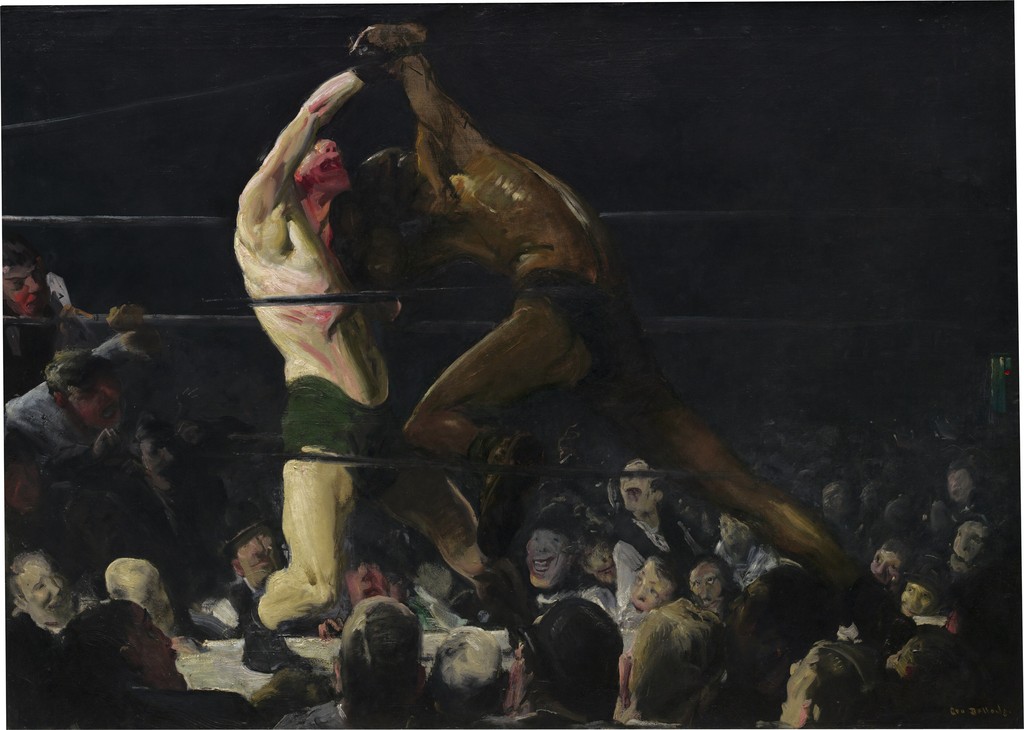
| Both Members of This Club | 1909 | Painting |
| Boy in a Blue Coat | 1915 | Painting |
| Boy with Eton Collar (Portrait of Meredith Hare) | 1921 | Painting |
| Breaking Sky, Monhegan | 1916 | Painting |
| Bridge, Blackwell’s Island | 1909 | Painting |
| Builders of Ship | 1916 | Painting |
| California Headlands | 1917 | Painting |
| Caricature of Adam and Eve and Two Female Portrait Sketches | Date unknown | Drawing |
| Central Park | 1905 | Painting |
| Chester Dale | 1922 | Painting |
| Children Playing in a Park | 1905 | Drawing |
| Cleaning Fish | 1913 | Painting |
| Cliff Dwellers | 1913 | Painting |
| Cliffs | Date unknown | Painting |
| Club Night | 1907 | Painting |
| Coming Storm | 1914 | Painting |
| Coopers Lake, Woodstock | 1924 | Painting |
| Counted Out, first stone | 1921 | |
| Counted Out, second stone | 1921 | |
| Criehaven Wharf | 1916 | Painting |
| Cross-Eyed Boy | Date unknown | Painting |
| Dance in a Madhouse | 1917 | |
| Dancing Town (The Top of the World) | 1922 | Drawing |
| Dempsey and Firpo | 1923 | |
| Dempsey and Firpo | 1924 | Painting |
| Dempsey through the Ropes | 1923 | |
| Dempsey Through the Ropes | Date unknown | Painting |
| Deserted Factory | 1924 | Painting |
| Dock Builders | 1916 | Painting |
| Edge of the Pasture - Glow of the Sun | 1916 | Painting |
| Edith Cavell | 1918 | Painting |
| Elinor, Jean and Anna | 1920 | Painting |
| Elsie, Emma and Marjorie, First Stone | 1921 | |
| Elsie, Emma and Marjorie, second stone | 1921 | |
| Elsie Reading to Emma, First Stone | 1921 | |
| Elsie Reading to Emma, Second Stone | 1921 | |
| Elsie Speicher [verso] | 1920 | Drawing |
| Emma and Her Children | 1923 | Painting |
| Emma at the Piano | 1914 | Painting |
| Emma at the Window | 1920 | Painting |
| Emma, Elsie and Gene | 1921 | |
| Emma in a Purple Dress | 1920 | Painting |
| Emma in the Black Print | 1919 | Painting |
| Emma in the Purple Dress | 1919 | Painting |
| Evening Blue | 1916 | Painting |
| Evening Swell | 1911 | Painting |
| Excavation at Night | 1908 | Painting |
| Family in a Surrey | 1921 | Drawing |
| Fern Woods | Date unknown | Painting |
| Five Cows | 1919 | Painting |
| Floating Ice | 1910 | Painting |
| Florence Davey | 1914 | Painting |
| Fog Breakers | 1913 | Painting |
| Forty-two Kids | 1907 | Painting |
| Frankie, the Organ Boy | 1907 | Painting |
| Garaldine Lee, No. 2 | 1914 | Painting |
| Gardiner's Bay from Sag Harbor | 1899 | Painting |
| Ghost of Sergeant Pelly | 1918 | Drawing |
| Golf Course, California | 1917 | Painting |
| Gorge and Sea | 1911 | Painting |
| Grandma Bellows | 1919 | Painting |
| Gray Sea | 1913 | Painting |
| Harbor of Monhegan, Fish Boats | 1911 | Painting |
| Haystacks and Barn | 1909 | Painting |
| Head of Boy (aka Gray Boy) | 1905 | Painting |
| Hungry Dogs, second stone | 1916 | |
| Hunter and Mountains | 1920 | Painting |
| In a Rowboat | 1916 | Painting |
| In an Elevator | 1916 | |
| In the Park, Dark | 1916 | |
| Introducing Georges Carpentier | 1921 | |
| Introducing John L. Sullivan | 1916 | |
| Introducing John L. Sullivan | 1923 | Painting |
| Introducing the Champion | 1916 | |
| Introductions | 1921 | |
| Jackie (Jacqueline Hudson) | 1914 | Painting |
| Jean 1923 | 1923 | |
| Jean in a Black Hat | 1923 | |
| Jean with Blue Book and Apple | 1916 | Painting |
| Jim Twadell's Place | 1924 | Painting |
| Julie Hudson | 1914 | Painting |
| Katherine Rosen | 1921 | Painting |
| Kids | 1906 | Painting |
| Lady Jean | 1924 | Painting |
| Lady of 1860 - The Actress | 1922 | Drawing |
| Lady with a Fan | 1921 | |
| Launching | 1913 | Painting |
| Little Girl in White (Queenie Burnett) | 1907 | Painting |
| Love of Winter | 1914 | Painting |
| Lychnis and Her Sons | 1923 | |
| Madeline Davis | 1914 | Painting |
| Man and Dog | 1905 | Painting |
| Matinicus | 1916 | |
| Maud Dale | 1919 | Painting |
| May Day in Central Park | 1905 | Painting |
| Men of the Docks | 1912 | Painting |
| Mill Dam | 1924 | Painting |
| Miss Bentham | 1906 | Painting |
| Monhegan Island | 1913 | Painting |
| Mother and Children | 1916 | |
| Mother and Children, Second State | 1916 | |
| Mountain Farm | 1922 | Painting |
| Mr. and Mrs. Phillip Wase | 1924 | Painting |
| Mrs. Chester Dale | 1919 | Painting |
| Mrs. T. in Cream Silk, No.1 | 1919 | Painting |
| Mrs. T. in Cream Silk, No.2 | 1920 | Painting |
| Mrs. Walter H. Richter | 1922 | Painting |
| Murder of Edith Cavell | 1918 | |
| My Family | 1916 | Painting |
| My Mother | 1921 | Painting |
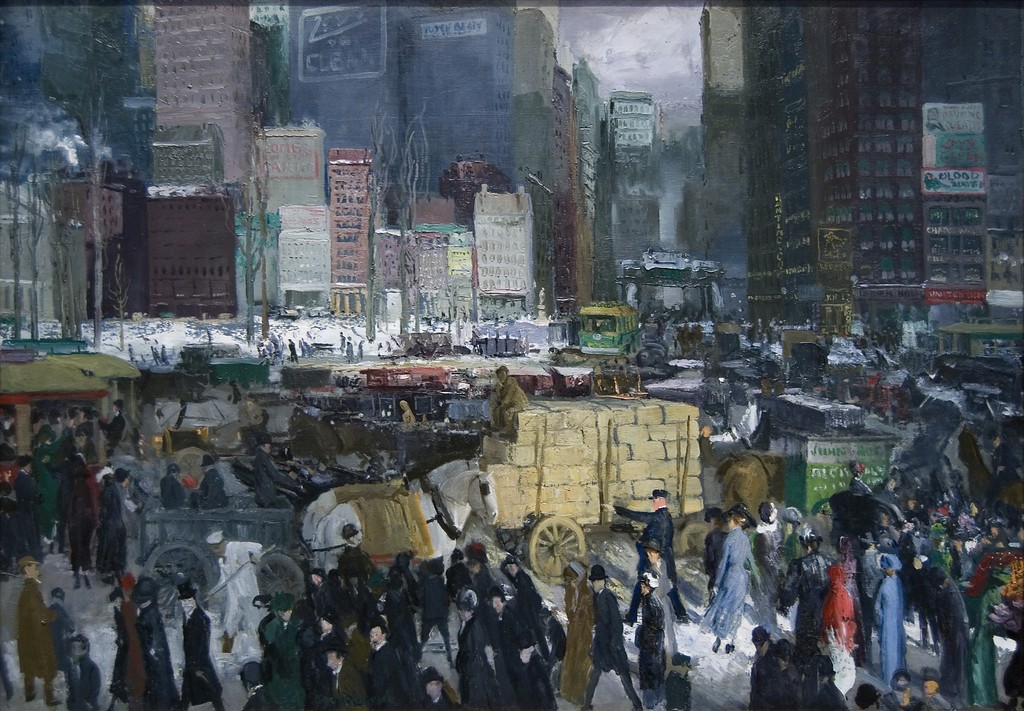
| New York | 1911 | Painting |
| North River | 1908 | Painting |
| Nude Girl, Miss Leslie Hall | 1909 | Painting |
| Nude Girl Reclining | 1919 | Drawing |
| Nude Study, Girl Standing on One Foot | 1923 | |
| Nude with Fan | 1920 | Painting |
| Nude with Hexagonal Quilt | 1924 | Painting |
| Nude with Parrot | 1915 | Painting |
| Nude with Red Hair | 1920 | Painting |
| Old Barn, Grey Day | 1920 | Painting |
| Old Fisherman | 1904 | Painting |
| Ox Team, Wharf at Matinicus | 1916 | Painting |
| Paddy Flannigan | 1908 | Painting |
| Padre | 1917 | Painting |
| Paradise Point | 1919 | Painting |
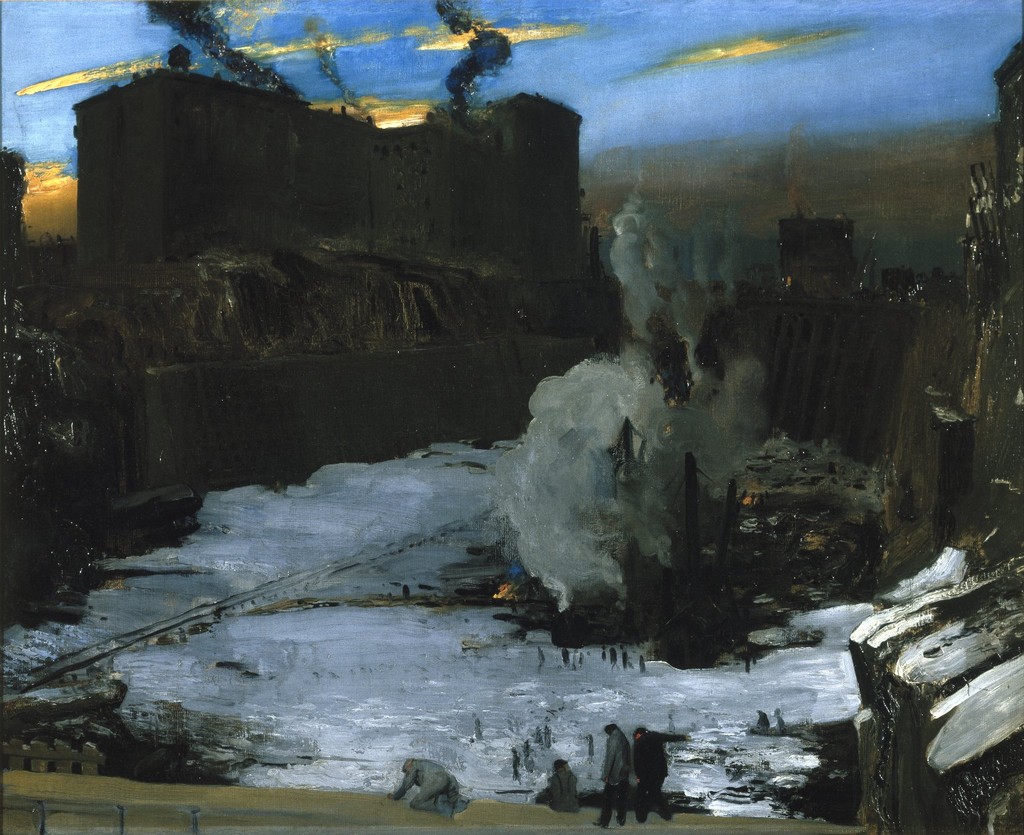
| Pennsylvania Station Excavation | c. 1907–1908 | Painting |
| Pigs and Donkey | 1920 | Painting |
| Polo at Lakewood | 1910 | Painting |
| Portrait of a Boy | 1921 | Painting |
| Portrait of a Laughing Boy | 1907 | Painting |
| Portrait of Florence Budd | 1914 | Painting |
| Portrait of Florence Pierce | 1914 | Painting |
| Portrait of Geraldine Lee, No. 1 | 1914 | Painting |
| Portrait of My Mother No. 1 | 1921 | Painting |
| Portrait of Prosper Invernizzi | 1907 | Painting |
| Portrait of Walter Littlefield | 1915 | Painting |
| Porträt der Anne | 1915 | Painting |
| Porträt der Laura | 1922 | Painting |
| Prayer Meeting, second stone | 1916 | |
| Preliminaries | 1916 | |
| Preliminaries | Date unknown | |
| Pueblo Tesuque, No. 2 | 1917 | Painting |
| Rain on the River | 1908 | Painting |
| Return of the Useless | 1918 | Painting |
| River Front No. 1 | 1914 | Painting |
| Rock Bound | 1913 | Painting |
| Rock Reef, Maine | 1913 | Painting |
| Rock Ridge Farm | Date unknown | Painting |
| Rocks and Coast | 1911 | Painting |
| Rolling Breakers | 1913 | Painting |
| Romance of Autumn | 1916 | Painting |
| Romance of Criehaven | 1916 | Painting |
| Roumanian Girl | 1921 | Painting |
| Samuel Knopf | 1922 | Painting |
| Santuario de Chimata | 1917 | Painting |
| Seated Female Nude (Emma Story Bellows) | Date unknown | Drawing |
| Seated Nude | 1910 | Painting |
| Self-Portrait | 1921 | |
| Shipyard Society | 1916 | Painting |
| Sixteen East Gay Street | 1923 | |
| Sketches of Heads, Including One of Chester Dale | Date unknown | Drawing |
| Sketches of Three Female Heads [recto] | Date unknown | Drawing |
| Snow-Capped River | 1911 | Painting |
| Snow Dumpers | 1911 | Painting |
| Society Ball [verso] | 1907 | Drawing |
| Splinter Beach | 1916 | |
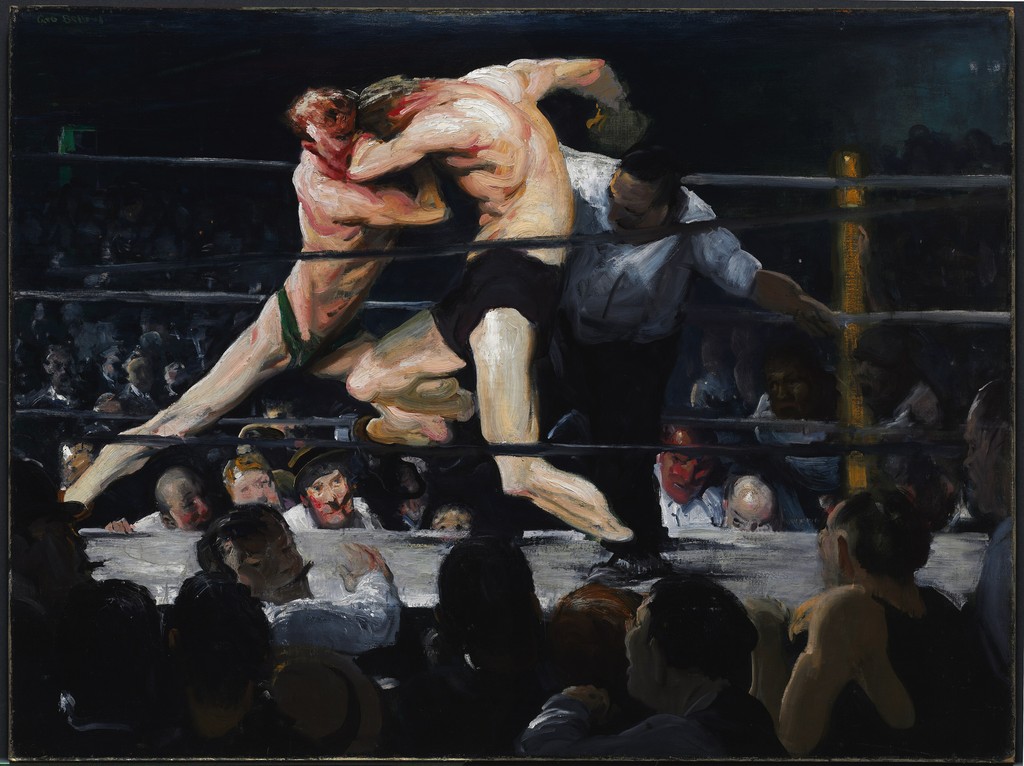
| Stag at Sharkey's | 1909 | Painting |
| Steaming Streets | 1908 | Painting |
| Storm Sea | 1913 | Painting |
| Street Fight [recto] | 1907 | Drawing |
| Studies of Jean | 1920 | Drawing |
| Study for "Mr. and Mrs. Philip Wase | 1924 | Drawing |
| Study for Nude with Hexagonal Quilt | 1924 | Drawing |
| Study for "Riverfront No. 1 | 1915 | Drawing |
| Study of Emma and the Children | 1917 | Painting |
| Summer City | 1909 | Painting |
| Summer Fantasy | 1924 | Painting |
| Summer Night, Riverside Drive | 1909 | Painting |
| Sun Glow | 1913 | Painting |
| Sun Shadows (Rocks at Monhegan) | 1913 | Painting |
| Sunday 1897 | 1921 | |
| Sunlit surf | 1913 | Painting |
| Swans in Central Park | 1906 | Painting |
| Tennis | 1920 | |
| Tennis at Newport | 1919 | Painting |
| Tennis at Newport | 1920 | Painting |
| Tennis Tournament | 1920 | Painting |
| The Barricade | 1918 | Painting |
| The Beach, Newport (In the Sand) | 1919 | Painting |
| The Big Dory | 1913 | Painting |
| The Black Derby / Head of a man with a red nose | 1905 | Painting |
| The Brook | Date unknown | Painting |
| The Charge | 1918 | |
| The Cigarette | 1918 | |
| The Coming Storm | 1916 | Painting |
| The Dock | 1913 | Painting |
| The Donkey Cart | 1922 | Drawing |
| The Fish Wharf, Matinicus Island | 1916 | Painting |
| The Fisherman | 1917 | Painting |
| The Germans Arrive | 1918 | Painting |
| The Grove — Monhegan | 1911 | Painting |
| The Gulls, Monhegan | 1911 | Painting |
| The Harbor, Monhegan Coast, Maine | 1913 | Painting |
| The Kindliness Came Not from Her | 1922 | Drawing |
| The Launching | Date unknown | Painting |
| The Law Is Too Slow | 1923 | |
| The Lone Tenement | 1909 | Painting |
| The Newsboy | 1908 | Painting |
| The Novitiate | 1916 | |
| The Palisades | 1909 | Painting |
| The Red Vine, Matinicus Island, Maine | 1916 | Painting |
| The Sand Cart | 1917 | Painting |
| The Sea | 1911 | Painting |
| The Shower-Bath | 1917 | |
| The Studio | 1919 | Painting |
| The Teamster | 1916 | Painting |
| The Tournament | 1920 | |
| The Village Houses | 1920 | Painting |
| The Warships | 1909 | Painting |
| The White Hope | 1921 | |
| The White Horse | 1922 | Painting |
| The Widow | 1917 | Painting |
| Three Children | 1919 | Painting |
| Three Pigs and a Mountain | 1922 | Painting |
| Three Rollers | 1911 | Painting |
| Through the Trees, Monhegan Island, Maine | 1913 | Painting |
| Tumble of Waters | 1913 | Painting |
| Two Girls | 1917 | |
| Two Women | 1924 | Painting |
| Up the Gorge | 1913 | Painting |
| Up the Hudson | 1908 | Painting |
| Village on the Hill | 1916 | Painting |
| Vine Clad Shore--Monhegan Island | 1913 | Painting |
| Waldo Peirce | 1920 | Painting |
| War Series | 1918 | Painting |
| West Wind | 1913 | Painting |
| Willard in Training Quarters | 1916 | |
| Winter Afternoon, Riverside Park | 1909 | Painting |
| Winter Road | 1912 | Painting |
| Woodstock Road, Woodstock, New York | 1924 | Drawing |
Frequently Asked Questions
No. Bellows tried to enlist, but he did not see combat in Europe. He also never travelled to Europe. The war pictures were made in the United States from information brought to him through print, photographs, illustrations and other people’s accounts.[1][3]
The concentrated campaign took place in 1918, chiefly from spring into autumn. It responded to events reported from the German invasion of Belgium in 1914 and to the Bryce Committee Report published in 1915.[2][6]
Bellows pictured reported atrocities against Belgian civilians, soldiers charging or threatened by unseen fire, and the killing of Edith Cavell. Works range from Sniped and The Charge to large multi-figure paintings. These are imagined episodes based on transmitted accounts rather than scenes observed firsthand.[2][3][4][5]
He worked in drawings, lithographs and large oil paintings. Museum summaries do not give one uniform total, but they agree that Bellows moved intensively between works on paper and canvas during 1918.[2][6]
They are reliable evidence of how Bellows and American wartime culture turned atrocity reports into images, but not direct visual documents of the depicted events. Bellows was absent from Europe, his sources were mediated, and some claims in the Bryce Report were later questioned. Each picture should be read as a forceful interpretation shaped by propaganda as well as moral outrage.[2][3]
Discussion
Use this evidence-led guide as a starting point for close looking rather than a final verdict.
Share an observation about George Bellows War Work or a source that adds useful context.
Reader Insights
Which work most clearly complicates the familiar image of Bellows as a strictly literal realist?
Where do New York, exhibition culture, printmaking, family or place most productively alter your reading?
Which source or surviving object would you investigate next?
Join the Conversation
Add your reading below, keeping observations specific and evidence clear.
References
- National Gallery of Art, “George Bellows”, accessed 31 August 2026.
- The Metropolitan Museum of Art, “George Bellows” exhibition overview, accessed 31 August 2026.
- The Metropolitan Museum of Art, “Sniped from War Series”, accessed 31 August 2026.
- National Gallery of Art, “The Charge”, accessed 31 August 2026.
- National Gallery of Art, “Murder of Edith Cavell”, accessed 31 August 2026.
- National Gallery of Art, Bellows: The Boxing Pictures, accessed 31 August 2026.