 by Tom Gurney
Tom Gurney BSc (Hons) is an art history expert with over 20 years experience
/
Email: tomgurney1@gmail.com / Phone: +44 7429 011000
George Bellows Biography: Introduction
George Bellows compressed an unusually wide career into forty-two years. He left Ohio State University for New York in 1904, trained with Robert Henri, and quickly became known for paintings of streets, construction, river life and boxing clubs. Yet the familiar image of Bellows as a painter of rough urban energy accounts for only one part of his work. He was also a teacher, illustrator and prolific lithographer who painted family portraits, coastal landscapes, wartime subjects and ambitious late figure compositions.
The life of George Bellows is best followed as a sequence of enlarging choices rather than a straight progression away from realism. Sport sharpened his interest in bodies and action; New York supplied subjects and institutions; marriage and fatherhood made the family central to his art; travel within the United States changed his palette and scale; and printmaking carried his images to a broader public. He never travelled to Europe, but he continually studied European art in American museums and reproductions.
At a Glance
- Full nameGeorge Wesley Bellows, usually known publicly as George Bellows.[1]
- Born12 August 1882 in Columbus, Ohio.[1]
- TrainingOhio State University, followed by the New York School of Art under Robert Henri from 1904.[1][2]
- Died8 January 1925 in New York City, aged forty-two, after a ruptured appendix.[1][3]
- FamilyHe married fellow art student Emma Story in 1910; their daughters were Anne and Jean.[1][3]
- Known forUrban and sporting paintings, portraits, landscapes, drawings, illustrations and lithographs.[1][3]
George Bellows in context
Realism
c. 1840–1900American Realism
c. 1870–1930Ashcan circle
c. 1898–1917Winslow Homer
1836–1910Thomas Eakins
1844–1916Robert Henri
1865–1929John Sloan
1871–1951George Bellows
1882–1925Edward Hopper
1882–1967Pennsylvania Station Excavation
c. 1907–08New York
1911Cliff Dwellers
1913My Family
1916A Stag at Sharkey's
1917Dempsey and Firpo
1924Contents
- Introduction
- Columbus, College and Sport
- New York and Robert Henri
- Recognition, Boxing and the Modern City
- Emma, Teaching and Independent Exhibitions
- Maine, Family and a Changing Practice
- Lithography and a Wider Public
- War Work and the Eyewitness Boundary
- Woodstock, Late Work and an Early Death
Columbus, College and Sport
Bellows was born in Columbus as the only child of George Bellows, a successful building contractor, and Anna Bellows. He attended Central High School and entered Ohio State University in 1901. Athletics and drawing developed alongside one another rather than as rival identities. He played baseball and basketball, contributed drawings to student publications and spent a summer playing semiprofessional baseball. The combination would remain visible in his mature art: an athlete's knowledge of balance, collision and recovery joined an illustrator's ability to seize a readable instant.[1][2]
He left university in the spring of 1904, before completing a degree. The decision is sometimes retold as a dramatic choice between professional sport and art, but the documented chronology is more practical. Bellows earned money by playing baseball and selling drawings, then used it to move to New York in September. He did not leave sport behind. Boxing, baseball, polo and tennis all entered his work, and his athletic experience gave him an unusually alert eye for the social distinctions surrounding different games.[4]
This background helps explain why Bellows's sporting pictures are not simply records of contests. A game or bout offered concentrated human movement, but also rules, audiences, class identities and public theatre. His later boxing pictures grew from that double attention to physical action and the crowd watching it.
New York and Robert Henri
In New York, Bellows enrolled at the New York School of Art, directed by William Merritt Chase, and studied with Robert Henri for about two years. Edward Hopper, Rockwell Kent and Guy Pène du Bois were among his fellow students. Henri urged younger painters to treat contemporary life as serious material, and Bellows responded to the city's streets, rivers, excavation pits, parks and informal sporting clubs. The Smithsonian describes him as Henri's protégé and assistant, while also stressing Bellows's particular gift for the movement of crowds.[1][2]
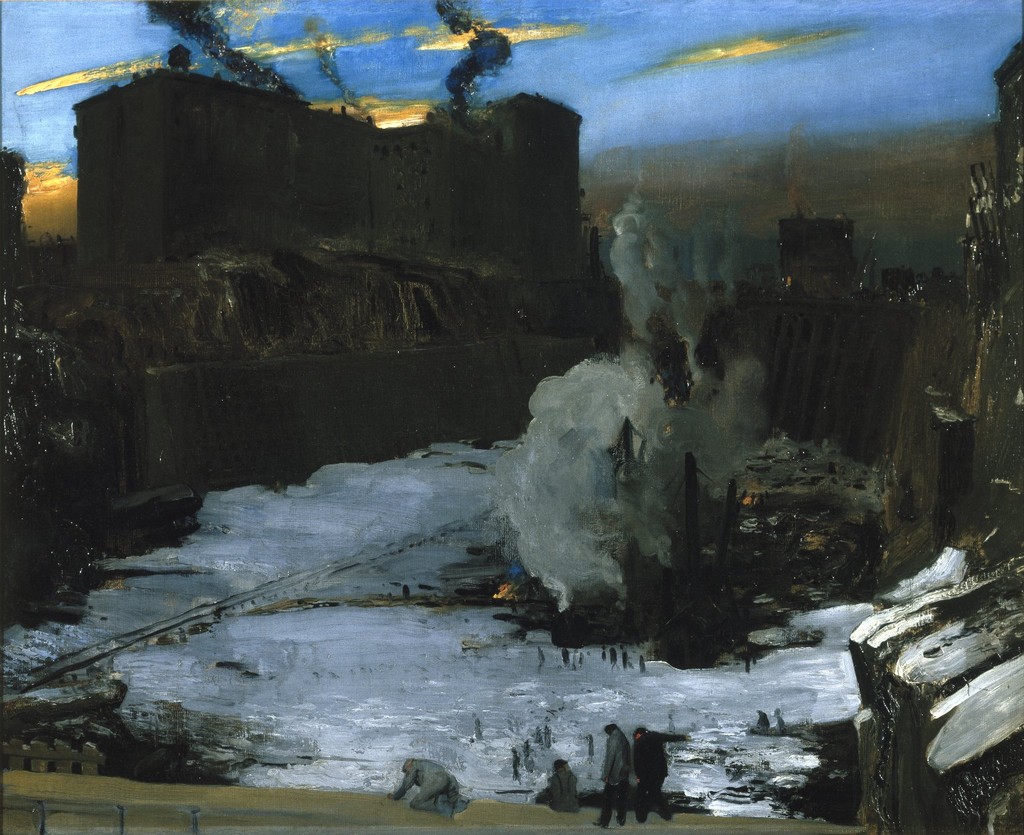
Henri's influence matters, but it should not make Bellows's early work seem like an assignment dutifully completed. Bellows chose abrupt viewpoints, dense groups and vigorous paint to meet subjects that were changing before him. The winter pit represented in Pennsylvania Station Excavation, dated about 1907–08, belongs to a moment when demolition and construction were remaking Manhattan. River swimmers, tenements, bridges and traffic likewise offered different forms of New York City in motion.
This is also the period most closely associated with the label “Ashcan School.” The term is useful for connecting Bellows with Henri and realist painters interested in ordinary urban life, dark tonalities and forceful handling. It is not the name of a formal group that Bellows joined. Most importantly, Bellows was not one of the eight painters in the landmark 1908 exhibition of The Eight. He was younger, did not exhibit in that show, and became associated with its artists and concerns afterward.[2][4]
Recognition, Boxing and the Modern City
Recognition came quickly. Bellows's work entered the National Academy of Design's exhibitions, won attention from critics, and earned him election as an associate of the Academy in 1909, when he was among its youngest members. His first one-person exhibition followed at New York's Madison Gallery in January 1911. Academic recognition did not prevent him from supporting less restricted exhibition opportunities; institutional standing and artistic independence coexisted throughout his career.[1][4]
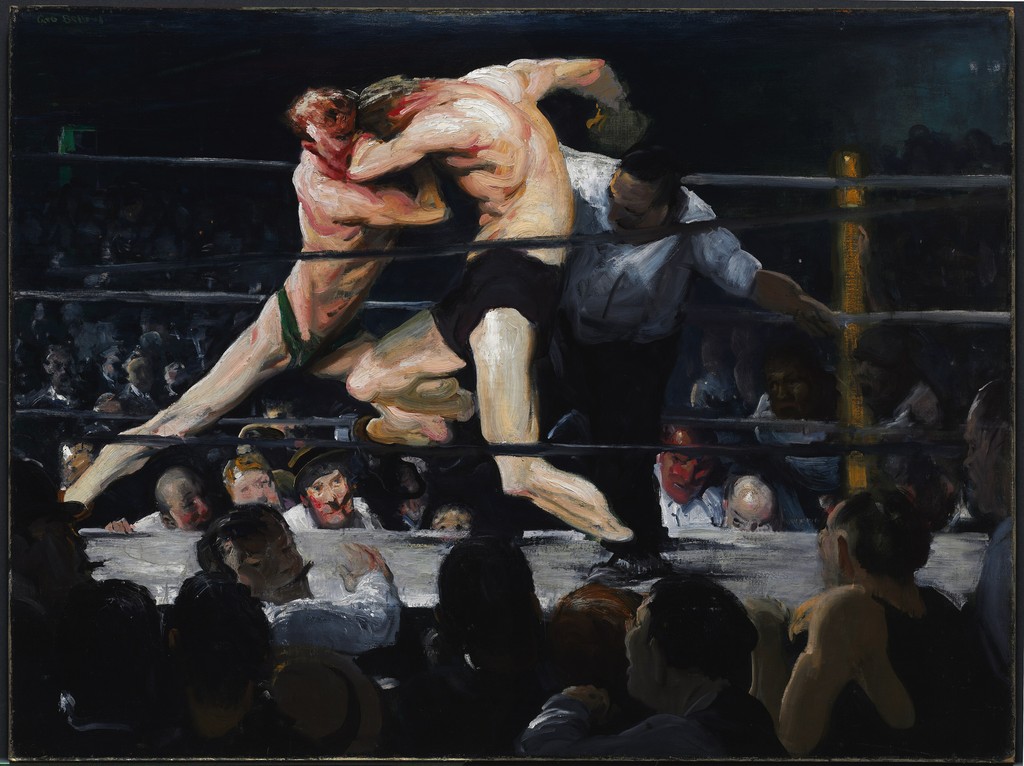
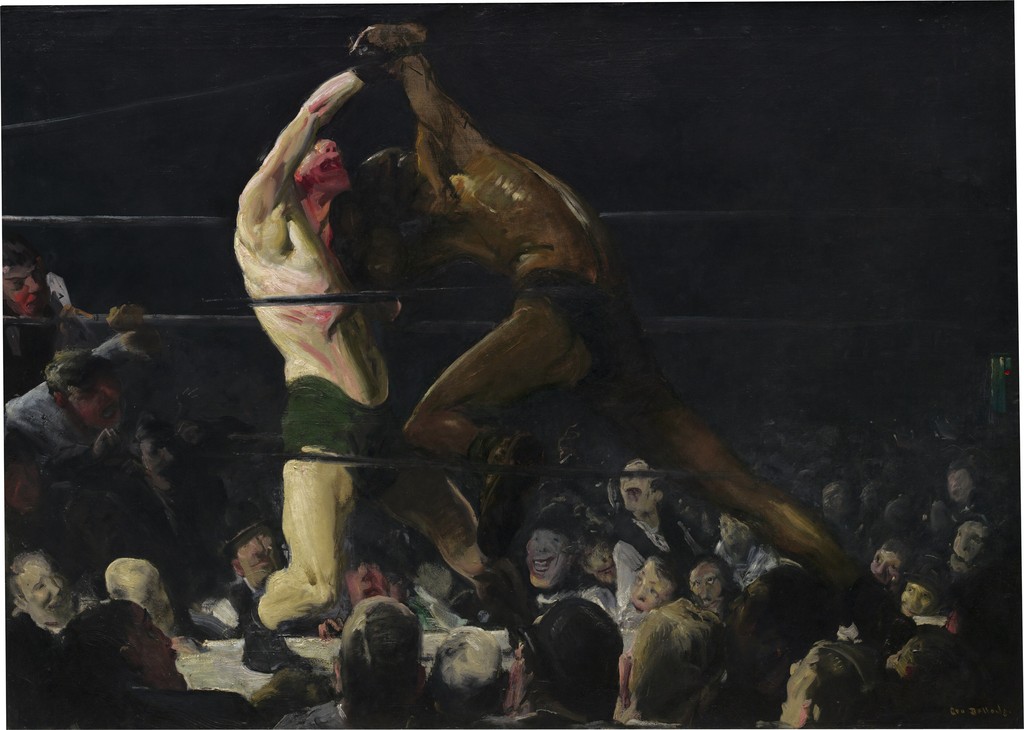
The early boxing paintings were central to this rise. Stag at Sharkey's and Both Members of This Club, both painted in 1909, turned an illicit club spectacle into large, public art. Their subjects, identities and histories need to remain distinct even though they belong to the same short sequence. Bellows later revisited boxing in drawings, lithographs and late paintings, changing composition and emphasis rather than merely copying an earlier success.[4]
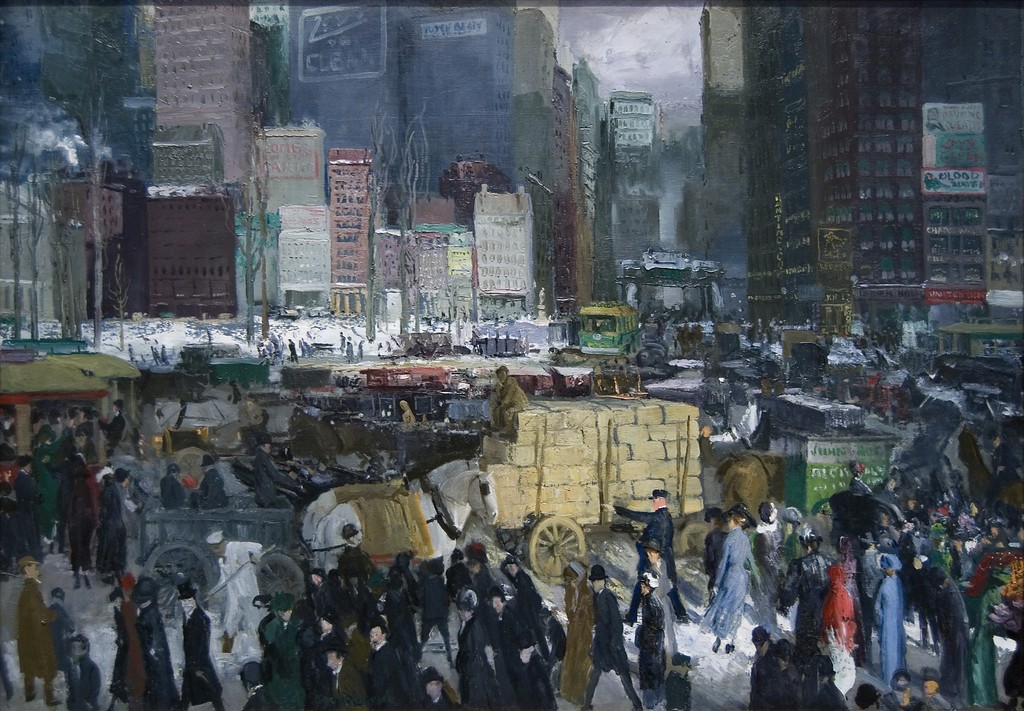
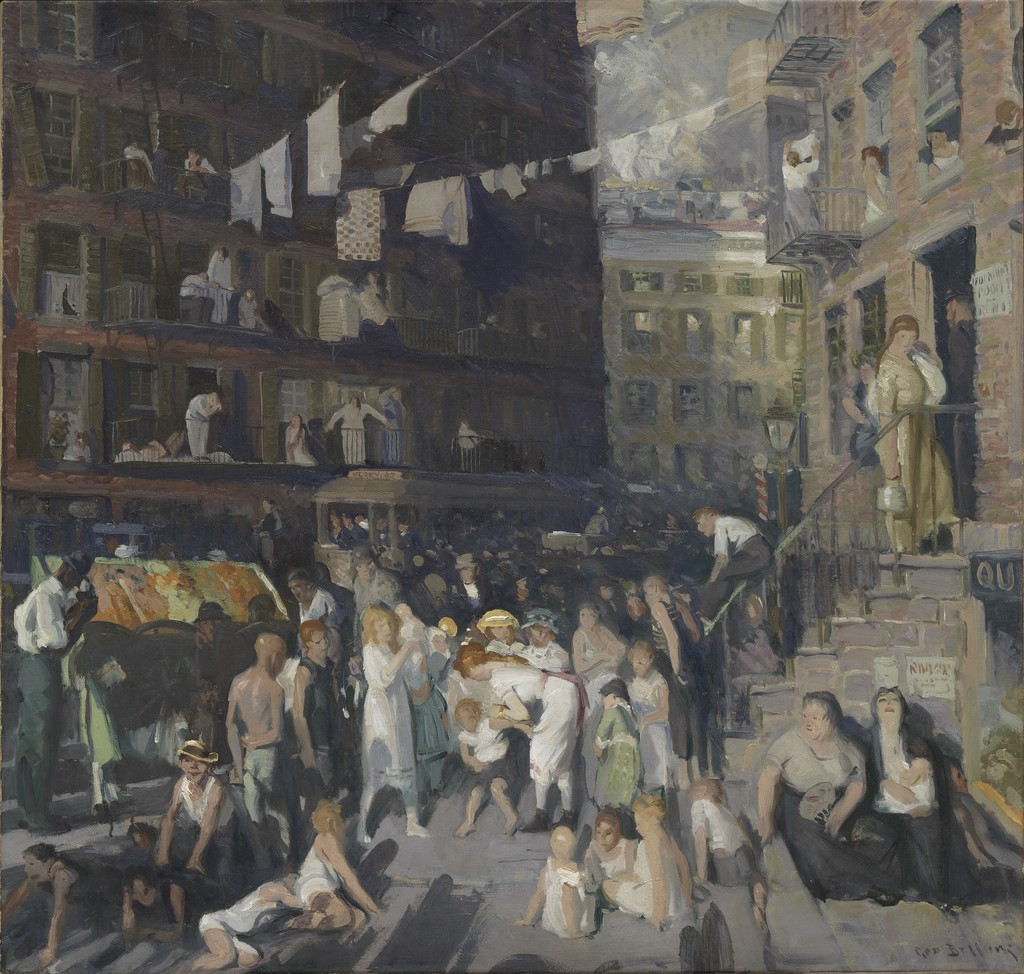
City painting also broadened. The 1911 canvas New York combines crowds, vehicles, architecture and weather into a deliberately concentrated vision rather than a map-like record of one intersection. Cliff Dwellers, completed in 1913, brought the summer life of a crowded Lower East Side street into a different palette and compositional order. These works anchor an account of Bellows's paintings, but no single one should stand for his whole career.
Emma, Teaching and Independent Exhibitions
Bellows met Emma Louise Story, another student at the New York School of Art, soon after arriving in the city. They married in September 1910 and later had two daughters, Anne and Jean. Emma was not simply a biographical presence kept outside the studio. She and the children became recurring subjects in paintings, drawings and prints, while the family's summers created new working settings. Museum records and surviving works show a sustained artistic relationship without requiring speculation about private feelings.[3][5]
The year of the marriage also marked a widening public role. Bellows began teaching at the Art Students League in the early 1910s. He participated in independent exhibitions, became a charter member of the Association of American Painters and Sculptors, and helped organize the 1913 International Exhibition of Modern Art, better known as the Armory Show. His own work appeared there, and in the same year he became a full member of the National Academy of Design.[1]
Those affiliations can look contradictory only if academic membership is mistaken for obedience. Bellows valued the right of artists to show work without conventional jury restrictions. He later became a founding member of the Society of Independent Artists. At the same time, he accepted honours, taught within established institutions and exhibited portraits with specialist associations. His career moved between institutions rather than belonging wholly to an official or rebellious camp.
Bellows also contributed drawings to periodicals. From 1912 to 1917 he worked for the socialist magazine The Masses, addressing political and social subjects through illustration. Such work belongs beside, but not underneath, his easel painting. It trained a different economy of line and public address, and it connected artistic independence to the contested issues of the day.[1]
Maine, Family and a Changing Practice
After 1910 Bellows increasingly painted landscapes, seascapes and portraits, and his palette and construction changed. He explored the colour systems of Hardesty Maratta and Denman Ross, followed later by Jay Hambidge's theory of dynamic symmetry. These were tools rather than formulas that replaced observation. Bellows tested them against very different subjects: surf, tennis, family groups and large narrative scenes.[1][3]
Maine was especially important. On Monhegan Island in 1913, he worked close to the rocky coast and made compact paintings in which waves, cliffs and paint seem to press against one another. Vine Clad Shore—Monhegan Island, a 1913 oil now at the Smithsonian American Art Museum, fixes one exact object within that larger coastal campaign.[6] The wider story of portraits, family and Maine shows why the seascapes are not a retreat from modern life but another arena for speed, structure and force.
During the summer of 1916, the family stayed in Camden, Maine. Bellows experimented there with outdoor portraiture, trying to integrate figures and landscape. The two large, closely related paintings My Family and Study of Emma and the Children both remained unfinished; the exact relationship between them is not certain. In each, Emma appears with Anne and Jean beneath an awning. A separate lithographic treatment altered the group again, demonstrating how a family subject could move between media without becoming the same object in another material.[5]
Bellows never travelled to Europe. That fact did not isolate him from European art. He studied older and modern painters through works in New York collections, exhibitions and reproductions. The Armory Show intensified that encounter, while fellow artists such as Leon Kroll encouraged him to look closely at Impressionism and Post-Impressionism. Influence in Bellows's work therefore came through viewing, discussion and experiment at home, not through a European study tour.[1][3][5]
Lithography and a Wider Public
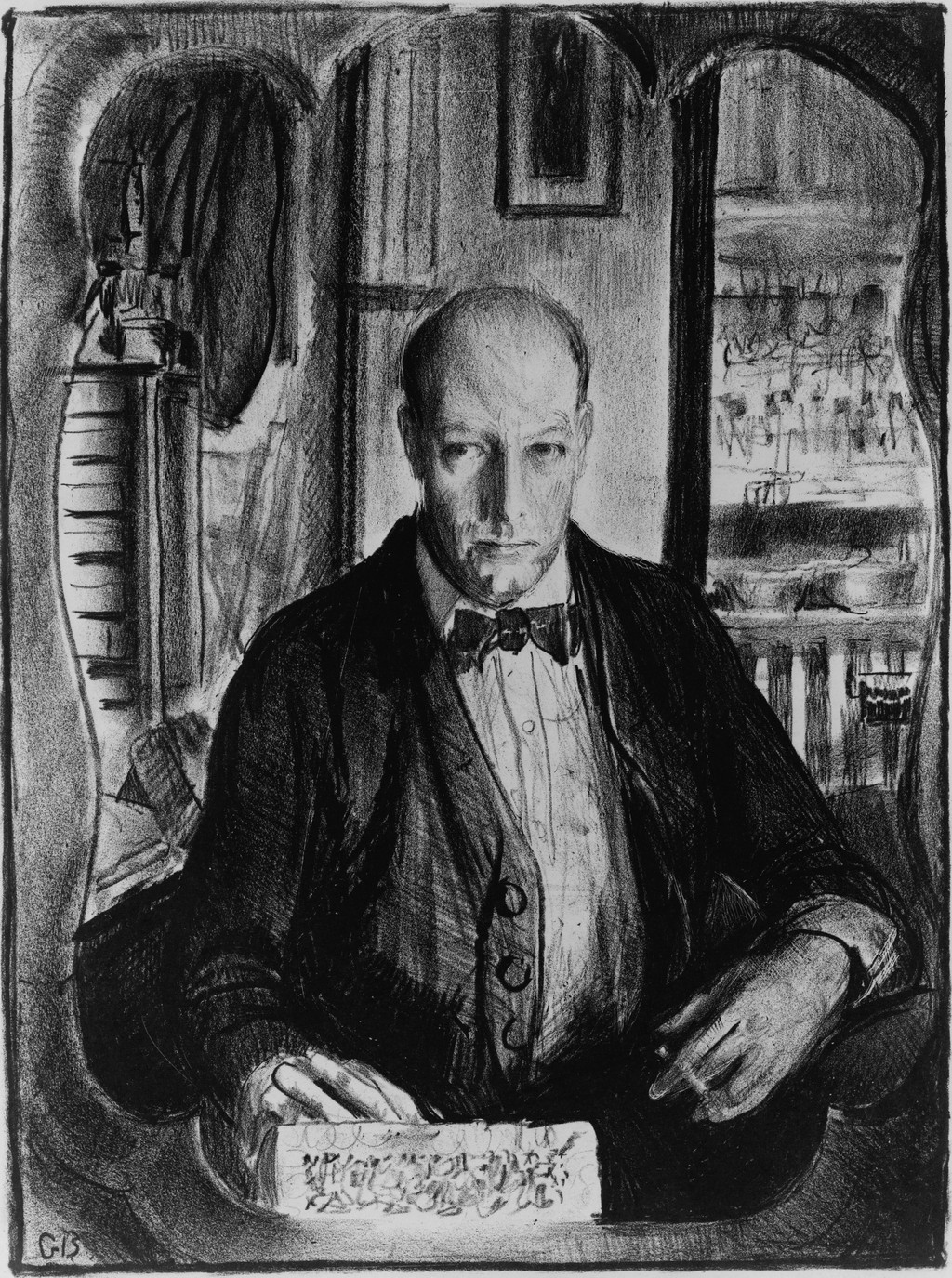
Bellows took up lithography in 1916 and pursued it intensely for the remaining nine years of his life. At a moment when etching held greater prestige among many American collectors, his achievement helped renew interest in lithography. The medium suited his command of massed darks, abrupt light and bodily movement, but it also supported intimate portraits and biting social satire. Editions could circulate an image more widely than a unique painting.[2][3]
The prints and lithographs require especially careful identification. A drawing, transfer drawing, lithographic stone, state and individual impression belong to related stages, not to one interchangeable object. A shared title does not erase differences between institutions or impressions. Nor is a print necessarily a reversed facsimile of a painting. Bellows reconsidered details, tonal structure and scale as subjects moved between media.[3]
The distinction is clear in his boxing work. The Cleveland painting Stag at Sharkey's dates from 1909; the lithograph A Stag at Sharkey's dates from 1917. The added article, later date and different medium identify a separate work. Bellows returned to the ring because printmaking let him recompose an already potent subject and place it before another audience, not because he was mechanically reproducing the oil.[4]
Printmaking also brought strands of his life together. Emma and the daughters appeared in domestic lithographs; sporting subjects drew on his early fame; social satires continued concerns familiar from illustration; and the wartime series used stark black-and-white contrasts to make imagined violence immediate. The medium became part of his thinking across subjects, not a sideline to the paintings.
War Work and the Eyewitness Boundary
In 1918 Bellows devoted sustained attention to reported atrocities committed by German forces in Belgium. The resulting drawings, lithographs and five monumental oils marked a rupture in both subject and method. Much of his best-known early art had grown from places he observed. The war pictures instead imagined scenes described by the American press and the British government's Bryce Committee report.[3]
Bellows did not serve in the military, never travelled to Europe and never saw combat. Other wartime images drew on published reports, photographs, illustrations and soldiers' accounts. That boundary is essential to any reading of his war work: the pictures are forceful constructions shaped by wartime information and propaganda, not eyewitness testimony. Some were used to support war-bond campaigns.[3]
The cycle also complicates a simple account of Bellows's politics. His earlier illustrations for The Masses had placed him in a left-wing publishing culture, while his response to the war moved toward public images supporting the Allied cause. Rather than smoothing those positions into a consistent doctrine, the chronology shows an artist reacting to a changing political crisis and making some of his most controversial works from second-hand evidence.
Woodstock, Late Work and an Early Death
Bellows taught at the Art Institute of Chicago in 1919 and began working around Woodstock, New York, in 1920. By the early 1920s, Woodstock had become a recurring family base as well as a landscape and portrait setting. The 1924 double portrait Mr. and Mrs. Phillip Wase depicts neighbours there and belongs to his continuing effort to give individual sitters physical and psychological presence without idealising them.[1][7]
His late work was neither a simple return to tradition nor a final abandonment of urban realism. Smooth curves, monumental figures and increasingly explicit compositional systems appeared beside small rural landscapes, family portraits and sporting subjects. The 1924 painting Dempsey and Firpo returned to boxing through the famous 1923 championship bout, but in a stylised language different from the dark club interiors of 1909.[8] Bellows's continued movement between observation, memory, published imagery and formal systems makes the late career feel exploratory rather than settled.
In January 1925, Bellows suffered a ruptured appendix and died in New York on the eighth of the month. He was forty-two. The Metropolitan Museum of Art organized a memorial retrospective later that year, recognition of a career already substantial but still changing when it ended.[3] A larger National Gallery of Art retrospective in 1957 assembled sixty-three paintings and eighty-nine drawings and lithographs from more than forty collections; it was the Gallery's first one-person exhibition and signalled a renewed institutional focus on American art.[9]
Those exhibitions helped establish the broad Bellows now visible in museum collections: not only the painter of boxing and crowded streets, but also a restless maker across oils, drawings, illustration and print. His early death explains the career's compression. It does not reduce its successive experiments to an unfinished promise.
Follow George Bellows's career through four stages
Columbus, sport and Robert Henri's classroom
Bellows grew up in Columbus, balanced drawing with baseball and basketball at Ohio State, and moved to New York in 1904. Study with Robert Henri redirected his energy toward the people, streets and immediate experience of the modern city.
Excavations, crowds and club fights
Rapidly handled paintings of the Penn Station excavation, East River swimmers and illicit boxing clubs established Bellows's reputation. Public recognition came early, but the apparent speed of his surfaces rested on controlled tonal and compositional decisions.
The Lower East Side, colour systems and lithography
Bellows broadened his subjects through tenement streets, family groups, Maine coasts and illustration. From 1916 lithography became a major practice, carrying boxing, satire, portrait and wartime imagery into a medium built around stones and multiple impressions.
Portraits, Woodstock and renewed sporting drama
Later years joined searching portraits and family images to landscapes made around Woodstock and the coast. Bellows also returned to public sport in ambitious boxing subjects before his sudden death after appendicitis in January 1925.
Researched works directory
This searchable evidence census was assembled from public museum records and a reproducible Wikidata snapshot. It is not a catalogue raisonné, not a claim to complete oeuvre coverage, and not a substitute for the published catalogue literature, which was not used to claim absolute completeness.
| Name | Date | Medium |
|---|---|---|
| A Cloudy Day / Hudson River: Coming Squall | 1908 | Painting |
| A Day in June | 1913 | Painting |
| A Fresh Breeze | 1913 | Painting |
| A Grandmother | 1914 | Painting |
| A Knockout | 1921 | |
| A Morning Snow--Hudson River | 1910 | Painting |
| A Stag at Sharkey's | 1917 | |
| A Winter Day - Under the Elevated near Brooklyn Bridge | 1907 | Painting |
| Allan Donn Puts to Sea | 1923 | |
| An Irish Girl | 1922 | Drawing |
| Anne | 1915 | Painting |
| Anne 1921 | 1923 | |
| Anne and Her Mother | 1917 | Drawing |
| Anne in Black Velvet | 1917 | Painting |
| Anne in White | 1920 | Painting |
| Anne with a Japanese Parasol | 1917 | Painting |
| Approach of Rain | 1913 | Painting |
| Approach to the Bridge at Night | 1913 | Painting |
| Arms of a Boxer | 1916 | Drawing |
| Artists' Evening | 1916 | |
| August Lundberg (No 2) | 1907 | Painting |
| Aunt Fanny | 1920 | Painting |
| Barnyard and Chickens | 1924 | Painting |
| Bethesda Fountain (Fountain in Central Park) | 1905 | Painting |
| Between Rounds, large, first stone | 1916 | |
| Between Rounds, small, second stone | 1923 | |
| Blue Morning | 1909 | Painting |
| Blue Snow, the Battery | 1910 | Painting |
| Both Members of This Club | 1909 | Painting |
| Boy in a Blue Coat | 1915 | Painting |
| Boy with Eton Collar (Portrait of Meredith Hare) | 1921 | Painting |
| Breaking Sky, Monhegan | 1916 | Painting |
| Bridge, Blackwell’s Island | 1909 | Painting |
| Builders of Ship | 1916 | Painting |
| California Headlands | 1917 | Painting |
| Caricature of Adam and Eve and Two Female Portrait Sketches | Date unknown | Drawing |
| Central Park | 1905 | Painting |
| Chester Dale | 1922 | Painting |
| Children Playing in a Park | 1905 | Drawing |
| Cleaning Fish | 1913 | Painting |
| Cliff Dwellers | 1913 | Painting |
| Cliffs | Date unknown | Painting |
| Club Night | 1907 | Painting |
| Coming Storm | 1914 | Painting |
| Coopers Lake, Woodstock | 1924 | Painting |
| Counted Out, first stone | 1921 | |
| Counted Out, second stone | 1921 | |
| Criehaven Wharf | 1916 | Painting |
| Cross-Eyed Boy | Date unknown | Painting |
| Dance in a Madhouse | 1917 | |
| Dancing Town (The Top of the World) | 1922 | Drawing |
| Dempsey and Firpo | 1923 | |
| Dempsey and Firpo | 1924 | Painting |
| Dempsey through the Ropes | 1923 | |
| Dempsey Through the Ropes | Date unknown | Painting |
| Deserted Factory | 1924 | Painting |
| Dock Builders | 1916 | Painting |
| Edge of the Pasture - Glow of the Sun | 1916 | Painting |
| Edith Cavell | 1918 | Painting |
| Elinor, Jean and Anna | 1920 | Painting |
| Elsie, Emma and Marjorie, First Stone | 1921 | |
| Elsie, Emma and Marjorie, second stone | 1921 | |
| Elsie Reading to Emma, First Stone | 1921 | |
| Elsie Reading to Emma, Second Stone | 1921 | |
| Elsie Speicher [verso] | 1920 | Drawing |
| Emma and Her Children | 1923 | Painting |
| Emma at the Piano | 1914 | Painting |
| Emma at the Window | 1920 | Painting |
| Emma, Elsie and Gene | 1921 | |
| Emma in a Purple Dress | 1920 | Painting |
| Emma in the Black Print | 1919 | Painting |
| Emma in the Purple Dress | 1919 | Painting |
| Evening Blue | 1916 | Painting |
| Evening Swell | 1911 | Painting |
| Excavation at Night | 1908 | Painting |
| Family in a Surrey | 1921 | Drawing |
| Fern Woods | Date unknown | Painting |
| Five Cows | 1919 | Painting |
| Floating Ice | 1910 | Painting |
| Florence Davey | 1914 | Painting |
| Fog Breakers | 1913 | Painting |
| Forty-two Kids | 1907 | Painting |
| Frankie, the Organ Boy | 1907 | Painting |
| Garaldine Lee, No. 2 | 1914 | Painting |
| Gardiner's Bay from Sag Harbor | 1899 | Painting |
| Ghost of Sergeant Pelly | 1918 | Drawing |
| Golf Course, California | 1917 | Painting |
| Gorge and Sea | 1911 | Painting |
| Grandma Bellows | 1919 | Painting |
| Gray Sea | 1913 | Painting |
| Harbor of Monhegan, Fish Boats | 1911 | Painting |
| Haystacks and Barn | 1909 | Painting |
| Head of Boy (aka Gray Boy) | 1905 | Painting |
| Hungry Dogs, second stone | 1916 | |
| Hunter and Mountains | 1920 | Painting |
| In a Rowboat | 1916 | Painting |
| In an Elevator | 1916 | |
| In the Park, Dark | 1916 | |
| Introducing Georges Carpentier | 1921 | |
| Introducing John L. Sullivan | 1916 | |
| Introducing John L. Sullivan | 1923 | Painting |
| Introducing the Champion | 1916 | |
| Introductions | 1921 | |
| Jackie (Jacqueline Hudson) | 1914 | Painting |
| Jean 1923 | 1923 | |
| Jean in a Black Hat | 1923 | |
| Jean with Blue Book and Apple | 1916 | Painting |
| Jim Twadell's Place | 1924 | Painting |
| Julie Hudson | 1914 | Painting |
| Katherine Rosen | 1921 | Painting |
| Kids | 1906 | Painting |
| Lady Jean | 1924 | Painting |
| Lady of 1860 - The Actress | 1922 | Drawing |
| Lady with a Fan | 1921 | |
| Launching | 1913 | Painting |
| Little Girl in White (Queenie Burnett) | 1907 | Painting |
| Love of Winter | 1914 | Painting |
| Lychnis and Her Sons | 1923 | |
| Madeline Davis | 1914 | Painting |
| Man and Dog | 1905 | Painting |
| Matinicus | 1916 | |
| Maud Dale | 1919 | Painting |
| May Day in Central Park | 1905 | Painting |
| Men of the Docks | 1912 | Painting |
| Mill Dam | 1924 | Painting |
| Miss Bentham | 1906 | Painting |
| Monhegan Island | 1913 | Painting |
| Mother and Children | 1916 | |
| Mother and Children, Second State | 1916 | |
| Mountain Farm | 1922 | Painting |
| Mr. and Mrs. Phillip Wase | 1924 | Painting |
| Mrs. Chester Dale | 1919 | Painting |
| Mrs. T. in Cream Silk, No.1 | 1919 | Painting |
| Mrs. T. in Cream Silk, No.2 | 1920 | Painting |
| Mrs. Walter H. Richter | 1922 | Painting |
| Murder of Edith Cavell | 1918 | |
| My Family | 1916 | Painting |
| My Mother | 1921 | Painting |
| New York | 1911 | Painting |
| North River | 1908 | Painting |
| Nude Girl, Miss Leslie Hall | 1909 | Painting |
| Nude Girl Reclining | 1919 | Drawing |
| Nude Study, Girl Standing on One Foot | 1923 | |
| Nude with Fan | 1920 | Painting |
| Nude with Hexagonal Quilt | 1924 | Painting |
| Nude with Parrot | 1915 | Painting |
| Nude with Red Hair | 1920 | Painting |
| Old Barn, Grey Day | 1920 | Painting |
| Old Fisherman | 1904 | Painting |
| Ox Team, Wharf at Matinicus | 1916 | Painting |
| Paddy Flannigan | 1908 | Painting |
| Padre | 1917 | Painting |
| Paradise Point | 1919 | Painting |
| Pennsylvania Station Excavation | c. 1907–1908 | Painting |
| Pigs and Donkey | 1920 | Painting |
| Polo at Lakewood | 1910 | Painting |
| Portrait of a Boy | 1921 | Painting |
| Portrait of a Laughing Boy | 1907 | Painting |
| Portrait of Florence Budd | 1914 | Painting |
| Portrait of Florence Pierce | 1914 | Painting |
| Portrait of Geraldine Lee, No. 1 | 1914 | Painting |
| Portrait of My Mother No. 1 | 1921 | Painting |
| Portrait of Prosper Invernizzi | 1907 | Painting |
| Portrait of Walter Littlefield | 1915 | Painting |
| Porträt der Anne | 1915 | Painting |
| Porträt der Laura | 1922 | Painting |
| Prayer Meeting, second stone | 1916 | |
| Preliminaries | 1916 | |
| Preliminaries | Date unknown | |
| Pueblo Tesuque, No. 2 | 1917 | Painting |
| Rain on the River | 1908 | Painting |
| Return of the Useless | 1918 | Painting |
| River Front No. 1 | 1914 | Painting |
| Rock Bound | 1913 | Painting |
| Rock Reef, Maine | 1913 | Painting |
| Rock Ridge Farm | Date unknown | Painting |
| Rocks and Coast | 1911 | Painting |
| Rolling Breakers | 1913 | Painting |
| Romance of Autumn | 1916 | Painting |
| Romance of Criehaven | 1916 | Painting |
| Roumanian Girl | 1921 | Painting |
| Samuel Knopf | 1922 | Painting |
| Santuario de Chimata | 1917 | Painting |
| Seated Female Nude (Emma Story Bellows) | Date unknown | Drawing |
| Seated Nude | 1910 | Painting |
| Self-Portrait | 1921 | |
| Shipyard Society | 1916 | Painting |
| Sixteen East Gay Street | 1923 | |
| Sketches of Heads, Including One of Chester Dale | Date unknown | Drawing |
| Sketches of Three Female Heads [recto] | Date unknown | Drawing |
| Snow-Capped River | 1911 | Painting |
| Snow Dumpers | 1911 | Painting |
| Society Ball [verso] | 1907 | Drawing |
| Splinter Beach | 1916 | |
| Stag at Sharkey's | 1909 | Painting |
| Steaming Streets | 1908 | Painting |
| Storm Sea | 1913 | Painting |
| Street Fight [recto] | 1907 | Drawing |
| Studies of Jean | 1920 | Drawing |
| Study for "Mr. and Mrs. Philip Wase | 1924 | Drawing |
| Study for Nude with Hexagonal Quilt | 1924 | Drawing |
| Study for "Riverfront No. 1 | 1915 | Drawing |
| Study of Emma and the Children | 1917 | Painting |
| Summer City | 1909 | Painting |
| Summer Fantasy | 1924 | Painting |
| Summer Night, Riverside Drive | 1909 | Painting |
| Sun Glow | 1913 | Painting |
| Sun Shadows (Rocks at Monhegan) | 1913 | Painting |
| Sunday 1897 | 1921 | |
| Sunlit surf | 1913 | Painting |
| Swans in Central Park | 1906 | Painting |
| Tennis | 1920 | |
| Tennis at Newport | 1919 | Painting |
| Tennis at Newport | 1920 | Painting |
| Tennis Tournament | 1920 | Painting |
| The Barricade | 1918 | Painting |
| The Beach, Newport (In the Sand) | 1919 | Painting |
| The Big Dory | 1913 | Painting |
| The Black Derby / Head of a man with a red nose | 1905 | Painting |
| The Brook | Date unknown | Painting |
| The Charge | 1918 | |
| The Cigarette | 1918 | |
| The Coming Storm | 1916 | Painting |
| The Dock | 1913 | Painting |
| The Donkey Cart | 1922 | Drawing |
| The Fish Wharf, Matinicus Island | 1916 | Painting |
| The Fisherman | 1917 | Painting |
| The Germans Arrive | 1918 | Painting |
| The Grove — Monhegan | 1911 | Painting |
| The Gulls, Monhegan | 1911 | Painting |
| The Harbor, Monhegan Coast, Maine | 1913 | Painting |
| The Kindliness Came Not from Her | 1922 | Drawing |
| The Launching | Date unknown | Painting |
| The Law Is Too Slow | 1923 | |
| The Lone Tenement | 1909 | Painting |
| The Newsboy | 1908 | Painting |
| The Novitiate | 1916 | |
| The Palisades | 1909 | Painting |
| The Red Vine, Matinicus Island, Maine | 1916 | Painting |
| The Sand Cart | 1917 | Painting |
| The Sea | 1911 | Painting |
| The Shower-Bath | 1917 | |
| The Studio | 1919 | Painting |
| The Teamster | 1916 | Painting |
| The Tournament | 1920 | |
| The Village Houses | 1920 | Painting |
| The Warships | 1909 | Painting |
| The White Hope | 1921 | |
| The White Horse | 1922 | Painting |
| The Widow | 1917 | Painting |
| Three Children | 1919 | Painting |
| Three Pigs and a Mountain | 1922 | Painting |
| Three Rollers | 1911 | Painting |
| Through the Trees, Monhegan Island, Maine | 1913 | Painting |
| Tumble of Waters | 1913 | Painting |
| Two Girls | 1917 | |
| Two Women | 1924 | Painting |
| Up the Gorge | 1913 | Painting |
| Up the Hudson | 1908 | Painting |
| Village on the Hill | 1916 | Painting |
| Vine Clad Shore--Monhegan Island | 1913 | Painting |
| Waldo Peirce | 1920 | Painting |
| War Series | 1918 | Painting |
| West Wind | 1913 | Painting |
| Willard in Training Quarters | 1916 | |
| Winter Afternoon, Riverside Park | 1909 | Painting |
| Winter Road | 1912 | Painting |
| Woodstock Road, Woodstock, New York | 1924 | Drawing |
Frequently Asked Questions
Bellows attended Ohio State University from 1901 to 1904 but left without completing his degree. After moving to New York, he enrolled at the New York School of Art and studied with Robert Henri. Henri's emphasis on contemporary subjects helped Bellows turn streets, crowds and everyday recreation into ambitious art.[1][2]
Bellows played semiprofessional baseball, but he did not make professional sport his career. He was also an accomplished college athlete who played baseball and basketball at Ohio State. Sport remained central to his work: boxing became his most famous athletic subject, while baseball, polo and tennis also appeared in paintings, drawings or prints.[2][4]
He married Emma Louise Story, a fellow student at the New York School of Art, in 1910. Their daughters were Anne and Jean. All three appeared repeatedly in Bellows's work, including paintings and lithographs made during family stays in Maine and Woodstock.[3][5]
Bellows died in New York on 8 January 1925 at the age of forty-two. Museum biographies describe the cause as appendicitis or, more specifically, a ruptured appendix.[1][3] His death came while his style and subjects were still developing.
Bellows is commonly associated with the Ashcan School because he studied with Robert Henri and shared an interest in unidealised modern city life. He was not, however, one of the painters in The Eight's 1908 exhibition. “Ashcan School” is a useful later critical label for affinities among artists, not proof that Bellows exhibited as one of The Eight.[2][4]
Discussion
Use this evidence-led guide as a starting point for close looking rather than a final verdict.
Share an observation about George Bellows Biography or a source that adds useful context.
Reader Insights
Which work most clearly complicates the familiar image of Bellows as a strictly literal realist?
Where do New York, exhibition culture, printmaking, family or place most productively alter your reading?
Which source or surviving object would you investigate next?
Join the Conversation
Add your reading below, keeping observations specific and evidence clear.
References
- National Gallery of Art, “George Bellows,” artist study:, accessed 31 August 2026.
- Smithsonian American Art Museum, “George Bellows,” artist study:, accessed 31 August 2026.
- The Metropolitan Museum of Art, “George Bellows,” retrospective exhibition overview, 2012–13:, accessed 31 August 2026.
- E. A. Carmean Jr., John Wilmerding, Linda Ayres and Deborah Chotner, Bellows: The Boxing Pictures, National Gallery of Art, 1982:, accessed 31 August 2026.
- National Gallery of Art, “American Paintings, 1900–1945: My Family, 1916,” online scholarly entry:, accessed 31 August 2026.
- Smithsonian American Art Museum, “Vine Clad Shore—Monhegan Island,” object record:, accessed 31 August 2026.
- Smithsonian American Art Museum, “Mr. and Mrs. Phillip Wase,” object record:, accessed 31 August 2026.
- Whitney Museum of American Art, “George Bellows,” artist record:, accessed 31 August 2026.
- National Gallery of Art, “A Retrospective Exhibition of the Work of George Bellows,” 1957 exhibition history:, accessed 31 August 2026.