 by Tom Gurney
Tom Gurney BSc (Hons) is an art history expert with over 20 years experience
/
Email: tomgurney1@gmail.com / Phone: +44 7429 011000
Pennsylvania Station Excavation: Introduction
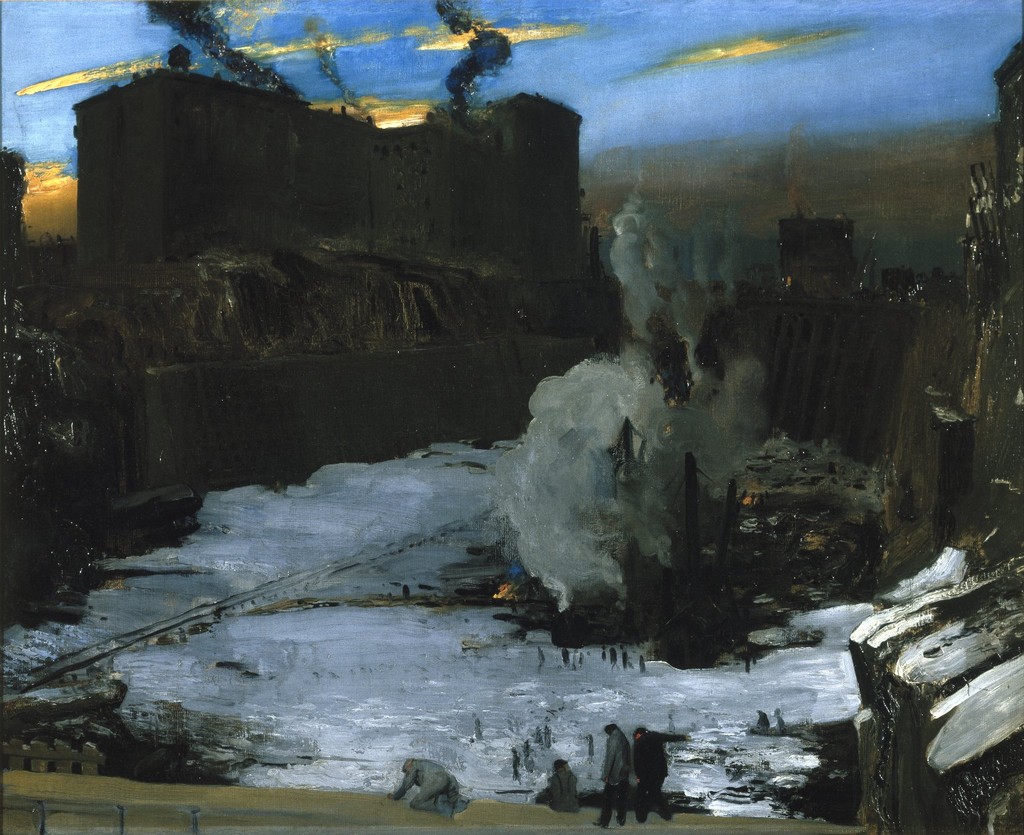
George Bellows’s Pennsylvania Station Excavation looks down into a winter construction pit where New York is being dismantled and rebuilt at once. Snow spreads across the exposed ground, smoke and steam rise through the cold air, and labourers appear perilously small beside the cut earth and machinery. Dated about 1907–1908, this is the oil painting in the Brooklyn Museum, accession 67.205.1, and one of four canvases Bellows devoted to the station project.[1]
At a Glance
- ArtistGeorge Bellows (1882–1925)
- TitlePennsylvania Station Excavation
- Date and mediumc. 1907–1908, oil on canvas
- Dimensions79.2 × 97.1 cm (31 3/16 × 38 1/4 in.)
- CollectionBrooklyn Museum, A. Augustus Healy Fund, 67.205.1
- Series contextOne of four paintings made between 1907 and 1909
George Bellows in context
Pennsylvania Station Excavation
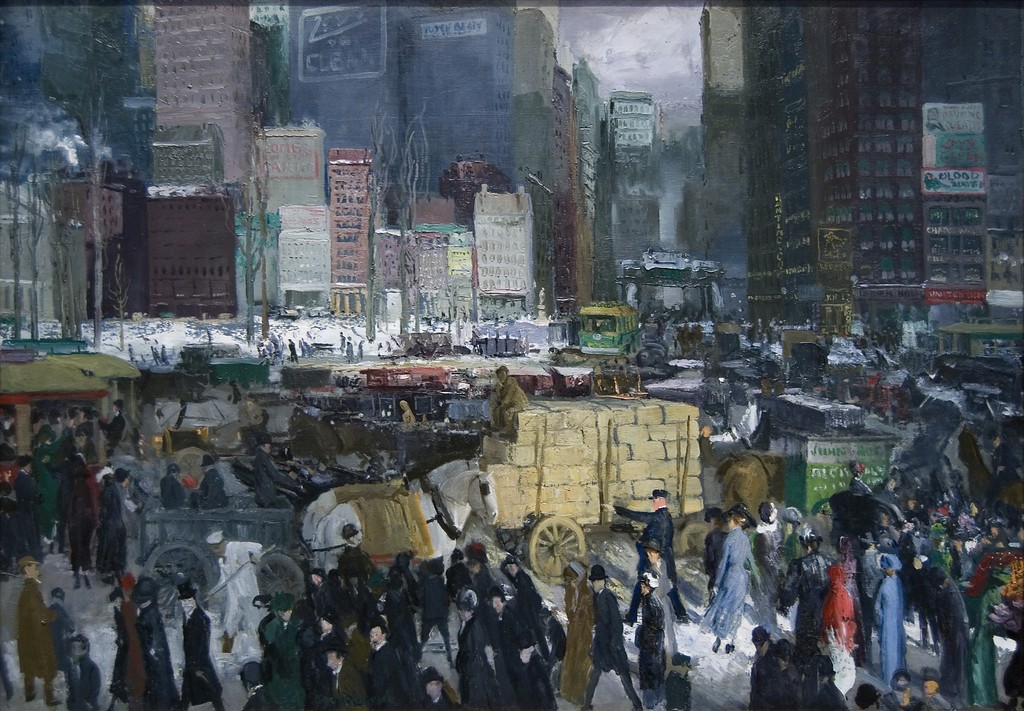
c. 1907–08New York
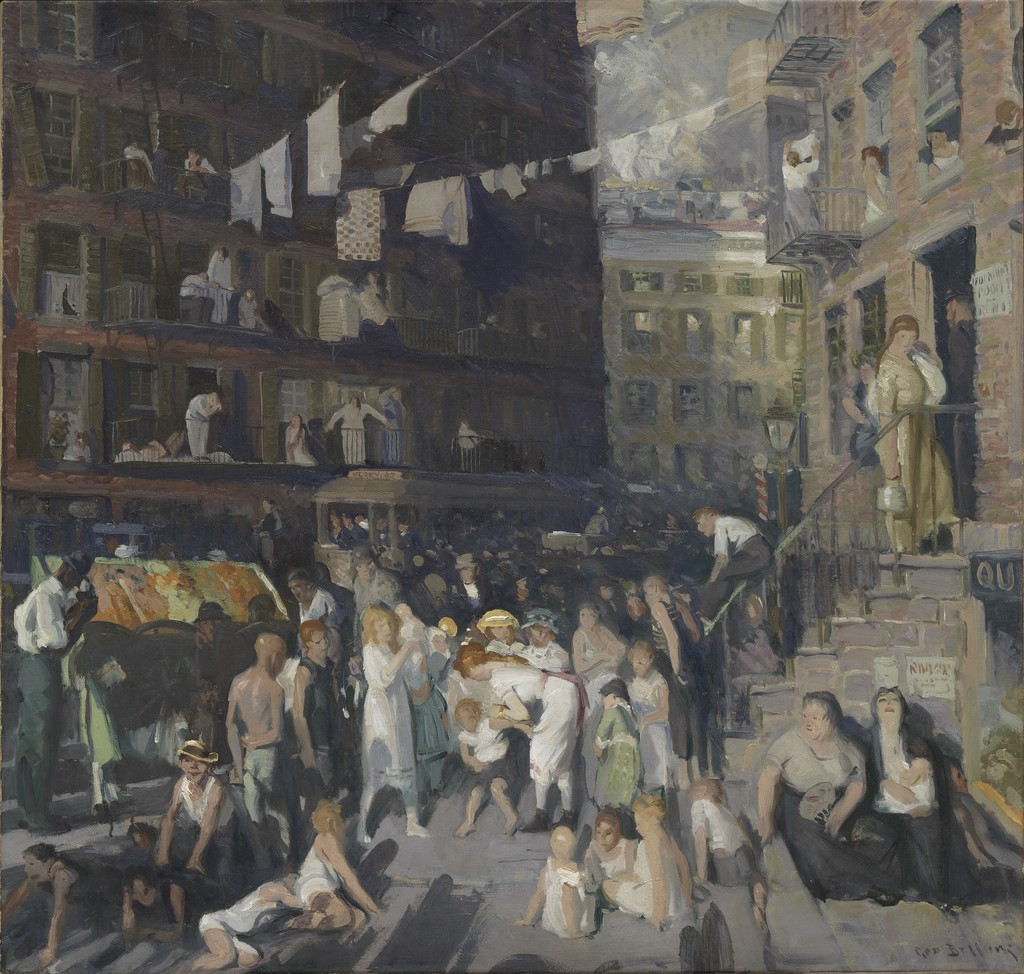
1911Cliff Dwellers
1913My Family
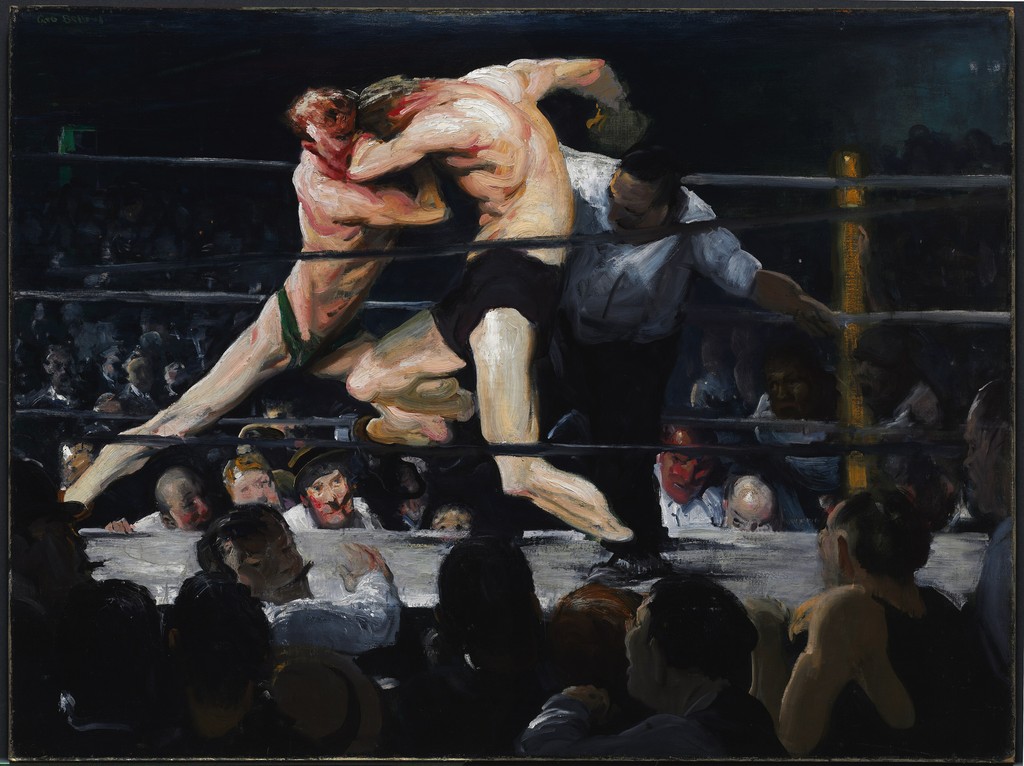
1916A Stag at Sharkey's
1917Dempsey and Firpo
1924Contents
- Introduction
- The Exact Brooklyn Museum Painting
- Before the Station Rose
- An Elevated View into the Pit
- Snow, Smoke and an Acidic Sky
- Labour at the Edge of Visibility
- Progress Without a Triumph
- Four Canvases, One Construction Project
- Opening in 1910, Demolition in 1963
- How to Look at Pennsylvania Station Excavation
The Exact Brooklyn Museum Painting
The Brooklyn Museum records the work under Bellows’s full name, George Wesley Bellows. The canvas is unsigned and held through the A. Augustus Healy Fund. Its date is approximate rather than a single documented year, so c. 1907–1908 is the precise form to retain. The museum also identifies the picture as one member of a four-canvas group made during 1907–1909.[1]
That distinction matters because “Pennsylvania Station excavation” can describe a building site, a recurring Bellows subject or this particular object. The other canvases record related views and moments, but they are separate works. Bellows painted this pit while the original station was being built, not during its later destruction.
At just under a metre wide, the painting suggests a chasm far beyond its own size. Viewpoint and contrasts of scale produce that expansion.
Before the Station Rose
The excavation occupied two midtown blocks, from West 31st to West 33rd Street and from Seventh to Eighth Avenue. A larger engineering scheme brought rail connections beneath the Hudson River, ending the ferry transfer for passengers travelling between New Jersey and Manhattan. McKim, Mead & White designed the Beaux-Arts terminal.[2]
Bellows left Columbus for New York in 1904. There he joined Robert Henri’s classes at the New York School of Art. Henri’s emphasis on contemporary experience directed the young painter towards street life, prizefights and work sites. The station pictures contributed to Bellows’s early reputation.[3] The George Bellows biography places this burst of work within his wider career.
Clearing the site displaced thousands of Tenderloin residents, including African American communities and recent immigrants. A Brooklyn Museum curator stresses that the transport hub changed the neighbourhood socially as well as physically.[2] The painting does not identify those residents, but this history prevents the pit from being read as vacant ground awaiting improvement.
An Elevated View into the Pit
Bellows positions the viewer above the excavation, looking down across its near edge. The foreground offers no welcoming street or stable platform. Instead, a narrow ledge and several larger figures establish the brink before the land falls away. Dark retaining walls close the site from both sides, while block-like buildings loom against the horizon. The pit opens between them as a broad, irregular basin.
This vantage point makes human effort visible without granting the labourers dominance. Four workers perch near the margins, and further figures diminish into marks across the snow.[2] Their bodies measure distance until the site itself becomes the principal force.
A vertical plume near the centre partly hides the machinery beneath it. Crane or steam-shovel elements rise through the vapour, yet no device becomes a heroic emblem of engineering. Fragmented among earth, shadow and smoke, technology never resolves the site into orderly progress.
Snow, Smoke and an Acidic Sky
Winter sharpens every contrast. Snow covers much of the pit with blue-white and grey passages, but it is mixed visually with churned soil, slush and tracks. Rather than purifying the site, the pale ground reveals how thoroughly it has been cut and worked. Broad, vigorous strokes keep the surface unsettled.[1][2]
Above it, buildings mass into almost black silhouettes. The sky moves from cold blue towards yellow and gold near the horizon, cut by dark smoke. Steam rises opaquely from the pit, connecting underground labour to the atmosphere while obscuring its source.
The palette is restrained but not colourless. Blue in the snow and sky, yellow at the horizon, grey-white vapour and scattered fire-orange accents compete with large areas of brown-black. Warm notes promise neither comfort nor sunrise; they flicker within an otherwise chilled scene. Bellows’s paintings often use such tonal oppositions to make weather and material conditions active parts of a subject.
Labour at the Edge of Visibility
The workers are indispensable, yet Bellows gives them little individual description. One bends low near the foreground edge; others stand, crouch or cross the snowy floor. Their postures communicate exertion and exposure more clearly than identity. They occupy a dangerous place but do not become portraits of named heroic builders.
Scale produces the social meaning. The labourers made the excavation, as the Brooklyn Museum notes, but the opening they created now dwarfs them.[1] That reversal turns construction into a bodily problem: people must descend, keep balance on cut ground, work around heat and vapour, and move through a site whose limits exceed any one figure’s control.
Bellows also withholds the crowds familiar from New York and Cliff Dwellers. Here separation replaces congestion. Distance between figures gives the pit an eerie emptiness, even though strenuous activity is occurring. The scene asks the viewer to notice workers without pretending to know more about them than the painting or museum sources establish.
Progress Without a Triumph
The Brooklyn Museum describes the painting’s atmosphere as “infernal” and relates that interpretation to Bellows’s possible ambivalence about the city’s rapid transformation.[1] This is curatorial analysis, not a surviving declaration by the artist. The visual evidence supports it: smoke rises from a dark cavity, fires burn below ground level, and massive walls enclose figures who seem exposed to forces larger than themselves.
Yet the image is not simply anti-technology. Bellows chose an ambitious engineering project and returned to it four times. The station promised direct rail access and a transformed midtown district.[2] What the Brooklyn canvas resists is the idea that modernisation arrives cleanly. Destruction, displacement, winter labour and mechanical power are not preliminary details to be forgotten once the building opens; they are the entire visible subject.
This tension links the picture to Bellows’s broader New York City paintings. He repeatedly found modern life at unstable boundaries—waterfronts, demolition zones, bridges, streets and rings—where bodies contend with structures and one form of city replaces another.
Four Canvases, One Construction Project
Bellows completed four paintings of the Penn Station construction site between 1907 and 1909.[1] The Brooklyn work belongs within that sequence, but “one of four” does not mean four copies. A sustained subject allowed him to alter viewpoint, illumination and the relative emphasis placed on the pit, machinery and workers.
Its high view, snowy basin and central vapour are choices within a continuing investigation, not the site’s only possible appearance. The city has been opened, but the celebrated terminal has not yet supplied a façade.
Bellows did not remain confined to excavations. Cliff Dwellers, shown at the 1913 Armory Show, centred another city composition on street and tenement life.[4] Here, by contrast, people disperse into depth and interrupted ground commands attention.
Opening in 1910, Demolition in 1963
Two historical moments must remain separate. Bellows’s canvas belongs to the building campaign that produced the original Pennsylvania Station, which opened in 1910. More than half a century later, that McKim, Mead & White terminal was demolished in 1963.[1][2] The painting does not depict or anticipate that demolition as an event.
Knowledge of the building’s later fate nevertheless changes the modern viewer’s experience. We look at earth cleared for an architecture that was itself eventually cleared away. That second loss adds hindsight, but it should not overwrite the first subject: workers and machinery transforming midtown during the station’s construction. The image is evidence of an unfinished phase, not an illustration of the terminal’s whole history.
How to Look at Pennsylvania Station Excavation
Begin with the near ledge and follow the descending scale of figures into the snow. Then trace the dark walls on either side until they make the open ground feel enclosed. Notice how the central vapour hides as much as it reveals, and how smoke above the skyline echoes steam rising from below.
Finally, compare the luminous sky with the nearly black architecture. The strongest light does not fall on a completed monument. It exposes a raw interval between what has been removed and what will be built. That interval—productive, destructive and unresolved—is the painting’s true subject.
Researched works directory
This searchable evidence census was assembled from public museum records and a reproducible Wikidata snapshot. It is not a catalogue raisonné, not a claim to complete oeuvre coverage, and not a substitute for the published catalogue literature, which was not used to claim absolute completeness.
| Name | Date | Medium |
|---|---|---|
| A Cloudy Day / Hudson River: Coming Squall | 1908 | Painting |
| A Day in June | 1913 | Painting |
| A Fresh Breeze | 1913 | Painting |
| A Grandmother | 1914 | Painting |
| A Knockout | 1921 | |
| A Morning Snow--Hudson River | 1910 | Painting |
| A Stag at Sharkey's | 1917 | |
| A Winter Day - Under the Elevated near Brooklyn Bridge | 1907 | Painting |
| Allan Donn Puts to Sea | 1923 | |
| An Irish Girl | 1922 | Drawing |
| Anne | 1915 | Painting |
| Anne 1921 | 1923 | |
| Anne and Her Mother | 1917 | Drawing |
| Anne in Black Velvet | 1917 | Painting |
| Anne in White | 1920 | Painting |
| Anne with a Japanese Parasol | 1917 | Painting |
| Approach of Rain | 1913 | Painting |
| Approach to the Bridge at Night | 1913 | Painting |
| Arms of a Boxer | 1916 | Drawing |
| Artists' Evening | 1916 | |
| August Lundberg (No 2) | 1907 | Painting |
| Aunt Fanny | 1920 | Painting |
| Barnyard and Chickens | 1924 | Painting |
| Bethesda Fountain (Fountain in Central Park) | 1905 | Painting |
| Between Rounds, large, first stone | 1916 | |
| Between Rounds, small, second stone | 1923 | |
| Blue Morning | 1909 | Painting |
| Blue Snow, the Battery | 1910 | Painting |
| Both Members of This Club | 1909 | Painting |
| Boy in a Blue Coat | 1915 | Painting |
| Boy with Eton Collar (Portrait of Meredith Hare) | 1921 | Painting |
| Breaking Sky, Monhegan | 1916 | Painting |
| Bridge, Blackwell’s Island | 1909 | Painting |
| Builders of Ship | 1916 | Painting |
| California Headlands | 1917 | Painting |
| Caricature of Adam and Eve and Two Female Portrait Sketches | Date unknown | Drawing |
| Central Park | 1905 | Painting |
| Chester Dale | 1922 | Painting |
| Children Playing in a Park | 1905 | Drawing |
| Cleaning Fish | 1913 | Painting |
| Cliff Dwellers | 1913 | Painting |
| Cliffs | Date unknown | Painting |
| Club Night | 1907 | Painting |
| Coming Storm | 1914 | Painting |
| Coopers Lake, Woodstock | 1924 | Painting |
| Counted Out, first stone | 1921 | |
| Counted Out, second stone | 1921 | |
| Criehaven Wharf | 1916 | Painting |
| Cross-Eyed Boy | Date unknown | Painting |
| Dance in a Madhouse | 1917 | |
| Dancing Town (The Top of the World) | 1922 | Drawing |
| Dempsey and Firpo | 1923 | |
| Dempsey and Firpo | 1924 | Painting |
| Dempsey through the Ropes | 1923 | |
| Dempsey Through the Ropes | Date unknown | Painting |
| Deserted Factory | 1924 | Painting |
| Dock Builders | 1916 | Painting |
| Edge of the Pasture - Glow of the Sun | 1916 | Painting |
| Edith Cavell | 1918 | Painting |
| Elinor, Jean and Anna | 1920 | Painting |
| Elsie, Emma and Marjorie, First Stone | 1921 | |
| Elsie, Emma and Marjorie, second stone | 1921 | |
| Elsie Reading to Emma, First Stone | 1921 | |
| Elsie Reading to Emma, Second Stone | 1921 | |
| Elsie Speicher [verso] | 1920 | Drawing |
| Emma and Her Children | 1923 | Painting |
| Emma at the Piano | 1914 | Painting |
| Emma at the Window | 1920 | Painting |
| Emma, Elsie and Gene | 1921 | |
| Emma in a Purple Dress | 1920 | Painting |
| Emma in the Black Print | 1919 | Painting |
| Emma in the Purple Dress | 1919 | Painting |
| Evening Blue | 1916 | Painting |
| Evening Swell | 1911 | Painting |
| Excavation at Night | 1908 | Painting |
| Family in a Surrey | 1921 | Drawing |
| Fern Woods | Date unknown | Painting |
| Five Cows | 1919 | Painting |
| Floating Ice | 1910 | Painting |
| Florence Davey | 1914 | Painting |
| Fog Breakers | 1913 | Painting |
| Forty-two Kids | 1907 | Painting |
| Frankie, the Organ Boy | 1907 | Painting |
| Garaldine Lee, No. 2 | 1914 | Painting |
| Gardiner's Bay from Sag Harbor | 1899 | Painting |
| Ghost of Sergeant Pelly | 1918 | Drawing |
| Golf Course, California | 1917 | Painting |
| Gorge and Sea | 1911 | Painting |
| Grandma Bellows | 1919 | Painting |
| Gray Sea | 1913 | Painting |
| Harbor of Monhegan, Fish Boats | 1911 | Painting |
| Haystacks and Barn | 1909 | Painting |
| Head of Boy (aka Gray Boy) | 1905 | Painting |
| Hungry Dogs, second stone | 1916 | |
| Hunter and Mountains | 1920 | Painting |
| In a Rowboat | 1916 | Painting |
| In an Elevator | 1916 | |
| In the Park, Dark | 1916 | |
| Introducing Georges Carpentier | 1921 | |
| Introducing John L. Sullivan | 1916 | |
| Introducing John L. Sullivan | 1923 | Painting |
| Introducing the Champion | 1916 | |
| Introductions | 1921 | |
| Jackie (Jacqueline Hudson) | 1914 | Painting |
| Jean 1923 | 1923 | |
| Jean in a Black Hat | 1923 | |
| Jean with Blue Book and Apple | 1916 | Painting |
| Jim Twadell's Place | 1924 | Painting |
| Julie Hudson | 1914 | Painting |
| Katherine Rosen | 1921 | Painting |
| Kids | 1906 | Painting |
| Lady Jean | 1924 | Painting |
| Lady of 1860 - The Actress | 1922 | Drawing |
| Lady with a Fan | 1921 | |
| Launching | 1913 | Painting |
| Little Girl in White (Queenie Burnett) | 1907 | Painting |
| Love of Winter | 1914 | Painting |
| Lychnis and Her Sons | 1923 | |
| Madeline Davis | 1914 | Painting |
| Man and Dog | 1905 | Painting |
| Matinicus | 1916 | |
| Maud Dale | 1919 | Painting |
| May Day in Central Park | 1905 | Painting |
| Men of the Docks | 1912 | Painting |
| Mill Dam | 1924 | Painting |
| Miss Bentham | 1906 | Painting |
| Monhegan Island | 1913 | Painting |
| Mother and Children | 1916 | |
| Mother and Children, Second State | 1916 | |
| Mountain Farm | 1922 | Painting |
| Mr. and Mrs. Phillip Wase | 1924 | Painting |
| Mrs. Chester Dale | 1919 | Painting |
| Mrs. T. in Cream Silk, No.1 | 1919 | Painting |
| Mrs. T. in Cream Silk, No.2 | 1920 | Painting |
| Mrs. Walter H. Richter | 1922 | Painting |
| Murder of Edith Cavell | 1918 | |
| My Family | 1916 | Painting |
| My Mother | 1921 | Painting |
| New York | 1911 | Painting |
| North River | 1908 | Painting |
| Nude Girl, Miss Leslie Hall | 1909 | Painting |
| Nude Girl Reclining | 1919 | Drawing |
| Nude Study, Girl Standing on One Foot | 1923 | |
| Nude with Fan | 1920 | Painting |
| Nude with Hexagonal Quilt | 1924 | Painting |
| Nude with Parrot | 1915 | Painting |
| Nude with Red Hair | 1920 | Painting |
| Old Barn, Grey Day | 1920 | Painting |
| Old Fisherman | 1904 | Painting |
| Ox Team, Wharf at Matinicus | 1916 | Painting |
| Paddy Flannigan | 1908 | Painting |
| Padre | 1917 | Painting |
| Paradise Point | 1919 | Painting |
| Pennsylvania Station Excavation | c. 1907–1908 | Painting |
| Pigs and Donkey | 1920 | Painting |
| Polo at Lakewood | 1910 | Painting |
| Portrait of a Boy | 1921 | Painting |
| Portrait of a Laughing Boy | 1907 | Painting |
| Portrait of Florence Budd | 1914 | Painting |
| Portrait of Florence Pierce | 1914 | Painting |
| Portrait of Geraldine Lee, No. 1 | 1914 | Painting |
| Portrait of My Mother No. 1 | 1921 | Painting |
| Portrait of Prosper Invernizzi | 1907 | Painting |
| Portrait of Walter Littlefield | 1915 | Painting |
| Porträt der Anne | 1915 | Painting |
| Porträt der Laura | 1922 | Painting |
| Prayer Meeting, second stone | 1916 | |
| Preliminaries | 1916 | |
| Preliminaries | Date unknown | |
| Pueblo Tesuque, No. 2 | 1917 | Painting |
| Rain on the River | 1908 | Painting |
| Return of the Useless | 1918 | Painting |
| River Front No. 1 | 1914 | Painting |
| Rock Bound | 1913 | Painting |
| Rock Reef, Maine | 1913 | Painting |
| Rock Ridge Farm | Date unknown | Painting |
| Rocks and Coast | 1911 | Painting |
| Rolling Breakers | 1913 | Painting |
| Romance of Autumn | 1916 | Painting |
| Romance of Criehaven | 1916 | Painting |
| Roumanian Girl | 1921 | Painting |
| Samuel Knopf | 1922 | Painting |
| Santuario de Chimata | 1917 | Painting |
| Seated Female Nude (Emma Story Bellows) | Date unknown | Drawing |
| Seated Nude | 1910 | Painting |
| Self-Portrait | 1921 | |
| Shipyard Society | 1916 | Painting |
| Sixteen East Gay Street | 1923 | |
| Sketches of Heads, Including One of Chester Dale | Date unknown | Drawing |
| Sketches of Three Female Heads [recto] | Date unknown | Drawing |
| Snow-Capped River | 1911 | Painting |
| Snow Dumpers | 1911 | Painting |
| Society Ball [verso] | 1907 | Drawing |
| Splinter Beach | 1916 | |
| Stag at Sharkey's | 1909 | Painting |
| Steaming Streets | 1908 | Painting |
| Storm Sea | 1913 | Painting |
| Street Fight [recto] | 1907 | Drawing |
| Studies of Jean | 1920 | Drawing |
| Study for "Mr. and Mrs. Philip Wase | 1924 | Drawing |
| Study for Nude with Hexagonal Quilt | 1924 | Drawing |
| Study for "Riverfront No. 1 | 1915 | Drawing |
| Study of Emma and the Children | 1917 | Painting |
| Summer City | 1909 | Painting |
| Summer Fantasy | 1924 | Painting |
| Summer Night, Riverside Drive | 1909 | Painting |
| Sun Glow | 1913 | Painting |
| Sun Shadows (Rocks at Monhegan) | 1913 | Painting |
| Sunday 1897 | 1921 | |
| Sunlit surf | 1913 | Painting |
| Swans in Central Park | 1906 | Painting |
| Tennis | 1920 | |
| Tennis at Newport | 1919 | Painting |
| Tennis at Newport | 1920 | Painting |
| Tennis Tournament | 1920 | Painting |
| The Barricade | 1918 | Painting |
| The Beach, Newport (In the Sand) | 1919 | Painting |
| The Big Dory | 1913 | Painting |
| The Black Derby / Head of a man with a red nose | 1905 | Painting |
| The Brook | Date unknown | Painting |
| The Charge | 1918 | |
| The Cigarette | 1918 | |
| The Coming Storm | 1916 | Painting |
| The Dock | 1913 | Painting |
| The Donkey Cart | 1922 | Drawing |
| The Fish Wharf, Matinicus Island | 1916 | Painting |
| The Fisherman | 1917 | Painting |
| The Germans Arrive | 1918 | Painting |
| The Grove — Monhegan | 1911 | Painting |
| The Gulls, Monhegan | 1911 | Painting |
| The Harbor, Monhegan Coast, Maine | 1913 | Painting |
| The Kindliness Came Not from Her | 1922 | Drawing |
| The Launching | Date unknown | Painting |
| The Law Is Too Slow | 1923 | |
| The Lone Tenement | 1909 | Painting |
| The Newsboy | 1908 | Painting |
| The Novitiate | 1916 | |
| The Palisades | 1909 | Painting |
| The Red Vine, Matinicus Island, Maine | 1916 | Painting |
| The Sand Cart | 1917 | Painting |
| The Sea | 1911 | Painting |
| The Shower-Bath | 1917 | |
| The Studio | 1919 | Painting |
| The Teamster | 1916 | Painting |
| The Tournament | 1920 | |
| The Village Houses | 1920 | Painting |
| The Warships | 1909 | Painting |
| The White Hope | 1921 | |
| The White Horse | 1922 | Painting |
| The Widow | 1917 | Painting |
| Three Children | 1919 | Painting |
| Three Pigs and a Mountain | 1922 | Painting |
| Three Rollers | 1911 | Painting |
| Through the Trees, Monhegan Island, Maine | 1913 | Painting |
| Tumble of Waters | 1913 | Painting |
| Two Girls | 1917 | |
| Two Women | 1924 | Painting |
| Up the Gorge | 1913 | Painting |
| Up the Hudson | 1908 | Painting |
| Village on the Hill | 1916 | Painting |
| Vine Clad Shore--Monhegan Island | 1913 | Painting |
| Waldo Peirce | 1920 | Painting |
| War Series | 1918 | Painting |
| West Wind | 1913 | Painting |
| Willard in Training Quarters | 1916 | |
| Winter Afternoon, Riverside Park | 1909 | Painting |
| Winter Road | 1912 | Painting |
| Woodstock Road, Woodstock, New York | 1924 | Drawing |
Frequently Asked Questions
The Brooklyn Museum dates the oil painting to about 1907–1908. Bellows produced the four related Penn Station canvases between 1907 and 1909.[1]
It belongs to the Brooklyn Museum through the A. Augustus Healy Fund. Its accession number is 67.205.1, and the museum records it as an unsigned oil on canvas.[1]
He made four canvases devoted to the construction project. The Brooklyn painting is one distinct member of that group, not a collective title for all four.[1]
It shows the midtown excavation during construction of the original Pennsylvania Station. From above, workers, machinery, snow, fire, steam and smoke occupy a vast pit between dark buildings. The completed station is not the subject.[1][2]
Discussion
Use this evidence-led guide as a starting point for close looking rather than a final verdict.
Share an observation about Pennsylvania Station Excavation or a source that adds useful context.
Reader Insights
Which detail most changes your reading of Pennsylvania Station Excavation?
How do scale, support, medium or present museum evidence shape the encounter?
What remains uncertain when visual inference is separated from documented fact?
Join the Conversation
Add your reading below, keeping observations specific and evidence clear.
References
- Brooklyn Museum, “Pennsylvania Station Excavation”, accessed 31 August 2026.
- Margarita Karasoulas and Steven Zucker, “George Bellows, Pennsylvania Station Excavation”, Smarthistory with the Brooklyn Museum, accessed 31 August 2026.
- National Gallery of Art, “George Bellows”, accessed 31 August 2026.
- LACMA, “From the Collection: Cliff Dwellers”, accessed 31 August 2026.