


 by Tom Gurney
Tom Gurney BSc (Hons) is an art history expert with over 20 years experience
/
Email: tomgurney1@gmail.com / Phone: +44 7429 011000
George Bellows Paintings: Introduction
George Bellows made paintings that seem to arrive all at once: a prizefighter lunges, a street surges, surf strikes rock. Yet the energy of his brushwork is only half the story. Across city views, boxing scenes, portraits and landscapes, Bellows repeatedly balanced immediate sensation with deliberate choices about viewpoint, colour and structure.
Selected George Bellows paintings
At a Glance
- ArtistGeorge Bellows (1882–1925)
- Principal painting mediumOil on canvas and panel
- Early subjectsNew York streets, construction sites, riverfronts and boxing clubs
- Later rangePortraits, family groups, landscapes and seascapes
- Characteristic tensionVigorous, visible brushwork held within strongly organised compositions
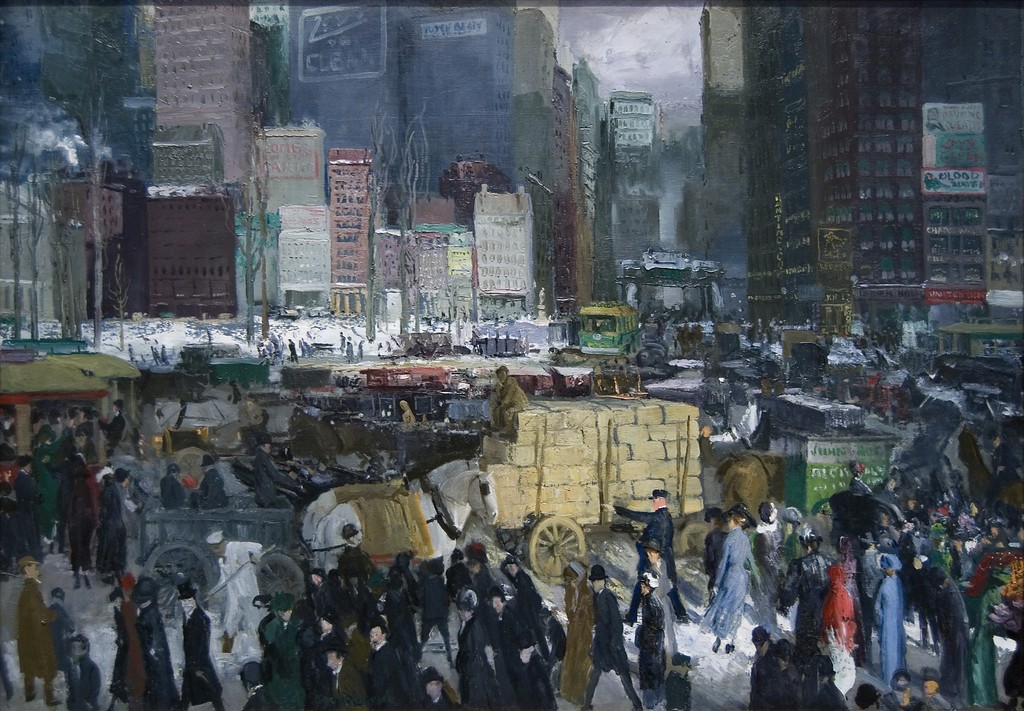
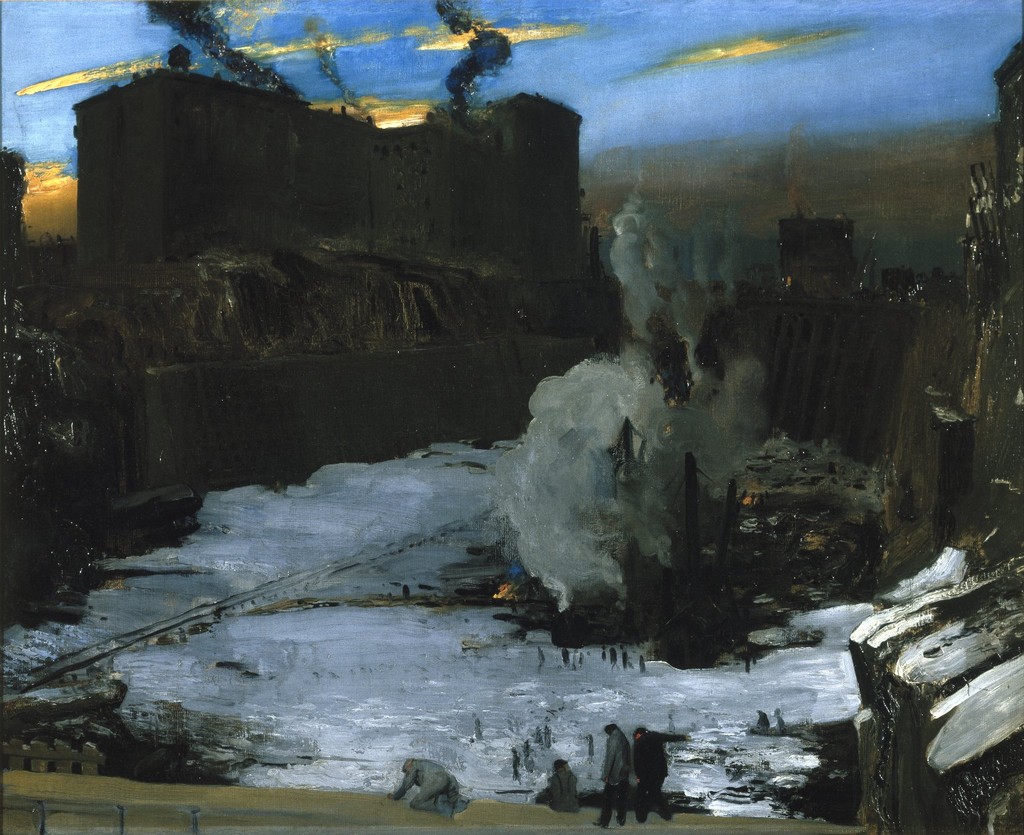
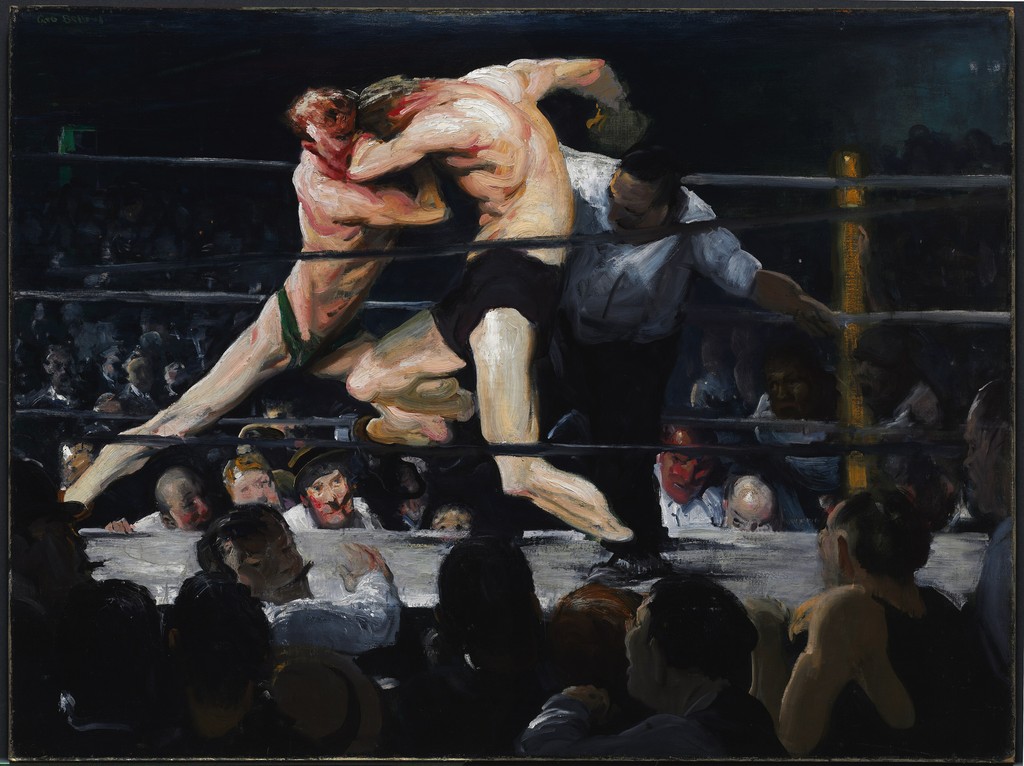
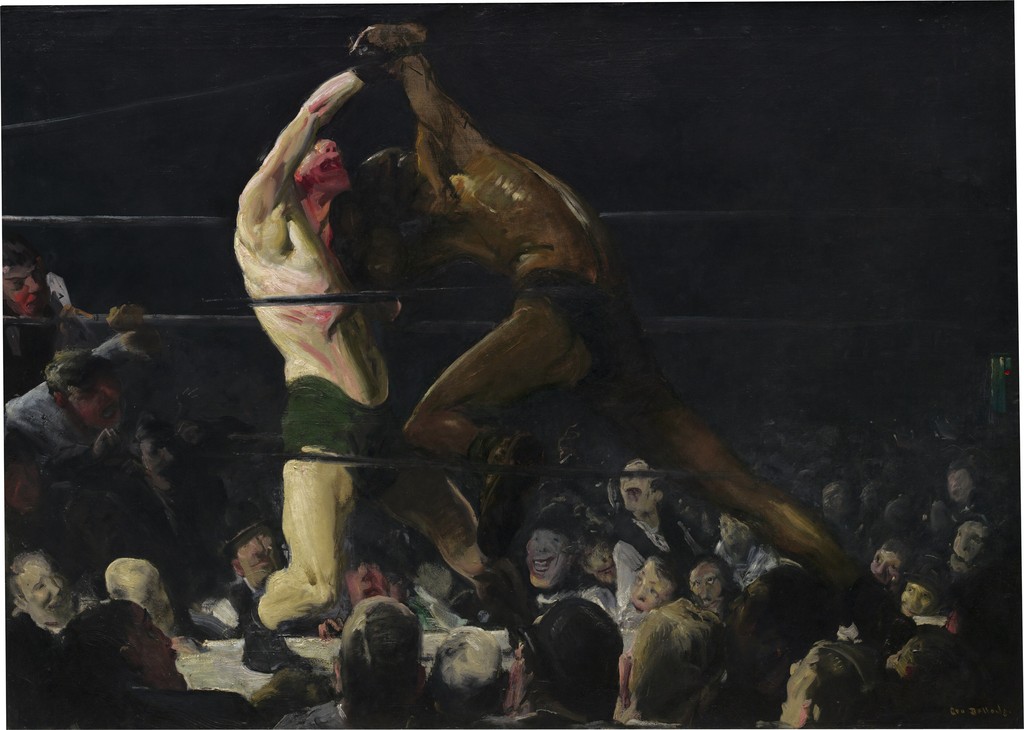
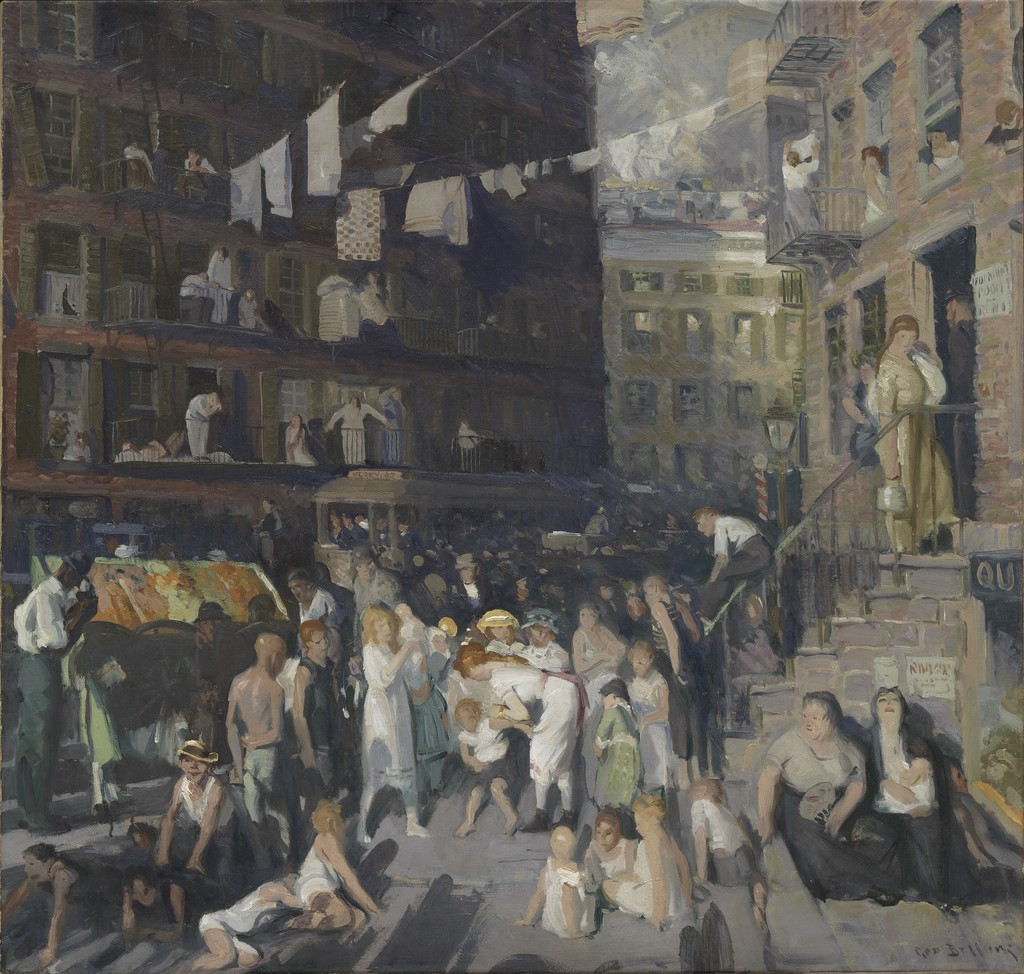
- Key paintingsPennsylvania Station Excavation, Stag at Sharkey's, Both Members of This Club, New York and Cliff Dwellers
Contents
- Introduction
- A Painting Practice Broader Than One Label
- The City as Construction and Collision
- Boxing: Bodies, Spectators and Artificial Light
- Colour Systems and Hidden Geometry
- Portraits and Family as Experiments
- Landscape and the Force of the Coast
- Speed Versus Structure
- How to Look at a Bellows Painting
A Painting Practice Broader Than One Label
Bellows is often introduced through the dark-toned realism associated with Robert Henri and the Ashcan circle. That connection is useful, but it does not describe the whole career. His early reputation rested on club fights, city children and excavation sites; after 1910, portraits, landscapes and seascapes became increasingly prominent, while his palette and compositional methods changed.[1] The Smithsonian American Art Museum also stresses that he was sympathetic to the Ashcan painters without having taken part in the 1908 exhibition of The Eight.[2]
Painting remained the place where Bellows tested an unusually wide range of visual problems. He could make human bodies collide under harsh artificial light, spread a city crowd across a broad horizontal field, or compress ocean, rock and sky into a small panel. The Metropolitan Museum of Art's retrospective account treats these subjects as parts of one restless practice rather than a simple march away from urban realism.[3] The continuity lies less in subject than in his search for forces: weight against weight, light against darkness, a figure against a crowd, or water against land.
The City as Construction and Collision
Bellows did not paint New York only as a finished skyline. He repeatedly looked at unstable spaces where demolition, labour and new infrastructure exposed the city's workings. The Brooklyn Museum's Pennsylvania Station Excavation, dated about 1907–1908, is one of four canvases Bellows devoted to the project. Tiny workers occupy the edges of a winter pit, while steam, smoke and earth turn modern construction into a scene of dangerous scale.[4] The work is not a neutral record of every phase of the excavation. Its elevated viewpoint, dark palette and emphatic contrasts make transformation itself the subject.
That distinction becomes even clearer in New York (1911), now at the National Gallery of Art. The view suggests Madison Square, but Bellows combined details from several commercial districts into an imaginary composite. Carriages, streetcars, pedestrians and buildings press into a space that could not exist exactly as shown.[5] Broad strokes make individual incidents difficult to isolate, while small accents of red, yellow, green and white keep the eye moving. Apparent eyewitness immediacy is therefore produced through selection and rearrangement.
His city paintings also attend to people whose leisure unfolds beside industrial New York. In Forty-two Kids (1907), boys occupy a dilapidated East River wharf, diving, sprawling and smoking. The National Gallery records both the painting's economy of means and its divided early reception: viewers praised its vitality while others attacked its drawing and proportions.[6] Such criticism helps explain what remains provocative in Bellows's crowds. Anatomical polish and orderly urban space give way to collective motion.
Boxing: Bodies, Spectators and Artificial Light
Bellows's boxing pictures are not simply illustrations of sport. They turn the ring into a theatre where fighters, spectators and the painter's marks all participate in the violence. Club Night (1907), the first of three closely related early boxing paintings, places the viewer behind a bank of heads. The fighters rise into hard light while faces emerge from a smoky darkness with only a few strokes.[7] The crowd is not background decoration: its grins, shadows and proximity make spectatorship part of the subject.
In Stag at Sharkey's (1909), the Cleveland Museum of Art's oil painting, the two boxers knot together above the ring as onlookers lean towards them. A “stag” was an outsider granted temporary membership so that a bout could proceed at a private club when public prizefighting was illegal in New York.[8] That legal fiction matters because Bellows paints an entertainment organised around controlled rule-breaking. The thrust of a leg, a bent torso and the enclosing ropes make physical force legible before the viewer identifies either fighter.
Both Members of This Club (1909), the current National Gallery title, brings racial conflict into that charged space. A Black boxer drives a white opponent backwards while the crowd appears almost fused to the action. The Gallery's scholarly entry cautions that attempts to link the scene to one specific match are unconvincing; it instead places the painting amid reactions to Jack Johnson's heavyweight championship and the racial antagonism of the period.[9] Bellows's distortions intensify the encounter, but the picture's social force depends on more than expressionistic handling. Ring, bodies and spectators are arranged so that no detached viewing position feels available.
Colour Systems and Hidden Geometry
The familiar contrast between an early “dark” Bellows and a later “colourful” Bellows is too neat. Even sombre city pictures contain strategic flashes of high colour, and his later works did not abandon tonal drama. What changed was his sustained investigation of colour theories associated with Hardesty Maratta and Denman Ross, followed later by Jay Hambidge's system of dynamic symmetry.[1]
Technical evidence from Cliff Dwellers (1913) makes that investigation concrete. LACMA's study cites Bellows's record-book notation of three Maratta colour “chords”: selected triads intended to establish harmony and mood. The museum also identifies regular pinholes and traces of lines that form a geometric scaffold beneath the busy street scene.[10] These findings demand a useful caution. It is reasonable to discuss measured structure in Bellows's work, but not every diagonal should be labelled dynamic symmetry, and the 1913 geometry should not automatically be attributed to Hambidge's later influence. In Cliff Dwellers, Maratta's colour and compositional ideas are the documented point of reference.
Portraits and Family as Experiments
Portraiture was not a quiet sideline to the public drama of streets and rings. It gave Bellows a different test of how figures occupy space. In the unfinished My Family (1916), Emma Bellows and the couple's daughters are placed beneath a striped awning in a dense Camden landscape. The National Gallery notes that the relationship between this canvas and a closely related version remains unclear. It also explains that Bellows was experimenting with plein-air portraiture and had difficulty resolving the balance between his family and their surroundings.[11] The uncertainty is revealing: the work records an ambitious experiment rather than an effortless domestic interlude.
Late portraits could be more enclosed and psychologically resistant. The Smithsonian's Mr. and Mrs. Phillip Wase (1924) shows Bellows's Woodstock neighbours posed apart in a grey parlour, with a small portrait hanging between them. The museum describes their detachment and identifies Mrs Wase as a cleaner and her husband as a gardener.[12] Broad handling remains visible, but motion is replaced by stillness, distance and the pressure of the room. The painting shows how Bellows could redirect his sense of bodily weight from athletic impact to social presence.
Landscape and the Force of the Coast
Maine changed the scale and rhythm of Bellows's painting without eliminating its physicality. The Metropolitan Museum estimates that the more than 250 seascapes and shore scenes he made between 1911 and 1917 account for half of his output as a painter. It also describes his practice of working outdoors on small panels, sometimes developing them into larger canvases, and applying colours wet into wet.[3] In the most compressed surf pictures, horizon and distance recede so that water, foam and rock behave almost like the colliding bodies in the boxing works.
Vine Clad Shore—Monhegan Island (1913), an oil on canvas in the Smithsonian American Art Museum, anchors that coastal practice to a specific surviving object.[13] Its subject belongs to a much larger body of Maine work, not a single excursion from the city. The coast offered Bellows shifting weather, resistant rock and repeated wave action—natural structures through which he could continue testing mass, rhythm and impact.
Speed Versus Structure
Bellows's surfaces encourage words such as rapid, raw and spontaneous. Those descriptions fit the visible brushwork, but they can obscure how his pictures are built. New York is a constructed composite; Cliff Dwellers preserves evidence of colour planning and geometry; the boxing paintings control viewpoint so tightly that the viewer is pressed into the crowd. Even wet-into-wet landscape painting involves decisions about panel size, horizon, cropping and the sequence in which colours meet.
The productive question is therefore not whether Bellows painted quickly or carefully. It is how he made preparation feel like an event. A blurred face may keep a crowd in motion, a sharp light-dark division may turn a ring into a stage, and a diagonal may direct the eye before its underlying geometry is noticed. The paintings gain force from the friction between a composed framework and marks that seem barely contained by it.
How to Look at a Bellows Painting
Begin with the viewpoint. Are you looking down into an excavation, across a ring, or directly at a seated figure? Then notice what blocks escape: ropes, buildings, crowds, rock faces or the edges of the canvas. Bellows often makes space feel compressed before revealing individual details.
Next, follow contrasts rather than trying to name every brushstroke. A pale body against blackness, a red accent inside a grey street, or white foam against dark rock may organise the entire picture. Finally, separate what seems observed from what has been designed. The scene may feel instantaneous while combining several locations, simplifying dozens of bodies or resting on a measured scaffold. That double awareness—event and construction held together—is central to the experience of Bellows's paintings.
Researched works directory
This searchable evidence census was assembled from public museum records and a reproducible Wikidata snapshot. It is not a catalogue raisonné, not a claim to complete oeuvre coverage, and not a substitute for the published catalogue literature, which was not used to claim absolute completeness.
| Name | Date | Medium |
|---|---|---|
| A Cloudy Day / Hudson River: Coming Squall | 1908 | Painting |
| A Day in June | 1913 | Painting |
| A Fresh Breeze | 1913 | Painting |
| A Grandmother | 1914 | Painting |
| A Knockout | 1921 | |
| A Morning Snow--Hudson River | 1910 | Painting |
| A Stag at Sharkey's | 1917 | |
| A Winter Day - Under the Elevated near Brooklyn Bridge | 1907 | Painting |
| Allan Donn Puts to Sea | 1923 | |
| An Irish Girl | 1922 | Drawing |
| Anne | 1915 | Painting |
| Anne 1921 | 1923 | |
| Anne and Her Mother | 1917 | Drawing |
| Anne in Black Velvet | 1917 | Painting |
| Anne in White | 1920 | Painting |
| Anne with a Japanese Parasol | 1917 | Painting |
| Approach of Rain | 1913 | Painting |
| Approach to the Bridge at Night | 1913 | Painting |
| Arms of a Boxer | 1916 | Drawing |
| Artists' Evening | 1916 | |
| August Lundberg (No 2) | 1907 | Painting |
| Aunt Fanny | 1920 | Painting |
| Barnyard and Chickens | 1924 | Painting |
| Bethesda Fountain (Fountain in Central Park) | 1905 | Painting |
| Between Rounds, large, first stone | 1916 | |
| Between Rounds, small, second stone | 1923 | |
| Blue Morning | 1909 | Painting |
| Blue Snow, the Battery | 1910 | Painting |
| Both Members of This Club | 1909 | Painting |
| Boy in a Blue Coat | 1915 | Painting |
| Boy with Eton Collar (Portrait of Meredith Hare) | 1921 | Painting |
| Breaking Sky, Monhegan | 1916 | Painting |
| Bridge, Blackwell’s Island | 1909 | Painting |
| Builders of Ship | 1916 | Painting |
| California Headlands | 1917 | Painting |
| Caricature of Adam and Eve and Two Female Portrait Sketches | Date unknown | Drawing |
| Central Park | 1905 | Painting |
| Chester Dale | 1922 | Painting |
| Children Playing in a Park | 1905 | Drawing |
| Cleaning Fish | 1913 | Painting |
| Cliff Dwellers | 1913 | Painting |
| Cliffs | Date unknown | Painting |
| Club Night | 1907 | Painting |
| Coming Storm | 1914 | Painting |
| Coopers Lake, Woodstock | 1924 | Painting |
| Counted Out, first stone | 1921 | |
| Counted Out, second stone | 1921 | |
| Criehaven Wharf | 1916 | Painting |
| Cross-Eyed Boy | Date unknown | Painting |
| Dance in a Madhouse | 1917 | |
| Dancing Town (The Top of the World) | 1922 | Drawing |
| Dempsey and Firpo | 1923 | |
| Dempsey and Firpo | 1924 | Painting |
| Dempsey through the Ropes | 1923 | |
| Dempsey Through the Ropes | Date unknown | Painting |
| Deserted Factory | 1924 | Painting |
| Dock Builders | 1916 | Painting |
| Edge of the Pasture - Glow of the Sun | 1916 | Painting |
| Edith Cavell | 1918 | Painting |
| Elinor, Jean and Anna | 1920 | Painting |
| Elsie, Emma and Marjorie, First Stone | 1921 | |
| Elsie, Emma and Marjorie, second stone | 1921 | |
| Elsie Reading to Emma, First Stone | 1921 | |
| Elsie Reading to Emma, Second Stone | 1921 | |
| Elsie Speicher [verso] | 1920 | Drawing |
| Emma and Her Children | 1923 | Painting |
| Emma at the Piano | 1914 | Painting |
| Emma at the Window | 1920 | Painting |
| Emma, Elsie and Gene | 1921 | |
| Emma in a Purple Dress | 1920 | Painting |
| Emma in the Black Print | 1919 | Painting |
| Emma in the Purple Dress | 1919 | Painting |
| Evening Blue | 1916 | Painting |
| Evening Swell | 1911 | Painting |
| Excavation at Night | 1908 | Painting |
| Family in a Surrey | 1921 | Drawing |
| Fern Woods | Date unknown | Painting |
| Five Cows | 1919 | Painting |
| Floating Ice | 1910 | Painting |
| Florence Davey | 1914 | Painting |
| Fog Breakers | 1913 | Painting |
| Forty-two Kids | 1907 | Painting |
| Frankie, the Organ Boy | 1907 | Painting |
| Garaldine Lee, No. 2 | 1914 | Painting |
| Gardiner's Bay from Sag Harbor | 1899 | Painting |
| Ghost of Sergeant Pelly | 1918 | Drawing |
| Golf Course, California | 1917 | Painting |
| Gorge and Sea | 1911 | Painting |
| Grandma Bellows | 1919 | Painting |
| Gray Sea | 1913 | Painting |
| Harbor of Monhegan, Fish Boats | 1911 | Painting |
| Haystacks and Barn | 1909 | Painting |
| Head of Boy (aka Gray Boy) | 1905 | Painting |
| Hungry Dogs, second stone | 1916 | |
| Hunter and Mountains | 1920 | Painting |
| In a Rowboat | 1916 | Painting |
| In an Elevator | 1916 | |
| In the Park, Dark | 1916 | |
| Introducing Georges Carpentier | 1921 | |
| Introducing John L. Sullivan | 1916 | |
| Introducing John L. Sullivan | 1923 | Painting |
| Introducing the Champion | 1916 | |
| Introductions | 1921 | |
| Jackie (Jacqueline Hudson) | 1914 | Painting |
| Jean 1923 | 1923 | |
| Jean in a Black Hat | 1923 | |
| Jean with Blue Book and Apple | 1916 | Painting |
| Jim Twadell's Place | 1924 | Painting |
| Julie Hudson | 1914 | Painting |
| Katherine Rosen | 1921 | Painting |
| Kids | 1906 | Painting |
| Lady Jean | 1924 | Painting |
| Lady of 1860 - The Actress | 1922 | Drawing |
| Lady with a Fan | 1921 | |
| Launching | 1913 | Painting |
| Little Girl in White (Queenie Burnett) | 1907 | Painting |
| Love of Winter | 1914 | Painting |
| Lychnis and Her Sons | 1923 | |
| Madeline Davis | 1914 | Painting |
| Man and Dog | 1905 | Painting |
| Matinicus | 1916 | |
| Maud Dale | 1919 | Painting |
| May Day in Central Park | 1905 | Painting |
| Men of the Docks | 1912 | Painting |
| Mill Dam | 1924 | Painting |
| Miss Bentham | 1906 | Painting |
| Monhegan Island | 1913 | Painting |
| Mother and Children | 1916 | |
| Mother and Children, Second State | 1916 | |
| Mountain Farm | 1922 | Painting |
| Mr. and Mrs. Phillip Wase | 1924 | Painting |
| Mrs. Chester Dale | 1919 | Painting |
| Mrs. T. in Cream Silk, No.1 | 1919 | Painting |
| Mrs. T. in Cream Silk, No.2 | 1920 | Painting |
| Mrs. Walter H. Richter | 1922 | Painting |
| Murder of Edith Cavell | 1918 | |
| My Family | 1916 | Painting |
| My Mother | 1921 | Painting |
| New York | 1911 | Painting |
| North River | 1908 | Painting |
| Nude Girl, Miss Leslie Hall | 1909 | Painting |
| Nude Girl Reclining | 1919 | Drawing |
| Nude Study, Girl Standing on One Foot | 1923 | |
| Nude with Fan | 1920 | Painting |
| Nude with Hexagonal Quilt | 1924 | Painting |
| Nude with Parrot | 1915 | Painting |
| Nude with Red Hair | 1920 | Painting |
| Old Barn, Grey Day | 1920 | Painting |
| Old Fisherman | 1904 | Painting |
| Ox Team, Wharf at Matinicus | 1916 | Painting |
| Paddy Flannigan | 1908 | Painting |
| Padre | 1917 | Painting |
| Paradise Point | 1919 | Painting |
| Pennsylvania Station Excavation | c. 1907–1908 | Painting |
| Pigs and Donkey | 1920 | Painting |
| Polo at Lakewood | 1910 | Painting |
| Portrait of a Boy | 1921 | Painting |
| Portrait of a Laughing Boy | 1907 | Painting |
| Portrait of Florence Budd | 1914 | Painting |
| Portrait of Florence Pierce | 1914 | Painting |
| Portrait of Geraldine Lee, No. 1 | 1914 | Painting |
| Portrait of My Mother No. 1 | 1921 | Painting |
| Portrait of Prosper Invernizzi | 1907 | Painting |
| Portrait of Walter Littlefield | 1915 | Painting |
| Porträt der Anne | 1915 | Painting |
| Porträt der Laura | 1922 | Painting |
| Prayer Meeting, second stone | 1916 | |
| Preliminaries | 1916 | |
| Preliminaries | Date unknown | |
| Pueblo Tesuque, No. 2 | 1917 | Painting |
| Rain on the River | 1908 | Painting |
| Return of the Useless | 1918 | Painting |
| River Front No. 1 | 1914 | Painting |
| Rock Bound | 1913 | Painting |
| Rock Reef, Maine | 1913 | Painting |
| Rock Ridge Farm | Date unknown | Painting |
| Rocks and Coast | 1911 | Painting |
| Rolling Breakers | 1913 | Painting |
| Romance of Autumn | 1916 | Painting |
| Romance of Criehaven | 1916 | Painting |
| Roumanian Girl | 1921 | Painting |
| Samuel Knopf | 1922 | Painting |
| Santuario de Chimata | 1917 | Painting |
| Seated Female Nude (Emma Story Bellows) | Date unknown | Drawing |
| Seated Nude | 1910 | Painting |
| Self-Portrait | 1921 | |
| Shipyard Society | 1916 | Painting |
| Sixteen East Gay Street | 1923 | |
| Sketches of Heads, Including One of Chester Dale | Date unknown | Drawing |
| Sketches of Three Female Heads [recto] | Date unknown | Drawing |
| Snow-Capped River | 1911 | Painting |
| Snow Dumpers | 1911 | Painting |
| Society Ball [verso] | 1907 | Drawing |
| Splinter Beach | 1916 | |
| Stag at Sharkey's | 1909 | Painting |
| Steaming Streets | 1908 | Painting |
| Storm Sea | 1913 | Painting |
| Street Fight [recto] | 1907 | Drawing |
| Studies of Jean | 1920 | Drawing |
| Study for "Mr. and Mrs. Philip Wase | 1924 | Drawing |
| Study for Nude with Hexagonal Quilt | 1924 | Drawing |
| Study for "Riverfront No. 1 | 1915 | Drawing |
| Study of Emma and the Children | 1917 | Painting |
| Summer City | 1909 | Painting |
| Summer Fantasy | 1924 | Painting |
| Summer Night, Riverside Drive | 1909 | Painting |
| Sun Glow | 1913 | Painting |
| Sun Shadows (Rocks at Monhegan) | 1913 | Painting |
| Sunday 1897 | 1921 | |
| Sunlit surf | 1913 | Painting |
| Swans in Central Park | 1906 | Painting |
| Tennis | 1920 | |
| Tennis at Newport | 1919 | Painting |
| Tennis at Newport | 1920 | Painting |
| Tennis Tournament | 1920 | Painting |
| The Barricade | 1918 | Painting |
| The Beach, Newport (In the Sand) | 1919 | Painting |
| The Big Dory | 1913 | Painting |
| The Black Derby / Head of a man with a red nose | 1905 | Painting |
| The Brook | Date unknown | Painting |
| The Charge | 1918 | |
| The Cigarette | 1918 | |
| The Coming Storm | 1916 | Painting |
| The Dock | 1913 | Painting |
| The Donkey Cart | 1922 | Drawing |
| The Fish Wharf, Matinicus Island | 1916 | Painting |
| The Fisherman | 1917 | Painting |
| The Germans Arrive | 1918 | Painting |
| The Grove — Monhegan | 1911 | Painting |
| The Gulls, Monhegan | 1911 | Painting |
| The Harbor, Monhegan Coast, Maine | 1913 | Painting |
| The Kindliness Came Not from Her | 1922 | Drawing |
| The Launching | Date unknown | Painting |
| The Law Is Too Slow | 1923 | |
| The Lone Tenement | 1909 | Painting |
| The Newsboy | 1908 | Painting |
| The Novitiate | 1916 | |
| The Palisades | 1909 | Painting |
| The Red Vine, Matinicus Island, Maine | 1916 | Painting |
| The Sand Cart | 1917 | Painting |
| The Sea | 1911 | Painting |
| The Shower-Bath | 1917 | |
| The Studio | 1919 | Painting |
| The Teamster | 1916 | Painting |
| The Tournament | 1920 | |
| The Village Houses | 1920 | Painting |
| The Warships | 1909 | Painting |
| The White Hope | 1921 | |
| The White Horse | 1922 | Painting |
| The Widow | 1917 | Painting |
| Three Children | 1919 | Painting |
| Three Pigs and a Mountain | 1922 | Painting |
| Three Rollers | 1911 | Painting |
| Through the Trees, Monhegan Island, Maine | 1913 | Painting |
| Tumble of Waters | 1913 | Painting |
| Two Girls | 1917 | |
| Two Women | 1924 | Painting |
| Up the Gorge | 1913 | Painting |
| Up the Hudson | 1908 | Painting |
| Village on the Hill | 1916 | Painting |
| Vine Clad Shore--Monhegan Island | 1913 | Painting |
| Waldo Peirce | 1920 | Painting |
| War Series | 1918 | Painting |
| West Wind | 1913 | Painting |
| Willard in Training Quarters | 1916 | |
| Winter Afternoon, Riverside Park | 1909 | Painting |
| Winter Road | 1912 | Painting |
| Woodstock Road, Woodstock, New York | 1924 | Drawing |
Frequently Asked Questions
Bellows worked chiefly in oil, using both canvas and panels. Museum records identify major canvases such as New York, Both Members of This Club and Cliff Dwellers, while the Metropolitan Museum also describes his direct painting on small panels, especially for outdoor work. His drawings and lithographs are separate parts of his practice and should not be treated as versions of the same object merely because they share a title.
His paintings are realist and strongly painterly, but their style changes across subjects and years. Early city and boxing works often use dark tonal masses and broad, visible strokes. Later portraits and landscapes explore brighter or more controlled colour, varied historical influences and increasingly explicit compositional systems.
Bellows is closely associated with the Ashcan circle because he studied with Robert Henri and painted ordinary urban life with directness. He was not, however, one of the artists in The Eight's 1908 exhibition. “Ashcan” is most useful for understanding his early New York context, not as a complete description of every painting he made.
Visible strokes, wet-into-wet colour, compressed spaces and strong light-dark contrasts all contribute. He also used carefully chosen viewpoints and, in documented cases such as Cliff Dwellers, planned colour relationships and geometric guides. The sense of speed is often the result of structure rather than its absence.
Essential examples include Pennsylvania Station Excavation (about 1907–1908), Stag at Sharkey's (1909), Both Members of This Club (1909), New York (1911) and Cliff Dwellers (1913). Forty-two Kids (1907), Club Night (1907), My Family (1916) and later portraits and coastal works broaden the view beyond those five landmarks.
Discussion
Use this evidence-led guide as a starting point for close looking rather than a final verdict.
Share an observation about George Bellows Paintings or a source that adds useful context.
Reader Insights
Which material decision best defines Bellows's practice in this group of works?
Where do you see observation and invention working together rather than as opposites?
Which work would you add to the selected group, and what would it change?
Join the Conversation
Add your reading below, keeping observations specific and evidence clear.
References
- National Gallery of Art, “George Bellows”, accessed 31 August 2026.
- Smithsonian American Art Museum, “George Bellows”, accessed 31 August 2026.
- The Metropolitan Museum of Art, “George Bellows”, accessed 31 August 2026.
- Brooklyn Museum, “Pennsylvania Station Excavation”, accessed 31 August 2026.
- National Gallery of Art, “New York”, accessed 31 August 2026.
- National Gallery of Art, “Forty-two Kids”, accessed 31 August 2026.
- National Gallery of Art, “Club Night”, accessed 31 August 2026.
- Cleveland Museum of Art, “Stag at Sharkey's”, accessed 31 August 2026.
- National Gallery of Art, “American Paintings, 1900–1945: Both Members of This Club, 1909”, accessed 31 August 2026.
- Los Angeles County Museum of Art, “George Bellows, Cliff Dwellers, 1913”, accessed 31 August 2026.
- National Gallery of Art, “American Paintings, 1900–1945: My Family, 1916”, accessed 31 August 2026.
- Smithsonian American Art Museum, “Mr. and Mrs. Phillip Wase”, accessed 31 August 2026.
- Smithsonian American Art Museum, “Vine Clad Shore—Monhegan Island”, accessed 31 August 2026.