 by Tom Gurney
Tom Gurney BSc (Hons) is an art history expert with over 20 years experience
/
Email: tomgurney1@gmail.com / Phone: +44 7429 011000
Portraits, Family and Maine: Introduction
George Bellows is so closely identified with New York crowds and boxing rings that his quieter subjects can look like a separate career. They are not. Portraits of his wife Emma and their daughters, paintings of the Maine coast and late works made around Woodstock gave him new ways to test colour, composition, character and the relationship between people and place.
At a Glance
- FamilyBellows married Emma Story in 1910; their daughters were Anne and Jean.[1]
- Portrait rangeFamily and friends, working people, commissioned sitters and self-portraits.[2]
- Maine visitsFive working visits beginning in 1911, with Monhegan Island a recurring focus.[3]
- Key family paintingMy Family (1916), an unfinished Camden portrait of Emma, Anne and Jean.[4]
- Key coastal paintingVine Clad Shore–Monhegan Island (1913), Smithsonian American Art Museum, 1997.30.[6]
- Late centreWoodstock, New York, where Bellows worked on landscapes and searching portraits in the early 1920s.[1][2]
Contents
- Introduction
- A Bellows Beyond the Boxing Ring
- Emma Story Bellows and the Work of Portraiture
- Maine as a Working Ground
- Reading Vine Clad Shore–Monhegan Island
- My Family : Figures Inside a Landscape
- From Family Painting to Family Print
- Woodstock and Mr. and Mrs. Phillip Wase
- The Artist as Sitter
A Bellows Beyond the Boxing Ring
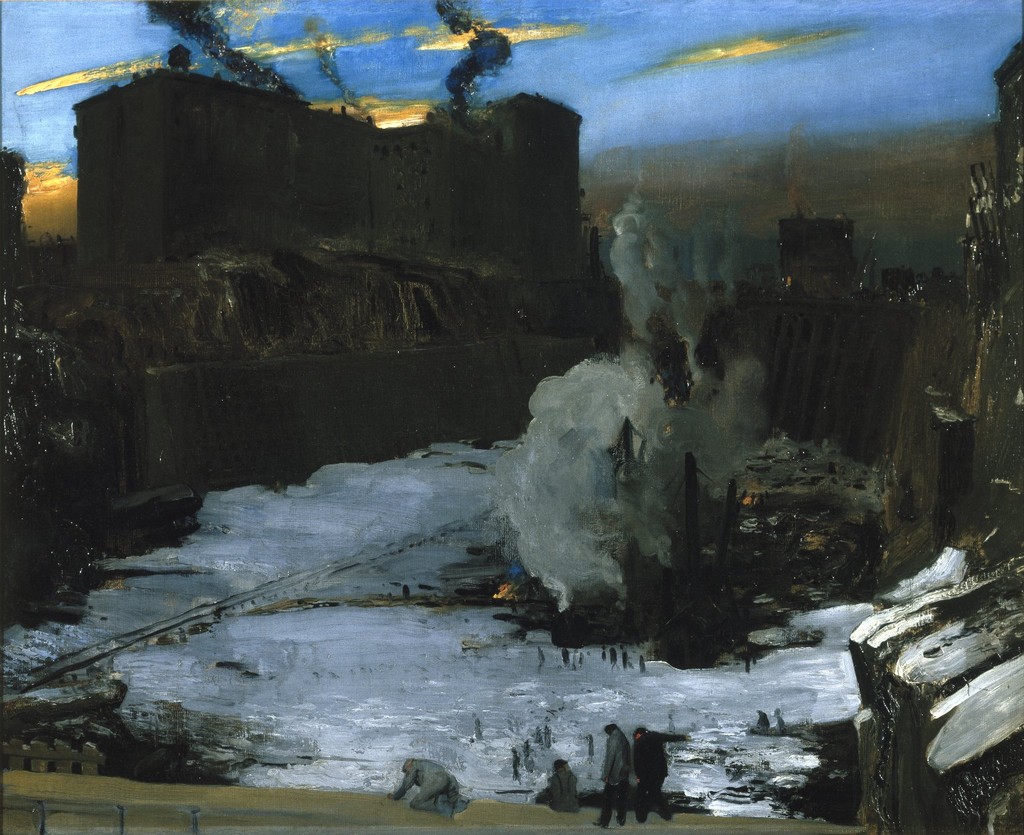
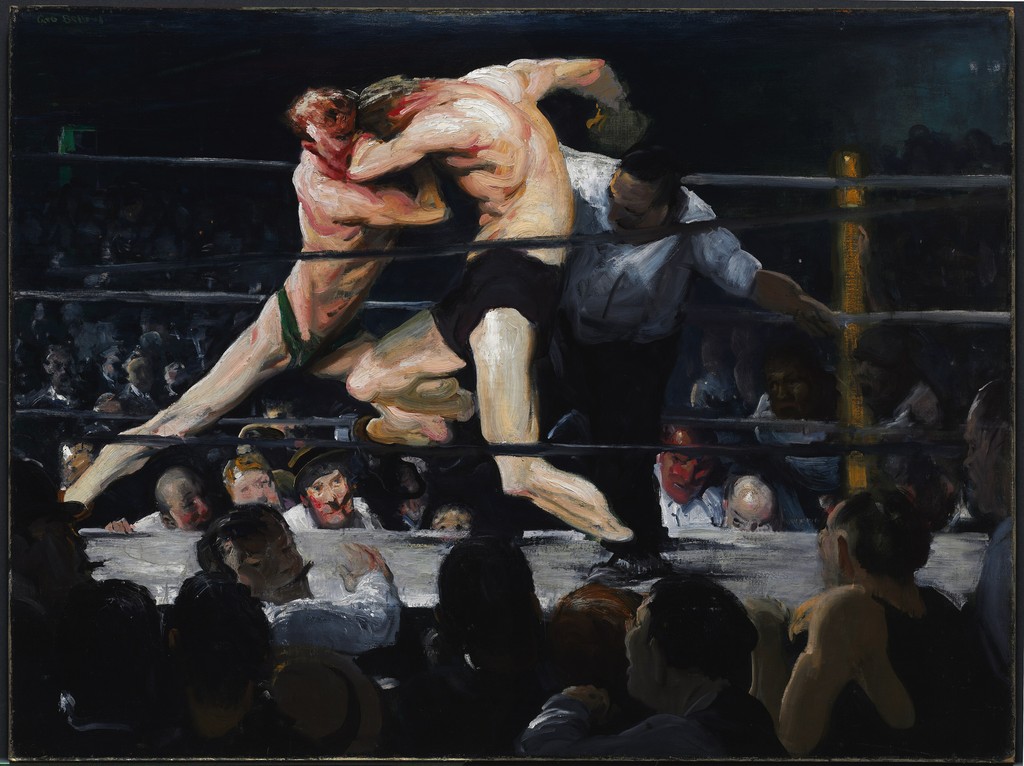
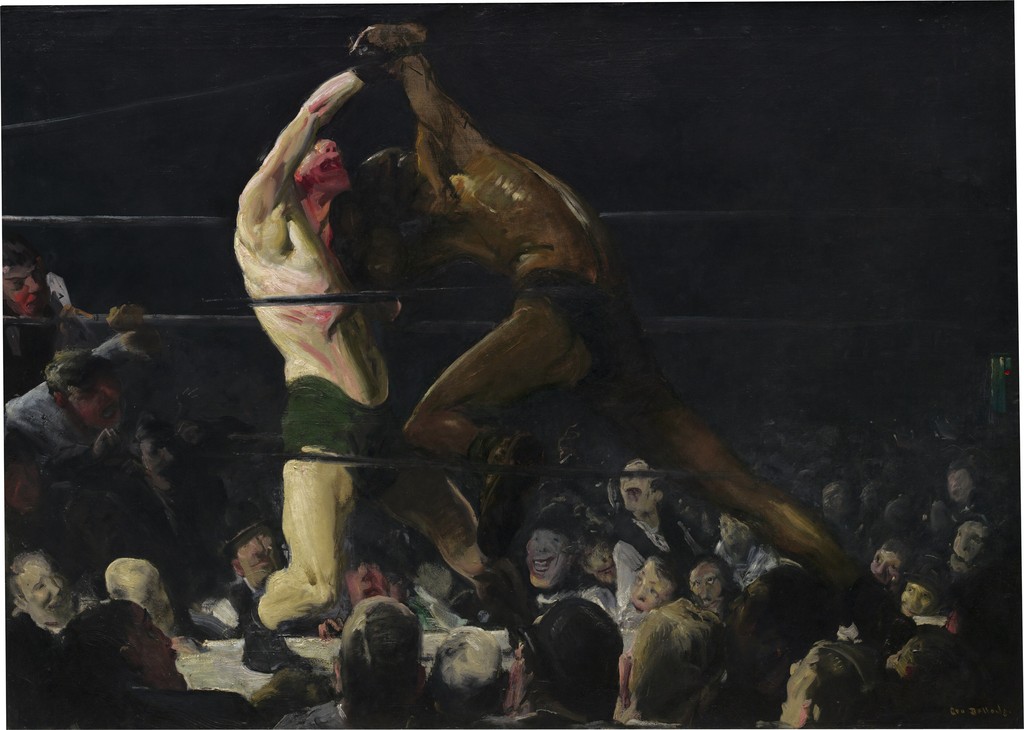
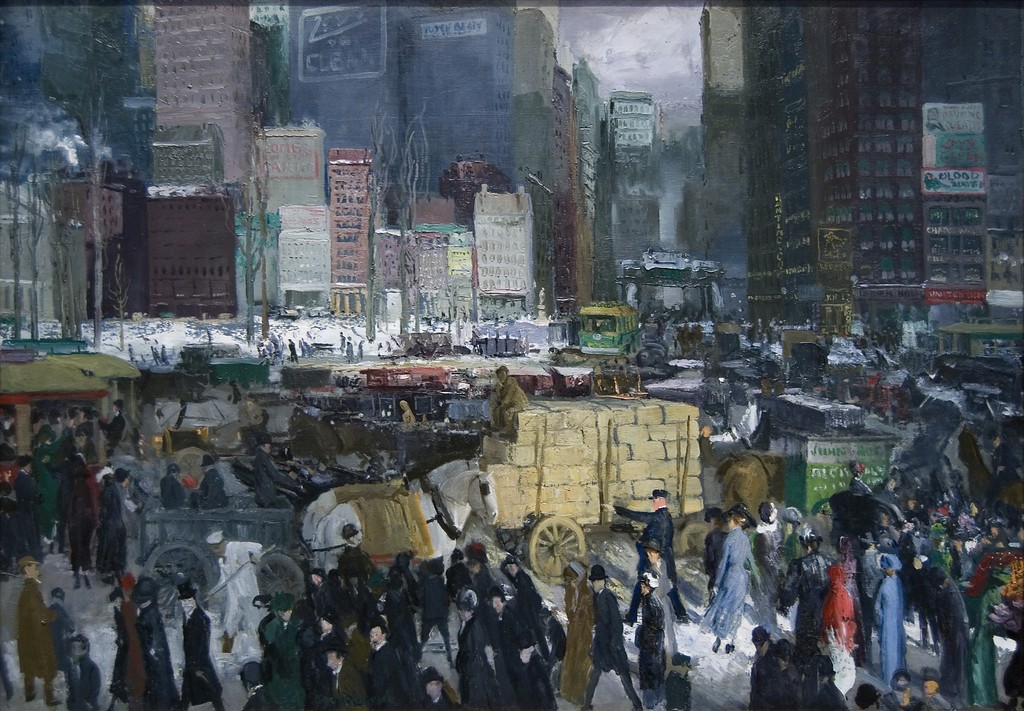
The familiar account of Bellows begins with the dark palette and compressed energy of early New York. His biography does show a gradual broadening after 1910 towards landscapes, seascapes and portraits, alongside experiments with the colour systems of Hardesty Maratta and Denman Ross and, later, Jay Hambidge's ideas about composition.[1] Yet “broadening” is more accurate than “withdrawal.” Bellows continued to address contemporary experience while changing what counted as an event in his art.
A portrait sitting could become an encounter between personalities; a family group could become a problem of bodies within a sunlit landscape; a rocky shore could provide impacts as forceful as those in his boxing pictures. The Metropolitan Museum of Art accordingly presents city scenes, portraits, seascapes and prints as parts of one varied career.[3] Looking across these subjects reveals persistent concerns with weight, pressure and unstable space, even when noisy crowds give way to a garden or a parlour.
Emma Story Bellows and the Work of Portraiture
Emma Story met Bellows when both were students at the New York School of Art, and they married in 1910.[1][3] She was not simply a biographical presence outside his studio. Bellows portrayed her repeatedly, sometimes alone and sometimes with Anne and Jean. The Met describes Emma as his lifelong artistic muse, while the Smithsonian points to The Black Hat (1921), a lithographic portrait of her, within the body of prints he made during his final nine years.[2][3]
Portraiture also extended beyond the household. Bellows painted people encountered in the city, friends and relatives, commissioned sitters and, during his Woodstock years, elderly family members and neighbours. The Smithsonian emphasises his interest in each sitter's distinctive character rather than idealisation.[2] This range matters: intimacy did not produce a single soft or sentimental manner, and a commission did not dictate one fixed formula. His paintings could move between blunt frontal presence, decorative colour, familial closeness and deliberate social distance.
Maine as a Working Ground
Bellows first travelled to Maine in August 1911 at Robert Henri's invitation. It was the first of five visits. The Met identifies Monhegan Island, about ten miles off the midcoast, as a particular focus and estimates that Bellows produced more than 250 seascapes and shore scenes between 1911 and 1917—roughly half his painting output for those years.[3] Those numbers make Maine central to his practice rather than an occasional holiday subject.
His methods combined direct observation with further development. He commonly painted outdoors on small panels, then sometimes translated an idea into a larger canvas on the island or after returning to New York. In 1913, working around Monhegan and Matinicus with his family and the painter Leon Kroll, he made more than one hundred small panels and thirteen larger compositions. During the 1916 visit he also painted Camden shipbuilders.[3] Sea, labour and family therefore occupied the same working geography; the coast did not isolate him from human activity or the problems of modern painting.
Reading Vine Clad Shore–Monhegan Island
The Smithsonian's Vine Clad Shore–Monhegan Island is a 1913 oil on canvas measuring 20 by 24 inches.[6] Its specific identity is important because Bellows painted the Maine coast repeatedly. This is object 1997.30, not a generic image of “Monhegan” and not an interchangeable example from the hundreds of coastal works.[6]
In the picture, bright green growth rises across the foreground, rounded rocks occupy the middle distance and dark blue water meets a narrow band of sky. White surf breaks through the rocks, while a slender tree on the right interrupts the horizontal movement. The broad paint handling converts vegetation, stone and water into different kinds of resistance. Colour is vivid, but the scene is not placid: the composition makes the eye cross a sequence of barriers before reaching open sea.
That physical construction connects the work to Bellows's urban and sporting art without making all subjects equivalent. Maine changed his palette, scale and contact with outdoor light. It did not erase his interest in collisions or tightly organised pictorial space. The coast offered another setting in which observed sensation and designed structure could operate together.[3]
My Family: Figures Inside a Landscape
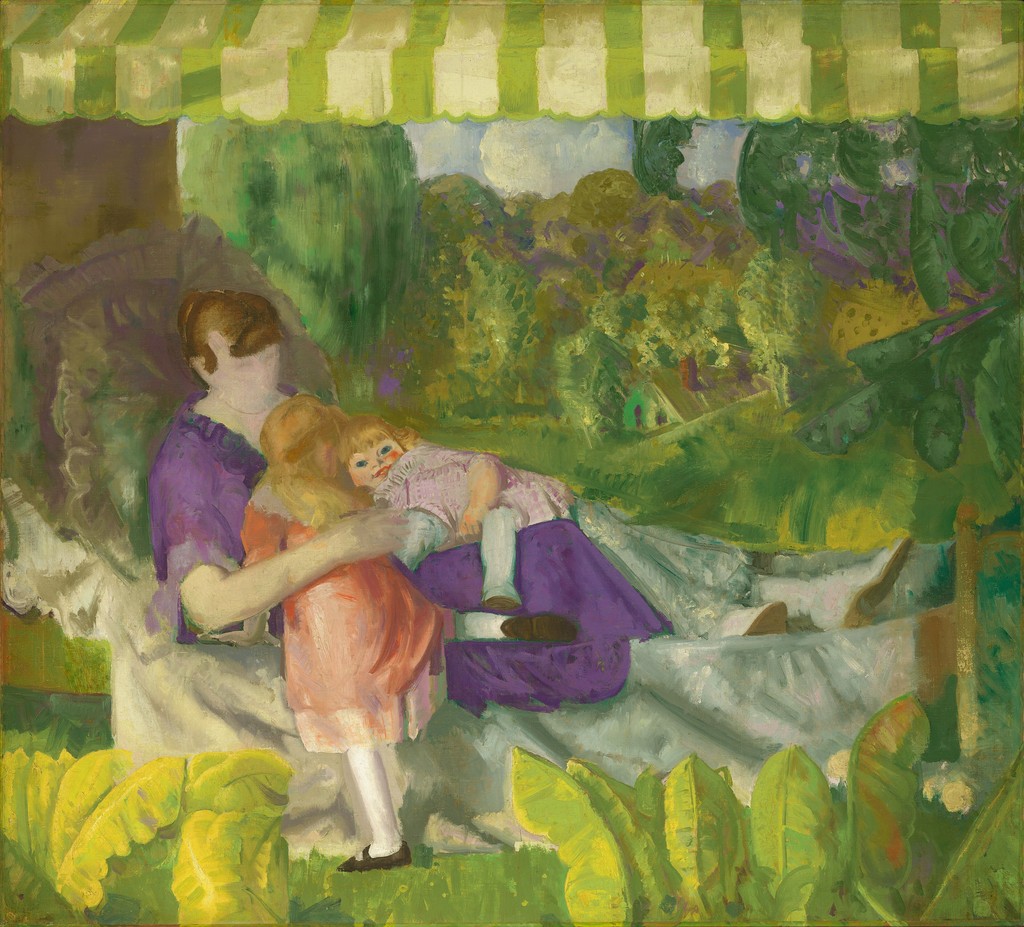
During the summer of 1916 in Camden, Bellows attempted to integrate portrait figures with an outdoor setting. My Family, now at the National Gallery of Art, is an oil on canvas showing Emma reclining beneath a striped awning with Jean beside her and Anne turned away as she moves towards them. The work is dated 1916 and carries accession number 1983.1.3.[4]
The domestic subject is easy to read, but the picture remains visually unsettled. The awning presses across the upper edge, large leaves screen the foreground and dense greens surround the seated group. Purple, pink and pale fabric hold the figures within that growth rather than separating them cleanly from it. Both My Family and the closely related Study of Emma and the Children were left unfinished. The National Gallery says their exact relationship remains unclear, although the Boston painting is generally treated as a preparatory study.[4][5]
That uncertainty should be preserved. The two canvases are related objects, not successive stages that can be reconstructed with complete confidence. Technical and scholarly evidence also shows Bellows reconsidering colour: the awning and Emma's dress were changed as paint accumulated, while the two versions use different red, green and purple relationships.[5] The unfinished surface is therefore evidence of sustained revision, not proof that a family subject demanded less effort than a public scene.
From Family Painting to Family Print
Bellows returned to the Camden group in the 1916 lithograph Mother and Children. The National Gallery calls it a third version of the subject and records its later reproduction in The Masses in June 1917 under the title June Again. Its contours are less geometric than those of the two paintings, and Jean appears as an infant rather than a toddler.[5]
These differences establish a necessary boundary. My Family, Study of Emma and the Children and Mother and Children share a composition, but they are not three names for one work. Painting, study and lithograph have separate material histories; individual prints also exist as distinct impressions. Bellows used translation between media to reconsider an image, a process explored more fully in George Bellows's prints and lithographs.
In 1923 he painted the family again in Emma and Her Children. The National Gallery describes that later group as more conventional than the Camden experiment.[5] The comparison resists a simple story of steady progress towards abstraction or novelty. Bellows could move between daring integration of figures and landscape and a more traditional family portrait while treating both as valid modern subjects.
Woodstock and Mr. and Mrs. Phillip Wase
After painting near Woodstock in 1920, Bellows bought a house there the following year; the Smithsonian also connects his Woodstock practice with a house built there in 1922.[1][2] The art colony became a base for landscapes and portraits of relatives, neighbours and older sitters. It was not coastal Maine, but it continued the productive movement between New York and places where domestic life, landscape and studio work overlapped.
The 1924 oil Mr. and Mrs. Phillip Wase belongs to this late phase. The Smithsonian identifies Mrs Wase as a cleaning woman and her husband as a gardener, both known to Bellows in Woodstock. In the painting they sit stiffly apart in a grey parlour; closed shutters interrupt the brilliant green day outside, and a smaller portrait—perhaps an image of Mrs Wase as a bride—hangs between them. The museum interprets their poses as detached and reflective rather than companionably relaxed.[7]
Stillness carries as much pressure here as motion does in the early city pictures. The couple's separation, the shadowed room and the blocked outdoor light turn a double portrait into an arrangement of emotional distances. Bellows's visible handling remains, but it serves duration and reserve instead of spectacle. The exact object is the Smithsonian painting dated 1924, accession 1967.39.1.[7]
The Artist as Sitter
Bellows also directed portraiture towards himself. His 1921 Self-Portrait is a lithograph, and the image record used here traces the work to the Library of Congress Prints and Photographs Division, digital ID cph.3m00107.[8] He appears formally dressed and unsmiling in his working interior, with one hand resting beside the marked surface at the bottom of the image. Dense black clothing anchors the figure while lighter passages define his head, shirt and hands.
The print closes the gap between portrait and process. The artist is both observer and subject, and lithographic tonal pressure builds the room around him. It also cautions against treating portraiture as a lesser, private alternative to public themes. Emma, the daughters, Woodstock neighbours and Bellows himself supplied different kinds of encounter through which he could investigate looking, recognition and pictorial structure.
Researched works directory
This searchable evidence census was assembled from public museum records and a reproducible Wikidata snapshot. It is not a catalogue raisonné, not a claim to complete oeuvre coverage, and not a substitute for the published catalogue literature, which was not used to claim absolute completeness.
| Name | Date | Medium |
|---|---|---|
| A Cloudy Day / Hudson River: Coming Squall | 1908 | Painting |
| A Day in June | 1913 | Painting |
| A Fresh Breeze | 1913 | Painting |
| A Grandmother | 1914 | Painting |
| A Knockout | 1921 | |
| A Morning Snow--Hudson River | 1910 | Painting |
| A Stag at Sharkey's | 1917 | |
| A Winter Day - Under the Elevated near Brooklyn Bridge | 1907 | Painting |
| Allan Donn Puts to Sea | 1923 | |
| An Irish Girl | 1922 | Drawing |
| Anne | 1915 | Painting |
| Anne 1921 | 1923 | |
| Anne and Her Mother | 1917 | Drawing |
| Anne in Black Velvet | 1917 | Painting |
| Anne in White | 1920 | Painting |
| Anne with a Japanese Parasol | 1917 | Painting |
| Approach of Rain | 1913 | Painting |
| Approach to the Bridge at Night | 1913 | Painting |
| Arms of a Boxer | 1916 | Drawing |
| Artists' Evening | 1916 | |
| August Lundberg (No 2) | 1907 | Painting |
| Aunt Fanny | 1920 | Painting |
| Barnyard and Chickens | 1924 | Painting |
| Bethesda Fountain (Fountain in Central Park) | 1905 | Painting |
| Between Rounds, large, first stone | 1916 | |
| Between Rounds, small, second stone | 1923 | |
| Blue Morning | 1909 | Painting |
| Blue Snow, the Battery | 1910 | Painting |
| Both Members of This Club | 1909 | Painting |
| Boy in a Blue Coat | 1915 | Painting |
| Boy with Eton Collar (Portrait of Meredith Hare) | 1921 | Painting |
| Breaking Sky, Monhegan | 1916 | Painting |
| Bridge, Blackwell’s Island | 1909 | Painting |
| Builders of Ship | 1916 | Painting |
| California Headlands | 1917 | Painting |
| Caricature of Adam and Eve and Two Female Portrait Sketches | Date unknown | Drawing |
| Central Park | 1905 | Painting |
| Chester Dale | 1922 | Painting |
| Children Playing in a Park | 1905 | Drawing |
| Cleaning Fish | 1913 | Painting |
| Cliff Dwellers | 1913 | Painting |
| Cliffs | Date unknown | Painting |
| Club Night | 1907 | Painting |
| Coming Storm | 1914 | Painting |
| Coopers Lake, Woodstock | 1924 | Painting |
| Counted Out, first stone | 1921 | |
| Counted Out, second stone | 1921 | |
| Criehaven Wharf | 1916 | Painting |
| Cross-Eyed Boy | Date unknown | Painting |
| Dance in a Madhouse | 1917 | |
| Dancing Town (The Top of the World) | 1922 | Drawing |
| Dempsey and Firpo | 1923 | |
| Dempsey and Firpo | 1924 | Painting |
| Dempsey through the Ropes | 1923 | |
| Dempsey Through the Ropes | Date unknown | Painting |
| Deserted Factory | 1924 | Painting |
| Dock Builders | 1916 | Painting |
| Edge of the Pasture - Glow of the Sun | 1916 | Painting |
| Edith Cavell | 1918 | Painting |
| Elinor, Jean and Anna | 1920 | Painting |
| Elsie, Emma and Marjorie, First Stone | 1921 | |
| Elsie, Emma and Marjorie, second stone | 1921 | |
| Elsie Reading to Emma, First Stone | 1921 | |
| Elsie Reading to Emma, Second Stone | 1921 | |
| Elsie Speicher [verso] | 1920 | Drawing |
| Emma and Her Children | 1923 | Painting |
| Emma at the Piano | 1914 | Painting |
| Emma at the Window | 1920 | Painting |
| Emma, Elsie and Gene | 1921 | |
| Emma in a Purple Dress | 1920 | Painting |
| Emma in the Black Print | 1919 | Painting |
| Emma in the Purple Dress | 1919 | Painting |
| Evening Blue | 1916 | Painting |
| Evening Swell | 1911 | Painting |
| Excavation at Night | 1908 | Painting |
| Family in a Surrey | 1921 | Drawing |
| Fern Woods | Date unknown | Painting |
| Five Cows | 1919 | Painting |
| Floating Ice | 1910 | Painting |
| Florence Davey | 1914 | Painting |
| Fog Breakers | 1913 | Painting |
| Forty-two Kids | 1907 | Painting |
| Frankie, the Organ Boy | 1907 | Painting |
| Garaldine Lee, No. 2 | 1914 | Painting |
| Gardiner's Bay from Sag Harbor | 1899 | Painting |
| Ghost of Sergeant Pelly | 1918 | Drawing |
| Golf Course, California | 1917 | Painting |
| Gorge and Sea | 1911 | Painting |
| Grandma Bellows | 1919 | Painting |
| Gray Sea | 1913 | Painting |
| Harbor of Monhegan, Fish Boats | 1911 | Painting |
| Haystacks and Barn | 1909 | Painting |
| Head of Boy (aka Gray Boy) | 1905 | Painting |
| Hungry Dogs, second stone | 1916 | |
| Hunter and Mountains | 1920 | Painting |
| In a Rowboat | 1916 | Painting |
| In an Elevator | 1916 | |
| In the Park, Dark | 1916 | |
| Introducing Georges Carpentier | 1921 | |
| Introducing John L. Sullivan | 1916 | |
| Introducing John L. Sullivan | 1923 | Painting |
| Introducing the Champion | 1916 | |
| Introductions | 1921 | |
| Jackie (Jacqueline Hudson) | 1914 | Painting |
| Jean 1923 | 1923 | |
| Jean in a Black Hat | 1923 | |
| Jean with Blue Book and Apple | 1916 | Painting |
| Jim Twadell's Place | 1924 | Painting |
| Julie Hudson | 1914 | Painting |
| Katherine Rosen | 1921 | Painting |
| Kids | 1906 | Painting |
| Lady Jean | 1924 | Painting |
| Lady of 1860 - The Actress | 1922 | Drawing |
| Lady with a Fan | 1921 | |
| Launching | 1913 | Painting |
| Little Girl in White (Queenie Burnett) | 1907 | Painting |
| Love of Winter | 1914 | Painting |
| Lychnis and Her Sons | 1923 | |
| Madeline Davis | 1914 | Painting |
| Man and Dog | 1905 | Painting |
| Matinicus | 1916 | |
| Maud Dale | 1919 | Painting |
| May Day in Central Park | 1905 | Painting |
| Men of the Docks | 1912 | Painting |
| Mill Dam | 1924 | Painting |
| Miss Bentham | 1906 | Painting |
| Monhegan Island | 1913 | Painting |
| Mother and Children | 1916 | |
| Mother and Children, Second State | 1916 | |
| Mountain Farm | 1922 | Painting |
| Mr. and Mrs. Phillip Wase | 1924 | Painting |
| Mrs. Chester Dale | 1919 | Painting |
| Mrs. T. in Cream Silk, No.1 | 1919 | Painting |
| Mrs. T. in Cream Silk, No.2 | 1920 | Painting |
| Mrs. Walter H. Richter | 1922 | Painting |
| Murder of Edith Cavell | 1918 | |
| My Family | 1916 | Painting |
| My Mother | 1921 | Painting |
| New York | 1911 | Painting |
| North River | 1908 | Painting |
| Nude Girl, Miss Leslie Hall | 1909 | Painting |
| Nude Girl Reclining | 1919 | Drawing |
| Nude Study, Girl Standing on One Foot | 1923 | |
| Nude with Fan | 1920 | Painting |
| Nude with Hexagonal Quilt | 1924 | Painting |
| Nude with Parrot | 1915 | Painting |
| Nude with Red Hair | 1920 | Painting |
| Old Barn, Grey Day | 1920 | Painting |
| Old Fisherman | 1904 | Painting |
| Ox Team, Wharf at Matinicus | 1916 | Painting |
| Paddy Flannigan | 1908 | Painting |
| Padre | 1917 | Painting |
| Paradise Point | 1919 | Painting |
| Pennsylvania Station Excavation | c. 1907–1908 | Painting |
| Pigs and Donkey | 1920 | Painting |
| Polo at Lakewood | 1910 | Painting |
| Portrait of a Boy | 1921 | Painting |
| Portrait of a Laughing Boy | 1907 | Painting |
| Portrait of Florence Budd | 1914 | Painting |
| Portrait of Florence Pierce | 1914 | Painting |
| Portrait of Geraldine Lee, No. 1 | 1914 | Painting |
| Portrait of My Mother No. 1 | 1921 | Painting |
| Portrait of Prosper Invernizzi | 1907 | Painting |
| Portrait of Walter Littlefield | 1915 | Painting |
| Porträt der Anne | 1915 | Painting |
| Porträt der Laura | 1922 | Painting |
| Prayer Meeting, second stone | 1916 | |
| Preliminaries | 1916 | |
| Preliminaries | Date unknown | |
| Pueblo Tesuque, No. 2 | 1917 | Painting |
| Rain on the River | 1908 | Painting |
| Return of the Useless | 1918 | Painting |
| River Front No. 1 | 1914 | Painting |
| Rock Bound | 1913 | Painting |
| Rock Reef, Maine | 1913 | Painting |
| Rock Ridge Farm | Date unknown | Painting |
| Rocks and Coast | 1911 | Painting |
| Rolling Breakers | 1913 | Painting |
| Romance of Autumn | 1916 | Painting |
| Romance of Criehaven | 1916 | Painting |
| Roumanian Girl | 1921 | Painting |
| Samuel Knopf | 1922 | Painting |
| Santuario de Chimata | 1917 | Painting |
| Seated Female Nude (Emma Story Bellows) | Date unknown | Drawing |
| Seated Nude | 1910 | Painting |
| Self-Portrait | 1921 | |
| Shipyard Society | 1916 | Painting |
| Sixteen East Gay Street | 1923 | |
| Sketches of Heads, Including One of Chester Dale | Date unknown | Drawing |
| Sketches of Three Female Heads [recto] | Date unknown | Drawing |
| Snow-Capped River | 1911 | Painting |
| Snow Dumpers | 1911 | Painting |
| Society Ball [verso] | 1907 | Drawing |
| Splinter Beach | 1916 | |
| Stag at Sharkey's | 1909 | Painting |
| Steaming Streets | 1908 | Painting |
| Storm Sea | 1913 | Painting |
| Street Fight [recto] | 1907 | Drawing |
| Studies of Jean | 1920 | Drawing |
| Study for "Mr. and Mrs. Philip Wase | 1924 | Drawing |
| Study for Nude with Hexagonal Quilt | 1924 | Drawing |
| Study for "Riverfront No. 1 | 1915 | Drawing |
| Study of Emma and the Children | 1917 | Painting |
| Summer City | 1909 | Painting |
| Summer Fantasy | 1924 | Painting |
| Summer Night, Riverside Drive | 1909 | Painting |
| Sun Glow | 1913 | Painting |
| Sun Shadows (Rocks at Monhegan) | 1913 | Painting |
| Sunday 1897 | 1921 | |
| Sunlit surf | 1913 | Painting |
| Swans in Central Park | 1906 | Painting |
| Tennis | 1920 | |
| Tennis at Newport | 1919 | Painting |
| Tennis at Newport | 1920 | Painting |
| Tennis Tournament | 1920 | Painting |
| The Barricade | 1918 | Painting |
| The Beach, Newport (In the Sand) | 1919 | Painting |
| The Big Dory | 1913 | Painting |
| The Black Derby / Head of a man with a red nose | 1905 | Painting |
| The Brook | Date unknown | Painting |
| The Charge | 1918 | |
| The Cigarette | 1918 | |
| The Coming Storm | 1916 | Painting |
| The Dock | 1913 | Painting |
| The Donkey Cart | 1922 | Drawing |
| The Fish Wharf, Matinicus Island | 1916 | Painting |
| The Fisherman | 1917 | Painting |
| The Germans Arrive | 1918 | Painting |
| The Grove — Monhegan | 1911 | Painting |
| The Gulls, Monhegan | 1911 | Painting |
| The Harbor, Monhegan Coast, Maine | 1913 | Painting |
| The Kindliness Came Not from Her | 1922 | Drawing |
| The Launching | Date unknown | Painting |
| The Law Is Too Slow | 1923 | |
| The Lone Tenement | 1909 | Painting |
| The Newsboy | 1908 | Painting |
| The Novitiate | 1916 | |
| The Palisades | 1909 | Painting |
| The Red Vine, Matinicus Island, Maine | 1916 | Painting |
| The Sand Cart | 1917 | Painting |
| The Sea | 1911 | Painting |
| The Shower-Bath | 1917 | |
| The Studio | 1919 | Painting |
| The Teamster | 1916 | Painting |
| The Tournament | 1920 | |
| The Village Houses | 1920 | Painting |
| The Warships | 1909 | Painting |
| The White Hope | 1921 | |
| The White Horse | 1922 | Painting |
| The Widow | 1917 | Painting |
| Three Children | 1919 | Painting |
| Three Pigs and a Mountain | 1922 | Painting |
| Three Rollers | 1911 | Painting |
| Through the Trees, Monhegan Island, Maine | 1913 | Painting |
| Tumble of Waters | 1913 | Painting |
| Two Girls | 1917 | |
| Two Women | 1924 | Painting |
| Up the Gorge | 1913 | Painting |
| Up the Hudson | 1908 | Painting |
| Village on the Hill | 1916 | Painting |
| Vine Clad Shore--Monhegan Island | 1913 | Painting |
| Waldo Peirce | 1920 | Painting |
| War Series | 1918 | Painting |
| West Wind | 1913 | Painting |
| Willard in Training Quarters | 1916 | |
| Winter Afternoon, Riverside Park | 1909 | Painting |
| Winter Road | 1912 | Painting |
| Woodstock Road, Woodstock, New York | 1924 | Drawing |
Frequently Asked Questions
Bellows married Emma Story in 1910 after they had met as students at the New York School of Art. They had two daughters, Anne and Jean. All three appear in My Family, and Emma and the daughters recur separately and together across paintings, drawings and lithographs.[1][3][5]
The Metropolitan Museum records five visits beginning in 1911. Bellows worked especially on Monhegan Island, and later visits included other Maine locations such as Camden. His coastal output between 1911 and 1917 was extensive, not the result of one isolated trip.[3]
His sitters included Emma, Anne and Jean, other relatives, working people, friends, neighbours and commissioned subjects. In Woodstock he painted older sitters and the double portrait of Mr and Mrs Phillip Wase. The variety defeats any single division between intimate and formal portraiture.[2][7]
His palette and compositional methods changed, and later work often gives portraits and landscapes greater prominence. But there was no clean break from his earlier concerns. Physical paint, compressed space and structured tensions recur even when a coastal view or motionless sitter replaces a city crowd.[1][3]
Discussion
Use this evidence-led guide as a starting point for close looking rather than a final verdict.
Share an observation about Portraits, Family and Maine or a source that adds useful context.
Reader Insights
Which work most clearly complicates the familiar image of Bellows as a strictly literal realist?
Where do New York, exhibition culture, printmaking, family or place most productively alter your reading?
Which source or surviving object would you investigate next?
Join the Conversation
Add your reading below, keeping observations specific and evidence clear.
References
- National Gallery of Art, “George Bellows”, accessed 31 August 2026.
- Smithsonian American Art Museum, “George Bellows”, accessed 31 August 2026.
- The Metropolitan Museum of Art, “George Bellows”, accessed 31 August 2026.
- National Gallery of Art, “My Family”, accessed 31 August 2026.
- National Gallery of Art, “American Paintings, 1900–1945: My Family, 1916”, accessed 31 August 2026.
- Smithsonian American Art Museum, “Vine Clad Shore–Monhegan Island”, accessed 31 August 2026.
- Smithsonian American Art Museum, “Mr. and Mrs. Phillip Wase”, accessed 31 August 2026.
- Library of Congress via Wikimedia Commons, “George Bellows self-portrait”, accessed 31 August 2026.