 by Tom Gurney
Tom Gurney BSc (Hons) is an art history expert with over 20 years experience
/
Email: tomgurney1@gmail.com / Phone: +44 7429 011000
Stag at Sharkey's: Introduction
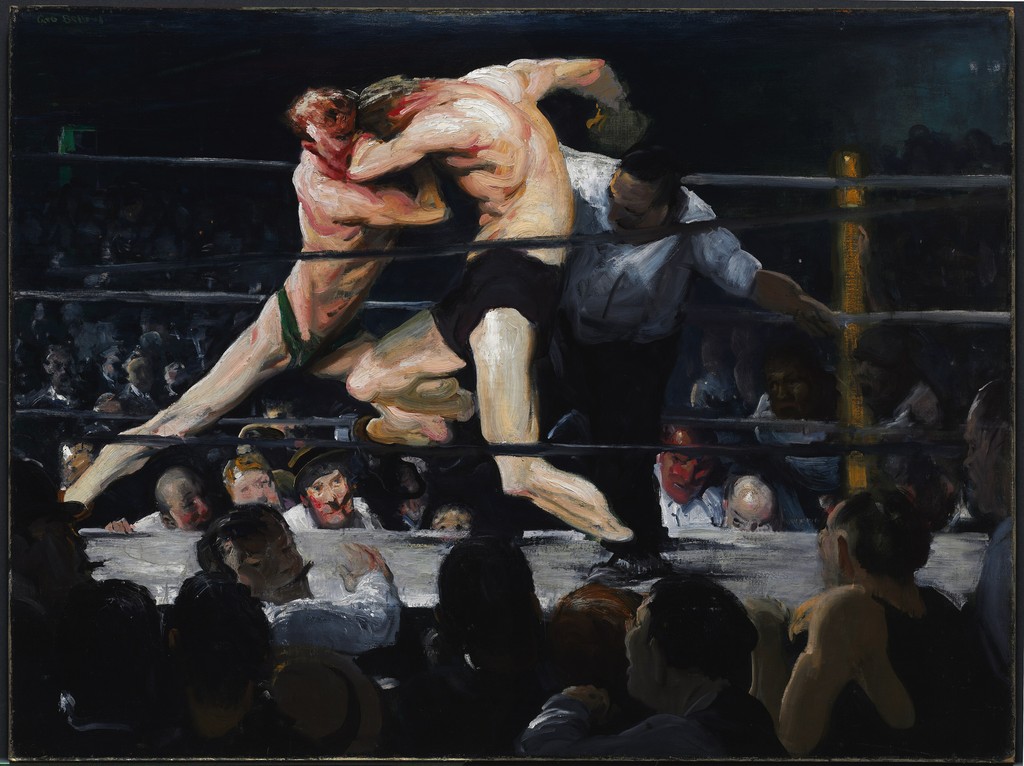
George Bellows's Stag at Sharkey's compresses a prizefight into a room that feels barely large enough to hold it. Two boxers meet head to head under hard light, the referee leans into their struggle, and rows of spectators crowd the ring. Painted in 1909, this is the oil on canvas now held by the Cleveland Museum of Art—not the later lithograph with a similar title.[1]
At a Glance
- ArtistGeorge Bellows (1882–1925)
- TitleStag at Sharkey's
- Date and medium1909, oil on canvas
- Size92 × 122.6 cm unframed
- CollectionCleveland Museum of Art, Hinman B. Hurlbut Collection, 1922.1133
- SubjectA private-club boxing match seen from close to the ring
George Bellows in context
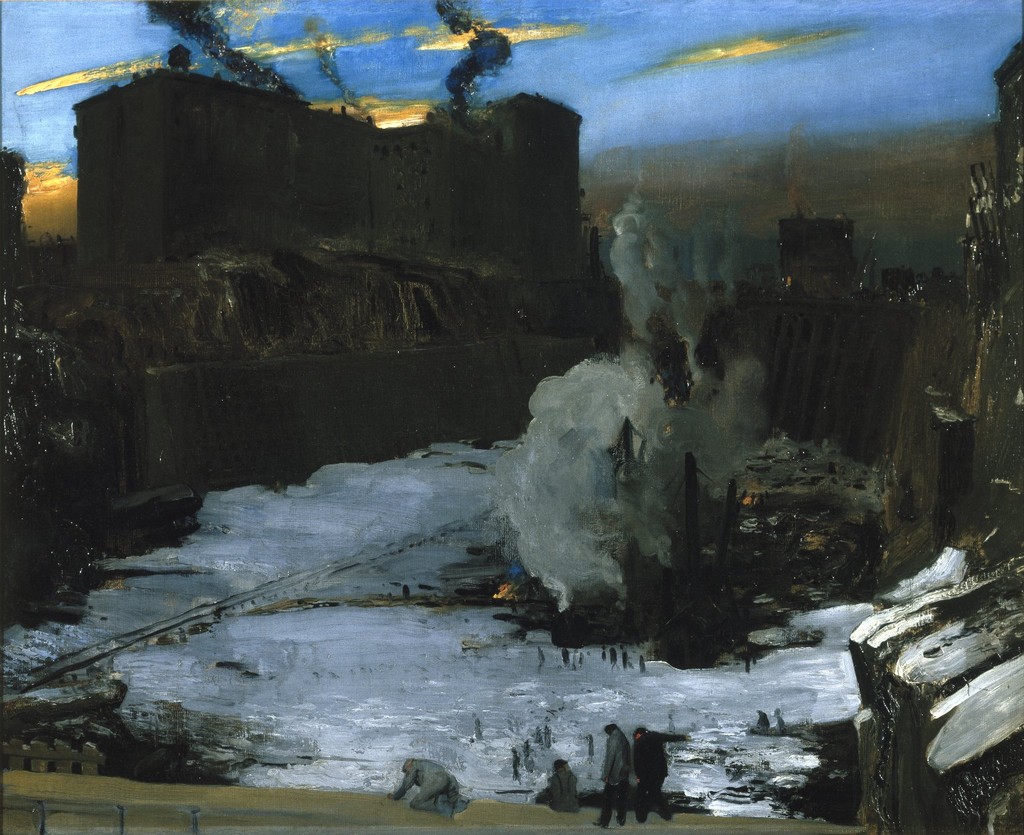
Pennsylvania Station Excavation
c. 1907–08New York
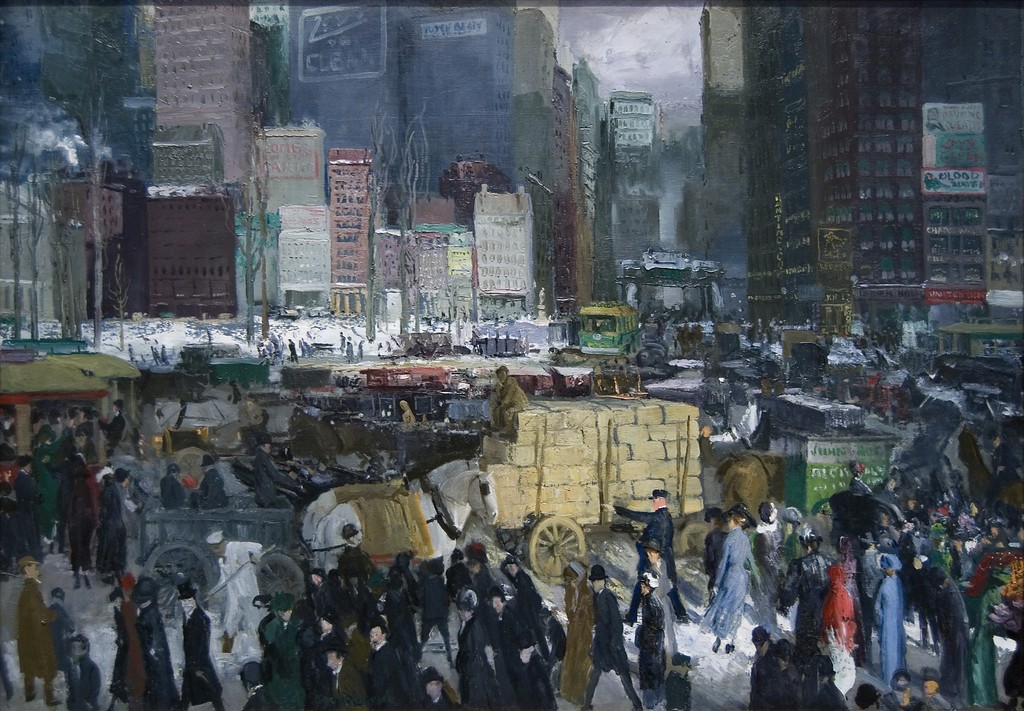
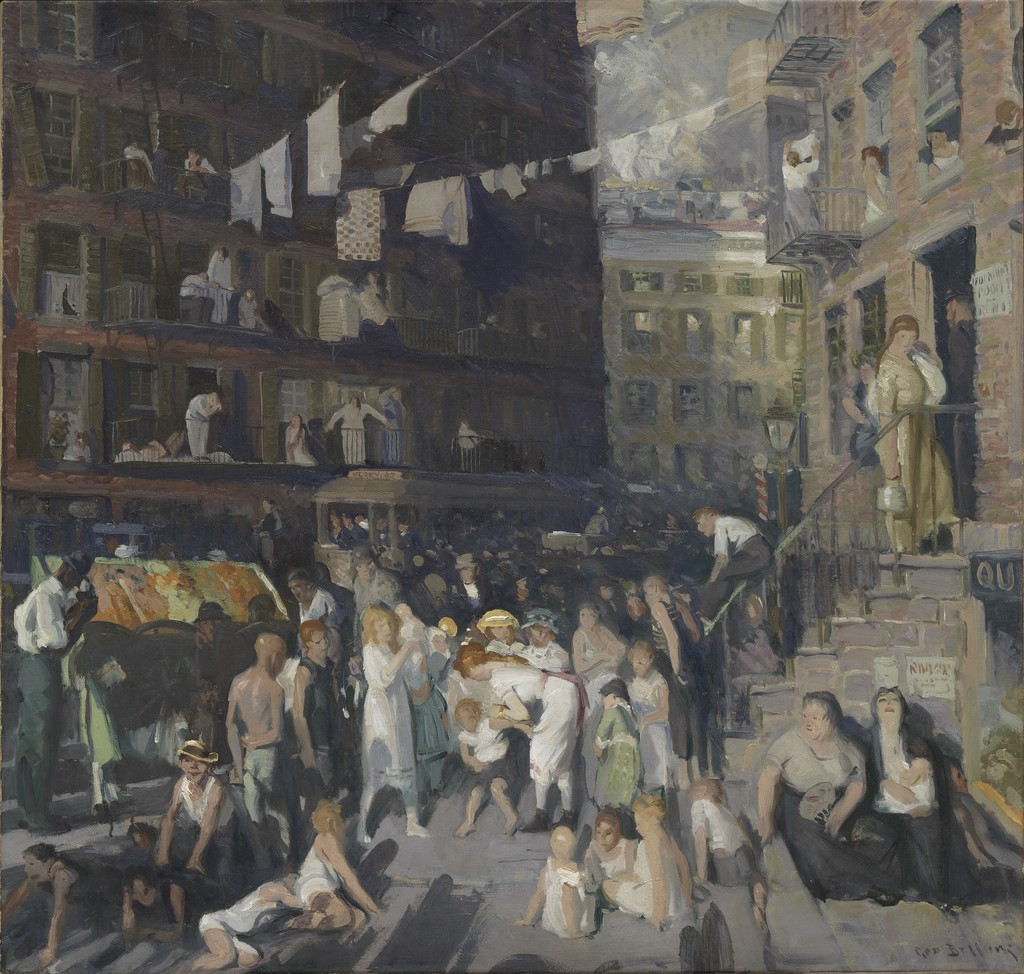
1911Cliff Dwellers
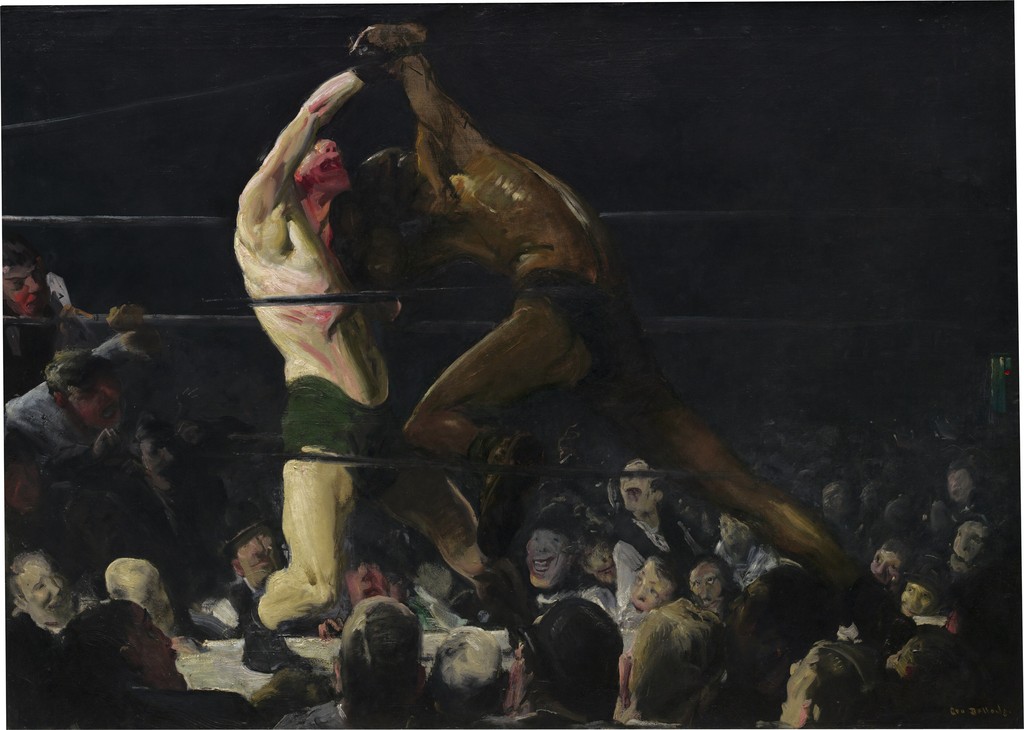
1913My Family
1916A Stag at Sharkey's
1917Dempsey and Firpo
1924Contents
- Introduction
- Sharkey's Athletic Club and the Word “Stag”
- A Fight Built from Opposing Forces
- The Referee and the Ropes
- The Crowd Is Part of the Contest
- Light, Colour and Loaded Paint
- A View from Ringside
- One Painting in an Early Trio
- The 1917 Lithograph Is a Different Object
- How to Look at Stag at Sharkey's
Sharkey's Athletic Club and the Word “Stag”
The title points to Tom “Sailor Tom” Sharkey's Athletic Club, a saloon with a boxing ring in its back room. Sharkey, an Irish-born former heavyweight boxer and US Navy veteran, ran the establishment near Bellows's studio in the Lincoln Arcade Building at Broadway and 66th Street. Bellows knew this environment directly, and his early boxing pictures grew from visits to it.[1][2][4]
The legal setting explains the unusual word “stag”. New York State had prohibited prizefighting under the Lewis Law after repealing the more permissive Horton Law in 1900. Promoters worked around the ban by holding contests inside nominally private athletic clubs. Spectators paid membership dues rather than admission to a particular bout, while a visiting fighter could receive temporary membership for the evening. That outsider was called a stag.[1][4]
This fiction turns the title into more than a colourful label. It identifies the bout as an event poised between regulation and evasion: organised enough to require ropes and a referee, yet staged in a space whose private-club status sheltered an otherwise prohibited public entertainment. The crowd's proximity makes the arrangement look both intimate and precarious.
A Fight Built from Opposing Forces
Bellows does not isolate a clean punch or the instant of a knockout. The fighters are tangled at the centre of an exchange that appears likely to continue. On the left, the boxer in green trunks drives across the canvas. One leg stretches back towards the lower corner while the other lifts, turning his whole body into a diagonal thrust. His opponent bends away but remains balanced against that pressure, with one arm swinging out as if gathering force for a reply.[2]
Their heads meet, yet their torsos and legs open away from this point of contact. That combination—compression at the top and separation below—makes the pose feel unstable. Pale limbs flare against the dark room, and the crossing directions make it difficult to decide which fighter controls the exchange. The uncertainty is important. Bellows depicts physical effort, not a diagram of correct technique or a report of a named result.
Neither the Cleveland record nor the National Gallery's study identifies the contestants by name. Reading them as anonymous participants preserves what the evidence supports. Their significance comes through posture, balance and force rather than an undocumented biography.
The Referee and the Ropes
The referee is not a detached official. He bends close behind the fighters, his face and torso caught between their pale bodies and the surrounding darkness. His attention fixes on the action, while his extended arm carries the movement towards the right edge. In the National Gallery's comparison of Bellows's three early boxing oils, the referee is a distinctive feature of Stag at Sharkey's; Bellows removed that mediating presence from Both Members of This Club.[2][4]
Dark ropes run almost the full width of the composition. They divide bodies into abrupt segments: one crosses the referee's chest, another passes in front of the fighters' trunks, and a lower line cuts through the audience. The ropes establish the ring's rules while also exposing how little distance separates combatants from onlookers. At the right, a yellow-brown corner post fixes the geometry, but the implied meeting of ropes beyond the frame makes the visible ring feel incomplete.
The Crowd Is Part of the Contest
The spectators do not form an orderly background. Foreground heads are cut by the bottom and sides of the canvas, placing the viewer among them. Across the ring, faces appear in a narrow strip between the ropes and the pale apron. Some are alert, others blurred or masked by shadow; a few seem to grin, shout or lean for a clearer view. Bellows varies their clarity so that individual reactions emerge from a larger human mass.
The National Gallery's study notes tiny red touches within the deep background, readable as glowing cigar ends. It also describes two dark figures near the right corner post that block part of the middle-distance audience. Such details prevent darkness from becoming an empty backdrop. The room is populated far beyond the faces that Bellows fully defines.[2]
This crowd changes the painting's subject. It is not simply two athletes demonstrating strength. It is also a picture of men paying to watch controlled violence at close quarters. The ring organises their attention, and their attention intensifies the fight.
Light, Colour and Loaded Paint
Although reproductions can make the painting seem nearly monochrome, its darkness contains purposeful colour. Bellows began with a light blue-green wash over the pale ground and left traces of it visible. A green-lit opening glows at the upper left, while warmer notes punctuate the opposite side. Against these muted zones, the fighters carry broken passages of cream, pink, red, yellow and green.[2]
The paint is not uniformly smooth. Faces across the ring thicken into impasto, with some passages applied by palette knife, while distant figures can be reduced to faint marks. Heavy strokes model muscles but also remain visible as strokes. At several edges Bellows used dense black contours to separate limbs from the room. Flesh therefore appears at once solid and momentary: the bodies have weight, yet their surfaces flicker in the glare.[2]
That handling is central to Bellows's paintings. Brushwork does not merely decorate the action after it has been drawn. Thick highlights, exposed ground and dark outlines create the visual collision.
A View from Ringside
The low viewpoint denies a comfortable survey of the entire match. We look upward across spectators and ropes rather than down onto a clearly mapped ring. Large heads obscure the foreground; parts of bodies disappear beyond the edges. The crop implies that the fight, crowd and room continue outside the rectangle.[2]
This arrangement makes the viewer's position ethically uneasy. We are close enough to feel the pressure of the bout but occupy the same zone as those who have come to watch it. No elevated distance separates looking at Bellows's art from looking at the staged violence he represents. The painting's force depends on that double role: it offers an intense spectacle and makes spectatorship itself visible.
One Painting in an Early Trio
Stag at Sharkey's belongs with Club Night and Both Members of This Club, but the three oils are not interchangeable. The National Gallery dates Club Night to 1907 and identifies it as Bellows's first painting in the closely related group. The Cleveland canvas followed in 1909. Both Members of This Club, painted two months later, enlarged and reversed aspects of the composition while removing the referee.[3][4]
The works share an elevated ring, fighters silhouetted against a near-black room and an audience compressed along the lower edge. Yet each alters the balance between blow, resistance and crowd. That sequence reveals why Bellows's return to a subject is not simple repetition. He changes who mediates the action, how bodies occupy the frame and what social questions enter the ring.
The 1917 Lithograph Is a Different Object
Bellows returned to the motif after taking up lithography. The National Gallery of Art's A Stag at Sharkey's dates from 1917 and is a lithograph in black, not an impression made from the 1909 canvas. The Gallery's particular sheet, accession 1956.6.13, measures 55.56 × 70.17 cm and is catalogued as Mason no. 46. Its graphite “No. 62” is recorded as an inscription; the museum does not use it as a state designation.[5]
The print returns to the club motif as a design of black ink and paper. It can be discussed alongside the painting, but its title includes the initial article, its medium and dimensions differ, and each surviving impression has its own collection history. The prints and lithographs overview follows these object distinctions in greater depth.
How to Look at Stag at Sharkey's
Begin where the fighters' heads press together, then follow each leg towards an opposite lower corner. Notice how that widening structure is crossed by the horizontal ropes. Next, move from the brightest flesh into the dim audience and look for the few coloured signals that keep the black room alive.
Finally, consider where Bellows has put you. The nearest spectators are not safely beyond the image; their cropped heads share your side of the ropes. The George Bellows introduction places this uneasy ringside encounter within a career that also addressed streets, excavation sites, portraits and the Maine coast.
Researched works directory
This searchable evidence census was assembled from public museum records and a reproducible Wikidata snapshot. It is not a catalogue raisonné, not a claim to complete oeuvre coverage, and not a substitute for the published catalogue literature, which was not used to claim absolute completeness.
| Name | Date | Medium |
|---|---|---|
| A Cloudy Day / Hudson River: Coming Squall | 1908 | Painting |
| A Day in June | 1913 | Painting |
| A Fresh Breeze | 1913 | Painting |
| A Grandmother | 1914 | Painting |
| A Knockout | 1921 | |
| A Morning Snow--Hudson River | 1910 | Painting |
| A Stag at Sharkey's | 1917 | |
| A Winter Day - Under the Elevated near Brooklyn Bridge | 1907 | Painting |
| Allan Donn Puts to Sea | 1923 | |
| An Irish Girl | 1922 | Drawing |
| Anne | 1915 | Painting |
| Anne 1921 | 1923 | |
| Anne and Her Mother | 1917 | Drawing |
| Anne in Black Velvet | 1917 | Painting |
| Anne in White | 1920 | Painting |
| Anne with a Japanese Parasol | 1917 | Painting |
| Approach of Rain | 1913 | Painting |
| Approach to the Bridge at Night | 1913 | Painting |
| Arms of a Boxer | 1916 | Drawing |
| Artists' Evening | 1916 | |
| August Lundberg (No 2) | 1907 | Painting |
| Aunt Fanny | 1920 | Painting |
| Barnyard and Chickens | 1924 | Painting |
| Bethesda Fountain (Fountain in Central Park) | 1905 | Painting |
| Between Rounds, large, first stone | 1916 | |
| Between Rounds, small, second stone | 1923 | |
| Blue Morning | 1909 | Painting |
| Blue Snow, the Battery | 1910 | Painting |
| Both Members of This Club | 1909 | Painting |
| Boy in a Blue Coat | 1915 | Painting |
| Boy with Eton Collar (Portrait of Meredith Hare) | 1921 | Painting |
| Breaking Sky, Monhegan | 1916 | Painting |
| Bridge, Blackwell’s Island | 1909 | Painting |
| Builders of Ship | 1916 | Painting |
| California Headlands | 1917 | Painting |
| Caricature of Adam and Eve and Two Female Portrait Sketches | Date unknown | Drawing |
| Central Park | 1905 | Painting |
| Chester Dale | 1922 | Painting |
| Children Playing in a Park | 1905 | Drawing |
| Cleaning Fish | 1913 | Painting |
| Cliff Dwellers | 1913 | Painting |
| Cliffs | Date unknown | Painting |
| Club Night | 1907 | Painting |
| Coming Storm | 1914 | Painting |
| Coopers Lake, Woodstock | 1924 | Painting |
| Counted Out, first stone | 1921 | |
| Counted Out, second stone | 1921 | |
| Criehaven Wharf | 1916 | Painting |
| Cross-Eyed Boy | Date unknown | Painting |
| Dance in a Madhouse | 1917 | |
| Dancing Town (The Top of the World) | 1922 | Drawing |
| Dempsey and Firpo | 1923 | |
| Dempsey and Firpo | 1924 | Painting |
| Dempsey through the Ropes | 1923 | |
| Dempsey Through the Ropes | Date unknown | Painting |
| Deserted Factory | 1924 | Painting |
| Dock Builders | 1916 | Painting |
| Edge of the Pasture - Glow of the Sun | 1916 | Painting |
| Edith Cavell | 1918 | Painting |
| Elinor, Jean and Anna | 1920 | Painting |
| Elsie, Emma and Marjorie, First Stone | 1921 | |
| Elsie, Emma and Marjorie, second stone | 1921 | |
| Elsie Reading to Emma, First Stone | 1921 | |
| Elsie Reading to Emma, Second Stone | 1921 | |
| Elsie Speicher [verso] | 1920 | Drawing |
| Emma and Her Children | 1923 | Painting |
| Emma at the Piano | 1914 | Painting |
| Emma at the Window | 1920 | Painting |
| Emma, Elsie and Gene | 1921 | |
| Emma in a Purple Dress | 1920 | Painting |
| Emma in the Black Print | 1919 | Painting |
| Emma in the Purple Dress | 1919 | Painting |
| Evening Blue | 1916 | Painting |
| Evening Swell | 1911 | Painting |
| Excavation at Night | 1908 | Painting |
| Family in a Surrey | 1921 | Drawing |
| Fern Woods | Date unknown | Painting |
| Five Cows | 1919 | Painting |
| Floating Ice | 1910 | Painting |
| Florence Davey | 1914 | Painting |
| Fog Breakers | 1913 | Painting |
| Forty-two Kids | 1907 | Painting |
| Frankie, the Organ Boy | 1907 | Painting |
| Garaldine Lee, No. 2 | 1914 | Painting |
| Gardiner's Bay from Sag Harbor | 1899 | Painting |
| Ghost of Sergeant Pelly | 1918 | Drawing |
| Golf Course, California | 1917 | Painting |
| Gorge and Sea | 1911 | Painting |
| Grandma Bellows | 1919 | Painting |
| Gray Sea | 1913 | Painting |
| Harbor of Monhegan, Fish Boats | 1911 | Painting |
| Haystacks and Barn | 1909 | Painting |
| Head of Boy (aka Gray Boy) | 1905 | Painting |
| Hungry Dogs, second stone | 1916 | |
| Hunter and Mountains | 1920 | Painting |
| In a Rowboat | 1916 | Painting |
| In an Elevator | 1916 | |
| In the Park, Dark | 1916 | |
| Introducing Georges Carpentier | 1921 | |
| Introducing John L. Sullivan | 1916 | |
| Introducing John L. Sullivan | 1923 | Painting |
| Introducing the Champion | 1916 | |
| Introductions | 1921 | |
| Jackie (Jacqueline Hudson) | 1914 | Painting |
| Jean 1923 | 1923 | |
| Jean in a Black Hat | 1923 | |
| Jean with Blue Book and Apple | 1916 | Painting |
| Jim Twadell's Place | 1924 | Painting |
| Julie Hudson | 1914 | Painting |
| Katherine Rosen | 1921 | Painting |
| Kids | 1906 | Painting |
| Lady Jean | 1924 | Painting |
| Lady of 1860 - The Actress | 1922 | Drawing |
| Lady with a Fan | 1921 | |
| Launching | 1913 | Painting |
| Little Girl in White (Queenie Burnett) | 1907 | Painting |
| Love of Winter | 1914 | Painting |
| Lychnis and Her Sons | 1923 | |
| Madeline Davis | 1914 | Painting |
| Man and Dog | 1905 | Painting |
| Matinicus | 1916 | |
| Maud Dale | 1919 | Painting |
| May Day in Central Park | 1905 | Painting |
| Men of the Docks | 1912 | Painting |
| Mill Dam | 1924 | Painting |
| Miss Bentham | 1906 | Painting |
| Monhegan Island | 1913 | Painting |
| Mother and Children | 1916 | |
| Mother and Children, Second State | 1916 | |
| Mountain Farm | 1922 | Painting |
| Mr. and Mrs. Phillip Wase | 1924 | Painting |
| Mrs. Chester Dale | 1919 | Painting |
| Mrs. T. in Cream Silk, No.1 | 1919 | Painting |
| Mrs. T. in Cream Silk, No.2 | 1920 | Painting |
| Mrs. Walter H. Richter | 1922 | Painting |
| Murder of Edith Cavell | 1918 | |
| My Family | 1916 | Painting |
| My Mother | 1921 | Painting |
| New York | 1911 | Painting |
| North River | 1908 | Painting |
| Nude Girl, Miss Leslie Hall | 1909 | Painting |
| Nude Girl Reclining | 1919 | Drawing |
| Nude Study, Girl Standing on One Foot | 1923 | |
| Nude with Fan | 1920 | Painting |
| Nude with Hexagonal Quilt | 1924 | Painting |
| Nude with Parrot | 1915 | Painting |
| Nude with Red Hair | 1920 | Painting |
| Old Barn, Grey Day | 1920 | Painting |
| Old Fisherman | 1904 | Painting |
| Ox Team, Wharf at Matinicus | 1916 | Painting |
| Paddy Flannigan | 1908 | Painting |
| Padre | 1917 | Painting |
| Paradise Point | 1919 | Painting |
| Pennsylvania Station Excavation | c. 1907–1908 | Painting |
| Pigs and Donkey | 1920 | Painting |
| Polo at Lakewood | 1910 | Painting |
| Portrait of a Boy | 1921 | Painting |
| Portrait of a Laughing Boy | 1907 | Painting |
| Portrait of Florence Budd | 1914 | Painting |
| Portrait of Florence Pierce | 1914 | Painting |
| Portrait of Geraldine Lee, No. 1 | 1914 | Painting |
| Portrait of My Mother No. 1 | 1921 | Painting |
| Portrait of Prosper Invernizzi | 1907 | Painting |
| Portrait of Walter Littlefield | 1915 | Painting |
| Porträt der Anne | 1915 | Painting |
| Porträt der Laura | 1922 | Painting |
| Prayer Meeting, second stone | 1916 | |
| Preliminaries | 1916 | |
| Preliminaries | Date unknown | |
| Pueblo Tesuque, No. 2 | 1917 | Painting |
| Rain on the River | 1908 | Painting |
| Return of the Useless | 1918 | Painting |
| River Front No. 1 | 1914 | Painting |
| Rock Bound | 1913 | Painting |
| Rock Reef, Maine | 1913 | Painting |
| Rock Ridge Farm | Date unknown | Painting |
| Rocks and Coast | 1911 | Painting |
| Rolling Breakers | 1913 | Painting |
| Romance of Autumn | 1916 | Painting |
| Romance of Criehaven | 1916 | Painting |
| Roumanian Girl | 1921 | Painting |
| Samuel Knopf | 1922 | Painting |
| Santuario de Chimata | 1917 | Painting |
| Seated Female Nude (Emma Story Bellows) | Date unknown | Drawing |
| Seated Nude | 1910 | Painting |
| Self-Portrait | 1921 | |
| Shipyard Society | 1916 | Painting |
| Sixteen East Gay Street | 1923 | |
| Sketches of Heads, Including One of Chester Dale | Date unknown | Drawing |
| Sketches of Three Female Heads [recto] | Date unknown | Drawing |
| Snow-Capped River | 1911 | Painting |
| Snow Dumpers | 1911 | Painting |
| Society Ball [verso] | 1907 | Drawing |
| Splinter Beach | 1916 | |
| Stag at Sharkey's | 1909 | Painting |
| Steaming Streets | 1908 | Painting |
| Storm Sea | 1913 | Painting |
| Street Fight [recto] | 1907 | Drawing |
| Studies of Jean | 1920 | Drawing |
| Study for "Mr. and Mrs. Philip Wase | 1924 | Drawing |
| Study for Nude with Hexagonal Quilt | 1924 | Drawing |
| Study for "Riverfront No. 1 | 1915 | Drawing |
| Study of Emma and the Children | 1917 | Painting |
| Summer City | 1909 | Painting |
| Summer Fantasy | 1924 | Painting |
| Summer Night, Riverside Drive | 1909 | Painting |
| Sun Glow | 1913 | Painting |
| Sun Shadows (Rocks at Monhegan) | 1913 | Painting |
| Sunday 1897 | 1921 | |
| Sunlit surf | 1913 | Painting |
| Swans in Central Park | 1906 | Painting |
| Tennis | 1920 | |
| Tennis at Newport | 1919 | Painting |
| Tennis at Newport | 1920 | Painting |
| Tennis Tournament | 1920 | Painting |
| The Barricade | 1918 | Painting |
| The Beach, Newport (In the Sand) | 1919 | Painting |
| The Big Dory | 1913 | Painting |
| The Black Derby / Head of a man with a red nose | 1905 | Painting |
| The Brook | Date unknown | Painting |
| The Charge | 1918 | |
| The Cigarette | 1918 | |
| The Coming Storm | 1916 | Painting |
| The Dock | 1913 | Painting |
| The Donkey Cart | 1922 | Drawing |
| The Fish Wharf, Matinicus Island | 1916 | Painting |
| The Fisherman | 1917 | Painting |
| The Germans Arrive | 1918 | Painting |
| The Grove — Monhegan | 1911 | Painting |
| The Gulls, Monhegan | 1911 | Painting |
| The Harbor, Monhegan Coast, Maine | 1913 | Painting |
| The Kindliness Came Not from Her | 1922 | Drawing |
| The Launching | Date unknown | Painting |
| The Law Is Too Slow | 1923 | |
| The Lone Tenement | 1909 | Painting |
| The Newsboy | 1908 | Painting |
| The Novitiate | 1916 | |
| The Palisades | 1909 | Painting |
| The Red Vine, Matinicus Island, Maine | 1916 | Painting |
| The Sand Cart | 1917 | Painting |
| The Sea | 1911 | Painting |
| The Shower-Bath | 1917 | |
| The Studio | 1919 | Painting |
| The Teamster | 1916 | Painting |
| The Tournament | 1920 | |
| The Village Houses | 1920 | Painting |
| The Warships | 1909 | Painting |
| The White Hope | 1921 | |
| The White Horse | 1922 | Painting |
| The Widow | 1917 | Painting |
| Three Children | 1919 | Painting |
| Three Pigs and a Mountain | 1922 | Painting |
| Three Rollers | 1911 | Painting |
| Through the Trees, Monhegan Island, Maine | 1913 | Painting |
| Tumble of Waters | 1913 | Painting |
| Two Girls | 1917 | |
| Two Women | 1924 | Painting |
| Up the Gorge | 1913 | Painting |
| Up the Hudson | 1908 | Painting |
| Village on the Hill | 1916 | Painting |
| Vine Clad Shore--Monhegan Island | 1913 | Painting |
| Waldo Peirce | 1920 | Painting |
| War Series | 1918 | Painting |
| West Wind | 1913 | Painting |
| Willard in Training Quarters | 1916 | |
| Winter Afternoon, Riverside Park | 1909 | Painting |
| Winter Road | 1912 | Painting |
| Woodstock Road, Woodstock, New York | 1924 | Drawing |
Frequently Asked Questions
The painting belongs to the Cleveland Museum of Art. Its credit line is the Hinman B. Hurlbut Collection, and its accession number is 1922.1133.[1]
The Cleveland Museum dates the work to 1909 and records its medium as oil on canvas. The unframed canvas measures 92 × 122.6 cm.[1]
At clubs such as Sharkey's, an outside boxer could be granted temporary membership so a fight could be presented as a private club contest despite New York's prohibition on public prizefighting. That visiting participant was known as a stag.[1][4]
The current museum sources do not name them. Specific identifications would go beyond the evidence used here, so the two men are best understood through their depicted roles and movements rather than assigned identities.[1][2]
Discussion
Use this evidence-led guide as a starting point for close looking rather than a final verdict.
Share an observation about Stag at Sharkey's or a source that adds useful context.
Reader Insights
Which detail most changes your reading of Stag at Sharkey's?
How do scale, support, medium or present museum evidence shape the encounter?
What remains uncertain when visual inference is separated from documented fact?
Join the Conversation
Add your reading below, keeping observations specific and evidence clear.
References
- Cleveland Museum of Art, “Stag at Sharkey's”, accessed 31 August 2026.
- National Gallery of Art, Bellows: The Boxing Pictures, accessed 31 August 2026.
- National Gallery of Art, “Club Night”, accessed 31 August 2026.
- National Gallery of Art, “American Paintings, 1900–1945: Both Members of This Club, 1909”, accessed 31 August 2026.
- National Gallery of Art, “A Stag at Sharkey's”, accessed 31 August 2026.