 by Tom Gurney
Tom Gurney BSc (Hons) is an art history expert with over 20 years experience
Email: tomgurney1@gmail.com / Phone: +44 7429 011000
The Milbanke and Melbourne Families: Introduction
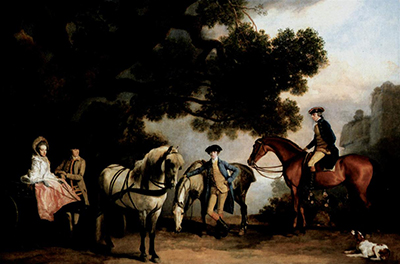
George Stubbs's The Milbanke and Melbourne Families, painted about 1769, is an oil on canvas measuring 97.2 × 147.3 cm. It belongs to the National Gallery, London, as NG6429. [1]
A pale horse faces us almost squarely. Behind it, another horse lowers its head, while a third carries a rider across the right side. Four people occupy the intervals around them: a woman in a carriage, two standing men and the mounted man. A dog rests near the lower edge. The group is compact enough to take in quickly, yet its individual parts turn in strikingly different directions. [2]
That difference makes the painting more interesting than a straightforward family line-up. The people hold their places, but the animals complicate the arrangement. One horse projects towards the spectator, another bends down, and the bay stretches laterally. The eye moves between these bodies before settling on any single face. Stubbs has made the horses central to the way a family group becomes visible. [2]
At a Glance
This work across George Stubbs’s career
Whistlejacket
about 1762 [7]Contents
- A marriage and four identities
- The woman in the carriage
- Three horses, three kinds of presence
- Clothes, poses and open spaces
- What makes this a conversation piece?
- What analysis found in the paint
- A family collection and a later copy
- Videos on George Stubbs
A marriage and four identities
The woman is Elizabeth Milbanke, beside her father, Sir Ralph. Her husband, Sir Peniston Lamb, later Viscount Melbourne, rides the bay on the right. The central man is most likely her brother John Milbanke. The Gallery associates the probable commission with Elizabeth's marriage in April 1769; Stubbs exhibited it at the Society of Artists the following year under the title A Conversation. [1]
Jonathan David Gross's Oxford Dictionary of National Biography entry records Elizabeth's baptism at Croft-on-Tees on 15 October 1751. It identifies her father as the fifth Milbanke baronet, a Yorkshire landowner and politician, and her mother as Elizabeth Hedworth. The baptismal record gives a firmer starting point than attempts to read a precise age from her painted face. [16]
Gross dates the marriage to 13 April 1769. The couple married at the London house of Peniston's uncle, Robert Lamb, bishop of Peterborough, after an introduction by Peniston's sister Charlotte, Lady Belasyse. Peniston was then a baronet and MP for Ludgershall. Brocket Hall in Hertfordshire and the Melbourne estate in Derbyshire had been acquired by his father, Sir Matthew Lamb. These connections place the portrait within a specific family alliance, rather than an anonymous scene of fashionable recreation. [16]
The Gallery contrasts the Milbankes' established county standing with Peniston's greater inheritance. That context does not make every difference of posture a measure of status. [1]
The canvas gives that alliance a curious shape. Elizabeth and her husband occupy opposite ends, separated by two standing men and substantial animal bodies. The carriage shelters her within an arrangement of straight rails and curved wheels; his elevated seat exposes him against the light sky. Neither simply mirrors the other. Their positions create an exchange across the full width of the picture, requiring the intervening figures and horses to hold the composition together. [2]
The woman in the carriage
Elizabeth's pale wrap and pink skirt supply the brightest concentration of cloth on the left. The skirt spreads across her lap, with folds that widen towards the carriage's edge. Her head remains relatively small above this broad, light shape. A bonnet frames it, while the surrounding foliage is much darker. Stubbs can therefore make the seated woman immediately distinct without raising her above the standing figures. [2]
The older man beside her is presented differently. His brown coat merges more readily with the shaded setting, and parts of his body are crossed or concealed by the carriage. Yet his upright head and the light touches on his waistcoat prevent him from disappearing. This partial concealment matters: the two people share a carriage-sized space without becoming a single silhouette, and their differing orientations keep that space from looking closed. [2]
The carriage itself is only partly included. Its left wheel meets the boundary of the canvas, and the horse occupies much of the space where we might otherwise expect to inspect its construction. Curving wheel rims, the seat and the dark lines running forwards establish a vehicle in use. Stubbs gives enough information to make its relation to the animal intelligible while allowing the human figure and the pale horse to remain more prominent than the apparatus. [2]
Three horses, three kinds of presence
The horse in front of the carriage is the most direct obstacle between us and the people. Its broad chest faces outwards, with the neck turning slightly and the forelegs descending beneath a substantial body. Dark harness crosses the pale coat. The lines are especially clear where they cut across light areas, so that the animal's volume and the equipment fitted around it can be seen at the same time. [2]
Its mane falls towards one side of the neck, softening the boundary between the head and shoulder. Below, the chest and legs offer a more emphatic sequence of light and dark. The animal does not function simply as a pale patch beside Elizabeth's clothes. It stands farther forwards, creating an interval between the spectator and the carriage and giving this side of the group a tangible depth. [2]
The second horse is easier to overlook. Much of its body lies behind the central man, but its lowered neck carries a pale face towards the ground. The descent is conspicuous once noticed: a long, bending form interrupts the upright human posture beside it. The man's extended arm reaches across this area without obscuring the whole animal. His relaxed, crossed legs and the horse's downward movement produce two very different patterns within one small part of the picture. [2]
On the right, the mounted bay supplies the longest uninterrupted animal body. Its head points inwards, while its hindquarters approach the opposite edge. Warm brown areas across the flank catch the light; darker legs and shadows anchor the mass below. The rider sits above the middle of that body, his dark coat separating him from the pale background. Horse and man form a tall, open group, distinct from the crowded carriage on the left. [2]
The reins visibly connect the rider and his mount. Several curved lines cross the open interval between his hand and the horse's head, rather than forming one rigid edge. Meanwhile, the raised head of the carriage horse, the downward head near the centre and the bay's inward-facing profile distribute attention at different heights. These variations make the animals readable as separate presences, even though their bodies help organise a single gathering. [2]
The dog introduces a fourth kind of bodily arrangement. It lies low on the ground, front legs extended and head lifted, with brown patches breaking up its white coat. Its small size would make it easy to lose, but the light body occupies an open patch below the bay. The upward tilt of the head carries attention back towards the larger figures, while the stretched forelegs emphasise the horizontal ground beneath them. [2]
Clothes, poses and open spaces
Blue and pale yellow recur across the two younger men's clothes. The central man's long coat opens around a light waistcoat and breeches; the mounted man's darker coat is set against similarly light legs. Their hats introduce compact dark accents above the faces. These repetitions create a relationship between figures who otherwise occupy different positions and make different shapes. Colour can join them without requiring identical gestures. [2]
The central pose is particularly expansive. One arm reaches out, the other bends back towards the waist, and the crossed legs spread the lower part of the figure unevenly. The coat's long edges frame the pale clothing beneath. By contrast, the rider's body is organised around the saddle, with one bent leg following the horse's side. Standing ease and mounted balance become visibly different ways of occupying the same outdoor setting. [2]
Small openings are as important as the bodies themselves. Ground appears between the carriage horse's legs; a pale interval separates the central figure from the bay's neck; light sky surrounds the rider's head. These spaces prevent the gathering from becoming an unbroken wall. They also allow the eye to pass behind the foreground figures, so that the painting can seem both carefully arranged and open to a landscape beyond. [2]
The tree produces a different kind of enclosure. Its heavy trunk rises at the left, and branches spread over much of the upper canvas. The canopy holds the left-hand figures in shadow while extending above the central group. To the right, its edge gives way to a brighter stretch of sky and a pale, steep-sided outcrop. The contrast is between a dense overhead shelter and a more exposed opening, rather than a uniform strip of scenery. [2]
The pale cliffs have prompted a possible identification with Creswell Crags. The Gallery retains that suggestion cautiously; the setting is not securely located. [1]
That arrangement changes the weight of the people. Elizabeth's light dress has to emerge from darkness; the rider's dark outline has to remain legible against light. The central figure lies between those two conditions. Stubbs varies the background behind each part of the gathering, creating distinct local contrasts while retaining a continuous setting. The landscape participates in the portrait's construction instead of merely filling the space left above the heads. [2]
What makes this a conversation piece?
Art historian William Vaughan discusses the painting within the British conversation portrait, a form concerned with people gathered in a shared social world. His account of the genre distinguishes such portraits from single grand figures and follows their changing relation to privacy, provincial patronage and public exhibition. For this painting, he stresses the precision with which Stubbs records the gathering and reads the central man's prominence as an expression of social hierarchy. [17]
Vaughan also interprets the scene as families meeting during a journey. That is a reading of the image, rather than documentation of a particular outing. His emphasis helps explain how readily apparently informal arrangements invite social conclusions. It does not settle the central sitter's uncertain identification or prove what any member of the group intended. The painting's exactness can support several interpretations without turning every visible difference into a known personal relationship. [17]
Look again at the distribution of attention. Some heads turn across the group; others face more towards the spectator. The bodies do not gather around one obvious speaker. The horses interrupt the intervals in which a continuous exchange might otherwise be imagined, and the dog remains below the principal human level. The image holds a gathering together through direction, spacing and repeated colour, while leaving the particular words or occasion beyond our knowledge. [2]
What analysis found in the paint
The painting has also been examined as a material object. In their 1995 study Analyses of Paint Media, Raymond White and Jennifer Pilc describe a procedure combining infrared examination with gas chromatography–mass spectrometry. Their table identifies two samples from NG6429: white paint from a cloud at the top edge contained walnut oil, while dark green paint from a tree bough contained linseed oil. [18]
Those results concern the binding media in particular sampled areas. They should not be expanded into a recipe for every colour or layer across the canvas. Their value is more precise: areas that appear simply as a light sky and dark vegetation contain materially distinguishable paint mixtures. The technical evidence adds another level of attention to the work, alongside the visible differences in bodies, clothes and landscape. [18]
A family collection and a later copy
Mary Louisa Boyle's 1885 catalogue of the portraits at Panshanger lists this family group as a work by Stubbs. Her entry describes Elizabeth in a small carriage, identifies her father and brother, and places Melbourne on a brown horse. It provides a historical witness to the picture's place among family portraits. A nearby entry describes the younger Peniston Lamb with the horse Assassin and dog Tanner: those names belong to a different painting. [19]
The family's patronage extended beyond this canvas. Sotheby's account of their collection records furnishings by Chippendale and paintings commissioned from Reynolds, Stubbs and Joseph Wright of Derby. Such a context helps place the group portrait among several ways in which the household represented and furnished its position. It does not supply a surviving specification for this commission or turn the landscape into a documented view of one of their estates. [20]
There is also a useful warning in Walter Gilbey's 1898 book on Stubbs. An appendix describes a similar family group as a contemporary copy by W. Best, signed and dated 1770. Gilbey gives it different dimensions and assigns the men's names differently. His entry therefore cannot be treated as the signature, date or authoritative sitter identification of NG6429. Distinguishing the object under discussion is essential before borrowing details from an older catalogue. [21]
The original passed through Emily Lamb, Countess Cowper, and female-line descendants to Julian Salmond. He sold it to Marlborough Fine Art in 1975. Following refusal of an export licence, the National Gallery acquired it that year. Its eighteenth-century English frame is recorded as original. [1]
The painting rewards that combination of identification and looking. Family names explain who the gathering represents; the three horses explain much of how it is built. The forward chest, lowered head and extended bay body keep the arrangement varied, while the tree and open sky distinguish its two sides. What first appears a quiet social encounter becomes a carefully sustained balance between individual presences and the group they form. [2]
Videos on George Stubbs
Explore Stubbs’s equestrian painting in its wider context, including two readings of Whistlejacket.
A Horse Lover’s Guide to the YCBA
A museum tour that places Stubbs alongside other artists who painted horses. It includes a look at Pumpkin with a Stable-lad.
Watch on YouTubeGeorge Stubbs artworks directory
Search works and related prints documented in this guide. Separate versions and printing matrices have separate entries; printmakers are named where known. Unidentified historical titles and untraced studio-sale material are discussed in the essays. A dash means that a date is not established here.
| Name | Date | Medium |
|---|---|---|
| A Bay Horse with a Groom | 1791 | Painting |
| A Bay Hunter with Two Playful Spaniels | 1777 | Painting |
| A Bay Hunter, a Springer Spaniel and a Sussex Spaniel in a wooded river Landscape | 1782 | Painting |
| A Cheetah and a Stag with Two Indian Attendants | about 1764 | Painting |
| A Couple of Fox Hounds (coloured print after Stubbs) | — | Print after Stubbs |
| A Couple of Foxhounds | 1792 | Painting |
| A Foxhound on the Scent | 1788 | Drawing |
| A Gentleman driving a Lady in a Phaeton | 1787 | Painting |
| A Grey Horse | 1793 | Painting |
| A Grey Horse (cantering companion) | 1793 | Painting |
| A Grey Stallion in a Landscape | — | Painting |
| A Horse Affrighted at a Lion | 1 May 1788 | |
| A Horse Belonging to the Rt. Honourable Lord Grosvenor called Bandy from his Crooked Leg | about 1763 | Painting |
| A Horse Frightened by a Lion | 1777 | |
| A Lion (A Lion Resting on a Rock) | 1 May 1788 | |
| A Lion Attacking a Horse | 1770 | Painting |
| A Lion Attacking a Horse (monumental Yale canvas) | 1762 | Painting |
| A lion attacking a horse (NGV) | about 1765 | Painting |
| A Lion Devouring a Horse (1788 print) | 1788 | |
| A lion devouring a horse (attribution disputed) | Proposed mid-1770s | Painting |
| A mare and foal with a bay horse | 1771 | Painting |
| A Monkey | 1799 | Painting |
| A Prancing Horse, Facing Right | c. 1790 | Drawing |
| A Rough Dog | 1790 | Painting |
| A Saddled Bay Hunter | 1786 | Painting |
| A Sleeping Leopard | 1 January 1791 | |
| A Tiger and a Sleeping Leopard | 1 May 1788 | |
| A Tigress (John Dixon after Stubbs) | 1772 | Print after Stubbs |
| A Tyger (A Recumbent Leopard by a Tree) | 1 May 1788 | |
| A Tyger (Sleeping Leopard) | 1 May 1788 | |
| An animal found on the coast of New Holland called kanguroo (after Stubbs) | 1773 | Print after Stubbs |
| An animal of a new species found on the coast of New South Wales (after Stubbs) | July 1773 | Print after Stubbs |
| Antinous and Jockey | — | Painting |
| Antinoüs, a chestnut racehorse, in a landscape | Undated | Painting |
| Bandy belonging to Lord Grosvenor (print after Stubbs) | — | Print after Stubbs |
| Baronet (George Townley Stubbs after Stubbs) | 20 February 1794 | Print after Stubbs |
| Baronet with Sam Chifney Up | 1791 | Painting |
| Baronet with Samuel Chifney up (Royal Collection) | 1791 | Painting |
| Bay Hunter by a Lake | 1787 | Painting |
| Brood Mares (Benjamin Green after Stubbs) | Issue 14 November 1776 | Print after Stubbs |
| Brood Mares and Foals | usually dated 1767 | Painting |
| Brown and White Norfolk or Water Spaniel | 1778 | Painting |
| Bulls Fighting | 1786 | Painting |
| Captain Samuel Sharpe Pocklington with His Wife, Pleasance, and possibly His Sister, Frances | 1769 | Painting |
| Death of the Doe (attribution disputed) | 1804 | |
| Der Englische Hühnerhund (Johann Wölfle after Stubbs) | about 1860 | Print after Stubbs |
| Dog (A Foxhound Viewed from Behind) | 1 May 1788 | |
| Dog [A Foxhound on the Scent] | 1788 | |
| Drill and albino baboon | before 1789 | Painting |
| Eclipse (Charles Hunt after Stubbs) | 12 November 1839 | Print after Stubbs |
| Eclipse (George Townley Stubbs after Stubbs) | 1796 | Print after Stubbs |
| Eclipse (oil study) | — | Painting |
| Eclipse (Thomas Burke after Stubbs) | First published 1772 | Print after Stubbs |
| Eclipse and John Wildman (Benjamin Green after Stubbs) | 1772 | Print after Stubbs |
| Eclipse at Newmarket (Jockey Club version) | Proposed early 1790s; often dated 1770 | Painting |
| Eclipse at Newmarket with a groom and jockey | 1770 | Painting |
| Eclipse with Mr Wildman and His Sons | 1769–71 | Painting |
| Eclipse, the Property of Capt.n O Kelly (anonymous print after Stubbs) | Imprint 4 June 1804; impression undated | Print after Stubbs |
| Euston | 1774 | Painting |
| Finished Study for the Seventh Anatomical Table of the Muscles of the Horse | 1756–58 | Drawing |
| Five Brood Mares at the Duke of Cumberland's Stud Farm in Windsor Great Park | 1765 | Painting |
| Fowl Body, Lateral View (Highly Finished Study for an Unpublished Table; Shows the Last Stage in Dissection) | — | Drawing |
| Fowl Body, Lateral View (Probably Prepared for Transfer to the Plate for Engraving of Table XV) | — | Drawing |
| Fowl Skeleton, Lateral View (Finished Study for Table V) | — | Drawing |
| Freeman, the Earl of Clarendon's Gamekeeper, with a Dying Doe and Hound (Yale) | 1800 | Painting |
| George Stubbs (enamel self-portrait) | 1781 | Enamel |
| Gimcrack (George Townley Stubbs after Stubbs) | 1775 | Print after Stubbs |
| Gimcrack on Newmarket Heath, with a trainer, a jockey and a stable lad | about 1765 | Painting |
| Gimcrack, with John Pratt up, on Newmarket Heath | about 1765 | Painting |
| Hambletonian, Rubbing Down | 1800 | Painting |
| Hay-Makers | 1791 | |
| Haycarting | 1795 | Enamel |
| Haymakers | 1785 | Painting |
| Haymakers (Lady Lever Art Gallery) | 1794 | Enamel |
| Hollyhock (with later additions by Vernet and Boucher) | about 1765–70 | Painting |
| Horse Attacked by a Lion (Episode C) | 1768–69 | Painting |
| Horse Attacked by a Lion (Tate enamel) | 1769 | Enamel |
| Horse Devoured by a Lion | Possibly exhibited 1763 | Painting |
| Horse Frightened by a Lion | 1770 | Painting |
| Horse Frightened by a Lion (Episode A; Wedgwood and Bentley after Stubbs) | — | Sculpture |
| Horse Frightened by a Lion (Tate) | Possibly exhibited 1763 | Painting |
| Horse Frightened by a Lion (Yale) | 1762–68 | Painting |
| Horse in the Shade of a Wood | 1780 | Painting |
| Hound Coursing a Stag | about 1762 | Painting |
| Human Figure, Anterior View (Intended for a Plate That was Never Published) | — | Drawing |
| Human Skeleton, Lateral View | 1795–1806 | Drawing |
| Hunt servants setting out (Southill commission) | 1767 | Painting |
| Hühnerhund (The Spanish Pointer) | about 1766 | Painting |
| John and Sophia Musters Riding at Colwick Hall | 1777 | Painting |
| John Musters on his hunter Pilgrim | 1777–78 | Painting |
| Labourers | 1789 | |
| Labourers (Richard Earlom after Stubbs and Amos Greene) | 25 March 1790 | Print after Stubbs |
| Laetitia, Lady Lade (d.1825) | 1793 | Painting |
| Lemon and White Water Spaniel | — | Painting |
| Lion Attacking a Stag | — | Painting |
| Lord Grosvenor's Arabian Stallion with a Groom | about 1765 | Painting |
| Lord Grosvenor's Arabian Stallion with a Groom (Peter Mazell after Stubbs) | 1771 | Print after Stubbs |
| Mambrino (Eaton Hall painting) | — | Painting |
| Mambrino (George Townley Stubbs after Stubbs) | 1794 | Print after Stubbs |
| Mares and Foals belonging to the 2nd Viscount Bolingbroke | about 1761–62 | Painting |
| Mares and foals beneath large oak trees | — | Painting |
| Mares and Foals by a stream | Exhibited 1764 | Painting |
| Mares and Foals in a River Landscape | about 1763–68 | Painting |
| Mares and Foals in an Extensive Landscape | about 1769 | Painting |
| Mares and Foals without a Background | 1762 | Painting |
| Moose Deer (after Stubbs) (Arctic Zoology plate VIII) | 1784–85 publication | Print after Stubbs |
| Newmarket Heath with a Rubbing-Down House | — | Painting |
| Otho (1796 print after Stubbs) | 1 December 1796 | Print after Stubbs |
| Otho, with John Larkin up | 1768 | Painting |
| Pangloss | about 1762 | Painting |
| Patch (Grafton commission) | 1759 | Painting |
| Phaeton and the Chariot of the Sun (enamel) | 1775 | Enamel |
| Phaeton with a Pair of Cream Ponies and a Stable-Lad | 1780–84 | Painting |
| Phillis | 1772 | Painting |
| Portrait of a Large Dog (Dingo) | 1772 | Painting |
| Pumpkin with a Stable-lad | 1774 | Painting |
| Racehorses Exercising at Goodwood | 1759–60 | Painting |
| Reapers (1791 print) | 1791 | |
| Reapers (Tate) | 1785 | Painting |
| Reapers (Yale) | 1795 | Enamel |
| Red Deer: A Stag and a Hind | 1792 | Painting |
| Richard Wedgwood | — | Enamel |
| Ringwood, a Brocklesby Foxhound | 1792 | Painting |
| Scrub, a bay horse belonging to the Marquess of Rockingham | about 1762 | Painting |
| Self Portrait on a White Hunter | 1782 | Enamel |
| Self-Portrait | about 1759 | Painting |
| Shooting (1770 Woollett plate after Stubbs) | 1770 | Print after Stubbs |
| Shooting (1771 Woollett plate after Stubbs) | 1771 | Print after Stubbs |
| Shooting at Goodwood | 1759–60 | Painting |
| Sir John Nelthorpe as a boy | 1756 | Painting |
| Sir John Nelthorpe partridge shooting with one pointer | — | Painting |
| Sir John Nelthorpe, 6th Baronet, out Shooting with His Dogs in Barton Field, Lincolnshire | 1776 | Painting |
| Sleeping Leopard | 1777 | Enamel |
| Soldiers of the 10th Light Dragoons | 1793 | Painting |
| Stallion and Mare (George Townley Stubbs after Stubbs) | 1776; reissued 1789 | Print after Stubbs |
| Steward and gamekeeper with dogs (Southill commission) | 1767 | Painting |
| Studies of a Lemur (Lemur murinus) in six different attitudes | 1773 | Drawing |
| Study for the Self-portrait in Enamel | c. 1781 | Drawing |
| Study of a Lemur | 1773 | Drawing |
| Study of a Racehorse in Action: Galloping to Left, a Semi-Anatomical Study, with Skin Flayed to Show Action of Muscles | — | Drawing |
| Study of the Legs of a Draught-Horse Pulling a Harrow (attributed to Stubbs) | Proposed about 1786 | Drawing |
| Sweet William (Grosvenor panel) | — | Painting |
| Sweet William (Turf Gallery canvas) | — | Painting |
| The Black Stallion Sampson, Portrayed from Three Angles (with landscape additions) | about 1764 | Painting |
| The Charlton Hunt | 1759–60 | Painting |
| The Fall of Phaeton | — | Sculpture |
| The Frightened Horse | 1780 | Sculpture |
| The Grosvenor Hunt | — | Painting |
| The Haymakers (Upton House) | 1783 | Painting |
| The Horse and Lion (George Townley Stubbs after George Stubbs) | 1770 | Print after Stubbs |
| The Kongouro from New Holland | 1772 | Painting |
| The Labourers | 1779 | Painting |
| The Labourers (Southill original) | 1767 | Painting |
| The lion and horse (Benjamin Green after Stubbs) | 1769; reissued 1777 | Print after Stubbs |
| The Milbanke and Melbourne Families | about 1769 | Painting |
| The Moose | 1770 | Painting |
| The Prince of Wales's Phaeton | 1793 | Painting |
| The Reapers (Upton House) | 1783 | Painting |
| The Sebra, or Wild Ass (George Townley Stubbs after Stubbs) | 1771 | Print after Stubbs |
| The Spanish Pointer (Bradford version) | about 1766–68 | Painting |
| The Spanish Pointer (William Woollett after Stubbs) | January 1768 | Print after Stubbs |
| The Third Duke of Dorset's Hunter with a Groom and a Dog | 1768 | Painting |
| Thomas Freeman, Lord Clarendon's gamekeeper, with a dog and a shot doe (with George Townly Stubbs) | 1803 | Painting |
| Turf, with Jockey up, at Newmarket | — | Painting |
| Turk and Crab | — | Painting |
| Two Bay Hunters Communing On The Bank Of A Lake | — | Painting |
| Tygers at Play | 1780 | |
| Viscount Gormanston's White Dog | 1781 | Painting |
| Viscount Gormanston's White Dog (canvas version) | — | Painting |
| Water Spaniel | 1769 | Painting |
| Wedgwood Family Portrait | 1780 | Painting |
| Whistlejacket | about 1762 | Painting |
| Whistlejacket with two other stallions and a groom | Recorded 1762 | Painting |
| White Poodle in a Punt | about 1780 | Painting |
| William Anderson with two Saddle-Horses | 1793 | Painting |
| Working Drawing for the Seventh Anatomical Table of the Muscles of the Horse | 1756–58 | Drawing |
| Zebra | 1763 | Painting |
Discussion
Look again at the images and ideas explored in The Milbanke and Melbourne Families. These editorial prompts invite your observations.
Reader Insights
Which figure first attracts your attention, and does that change once you notice the lowered horse near the centre?
How would the gathering alter if the dog, the carriage horse or the spreading canopy were removed?
Compare the way equipment shapes this portrait with Stubbs's later A Gentleman Driving a Lady in a Phaeton.
Join the Conversation
Share a detail, comparison or question about The Milbanke and Melbourne Families below.
References
- National Gallery, London, The Milbanke and Melbourne Families, NG6429, current collection record; provenance excerpt from Judy Egerton, National Gallery Catalogues: The British Paintings (2000). View source.
- National Gallery, official image of NG6429. Visual observations refer to this work. View source.
- Goodwood, The Collection, Painting Collection modal, Racehorses Exercising at Goodwood; An exciting acquisition: a study by George Stubbs, 30 June 2023; History of the Estate Hounds, 4 October 2023; About Goodwood Racecourse. Accessed 4 November 2026. View source.
- Goodwood, The Collection, Painting Collection modal, Racehorses Exercising at Goodwood; An exciting acquisition: a study by George Stubbs, 30 June 2023; History of the Estate Hounds, 4 October 2023; About Goodwood Racecourse. Accessed 4 November 2026. View source.
- Goodwood, The Collection, Painting Collection modal, Racehorses Exercising at Goodwood; An exciting acquisition: a study by George Stubbs, 30 June 2023; History of the Estate Hounds, 4 October 2023; About Goodwood Racecourse. Accessed 4 November 2026. View source.
- Goodwood, The Collection, Painting Collection modal, Racehorses Exercising at Goodwood; An exciting acquisition: a study by George Stubbs, 30 June 2023; History of the Estate Hounds, 4 October 2023; About Goodwood Racecourse. Accessed 4 November 2026. View source.
- National Gallery, Whistlejacket, NG6569, current collection record, provenance, in-depth discussion and frame entry. View source.
- Yale Center for British Art, Zebra, B1981.25.617, current object metadata, gallery labels, Malcolm Warner’s 1998 catalogue entry and provenance supplied through the museum’s public collection record. View source.
- Christie’s, Gimcrack on Newmarket Heath, with a trainer, a jockey and a stable lad, London, 5 July 2011, lot 12; object details, essay, provenance, exhibitions and whole image. View source.
- Christie’s, Gimcrack on Newmarket Heath, with a trainer, a jockey and a stable lad, London, 5 July 2011, lot 12; object details, essay, provenance, exhibitions and whole image. View source.
- National Gallery, London, The Milbanke and Melbourne Families, NG6429, current collection record; provenance excerpt from Judy Egerton, National Gallery Catalogues: The British Paintings (2000). View source.
- Yale University Art Gallery, A Lion Attacking a Horse, 1770, 1955.27.1, collection record. Accessed 4 November 2026. View source.
- Royal Museums Greenwich, ‘The Kongouro from New Holland’ (Kangaroo), ZBA5754. Accessed 4 November 2026. View source.
- Tate, George Stubbs, Haymakers, 1785, T02256; details, Terry Riggs’s collection text (January 1998), and online caption. Collection record. View source.
- Frances Bailey, ‘Hambletonian, Rubbing Down: A masterpiece by George Stubbs’, National Trust Cultural Heritage Magazine, Autumn/Winter 2024, pp. 22–33. Article. View source.
- Jonathan David Gross, Elizabeth Lamb, Viscountess Melbourne, Oxford Dictionary of National Biography (2004; version 2008), accessible extract. View source.
- William Vaughan, British Painting: The Golden Age from Hogarth to Turner, pp. 52–65, especially 64–65, and plate 42. View source.
- Raymond White and Jennifer Pilc, Analyses of Paint Media, National Gallery Technical Bulletin 16 (1995), pp. 85, 90–91. View source.
- Mary Louisa Boyle, Biographical Catalogue of the Portraits at Panshanger (1885), p. 322, no. 11; compare no. 15. View source.
- Sotheby's, Masterpiece of the Flemish Baroque to Headline Sotheby's Old Masters Sale, 11 November 2020, family patronage context. View source.
- Walter Gilbey, The Life of George Stubbs, R.A. (1898), appendix B, p. 161, no. 26. View source.
- Basic title, date and material metadata for Tate’s Reapers (T02257) and Otho (T02375) is adapted from the Tate collection dataset, October 2014, released under CC0. TheHistoryOfArt.org has reconciled labels and versions. This credit does not apply to Tate’s authored catalogue commentary or images.
- Data Source: Yale Center for British Art. Basic object fields are adapted and reconciled for this directory. Reuse is subject to the Center’s Open Data and Data Services Terms of Use. No museum endorsement is implied. This metadata credit does not relabel scholarly essays or images as open data.
- Basic object metadata for A Horse Frightened by a Lion, 1985.38, The Cleveland Museum of Art, John L. Severance Fund, is available under CC0. Titles and design-level grouping have been reconciled for this directory.