 by Tom Gurney
Tom Gurney BSc (Hons) is an art history expert with over 20 years experience
Email: tomgurney1@gmail.com / Phone: +44 7429 011000
Katsushika Ōi
Katsushika Ōi (葛飾応為), also known as Ei or O-Ei, was an Edo-period painter and book illustrator and the daughter of Katsushika Hokusai. Her surviving work takes us from a lantern-lit street in the Yoshiwara to a scene of surgery from a Chinese novel. The pictures share an unusually precise interest in how people use their hands and in what the viewer can see when the strongest light falls only on part of a scene. They also show how much variety can be lost when a painter is remembered primarily as a famous man's assistant.
At a Glance
- ArtistKatsushika Ōi, also known as Ei or O-Ei
- ActiveFirst half of the nineteenth century
- MediaPaintings and book illustration
Contents
- O-Ei, Ōi and the name Eijo
- Training, marriage and the return to Hokusai's household
- Three letters from Ōi's working life
- What people called her while she was alive
- Two early and late points in her printed career
- Night Scene in the Yoshiwara
- Beauty Fulling Cloth in the Moonlight
- Three Women Playing Musical Instruments
- Operating on Guan Yu's Arm
- The illustrator of Onna chōhōki
- What working with Hokusai meant
- Two different catalogue judgements about a shared painting
- What the exhibitions have brought into view
- Ōi among the night pictures in the 2026 exhibition
- Reading the record after 1849
- Works discussed on this page
Ōi lived and worked alongside Hokusai in his later years. Evidence for their shared household, evidence for particular collaborations and evidence for her own authorship have different strengths. A nineteenth-century drawing can show them working in the same room. A book can name her as the illustrator. A study of two versions of a composition may leave open which version came first. The differences among those records are the key to understanding her career. [1] [2]
O-Ei, Ōi and the name Eijo
Japanese institutional records use several forms of the painter's name. Ei (栄) is the personal name, and the familiar O-Ei may be written お栄 or 阿栄. Eijo (栄女) is another form attached to her work. Ōi (応為) is the name under which museums generally catalogue her paintings today. The long vowel in Ōi matters to the romanisation, but a collection search for “Katsushika Oi” often finds the same person. Searching by Japanese characters is particularly useful for Japanese exhibition lists and digital copies of books. [3] [4]
The museum accounts agree on her identity as Hokusai's daughter. The Sumida Hokusai Museum calls her his third daughter and describes her painting alongside him in his old age. The Tokyo National Museum gives a birth around 1800 and a death around 1866 in its biographical profile. The Ōta Memorial Museum leaves both dates uncertain, and Cleveland uses “c. 1800–after 1857.” These are different ways of marking the limits of a sparse record. The most useful answer is that she was probably born around 1800, was active in the first half of the nineteenth century and survived her father, who died in 1849. An approximate date adopted by a catalogue should not be turned into the year of a documented event. [5] [6] [7]
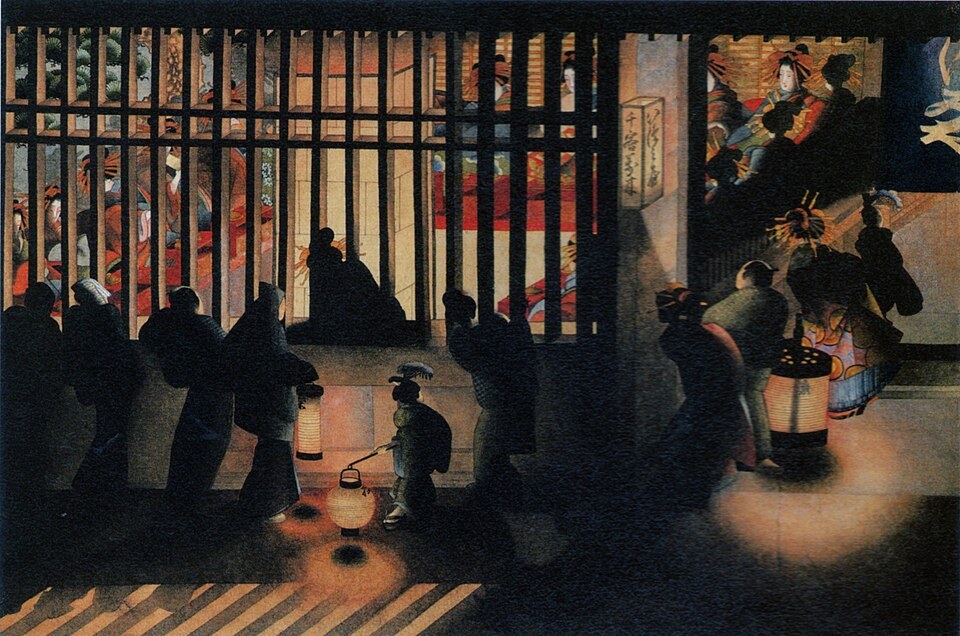
The name appears in places where a reader might not expect to find a signature. The Ōta Memorial Museum identifies characters from her art name and personal name on three separate lanterns in Night Scene in the Yoshiwara. The National Diet Library's record of Onna chōhōki, in contrast, credits the illustration with a form combining Ōi and Eijo. One is an inscription made to look like part of an illuminated street. The other is a credit a reader or bookseller could use. Both connect a work to the artist, and the difference tells us how freely she could vary the way she presented herself across formats. [8] [4]
Training, marriage and the return to Hokusai's household
The Tokyo National Museum names the painter Minamisawa Tōmei as Ōi's husband and explains that, after the marriage ended, she returned to her father's household. Her husband had trained in the line of Tsutsumi Tōrin. The relationship connects Ōi to a wider network of painters, but the surviving works and documents offer little basis for reconstructing private conversations, the course of the marriage or the reasons it ended. The significant professional fact is that she continued to paint and illustrate after her return. [3]
The years in which Ōi trained are less well illuminated than the period of their later work together. We can see what familiarity with a painter's household might have offered: access to models, to drawings in different stages of completion, to clients looking at a picture and to the practical work involved in bringing an image into being. But an understanding of those opportunities does not give us a lesson-by-lesson record. Her hand is known through such acts as raising the mallet in the moonlit painting, setting three musical performers around open paper, or showing someone avert his head during an operation. The poses are more informative evidence of what she learned to do than a reconstructed account of how she learned it. [9] [10]
Two Japanese sources bring the late household into focus. The Sumida Hokusai Museum's map places Hokusai and O-Ei in the Han'nokibaba area of Honjo Kamezawa toward the end of the Tenpō era. The National Diet Library preserves Picture of Hokusai's Temporary Dwelling, a drawing by his pupil Tsuyuki Iitsu. The Sumida museum used this record as the basis for a reconstructed studio in its permanent exhibition. The surviving drawing, the modern reconstruction and the chronology of addresses are three different kinds of evidence. The drawing shows how a pupil represented the pair at work. The reconstruction helps a viewer grasp room size and working positions. The address record connects that working life to a neighbourhood. Neither a drawing nor a reconstruction inventories which brush painted any given scroll. [11] [12] [5]
Late testimony can be read with the same care. The Tokyo National Museum presents accounts preserved by Iijima Hanjurō in his biography of Hokusai. The pupil Tsuyuki remembers Ei staying close to her father and describes habits that reminded him of Hokusai. Another recollection presents her as confident that she could support herself by painting. These are valuable glimpses of someone with a reputation and a firm expectation that her brush could earn her living. The recollections are mediated by the people who remembered her and the biographer who gathered them. They should be attributed to their witnesses and checked against what can actually be seen in surviving work. [3]
Three letters from Ōi's working life
Julie Nelson Davis's chapter in the British Museum's 2023 Late Hokusai research volume begins with three surviving letters in Ōi's hand. They come closer to her activity than the later anecdotes about how she spoke or kept house. They are also short, practical documents, concerned with people awaiting material, the things a painter needs to know and the movement of news between members of a school. They permit more precise statements about her work than a general idea of a daughter sitting beside her father can support. [13]
In the first letter, one of her correspondents had evidently been waiting for a reply. Ōi thanks them for chestnuts and says she will send a tehon. The term is connected with models for learning, but the precise thing to be sent remains open. It might be a printed manual or preparatory work for something of that kind. The surviving piece of paper does not supply the recipient's identity. The letter nonetheless shows that Ōi was expected to respond and could make arrangements for material to reach someone waiting for it. Davis also notes a name used in this correspondence, Miuraya. That contextual identity belongs with a document carrying out the business of a household, alongside the names Ei and Ōi by which paintings and printed work can be identified. [14]
Another letter goes farther in demonstrating a painter's knowledge. Sent to an acquaintance in Obuse, it deals with a preliminary picture of a beautiful woman and includes instructions and drawn explanations for a red colourant. Sketching how hands work with the substance makes the document particularly interesting in relation to the fingers and tools in her finished paintings. It also gives a question for an examination of a printed book. Davis notes a closely comparable discussion of the red in a painting manual published under Hokusai's name in 1848, Ehon saishiki tsū. The similarities support a discussion of shared methods and knowledge. The letter cannot determine whether Ōi wrote portions of the book, prepared a clean copy or supplied instructions within a workshop that later put them into print. [13]
The third letter informs Kōsai Hokushin, one of Hokusai's students, of her father's death in 1849 and gives the time for the funeral. The chronology can be anchored here to something Ōi was doing at a particular moment. She wrote to a named person in the working circle about a matter requiring rapid action. That information has a different relationship to her life from a record of a death much later placed at an approximate date by a museum. The fast, direct communication also shows an aspect of the working household seldom visible in paintings: it was a social unit in contact with other people whose work or attendance it depended upon. [13] [15]
Placed side by side, the letters document contact about a model, show expertise in colour and establish her role in informing a pupil when Hokusai died. They give different kinds of responsibility rather than an undifferentiated portrait of assistance. The differences are instructive. Knowledge of colour can be compared with another textual source and with pictures. A promise to forward a model cannot identify its designer. A funeral notice is the best kind of evidence for her role in an event whose urgency left little space for an account of studio techniques.
What people called her while she was alive
Davis brings several people closer to the centre of the story. In 1833 the painter Keisai Eisen referred to Eijo in his account of ukiyo-e and described her as an eshi, a recognised picture maker. His estimate is significant because it comes from an artist who moved in the same world, writing while both were active. It gives her a professional status beyond the modern decision to put her name on a label. Eisen also writes of her in relation to her father, an indication that the reasons to remember her and the ways of naming her were already bound together in the nineteenth century. [13]
Saitō Gesshin's accounts connect her with an exhibition of works by teachers and pupils in 1836, with book illustration and with a much harder question of work done under another name. In one report that he attributes to another informant, he describes her making drawings for blocks under the Iitsu name. It is an unusually specific claim about the division of labour. Its weakness is also unusually clear: it reaches the reader through Gesshin's source rather than a series of marked drawings from her hand. It warrants taking collaboration seriously and looking for other evidence. It should not be used to produce a list of anonymous prints and then assign all of them to her. [13]
The same distance can be applied to the representation of the late household by Tsuyuki Iitsu, also known as Tsuyuki Kōshō. Our sense that we are looking over the shoulders of people at an actual moment comes from the specificity of a drawn room. His rendering passes through the scrutiny of a pupil with reasons to remember the master. In the British Museum volume, Davis asks what gendered expectations a later audience might recognise in making one person the active painter and showing the other beside him. That reading adds a reason to compare the picture with the letters. The room can be drawn as a place associated with the painter Hokusai while the written evidence reveals the active expertise of someone else occupying it. [12] [13]
Two early and late points in her printed career
The poetry collection Kyōka kunizukushi includes a view with sailboats signed Eijo. Davis identifies it as an early example, around 1810, in an anthology with contributions from Hokusai and pupils. A date for the publication and a reading of the signature give a firmer point in the chronology than calculations based on a proposed birth date. The format also puts her early work in a setting appropriate to her later trade. She supplied an image to a larger project in which other contributors had their own work. The publication can establish that she participated without telling a global story about the speed at which her drawing developed. [13]
Onna chōhōki provides a quite different point of comparison. Tokyo Gakugei University and Nara Women's University catalogue the illustrated revision under 1847 and identify Ōi Eijo as the illustrator. The latter library notes that the preface by editor Takai Ranzan is read as dating to 1829, and explains that its own copy was printed later than the edition described in the colophon. These distinctions make the book an excellent example of the different dates tucked into one object. The date of the original text, the date of a preface in a revision, the date of the illustrated edition and the date of a particular printing can all be different. Knowing them still leaves open when the book's artist supplied the illustrations. [16] [17]
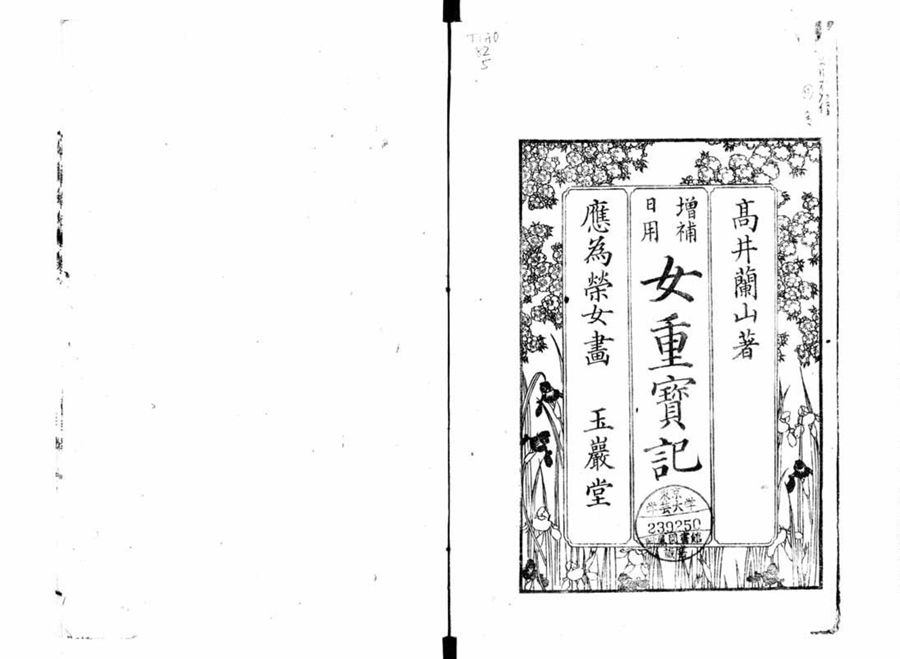
The text on the right opening places the credit in the left column of the printed title device. Read 應為榮女畫 there, using the older written forms of Ōi and Eijo. The last character identifies the drawing, while the publisher's name appears lower in the same column. A reader without specialist access to the book can check the words against the university's catalogue, where these characters have been supplied in modern forms. The credit is direct evidence of the relationship between the illustrator and this edition.
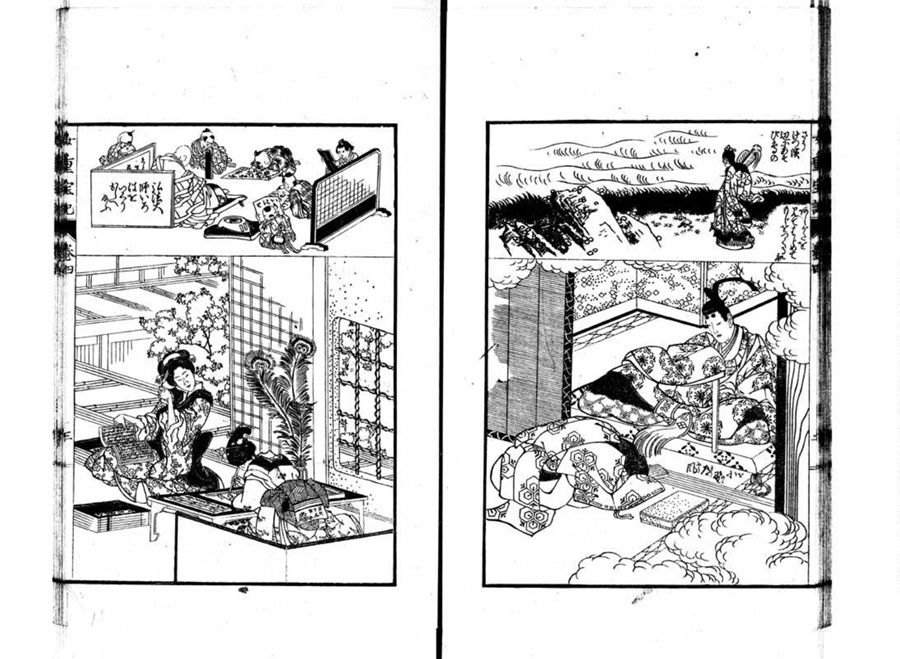
Look next at a pair of illustrated leaves from the same digitised book. The smaller panels above can divide their space unevenly to show outdoor or interior scenes. In the lower panels, a patterned garment or a series of repeated lines in a screen sets a scale against which a hand is very small. The absence of the bright colours used in the Boston scroll puts emphasis on the silhouette and the fingers. Neither example turns these women into portraits of actual named people. The drawings give readers alternative situations in which a figure is recognisable by her occupation, position or attention. [16]
The Nara commentary places the illustrated publication in relation to a book first published in 1692. It explains the revised edition as an effort to bring advice for women up to date and points out changes in the topics and in the illustrations. A new illustration therefore did a job quite different from illustrating an entirely new work. It helped make an inherited text recognisable as an object for contemporary users. Within a handbook, an image can become an example of how something is done. In a scroll the gestures could serve a more ambiguous or meditative purpose. Ōi's design for a woman judging perfume connects the formats through the exact placement of fingers and the different ways pictures let the viewer read their use. [17] [5]
Davis also records an illustrated book commissioned by a tea producer, Sencha tebiki no tane, published in 1848. The two late dates matter because the projects could circulate under her own identity close to the end of Hokusai's life. They give a route into her professional networks at a time usually described through the schedule of his travels and celebrated large paintings. An early signed contribution, a revised handbook and a work for a tea producer put her in contact with readers for different reasons. Together they are more useful for a biography than a count of the pictures that can be confidently named in her hand. [13]
Night Scene in the Yoshiwara
Night Scene in the Yoshiwara (吉原格子先之図) is an unusually good painting to approach from its darkest part. Begin with the upright bars of the lattice. They make light appear in slender strips and allow only partial views of the figures behind them. The unlit side of a person standing close to the barrier can be almost featureless, while a figure farther away can read quite clearly when light falls behind or beside her. Ōi parcels out visibility without giving the scene a single even illumination. [8]
The lattice served an actual purpose in the licensed pleasure district. It allowed visitors to look into an establishment while drawing a boundary between the street and its occupants. In the painting it is also an instrument for controlling the spectator's access. Following the verticals across the scene makes the women's visibility appear intermittent. A striped stretch of light is enough to establish the depth of a room. A few pale accents pick out patterns on clothing. The atmosphere depends on these local readings and on how they interrupt the architecture. The screen is simultaneously the subject of the scene and a way of building the picture.
The painting keeps the street and interior in play at the same time. Figures near the viewer are placed where the street has far less illumination. Behind the lattice, where display matters to the commerce of the place, the women can be seen more readily. Ōi's viewer occupies an uncomfortable position near the potential customers, yet has no power to make the figures turn or to extend the light beyond the areas she has painted. This structure is part of the work's account of spectatorship. Describing the picture solely as an exercise in dramatic lighting would miss what is being seen and who has permission to see it.
Search the lanterns for the painter's marks after getting used to the larger rhythms of the screen. The Ōta museum reads 応, 為 and 栄 on three separate lanterns. The discovery rewards the sort of close inspection that the dark parts of the painting initially discourage. It also complicates the idea of a “hidden” woman artist. The artist has presented herself through design and lettering in the body of the picture. A modern observer unfamiliar with those forms can miss her mark even when following the painted lights. [8]
The museum devoted a 2023 exhibition to the painting in the context of hand-painted ukiyo-e. In 2026 it gave the same painting a different circle of comparisons, placing it in a history of night scenes alongside artists including Suzuki Harunobu, Utagawa Hiroshige and Kobayashi Kiyochika. These are two particularly productive ways of seeing Ōi. One asks what hand painting on a single surface can do. The other asks what Japanese artists did with the problem of illuminating a picture in which most features cannot be seen clearly. Comparing the pictures across dates can reveal similar solutions without assuming that every later painter had seen this particular object. [6] [18]
Beauty Fulling Cloth in the Moonlight
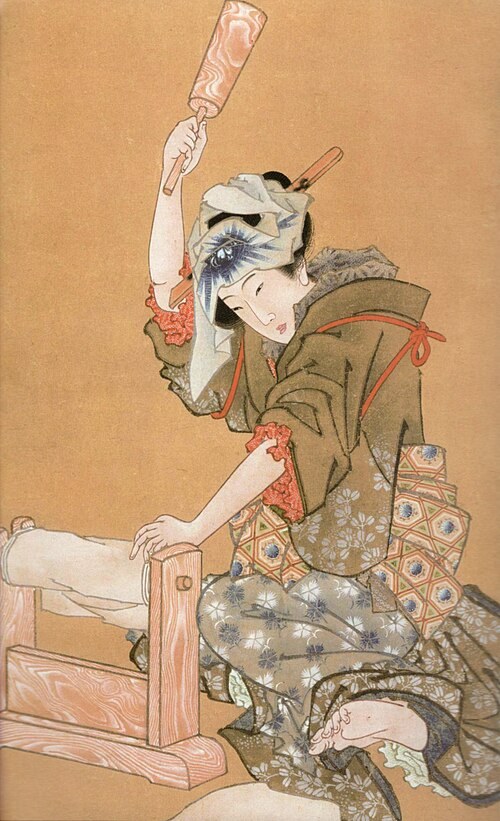
The Tokyo National Museum's Beauty Fulling Cloth in the Moonlight (月下砧打美人図, A-11653) takes a single movement as its subject. The woman raises a mallet before bringing it down on cloth. A moment later the angle of the arm, cloth and mallet will be different. Ōi selects the instant when the visitor to the picture can still reconstruct both the lift and the coming strike. The term kinuta refers to the implement or block associated with beating cloth. The activity is skilled work, and identifying it gives the figure's posture a purpose beyond her elegance. [19] [20]
The edge of a garment here is a clue to both training and movement. The Tokyo National Museum has pointed out the fine crinkled lines of the underclothing as a manner learnt from Hokusai. They hold a long curve in place while interrupting it with small uneven changes. Compare the flexible lower edge of a sleeve with the straight weight of the tool. The contrasts ask the eye to imagine what is heavy, what yields and what will move next. A shared device from her father's painting can be isolated without treating all the decisions around it as derivative. [21]
The image also implies a sound. A blow against the cloth would break the quiet, and the raised mallet delays it. The Ōta night scene creates much of its meaning out of multiple visible lights and the socially organised view through a grate. Here the moon signals the hour while the narrow interplay of tool and body makes the act legible. Compare the two by looking initially for where the night is established. In one, lanterns compete with shadow right across the scene. In the other, a more compact action can give a stretch of darkness narrative interest. The two works share an interest in withholding visual information, but they ask the viewer for markedly different kinds of attention.
Three Women Playing Musical Instruments
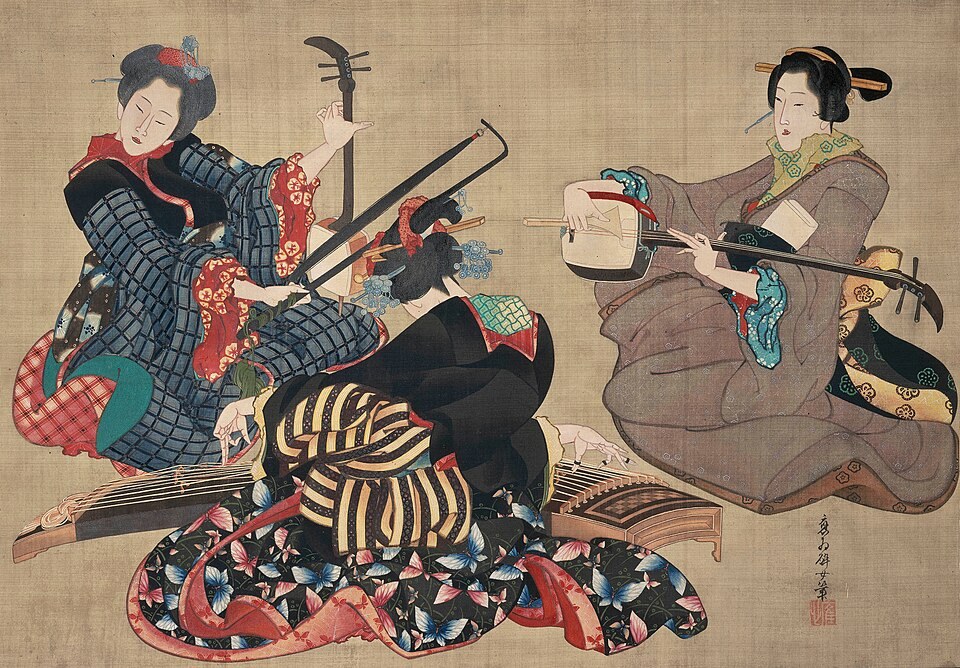
The Museum of Fine Arts, Boston dates Three Women Playing Musical Instruments to 1818–44 and describes it as a hanging scroll in ink and colour on silk. The institution's range spans more than two decades, so the object cannot fix a specific year in Ōi's personal chronology. It can establish that she could coordinate several seated figures, who are all doing something too precise to be reduced to decorative poses. The instruments, hands and glances give a relatively quiet setting a clear point of concentration. [22] [10]
Observe how the musicians manage space between their instruments and their bodies. The long neck of an instrument asks one player to reach or turn. The angled bow on the left, the hands over the strings in the centre and the plectrum over the instrument at the right each require quite different kinds of concentration. At every contact point, Ōi has to tell the viewer which surfaces lie next to each other and which are several inches apart. The group reads as an ensemble partly because each figure is given a different shape of attention. The relationships between their hands supply much of the information that a fuller account of the room would otherwise have to provide.
The silk support lets extended passages of colour and minute details sit together without the divisions imposed by separate colour blocks. There is a different economy of concentration within a garment. An area of patterned textile can attract as much attention as the face above it; the composition gives shape to that attention by regularly leading back to hands and musical instruments. In a print, repeated linear marks can standardise a texture across a run of sheets. Here each passage has the force of a particular choice on one painted object. Looking at the texture of the silk and at the precision of the gesture together makes the museum's description of the medium useful to a viewer.
Boston selected the work for its 2015 Hokusai exhibition and again for Hokusai: Inspiration and Influence in 2023. The first exhibition included it in a discussion of urban pleasures, along with Hokusai's Woman Looking at Herself in a Mirror. The later show deliberately put works by pupils, rivals and later artists alongside Hokusai. In the earlier comparison, a woman positioned before a mirror has a different quality of attention from any of the three musicians. In the later context, Ōi's scroll could stand as an exercise in what a student could do with shared techniques. The painting can answer both questions because its handling of gesture is so specific. [23] [10]
Operating on Guan Yu's Arm
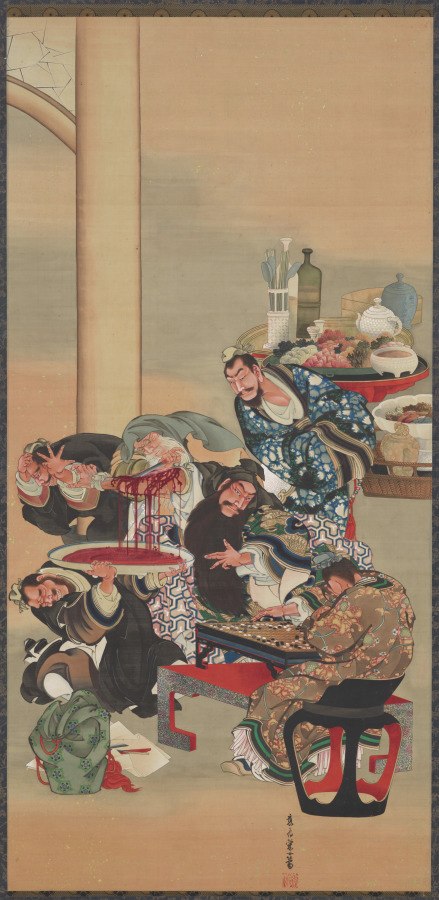
The Cleveland Museum of Art identifies Operating on Guan Yu's Arm (関羽割臂図) as the largest known surviving painting by Ōi. The painting alone is more than 140 centimetres high. The mounted scroll exceeds two metres. Ink, colour and gold on silk allow her to work with a range of surfaces from a patterned bag and Guan Yu's robe to the open wound in his arm. The scale suits an image about conflicting kinds of attention: the surgeon concentrates on the injury, Guan Yu on the game and the surrounding people can hardly bear to look. [7]
Art historian and Cleveland curator Sinéad Vilbar identifies the episode in Romance of the Three Kingdoms. The doctor Hua Tuo attends to an old poisoned wound while the military hero Guan Yu keeps playing Go. The responses of the attendants establish how painful the operation is supposed to be. Taking those expressions as the baseline makes Guan Yu's composure visible as a choice. Look particularly at the hand reaching for the board. The small white stone becomes an alternative object of concentration next to the streaks of blood and the doctor's finely drawn hand. The physical contrast makes the story intelligible even to a viewer encountering it for the first time. [24]
Vilbar compares the scroll to a printed rendition associated with Katsushika Taitō II in a Japanese illustrated edition published between 1836 and 1841. Separation of the formats clarifies what Ōi changes. Across a horizontal book spread the viewer can look from the physician's implements to a larger cast of witnesses. In the painted scroll the shape of the textile and the selective emphasis on the wound, bowl and board tighten that movement. Ōi keeps enough of the operation to make its practical details believable. She can also use colour to distribute the viewer's attention across features with very different narrative functions. Gold in the clothing carries a different kind of emphasis from red in the blood. [24]
Comparison with Three Women Playing Musical Instruments reveals how easily a label such as “painter of beauties” can hide parts of a career. Across those two works, gathering around a shared activity gives the figures their relation to the viewer. In the musical gathering, hands come together to produce a performance, and most of the gestures are small and contained. In the surgery, one pair of hands conducts a delicate task, another works a game board and the rest try to help or stay out of the way. The continuity lies in the attention to what each person does with their hands. The emotional force of the two pictures is radically different.
The illustrator of Onna chōhōki
The surviving book evidence changes the picture of Ōi as a painter working exclusively for patrons of scrolls. A National Diet Library catalogue entry for Onna chōhōki credits her illustrations as Ōi Eijo. The Sumida Hokusai Museum exhibited a scene from its fourth part in which a woman judges a scent. It directed attention to the delicacy of the fingertips, juxtaposing Ōi's design with a picture by Hokusai concerned with another kind of handwork. The comparison puts book illustration within a continuum of depicting action across formats. A small gesture must remain interpretable after it has passed through carving and printing. [4] [5]
A book credit identifies her work as an illustrator without showing that she did the work of the block cutter or printer. That distinction is familiar from the Hokusai woodblock print process and is equally important here. A drawing may be adjusted by a cutter to survive transfer and printing. The repeated impression of a line carries the illustrator's design to readers who could never see the working drawing. As a result, the physical object continues to testify to her professional participation even where a preparatory sheet no longer survives. The evidence differs from the clustered clues in an unsigned painting.
A useful comparison is with a viewing of Beauty Fulling Cloth. A woman about to strike cloth and a woman checking a fragrance both direct attention to skilled action. One makes the object being handled conspicuous, while the other can make an invisible scent legible by showing the way a hand holds something and the way the figure responds. The formats invite different distances of inspection. A scroll draws a viewer toward it from across a room. A book can assume a close reader from the beginning. The small gesture belongs to both; it needs a different relation to surrounding space in each.
What working with Hokusai meant
A family workshop could involve sharing workspace, tools and drawings, helping prepare work for a commission, providing care in a household and making contributions to a picture. Each possibility calls for its own evidence. The Sumida museum describes Ōi as a painter and assistant. The British Museum's Great Picture Book of Everything guide puts the two in the same household when Hokusai was still corresponding with a publisher. It is from such records that the broad relationship can be established. An argument about who actually applied colour to a surviving silk needs to start again with the object and its history. [1] [2]
One small print in Sumida's collection lets us see the value of leaving a qualified identification in place. The museum describes a fisherman seated on rocks with a pipe and considers the image a possible self-portrait. It reads one verse as Hokusai's on the basis of the name Manji and suggests that another may be by O-Ei because its final signature character can be read Ei. The museum's language matters. It recognises participation by two artists as a serious possibility without turning a reading of a character into a secure division of labour for the whole print. The subject of the proposed portrait, the identity of a poet and the identity of the designer are separate questions. [25]
A more substantial case is the 1847 Chrysanthemums listed by the Musée d'histoire de Nantes under the names of both Hokusai and Ōi in its French exhibition dossier. The record describes an ink-and-colour work on silk, with two inscriptions naming the elderly Manji. Read the difference between the artist credit used by the curators and the names they transcribe from the object. The record gives a concrete example of a late painting that an institution considers collaborative even though the documented signature forms point to Hokusai. It supports discussion of that painting in particular. It neither supplies a map of which painter made each flower nor settles the attribution of any unrelated work. [26]
A comparison discussed by Sarah E. Thompson, curator at the MFA, shows how quickly the direction of copying becomes uncertain within a shared school. Three drawings in the album carry Eijo signatures. Comparing examples with similar work in a different album signed by Manjisai Isshō gives several plausible directions for borrowing, including the possibility that both reached back to a Hokusai model. Which drawings can be linked? Which are signed? Which could supply an earlier design? These questions make a stronger starting point than trying to decide which artist had the idea from their status in the workshop. If a composition was deliberately preserved for reuse, traces of the same design can survive without a single chain of custody that identifies the source and date of every sheet. [27]
There is a tempting shortcut in the idea that all the remarkable uses of shadow in a Hokusai painting must have come from Ōi. It would erase Hokusai's own interest in shading and erase the range of Ōi's own experiments outside night scenes. The dark portions of Night Scene in the Yoshiwara, the clear gesture in Fulling Cloth and the uncompromising red of Guan Yu should give us a set of questions to ask about other pictures. An attribution still requires corroboration from the inscriptions, materials, documentary records or a secure comparison. The strongest account of her influence can accommodate evidence that two painters watched each other's choices and adapted common techniques in individual ways.
Two different catalogue judgements about a shared painting
The British Museum research volume and the Nantes exhibition dossier are especially productive to read together. Davis discusses Chrysanthemums among works where Ōi's hand has been proposed and calls for closer examination. The Nantes dossier then lists a specific 1847 painting of this title under both Hokusai and Ōi. The object credit makes it possible to discuss that exhibition's decision precisely. It would be an overstatement to present the joint listing as a professional consensus that resolves broader questions about the late workshop. It is a positive, identifiable example of the difference between the signature and a much later judgement made about authorship. [13] [26]
A comparable distinction helps with Beauty with Cherry Blossoms. The Menard Art Museum has presented the work attributed to Ōi, and Davis observes that the use of light could make the attribution appealing. In the absence of a signature she argues for examining other explanations and related works. This kind of uncertainty gives a reader a better understanding of what makes the Yoshiwara night scene so important. Its organisation of the darkness can be studied alongside specific signs matching the artist's names. Other nocturnal paint surfaces can be brought into the comparison without claiming that a similar subject or visual effect answers the question of authorship. [28] [13] [8]
The Menard display, the Tokyo National Museum's exhibition of women painters and the Ōta display of night pictures present different ways to think about the career. One can map the show history of a given object, or ask why a particular comparison prompted Ōi to be mentioned. The same picture can be part of a discussion of painting at night, of the changing representation of women in an Edo street or of the history of women professional painters. The value of the small surviving group is that it can already support several distinct questions, even where an attempt to answer every question about the artist's life would exhaust the record.
What the exhibitions have brought into view
In Tokyo, the Sumida exhibitions have placed Ōi beside several painters associated with Hokusai, using small comparisons of style and subject. The 2025 show on the lineage of his paintings of beauties put works by named pupils and contemporaries in the same discussion. A municipal note for the later part of the exhibition gives an especially valuable detail: it calls attention to Ōi's Two Beauties with Butterflies as a hand painting. The show placed the figure pictures in a longer history, starting with Hokusai's early treatments of women and salons associated with the Sōri phase. This avoids a false choice between an artist in a famous school and an artist with a voice of her own. [29] [30]
The Tokyo National Museum's exhibition of women painters gives Ōi another company entirely. The 2012 exhibition placed her alongside artists such as Kiyohara Yukinobu and Ike Gyokuran. The family relationships behind these careers varied, as did their subject matter and the traditions to which they belonged. Here the question becomes what kinds of training, patronage and recognition different women could find in early modern Japan. A network of family ties could be a route into professional practice. The relatively few surviving documents that name women make it important to preserve the details of their working lives when an individual record does give a name, a school or a commission. [9]
In Cleveland, the 2022 rotation put Operating on Guan Yu's Arm in a group of objects relating to Japanese literary and theatrical culture. This arrangement brings out the decisions by which Ōi turns a widely circulated story into a tall painted drama. Nantes in 2025 included collaborative Chrysanthemums in the programme organised with the Hokusai-kan in Obuse and placed it among works about painting nature. In Tokyo in 2026 the Ōta Memorial Museum used her single great night painting as the centre of a show on an entire pictorial problem. An artist with few securely documented works can have a different position in each of these displays without the borrowed authority of Hokusai's name having to be the main reason for including her. [24] [26] [18]
Ōi among the night pictures in the 2026 exhibition
The 2026 exhibition at the Ōta Memorial Museum paired Ōi's painted night with printed works that give darkness a different material form. The checklist includes Hiroshige's Night View of Saruwaka-machi and his Geese and the Moon in the first part and a night view of Ryōgoku Bridge by Kobayashi Kiyochika in the second. The museum's commentary draws attention to dark Prussian blue in Hiroshige's nights and to Kiyochika's exceptional interest in light effects in the later city. This is a chance to compare objects where darkness is a component of spatial description, a store of colour or a way of deciding what the viewer may see. [18]
The street chosen by Hiroshige in the Saruwaka print gives walkers and long shadows a relation to a broad stretch of open space. Ōi puts our attention right against a wooden boundary. Her night has bright patches very close to each other that nevertheless belong to different depths. Light over an open stretch of ground can tell us how far a walker remains traceable. Light found in moments through a grille can instead tell us how a person's visibility is controlled by an arrangement of the built environment. The curator can put these effects next to one another while leaving open how much either painter knew of the other's particular choices.
The painted night also supplies images to much later stories about the artist. The Sumida museum's short profile of O-Ei points to several books and the animated drama Miss Hokusai. The Musée Guimet has introduced the film to a French audience with its own description of the shared studio. That material belongs to the history of how viewers meet the artist, and it helps explain why someone might come to her work expecting to discover famous pictures made together. An animated film has room to give a definite setting, colour and action to parts of the story for which a historian has only a few letters. Ask what sort of evidence you are encountering. A fictional scene, a museum's reconstruction and a document giving her a published illustration credit have very different powers to explain what she did. [1] [31]
Reading the record after 1849
Ōi's surviving work and later testimony do not furnish a continuous year-by-year history after Hokusai's death. Cleveland's dating of her life to after 1857 and the Ōta museum's decision to leave the death date open are useful reminders of that gap. Retellings can describe what her father's loss might have meant to the household, but they cannot establish her final place of residence or movements on the basis of an attractive anecdote. Where a catalogue offers a possible death date, compare the certainty of the date with the certainty of the identification of one of her paintings. The second can be more persuasive than the first. [7] [6]
Hokusai's fame gave later writers a reason to remember her, and their treatment of her as part of his household makes it especially important to begin again with the art. A personal name in a publisher's credit, three scattered characters on a lantern and an activity that a painter has carefully described are all evidence. Take any one of them out of context and a page can overstate what it knows. Read them together and a fuller artist appears: a woman with access to a workshop, a book illustrator whose name appeared in print and a painter who found several distinct ways to make viewers pay attention to labour, light and action. For the household chronology and Hokusai's working names, see the biography and the timeline.
Works discussed on this page
| Work | Discussion |
|---|---|
| Onna chōhōki, title and illustrator credit | The printed credit identifies Ōi as the book’s illustrator. |
| Onna chōhōki, an illustrated opening | The opening gives a view of how her drawing works within the printed book. |
| Night Scene in the Yoshiwara | Small lanterns illuminate figures through a lattice. |
| Beauty Fulling Cloth in the Moonlight (detail) | A figure works at cloth under sharply divided light. |
| Three Women Playing Musical Instruments | The musicians’ hands make three different actions readable. |
| Operating on Guan Yu’s Arm | The painter directs attention to the hands and faces around the operation. |
Discussion
Look again at the images and ideas explored in Katsushika Ōi. These editorial prompts invite your observations.
Reader Insights
What becomes visible only after you look into the darkest parts of the Yoshiwara painting?
Which kinds of evidence help distinguish Ōi’s own works from collaboration?
Join the Conversation
Share a detail, comparison or question about Katsushika Ōi below.
References
- Sumida Hokusai Museum, Sumida Hokusai Museum on O-Ei. View source.
- The British Museum, British Museum exhibition guide. View source.
- Tokyo National Museum, Tokyo National Museum profile. View source.
- National Diet Library, National Diet Library catalogue. View source.
- Sumida Hokusai Museum, Sumida exhibition on Hokusai and his pupils. View source.
- ukiyoe-ota-muse.jp, Ōta exhibition on hand paintings. View source.
- Cleveland Museum of Art, Cleveland collection record. View source.
- ukiyoe-ota-muse.jp, Ōta collection record. View source.
- Tokyo National Museum, Tokyo National Museum exhibition of women painters. View source.
- Museum of Fine Arts, Boston, Museum of Fine Arts, Boston exhibition. View source.
- Sumida Hokusai Museum, Sumida map of places linked to Hokusai. View source.
- National Diet Library, National Diet Library record for the drawing. View source.
- doi.org, Davis, Partners in the Studio: Reconsidering Ōi and Hokusai, pp. 59–70. View source.
- britishmuseum.iro.bl.uk, Davis, pp. 60–62, and Frank Feltens on the letter. View source.
- The British Museum, British Museum, Tim Clark on Hokusai's death. View source.
- d-archive.u-gakugei.ac.jp, Tokyo Gakugei University, digitised library copy. View source.
- nara-wu.ac.jp, Nara Women's University, Japanese commentary on the revised book. View source.
- ukiyoe-ota-muse.jp, Ōta 2026 exhibition, Japanese. View source.
- Tokyo National Museum, Tokyo National Museum object listing. View source.
- Tokyo National Museum, Tokyo National Museum exhibition notes. View source.
- Tokyo National Museum, Tokyo National Museum, 2020 exhibition bulletin. View source.
- Museum of Fine Arts, Boston, MFA collection record. View source.
- Museum of Fine Arts, Boston, MFA 2015 exhibition release. View source.
- Cleveland Museum of Art, Cleveland curator's close reading. View source.
- Sumida Hokusai Museum, Sumida collection record, Fisherman. View source.
- chateaunantes.fr, Nantes exhibition dossier, catalogue entry 80. View source.
- sainsbury-institute.org, Sarah E. Thompson, drawings by Hokusai and his students, Sainsbury Institute. View source.
- museum.menard.co.jp, Menard Art Museum exhibition archive. View source.
- Sumida Hokusai Museum, Sumida exhibition. View source.
- city.sumida.lg.jp, Sumida municipal exhibition note, Japanese. View source.
- guimet.fr, Musée Guimet programme note for Miss Hokusai. View source.