 by Tom Gurney
Tom Gurney BSc (Hons) is an art history expert with over 20 years experience
Email: tomgurney1@gmail.com / Phone: +44 7429 011000
One Hundred Ghost Stories
Five designs survive in the group usually called Hokusai’s One Hundred Ghost Stories (Hyaku monogatari, 百物語). In one, a lantern takes on Oiwa's face. A second brings a horned woman close to a child’s head. The others give a skeleton a position behind a mosquito net, let the ghost of a wronged woman rise with a body of plates, and make a snake coil around a memorial tablet. Each is a small colour woodblock print. Read together, they show Hokusai making ordinary things instrumental to fear. The Library of Congress catalogues all five designs in an album and gives an approximate publication date of 1831–32. [1] [2]
At a Glance
- ArtistKatsushika Hokusai
- DateAround 1831–32
- MediumColour woodblock print
- Surviving designsFive
Contents
- What the hundred means
- Oiwa and the lantern
- The Laughing Hannya
- Kohada Koheiji and the mosquito net
- Sarayashiki, a story of plates and a well
- Obsession and a memorial tablet
- Ghosts in a separate Hokusai book project
- How the lantern returned to the stage in print
- How to look at the five together
- Works discussed on this page
What the hundred means
The series title invokes the practice of telling supernatural tales at night. A hundred provides an implied horizon for telling, the point at which the occasion is supposed to exhaust its light and open the possibility of an encounter. A household gathering can move from a story that everyone knows toward an hour when familiar surroundings become hard to recognise. Hokusai gives a version of this disturbed domestic scale to the prints. Mosquito netting, a paper lantern and a memorial tablet belong to ordinary practices. A change of face, scale or shape makes them behave differently.
The title does not give a surviving count of a hundred designs. The album at the Library of Congress records Oiwa-san, Warai hannya, Kohada Koheiji, Sarayashiki and Shūnen. It also has accompanying notes and covers. That record establishes the objects brought together in this copy and identifies a publisher, Tsuruya Kiemon, with the suggested Edo publication. It does not tell us what form the full project might have taken had more designs appeared. Nor does it prove that each print first reached its owner bound in an album. How an object was collected and how the sheets circulated at first are related questions, with different evidence. [1]
Oiwa and the lantern
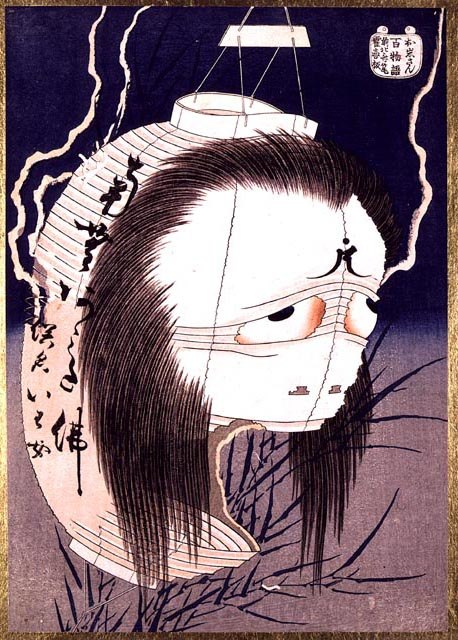
The Ghost of Oiwa evokes the story staged as Yotsuya kaidan, first performed in 1825 according to the Library of Congress. Oiwa’s suffering and return are only the background to this sheet. Hokusai gives the viewer a lantern with enough familiar signs of its construction to remain recognisable while its surface appears to deform into a face. Read the face by comparing its eyes and mouth with the material the lantern seems to be losing. Rather than an actor standing in a room beside an object, the picture gives the object a part of the actor’s work to perform. [3]
The lantern also makes the presence of a viewer unusually important. A light normally lets someone see what else is in the room. Here the thing that would make other objects visible takes up so much attention that the space around it offers little relief. A lantern's ordinary vulnerability matters to the image. Paper can take a fold, be scorched or tear. It can describe a distorted face without ceasing to be the same object. The composition depends on reading both identities at once, rather than discovering a hidden second figure.
The Laughing Hannya
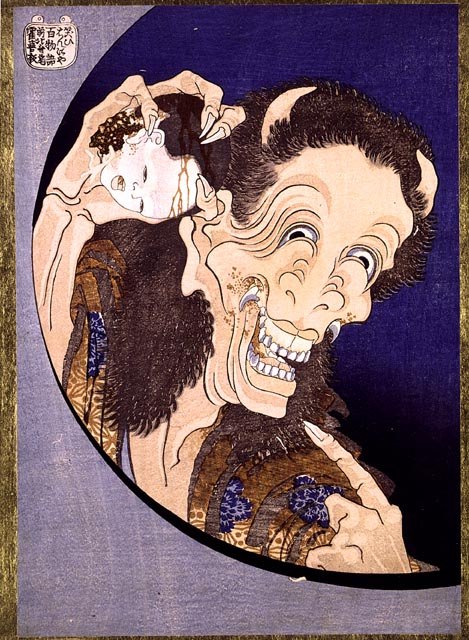
The Laughing Demon has a more physical closeness. The Library of Congress reads it as blending a horned hannya with the mountain woman or yamanba, an association that helps explain the dreadful relationship between the large head and the smaller one held nearby. There is no need to give the figure a precise name from an individual incident to see the force of the composition. Teeth, fingers, a horn and the curve around the smaller head take on meaning from what is almost touched. [4]
Compare two reading distances. Farther away the shapes of the horn and the heads give the image its strongest identity. Up close it becomes possible to follow the fingers in relation to hair, mouth and other features. The nearer view does not clarify the geography of the scene, but it makes the figure's gesture much more intimate. Where the Oiwa lantern asks someone to notice how a face has come into an object, this picture makes a face and hands almost too large to consider comfortably. The landscape formatting that lets figures in a Hokusai waterfall seem far away has been put aside. A concentrated foreground is the principal setting.
Kohada Koheiji and the mosquito net
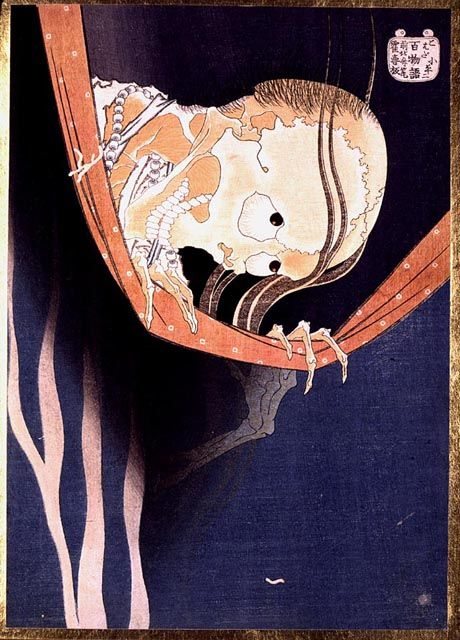
Kohada Koheiji returns to haunt the couple responsible for his death. The Library of Congress traces the story through Santō Kyōden’s 1803 novel and then to the kabuki stage in 1808. The printed design does not need to show either the killing or the occupants of the bed. A skeleton raises its face and hands over the upper edge of the mosquito netting. Some recognizable domestic protection remains between the viewer and the intruder, but the hand crossing the edge reveals that protection’s inadequacy. [5]
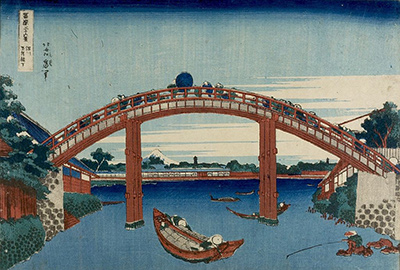
The net does work comparable to a bridge or window in Hokusai's landscapes. It determines how much the viewer can see and offers a sharp contrast between an object whose structure is understood and something whose behaviour cannot be predicted. In a landscape one could follow the opening beneath a solid span out to a distant mountain. Here the edge of the net controls the point at which an intruder becomes visible, a small distance that matters immediately to the people who might be inside. The delicacy of the skeleton's grip also invites comparison with the hand in the demon print. The viewer sees the two figures handling things in very different ways, while the image stays focused on the same kind of minor movement.
Sarayashiki, a story of plates and a well
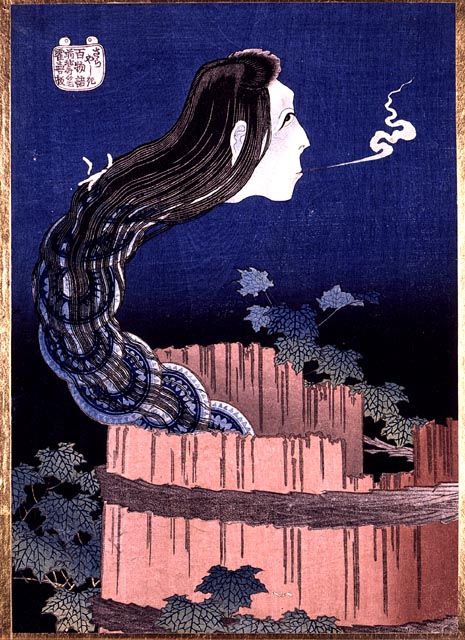
In accounts of Okiku's story, an injustice at a household sends a woman down a well and her ghost returns. There is more than one version of the story. The Library of Congress draws attention to a form in which one of a set of precious plates has been broken and to a later association with a worm found in wells. Hokusai's image makes the well and the plates enough to identify the story, while reassigning them to the space of a moving body. The circular rims of the plates supply a repeatable unit in a form that rises into the dark. [6] [7]
The shape makes a different demand from the face of Oiwa in the lantern. In the lantern a series of altered lines makes one object change identity. In Sarayashiki an increasing number of separately recognizable disks can itself establish a body. Follow them in order and a viewer effectively builds the creature from repeated marks. That gives counting a visual part in a work associated with a set of dishes and a famous returning voice. The print can evoke the order and repetition of a telling without describing a sound on paper.
Obsession and a memorial tablet
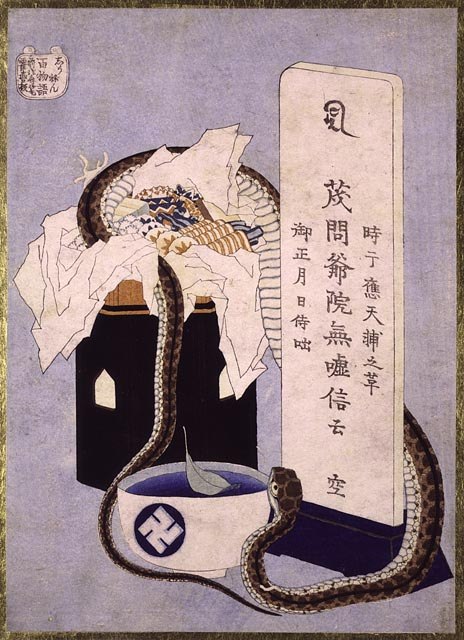
In Shūnen, a snake coils around an ihai, the tablet used in domestic Buddhist remembrance. The Library of Congress interprets the snake as the embodiment of obsessive jealousy or resentment persisting after death. The title is an abstract condition, and the tablet supplies a physical stake in it. The body of the snake can twist out into air and return against the upright whose edges offer a way to judge its displacement. A viewer can recognize the memorial object before the terrible significance of the movement around it is clear. [8]
It makes sense that this design has been called a title piece in catalogue descriptions. The scene can introduce a condition common to several stories without naming the people in the others. One object of remembrance is enough to explore what it means for the dead to remain present in a household. As a starting point for viewing, it sends the reader looking for other domestic objects through which the return takes place.
Look closely at the tablet's writing. Sumida's Japanese catalogue notes that it resembles the wording of a Buddhist memorial but includes a joke about the early Tenpō years and the momonjii, a supernatural figure used to frighten children. The little offerings, identified as drink and sweets in the museum's account, help establish the setting in which a viewer might ordinarily expect to find such a tablet. Someone able to read the inscription can spot the joke a moment after also recognising the objects. The snake beside the tablet keeps that moment of recognition uncomfortable. The design bears comparison with the lantern in Oiwa. At first we see a familiar object, then a detail forces us to reconsider how it is being used. [9]
These distinctions matter to the translation of the title Shūnen. “Obsession” suggests persistence beyond a single quarrel and lets the expression retain some of its ambiguity. The spirit can be read through the association of a snake with lingering attachment and through signs of commemoration assembled around it. A more literal name for the creature would place weight on its classification. Here a relation among the animal, writing and offerings is much more important to the experience of the picture.
Ghosts in a separate Hokusai book project
The Sumida Hokusai Museum's exhibition on One Hundred Ghost Stories also included an illustration by Hokusai for Kinsei kaidan Shimoyo no hoshi, in which Osawa returns as a vengeful spirit. That image belongs to a book and has a different job. The reader can arrive at it by following the circumstances that bring Osawa back. On a single sheet such as Sarayashiki, a well and the repeated shapes of plates must recall enough of the story to bring it to mind without the preceding pages. A reader who recognises one of the stories can reconstruct more of what happened, but the print still has to hold the attention of someone seeing the apparition for the first time. [10]
The two formats also leave different gaps. A book illustration can supply a moment at which the reader stops and looks, then turns to see what happens. The period between one event and the next can be supplied in words. The five surviving prints have no compulsory order. The mosquito net, well, tablet and lantern teach the viewer to look for disturbances in a known object or place, while the Hannya face and hands bring the threat up close. A viewer who sees all five can recognise this alternation without having to decide on an ideal first print.
How the lantern returned to the stage in print
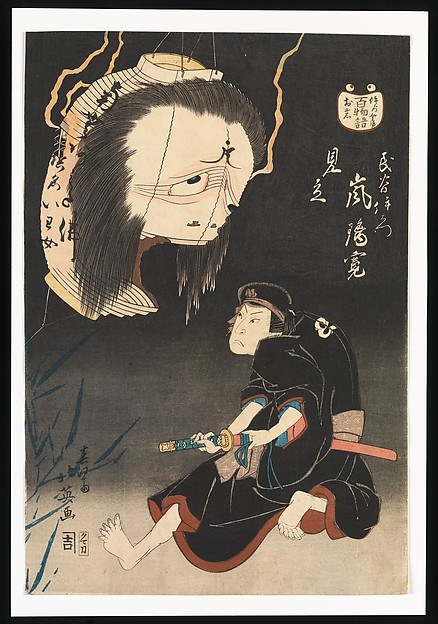
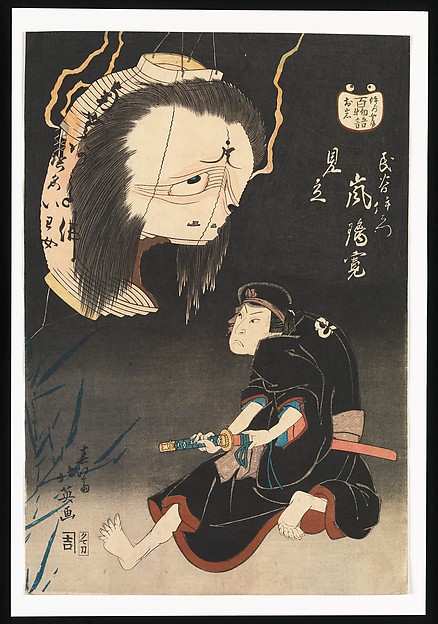
The Met catalogues a print by the Osaka artist Shunbaisai Hokuei in which the actor Arashi Rikan II, playing Iemon, confronts Oiwa's image on a damaged lantern. The museum explicitly links its image to Hokusai's ghost series. This is an especially useful companion because it reverses a familiar route between stage stories and printed pictures. Hokusai condensed the kabuki story into a supernatural close view. Hokuei restored the reaction of a visible actor while keeping the force of the lantern image. Both can be compared at the level of the print, without treating either as a photograph of a stage performance. [11]
Notice which figure provides the first human response in each image. Hokuei gives it to the actor playing Iemon. His placement gives the viewer some distance from which to observe his confrontation and invites an understanding of the lantern in relation to his body. Hokusai permits more room for the reader to imagine a response because little else shares the sheet. The two images offer a concrete example of a picture developing a life beyond the series that introduced it. It is much clearer than describing any lantern-headed Oiwa as an indistinguishable view of the same source.
How to look at the five together
Start by finding the object or body that gives the print something stable. It may be a piece of paper, the edge of netting or the hard side of a tablet. Then follow the line that offers the strongest disruption to it. The face in the lantern and the snake against the tablet both alter the meaning of a recognisable object. The skeletal face above the net needs only to cross a small boundary to change the experience of the room. The well and plates join into a body, while the Hannya leans in so close that the larger body can scarcely be put at a convenient distance.
Look separately at the material evidence of an impression. A museum scan of an album leaf may include margins, notes or mounted material that were not part of the printing block. A sheet displayed outside the album can emphasise something else. Colour may vary among examples, and the way an image was digitised can do a great deal to its darkest areas. Looking at another documented impression is useful before deciding whether a faint line belongs to the design, the condition of the paper or a particular reproduction. The printmaking guide discusses that kind of comparison, and the Series & Books directory helps set these small sheets beside his other projects.
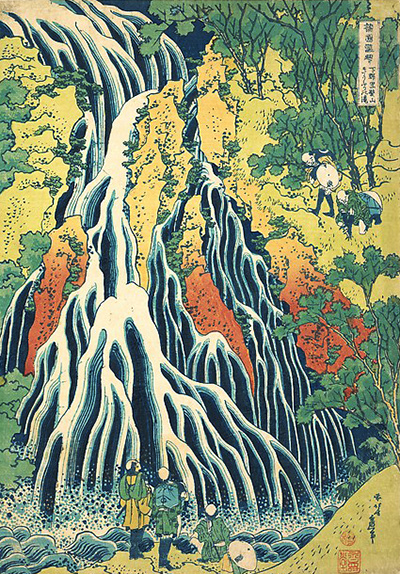
A comparison with the landscape series also brings out how much Hokusai changes by choosing another scale of subject. A waterfall can take up most of a vertical sheet and still be seen at a great distance, given the bodies at its foot. A lantern at almost the same position on another rectangle can be close enough to confront a single spectator. A few edges, an opening and an object of known size help a viewer locate themselves in both settings. Knowing how those devices work makes the ghost prints more unsettling. Their design gives the viewer a clear place from which to witness an event that the room or setting will never fully explain.
Works discussed on this page
| Work | Discussion |
|---|---|
| The Ghost of Oiwa | Oiwa and the lantern |
| The Laughing Hannya | The Laughing Hannya |
| Kohada Koheiji | Kohada Koheiji and the mosquito net |
| Sarayashiki | Sarayashiki, a story of plates and a well |
| Obsession (Shūnen) | Obsession and a memorial tablet |
| Kabuki Actor Arashi Rikan II as Iemon Confronted by an Image of His Murdered Wife, Oiwa, on a Broken Lantern | How the lantern returned to the stage in print |
Discussion
Look again at the images and ideas explored in One Hundred Ghost Stories. These editorial prompts invite your observations.
Reader Insights
Which part of Oiwa’s lantern first reads as a face?
How do the lantern, the mosquito net and the memorial tablet change the way each ghost appears?
Join the Conversation
Share a detail, comparison or question about One Hundred Ghost Stories below.
References
- Library of Congress, Library of Congress album. View source.
- Sumida Hokusai Museum, Sumida Hokusai Museum chronology. View source.
- Library of Congress, Library of Congress, 2024 curatorial commentary. View source.
- Library of Congress, Library of Congress exhibition commentary. View source.
- Library of Congress, Library of Congress, Floating World of Ukiyo-e. View source.
- Library of Congress, Library of Congress item record. View source.
- Library of Congress, Library of Congress, accounts of the story. View source.
- Library of Congress, Library of Congress, Shūnen. View source.
- Sumida Hokusai Museum, Sumida Hokusai Museum, Japanese object commentary. View source.
- Sumida Hokusai Museum, Sumida Hokusai Museum, Japanese exhibition on the ghost prints. View source.
- The Metropolitan Museum of Art, Met collection record for Hokuei’s print. View source.