 by Tom Gurney
Tom Gurney BSc (Hons) is an art history expert with over 20 years experience
Email: tomgurney1@gmail.com / Phone: +44 7429 011000
A Tour of Waterfalls in Various Provinces
In A Tour of Waterfalls in Various Provinces (Shokoku taki meguri, 諸国瀧廻り), Katsushika Hokusai gives eight waterfalls eight distinct forms. Some plunge almost straight down, while others divide into roots of white water or emerge from a round opening that appears to be seen from above. Visitors bathe, cross bridges, stop to look or attend to a horse. Put the prints side by side and it becomes apparent that Hokusai was as interested in how people came close to water as in how water fell. The Sumida Hokusai Museum dates its Yōrō impression to about 1833 and has exhibited all eight designs. [1] [2]
At a Glance
- ArtistKatsushika Hokusai
- DateEarly 1830s
- FormatVertical colour woodblock prints
- SeriesEight published designs
Contents
- Eight prints and an imaginary itinerary
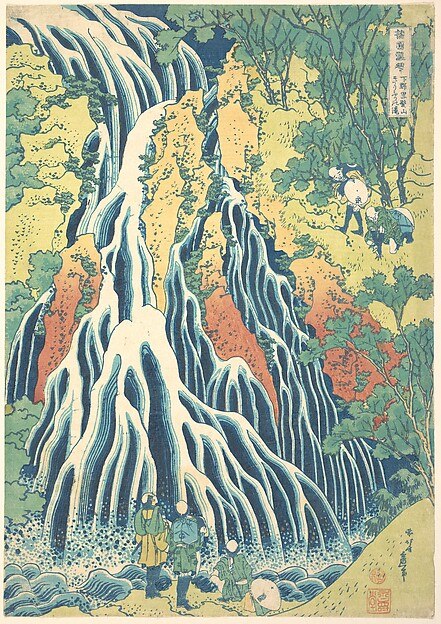
- Kirifuri at Kurokami Mountain
- The publisher hidden at Kirifuri
- Yoshitsune’s horse at Yoshino
- Amida and the view into the source
- Yōrō and the different states of water
- Ono and Kiyotaki, routes passing a waterfall
- Rōben and the visitors at Ōyama
- Aoigaoka and water in the city
- Compare the eight as a group
- The complete series
Eight prints and an imaginary itinerary
The title promises a tour of notable places. Read the names as descriptions of where the waterfalls belong in the world of the print buyer. Some name an old province, while others give a route such as the Tōkaidō or Kisokaidō. The Falls at Aoigaoka names the eastern capital itself. This vocabulary lets a purchaser place the pictures within a shared geography. It does not supply a dated record of the artist taking a trip to all eight sites. The most revealing order for a reader may be a comparison of like shapes, or a route from the city to a mountain pilgrimage. Modern museum catalogues collect the sheets without claiming that the order in which a viewer opens them reconstructs a historical itinerary. [3]
Most of the series invites reading from the bottom of the sheet upward. Footing and human activity are visible near the base, where we first establish the scale of a place. The water gives the eye a route to the top. That upward movement crosses the visible downward motion of the falls. In a print with a single clear drop the contradiction can be timed quickly. In the complicated pattern at Kirifuri, following one branch can lead to another before we arrive back where the water first appears. The vertical format becomes a way of varying the length and rhythm of a look.
Kirifuri at Kurokami Mountain
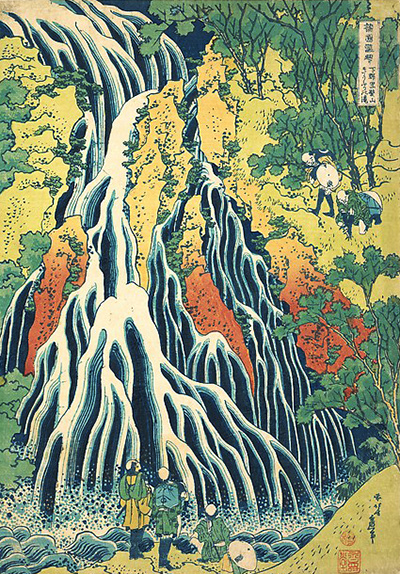
In Kirifuri Waterfall, the flow subdivides and regroups as it hits the slopes. Several little tongues of white occupy gaps in a much darker field. Follow one from its broadest point and the contours make it possible to imagine streams that briefly join before separating again. The figures below do more than establish how high the rock stands. A raised arm, a tilted head or a body handling steep ground can show that the falls extend beyond the space the visitors are immediately using. There is time to look up even if the terrain asks for attention closer to the feet. [4]
A useful way to compare impressions is to find the places where the colour of water gives way to white or meets a dark deposit of ink on the rock. Small differences in the pressure or in the way colour was applied can tie separate threads together or let them stay distinct. One impression can make the rock feel continuous beneath the white flow, and another can let the lighter streaks carry the whole design. Look for agreement in the lines in a number of places before using a difference as evidence that one impression belongs to an earlier printing. The printmaking guide explains the difference between a printed impression and a separately recut design.
The publisher hidden at Kirifuri
There are three small publishing clues in the Kirifuri scene. In her book on Hokusai's landscapes, Sarah E. Thompson identifies two characters on travellers' hats that together suggest Eijudō, the trade name of the publisher Nishimuraya Yohachi. She also points to the publisher's trademark on one traveller's pack. Start with the hat near the upper right of the group, then look along the bottom of the scene for the other hat. The wearer with the pack stands second from the left. The signs follow things a traveller might actually carry, so they remain part of the scene even for a reader who misses the joke. [5]
Nikkō gives that group a historical setting. Thompson identifies Kirifuri as a popular stop for travellers visiting the Tōshōgū shrine, the burial place of Tokugawa Ieyasu. She also connects an 1831 drawing of a different waterfall in the area, published later as a book illustration, with the possibility that Hokusai made the journey himself. The drawing supplies a reason to take the possibility seriously. The prints represent an eight-site project, and what can be documented for one area cannot establish how he gathered material for all eight. On the printed page, the five figures already offer more than one way to stand and face the waterfall. For a buyer in Edo they performed a trip that could be made again each time the sheet was unrolled. [5]
Yoshitsune’s horse at Yoshino
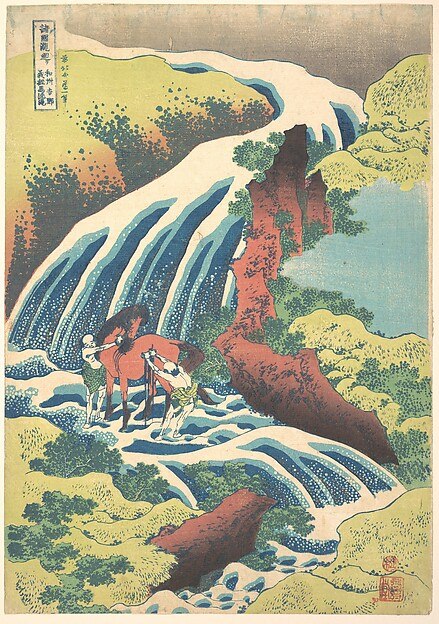
The Yoshino print gives an identifiable episode to a landscape. The title recalls Yoshitsune washing his horse, as the Met’s object record explains. The white water, horse and small figures can be picked out within a narrow ravine. Their relationship is important to understanding how the military hero is brought into the setting. The horse occupies the ground on which people are working, while the falls establish a scale that makes the action appear small. Hokusai can invoke a celebrated person and still let the disproportionately large work of nature set the pace of the picture. [6]
Look for the repetitions of pale strips down the tall expanse of rock, then consider the different kinds of movement in the group at their foot. A waterfall with almost no narrative might still communicate force. The stable ground a horse needs and the surfaces the figures must negotiate make the flow read as water one could step into. A reader interested in the historical figure can follow him through a well-known story. A reader looking at the composition can see why a painter might choose this episode rather than a moment when the waterfall is being viewed from far away.
Amida and the view into the source
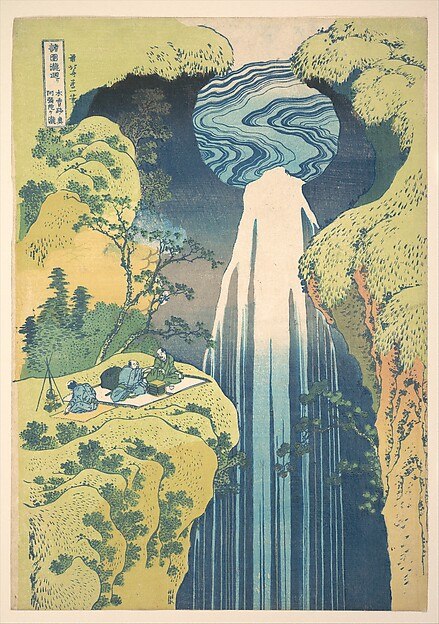
At Amida Falls a round opening and the marks inside it seem to belong to a different angle of view from the front of the falling water. The Sumida Hokusai Museum observes that the mouth is seen almost as though from above while the plunge is shown face on. This is a visual argument for the form of the cascade. Above the edge a visitor can imagine looking down into a gathering surface. Below it a visitor sees a falling sheet. Hokusai preserves both experiences at once. [7]
The small gathering near the falls makes another way of measuring that invention possible. The people share a narrow shelf or vantage near a shape that fills most of the upper picture. Their limited need for space gives the water room to appear colossal. It also gives the composition a scale that the circular source alone could not have. If you cover the figures, the dark profiles around the water may still make a compelling design. When you uncover them, the relation between a body, the rock and the height of the fall comes back into view. [8]
Yōrō and the different states of water
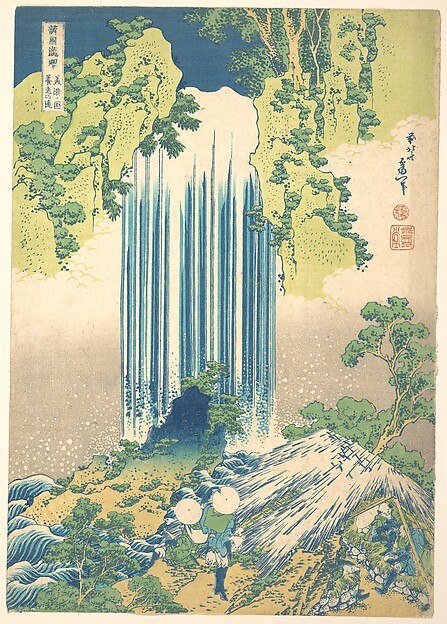
The Sumida collection record places Yōrō in present-day Gifu and recounts the legend of a poor woodcutter whose gift of water to his father became sake. A viewer need not look for a literal change of substance in the print. The record calls attention to a series of changes that Hokusai does show. The water is a column, spray above a plunge pool, a current with its own turns and mist. The visitors help direct attention to more than one of those features. One can look uphill with the person facing the fall or down toward the busy water beside a seated figure. [2]
Yōrō rewards an unusually long look at the boundaries between solid and liquid. The big drop has a stable edge compared with the curves downstream. Mist is more diffuse still. Each part has to be readable at the same distance from the paper. That consistency is difficult to imagine if the scene is described just as a high waterfall. The change of texture over the height of the sheet is an account of what a falling liquid does after its first visible descent.
Ono and Kiyotaki, routes passing a waterfall
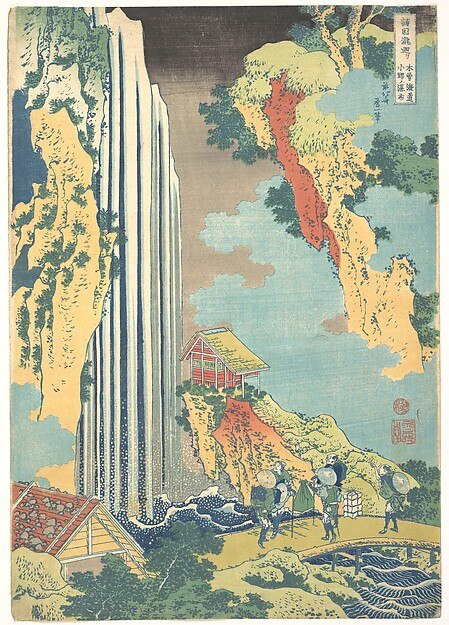
At Ono, on the Kisokaidō, a bridge and the walkers placed on it offer another way to track the depth of a ravine. The crossing interrupts the descent and separates the place available to a traveller from the wall of rock and water behind. Compare the essentially straight course of the visible fall with the structure supporting people. One continues by gravity. The other is designed to hold steadily even while bodies move across it. The man-made span has some of the pictorial importance it would have in a bridge print, even though the fall remains the subject named here. [9]
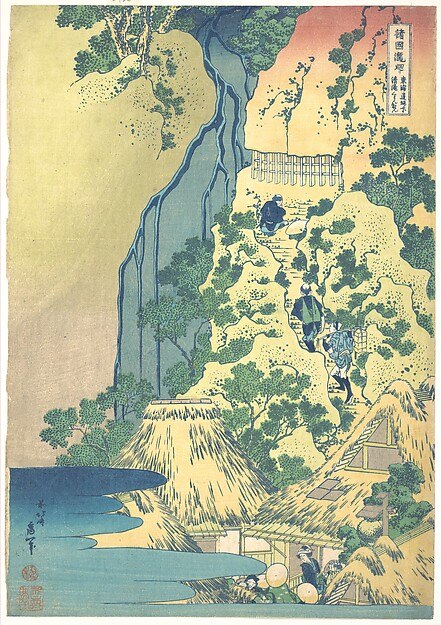
Kiyotaki Kannon Waterfall near Sakanoshita brings a different relation between road and spectacle. The figures and near ground give the print more than one route of entry. A reader can notice the people and then follow their surroundings out to the narrow channel occupied by the fall. The title explains why a familiar station name matters. It also explicitly introduces Kannon to the identification. That link allows religious and practical movement to remain in the same view without requiring every figure to have an individually documented purpose. [10]
Rōben and the visitors at Ōyama
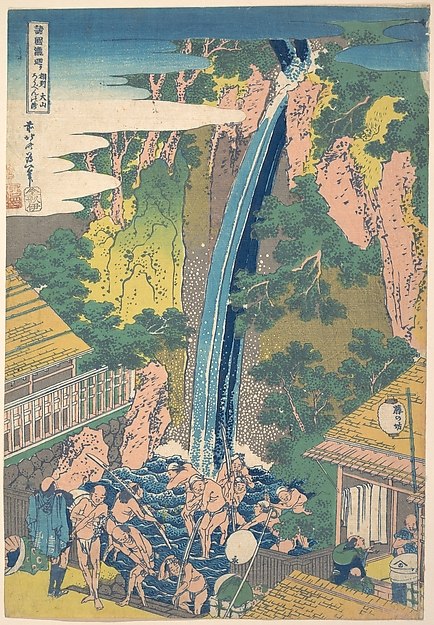
The Rōben print is particularly direct about people coming within reach of the water. The groups before the fall need different amounts of space according to what they are doing. The narrowness of the falling column lets Hokusai put attention on the place where the visitors approach or gather, while a steep surface behind makes the water seem to travel considerably farther than the height we initially register. Someone can enter either side of the picture and eventually be led to the same narrow fall. The shrine and pilgrimage associations of Ōyama help make sense of a scene in which visiting the place comes so close to experiencing its water. [11]
Sumida's Japanese catalogue traces the name to Rōben, an eighth-century monk associated with the foundation of Tōdaiji, and to accounts of his water austerities. The named waterfall invokes a precedent for a body placed directly under cold falling water. Hokusai makes the approach legible in stages. One can compare the people held back by the slope or rock ledge with those at the base of the descent. Their positions make ritual something a reader can understand as action even without identifying every person or item of dress. [12]
A useful second point of comparison is Kiyotaki Kannon. The falls there have their own religious dedication and interest for travellers, but the composition gives the steep terrain and surrounding route a different share of the paper. Read the dedication in the title first, then see what a visitor could actually do in each image. At Rōben there is room for people waiting near the base. At Kiyotaki the foliage and sloping ground mediate the encounter. The two prints make sacred associations visible through the different ways in which the body can travel and stop.
Aoigaoka and water in the city
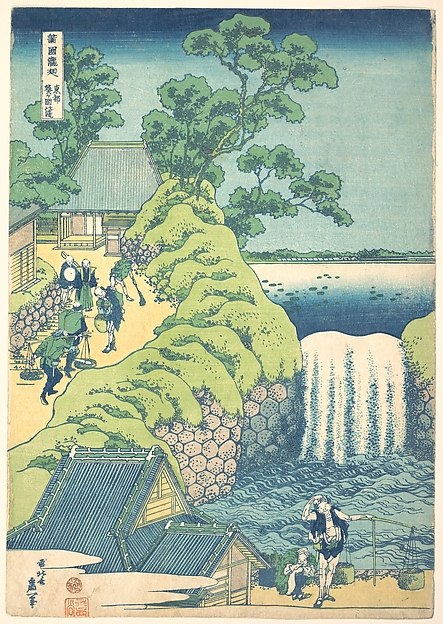
At Aoigaoka, a cascade within Edo competes for our attention with built ground, straight edges and signs of people going about their day. A reader might begin in the upper area, where the surroundings of the cascade matter to its identity, and then follow water down a sharp change of level. Compared with the prints set in mountain terrain, the scene makes the difference between construction and the behaviour of water particularly easy to see. A different kind of place can still belong in the same series without being made to resemble a remote gorge. [13]
Compare the eight as a group
Start with the blue in the small spaces around the falling water. In one print it can act as a field against which the white descent is drawn quite clearly. In another it is most apparent where water has gathered below the fall. The Sumida exhibition uses the variety of Hokusai's blue effects to connect the waterfalls to a larger body of prints about water. In these eight designs, the same family of colours has to describe distance, surface and depth. The difference between blue in the body of the water and blue as a contour can make even a familiar view appear to move differently. Screen images can help a reader find those positions. For questions about the pigments in a particular blue, the physical impression is the evidence. [3]
For a good first comparison, put Amida beside Kirifuri and ask where the water divides. Amida gives the eye a single powerful white descent after the circle at the top. At Kirifuri, the fragmentation of the flow is the first thing that makes the picture distinctive. Yōrō provides a third option. It allows a strongly gathered descent and makes fragmentation a consequence near the foot. These are observable differences without reading a title or learning the geography. Then look for a figure in each. A small change in the distance from a visitor to the drop can change how imposing each solution feels.
The exhibition of all eight by the Sumida Hokusai Museum is a reminder of what is lost if the practical name of a waterfall is all that accompanies its reproduction. An individual view can be strong enough to circulate alone. A series allows one sheet to do what the previous sheet deliberately leaves out. The person touring the prints can recognise the height of the paper, changes of viewpoint and different uses of whiteness in quicker succession than anyone could see the sites themselves. This is a good way to read the works as a visual project and to understand what made the prospect of another Hokusai waterfall worth a print buyer's attention. [3]
The complete series
| Work | Discussion |
|---|---|
| Kirifuri Waterfall at Kurokami Mountain in Shimotsuke (Shimotsuke Kurokamiyama Kirifuri no taki) | Kirifuri at Kurokami Mountain |
| “The Waterfall Where Yoshitsune Washed His Horse at Yoshino in Yamato Province,” from the series A Tour of Waterfalls in Various Provinces | Yoshitsune’s horse at Yoshino |
| The Amida Falls in the Far Reaches of the Kisokaidō Road (Kisoji no oku Amida-ga-taki) | Amida and the view into the source |
| Yōrō Waterfall in Mino Province (Mino no Yōrō no taki) | Yōrō and the different states of water |
| Ono Waterfall on the Kisokaidō (Kisokaidō Ono no bakufu) | Ono and Kiyotaki, routes passing a waterfall |
| Kiyotaki Kannon Waterfall at Sakanoshita on the Tōkaidō (Tōkaidō Sakanoshita Kiyotaki kannon) | Ono and Kiyotaki, routes passing a waterfall |
| Rōben Waterfall at Ōyama in Sagami Province (Sōshū Ōyama Rōben no taki) | Rōben and the visitors at Ōyama |
| The Falls at Aoigaoka in the Eastern Capital (Tōto Aoigaoka no taki) | Aoigaoka and water in the city |
Discussion
Look again at the images and ideas explored in A Tour of Waterfalls in Various Provinces. These editorial prompts invite your observations.
Reader Insights
Where does the flow first divide in Kirifuri and in Amida?
How do the figures at Ōyama change the scale and meaning of its waterfall?
Join the Conversation
Share a detail, comparison or question about A Tour of Waterfalls in Various Provinces below.
References
- Sumida Hokusai Museum, Sumida Hokusai Museum, Japanese exhibition materials. View source.
- Sumida Hokusai Museum, Yōrō collection record. View source.
- Sumida Hokusai Museum, Sumida’s Water Wonderland exhibition. View source.
- The Metropolitan Museum of Art, Met collection record. View source.
- Museum of Fine Arts, Boston, Museum of Fine Arts, Boston, Thompson, Hokusai's Landscapes, Kirifuri entry. View source.
- The Metropolitan Museum of Art, Met, Yoshino. View source.
- Sumida Hokusai Museum, Sumida Hokusai Museum exhibition materials. View source.
- The Metropolitan Museum of Art, Met, Amida Falls. View source.
- The Metropolitan Museum of Art, Met, Ono. View source.
- The Metropolitan Museum of Art, Met, Kiyotaki Kannon Waterfall. View source.
- The Metropolitan Museum of Art, Met, Rōben Waterfall at Ōyama. View source.
- Sumida Hokusai Museum, Sumida Hokusai Museum, Rōben catalogue commentary. View source.
- The Metropolitan Museum of Art, Met, The Falls at Aoigaoka. View source.