 by Tom Gurney
Tom Gurney BSc (Hons) is an art history expert with over 20 years experience
Email: tomgurney1@gmail.com / Phone: +44 7429 011000
Oceans of Wisdom
A boat can ride up a wave, a line can drop almost invisibly into a river, and torchlight can keep a small group of fishermen together in the dark. Hokusai made all three experiences part of Chie no umi (千絵の海), a print series known in English as Oceans of Wisdom, One Thousand Pictures of the Ocean and A Thousand Pictures of the Sea. Its ten known published designs cover rivers and shores as well as the open sea. They are as much about what people know how to do on water as what its surface looks like. [1] [2]
At a Glance
- ArtistKatsushika Hokusai
- DateAround 1833
- FormatHorizontal chūban colour woodblock prints
- Published designsTen known
Contents
- A fishing series in ten designs
- Chōshi, boats judged against the sea
- Noboto and the ground between land and sea
- Torchlight in Kai and the size of a working group
- Looking at a longline
- Net fishing on the Tone and Kinu rivers
- Fly fishing, and the work done by two hands
- Whaling off the Gotō Islands
- What a treetop at the edge can tell us about printing
- The ten published designs
A fishing series in ten designs
The names on Suntory's checklist are a useful starting point because they carry two different sorts of information. Some emphasise where the scene takes place, even if fishing can be seen there. Others put the activity in the name. The museum has also discussed proofs for other designs associated with the project. A proof, an issued design and a modern collection of all the known prints are different objects. It is possible to discuss the reach of the series without assuming a published run for every projected view. [1]
The names also make it easier to avoid confusing two Hokusai prints with similar English titles. The Met's Noboto at Shimōsa in this series is a working scene by the bay. The Bay of Noboto in Thirty-six Views belongs to a separate project and is identifiable by its relationship to Fuji. The very familiarity of a coastal name makes it useful to compare both records before treating a reproduction labelled “Noboto” as evidence for either print. [3]
The Japanese spelling takes the title in two directions. Sarah E. Thompson explains that chie as heard means wisdom and can have Buddhist associations, while the characters here can be read as a thousand pictures. Umi, often translated as sea or ocean, encompasses the waterways depicted in the series. “One Thousand Pictures of the Ocean” makes the wit of the written title easier to understand, while “Oceans of Wisdom” conveys something of the knowledge its fishermen use. Seeking a specific run of a thousand is less productive than asking how the wordplay let the series encompass different places, kinds of water and methods of work. [4]
Chōshi, boats judged against the sea
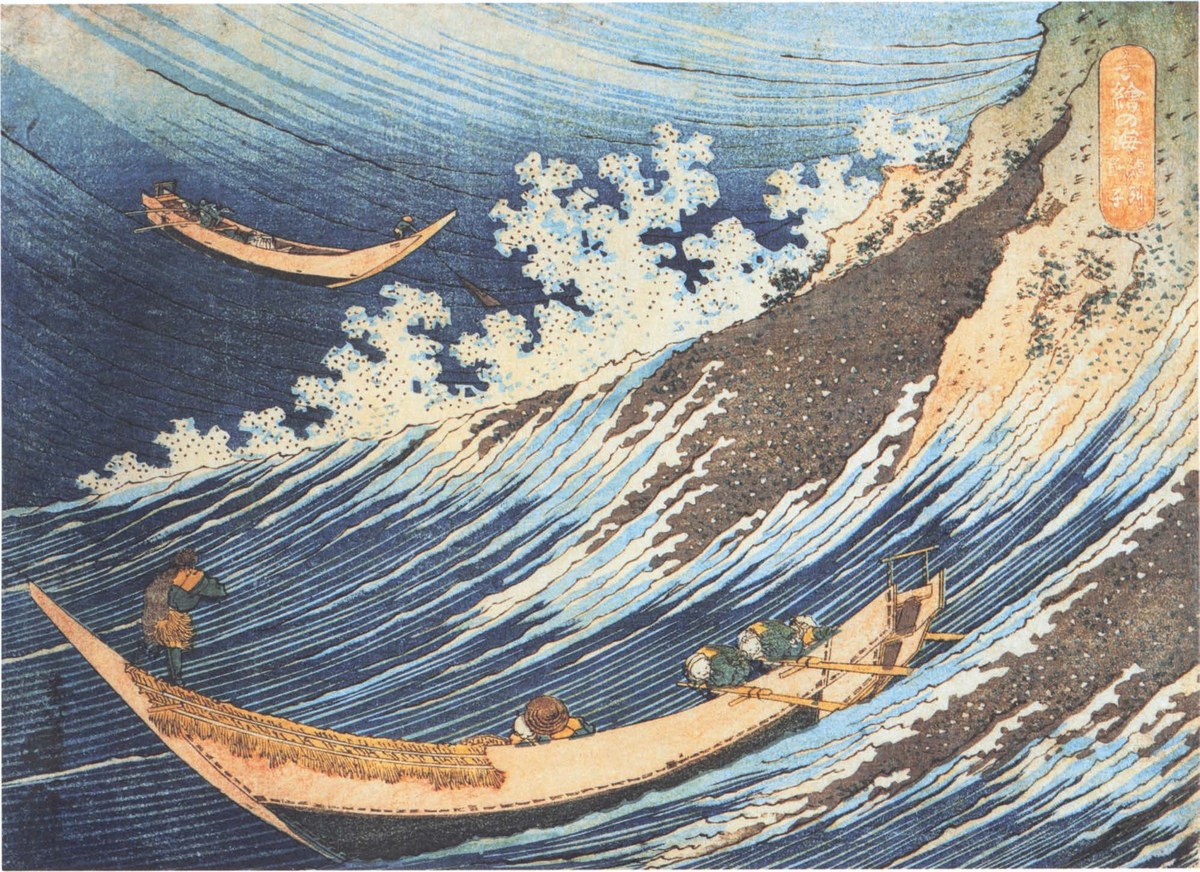
Choshi in Shimosa initially offers a visible relation between boats and waves. The foremost boat rides the water closely enough that the edge of the hull competes with the water around it. The farther boat, much smaller on the page, allows the near forms to register as the effects of distance as well as disturbance. James T. Ulak’s study of the Art Institute of Chicago impression notes the confidence with which the figure near the prow seems to meet the rough sea. The attitude of even a tiny body can change the apparent danger of a scene. It registers work within the dominating movement of the water instead of merely serving as a sign of the water’s height. [5]
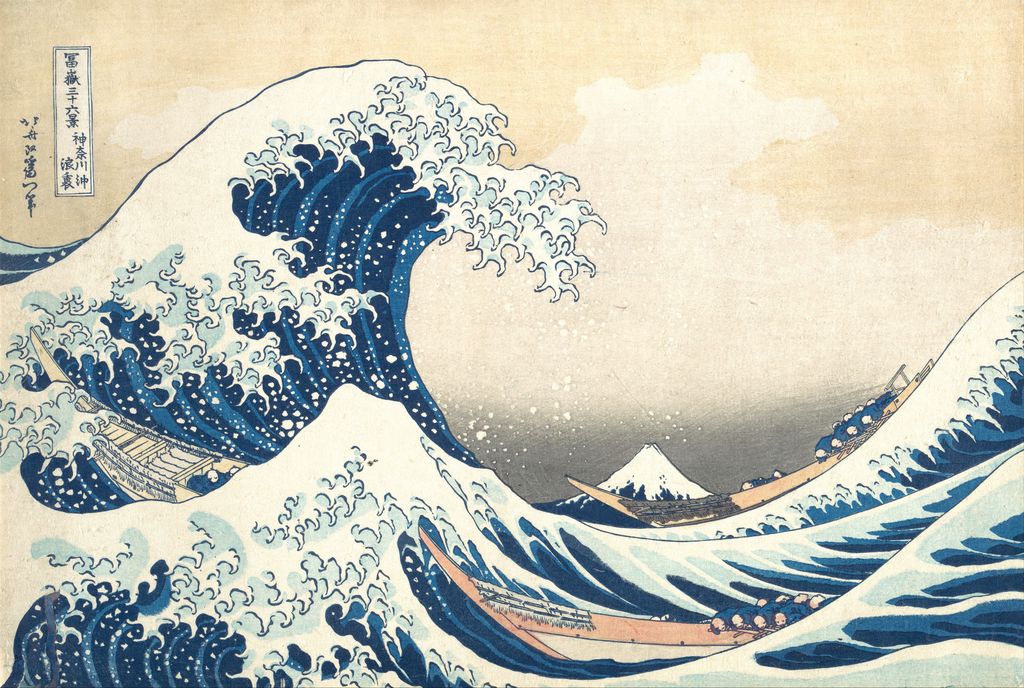
Compare this with The Great Wave. There the mountain is an important fixed shape beyond the apparent danger and the towering crest resolves into a silhouette of its own. The boats in Chōshi help organise the sea throughout the lower part of the print. These choices encourage different kinds of looking. A viewer of the Great Wave may begin at a huge shape and work slowly down to the crew. Chōshi rewards looking back and forth between more than one boat and judging how each sits within the forms around it. A small sheet does not entail an unambitious design.
Noboto and the ground between land and sea
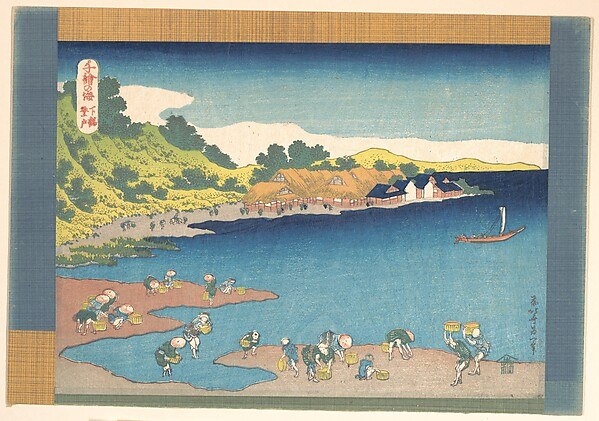
In the Met’s Noboto at Shimōsa, human activity takes place over a relatively broad shallow area. The people distributed across it mark places where a person can work. They also divide the space at a much smaller scale than the changes of colour between shore and water. A coast can read as a line on a map. Here it is a field with some depth. That field has enough room for people to be distinguishable by their situation, even where the paper gives little room for faces. [3]
The design has a particularly close relationship between position and labour. Where a person can stand partly depends on the state of the water. The collecting activity makes that moment observable without giving us a measurement of the depth. Compare it with the workers crossing or gathering on the platform in a Fuji-series print. The rules for reaching those places are architectural. Here they concern things that seem stable enough for an afternoon and will change again with the water. A series on fishing can include labour at the edge of the sea as naturally as the heaviest motion off Chōshi.
Torchlight in Kai and the size of a working group
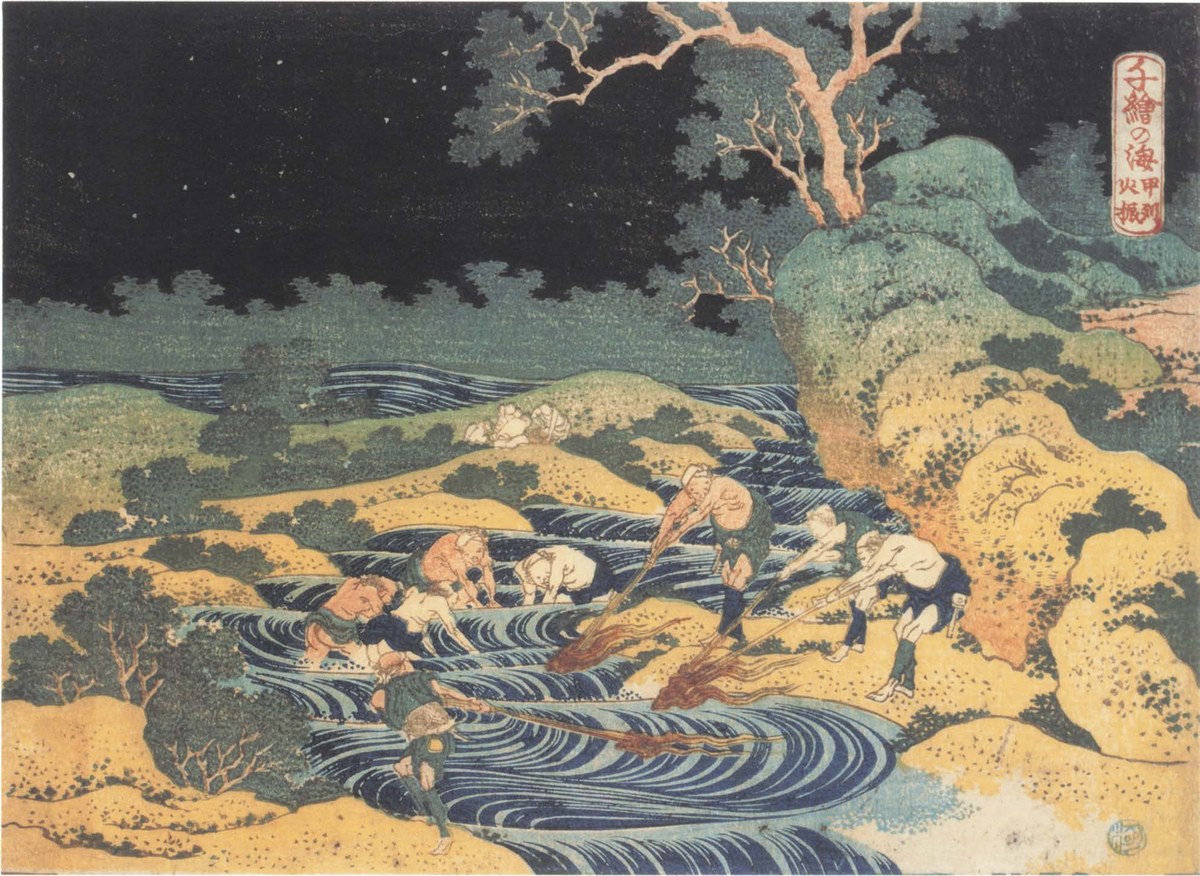
In Fishing by Torchlight, vegetation and the bank can recede into bands of tone across the river while the bright source keeps a smaller working group legible. Begin with what is still visible beyond the light. A viewer can recognise the place by its dark and pale masses before finding the particular figures. The brightest marks do not create uniform illumination. They establish a centre of practical activity and a way of judging which people are near each other. [6]
There is a material comparison with One Hundred Ghost Stories. Oiwa's lantern makes a source of illumination into the subject that occupies the viewer. The torch in Kai is an object people use together, and has to remain small enough for the space around it still to be interesting. Compare the exposed river and the unseen interior suggested by the lantern. Using light selectively can have completely different narrative consequences. The scale and setting tell the viewer how much more there might be beyond what the strongest colour allows them to read.
Looking at a longline
The Sumida Hokusai Museum's account of Miyatogawa naganawa translates the particular fishing technique into a structure: a main line with branch lines carrying hooks. The museum connects the place name Miyato with the Sumida River. Those details are worth checking alongside the picture because the behaviour of the working group can be lost when the title becomes merely “fishing.” A method of holding and deploying gear gives the small figures a reason to occupy particular positions. Longline fishing also creates an expectation of something under the surface whose form a picture need not describe. [2]
This observation helps to compare designs about more than one sort of fishing. A net spreads over an area. A linked line leads away along a course. A torch can attract attention to a small position whose darkness hides everything nearby. The artist makes activities with different spatial shapes visible by varying gestures, open stretches of water and lines. The series is especially rewarding if the name of the device is treated as a clue about the picture rather than as a gloss added at the end.
Net fishing on the Tone and Kinu rivers
Chiba City Museum of Art describes a single fisher using a four-cornered lift net in The Tone River in Shimōsa. His foot helps operate the gear while his body remains in a small boat. The structure of the net spreads across an area far larger than the person using it. The museum draws particular attention to the printing of the net, where the graduations let the river show through. A firmly drawn edge tells us how much the net covers. The fainter interior lets us continue to read the space behind it. The same object can therefore indicate a large mechanical action and still appear light enough to move. [7]
Kinu's basket fishing calls attention to a different kind of teamwork and equipment. The scene has a river current, a bank and positions from which the figures can attend to the catch. Compare where the action happens in the two prints. At the Tone, we can reconstruct the force applied to the lift net from the equipment and the fisher's posture. The Kinu print gives relatively more work to the relationship between figures, bank and moving water. Compare both to longline fishing, where much of the apparatus is under the surface and its course is conveyed by the arrangement of the people attending it. [8] [1]
Fly fishing, and the work done by two hands
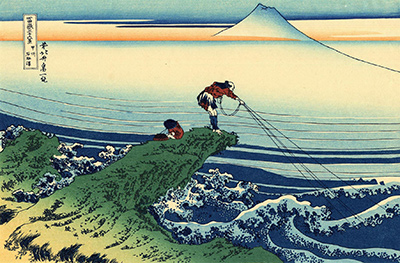
In Fly Fishing, a small piece of equipment can carry a central action. The MFA's commentary draws attention to the little hand nets the anglers use to transfer a fish from a line to a creel. The fish needs to pass through several distinct positions before it can be taken away. The viewpoint across the stream leaves space for the nearly invisible casting line and for a reader to notice the pose of an angler at work. Large gear, such as the lift net on the Tone, supplies an immediate outline. In Fly Fishing, the connection among hand, line and net occupies a much smaller space. The shape of the bank and its relation to the current give a first indication of where to look. [4]
The title Fishing with Handheld Nets can easily be taken as another translation of Fly Fishing because small hand nets appear in that scene. The two are separate designs. The Nelson-Atkins Museum uses Fishing with Handheld Nets for its example of Machi ami, recorded by Tokyo National Museum as 待チ網 and also translated as Waiting Nets. As with Noboto, the wording in the cartouche and the Japanese museum record help distinguish prints which may come up under similar terms in an image search. [9] [10]
Whaling off the Gotō Islands
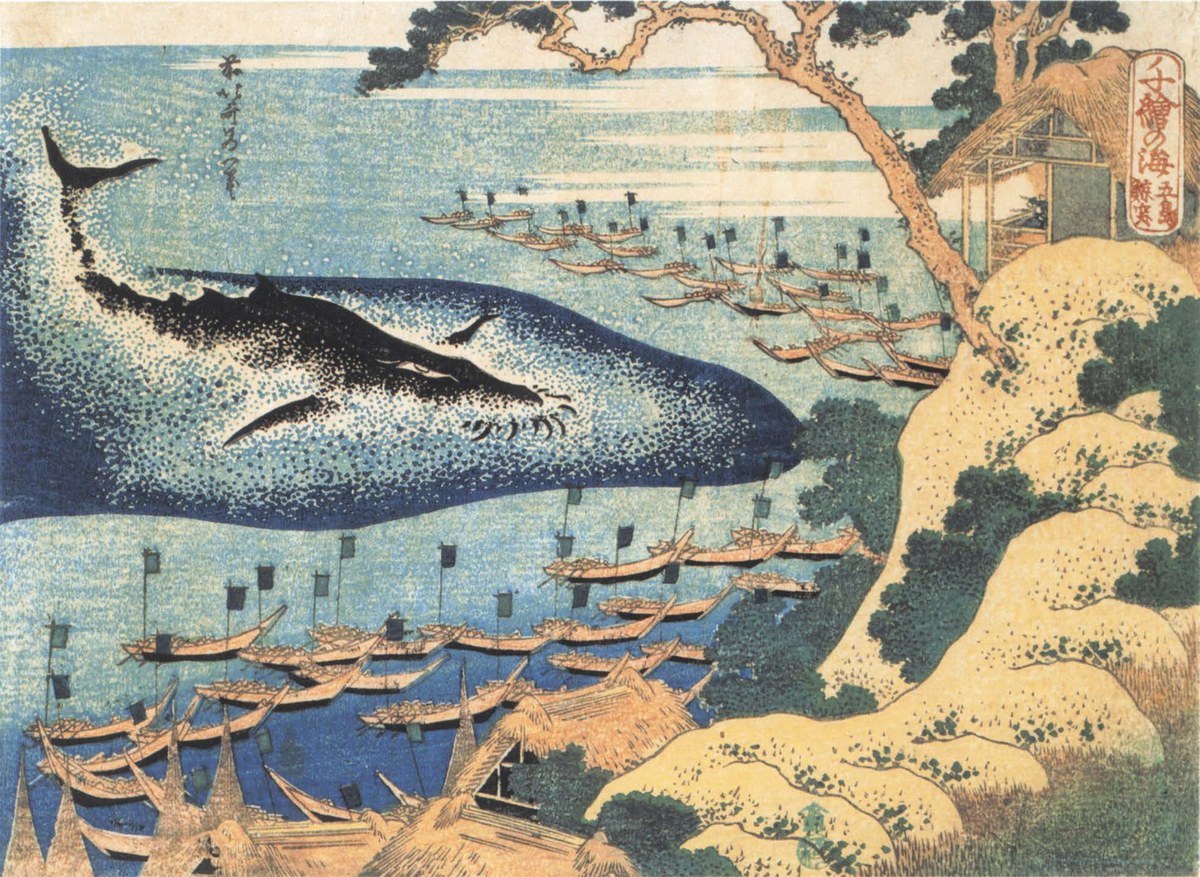
The whale is a different scale of object from anything caught at the edge of a river. Hokusai can relate the smaller boats and the dark body through the position of the crews and the interruption the animal makes in the visible water. A viewer following the people can recognise the size of the whale more reliably than from its outline alone. The water around the scene also makes it hard to see where the whole action begins or ends. This print places its viewer close enough to discover how the participants occupy the space, without giving the broad detachment of a chart. [11]
What a treetop at the edge can tell us about printing
Ulak's account of the Chicago acquisitions makes a technical observation easy to overlook in a digital reproduction. The series uses a horizontal chūban format, around nineteen by twenty-six centimetres in the examples discussed. The paper is roughly half the size of a common ōban sheet. Some impressions show hints of another design near a cut edge. Ulak uses these traces, including a tiny treetop associated with the torchlight and whaling designs, to investigate the possibility that the two were printed in tandem before the sheet was divided. This is a different argument from simply doubling the width of a surviving print. A trace remaining in the margin connects the material practice to these pictures specifically. [5]
Other physical evidence takes the series beyond the ten designs. When the MFA discusses two surviving outline impressions, the key distinction is what has been printed. An outline gives the design enough form to be legible, and it demonstrates that work advanced to cutting and printing at least a key block. Colours would have required further preparation. Separate records of a design drawing, a single-colour proof and a finished colour impression thus allow us to follow the progress of more work than appears in the ten-print checklist. The fate of a project can be partly understood through those production stages even when the reasons a publisher ceased issuing designs are unclear. [4]
The paper does not give a viewer the complete history of preparing a block. A photographer may crop a sliver from the edge. A collector might trim a print that once had it. A researcher needs several examples and should look for both positive evidence and occasions where the presumed feature is missing. Look at how a design has been reproduced before treating the result as the same object a print historian described. The Ukiyo-e Woodblock Prints guide follows similar distinctions in the Fuji series.
The market for a group of ten designs could give an individual print different lives. The Art Institute purchased its three sheets together after an earlier history of collecting as a set. A museum labels them separately so a reader can identify each material object. A series checklist reconstructs their relationships at a different scale. Reading across those catalogues lets the viewer follow what is known from a selling or collecting history and what is available only by inspecting the sheet. [5]
The ten published designs
| Design | What to look for |
|---|---|
| Line Fishing in the Miyato River | Where does the fishing gear sit in relation to the bank and the current? |
| Noboto in Shimōsa | How much working ground becomes available in the shallows? |
| Chōshi in Shimōsa | Which bodies and boats give the rough sea its scale? |
| Uraga in Sagami Province | Where does the enclosed shore give way to open water? |
| The Tone River in Shimōsa | What work and movement can be read across a large river? |
| Basket Fishing in the Kinu River | How does a piece of fishing gear give the figures a shared activity? |
| Whaling off the Gotō Islands | How do the boats and whale set one another’s scale? |
| Fishing by Torchlight in Kai Province | What remains visible outside the group using the torch? |
| Fly Fishing | How little of a line or gesture needs to be present to establish the activity? |
| Fishing with Handheld Nets | How does the span of a net change the way the figures occupy the water? |
Discussion
Look again at the images and ideas explored in Oceans of Wisdom. These editorial prompts invite your observations.
Reader Insights
Where does the eye find the crew in the rough water off Chōshi?
What clues to the printing process can survive at the cut edge of a sheet?
Join the Conversation
Share a detail, comparison or question about Oceans of Wisdom below.
References
- Suntory Museum of Art, Suntory Museum of Art, series checklist. View source.
- Sumida Hokusai Museum, Sumida Hokusai Museum on the Miyato River print. View source.
- The Metropolitan Museum of Art, Met, Noboto at Shimōsa, Chie no umi. View source.
- Museum of Fine Arts, Boston, Museum of Fine Arts, Boston, Thompson, Hokusai's Landscapes. View source.
- Art Institute of Chicago, Art Institute of Chicago acquisition study. View source.
- Art Institute of Chicago, Art Institute of Chicago, collection data for 1983.581. View source.
- Chiba City Museum of Art, Chiba City Museum of Art, Japanese object record. View source.
- Tokyo National Museum, Tokyo National Museum, Basket Fishing in the Kinu River. View source.
- Nelson-Atkins Museum of Art, Nelson-Atkins Museum of Art, 32-143/178. View source.
- Art Platform Japan, Tokyo National Museum record via Art Platform Japan. View source.
- Art Institute of Chicago, Art Institute of Chicago, collection record. View source.