 by Tom Gurney
Tom Gurney BSc (Hons) is an art history expert with over 20 years experience
Email: tomgurney1@gmail.com / Phone: +44 7429 011000
One Hundred Poems Explained by the Nurse
Katsushika Hokusai's late and unfinished series One Hundred Poems Explained by the Nurse (Hyakunin isshu uba ga etoki, 百人一首乳母かゑとき) sets classical poems alongside landscapes, journeys and scenes of work. Hunters warm themselves at a fire. People work with cloth in sight of a mountain. A poet's memory of the moon reaches across the sea. The poems appear in the prints, but the landscapes make their own choices about whose experience to show and which image in a verse to develop. The Sumida Hokusai Museum records twenty-seven published designs and places them within the history of the anthology's popularity in Edo. [1]
At a Glance
- ArtistKatsushika Hokusai
- DateAround 1835–36
- Source textHyakunin isshu, one hundred short poems
- Issued colour designsTwenty-seven
Contents
- An anthology retold through pictures
- Reading words and images on the same sheet
- Minamoto no Muneyuki and warmth in winter
- Kakinomoto no Hitomaro and the length of a fishing rope
- Ise, the scale of a reed and a human separation
- Sarumaru and a landscape that asks us to listen
- Empress Jitō and the task behind a change of season
- Abe no Nakamaro and a remembered moon
- Sangi no Takamura and an imagined witness at sea
- Dainagon Tsunenobu and multiple kinds of attention
- Ono no Komachi, blossom and dye
- An anthology people could already see and play
- The work left in drawings
- Works discussed on this page
An anthology retold through pictures
Hyakunin isshu brings together one poem each by a hundred poets. The collection is traditionally associated with Fujiwara no Teika. The ordering supplies a continuity for readers even where the poets and subjects differ. By the time Hokusai made his series the anthology was widely familiar. The Sumida exhibition puts it alongside playful reworkings, prints of poets and designs by related artists. This shows why a buyer might already be able to supply meanings or associations missing from the picture. Illustrating the poem could be an opportunity to propose a different connection rather than an obligation to describe each line. [1] [2]
The nurse of the title offers a way of framing this freedom. The Smithsonian National Museum of Asian Art describes a voice or perspective that gives the passing scene room to differ from a learned reconstruction of the classical setting. It is a premise of the series, not a requirement that a woman telling a story appear on every sheet. The relationship is often clearest if a reader starts with the ordinary activities on the paper, then tries to find a word, an image or a setting in the poem that could have made that activity a useful choice. [3]
Reading words and images on the same sheet
The poem and poet's name are kept in the small title and verse fields above the landscape. They can occupy a modest portion of the paper while the verse supplies much of the reason for every other choice on it. A poem about weather may give Hokusai the occasion to show a large number of people at work. A verse with a particular place may let him bring a viewer closer to someone remembering it. A reference to a natural phenomenon can become an account of how bodies move in the space around it. None of those decisions would be available if the picture merely repeated the poet's description line by line.
The prints can be grouped around questions that are different from the order of the anthology. Take two very cold landscapes first, examining how the small signs of activity prevent either one from being empty. Then place a scene of cloth drying beside a departure by boat, asking how much of the work is recognisable without reading. Finally, move from an image where a poem remembers a particular moon to one where a tiny physical object becomes a measure for separation. Each comparison uncovers another means by which the print and its text can occupy the same rectangle.
Minamoto no Muneyuki and warmth in winter
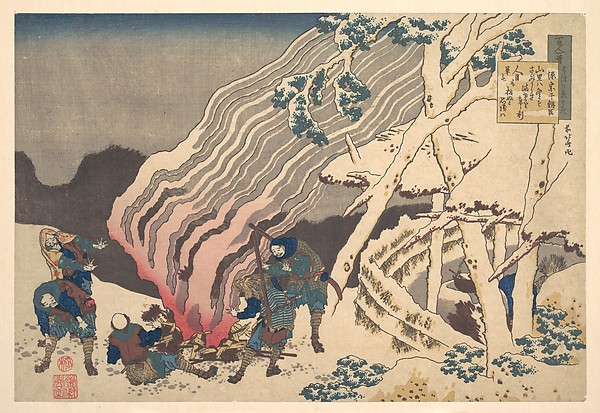
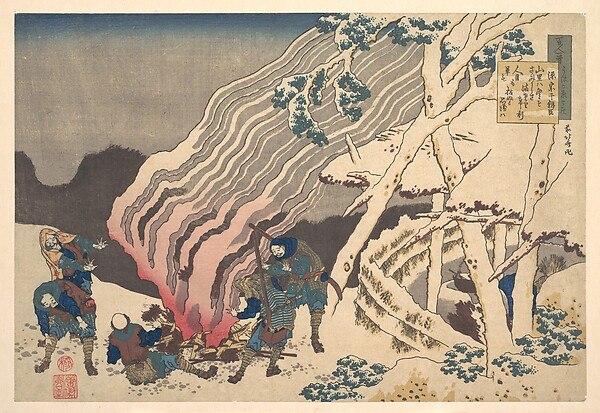
The verse of Minamoto no Muneyuki makes a mountain village feel especially lonely in winter. In Hokusai's picture a group occupies that cold setting with conspicuous energy. Sumida describes hunters gathering around the fire and calls attention to the column that changes from flame into smoke. The Met points to the difference between the poem's isolation and the lively group. The two observations fit together. The snowy isolation offers a reason to study what the people do, and what they do makes the weather easier to imagine. [4] [5]
Follow the branch tips, smoke and heavy winter ground before looking closely at a face. These changing surfaces make the single source of warmth legible at different distances. There is no requirement that the travellers in the valley feel what the poet says. Their fire is a small material answer to the cold. The way the smoke remains visible far beyond the fire makes their answer available to anyone opening the sheet, including someone who has never read the verse.
Kakinomoto no Hitomaro and the length of a fishing rope
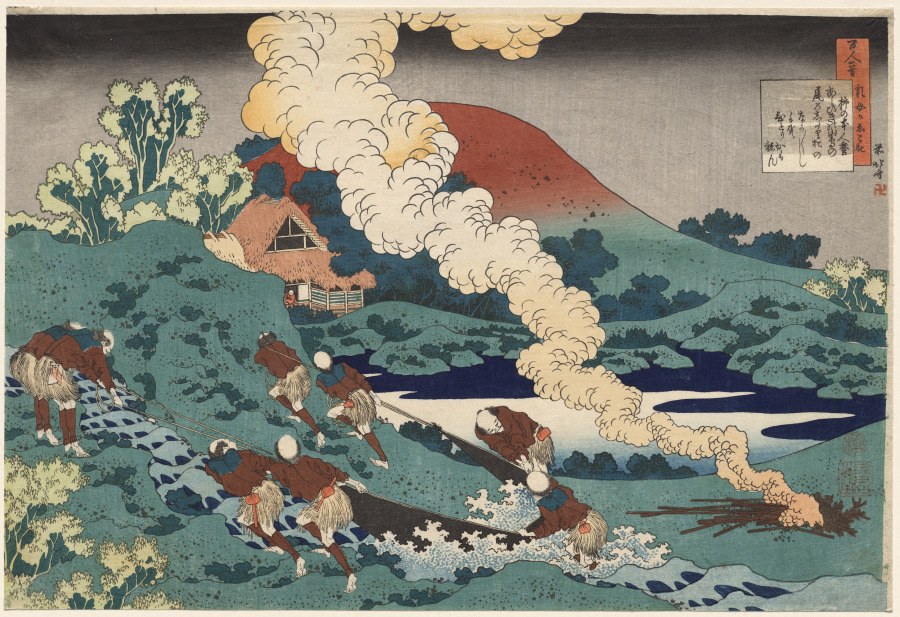
Hitomaro's poem relates the length of an autumn night spent alone to the long tail of a mountain pheasant. The Cleveland Museum of Art reads Hokusai's response through the labour of the fishermen, who drag a net by rope. The line the figures have to pull stretches through the landscape, where its length can be experienced as the time and work a task takes. The print gives this labour a large share of the picture. A long drift of smoke also moves across the landscape, between the fishing scene and the house on the left. Cleveland suggests the figure glimpsed there could be the nurse. There is enough distance between her and the action for the impression of someone watching the work to emerge. [6]
This print can be compared with the fishing series, where a net's shape and how a person handles it often help identify a technique. In the poem print, the rope makes us think of how long someone might pull or how far the whole group must go. It can do that even for viewers who do not know how the catch is made. Read the poem again after looking at where the men's feet meet the uneven ground. The words and the picture keep the experience of effort going, from a night of sleeplessness to a journey a viewer can follow along the river.
Ise, the scale of a reed and a human separation
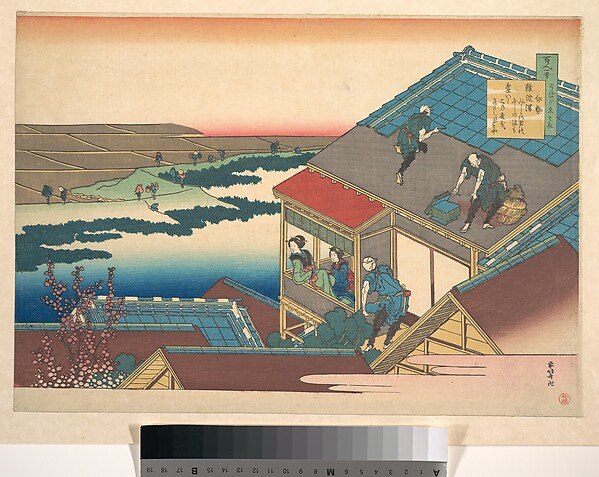
The Met's translation of Lady Ise's poem gives the joint of a tiny reed from the Naniwa marsh as a measure for the briefest of intervals. That figure of speech lets a small physical object carry an enormous imaginative separation. In the print, the built shoreline and the water occupy a much wider interval. The memory of a place is its visible setting, the space available to people moving around an inlet or marsh. One way to approach the print is to look for the difference in scale between what the words ask us to imagine and what Hokusai has room to show. [7]
The Japanese collection record at Sumida is useful when searching for the work because it gives the short form of the title as it appears in Japanese. Names of the poets can appear in long or short versions in different collections. Finding the same grove, shore or arrangement of buildings in two examples is a better check of design identity than expecting the translated titles always to agree in length. [8]
Sarumaru and a landscape that asks us to listen
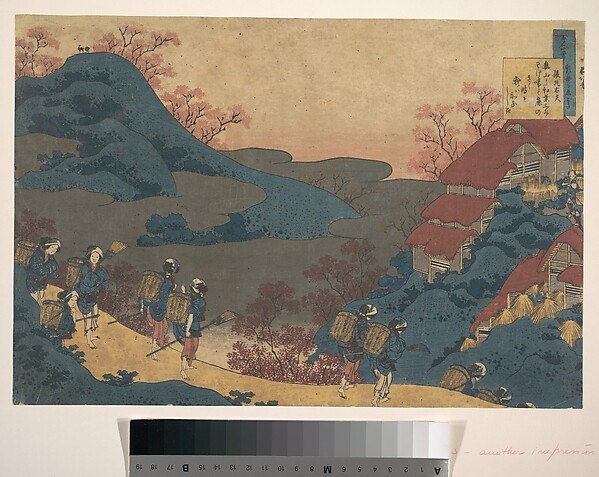
The anthology's poem attributed to Sarumaru Dayū ties the sound of a deer to the feeling of autumn. Hokusai has a whole mountainside in which to work out how that feeling can be made visible. The sloping ground and different groups of trees give the figures room to become very small. A reader can look from one part of the valley to another without finding the equivalent of a fire or other bright object around which every action is arranged. What literature can give as a brief sound must be made present in a different way. [9] [10]
Here as elsewhere, a museum date attached to a sheet should be read with the rest of the object record. The Met dates this impression to 1839. The Sumida chronology gives an example of the Sarumaru design around 1835. The two can be reported together as catalogue datings, without deciding from those alone exactly when each printing happened. The late series can be identified from its title, poet and image even when the years attached to a particular record vary. [11]
Empress Jitō and the task behind a change of season
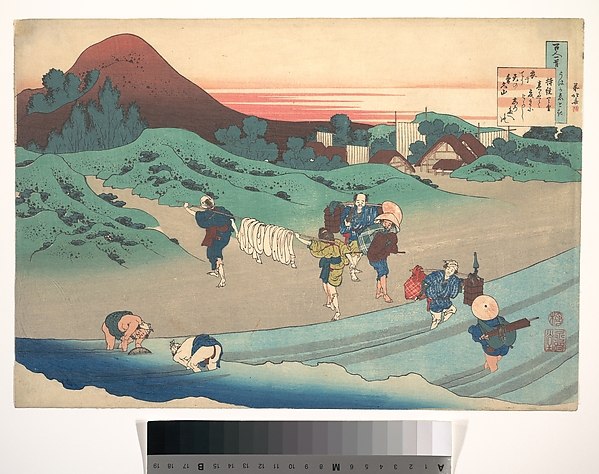
The Met's translation of the verse by Empress Jitō links the arrival of summer with white garments set out to dry near Mount Kagu. Hokusai gives the reader a landscape with work and movement in the foreground. The sheets, costumes and changes of direction across the more open ground make it possible to look at cloth as the consequence of labour. That helps explain why a work growing from a relatively short seasonal observation can have people at many different distances from the written poem. Even if each person is doing something ordinary, their gathering in one set of conditions gives the viewer a way of putting the season together. [12]
A more explicit account of labour appears in Sumida's record for Fujiwara no Teika. The poem's image of seaweed salt being fired gives Hokusai an occasion to show people collecting brine, carrying fuel and tending equipment. The connection is specific enough to be followed from word to action. Read it alongside the print for Jitō and see how the moment of interest can change. A mark of a season in one print can be encountered through work in progress. In another, an image ostensibly about waiting for someone provides the material for a much more extensive account of a group at its tasks. [13]
Abe no Nakamaro and a remembered moon
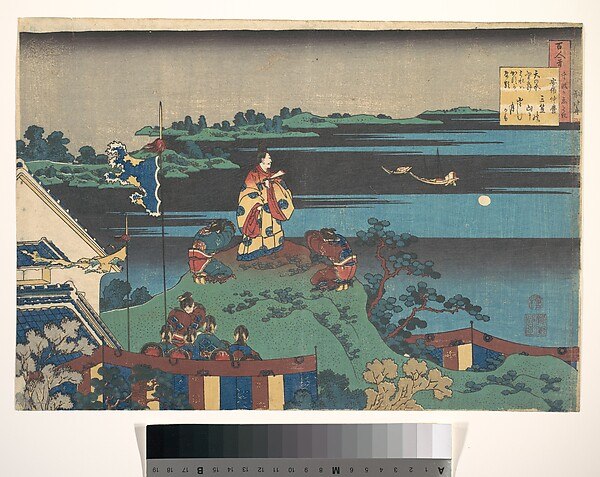
The Met explains the verse by Abe no Nakamaro in relation to his time in China and his longing for home. The moon he sees evokes Mount Mikasa. The picture can connect two places with the same act of looking even though only one scene occupies the main part of the print. Look at where people stand and how the built shape in the near field makes a position for a viewer looking out. Across the open background the moon can hold attention without answering a question about which view of the two it is meant to reproduce. Memory, distance and time of day can be communicated in a relatively small number of objects. [14]
Sangi no Takamura and an imagined witness at sea
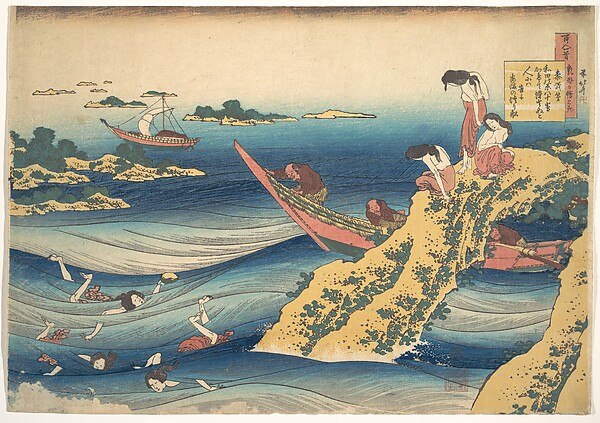
The poet Sangi no Takamura addresses the boats of fishing people as he sets out over the sea toward distant islands. In Hokusai's print sea and shore still offer enough details to occupy the reader without a single figure having to act as a literal portrait of the poet. Think of the speakers, companions and witnesses a picture could choose to distinguish. Where the poem makes an address to people the writer expects to encounter, the print can build a place in which people can see each other across spaces of water. Compare it with Oceans of Wisdom, where the activity is the subject a reader comes to discover. Here it helps to place a departure that belongs first to a voice. [15]
Dainagon Tsunenobu and multiple kinds of attention
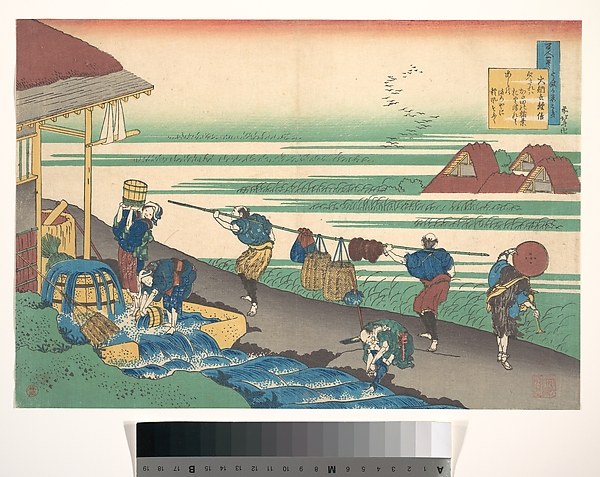
Tsunenobu's print provides another point of comparison for night. See how many of the figures in and around the visible building can share the page without being gathered around a single source of light. The print can hold a very broad part of a landscape in view while the closer human activities offer something recognisable within it. The Sumida exhibition placed the same poet in the company of designs around the anthology by other artists, a useful way to step from the individual interpretation back to the reading practices that made the series possible. [16] [17]
Ono no Komachi, blossom and dye
The Sumida Hokusai Museum's Japanese catalogue reads the Komachi print as a scene prompted by the poet's verse on the fading colour of flowers and the passage of her life. In the middle of Hokusai's scene, a large cherry tree gives the reader a visibly temporary display of colour. The older woman under it invites a comparison between flowers that return every season and a person looking back across a lifetime. Nearby figures dyeing cloth introduce another meaning of colour changing, this time as someone's work. Their activity does not simply supply the background to an isolated portrait of the poet. It shares in the interpretation of her words. [18]
Komachi's beauty had long been part of the legends and plays associated with her. The cherry blossom and the older observer leave it possible to recognise a familiar association while attending to the experience of the poem. Dyeing then gives the viewer something she could scarcely find in a portrait alone. A line one person might read as loss is answered by the practical production of colour. The printed sheet itself was also made through deliberate choices about placing colour. This makes the Komachi design particularly suited to comparison with the Empress Jitō sheet, where work on cloth helps make the season visible.
An anthology people could already see and play
The Sumida exhibition presented Hokusai's project within an older tradition of images about the Hundred Poets, displaying twenty-three published designs from the museum's collection across two rotations and including other depictions of the poets by Hokusai and his followers. Its curators also situated the collection of verses within the culture of illustrated Hyakunin isshu and poetry cards. The anthology was a well-known small collection of verses with a life beyond the shelf. Someone who could supply a second part of a line on seeing a card had a quite different encounter with a print from someone reading that particular verse for the first time. [1]
Look at what the comparable works make visible. A poet portrait gives a name, dress and a place among the other poets. A card links recognition to speed and memory. Hokusai's full sheets can spend much of their paper pursuing the setting, wordplay or associations the poetry prompted. The writing remains visible and companions to a print could disagree over where its interpretation was most persuasive. The fictional framing of a nurse's explanation makes those ways of seeing compatible with a reader's prior knowledge and with her surprise at a particular image.
The work left in drawings
The difference between a published print and a surviving drawing matters more here than in Thirty-six Views of Mount Fuji. The Smithsonian holds a number of sheets associated with the project, including a drawing for Go-Toba and one for Ki no Tomonori. In the latter the museum points out a reading of haru no hi in which the days of spring become fires. The design can embody a pun or unexpected reading whether or not it reached print. Its survival shows one of the paths the project might have explored beyond the known published sheets. [3] [19]
A prepared drawing could be transferred to a woodblock in a way that destroyed the working paper. The Smithsonian's exhibition on Hokusai's painting practice used such survivals to bring some of the usually invisible stages of making a print into view. A viewer can ask where the line draws attention to a feature on one of those sheets. It would be a further step to recover colour or decide how it would have looked after cutting and printing. The drafts broaden the record of the series without giving grounds to add them to the number of issued colour designs. [20]
Works discussed on this page
| Work | Discussion |
|---|---|
| Poem by Minamoto no Muneyuki Ason | Minamoto no Muneyuki and warmth in winter |
| Poem by Kakinomoto no Hitomaro | Kakinomoto no Hitomaro and the length of a fishing rope |
| Poem by Ise | Ise, the scale of a reed and a human separation |
| Poem by Sarumaru Dayū | Sarumaru and a landscape that asks us to listen |
| Poem by Jitō Tenno (Empress Jitō) | Empress Jitō and the task behind a change of season |
| Poem by Abe no Nakamaro | Abe no Nakamaro and a remembered moon |
| Poem by Sangi no Takamura (Ono no Takamura) | Sangi no Takamura and an imagined witness at sea |
| Poem by Dainagon Tsunenobu (Minamoto no Tsunenobu, Katsura no Dainagon) | Dainagon Tsunenobu and multiple kinds of attention |
Discussion
Look again at the images and ideas explored in One Hundred Poems Explained by the Nurse. These editorial prompts invite your observations.
Reader Insights
Where does Hitomaro’s verse about length reappear as a task in the picture?
What does the print of Komachi add to the poem’s changing colours?
Join the Conversation
Share a detail, comparison or question about One Hundred Poems Explained by the Nurse below.
References
- Sumida Hokusai Museum, Sumida Hokusai Museum, Japanese exhibition overview. View source.
- The Metropolitan Museum of Art, Met bulletin, discussion of the classical anthology and late series. View source.
- Smithsonian National Museum of Asian Art, National Museum of Asian Art, Go-Toba drawing and series context. View source.
- Sumida Hokusai Museum, Sumida Hokusai Museum, Japanese object commentary. View source.
- The Metropolitan Museum of Art, Met, Poem by Minamoto no Muneyuki. View source.
- Cleveland Museum of Art, Cleveland Museum of Art, 1930.190. View source.
- The Metropolitan Museum of Art, Met, Poem by Ise. View source.
- Sumida Hokusai Museum, Sumida Hokusai Museum, Ise. View source.
- The Metropolitan Museum of Art, Met, Poem by Sarumaru Dayū. View source.
- The Metropolitan Museum of Art, Met, discussion of the verse in its anthology context. View source.
- Sumida Hokusai Museum, Sumida chronology and Sarumaru example. View source.
- The Metropolitan Museum of Art, Met, Poem by Empress Jitō. View source.
- Sumida Hokusai Museum, Sumida Hokusai Museum, Japanese record for Teika. View source.
- The Metropolitan Museum of Art, Met, Poem by Abe no Nakamaro. View source.
- The Metropolitan Museum of Art, Met, Poem by Sangi no Takamura. View source.
- The Metropolitan Museum of Art, Met, Poem by Dainagon Tsunenobu. View source.
- Sumida Hokusai Museum, Sumida, Japanese and English exhibition checklist. View source.
- Sumida Hokusai Museum, Sumida Hokusai Museum, Ono no Komachi. View source.
- Smithsonian National Museum of Asian Art, Smithsonian, Ki no Tomonori drawing. View source.
- Smithsonian National Museum of Asian Art, National Museum of Asian Art, Hokusai: Mad about Painting. View source.