 by Tom Gurney
Tom Gurney BSc (Hons) is an art history expert with over 20 years experience
Email: tomgurney1@gmail.com / Phone: +44 7429 011000
Remarkable Views of Bridges in Various Provinces
Katsushika Hokusai's Remarkable Views of Bridges in Various Provinces (Shokoku meikyō kiran, 諸国名橋奇覧) turns a familiar object into eleven different ways of looking at a landscape. The series includes a low footbridge laid across marshes, a bridge made of boats, a steep arch at a shrine and a huge wooden span above an almost exposed river bed. Bridges connect distant banks. In these prints they also give people a place to watch other people, to celebrate or to enter a setting they could scarcely reach by another route. The Sumida Hokusai Museum notes that some of the depicted bridges had already disappeared by the time of Hokusai, and that one has no certain location. [1]
At a Glance
- ArtistKatsushika Hokusai
- DateEarly 1830s
- FormatHorizontal ōban colour woodblock prints
- SeriesEleven designs
Contents
- What makes the bridge a remarkable view?
- Yatsuhashi, a route made of bends
- Yahagi and the riverbed seen from above
- Kameido, from one bank to the other in a few steps
- A bridge supported by boats in Sano
- Tenma Bridge and an Osaka festival
- Tenpōzan and a newly made attraction
- Hida and Etchū, suspended above a mountain gorge
- Kintai, a repeating profile across a wide river
- Fukui, traffic and the breadth of a river
- Togetsu Bridge and the view of Arashiyama
- The Hanging-cloud Bridge at Ashikaga
- Bridges in other series
- The complete series
What makes the bridge a remarkable view?
The Sumida museum's account of the Mogi Honke exhibition explains the title in terms of unusually varied views and constructions. This is a stronger starting point than assuming all the images commemorate famous feats of engineering. Hokusai can be interested in the occasion of a crossing, an older idea of a place or an object whose proportions are made to fit the wider shapes of his picture. His other major early-1830s series took a mountain and let its place in the landscape change. A bridge is closer to the people using it and has immediate consequences for where the body can go. In each new print those practical effects can support a new arrangement of the viewer, the figures and what lies farther away. [2]
Some routes and places can be identified from other records. The crossing in an ancient view, an object with a popular name and a department of a publishing catalogue can still refer to different levels of identity. Read the series wording on the record before interpreting a historical place. The story of a bridge known from earlier pictures might justify an ancient view even where a modern visitor could find nothing like it. That is exactly the kind of information that matters to an account of the series. The print can circulate knowledge about a site through memory and literature as well as contemporary construction.
Yatsuhashi, a route made of bends
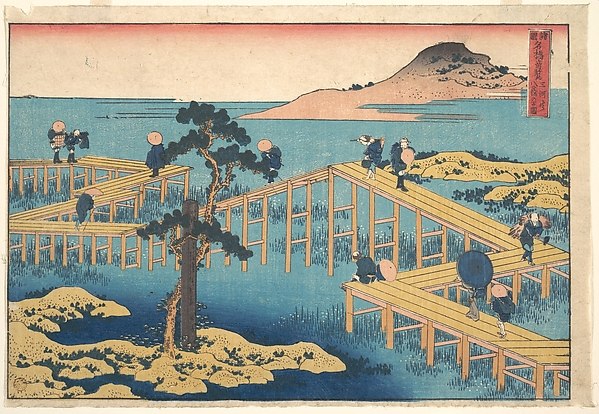
Hokusai's Ancient View of Yatsuhashi in Mikawa Province shows a low path of short stretches changing direction. Follow the bridge rather than looking first for an ideal view of the marsh. Each change of angle creates a position from which one person can appear to approach another or turn in a new direction. No lofty viewpoint is needed. The print makes the force of the construction legible through the distance its users have to cover and the marshy space they can enter because the bridge is there. [3]
The Met's bulletin compares the work with the older literary association of Yatsuhashi, the eight-plank bridge and its irises. A meeting point between poetry and landscape can carry familiarity into a markedly different kind of image. Hokusai's bridge gives actual day-to-day movement considerable weight on the paper. The irises take up relatively little of the room around the crossing in comparison with a Rinpa painting dominated by flowers. Look at the distribution of the people and the intervals among them. The visual prominence of the crossing has not automatically carried with it the same balance of plants, people and words that a reader might have brought from tradition. [4] [5]
Yahagi and the riverbed seen from above
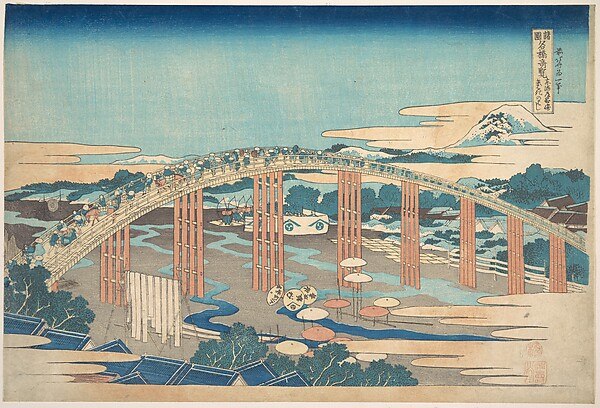
In Yahagi Bridge at Okazaki on the Tōkaidō, an extended shallow arch carries people high across a wide channel. The Met describes archers in the riverbed and a crowd crossing above. The relationships of attention are striking. A crossing can be a way to pass above a river without looking at it for long. This one creates places from which people stop or look toward a separate activity below. Figures on the river bed are small enough to read against its scale, while the most prominent edge of the bridge can stretch across the whole paper. [6] [7]
There is no need to treat the riverside archers as a reason to assign the print to a particular day. The key relationship of the banks and raised deck already lets the viewer understand how these two groups could share a landscape. Compare the freedom of a person crossing a deck with the small range of motions visible below. A bridge can impose a clear horizontal movement on the figures it supports while making that movement stand out against the uneven forms of the river. The arch and piers also establish a much bigger scale than the short segments of Yatsuhashi can provide.
Kameido, from one bank to the other in a few steps
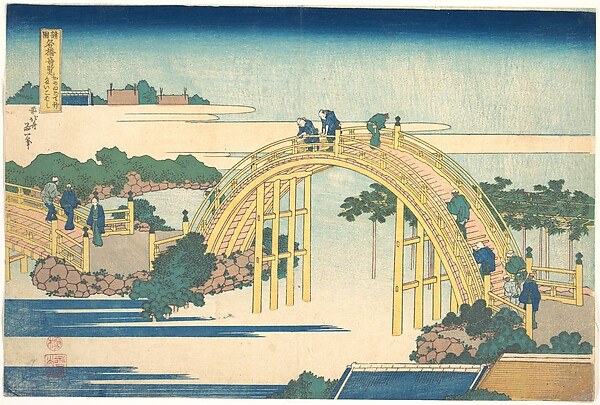
At Kameido Tenjin, the short, sharply arched bridge fills an unusually large part of one local view. The raised part of the deck concentrates attention at a single high point. A small change in the position of a pedestrian can mean a considerable change in height. Compare the much longer rise and fall at Yahagi, where the viewer gets a prolonged idea of the crossing. Here one near, strongly curved structure makes the movement of a body over it particularly easy to imagine. [8]
These differences in form are more useful than putting the bridges on a scale from oldest to newest. Each produces a particular relation between the head of a viewer, the body of a crossing person and the surface below. Kameido lets people pass through a visible arc over a pond. The view of Yahagi keeps the top of a large deck apart from the far bed of a river. If you follow only the printed lines that show the highest point of the deck, the drawings can already give a sense of how differently a person moves across each kind of water.
A bridge supported by boats in Sano
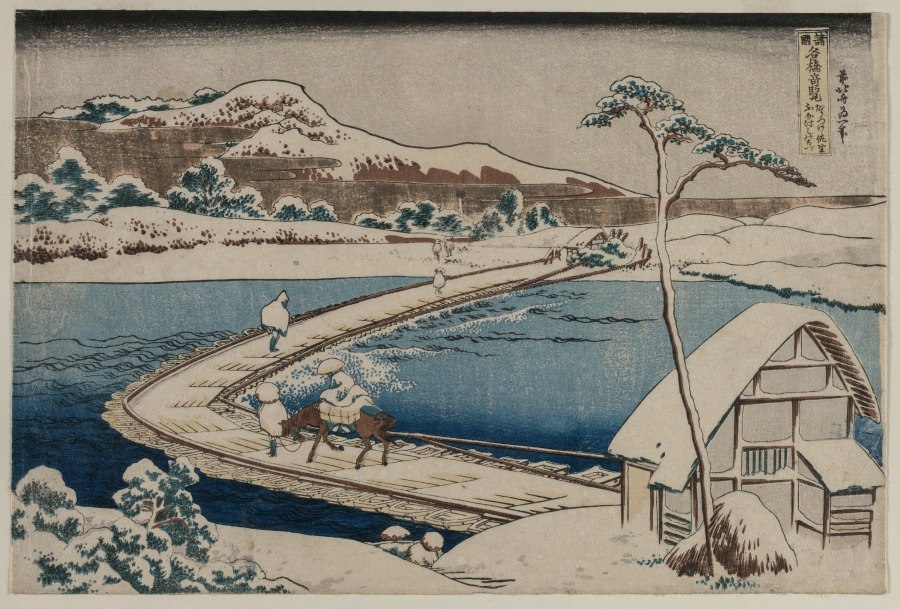
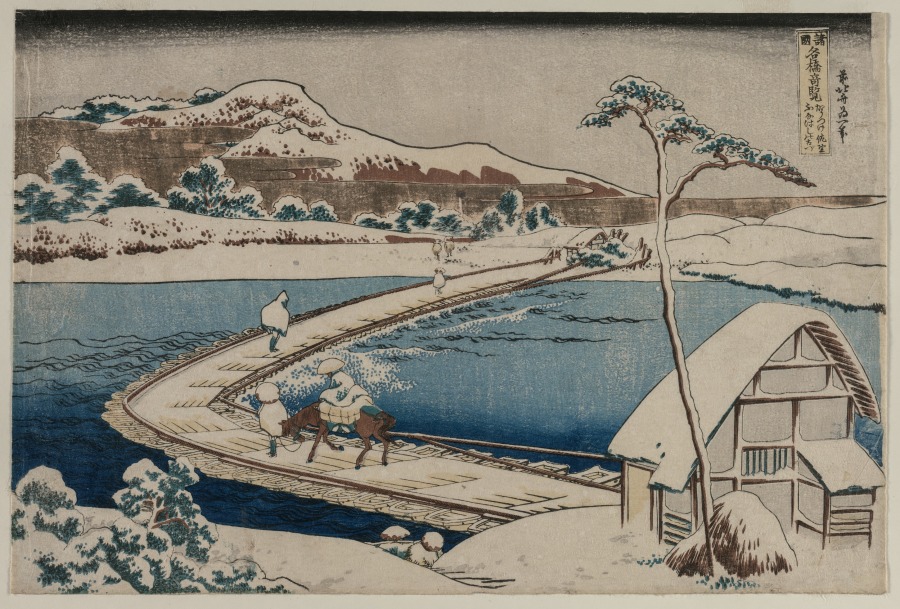
Sumida's Japanese record relates the setting of an old pontoon bridge to the Karasu River in the area of present-day Takasaki, Gunma. In the Cleveland impression, travellers cross a flexible-looking span set over a dark river in winter. The title presents an old view. That distance gives a reader a reason to see the small forms on the water as more than picturesque shipping. Boats provide the structure that holds the route in place. They are normally understood as ways of moving across water and can now serve as the comparatively stable means of walking over it. [9] [10]
The snow offers a particularly effective separation of the crossing and the water. The little signs of regular support stand out against the cold scene, making it easier to read the route before fully appreciating its construction. The winter setting can also make the visitors appear constrained in their movement. They have a narrow safe line to follow. Sano and Yatsuhashi both use multiple supports to cover an irregular course, but they offer completely different ideas of what a person would feel below the surface of the route.
Tenma Bridge and an Osaka festival
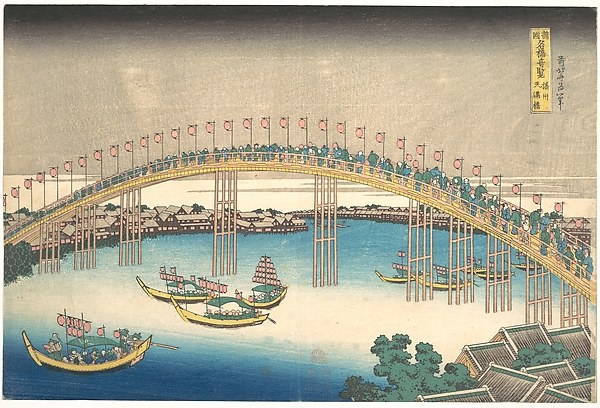
Tenma Bridge has a river full of boats and a crowded crossing. The festival changes the reason to cross or occupy the bridge. It also changes what a viewer should look for at the level of the river. Boats and their passengers define one crowded portion of the picture, while the people above form a different band. A bridge can be necessary infrastructure and an excellent platform for viewing an event. In Hokusai's arrangement it holds those functions together by giving the two levels rather different visual rhythms. [11]
Look at the pictures of Tenma Bridge and Kameido side by side. It is much easier at Kameido to follow an individual trajectory over the arch. At Tenma the larger concentrations of people can seem almost to form a continuous shape. The groups below have different relations to time. They may wait, shift position or pass through the near scene more slowly than a walker. Hokusai can make the bridge give people somewhere to be seen without having to give each figure a separate story.
Tenpōzan and a newly made attraction
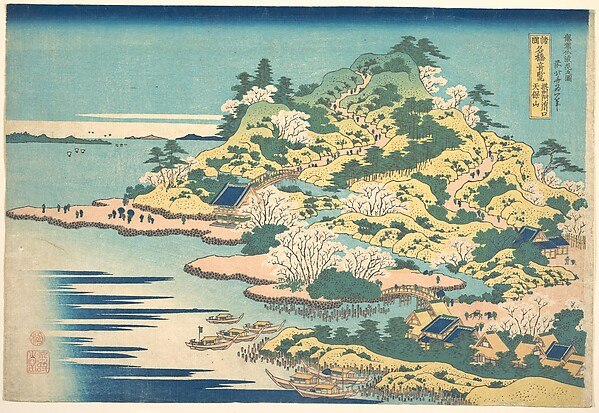
The Sumida museum explains that Tenpōzan, at the Aji River mouth in Osaka, was made with earth from dredging in 1831. The image depicts a site newly available to visitors, with cherry blossoms and people enjoying the setting. A print of an ancient bridge and a print of a recent improvement can both offer buyers something unusual. The Tenpōzan design has the additional interest of showing what a change to a working waterfront could do for the public life of a place. It makes building and visiting part of the same visual history. [12] [13]
The example helps to illuminate the title as an editorial device. A publisher could bring a new public place to a buyer who had heard about it or a crossing that existed chiefly in accounts of past travel. Both could satisfy curiosity about a place the buyer would not normally see. One does it through recognition of what has been recently added. The other restores the view of a structure that may no longer have any corresponding position on the ground.
Hida and Etchū, suspended above a mountain gorge
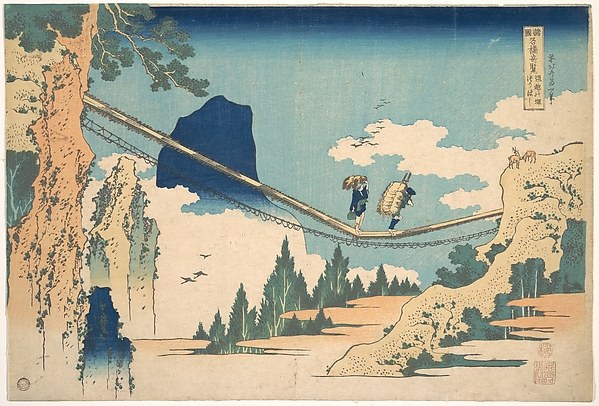
One traveller puts a foot forward on the suspension bridge. The other, facing away, appears to pause and look down. Princeton's catalogue reads these as two separate reactions to a very precarious crossing. The bundles help locate them as people carrying goods, while the pause gives us enough time to consider what lies below. Hokusai builds the paper into an experience of looking down as well as across. At ground level in Kameido someone may be close enough to follow the progress of another walker. Here the nearest part of the route allows a look into a much greater depth. The steepness of the slope and the river's small presence well below the bridge make the act of balancing matter from the first step. [14] [15]
Kintai, a repeating profile across a wide river
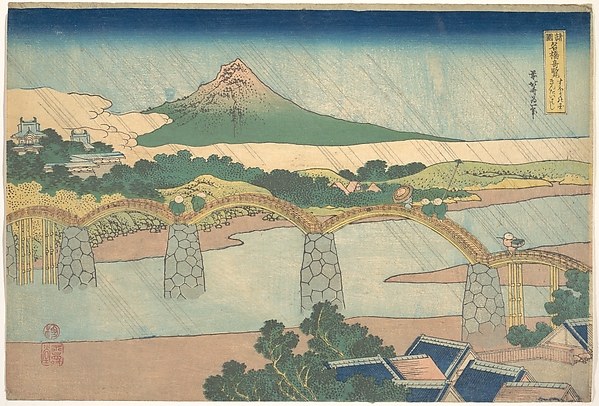
Kintai Bridge in Suō looks very different at first glance. Successive arches give the crossing a long, repetitive profile, and the marks on the water below it have room to convey a current without interrupting the structure. Try to trace one arch from support to support, then continue across the page. The repeated structure lets a viewer judge the relation between the small people and the very long route. Kameido offers a single steep arch and a much quicker movement up and over. Hokusai could use the curve of a bridge to put special emphasis on one moment of travel or use several curves to set the rhythm of a whole scene. The crossing at Kintai has been reconstructed, as has the Kameido drum bridge. In each case the modern crossing supplies a comparison for the setting and forms of the print. [16] [17]
Fukui, traffic and the breadth of a river
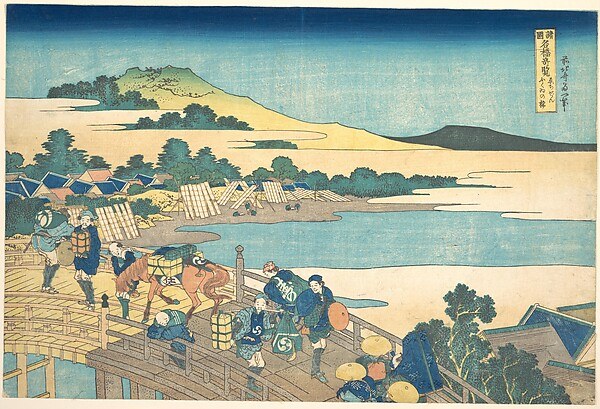
At Fukui, the nearest travellers are large enough to make out their hats, bundles and individual postures. The bridge cuts diagonally across the foreground, with its continuation running off the edge of the print. It is much harder to see its complete shape than at Kintai, where several arches can be traced in succession. Begin with the raised deck and look past it over the pale bends of the river. The closeness of the travellers lets us see the traffic itself while their route places us above the river and the roofs on the nearer bank. Compare the figures with the festival crowd at Tenma. There, bridge users form a distant band across the scene. Here the crossing is close enough for one party and its bundles to matter. [18]
Togetsu Bridge and the view of Arashiyama
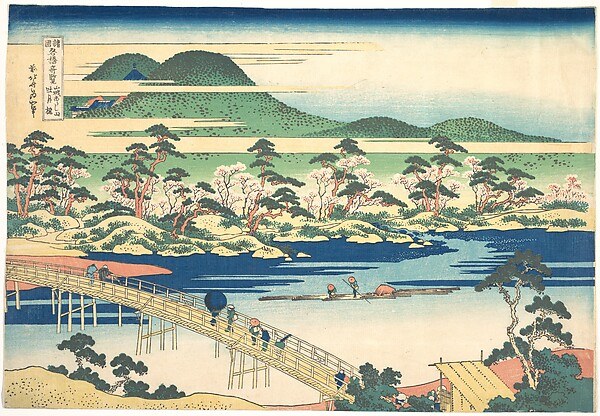
The Togetsu Bridge at Arashiyama invites a longer view across water and into the surrounding landscape. Begin with the banks and consider how far the scene extends on either side of the bridge. There is no isolated leap from one cliff to another. The bridge is part of a continuous river landscape with a much broader range of colour and shapes behind it. As with Kintai and Kameido, the crossing has been reconstructed. Compare a modern landscape with the sheet before making claims about an exact angle or treating the colour of vegetation as a record of a particular day. The relative position of the banks and the way the crossing sits in the valley offer much better grounds for comparison. [19] [17]
The Hanging-cloud Bridge at Ashikaga
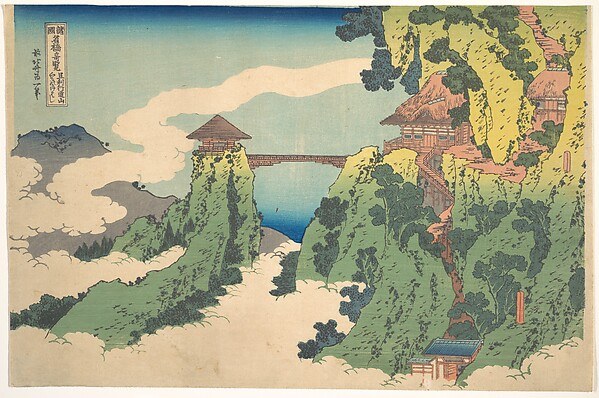
The Sumida museum discusses Hokusai's print of the hanging crossing at Gyōdōzan in Ashikaga, where buildings occupy precarious positions above clouds and a crossing extends across a gap. Even in a reproduction the cloud and surrounding rock carry information about the way people can reach a building. Here an effect that might seem purely atmospheric matters to the reader's estimate of vertical danger. The museum's research also identifies the publisher as Nishimuraya Yohachi, whose name links the group to the print trade behind the Fuji series. [20]
Sumida identifies the pavilion as Seishintei. The architecture has its own appeal as a place someone might visit, and once the viewer has found it, the print raises the question of how anyone can reach it. At Hida and Etchū, Hokusai puts the travellers in clear view and lets a precarious action unfold across the sheet. At Ashikaga, the crossing is small beside the surrounding shapes. One look has to establish the presence of the building, another the link it has to the route around the rock. It makes a fitting companion to the suspension bridge without giving the two sites the same scale or direction of travel. [20] [21]
Bridges in other series
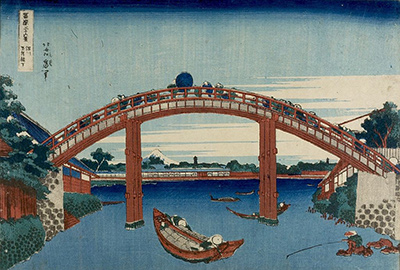
Nishimuraya Yohachi also published the Fuji series, where several bridges are integral to the views. Under Mannen Bridge at Fukagawa and Nihonbashi Bridge in Edo belong to Thirty-six Views of Mount Fuji. At Mannen Bridge, the structure provides a massive near frame through which the eye can find something much farther away. In the bridge group, a view can take the crossing's construction, its name or an occasion of use as the ending point of a reader's exploration. As with the waterfall tour, it is possible to ask what changed when a familiar feature of Hokusai's landscape practice was allowed to organise a series of its own.
The complete series
Discussion
Look again at the images and ideas explored in Remarkable Views of Bridges in Various Provinces. These editorial prompts invite your observations.
Reader Insights
Which crossing gives you the strongest sensation of height?
How do the party at Fukui and the crowd at Tenma change the role of their bridges?
Join the Conversation
Share a detail, comparison or question about Remarkable Views of Bridges in Various Provinces below.
References
- Sumida Hokusai Museum, Sumida Hokusai Museum, exhibition discussion of the eleven designs. View source.
- Sumida Hokusai Museum, Sumida Hokusai Museum Japanese exhibition. View source.
- The Metropolitan Museum of Art, Met, Ancient View of Yatsuhashi. View source.
- The Metropolitan Museum of Art, Met bulletin on Hokusai. View source.
- The Metropolitan Museum of Art, Met, Designing Nature. View source.
- The Metropolitan Museum of Art, Met object commentary. View source.
- Sumida Hokusai Museum, Sumida Hokusai Museum, Japanese collection record. View source.
- The Metropolitan Museum of Art, Met, The Arched Bridge at Kameido Tenjin Shrine. View source.
- Sumida Hokusai Museum, Sumida, Japanese collection commentary. View source.
- Cleveland Museum of Art, Cleveland Museum of Art, 1940.1001. View source.
- The Metropolitan Museum of Art, Met collection record. View source.
- Sumida Hokusai Museum, Sumida Hokusai Museum, Japanese object record. View source.
- The Metropolitan Museum of Art, Met, Tenpōzan. View source.
- Princeton University Art Museum, Princeton University Art Museum, 2012-60. View source.
- The Metropolitan Museum of Art, Met, JP2945. View source.
- The Metropolitan Museum of Art, Met, Kintai Bridge. View source.
- National Gallery of Victoria, National Gallery of Victoria exhibition labels. View source.
- The Metropolitan Museum of Art, Met, Fukui Bridge. View source.
- The Metropolitan Museum of Art, Met, Togetsu Bridge. View source.
- Sumida Hokusai Museum, Sumida museum Japanese bulletin on the Ashikaga print. View source.
- The Metropolitan Museum of Art, Met, Ashikaga. View source.