Jackson Pollock.jpg)
 by Tom Gurney
Tom Gurney BSc (Hons) is an art history expert with over 20 years experience
Published on June 19, 2020 / Updated on October 30, 2026
Email: tomgurney1@gmail.com / Phone: +44 7429 011000
Untitled, c.1945 (Crayon and Watercolour): Introduction
Crayon, coloured pencil, ink and watercolour share the paper in Jackson Pollock’s Untitled, dated about 1945 by the Museum of Modern Art. The sheet measures 51.5 × 63.5 cm: a substantial, horizontally proportioned drawing. MoMA’s title contains no numeral; its object number, 662.1983, identifies this particular work among Pollock’s many untitled sheets. The museum credits its acquisition to the gifts of Philip Johnson, Abby Aldrich Rockefeller, Curt Valentin and Edward M. M. Warburg, by exchange. Its four media offer a useful starting point for understanding the work: solid drawing tools and fluid colour brought together on one support. [1]
At a Glance
This work across Jackson Pollock’s career
The Flame
c.1934–38The She-Wolf
1943Mural
1943Alchemy
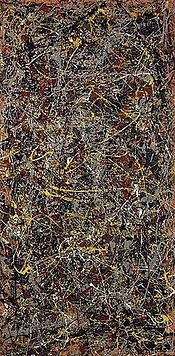
1947Number 1A, 1948
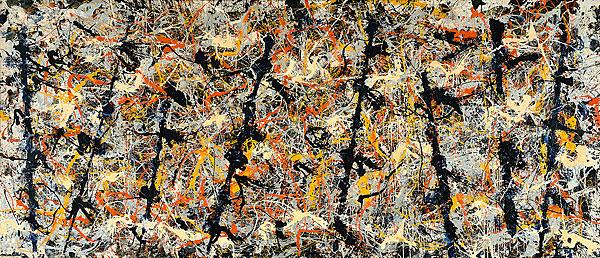
1948Blue Poles
1952The Deep
1953White Light
1954Contents
- Marks with different possibilities
- Where drawing meets painting
- A drawing with its own purpose
- Seen among paintings and prints
Marks with different possibilities
A coloured pencil need not behave like another coloured pencil. Conservators Margaret Holben Ellis and M. Brigitte Yeh describe a range of formulations and surface effects, from matte to glossy. They specifically note that Pollock sometimes used pencils sensitive to water and to organic solvents within the same composition. Their example concerns his practice generally, without identifying this drawing. It nevertheless makes a useful point: the names of media do not tell us everything about their behaviour. Their account also distinguishes wax crayons from oil pastels, despite the overlapping everyday vocabulary. For this sheet, “crayon” should therefore remain a material description with some breadth. We cannot turn it into a named brand, a precise formula or proof of wax resisting a wash. The interest lies in the possible encounters between unlike marks; the exact response of each material would require evidence about the sheet itself. [2]
Watercolour introduces another way for colour to occupy paper. MoMA defines it as finely ground pigment in a water-based gum solution, traditionally gum arabic or gum tragacanth. Its characteristic transparency differs from the opacity associated with gouache, which can contain white fillers or a higher proportion of pigment. That distinction helps explain why the medium matters here. Colour can allow the support beneath it to remain optically present, offering a different relationship between mark and surface from a covering layer of paint. In a mixed-media drawing, transparency also makes the meeting of one mark with another potentially significant. MoMA also notes that ink can be applied with a nib or as a brush wash: liquid colour can describe a line as well as occupy an area. These general possibilities help us approach the four-media combination without supplying its order of application. [3]
Where drawing meets painting
Bernice Rose’s Jackson Pollock: Drawing into Painting provides a broader way of thinking about such combinations. She describes an early tension between Pollock’s strongly linear conception of form and his interest in the surface and spatial effects of paint. Drawing and painting increasingly exchanged tasks: a painted line could describe a shape, move across it or join separate parts of a composition. Rose also examines the interchange between figures and the areas surrounding them, with either capable of asserting itself. Applied as a general framework, her argument shifts attention from the inventory of tools to what marks can do together. A crayon line and a passage of watercolour need not belong to separate expressive worlds. Their different physical characters can participate in a common pictorial problem. This is a useful context for the sheet’s combination of media, without assigning it the particular procedures Rose documents in other works. [4]
The surrounding history was similarly varied. In his 1998 account, Kirk Varnedoe cautions against arranging Pollock’s early 1940s work into a neat progression. He discusses the relatively open, calligraphic Stenographic Figure alongside the more densely reworked paintings associated with Pollock’s first solo exhibition. Different palettes, densities and approaches could coexist. The freedom of a line, the presence of a figure and the texture of a painted surface were questions he could approach in several ways. That account gives an approximately dated drawing like this one room to be understood within active experimentation. Its mixed materials need not announce a single destination in advance. The celebrated later poured paintings make one part of this history especially familiar, but they should not make the earlier alternatives seem incidental. Varnedoe’s emphasis on simultaneous exploration helps preserve that variety. [5]
Watch: Jackson Pollock
Choose a film about Pollock’s paintings and ways of working.
A drawing with its own purpose
Pollock himself distinguished a relationship to painting from preparation for painting. Francis V. O’Connor’s 1967 catalogue reproduces a draft associated with the artist’s 1947 statement “My Painting.” There Pollock described approaching painting directly, as he approached drawing, and said his drawings related to his paintings without being made for them. The distinction is valuable when approaching this sheet. It allows affinities between media and works without requiring a missing canvas for which the drawing served as a plan. It also gives the paper work its own scale of decisions and its own pictorial life. The statement comes later than the museum’s approximate date, so it cannot identify the occasion or intended use of this particular drawing. It does, however, offer the artist’s own reason to approach his drawings as a substantial part of his practice. [6]
His comments on invention also leave room for practical judgement. In a 1944 questionnaire, Pollock expressed an interest in the unconscious while insisting on the necessity of craftsmanship. In “My Painting,” published in winter 1947–48, he described a period of recognising what had happened in a work and a willingness to change or destroy an image as the painting developed. Together these statements give a fuller sense of experimentation: materials, discovery and revision could all matter. They make it possible to take the responsiveness of drawing seriously without imagining that every mark bypassed thought. Neither text is a report on the making of this sheet. Their relevance is to the larger artistic attitude in which working with different materials could involve both openness and selection. His account makes craftsmanship and discovery partners in the developing work, with revision a continuing possibility. [7]
Seen among paintings and prints
MoMA included the drawing in Jackson Pollock: A Collection Survey, 1934–1954, held from 22 November 2015 to 1 May 2016. Its online exhibition checklist links this Untitled to the museum’s object record. Organized by Starr Figura with Hillary Reder, the survey brought together approximately fifty paintings, drawings and prints, emphasizing experimentation across materials and techniques. That setting offered a particularly useful way to encounter a work made with four media: within a practice that also included engraving, lithography and screenprinting, as well as painting. The curatorial emphasis encouraged attention to how Pollock worked across these different forms. For readers exploring the drawing now, the same comparison remains productive. Following a medium from one work to another can reveal a different artistic question from following a famous title or a familiar period label. [8]
Pollock artworks directory
Explore the distinct works discussed in these guides. This selection is not a complete catalogue. Green Silver and Untitled, 1949 are two guides to the same painting.
Discussion
Look again at the images and ideas explored in Untitled, c.1945 (Crayon and Watercolour). These editorial prompts invite your observations.
Reader Insights
Which detail in “Marks with different possibilities” changes how you understand this work?
What comparison comes to mind after “Where drawing meets painting”?
What would you like to discuss about “A drawing with its own purpose”?
Join the Conversation
Share a detail, comparison or question about Untitled, c.1945 (Crayon and Watercolour) below.
References
- The Museum of Modern Art. “Jackson Pollock. Untitled. (c.1945).” Object 662.1983; medium, dimensions and acquisition credit. Accessed 26 October 2026. View source.
- Margaret Holben Ellis and M. Brigitte Yeh. “Categories of Wax-Based Drawing Media.” WAAC Newsletter 19, no.3 (September 1997), “Colored Pencil” and “Wax Crayon”; excerpt from their June 1997 AIC paper. View source.
- The Museum of Modern Art. Art Terms: “Watercolor” “Gouache” and “Ink.” Complete indexed definitions, accessed 26 October 2026. View source 1. View source 2. View source 3.
- Bernice Rose. Jackson Pollock: Drawing into Painting. New York: The Museum of Modern Art, 1980, pp.8–9 (PDF11–12). View source.
- Kirk Varnedoe. Jackson Pollock, with Pepe Karmel. New York: The Museum of Modern Art, 1998, pp.35–36 (PDF40–41). View source.
- Jackson Pollock, 1947 draft statement, reproduced in Francis V. O’Connor, Jackson Pollock. New York: The Museum of Modern Art, 1967, p.40 (PDF45). View source.
- Jackson Pollock. “A Questionnaire,” Arts and Architecture 61, no.2 (February 1944): 14; “My Painting,” Possibilities 1 (winter 1947–48): 78–83. Reprinted in Pepe Karmel, ed., Jackson Pollock: Interviews, Articles, and Reviews. New York: The Museum of Modern Art, 1999, pp.15–18 (PDF18–21). View source.
- The Museum of Modern Art. Jackson Pollock: A Collection Survey, 1934–1954, exhibition overview, 22 November 2015–1 May 2016; online checklist, Untitled (c.1945), linked to object 37756. Accessed 26 October 2026. View source 1. View source 2.