 Buy Art Prints Now
from Amazon
* As an Amazon Associate I earn from qualifying purchases.
Image reference [image]
 by Tom Gurney
Tom Gurney BSc (Hons) is an art history expert with over 20 years experience
Published on August 14, 2026 / Updated on August 14, 2026
Email: tomgurney1@gmail.com / Phone: +44 7429 011000
A Naiad: Introduction
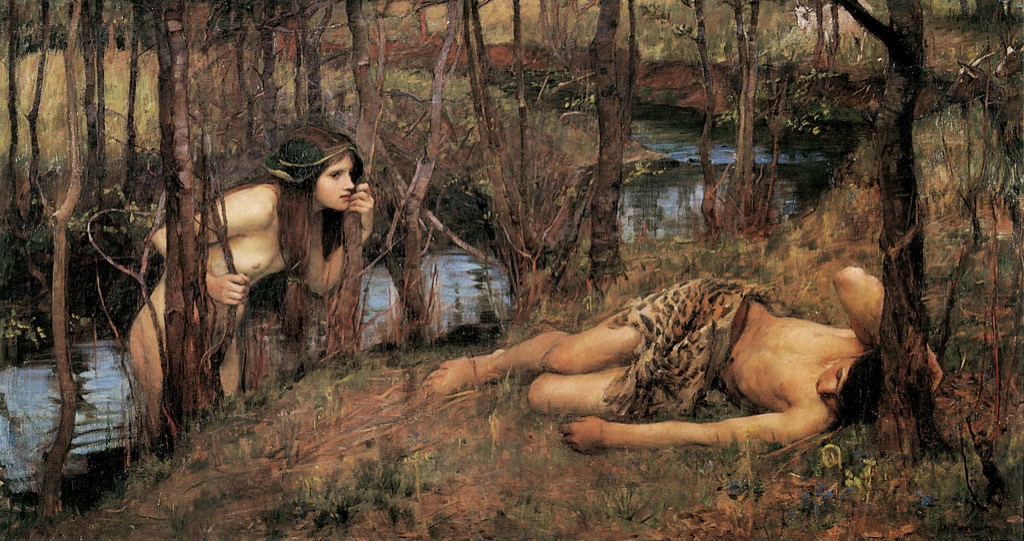
A water nymph rises silently from a woodland stream towards a sleeping young man. She has not seized him, and he has not yet seen her. John William Waterhouse's A Naiad of 1893 transforms the mythic meeting of human and supernatural into an interval of inspection whose outcome remains uncertain.
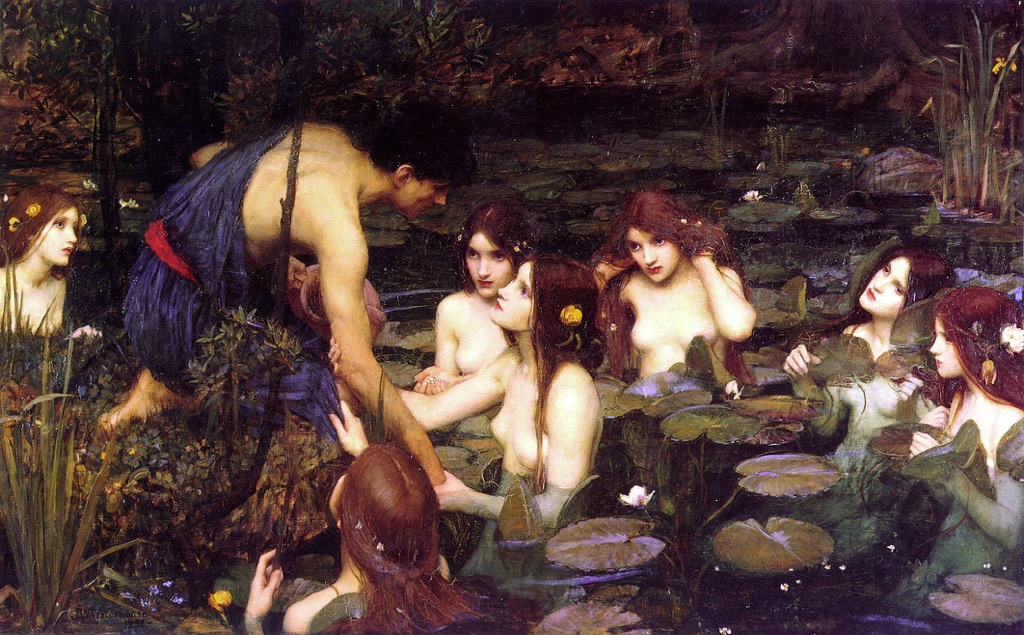
The painting is also known as Hylas with a Nymph, linking it to the youth later shown facing seven water nymphs in Waterhouse's Hylas and the Nymphs. Yet the earlier work is not simply a preliminary version. Its long horizontal space, sleeping figure and single emerging naiad create a quieter and more ambiguous encounter. [1] [2]
At a Glance
- ArtistJohn William Waterhouse (1849–1917)
- TitleA Naiad; also known as Hylas with a Nymph [1]
- Date1893 [1] [2]
- MediumOil on canvas [1]
- Dimensions66 × 127 cm [1]
- CollectionPrivate collection [1] [3]
- First exhibitedNew Gallery, London, 1893 [1]
- SubjectA water nymph approaching a sleeping or resting youth beside a woodland stream
- Mythic associationHylas and the naiads, known from ancient authors including Theocritus and Apollonius of Rhodes [4] [5]
- Essential distinctionThe 1893 painting shows one nymph and a recumbent youth; the 1896 Hylas and the Nymphs shows the conscious Hylas leaning towards seven nymphs in a pool
Contents
- Introduction
- An Encounter before Recognition
- What Is a Naiad?
- Hylas in the Ancient Sources
- Is the Young Man Hylas?
- Water, Sleep and Divided Space
- From One Nymph to Seven
- Exhibition and Preparatory Evidence
An Encounter before Recognition
The canvas opens laterally across stream, bank and wooded enclosure. On one side, the young man lies along the earth. On the other, the naiad emerges from water and vegetation. Their bodies belong to different elements but share the same narrow interval.
The youth appears asleep or deeply at rest. His extended body lacks the alert tension of a traveller surprised by danger. The nymph, by contrast, is awake and observant. She studies him before he can return her gaze.
This unequal awareness supplies the drama. No violent gesture identifies an attack, but he is vulnerable because he does not know he is being watched. Her movement from the stream crosses the boundary between supernatural nature and human bodily space.
Waterhouse keeps the naiad partly continuous with her environment. Water-lily leaves are woven into her hair, as Christie's notes in cataloguing a surviving head study. [2] Wet vegetation, water and flesh make her seem to form from the place rather than merely enter it.
The young man's feline skin gives him a more complicated identity than a modern sleeper in a forest. Christie's associates the garment with Dionysus and notes goats observing the scene. [2] These classical or pagan signs draw the encounter away from ordinary anecdote.
The naiad does not smile broadly or reveal a monstrous attribute. Her expression combines attention, curiosity and possible desire. Waterhouse asks viewers to decide whether approach means wonder, seduction, rescue or danger.
That decision cannot be settled from posture alone. Her body advances, but the image stops before contact. The youth's sleep suspends reciprocity. The painting contains possibility rather than outcome.
The title A Naiad preserves that openness. It names the supernatural woman but not the man or a specific incident. The alternate title Hylas with a Nymph narrows the scene by attaching it to a famous disappearance.
Both titles have historical value, but they lead viewers differently. One begins with a class of nature spirit; the other supplies a story in which water nymphs take a beautiful youth away from his companions.
What Is a Naiad?
In Greek myth, naiads are nymphs associated with fresh water: springs, streams, fountains, rivers or pools. They belong to local natural places rather than to the Olympian hierarchy in the same way as Zeus, Hera or Athena.
Ancient poetry can name individual water nymphs, gather them in groups or treat them as the living presences of particular waters. Their beauty and immortality or long life do not make them harmless by definition.
The Greek word and later artistic tradition allow water to become female and animate. A pool is no longer background; it can look back. Waterhouse makes that idea physical by placing the nymph between immersion and emergence.
Peter Trippi describes Waterhouse's interest in the “lower” pagan gods during the early 1890s and connects A Naiad with A Hamadryad and La Belle Dame Sans Merci, all exhibited in 1893. [3] These figures allow landscape to acquire consciousness without requiring a grand assembly of Olympians.
A hamadryad belongs to a tree, while a naiad belongs to fresh water. Waterhouse's paired interests make woodland and stream active sources of encounter. Nature is beautiful because it is inhabited, and dangerous because its inhabitants have desires.
The Victorian and Symbolist attraction to nymphs also carried modern ideas about sexuality, femininity, instinct and escape from industrial life. These cultural associations should not be mistaken for one fixed ancient doctrine. Waterhouse's naiad is simultaneously classical by title and late nineteenth-century in visual treatment.
Her water-lily adornment makes the botanical relation intimate. She does not simply stand beside plants; leaves enter her appearance. In the later Hylas and the Nymphs, flowers and women's heads repeat across the pool so closely that nymph and water lily become compositional equivalents.
The single naiad of 1893 is less patterned. Her individuality matters because she alone bears the uncertainty of approach. Viewers cannot distribute intention across a chorus.
Calling her a “mermaid” would be inaccurate. Mermaids are generally marine or hybrid beings represented with fish tails in later European tradition. Waterhouse's naiad has a fully human female form and inhabits fresh water.
Nor does “nymph” mean merely a young woman used decoratively. The mythological category is the basis of the painting's transformation of landscape into agency.
Hylas in the Ancient Sources
Hylas sails with Heracles and the Argonauts. During a landing in Mysia, he goes to find fresh water for the company. His beauty attracts the nymphs of the spring, and he disappears. [4] [5]
Theocritus's Idyll 13 makes Hylas the beloved companion of Heracles. Heracles has raised him and teaches him the skills by which he himself became admirable. Their connection gives the disappearance emotional force rather than treating Hylas as an incidental servant. [4]
When the ship reaches the land of the Cianians, Hylas takes a bronze pitcher and searches for water. He finds a spring around which rushes, celandine, maidenhair and other plants grow. The detailed vegetation establishes a place already inhabited by nymphs. [4]
Theocritus names three water nymphs—Eunica, Malis and Nycheia—who hold hands and draw the youth into the dark water. His cry is heard, but the listener cannot locate him. Hylas sinks while the nymphs comfort him on their knees. [4]
Heracles searches in distress, calling Hylas repeatedly. He abandons the onward voyage in his urgency and becomes separated from the Argonauts. The loss changes both personal relation and heroic expedition. [4]
Apollonius of Rhodes gives another extended account in the Argonautica. Hylas goes out with a pitcher, and a nymph rising in the water sees his beauty. As he bends to fill the vessel, she puts an arm around his neck and pulls him beneath the surface. [5]
The difference in number is significant. Theocritus names three nymphs, while Apollonius concentrates the seizure through one. Later artists could therefore choose a single naiad or a group without inventing the basic variation from nothing.
Neither ancient scene corresponds in every detail to Waterhouse's 1893 canvas. The literary Hylas is awake and actively fetching water when he is drawn in. The pictured young man lies asleep or rests with no pitcher clearly controlling the action.
That discrepancy does not disprove the Hylas association, but it warns against calling the painting a literal illustration of one exact line. Waterhouse adapts a mythic relationship: beautiful youth, water nymph and dangerous attraction at the pool's edge.
Is the Young Man Hylas?
The alternate title Hylas with a Nymph supports identifying the youth with Hylas. [1] The subject also anticipates Waterhouse's unmistakable 1896 painting of Hylas encountering seven naiads.
At the same time, A Naiad was the title under which the work became known and first exhibited at the New Gallery in 1893. [1] That title leaves the male figure unnamed and places emphasis on the nymph's emergence.
A cautious description should preserve both levels. The painting can be discussed within the Hylas tradition without pretending that every detail confirms a single source passage.
The boy's recumbent position is the largest complication. Theocritus and Apollonius send Hylas to collect water, a practical errand requiring a pitcher and conscious movement. [4] [5] Waterhouse replaces the instant of water gathering with sleep or repose.
That invention changes agency. In the poems, Hylas approaches the spring and the nymph reacts to his beauty. In the painting, the naiad appears to leave her element and approach him while he remains unaware.
The feline skin and goats introduce Dionysian or pastoral associations, according to the Christie's catalogue. [2] They may broaden the youth into an inhabitant of pagan nature rather than specifying one Argonautic uniform.
It is possible that Waterhouse wanted recognition to remain unstable. A named Hylas would bring a predetermined drowning or immortal union; an unnamed sleeper allows a viewer to encounter a more general fantasy of nature discovering the human body.
The title history should therefore inform rather than close interpretation. “Hylas” tells us what mythic family the picture belongs to. “A Naiad” tells us whose action Waterhouse makes visible.
The painting also lacks Heracles and the Argonauts. Their absence makes the loss private. No search party calls from the woods; no ship waits. The encounter is complete within two bodies and one boundary.
That economy is distinct from Hylas and the Nymphs, where title, pitcher and clustered figures make the ancient episode more immediately legible.
Water, Sleep and Divided Space
Water forms a threshold across the horizontal composition. The naiad's body rises from one side of it, while the youth belongs to the bank. The scene asks whether she will cross fully onto land or draw him towards water.
The stream is not painted as a transparent neutral surface. Dark water conceals depth and origin. Plants soften its edge, making the exact division between ground and pool difficult to trace.
That uncertainty extends to the nymph. Her human form is visible, but her elemental home remains around and behind her. She is both body and manifestation of place.
Sleep makes the youth another kind of threshold figure. He is alive but temporarily absent from conscious exchange. His stillness resembles the vulnerability of Psyche's infernal sleep or the suspended lovers in Waterhouse's literary scenes, without sharing their exact causes.
Because his eyes are closed, the main gaze belongs to the woman. This reverses the conventional arrangement in which a male viewer inspects an unaware female figure. The naiad looks, the youth is looked at, and the gallery viewer observes both.
The reversal does not remove voyeurism; it layers it. We see a vulnerable body through the attention of a supernatural woman. Her curiosity can serve as a mirror for ours.
Christie's describes the nymph as entranced by the sleeping youth and interprets the union as imminent. [2] The catalogue's reading is persuasive but remains an interpretation of a scene stopped before touch.
Goats at the edge of the encounter add witnesses within nature. Unlike human companions, they will not warn or explain. Their presence makes the setting inhabited without breaking its secrecy.
Horizontal format allows the separation to breathe. A vertical canvas would compress one figure above another; this long field lets land and water face across space. The distance is small enough for approach but large enough for anticipation.
The colour relation between flesh, fabric, leaves and water can vary in reproduction. The most stable reading comes from placement: the nymph rises, the youth reclines, and the stream divides their states.
No literal violence has occurred. The visual suspense depends on recognizing that beauty and danger are not opposites in the Hylas tradition. The nymph may desire the youth precisely because she finds him beautiful.
From One Nymph to Seven
Three years after A Naiad, Waterhouse completed Hylas and the Nymphs, now in Manchester Art Gallery. The later picture presents Hylas kneeling at a pool while seven nymphs rise among water lilies.
The relationship is clear but should not turn the 1893 canvas into a mere sketch. A Naiad is a finished, exhibited oil with its own dimensions, title and private ownership. [1] It solves the encounter differently.
The early work has one nymph, one recumbent youth and an extended landscape. The later work multiplies female figures, turns the male body towards them and compresses the decisive attraction around the pool.
In 1893, the woman advances while the man sleeps. In 1896, Hylas advances and meets the foremost nymph's gaze. Reciprocal vision replaces unilateral inspection.
The number seven in the later composition does not come directly from Theocritus's three named nymphs or Apollonius's one. Waterhouse builds a visual chorus. Repetition links pale bodies to lily blossoms and surrounds the kneeling youth.
The earlier naiad remains more individual. Her possible innocence, investigation or desire cannot be averaged across other faces. Trippi emphasizes the ambiguous intentions of the nymphs in A Naiad and A Hamadryad. [3]
This difference also affects culpability. A group can look like a trap or collective force. One woman approaching one sleeper can look tender, curious or predatory according to the viewer's expectations.
The later painting includes Hylas's water pitcher, anchoring the scene to the errand in the ancient narratives. The earlier canvas loosens that narrative specificity through sleep and pastoral attributes.
Seen together, the works demonstrate Waterhouse's process of rethinking rather than simply enlarging. He moved from lateral separation to frontal seduction, from sleep to gaze and from a solitary spirit to a patterned supernatural community.
Both pictures stop before disappearance. Waterhouse repeatedly preferred what Rose Sketchley later called a kind of emotional equilibrium: a point at which desire and consequence are balanced, with neither fully resolved. [3]
Exhibition and Preparatory Evidence
A Naiad was first exhibited at the New Gallery in London in 1893 and is now privately owned. [1] Its placement outside the Royal Academy is a reminder that Waterhouse used more than one major London exhibition venue.
The same year saw La Belle Dame Sans Merci and A Hamadryad, forming a group of images concerned with supernatural or fatal female presence in landscape. [3] Their subjects range from Keats's named enchantress to less narratively fixed nature spirits.
The painting did not find an immediate purchaser and remained difficult for critics to summarize because its subject was less explicit than a familiar literary climax. Trippi notes that A Naiad and A Hamadryad did not sell during Waterhouse's lifetime. [3]
A surviving oil study of the female head provides unusually direct evidence of Waterhouse's preparation. Christie's identifies it as a study for A Naiad, dates it to about 1892 and records oil on canvas laid on board, measuring approximately 30 by 26 centimetres. [2]
The study concentrates upon face, hair and water-lily leaves. Removing landscape and male figure allows close examination of the expression on which the finished work's ambiguity depends.
Christie's also documents the study's later provenance and notes Peter Trippi's assistance in cataloguing it. [2] Auction records are particularly important for Waterhouse studies dispersed from the studio into private collections.
Preparatory work does not prove a single verbal intention. It shows that Waterhouse invested separately in the nymph's appearance before integrating her with stream, youth and animals.
The finished canvas's private ownership limits regular direct comparison, while the later Manchester Hylas is publicly accessible. This imbalance can make the famous 1896 work seem primary and the 1893 painting derivative. Chronology reverses that assumption.
A Naiad belongs to Waterhouse's exploration of pagan nature before his most famous formulation of the theme. Its quieter ambiguity is not an incomplete version of later drama; it is a different idea about who sees whom first.
Related Pages
- Paintings: Return to the protected Waterhouse paintings hub.
- Literary and Mythological Sources: Read the classical source frame for Waterhouse's A Naiad.
- Technique and Style: Connect A Naiad with Waterhouse's late colour, surface and figure handling.
Frequently Asked Questions
A naiad is a nymph associated with fresh water such as a spring, stream, fountain or pool.
The alternate title Hylas with a Nymph supports that identification. [1] However, the exhibited title A Naiad leaves him unnamed, and his sleeping pose differs from ancient accounts in which Hylas is awake and collecting water.
Water nymphs draw him into a spring because of his beauty. Heracles searches for him and becomes separated from the Argonauts. [4] [5]
No. It shows a nymph approaching a recumbent youth before any seizure or immersion.
The leaves connect her appearance with the fresh-water habitat from which she emerges. A surviving head study records Waterhouse's attention to this detail. [2]
It was painted and first exhibited at the New Gallery in 1893. [1]
The 1893 picture has one nymph approaching a sleeping youth. The 1896 painting has seven nymphs facing a conscious, kneeling Hylas at the pool.
Yes. Christie's has catalogued an oil head study from about 1892, including the nymph's water-lily adornment. [2]
Discussion
1. Does the naiad's approach appear curious, erotic, protective or dangerous? 2. What changes when the male figure is asleep rather than returning her gaze? 3. How does the alternate title Hylas with a Nymph alter the painting's outcome? 4. Why might Waterhouse have replaced an ancient water-fetching scene with sleep? 5. How does the horizontal format divide land and water? 6. Compare the single naiad with the seven figures in Hylas and the Nymphs. Which encounter feels more threatening? 7. In what ways does vegetation make the nymph seem part of the stream? 8. How does the painting reverse or complicate the usual direction of looking at an unaware body?
Reader Insights
Which visible detail most changes the way you read this page?
Which source or comparison helps the work feel less familiar and more specific?
What question would you bring back to the painting after reading?
Join the Conversation
Share your reading of this page below.
References
- Main image: John William Waterhouse, A Naiad or Hylas with a Nymph, public-domain faithful reproduction via Wikimedia Commons.
- Wikimedia Commons, “A Naiad or Hylas with a Nymph by John William Waterhouse,” object metadata for alternate title, date, medium, dimensions, private ownership and New Gallery exhibition in 1893, View source.jpg).
- Christie's, “John William Waterhouse, R.A., R.I., A female head study for A Naiad,” lot record and catalogue essay, including the study's date, medium and dimensions and a description of the finished painting's nymph, water-lily leaves, youth and animals, View source.
- Peter Trippi, “The very Victorian nymphs of J. W. Waterhouse,” Apollo, 16 February 2018, discussion of A Naiad, A Hamadryad, the 1893 exhibition group, pagan nature and the ambiguity of the nymphs' intentions, View source.
- Theocritus, Idyll 13, “Hylas,” translated by J. M. Edmonds, Theoi Classical Texts Library, Hylas's water errand, the named nymphs and Heracles' search, View source.
- Apollonius of Rhodes, Argonautica, Book I, translated by R. C. Seaton, Project Gutenberg, the single spring nymph's seizure of Hylas and the ensuing search, View source.