 Buy Art Prints Now
from Amazon
* As an Amazon Associate I earn from qualifying purchases.
Image reference [image]
 by Tom Gurney
Tom Gurney BSc (Hons) is an art history expert with over 20 years experience
Published on August 14, 2026 / Updated on August 14, 2026
Email: tomgurney1@gmail.com / Phone: +44 7429 011000
Pandora: Introduction
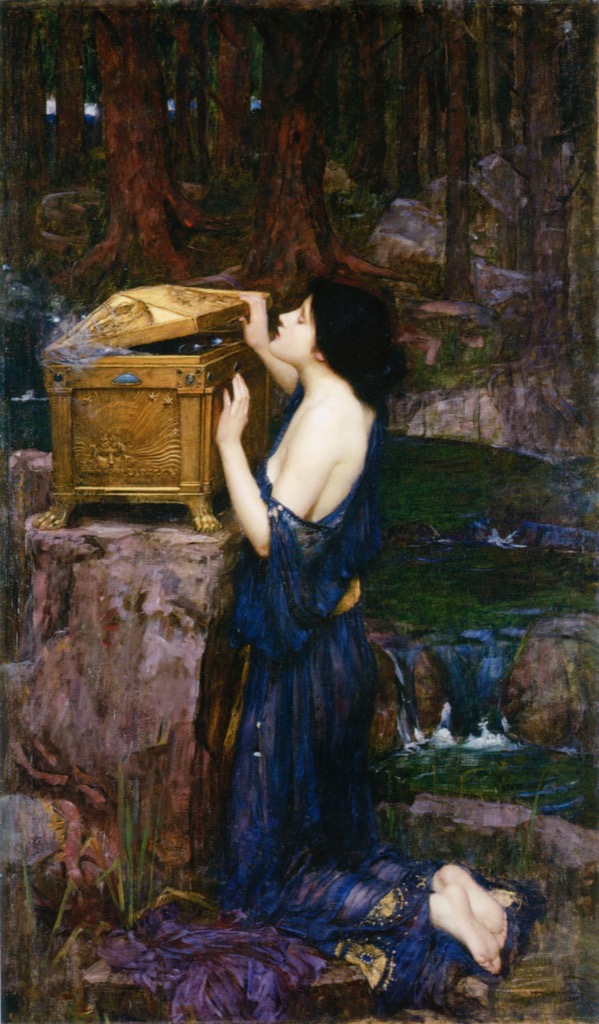
Pandora kneels in a wooded place and raises the lid of an ornate casket. She has not yet recoiled from what it contains. John William Waterhouse fixes the story at its narrowest point of suspense: the prohibited or dangerous object is open, but the consequences that will alter human life remain invisible.
Exhibited at the Royal Academy in 1896, Pandora transforms Hesiod's huge storage jar into the small precious box familiar from later European retellings. That difference is not incidental. Waterhouse replaces the practical weight of a pithos with an object that can be held, inspected and made the centre of a solitary act of looking. [1] [2]
At a Glance
- ArtistJohn William Waterhouse (1849–1917)
- TitlePandora
- Date1896 [1] [3]
- MediumOil on canvas [3]
- Dimensions152 × 91 cm [3]
- CollectionPrivate collection; documented in the Andrew Lloyd Webber collection in 2018 [4]
- First exhibitedRoyal Academy, London, 1896, no. 271 [1]
- Early ownerAlfred Aaron de Pass, who lent it to the Victorian Era Exhibition in 1897 [5]
- Principal ancient sourceHesiod, Works and Days, lines 42–105 [2]
- Essential distinctionHesiod describes a large storage jar, not a small box, and says that Hope remains inside rather than escaping last
Contents
- Introduction
- The Moment before the World Changes
- Pandora in Hesiod
- Jar, Box and Waterhouse's Casket
- Curiosity, Blame and Divine Design
- Figure, Forest and the Unseen Contents
- Hope beneath the Rim
- Exhibition and Provenance
The Moment before the World Changes
Waterhouse does not paint a swarm of personified evils. No winged sicknesses, demons or clouds announce that the container has been opened. Pandora's attention is directed into the casket, and the viewer's attention follows hers.
The vertical canvas concentrates that act. The kneeling figure occupies the lower and middle space, surrounded by woodland, rocks and water. Her body bends towards the object while the upright trees continue beyond her. Human decision is small within nature but immense within the story.
Pandora's pose is active and controlled. One hand raises or steadies the lid; the other approaches the container. Waterhouse catches investigation rather than panic. The catastrophe is legible only through title and mythic knowledge.
The casket's ornament and golden colour make it desirable before its contents are known. It appears valuable, made and finite. That material beauty stands against the formless troubles it will release.
Her pale dress and exposed arms distinguish her from the darker landscape. Fabric pools and folds around the kneeling body, giving physical weight to the moment. Waterhouse does not show a generalized emblem called Woman; he makes a particular body lean, balance and look.
The scene's quiet is essential. If the evils had already filled the air, Pandora would become one actor among many. By withholding them, Waterhouse makes the interval of choice dominate the composition.
Yet “choice” requires qualification. In Hesiod, Pandora is created by divine command as part of Zeus's punishment after Prometheus steals fire for humanity. Her capacities and deceptions are designed into her by the gods. [2] Waterhouse shows an individual action whose conditions were arranged before she existed.
The viewer is placed in a morally uneasy position. We know that the box should remain closed, but the painting makes its interior the place we most want to see. Curiosity belongs not only to Pandora; composition recruits it from everyone looking at her.
This shared looking helps explain the picture's lasting clarity. One figure, one container and one lifted lid can carry an origin story about suffering without literal illustration of disease, toil or death.
Pandora in Hesiod
The oldest surviving extended account of Pandora appears in Hesiod's Works and Days. The poet presents the story while advising his brother Perses about labour, justice and the hard conditions under which humans live. [2]
Prometheus has deceived Zeus and stolen fire for human beings. Zeus retaliates by withholding easy livelihood and then ordering the creation of a beautiful affliction. Hephaestus mixes earth and water and gives the new figure a human voice and form. [2]
Athena teaches her textile work and dresses her. Aphrodite gives painful desire and care that wears away the body. Hermes supplies a shameless mind, deceitful character and speech. Other gods add ornaments and gifts. Hermes names her Pandora because the Olympians have contributed to the gift sent as a sorrow to men. [2]
Zeus sends Pandora to Epimetheus, the brother of Prometheus. Prometheus has warned him not to accept a gift from Zeus, but Epimetheus receives her and understands the danger only after it has arrived. [2]
Hesiod then explains that human beings had previously lived without evils, harsh toil and painful diseases. Pandora removes the lid of a great jar and scatters what it contains. Troubles thereafter move among mortals by day and night, silently, because Zeus has taken away their voices. [2]
The poem does not provide the familiar modern catalogue of every vice or monster flying out. It names the resulting condition broadly through evils, disease, labour and sorrow. Later retellings make the contents more pictorial and individually recognizable.
One thing remains within the jar: Elpis, commonly translated as Hope or Expectation. It stays beneath the rim because Pandora replaces the lid, in accordance with the will of Zeus. [2]
Hesiod does not explain in a simple sentence whether Hope's confinement benefits humanity or increases its punishment. The ambiguity has generated sharply different readings. Hope may remain available as a consolation held in reserve, or it may be withheld; elpis can also include expectation rather than exclusively optimistic hope.
The tale belongs to an ancient explanation of why life requires work and includes suffering. Its account of the first woman is explicitly shaped by a male poet's hostile model of gender. Reading Waterhouse responsibly requires acknowledging that misogynistic structure instead of merely repeating that a naturally curious woman ruined a perfect world.
The poem also complicates moral responsibility. Zeus plans the punishment; multiple gods construct its instrument; Epimetheus ignores a warning; Pandora opens the jar. A later summary that places all blame on one woman's curiosity simplifies the divine machinery of the source.
Jar, Box and Waterhouse's Casket
Hesiod calls the container a pithos. This is a large ceramic storage jar used for commodities such as grain, oil or wine, not a hand-held jewel box. [2]
Waterhouse paints a comparatively small decorated chest or casket. Pandora can kneel beside it, raise its hinged lid and look directly inside. The object belongs to the later Western “Pandora's box” tradition rather than to the scale and form of Hesiod's vessel.
The change is often described as a mistranslation that began in Renaissance humanist reception. Whatever route Waterhouse knew, by the nineteenth century “Pandora's box” was a familiar English expression. His title needs no explanatory reference to a jar.
This history matters because form changes action. A huge storage vessel requires bodily leverage and implies contents accumulated on a domestic or agricultural scale. A casket invites intimate inspection. It can resemble a jewellery box, reliquary or treasure chest.
The smaller container also lets Waterhouse frame Pandora and object together within a narrow canvas. Her hands can control its lid, and her face can approach its opening. Painting gains psychological proximity at the cost of ancient material accuracy.
The box's preciousness intensifies temptation. Hesiod's jar could be visually ordinary despite its cosmic function. Waterhouse's decorated gold surface promises value. The painting asks why a beautiful object would be expected to remain unseen.
That promise is deceptive. The goods supplied by the gods have made Pandora herself alluring, while the casket's ornament makes the instrument of suffering alluring. Figure and object mirror the structure of Zeus's gift: beauty conceals harm.
This parallel should not be turned into a claim that Pandora is identical to the box. The poem and painting distinguish woman, container and contents. But Waterhouse makes their surfaces participate in the same visual economy of attraction.
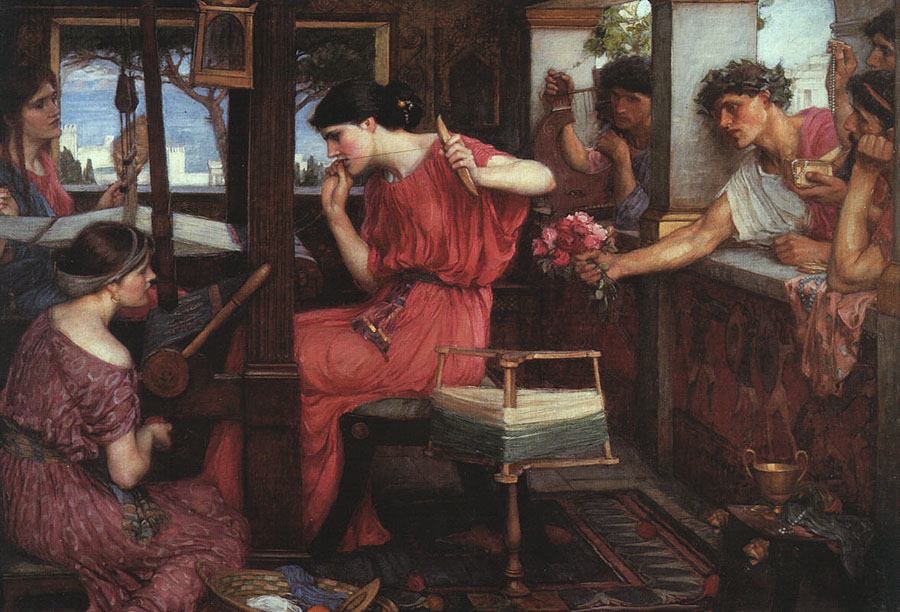
The casket also provides a useful contrast with Psyche Opening the Golden Box, painted seven years later. Both heroines bend over a precious forbidden container, but the stories are different. Pandora's action changes the condition of humanity; Psyche is personally overwhelmed by infernal sleep and later rescued by Cupid.
Confusing the two because of a “golden box” erases the distinct moral and narrative structures. Waterhouse's repetition is better understood as an experiment in how a closed object can make invisible knowledge pictorial.
Curiosity, Blame and Divine Design
Modern summaries frequently describe Pandora as a woman whose uncontrolled curiosity releases evil. Hesiod's surviving passage, however, concentrates as much on Zeus's planned retaliation and divine manufacture as on her inner motive. [2]
The gods give Pandora qualities for a purpose. She is not an independent person who happens upon a neutral container within an otherwise open world. She arrives as a beautiful trap within a conflict between Zeus and Prometheus.
Waterhouse removes that cosmic council. Zeus, Prometheus, Epimetheus, Hephaestus, Athena, Aphrodite and Hermes are absent. The omission makes the represented action psychologically concentrated, but it can also make responsibility appear more individual than it is in the poem.
The picture's silence invites viewers to supply motive. Is Pandora curious, compelled, innocent of the contents, secretly warned or knowingly disobedient? The title identifies the myth without visibly answering all those questions.
That uncertainty is productive. Her face is intent rather than grotesquely wicked. Waterhouse does not caricature her. The visual appeal that makes the viewer linger also resists an easy division between an innocent observer and a blameworthy subject.
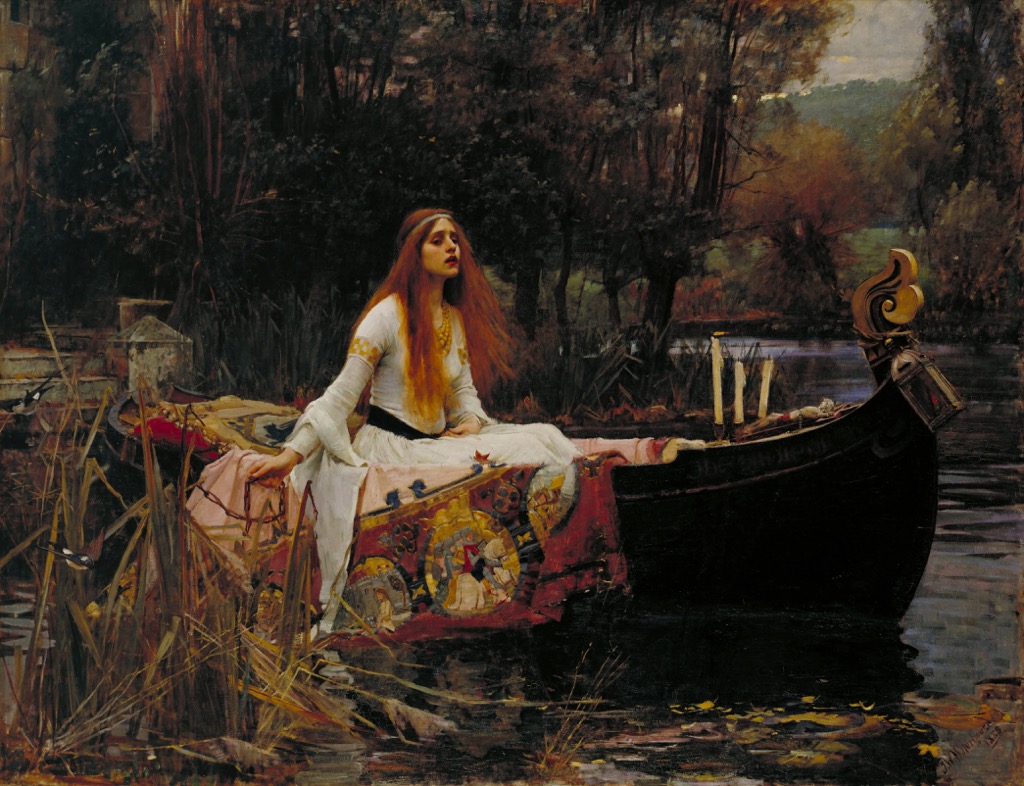
The nineteenth century often treated dangerous female curiosity through stories of Eve, Bluebeard's wife, Psyche and the Lady of Shalott. These comparisons can illuminate a cultural pattern, but the narratives should not be collapsed. The command, object, knowledge and consequence differ in each.
Pandora's act is especially political because the source makes the first woman a punishment for men. A modern reader need not endorse that premise to interpret its history. The story records how an ancient agrarian poem explained labour and gender through divine hostility.
Waterhouse's beautiful young heroine both inherits and softens the tradition. Her aesthetic idealization may reproduce the idea of alluring danger, yet her solitary concentration creates sympathy unavailable in a moral emblem of ugliness or vice.
The painting thus holds two readings in tension. Pandora can be seen as the agent who opens disaster, and as a created being performing the function Zeus designed for her. Neither requires inventing a facial expression of malice.
The larger question is whether knowledge itself is condemned. The casket attracts because it withholds. Waterhouse makes the wish to know visually persuasive even while myth identifies the result as suffering. The viewer experiences the mechanism rather than observing it from moral safety.
Figure, Forest and the Unseen Contents
Waterhouse places Pandora outside rather than in a palace or workshop of the gods. Woodland encloses her with trunks, leaves, rocks and water. Nature continues calmly around a mythic rupture.
This setting is not specified by Hesiod. It belongs to Waterhouse's mature language of women beside pools and within dense, enchanted landscapes. The ancient story is relocated into a recognizably Waterhouse environment.
The vertical shape allows trees and figure to echo one another. Pandora's body bends, while trunks rise. The movement towards the ground makes the casket feel like a point of gravity.
Rock provides a hard base for the soft folds of her garment. Vegetation gives irregular texture around the manufactured geometry of the box. These oppositions keep the object visually distinct without placing it on a theatrical pedestal.
The painting's atmosphere is dark but not conventionally infernal. No flames or underworld architecture declare evil. Shadow instead protects the unknown interior and delays certainty.
Because the contents remain unseen, interpretation depends on the hinge and hands. A lid is an ordinary mechanism that divides visible exterior from concealed interior. Waterhouse turns that division into the painting's narrative threshold.
Pandora's kneeling pose can suggest submission, worship or practical convenience, but the secure action is inspection. She does not pray to the box. Nor does any source used here establish a ritual ceremony within the pictured moment.
The absence of Epimetheus intensifies isolation. In Hesiod, Pandora enters a household through his acceptance. Waterhouse makes the decisive action belong to her alone, while the consequences will extend far beyond the frame.
No specific flying shapes can be counted because Waterhouse does not paint them. Reproductions sometimes encourage viewers to find vapour in darkness, but the picture's force rests upon withholding rather than a concealed swarm waiting to be decoded.
The body itself carries suspense. Knees and lower legs stabilize Pandora, arms bridge the distance to the casket, and the head descends towards it. She is balanced at the instant before balance—social, cosmic or physical—is lost.
Hope beneath the Rim
The phrase “hope remained” is often retold as though Hope escaped last and softened the release of evil. Hesiod says the opposite at the literal level: Elpis remains inside beneath the jar's rim because the lid closes before it can fly out. [2]
The meaning is not thereby simple. If hope is a good available to mortals, its preservation in the jar may imply that it has not been destroyed. If the jar's contents are withheld from humans once sealed, hope may be denied. If elpis means expectation, its value can depend upon what is expected.
Waterhouse does not show a personified Hope. The casket's interior remains dark, and no labelled figure settles the ancient ambiguity. This restraint is one of the work's strengths.
The partly open lid holds past and future together. Most evils may already be imagined outside while Hope remains within, or the painting may precede the full release. A still image cannot conclusively place every invisible content in sequence.
The casket's continued physical presence also matters. After the action, it is not simply an empty prop. It remains the boundary around whatever has not escaped.
Hope therefore prevents the myth from ending as a flat account of total despair. The world contains suffering, but readers must decide whether expectation is a resource, a withheld good or another part of Zeus's design.
Waterhouse's image does not answer through allegorical gesture. Pandora looks into the very space where the interpretive problem resides. Her gaze makes uncertainty the subject.
This is preferable to forcing an optimistic modern slogan onto Hesiod. “Hope was left to comfort humanity” is a possible later interpretation, not a sentence the ancient poem states without qualification.
The painting can nevertheless sustain hope as a formal effect. Its stopped moment means consequence has not fully arrived for the viewer. We look before the story closes, even when we know that closure cannot prevent suffering.
Exhibition and Provenance
Waterhouse exhibited Pandora at the Royal Academy in 1896 as catalogue number 271. [1] The appearance came soon after his election as a full Royal Academician and placed a major mythological heroine before the Academy audience.
Alfred Aaron de Pass became the picture's first recorded owner. The catalogue of the Victorian Era Exhibition at Earl's Court in 1897 lists Pandora as number 99 and records that de Pass lent it. [5]
Historic photographs preserved by Falmouth Art Gallery show the painting installed at Cliffe House, de Pass's residence in Falmouth. [6] Such photographs provide evidence of domestic display rather than only a sequence of names in a sale record.
De Pass presented the work to the Royal Institution of Cornwall in 1922. Peter Trippi records that the institution sold several Victorian pictures during the 1960s, including Pandora. [4]
By 2018, Trippi identified it as owned by Andrew Lloyd Webber. [4] Because the painting is privately held, public visibility has depended upon loans, exhibitions, publications and reproductions rather than continuous museum display.
The provenance has a broader significance. Works now treated as major examples of Victorian painting were not always retained by institutions during the period when academic and Pre-Raphaelite art was unfashionable. Deaccession could move a publicly gifted picture back into private ownership.
The 1897 exhibition record also establishes that the picture circulated beyond its Royal Academy debut almost immediately. Its clear title and concentrated composition made it suitable for a survey intended to represent Victorian achievement.
Published measurements give the work substantial physical presence: approximately one and a half metres high. [3] Online images can make the casket appear dominant, but in front of the canvas the life-sized or near-life-sized figure would govern the encounter.
No evidence used here securely establishes every later transfer between the Royal Institution of Cornwall and the present private collection. Where a complete sale chain is unavailable, it is better to state the documented endpoints than invent intermediate owners.
Related Pages
- Paintings: Return to the protected Waterhouse paintings hub.
- Literary and Mythological Sources: Read the classical source frame for Waterhouse's Pandora.
- Technique and Style: Connect Pandora with Waterhouse's late colour, surface and figure handling.
Frequently Asked Questions
She is opening and looking into an ornate casket. Waterhouse depicts the action associated with the release of suffering into human life.
In Hesiod it is a pithos, a large storage jar. Waterhouse follows the later European tradition of representing it as a smaller box or casket. [2]
Hesiod describes evils, painful diseases and troubles that thereafter move silently among human beings. He does not supply the familiar modern list of individually named vices. [2]
No. Hesiod says that Elpis, commonly translated as Hope, remains beneath the jar's rim when the lid closes. The significance of that confinement is debated. [2]
Zeus orders her creation as part of his retaliation after Prometheus steals fire for humanity. Several gods give her qualities, clothing and ornaments. [2]
Alfred Aaron de Pass was its first recorded owner and lent it to the Victorian Era Exhibition in 1897. [5]
It is privately owned. A 2018 account identified it in the Andrew Lloyd Webber collection. [4]
The compositions share a woman opening a precious container, but the myths differ. Pandora releases afflictions into the human world; Psyche is overcome by underworld sleep and later revived.
Discussion
1. How does Waterhouse make unseen consequences feel present? 2. What changes when Hesiod's large storage jar becomes an ornate hand-held casket? 3. Does the painting blame Pandora, sympathize with her or suspend judgement? 4. How does the viewer's desire to see inside repeat Pandora's action? 5. What is lost when Zeus's deliberate design is omitted from the image? 6. Why might Waterhouse stop before representing the released evils? 7. How should the ambiguity of Hope remaining inside affect interpretation? 8. What does the painting's movement between private ownership and a public institution reveal about Victorian art's reputation?
Reader Insights
Which visible detail most changes the way you read this page?
Which source or comparison helps the work feel less familiar and more specific?
What question would you bring back to the painting after reading?
Join the Conversation
Share your reading of this page below.
References
- Main image: John William Waterhouse, Pandora, public-domain faithful reproduction via Wikimedia Commons.
- Algernon Graves, The Royal Academy of Arts: A Complete Dictionary of Contributors and Their Work from Its Foundation in 1769 to 1904, Waterhouse entry for 1896, no. 271, “Pandora,” Internet Archive scan, View source.
- Hesiod, Works and Days, translated by Gregory Nagy, Center for Hellenic Studies, Harvard University, lines 42–105, including Pandora's creation, the opening of the pithos and Elpis remaining within, View source.
- Wikimedia Commons, “John William Waterhouse, Pandora, 1896,” object metadata for date, medium, dimensions and private ownership, View source.
- Peter Trippi, “The very Victorian nymphs of J. W. Waterhouse,” Apollo, 16 February 2018, recording de Pass's gift, the Royal Institution of Cornwall's later sale and ownership by Andrew Lloyd Webber, View source.
- Victorian Era Exhibition, 1897, Earl's Court, London: Catalogue, Fine Art Sections, no. 99, “Pandora,” J. W. Waterhouse, lent by Alfred de Pass, Internet Archive scan, View source.
- Falmouth Art Gallery, Photograph Collection, historic interior photograph of Cliffe House showing Waterhouse's Pandora, FAMAG 1000.174.12, View source.