


 by Tom Gurney
Tom Gurney BSc (Hons) is an art history expert with over 20 years experience
Page Created on September 22, 2026 / Page Updated on September 22, 2026
Email: tomgurney1@gmail.com / Phone: +44 7429 011000
Introduction
Marc Chagall’s The Blue Circus turns a theatre commission into a suspended world. An acrobat rises above a green horse while a moon, flying fish, bouquet, musicians and hybrid bodies gather around an empty centre. Deep blue joins the separate incidents without making them obey ordinary scale, gravity or narrative time.
The painting belongs to the Musée national d’art moderne, Centre Pompidou, and is deposited at the Musée national Marc Chagall in Nice. Its inventory record gives oil on linen canvas and dimensions of 232.5 by 175.8 centimetres.[1] The scale matters: this is an architectural painting conceived to address an auditorium, not an easel-sized recollection enlarged only in reproduction.
At a Glance
- ArtistMarc Chagall
- ArtworkThe Blue Circus
- Artistic contexttwentieth-century modern art
Contents
- Title, date and object record
- A commission for the Watergate Theatre
- Built for a room but kept as a painting
- The acrobat and the circle of colour
- Horse, fish, moon and musicians
- Blue as structure rather than mood alone
- Chagall’s circus before 1950
- The performer as an image of the artist
- Circus, theatre and Jewish performance
- A modern-art circus rather than a recorded show
- Exhibition history and canonisation
- From the artist’s collection to the French state
- What the evidence does not establish
- Why The Blue Circus remains distinctive
Title, date and object record
French records call the work Le Cirque bleu; English cataloguing usually translates this as The Blue Circus. The Musée national Marc Chagall dates it 1950, matching the painted inscription recorded by Centre Pompidou, while the owner and official catalogue use 1950–52 or circa 1950–52.[1][2][3] The difference reflects a work begun and dated in 1950 but developed within a project extending into 1952.
Centre Pompidou classifies the support more precisely than the generic phrase “oil on canvas”: oil paint on linen canvas. The record also preserves the inscription at lower right, the inventory number AM 1988-84 and acquisition by dation in 1988.[1] These details anchor a picture whose imagery otherwise resists stable physical laws.
The painting is now associated closely with Nice because of its deposit at the Musée national Marc Chagall. Ownership and location should remain distinct: it belongs to the national modern-art collection administered by Centre Pompidou and is presented within the Chagall museum’s account of the artist.[1][2]
A commission for the Watergate Theatre
Chagall made The Blue Circus with The Dance for the auditorium of London’s new Watergate Theatre. The official catalogue identifies the pair as commissioned decorations, while the Nice museum states that they were returned to Chagall and remained with him until his death.[2][3] A Vence-period museum dossier says the foyer project was never installed, clarifying the distance between design and architectural completion.[9]
The Watergate was a small experimental theatre at 29 Buckingham Street. Bristol Theatre Collection holds a file of historical accounts, programmes, handbills, music and press material documenting productions from 1950 to 1958, including the 1951 staging of Picasso’s Desire Caught by the Tail.[8] Chagall’s commission therefore belonged to a venue that brought theatre, visual art and international modernism into unusually close contact.
The old specialist page says the theatre could not pay for the paintings. Public institutional accounts establish the commission, their return or non-installation, and Chagall’s subsequent custody, but provide less detail about the financial negotiation.[2][3][9] It is safer to describe an unrealised commission than to turn an incompletely documented payment dispute into the whole explanation.
Built for a room but kept as a painting
An auditorium panel must work at a distance and in relation to bodies entering, sitting and watching. Chagall answered with a tall format, large colour masses and figures that remain legible without a single fixed viewpoint. The acrobat, horse, moon and fish can each command attention, yet their diagonals continually return the eye to the centre.
The work’s later history changed that relationship. Once detached from the proposed Watergate setting, it became a movable museum painting with its own exhibition and publication life. The architectural origin still explains scale and address, but viewers now encounter the canvas within changing galleries rather than as part of one designed theatrical interior.
Its pairing with The Dance remains essential. The two panels joined circus, music and bodily movement as related forms of performance. Treating The Blue Circus as an isolated dream image loses the commission’s planned dialogue between painted spectacle and a live stage.[3][9]
The acrobat and the circle of colour
The principal acrobat rises on a trapeze beneath a diagonal beam of light. Her red costume cuts across the prevailing blue while the green horse curves upward below. A yellow moon occupies the right side, simultaneously frontal and profiled in the Nice museum’s description.[2] The three colours establish separate weights around a centre that is conspicuously unoccupied.
The museum interprets the acrobat’s movement and these coloured masses as forming a circle around a silent void.[2] That emptiness prevents the composition from becoming a crowded catalogue of motifs. It behaves like the pause inside a performance: an interval made visible amid the implied noise of drum, trumpet, movement and audience.
The circle is not geometrically drawn. It emerges from repeated curves, glances and colour relations. Chagall lets the viewer complete it, just as spectators assemble separate acts into the idea of a circus.
Horse, fish, moon and musicians
The horse at the bottom is green and bears a human eye. The official Marc Chagall catalogue calls it an animal double of the artist, a suggestive institutional interpretation rather than an identity proved by inscription or document.[3] Its great head supplies both stage animal and observing presence, looking into the same spectacle that contains it.
At upper left, a flying fish extends a hand and bouquet towards the acrobat. The official catalogue connects this fish with Chagall’s designs for Daphnis and Chloe and with his ceramics of the 1950s.[3] Such recurrence matters more than a fixed symbolic translation: fish, hand and flowers migrate across media and projects, carrying memory through formal variation.
A rooster plays a bass drum, while a partly hidden inverted trumpeter and the moon-musician complicate the division between performer, animal and celestial body.[2][7] Chagall does not assign music to a realistic orchestra pit. Sound seems to come from the whole painted environment.
Blue as structure rather than mood alone
Navy and indigo dominate the canvas, but blue does more than establish night. It binds incompatible scales and bodies into a common field, allowing the acrobat’s red, the horse’s green and the moon’s yellow to remain distinct without breaking the composition.[3] The colour works architecturally across a canvas more than two metres high.
Calling the blue merely dreamlike or spiritual would flatten this operation. Dark and light passages direct attention as a stage designer might use illumination, while the diagonal spotlight supplies an explicit theatrical source. Colour produces entry, pause and emphasis before it carries any emotional association.
The painting’s blues also connect the circus to the Mediterranean world Chagall encountered after returning to France. The official catalogue identifies that conjunction directly.[3] Yet the night is not a literal Riviera landscape; Mediterranean light is translated into an invented performance space.
Chagall’s circus before 1950
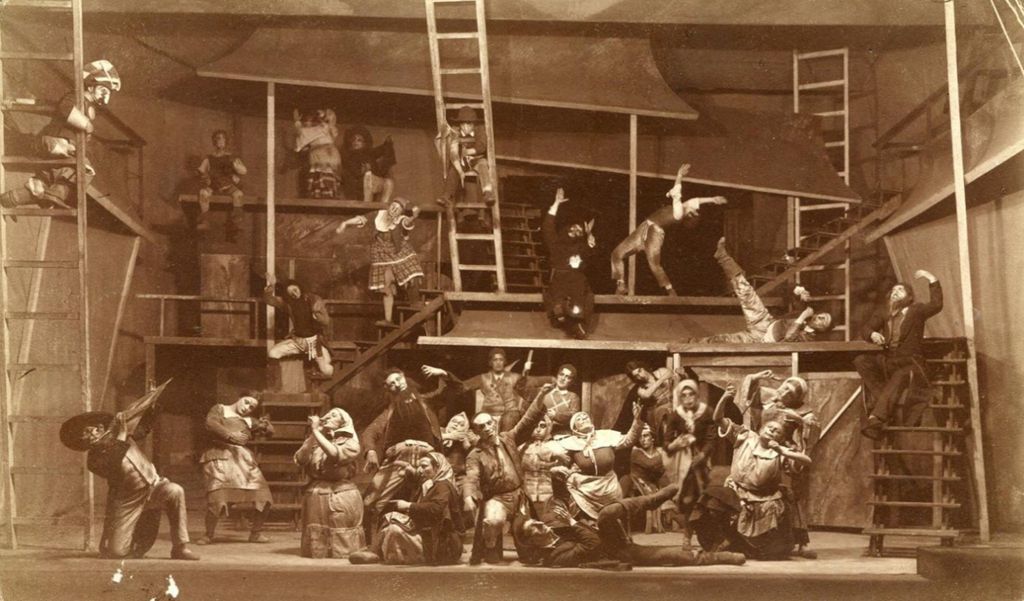
Circus imagery had occupied Chagall long before the Watergate project. Centre Pompidou traces it from an Acrobat of 1914 through the spectacular 1920 decorations for the Moscow State Jewish Theatre, where musicians, actors and disguised bodies formed a theatrical procession.[5] The circus entered a broader practice of collapsing visual art, stage and communal performance.
Ambroise Vollard intensified that engagement in 1927. After evenings with Chagall at the Cirque d’Hiver, the dealer proposed a circus project, and Chagall produced a cycle of nineteen gouaches.[4] Acrobats, clowns and riders emerge from deep grounds as unstable, luminous presences rather than documentary records of individual acts.
Centre Pompidou’s smaller Le Cirque carries the unusual creation range 1922–44, recording Chagall’s return to an earlier circus canvas across decades.[11] That object makes revision part of the theme’s history: circus imagery did not simply recur in new works but could remain materially open long after its first conception.
The official chronology places this work beside Chagall’s Fables and his developing relationship with Bernheim-Jeune.[10] Circus imagery therefore grew within a period of sustained work across books, prints, gouache and painting, not as a late decorative diversion.
The performer as an image of the artist
The circus performer offered Chagall a body trained for imbalance. Trapeze artists and riders depend on physical discipline while presenting danger as apparent ease. In The Blue Circus, the acrobat’s poised extension makes risk visible without recording the labour needed to control it.
The Nice museum describes Chagall’s circus as a stage of humanity in its fantasy, joy and sadness.[9] Another museum account calls the saltimbanque a figure of the universal artist.[12] These readings locate creative work inside public exposure: the artist, like the acrobat, must transform preparation and vulnerability into an event for others.
That analogy need not make every circus figure a self-portrait. The horse may carry an attributed autobiographical role, while the acrobat remains her own visual centre.[3] The painting distributes artistic identity among watcher, musician, animal and aerial performer rather than assigning it to one face.
Circus, theatre and Jewish performance
Chagall’s early theatre work prevents the Watergate commission from being read only through Parisian entertainment. The 1920 Jewish Theatre decorations joined Yiddish performance, music, acrobatics and modernist geometry.[5] By 1950, his theatre imagery carried memories of revolutionary Moscow alongside his later work in ballet and French cultural life.
The Watergate setting added another institutional layer: a small postwar London theatre presenting experimental and international repertory.[8] Painted circus and live theatre would have occupied the same room, while Chagall’s imagery connected that room to earlier Jewish performance and to Vollard’s Parisian circus outings.
These histories do not collapse into a single origin. Jewish theatre, commercial circus, ballet and experimental London drama had different audiences and politics. Chagall’s achievement lies in making their visual energies coexist without pretending that they were interchangeable.
A modern-art circus rather than a recorded show
French national circus research places Chagall among modern artists who used circus figures to explore intimate imagination and political concern.[6] His approach differs from the frozen spectacle of a single observed performance. There is no coherent ring, audience, architecture or sequence of acts in The Blue Circus.
Instead, fragments of a circus become a model of how the world might be pictured. Bodies float, species combine and illumination lacks a stable source. The recognisable apparatus of trapeze, horse and drum gives viewers enough structure to enter a scene that then refuses ordinary theatrical continuity.
This refusal should not be mistaken for randomness. The circular movement, diagonal spotlight and calculated colour masses create strong organisation.[2][7] Chagall replaces realistic stage space with a painting that behaves like performance.
Exhibition history and canonisation
Centre Pompidou’s record documents an extensive exhibition history. The painting appeared in Turin in 1953, Basel and Bern in 1956, Brussels in 1957, Hamburg and Munich in 1959, and the major Paris decorative-arts exhibition of that year.[1] Later appearances included Zurich in 1967, the Grand Palais homage of 1969–70 and international presentations of the works received by dation.
This chronology shows how rapidly an unrealised architectural panel became a representative Chagall painting. Repeated retrospective display detached it further from the small Watergate auditorium while strengthening its position within accounts of his late work, colour and music.
Recent catalogues continue that process. Centre Pompidou lists the work in the 2015–16 exhibitions on Chagall and music and in the 2024–25 Albertina and Kunstsammlung Nordrhein-Westfalen retrospective.[1] Its reception now moves between circus, music, monumentality and general career surveys.
The German-language Albertina presentation names it Der blaue Zirkus and retains the 1950–52 range, while the Museo Thyssen-Bornemisza’s 2012 retrospective records the same oil-on-linen support, dimensions, ownership and Nice deposit.[13][14] Agreement across French, German and Spanish museum records strengthens the object identity while showing how its translated title circulates internationally.
From the artist’s collection to the French state
The Nice museum states that Chagall kept The Blue Circus and The Dance until his death.[2] Centre Pompidou records acquisition by dation in 1988, bringing the canvas into the national collection under inventory AM 1988-84.[1] The route is concise but significant: unrealised theatre decoration, artist-held work, then public collection.
The work’s deposit in Nice places it near the Biblical Message cycle and other evidence of Chagall’s engagement with monumental and spiritual environments. That setting can encourage sacred readings of the circus, but institutional proximity is not proof that the painting belongs to a biblical programme.
Its public life instead demonstrates how Chagall’s categories overlap. A circus panel can be theatrical, musical, architectural and autobiographical at once while remaining materially distinct from stained glass, Bible paintings and stage sets.
What the evidence does not establish
No public work-specific technical report was found that identifies pigments, ground, underdrawing or later treatment for The Blue Circus. Conservation findings from other Chagall paintings cannot be transferred automatically to this canvas. The secure material description remains oil on linen canvas, with the dimensions and inscription recorded by the owner.[1]
The public Watergate archive description proves that extensive theatre records survive, but it does not digitise correspondence or accounts for Chagall’s commission.[8] Museum sources establish the intended setting and failed installation more securely than the exact contractual or financial sequence.
Interpretations of colour and hybrid animals also require attribution. Museums describe the horse as an artist-double and green as associated with love, but the painting does not provide a universal code for every Chagall horse, fish or moon.[2][3] Close looking should remain open where documentation stops.
Why The Blue Circus remains distinctive
The painting joins a specific postwar commission to motifs developed across four decades. Watergate supplied the intended room; the Jewish Theatre and Vollard projects supplied earlier models of performance; southern France and Mediterranean colour altered the atmosphere; museum circulation transformed an unrealised decoration into an autonomous canonical work.
Its visual argument remains concentrated in the centre it leaves empty. Acrobat, horse, fish, moon and musicians turn around a pause that no figure possesses. The circus becomes neither simple celebration nor tragic allegory, but a structure in which risk, colour, music and silence remain active together.
That complexity justifies treating The Blue Circus as more than one example in a survey of Chagall’s paintings. Its commission, scale, institutional history and long exhibition record make it a distinct object whose apparent fantasy rests on carefully organised relationships.
Discussion
Which piece of evidence most changes the way you read The Blue Circus?
Reader Insights
Which visible detail most changes your reading of The Blue Circus?
How do medium, setting and documented history shape the encounter?
What remains uncertain when documented fact is separated from interpretation?
Join the Conversation
Share your reading of The Blue Circus below.
References
- Centre Pompidou, “Le cirque bleu”
- Musée national Marc Chagall, “Le Cirque bleu”
- Official Marc Chagall catalogue, “The Blue Circus”
- Official Marc Chagall catalogue, “Vollard Circus: Clown with White Horse”
- Centre Pompidou, Didier Schulmann, “L’Acrobate”
- Bibliothèque nationale de France / Centre national des arts du cirque, “Cirque et arts plastiques”
- Panorama de l’art, “Le Cirque bleu”
- University of Bristol Theatre Collection, Watergate Theatre archive record
- Musée national Marc Chagall, Chagall: les années vencoises press dossier
- Official Marc Chagall biography
- Centre Pompidou, “Le Cirque”
- Musée national Marc Chagall, “L’Acrobate”
- Albertina Museum, “Chagall”
- Museo Nacional Thyssen-Bornemisza, “Chagall” retrospective