


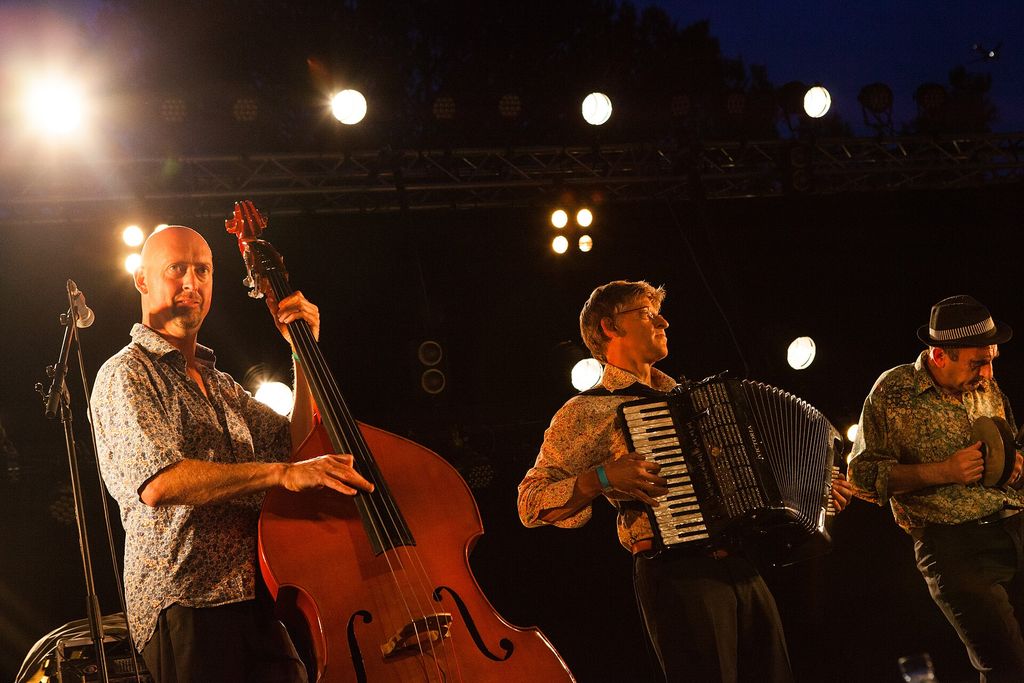
 by Tom Gurney
Tom Gurney BSc (Hons) is an art history expert with over 20 years experience
Page Created on September 22, 2026 / Page Updated on September 22, 2026
Email: tomgurney1@gmail.com / Phone: +44 7429 011000
Introduction
Marc Chagall’s The Fiddler makes music physically larger than the town around it. A monumental violinist balances between roof and rising ground, dressed in a long patchwork coat and playing above small houses, trees and figures. Snow, dark sky and tilted architecture evoke Vitebsk, while fractured planes and intense colour belong to Chagall’s encounter with Parisian modernism.
The work dates from 1912–13 and belongs to the Dutch State, in the care of the Stedelijk Museum Amsterdam. It is oil paint on a decorative linen tablecloth woven with blue cotton threads, not on conventional artist’s canvas.[2][3] The current painted support measures 189 by 158.5 centimetres; larger published dimensions of 196.5 by 166.5 centimetres appear to include framing or the full object assembly.[2]
Keeping those records separate prevents a conservation measurement from being confused with a display measurement.
At a Glance
- ArtistMarc Chagall
- ArtworkThe Fiddler
- Artistic contexttwentieth-century modern art
Contents
- A musician too large for the town
- Fiddler, musician or klezmer?
- Jewish music without a literal wedding
- Cubism does not silence the tune
- A tablecloth becomes the support
- The woven grid entered the composition
- No conventional ground
- What infrared revealed
- Pigments, bronze and the white coat
- A surface changed by lining
- Paris, Amsterdam and the Regnault collection
- Willem Beffie and what the 1914 records prove
- From Chagall’s fiddler to Broadway
- The Concert in 1957: from solo figure to ensemble
- Painting, magazine lithograph and edition evidence
- Looking at The Fiddler as an object
A musician too large for the town
The fiddler dominates the vertical canvas. One foot rests on a roof or building edge, the other on a rounded hill that rises unnaturally towards him. His white coat occupies much of the centre; black-and-coloured passages divide it into broad planes.
A pale face turns towards the violin, while instrument and bow establish a strong diagonal across the upper body.
Below and beside him, houses contract into small geometric units. A church or tower rises among them. Figures and animals are dispersed through the ground, and a tree reaches into the dark field.
The differences in scale prevent the town from functioning as ordinary landscape. Music becomes the organising body around which place is assembled.
The Stedelijk interprets the work as a memory of Russia made soon after Chagall moved from Saint Petersburg to Paris, with Cubist flattening and non-traditional perspective joining remembered houses to his new surroundings.[1] A Russian-language account from ICOM Belarus makes the same Paris/Vitebsk conjunction visible to a regional audience.[9]
Memory, however, should not be mistaken for vagueness. Roof, hill, clothing, violin and bow are carefully positioned. Chagall does not dissolve Vitebsk into atmosphere; he makes its architecture answer the physical rhythm of the musician.
Fiddler, musician or klezmer?
English commonly calls the work The Fiddler, French records use Le Violoniste and some catalogues use Le Musicien. Each title shifts emphasis. “Violinist” names an instrument, “musician” a profession, while “fiddler” evokes vernacular performance and later popular culture.
The figure is often called a klezmer. Historically, klezmer came to designate a professional instrumentalist, from the Hebrew words for musical instruments or “vessels of song”. Jewish musician guilds could raise occupational status, and ensembles developed specialised repertories for weddings and other communal occasions.[7]
The violin often carried the principal melodic line, accompanied by instruments such as a second violin or viola, bass, flute, clarinet and tsimbl. At weddings, musicians worked with the badkhn, the master of ceremonies and verbal performer, to guide movement between solemn preparation, weeping, procession and dance.[7][8]
This history gives Chagall’s figure social substance. He is not merely a universal symbol of artistic inspiration. He recalls skilled, paid musicians whose work organised communal time.
Yet the canvas shows no complete ensemble or documented ceremony, so “klezmer violinist” remains a contextual identification rather than an ethnographic inventory.
Jewish music without a literal wedding
The old East European Jewish wedding became a powerful cultural image because it joined contract, family, religious practice, public emotion, theatre and music. YIVO notes that artists and writers increasingly represented it in the late nineteenth and twentieth centuries as a distinctive world undergoing change.[8]
Chagall’s musician can summon that world without depicting bride, groom and canopy. His scale conveys the reach of performance beyond one event. Music crosses rooftops, houses and religious boundaries; it is public even when the performer appears alone.
It is tempting to assign each colour or architectural element a fixed ritual meaning. The painting does not support such a code. The fiddler’s white coat may create luminosity and visual mass before it signifies purity; the roof may be a precarious stage before it becomes a metaphor for Jewish survival.
Nor should the church-like tower be ignored. Vitebsk was a mixed city where Jewish life existed beside Orthodox and Catholic institutions. The violinist’s enlarged body overlays that shared but unequal urban space.
He is not isolated in a sealed, picturesque shtetl.
Cubism does not silence the tune
Chagall arrived in Paris during a period of rapid experiment and worked at La Ruche among artists and poets associated with the École de Paris. He encountered Cubism, Fauvism and the colour structures of Delaunay, while exhibiting at the Salon des Indépendants in 1912 and 1913.[10]
In The Fiddler, angular planes divide the coat, shoe, roof and ground. Perspective flattens so that the musician’s feet can rest on discontinuous supports. Houses stack rather than recede.
LACMA identifies both Cubist structure and Fauvist colour while stressing the work’s continuing relation to Chagall’s cultural roots.[11]
The picture does not analyse violin and body into Cubist facets until their identity disappears. Instrument, bow, face and town remain readable. Chagall uses fragmentation to intensify performance: the body can occupy several spatial systems because music already exceeds an ordinary standing pose.
This selective modernism matters. Describing the work simply as folk memory misses its formal ambition; calling it Cubist without qualification erases the musician’s social and cultural specificity. Chagall makes each pressure alter the other.
A tablecloth becomes the support
Technical examination established that the painting is carried by a decorative tablecloth: linen crossed by blue cotton threads, woven at approximately 17.6 threads per centimetre horizontally and 20.4 vertically. It has no supplier’s mark and is a non-standard format.[2] The present stretcher and stretching are probably not original, though original tacking margins survive.
The material confirms Chagall’s limited means in Paris and his willingness to paint on what was available. It also brings domestic textile into a monumental artwork. The cloth had been made to cover a table, absorb wear and organise shared space; Chagall turned it upright and made it hold a public musician.
A compelling story says that Bella Rosenfeld gave Chagall this tablecloth as a parting gift before he left Vitebsk. The technical study cites the account but states plainly that no proof identifies this particular cloth as Bella’s gift.[2] Dutch public broadcasting likewise presents it as a possibility.[4]
The distinction is essential: the tablecloth is material fact; Bella’s ownership is biographical hypothesis.
Even without proven personal origin, the support carries associations of domestic life and eastern European weaving into the Paris studio. Those associations arise from use and manufacture, not from a romantic ownership story alone.
The woven grid entered the composition
The tablecloth was not merely hidden beneath paint. Transmitted light and X-radiography show its blue grid clearly, and Chagall followed that grid when constructing the checkerboard pattern beside the violinist’s shoulder.[2][3] The available textile helped generate visible architecture.
This finding changes the relation between form and necessity. Poverty may explain why Chagall chose the cloth, but material constraint became a compositional resource. The regular weave offered lines; he answered them with houses and checks.
Modernist geometry emerges partly from an ordinary patterned object.
The grid also complicates the boundary between Vitebsk and Paris. A type of household textile associated with his eastern European world supports a painting made within the Paris avant-garde. Its pattern becomes a device for flattening and organising pictorial space.
The blue threads are most visible where paint is thin or absent. They remind viewers that some lines belong to weaving before they belong to drawing. Looking closely, one sees image and support collaborate rather than a painted scene placed on a passive surface.
No conventional ground
Unlike later paintings prepared with an opaque ground, The Fiddler has no traditional ground layer. Researchers found evidence for a possible very thin sizing containing zinc white, but paint often meets or leaves exposed the textile directly.[2] The cloth’s colour and structure therefore participate in the final image.
Chagall worked systematically despite the appearance of improvisation. He drew the composition, laid in principal areas of the central figure and painted backgrounds around them. Narrow unpainted borders remain between major colour blocks.
In transmitted light they form bright contours around the musician and surrounding shapes.[2]
Paint layers are often thin, while selected details carry more body. Fine brushes create small marks against smoother fields. This difference helps the large coat remain legible without becoming an even wall of colour.
The method makes the figure seem cut into the painting while allowing the tablecloth to breathe through it. Lightness is partly the absence of coverage. Chagall’s economy is optical as well as financial.
What infrared revealed
Infrared reflectography recovered underdrawn elements that Chagall did not complete in paint. One small figure wears dotted trousers and raises outstretched arms towards something in a tree. Chickens also appear in the hidden or partly suppressed planning.[2][3][4]
These forms belong mainly to the background rather than to a radically different first composition. That pattern fits the broader technical finding: Chagall planned central figures firmly and made more adjustments around them.[2] The monumental fiddler was structurally stable while the town and its incidents remained negotiable.
The abandoned figure matters because it reveals decision. The visible emptiness near the tree is not evidence that nothing was imagined there. Chagall reduced narrative detail to preserve the musician’s dominance or clarify the composition.
Technical imaging therefore resists the myth of an entirely spontaneous visionary. Chagall drew, evaluated and withheld. The painting’s apparent irrationality rests on selection.
Pigments, bronze and the white coat
Analysis found a broad early twentieth-century palette. The official Chagall materials project identifies lead white, ultramarine blue, cadmium yellow, vermilion and Véronèse or emerald green in relation to The Fiddler.[5] The technical table also records zinc chromate yellow, synthetic alizarin, cobalt blue, viridian, carbon black and yellow ochre among identified materials.[2]
An unusual bronze-coloured paint appears on the upper-left house and in the halo-like area above the musician. It was not fully analysed, but researchers compare it cautiously with metallic-looking paints in To Russia, Donkeys, and Others and Homage to Apollinaire.[2] The effect belongs to material experimentation, not necessarily a sacred halo.
Pure black occurs in houses, feet and background. Elsewhere Chagall often constructed dark tones by mixing colours rather than relying on black pigment.[2] The distinction gives the painting a variable darkness: some passages absorb strongly, while others vibrate through chromatic mixture.
Samples from the coat contain drying oil, proteins and extenders including barium sulphate and gypsum. Beeswax and natural resin are attributed to later wax-resin treatment.[2] Conservation residues must not be mistaken for Chagall’s original recipe.
A surface changed by lining
The painting was formerly lined or impregnated with wax and resin. That old lining has been removed and the work now has strip lining, but absorbed treatment material remains.[2] The intervention helped stabilise an unusually loose and fragile support while changing its optical character.
Researchers conclude that wax-resin made thin bright passages and exposed cloth darker and more saturated. These were precisely the areas on which early works such as The Fiddler depended.[2] The original appearance was probably lighter, less greasy and more matte than the canvas now looks.
This material history affects interpretation. The contrast between white coat, dark ground and coloured detail may now be stronger or denser in reproduction than Chagall first intended. “Mystical darkness” can partly be conservation history.
The loose tablecloth weave also makes travel and handling consequential. It was not designed to carry a large oil painting through repeated loans. The support’s survival depended on later structural interventions that preserved and altered it at once.
Paris, Amsterdam and the Regnault collection
The Fiddler, Self-Portrait with Seven Fingers and Maternity formed a group of early works that circulated in 1914 through Paris, the Amsterdam artists’ society De Onafhankelijken and Chagall’s Der Sturm exhibition in Berlin.[2][10] This route placed his Paris-made Russian imagery within international modernist networks just before war prevented his return west.
Willem Beffie and what the 1914 records prove
The technical study adds an owner missing from a compressed Regnault-to-State narrative. After the three early paintings appeared with De Onafhankelijken in Amsterdam, collector Willem Beffie bought them. They remained outside public view in his growing collection until their sale to Pierre Alexandre Regnault in 1930.[2]
Beffie therefore forms the documented bridge between the 1914 exhibition and Regnault’s later group.
This correction matters because “shown in Amsterdam” and “acquired in Amsterdam” describe different parts of the object’s life. The exhibition introduced the canvas to a Dutch audience; Beffie’s purchase moved it into private custody; Regnault’s acquisition and long Stedelijk loan later returned it to public view.
The original catalogue for Chagall’s twenty-sixth Der Sturm exhibition in Berlin has now been digitised by Heidelberg University Library. Its surviving contents include Apollinaire’s “Rotsoge”, reproductions of Paris Through the Window and The Cattle Dealer, and a section of watercolours and drawings.[13] The catalogue proves the exhibition and its literary framing, but its online contents do not identify The Fiddler by title.
That absence does not overturn the technical study’s reconstructed route, which draws on exhibition and collection research beyond two reproduced works. It does require precise wording. The three canvases travelled through the 1914 exhibition network according to the Stedelijk-led study; the surviving Der Sturm catalogue independently confirms Chagall’s Berlin show, not a complete object-by-object checklist for The Fiddler.
The Der Sturm digital source edition describes its catalogue project as a continuing effort to transcribe and identify works, artists and places through structured data.[14] This is a reminder that exhibition history can change as page-level catalogues are indexed. A reproduced object, a listed title and a work inferred from shipping or ownership records are different grades of evidence.
Pierre Alexandre Regnault, whose fortune came from manufacturing paint, bought the three paintings in 1930 and soon placed them on loan at the Stedelijk. In 1935 they travelled to the Netherlands Indies for a year-long display of his collection. During the Second World War they were stored in a bunker in the dunes near Castricum.[2]
In 1953 Regnault gave the early Chagalls to the Dutch State on terms that kept them at the Stedelijk. The museum’s director Willem Sandberg regarded them as central works that attracted substantial public attention.[2][6] State ownership and museum care explain differing collection labels.
MoMA’s 1946 retrospective already treated the early violinist as part of the core American account of Chagall’s development, while documenting related musician imagery across later decades.[12] The canvas’s status was therefore established internationally before the Dutch State gift formalised its long-term Amsterdam home.
The painting’s history of repeated movement is material, not merely administrative. Travel, rolling or vibration and changing climates can affect a loose textile, thin paint and fragile boundaries. Provenance and conservation cannot be separated.
From Chagall’s fiddler to Broadway
Chagall returned repeatedly to elevated musicians, including the later Green Violinist of 1923–24.[11] Repetition changed colour, scale and architecture while retaining the musician as mediator between town, ceremony and imagination.
The 1964 musical Fiddler on the Roof made the image globally familiar. Its title and original visual conception drew on several Chagall paintings rather than functioning as a stage adaptation of this one canvas. The musical came more than fifty years later and belongs to reception history.
That afterlife can distort the earlier painting by making the roof an instantly legible metaphor for “tradition”. Chagall’s musician existed before Tevye’s Broadway world. The canvas contains no lyric, named village of Anatevka or explicit story of arranged marriage and emigration.
The connection remains historically powerful because both works use performance to negotiate continuity and change. But influence runs from Chagall’s recurring imagery to the musical, not backwards from the musical into the 1912–13 picture.
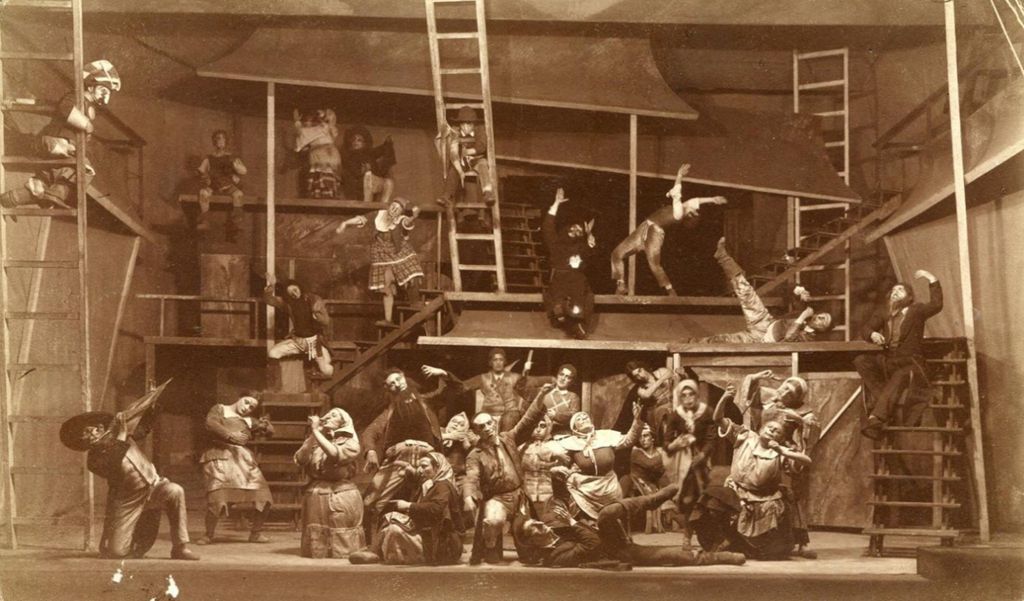
The Concert in 1957: from solo figure to ensemble
The legacy page's Concert is a documented but privately held oil painting, not another title for The Fiddler. A scholarly survey of Chagall's musical images records A Concert as a 1957 oil on canvas measuring 140 by 239.5 centimetres and in a private collection.[15] The panoramic width alone distinguishes it from the upright 1912–13 tablecloth canvas in Amsterdam.
Its organisation also changes the musical argument. The study identifies a large group of string, wind and percussion players, a directing figure and music stands, describing an ensemble closer to a symphonic orchestra than a single village musician. Humans, animals and birds participate together; it specifically notes a goat with a violin, a winged bird-beaked animal and a human-cello among the players.[15]
The picture makes music a collective environment rather than the act of one monumental fiddler.
The legacy description correctly recognises Paris, lovers, water and a gathering of musicians, but then turns each animal into a fixed autobiographical sign. The available scholarship supports a mixed orchestra and Chagall's long musical repertoire; it does not establish that a fish must commemorate his father's work or that every fiddler represents a particular Vitebsk ceremony. Motif, instrument and compositional role should be described before symbolic biography.
Chronology further alters the comparison. The Fiddler belongs to Chagall's first Paris period, when a poor artist reused domestic cloth and tested fractured space at near-monumental scale. The Concert was made after exile, return to France and settlement in the south, during a decade of ceramics, Bible printing, theatre and large decorative ambitions.
The official Chagall research site describes music as a career-long concern extending through Jewish theatre, ballet, opera and public commissions, rather than a motif confined to youthful memory.[16]
The later painting therefore belongs in this article as a transformation of musical space, not as a subordinate illustration. A vertical figure who seems to generate the town's rhythm becomes, forty-four years later, a wide field in which lovers, Paris and heterogeneous performers share the music. The comparison reveals continuity of violinist, hybrid body and altered gravity, alongside a decisive shift from solitary scale to collective orchestration.
Painting, magazine lithograph and edition evidence
The title Le Concert also names a 1957 lithograph, and the two objects must not be merged. Goldmark records an original, unsigned 38 by 56 centimetre lithograph printed by Arte Aimé Maeght and issued as a centrefold.[19] It is a work on paper with its own publishing history, not a small version of the private oil whose medium and dimensions can be silently transferred.
The publication context is Derrière le miroir nos. 99–100. Maeght's own record states that the 1957 issue accompanied an exhibition of twenty-two Chagall paintings, comprised sixteen unbound pages and included seven original colour lithographs, two double-page, plus three in black.[17] That evidence joins painting, exhibition and printmaking without implying that every image in the magazine was an original lithograph of the same kind.
Toledo Museum of Art's second-edition copy provides a useful material check. Its catalogue distinguishes four original colour lithographs from line-block reproductions of drawings and photolithographs of paintings, and separately records letterpress text and cream wove paper.[18] Edition and catalogue descriptions can therefore vary in count and process; a detached sheet needs identification through the complete issue, printer and catalogue, not through the familiar title alone.
This distinction matters to migration and collecting alike. An online image labelled The Concert, 1957 may reproduce the large private painting, a magazine photolithograph or an original lithographic centrefold. Date and composition do not settle medium.
The secure account keeps the 140 by 239.5 centimetre oil, the 38 by 56 centimetre lithograph and the multi-process Maeght publication as related but separate records.[15][17][18][19]
The legacy route is therefore best absorbed into The Fiddler. Its valuable subject is the development of Chagall's musical imagery, while its unsupported fixed symbols and undifferentiated object language need correction. A separate page would depend mainly on a private painting for which a public provenance, signature record, exhibition chain and technical dossier have not been located.
Looking at The Fiddler as an object
Begin with scale. Compare the musician’s feet to roofs and hill, then trace the instrument’s diagonal through his body. Ask how balance is achieved when ordinary perspective has been withdrawn.
Next separate music history from generic symbolism. A Jewish professional violinist could guide wedding emotion and communal movement. That context gives the figure cultural weight without proving a particular ceremony.
Then search for the tablecloth. The blue grid beneath and beside the paint is part of the composition. Architecture follows weaving; unpainted borders create light; hidden figures show revision.
The support is active evidence.
Finally, remember that the present surface has been treated. Wax-resin changed the very exposed cloth and thin bright layers Chagall used to make the painting breathe. Looking historically requires imagining a lighter, more matte object without pretending that its exact original appearance can be recovered.
The Fiddler does not merely place a musician above Vitebsk. It builds his town from domestic textile, Parisian geometry, professional Jewish music and revised drawing. The figure becomes monumental because all those structures meet beneath his bow.
Discussion
Which piece of evidence most changes the way you read The Fiddler?
Reader Insights
Which visible detail most changes your reading of The Fiddler?
How do medium, setting and documented history shape the encounter?
What remains uncertain when documented fact is separated from interpretation?
Join the Conversation
Share your reading of The Fiddler below.
References
- Stedelijk Museum Amsterdam, “Le Violoniste”, View Source
- Meta Chavannes et al., “Marc Chagall’s Painting Materials and Technique: Nine Paintings from the Stedelijk Museum Amsterdam”, 2019, View Source
- Stedelijk Museum Amsterdam, “5-year Marc Chagall research project reveals new discoveries in his paintings”, View Source
- AVROTROS, “Hoe een tafelkleed een meesterwerk werd”, View Source
- Marc Chagall official website, “The Fiddler (1912–1913)”, View Source
- Rijksdienst voor het Cultureel Erfgoed, “Regnault in het Stedelijk Museum Amsterdam”, View Source
- YIVO Encyclopedia of Jews in Eastern Europe, “Traditional and Instrumental Music”, View Source
- YIVO Encyclopedia of Jews in Eastern Europe, “Weddings”, View Source
- ICOM Belarus, “Скрипач”, View Source
- Musée national Marc Chagall, “Biography of Marc Chagall”, View Source
- Los Angeles County Museum of Art, Chagall: Fantasies for the Stage — Evenings for Educators, View Source
- Museum of Modern Art, Marc Chagall, 1946, View Source
- Galerie Der Sturm, Marc Chagall: sechsundzwanzigste Ausstellung (1914), digitised by Heidelberg University Library, View Source
- DER STURM: Digitale Quellenedition zur Geschichte der internationalen Avantgarde, “STURM-Kataloge”, View Source
- L. G. Safiullina and G. I. Batyrshina, “Musical Images as a Reflection of the Artistic Universalism of Marc Chagall”, Terra Sebus, special issue, 2014, View Source
- Archives & Catalogue raisonné Marc Chagall, “Music”, View Source
- Maeght, “Derrière Le Miroir n°99-100”, View Source
- Toledo Museum of Art, “Derrière le miroir: Chagall (Numéros 99-100, Juillet-Août 1957)”, View Source
- Goldmark Gallery, “Marc Chagall: Le Concert”, View Source