


 by Tom Gurney
Tom Gurney BSc (Hons) is an art history expert with over 20 years experience
Page Created on September 22, 2026 / Page Updated on September 22, 2026
Email: tomgurney1@gmail.com / Phone: +44 7429 011000
Introduction
Marc Chagall began making stained glass when he was almost seventy and turned it into a defining medium of his final three decades. More than seventy windows for fifteen religious and civic buildings carried his art beyond the portable picture and into architecture. Synagogues, Catholic and Protestant churches, a hospital, the United Nations and his purpose-built museum in Nice required different subjects and forms of address. What joins them is an investigation of coloured light as a material that changes with place, weather, season and time.[1]
These works also demand a more exact account of authorship than the familiar phrase “a Chagall window” suggests. Chagall made drawings, gouaches, collages, maquettes and cartoons, chose themes and supervised colour. Specialist glassmakers—including Paul Bony at Plateau d’Assy and, from the Metz commission onwards, Charles Marq and Brigitte Simon of the Atelier Simon in Reims—selected, cut, etched, painted, fired and leaded glass capable of translating those designs into durable structures. The windows are neither reproductions of paintings nor anonymous craft objects. They are collaborative works in which conception, material intelligence, architectural setting and transmitted light cannot be separated.
At a Glance
- ArtistMarc Chagall
- SubjectMarc Chagall Stained Glass Windows
- Artistic contexttwentieth-century modern art
- Art formStained glass
Contents
- Why glass changed Chagall’s art
- Plateau d’Assy: the first windows
- The Simon–Marq partnership
- Metz Cathedral: scripture in a layered building
- Jerusalem: the twelve tribes
- The United Nations Peace Window
- Pocantico Hills: patronage and family memory
- Tudeley: a complete memorial environment
- Chichester: Psalm, patron and one red window
- Sarrebourg: La Paix closes an absent nave
- Reims: restoration and French history
- Fraumünster, Zurich: six windows
- Mainz: reconciliation and its limits
- Nice: an artist-designed museum
- Chicago: civic glass and conservation evidence
- Smaller commissions and conservation histories
- How to read a Chagall window in place
- An architecture of changing colour
Why glass changed Chagall’s art
In an oil painting, coloured pigment reflects light from an opaque surface. Stained glass filters daylight through material colour and projects it into a building. A blue passage can tint stone, floor, furniture and visitors; a cloud can temporarily extinguish it; low evening light can disclose details that disappear at noon. The wall is part of the work. Mullions and armatures set intervals, while lead lines must both hold the glass and draw within the composition.
Chagall’s earlier art had already loosened colour from descriptive duty. A face could be green, a horse red and a village blue because colour carried emotional and structural force. Glass gave that independence a physical basis. Yet it imposed resistance. Curves had to be divided into pieces that could be cut and supported; tonal modelling required glass paint; intense colours could become opaque when layered too heavily. The mature windows emerged from repeated negotiation between painterly impulse and material constraint.
The official catalogue distinguishes laminated glass, acid-etched glass, grisaille painting and leading among the procedures used in Chagall’s work.[1] Acid etching could remove a thin coloured layer and disclose a paler or contrasting field without another lead boundary. Grisaille—pigment fired onto glass—supplied contour, shadow, inscriptions, faces and feathers. Leading joined pieces into panels and became a graphic network. These procedures explain why a watercolour design and an installed window may share a composition while producing different visual experiences.
Plateau d’Assy: the first windows
Chagall’s first two windows were made in 1956–57 for the baptistery of Notre-Dame-de-Toute-Grâce at Plateau d’Assy with Paul Bony. The Angel with the Candlestick and The Angel with the Holy Oils formed part of a larger ensemble with the ninety-tile ceramic Crossing of the Red Sea and two marble reliefs based on Psalms 124 and 42.[2]
The commission belonged to the post-war renewal of sacred art promoted by Dominican priest Marie-Alain Couturier and Canon Jean Devémy. Maurice Novarina’s church gathered works by Fernand Léger, Jean Lurçat, Germaine Richier, Georges Rouault, Henri Matisse, Georges Braque, Jacques Lipchitz and others rather than requiring conformity to one confessional style. The French heritage register describes the entire church as an ensemble of modern painting, sculpture and glass protected as a historic monument.[3]
Assy was both a beginning and a model. Chagall discovered that several media could make one environment and that an artwork could take meaning from ritual location. Angels associated with the baptistery’s vessels, water and passage imagery connect bodily entry into a Christian community with Israel’s crossing of the sea. The setting also introduces a recurring interpretive question: how should a Jewish artist’s work in a Christian building be read without suppressing its Jewish sources or treating every image as uncomplicated interfaith harmony?
The Simon–Marq partnership
Chagall met Charles Marq and Brigitte Simon, directors of the historic Atelier Simon in Reims, in the late 1950s while developing windows for Metz Cathedral. The official chronology says that they addressed problems created by the intensity of his colour and the translation of his 1959 maquettes.[4] Their partnership extended across most later cycles.
The process moved between scales. An initial drawing fixed a broad relation of figures, colour and architecture. Gouache, pastel and collage approximated opacity and the interruption of lead. Full-size cartoons clarified boundaries. In the workshop, sheets were chosen for hue, thickness, bubbles and striations. Pieces were cut and sometimes etched; grisaille and enamels were fired; panels were leaded, reinforced and installed. Chagall visited, worked directly on designs and evaluated samples, while Marq and Simon made innumerable judgements no small maquette could settle.
Preparatory works make this reciprocal method visible. A 2024–25 Rockefeller Archive Center exhibition assembled twenty-seven mixed-media studies for Pocantico Hills, tracing movement from pencil or ink ideas to coloured maquettes in which Chagall anticipated sunlight passing through glass.[5] The evidence cautions against attributing every material decision to Chagall alone or reducing his role to an image mechanically executed by others. “Designed by Chagall and realised with the Simon–Marq workshop” is often the most accurate formula.
Metz Cathedral: scripture in a layered building
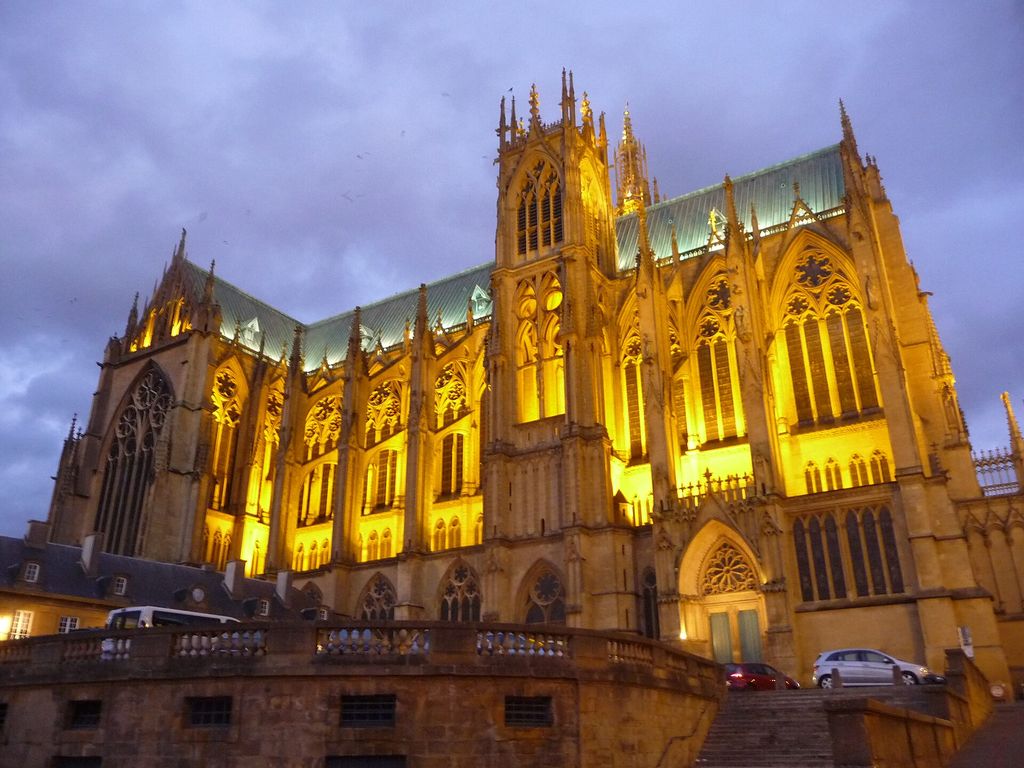
Metz was Chagall’s first sustained collaboration with Marq and Simon. Work began with maquettes in 1959, and the diocesan history dates his Old Testament glazing to 1962–69.[6] The cathedral already contained glass from the thirteenth to the twentieth century, including modern work by Roger Bissière and Jacques Villon. Chagall entered a building whose windows register successive campaigns, war damage, restoration and Lorraine’s changing political history.
Episodes from Genesis and Exodus unfold within specific stone openings. Figures appear inside blue, red, yellow and green fields, but the lead network prevents colour from becoming a seamless wash. Scale changes and floating bodies recall Chagall’s painting; the armature gives them a new discipline. Hebrew scripture occupies a Catholic cathedral without losing its textual origin.
That placement complicates claims about “universal spirituality”. Chagall could address a Christian commission through narratives shared, but differently interpreted, by Jewish and Christian traditions. The result encourages connection, yet the histories are not interchangeable. Metz is most revealing when its institutional setting, Biblical material and the artist’s Jewish formation remain simultaneously visible.
Jerusalem: the twelve tribes
The twelve windows for the Abbell Synagogue at the Hadassah–Hebrew University Medical Center, Ein Kerem, were displayed in Paris and at New York’s Museum of Modern Art before Chagall attended their unveiling in Jerusalem on 6 February 1962.[4] Each corresponds to a tribe of Israel and draws principally on Jacob’s blessings in Genesis 49 and Moses’s blessings in Deuteronomy 33. Together they create a ring of coloured light around a synagogue within a hospital.
The scheme required invention because Jewish traditions of sacred representation made a conventional cycle of heroic portraits inappropriate. Animals, plants, ritual objects, hands, Hebrew inscriptions and emblems carry identity. Judah’s lion, Issachar’s ass, Dan’s serpent, Naphtali’s hind and Benjamin’s wolf emerge from the blessings; Joseph’s abundance invites vegetation and fruit. Colour differentiates the lights while binding the ensemble.[7]
The setting matters. Patients, families and medical staff encounter the windows during prayer, illness and recovery. The cycle joins the land of Israel to tribal memory in scripture and diaspora, while its French manufacture and international exhibition history make it transnational. Made less than two decades after the Holocaust and during the first generation of the State of Israel, it bears themes of survival and collective identity without allowing every sign to be converted into a political allegory.
Its physical history resists timelessness. Before the June 1967 war, nine panels had been removed for storage. Shelling damaged one of the three remaining, alongside parts of the hospital.[8] Repair became part of the biography: glass signifying continuity proved vulnerable, removable and restorable.
The United Nations Peace Window
The UN Staff Memorial Committee commissioned the Peace Window after the September 1961 plane crash near Ndola that killed Secretary-General Dag Hammarskjöld and fifteen staff members and peacekeepers. Unveiled on 17 September 1964, the stained-glass and grisaille window measures about twelve by fifteen feet and was realised with Simon and Marq.[9]
A Tree of Paradise anchors people and animals, a mother and child, the tablets of the law, serpent and crucifixion. Musical notation alludes to Beethoven’s Ninth Symphony, which Hammarskjöld admired. The imagery supports themes of peace, sacrifice, creation and fellowship, but the commission prevents it from becoming generic humanitarian decoration. It memorialises specific service and death inside a political institution established to manage conflict.
Unlike Jerusalem or Metz, the UN building is neither synagogue nor church. Scriptural signs address an international civic audience of different faiths and none. Chagall did not eliminate religious imagery to achieve accessibility; he placed it within a broader network of bodies, animals, music and natural growth. The tension between particular symbols and international reception is central to the work.
Pocantico Hills: patronage and family memory
Union Church at Pocantico Hills is a small non-denominational Protestant church connected with the Rockefeller family. Its ten artist-designed windows include Henri Matisse’s rose window commemorating Abby Aldrich Rockefeller and nine by Chagall. The Rockefeller children commissioned Chagall’s large Good Samaritan after John D. Rockefeller Jr died in 1960; after Michael Rockefeller’s death in 1961, the family asked him to design the eight remaining side windows.[10]
The principal memorial adopts the parable of neighbourly aid because the family associated it with Rockefeller’s philanthropy. Later windows include Old and New Testament subjects and Hebrew prophets while commemorating family members. Their proximity to the congregation distinguishes the ensemble from cathedral glass: colour encloses the visitor at almost domestic range.
Patronage belongs to the interpretation. A powerful American family selected two canonical European modernists for a modest country church and used Biblical subjects to shape familial memory. The windows perform worship, commemoration, philanthropy and cultural prestige at once. Preparatory studies preserved by the Rockefeller Archive Center allow unusually close reconstruction of their making.[5]
Tudeley: a complete memorial environment
The east window at All Saints’ Church, Tudeley, Kent, began as a memorial to Sarah Venetia d’Avigdor-Goldsmid, who drowned in a sailing accident in 1963. Commissioned by her parents and installed in 1967, it joins mourning with Crucifixion and Resurrection. Historic England describes a lower blue zone with the girl floating in the sea and mourners, while a predominantly yellow Crucifixion rises above.[11]
The commission expanded. Seven nave and aisle windows were installed in 1974; four predominantly blue chancel windows followed in 1985. Warmer yellows on the south and blues in the north aisle respond to orientation as well as iconography. Irregular frames avoid a rigid grid. Historic England judges the completed programme to be of European importance.[12]
This growth changes the memorial. A particular loss remains at the east end but is absorbed into a building-wide sequence experienced through movement and changing daylight. The completed interior does not erase the accident; it gives grief an architectural duration. Reproducing the east window alone conceals the chromatic relations later established across the church.
Chichester: Psalm, patron and one red window
Chichester Cathedral supplies a useful counterpoint to Tudeley. Dean Walter Hussey first approached Chagall in 1969 after seeing the Jerusalem and Tudeley glass. He renewed the invitation in 1975, and Chagall accepted a commission for a single north-choir-aisle window on the theme The Arts to the Glory of God. Its source is Psalm 150, the closing psalm, which summons trumpet, harp, lyre, timbrel, strings, pipe and cymbals into praise.[20]
The subject suited Hussey's long campaign to commission modern artists and musicians for the Church of England. Chagall did not illustrate the instruments as a catalogue. Musicians, dancers and animal-like bodies move across an intense red field, their rhythms compressed inside a tall Gothic opening. The cathedral identifies Jerusalem as the only other predominantly red Chagall glazing and Chichester as the only example in Britain outside the twelve-window Tudeley programme.[20] That comparison makes colour a historical choice rather than a generic Chagall signature. The red distinguishes this compact, celebratory response from the blues associated with mourning, creation and visionary ascent elsewhere.
Charles Marq's workshop translated the design, and the window was unveiled and dedicated in October 1978.[20] Vava Chagall helped communications across languages, a reminder that the social machinery of a commission extends beyond the two names normally retained by art history. Hussey set the institutional purpose, Chagall devised the image, Marq and the workshop converted it into glass, and the cathedral gave it a liturgical position.
Chichester also corrects the habit of judging importance by size. It is neither a complete building-wide scheme nor part of a group by several modern artists. Its force comes from concentration: one opening, one psalm and one dominant chromatic register. The window asks how much a single modern insertion can alter a historic interior without pretending to remake the whole building.
The Chapelle des Cordeliers at Sarrebourg preserves the choir of a thirteenth-century Franciscan church after the nave was demolished. Pierre Messmer, then mayor of Sarrebourg, commissioned Chagall to close the newly exposed west end with glass. The result, La Paix, was made with Charles Marq at the Simon workshop in 1974–76 and measures approximately twelve metres high by 7.5 metres wide. The city calls it Chagall's largest stained-glass window.[21]
That architectural history is inseparable from the image. La Paix is not simply placed in an opening left by the old building; it forms the luminous boundary that made continued use of the surviving choir possible. A modern artwork therefore performs as enclosure, facade and picture. Its scale can be understood only from inside, where coloured light replaces the material mass that a conventional west wall would have supplied.
The great central composition is accompanied by lateral windows, so the commission is an environment rather than one enlarged panel.[21] The imagery brings together lovers, family, animals, flowers, a village and Biblical signs in a vision of concord. Yet its civic origin and municipal setting distinguish it from the denominational programmes at Metz or Mainz. Peace here is simultaneously a subject, an architectural condition and a public cultural claim in post-war Lorraine.
Sarrebourg also links different monumental media. The city's Chagall route displays Yvette Cauquil-Prince's tapestry La Paix, woven from the maquette connected with the United Nations commission, near the Cordeliers glass.[21] The juxtaposition shows that Chagall's peace imagery was neither fixed to one institution nor translated identically from design to object. Wool absorbs light; glass transmits it. The related works share motifs while their materials produce different kinds of presence.
The fiftieth-anniversary programme in 2026 placed the window beside lithographs after the Hadassah maquettes.[22] Such commemorations can flatten distinct works into a recognisable brand, but they can also make process visible. In Sarrebourg, the museum route permits comparison among paper designs, tapestry and architectural glass and makes the surviving choir's transformation part of local history.
Reims: restoration and French history
Three windows were unveiled in the axial chapel of Notre-Dame de Reims in June 1974. The commission placed modern glass in a cathedral inseparable from French coronations, First World War destruction and decades of restoration. It also brought Chagall into the city of the Simon–Marq workshop.
Chagall described three linked themes: the kings of France, tribes of Israel and Passion of Christ. The right window includes the baptism of Clovis, binding local and national history to the cathedral; other sections join Abraham, Christ and the Tree of Jesse. Blue predominates partly because the new work had to relate to surviving historic glass. In an interview Chagall credited Marq’s chromatic judgement and emphasised the artisans involved in three years of labour.[13]
Reims makes collaboration especially legible. The artist supplied a programme bridging Hebrew genealogy, Christian fulfilment and French monarchy; the workshop translated it beside medieval glass it knew intimately. The work can signify recovery after wartime destruction, but also participates in the cathedral’s institutional account of nation and Christianity. The tribes of Israel do not automatically dissolve those structures.
Fraumünster, Zurich: six windows
Five tall choir windows at the Fraumünster were installed in 1970, followed by the south-transept rose in 1978. Each choir light has a dominant colour and programme. The Prophets window includes Elijah, Elisha and Jeremiah; Jacob shows the ladder and wrestling; the central Christ window develops the Tree of Jesse, parables, Crucifixion and Resurrection; Zion joins the new Jerusalem with David and Bathsheba; and the Commandments window centres on Moses and Isaiah’s vision of peace. The rose turns to Genesis and Noah’s ark.[14]
Vertical architecture structures the imagery. Ladders, trees, ascending figures and stacked episodes conduct the eye upwards without forming a simple chronological strip. Dominant colours distinguish adjacent windows while the choir makes them one field. Jacob’s ladder becomes both narrative motif and analogue for the lancet itself.
Their placement remains essential. Hebrew Biblical figures surround a central Christological programme within a former convent church shaped by the Swiss Reformation. The glass enters histories of Catholic foundation, Protestant worship, tourism and modern civic identity. The later rose extends the ensemble rather than merely supplementing it.
Mainz: reconciliation and its limits
Nine windows for St Stephan’s in Mainz were installed between 1978 and 1985. Pastor Klaus Mayer approached Chagall in 1973 and proposed glass for the east choir of a church heavily damaged during the Second World War. City accounts present the project as Jewish–Christian solidarity and international understanding. Chagall, who never visited Mainz, became an honorary citizen and completed the final design shortly before his death.[15]
Blue light unifies angels and predominantly Hebrew Biblical figures across choir and transept. Charles Marq later made nineteen deliberately simpler windows for the side aisles and west choir, creating an approach to the Chagall ensemble. The city records a twenty-eight-year partnership between Marq and Chagall.[16]
Reconciliation is integral to reception, but the word requires historical weight. Chagall fled Nazi persecution; modern German institutions had labelled his art “degenerate”; Europe’s Jewish communities had been devastated. Calling the windows symbols of harmony without stating that asymmetry turns history into sentiment. Their significance lies partly in a Jewish artist’s Biblical imagery entering a rebuilt German Catholic church, not in a claim that art cancelled preceding violence.
There is a factual caution. Mainz’s English and German materials agree on nine Chagall windows but differ in counting the choir group: one says six for the east choir and three for the transept; the 2023 brochure says five for the choir and three in the transept after the first window. The variation appears to depend on whether the initial installation is counted separately.[15][16] A responsible account preserves the secure total.
Nice: an artist-designed museum
The Musée national Message Biblique Marc Chagall, opened in Nice in 1973, was created for the seventeen large Biblical Message paintings and related gouaches donated to France. Chagall did not treat the building as a neutral container. With architect André Hermant, he helped develop a place combining galleries, garden, library, auditorium and works made in situ.[17]
Three Creation of the World windows, realised by Charles Marq in 1971–72, wrap the auditorium in blue light. Cosmic forms, Adam and Eve and animals connect Genesis with the nearby paintings. The windows share the museum with the Mediterranean Landscape tapestry and exterior Prophet Elijah mosaic, allowing colour, music, stone, water, textiles and glass to interact.[18]
The auditorium clarifies Chagall’s living museum. Concerts activate the space and daylight alters it; the windows address listeners as well as viewers. Creation refers simultaneously to scripture, artistic making and music. This is neither a denominational church nor a neutral gallery, but an environment built around Chagall’s Biblical art, sponsored by the French state and shaped by the artist.
Chicago: civic glass and conservation evidence
The America Windows at the Art Institute of Chicago broaden the survey beyond European religious settings. Chagall presented the work to the museum in 1977, dedicating it to the memory of Mayor Richard J. Daley. Six panels, organised as three large window units and subdivided into thirty-six sections, join music, theatre, painting, literature, family, freedom and the Chicago skyline within a civic meditation on the arts and the United States. They were installed under Charles Marq's supervision and unveiled on 15 May 1977.[23]
The museum context changes the conditions of address. No inherited scripture or rite tells viewers how to move from scene to scene. Recognisable American signs mingle with motifs from Chagall's wider visual vocabulary, including embracing figures, musicians, birds and floating bodies. The dedication to Daley fixes the work within Chicago's contested civic history, while the museum's own interpretation stresses artistic freedom and the city's public culture.[23] The word “America” is therefore a commission-specific proposition rather than evidence that every motif represents a stable national allegory.
The Art Institute's documentation is unusually valuable because it makes translation from maquette to glass concrete. Marq laid transparent paper over Chagall's final gouache to plan the network of cames—the grooved metal strips holding the glass.[24] That overlay converted passages of paint into divisions which could be cut, assembled and supported. The operation was not passive enlargement. Every boundary affected the movement of colour and every structural decision became a drawn line visible in the finished work.
The partnership then revised colour in material form. Chagall and Marq examined glass pieces, adjusted selections and replaced colours where transmission differed from the design. Flashed glass—clear or pale glass bearing a thin layer of strong colour—allowed acid to remove parts of that layer and produce transitions without multiplying lead lines. Chagall applied grisaille directly across assembled sections, working with trace lines, stipples and washes, using tools and fingers and scratching back to bare glass. After firing, the pieces were re-camed and waterproofed with putty.[25] These records justify describing Chagall as physically engaged with the glass while preserving Marq's authority over its fabrication.
Removal and treatment later exposed information the installed windows could not yield. Construction of the museum's Modern Wing created a risk from vibration, so the glass was deinstalled in 2005 for the first time in twenty-eight years.[26] Conservators separated and examined all thirty-six sections. They found grime, oil and residues associated with the original installation, whose arrangement had permitted condensation. Cleaning restored transmission, but investigation mattered as much as appearance: the treatment recorded leads, glass, painted layers and previous assembly at close range.
Scientific analysis added a material vocabulary to the account of colour. X-ray fluorescence identified cobalt in blue glass and chromium and copper in green, while the grisaille contained metal oxides. The fired paint was well attached and showed no general flaking.[27] Such findings cannot tell us what blue “means”, but they prevent interpretation from treating blue as an immaterial emanation. Its effect depends upon chemical colourants, glass thickness, surface paint, light source and the observer's position.
The five-and-a-half-year conservation programme ended with reinstallation in October 2010, and the work was presented in its new location in the following period.[28] Artificial backlighting now provides steadier illumination and protects the windows from some environmental fluctuation, but it also changes their relation to daylight. A window made to modulate an exterior source becomes closer to a continuously lit screen. Conservation thus preserves physical material while altering an important aspect of experience. The change is neither simple loss nor transparent restoration; it belongs to the object's history and should be stated when present viewing is compared with 1977 photographs.
Chicago gives unusually firm answers to questions that remain implicit at many sites: who mapped the lead, how Chagall marked the glass, which pigments survived and why a later installation changed. It also demonstrates why technical research belongs inside interpretation rather than in an appendix. The visible image is the accumulated result of design, workshop translation, firing, architecture, environmental damage, conservation choice and new lighting.
Smaller commissions and conservation histories
Focusing on Jerusalem, Reims, Zurich and Mainz makes Chagall’s glass appear more uniform than it was. The official catalogue counts more than seventy windows in fifteen religious and civic buildings.[1] The sites discussed here identify fourteen commission groups—Assy, Metz, Jerusalem, the United Nations, Pocantico Hills, Tudeley, Chichester, Sarrebourg, Reims, Zurich, Mainz, Nice, Chicago and Le Saillant—but that is not a claim to an object-level catalogue. The current online catalogue raisonné is a developing scholarly resource and does not yet provide a complete public enumeration of the glass corpus.[29] The official total should be retained without inventing a fifteenth site or treating the absence of a public record as evidence of exclusion.
The chapel at Le Saillant in Corrèze has six windows made by Charles Marq between 1978 and 1981. A conservation campaign removed them, exhibited them at the Centre Pompidou-Metz and returned them with protective exterior glazing in 2021.[19] Their intimate chapel scale broadens the story beyond urban monuments.
Stained glass is exposed to movement, condensation, pollution, impact, war and changes in a building envelope. Glass may survive while fired paint loosens, leads fatigue and bars corrode. Cleaning can disclose colour but remove fragile material if poorly judged. Protective glazing changes ventilation and can alter incoming light.
Chagall’s windows already have distinct conservation biographies: Jerusalem suffered shell damage; Le Saillant received protective glazing; Tudeley accumulated over three campaigns; Reims and Metz place modern panels within cathedrals shaped by destruction and restoration. “The original” is therefore more complex than an untouched object. Cartoons, replacement pieces, workshop records, leads, frames and protective systems all supply evidence.
Conservation sharpens authorship. A restorer must distinguish Chagall’s design, the workshop’s materials and fabrication, and later intervention. Workshop documentation is not secondary background: it can establish glass types, paint layers, panel divisions and approved changes that photographs cannot.
How to read a Chagall window in place
Begin with the building. Identify denomination or civic function, patron, memorial purpose, date, architectural position and workshop. Establish whether it is one window, a staged sequence or a complete programme. Check title and count variants against site-owner and catalogue records.
Map imagery to textual and institutional sources. In Jerusalem, tribal animals come from particular blessings; in Reims, French kings and Clovis belong to national history; at Pocantico Hills, the Good Samaritan became a family memorial; at the UN, Beethoven and the tree of life contribute to Hammarskjöld’s commemoration. A floating figure does not mean the same thing everywhere.
Observe material behaviour. Follow lead lines before treating them as outlines. Look for etched transitions and fired grisaille. Notice bubbles, streaks and thickness. Compare changing weather and attend to colour cast on stone and people. A reproduction records an instant and usually suppresses the coloured environment beyond the panel.
Finally distinguish evidence from attractive generalisation. Chagall repeatedly spoke through Biblical subjects, but “spiritual”, “timeless” and “universal” can conceal Jewish specificity, Christian commissioning structures, family wealth, national history or post-war trauma. The strongest interpretations hold those conditions together with the sensory force of colour.
An architecture of changing colour
Stained glass allowed Chagall to retain the mobile figures and scale changes of painting while making architecture, craft and daylight active participants. It carried his Biblical imagination into institutions with sharply different histories. It also made duration visible: clouds pass, the sun changes direction, buildings are damaged, glass is repaired and communities reinterpret the work.
The windows combine immediacy and specificity. They can surround a visitor with blue before any subject is recognised, yet each major cycle arose from a negotiated commission, named workshop, physical building and identifiable history. To call them simply radiant describes only their first effect. Understanding requires the slower work of tracing who made them, for whom, from which texts, in what place and through what subsequent history.
Discussion
Which piece of evidence most changes the way you read Marc Chagall Stained Glass Windows?
Reader Insights
Which visible detail most changes your reading of Marc Chagall Stained Glass Windows?
How do medium, setting and documented history shape the encounter?
What remains uncertain when documented fact is separated from interpretation?
Join the Conversation
Share your reading of Marc Chagall Stained Glass Windows below.
References
- Marc Chagall official website, “Glass in Marc Chagall’s work”, View Source
- Marc Chagall official website, “La mosaïque dans l’œuvre monumental de Chagall”, View Source
- Ministère de la Culture, POP, “Église Notre-Dame-de-Toute-Grâce”, View Source
- Marc Chagall official website, “Biography”, View Source
- Rockefeller Brothers Fund, “Sketching Light: Chagall’s Windows for Union Church”, View Source
- Diocèse de Metz, “Des vitraux remarquables”, View Source
- Hadassah, “Chagall’s Windows: A Source of Light in Dark Times”, View Source
- Hadassah, “1967 Return of Mount Scopus Hospital”, View Source
- United Nations Gifts, “Peace Window”, View Source
- Rockefeller Brothers Fund, “Union Church of Pocantico Hills”, View Source
- Historic England, “The stained glass east window in the Church of All Saints, Tudeley”, View Source
- Historic England, “Church of All Saints, Capel”, View Source
- Marc Chagall official website, “Marc Chagall on his stained-glass windows for Notre-Dame de Reims cathedral”, View Source
- Evangelisch-reformierte Kirchgemeinde Zürich, “Chagall Windows”, View Source
- Landeshauptstadt Mainz, “St. Stephan”, View Source
- Landeshauptstadt Mainz, Magenza: Jewish Mainz, 2023, View Source
- Musée national Marc Chagall, “Musée national Marc Chagall, Nice”, View Source
- Marc Chagall official website, “The Prophet Elijah, or Elijah’s Chariot”, View Source
- Fondation du patrimoine, “Vitraux Chagall de la Chapelle du Saillant”, View Source
- Chichester Cathedral, “Delve Deeper: Marc Chagall Window”, View Source
- Ville de Sarrebourg, “Chapelle des Cordeliers”, View Source
- Ville de Sarrebourg, “50 ans du vitrail La Paix de Marc Chagall”, View Source
- Art Institute of Chicago, “The Installation and Dedication of the America Windows”, View Source
- Art Institute of Chicago, “Developing the Caming Network”, View Source
- Art Institute of Chicago, “Applying and Firing the Grisaille”, View Source
- Art Institute of Chicago, “The Removal of the America Windows”, View Source
- Art Institute of Chicago, “Scientific Analysis”, View Source
- Art Institute of Chicago, “Conservation Complete”, View Source
- Association des Amis de Marc Chagall, “Marc Chagall Catalogue Raisonné”, View Source