


 by Tom Gurney
Tom Gurney BSc (Hons) is an art history expert with over 20 years experience
Page Created on September 22, 2026 / Page Updated on September 22, 2026
Email: tomgurney1@gmail.com / Phone: +44 7429 011000
Introduction
Marc Chagall made modern art from materials that modernity seemed likely to scatter: a childhood in the Jewish communities of the Russian Empire, the streets and studios of Paris, revolution and two world wars, Yiddish theatre, the Bible, marriage, bereavement and exile. Across nearly eight decades he painted people who fly, animals that look back at the viewer, villages folded into memory and lovers who escape ordinary gravity. Yet the apparent dream is anchored in history. Chagall's art does not retreat from the twentieth century. It asks how private affection, inherited stories and remembered places can endure within it.
His long career resists a single label. Chagall learned from Fauvism, Cubism, Futurism, Orphism, Suprematism and the Russian avant-garde, while remaining too figurative for some modernist accounts and too formally adventurous for traditional ones. The Surrealists later admired the freedom of his images, but his mature vocabulary preceded their movement. He was at different moments a Russian Jewish provincial, an international artist in Paris, a revolutionary cultural organiser, an émigré, a French citizen, an American refugee and a maker of public art for Jewish and Christian sites. Those positions overlap without becoming interchangeable.
At a Glance
- ArtistMarc Chagall
- SubjectMarc Chagall
- Artistic contexttwentieth-century modern art
Contents
- Names, nations and the conditions of belonging
- From Vitebsk to Saint Petersburg
- Paris and the invention of a visual language
- Bella, revolution and a new Jewish theatre
- Theatre as a second laboratory
- Books, Paris and the pressure of the 1930s
- Books, publishers and the art of sequence
- Politics, witness and the limits of “dream”
- Exile in the United States
- Colour made architectural
- Materials, revision and conservation
- The Bible and the museum at Nice
- Reception, reproduction and the problem of popularity
- Archives, catalogues and an unfinished corpus
- How to look at a Chagall
- A modern artist of memory and relation
Names, nations and the conditions of belonging
The artist known as Marc Chagall was born Moyshe Segal or Shagal; Russian, Yiddish, French and later English records transliterate his name differently. YIVO notes the gradual adoption of Marc and the French spelling Chagall after migration.[19] This was not a simple exchange of Jewish identity for a cosmopolitan one. Names changed as he moved among alphabets, publishers, legal systems and audiences.
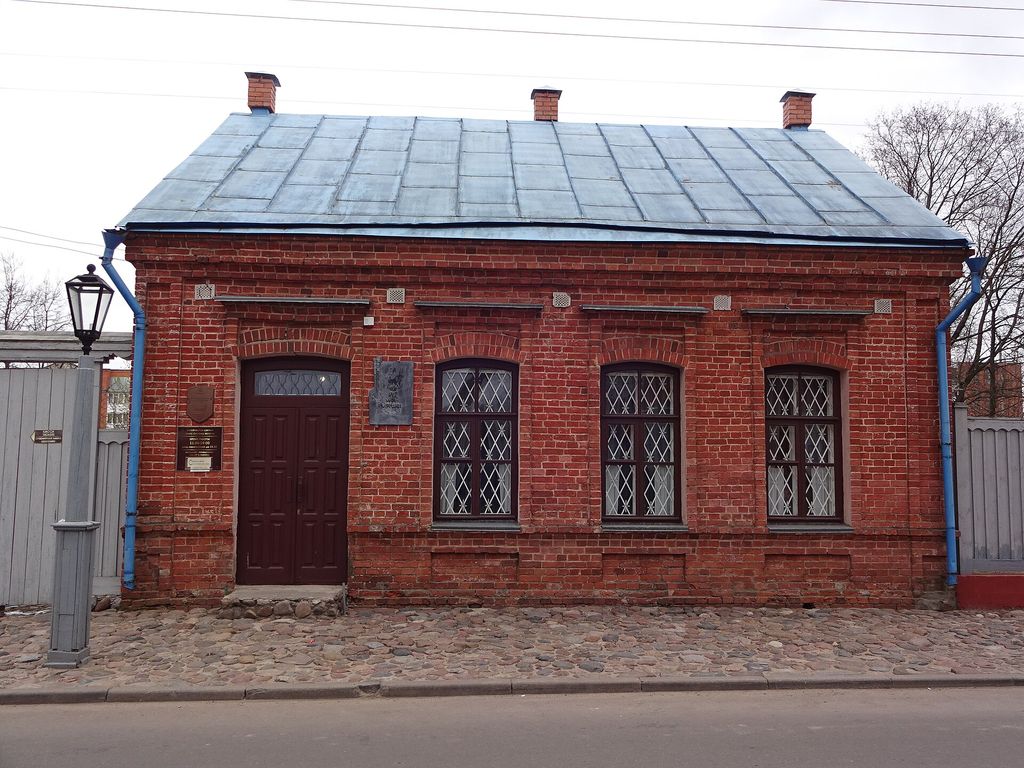
Birthplace labels require similar care. Current official records use Vitebsk, while other documentation names Liozno or a settlement near the city. His parents came from Liozno, he spent summers with extended family there, and Vitebsk was the urban centre of childhood, education and later public work. All were then in the Russian Empire and now lie in Belarus. Calling him only Russian, Belarusian or French turns a historical sequence into a permanent nationality.
The legal sequence was consequential. Chagall was an imperial Russian subject restricted by anti-Jewish residence law, became a Soviet citizen after revolution, lived in France as a Russian refugee, received French nationality in 1937 after earlier refusals, was denaturalised by Vichy in 1943 and had citizenship restored after liberation.[20] These statuses determined where he could reside, travel, work and escape. They also explain why belonging appears in his art as something made through relation rather than possessed without question.
Language was equally plural. Yiddish connected family, Bella's writing and modern Jewish theatre; Hebrew entered through prayer and scripture; Russian served school, literature and administration; French became the principal language of career and citizenship; German belonged to Berlin publishing; English remained difficult in exile. Titles translated across those languages can vary without one version being false.
From Vitebsk to Saint Petersburg
Chagall was born Moishe Shagal on 7 July 1887, near Vitebsk in the Pale of Settlement, the part of the Russian Empire in which most Jewish subjects were legally required to live. Present-day borders place his birthplace and Vitebsk in Belarus. He was the eldest of nine children. His father worked in the herring trade and his mother helped support the household. The noise, labour, worship, animals, buildings and seasonal rituals of this environment became a storehouse that his art would revisit throughout his life.[1]
Calling those later paintings records of Vitebsk would be misleading. Chagall repeatedly altered scale, direction and chronology. A street might be recognisable yet carry a floating figure; a fiddler might stand on a roof; a cow might contain another rural scene. Memory in his art is an active method. Distance made the town available for reconstruction, while migration allowed images from different times to coexist. Vitebsk became both a geographical place and a portable structure for thinking about belonging.
The decision to become an artist crossed social and religious boundaries. Chagall first studied with the Vitebsk painter Yehuda Pen, whose school offered training to several young Jewish artists. In 1907 he moved to Saint Petersburg. Legal restrictions made residence difficult for Jews without the required permits, while the imperial capital exposed him to art schools, collections, theatre and new styles. Study connected with Nikolai Roerich and, more decisively, Léon Bakst brought him near the sophisticated world of Mir iskusstva and the Ballets Russes. Bakst's use of colour and stage space helped show that a picture could be an environment as well as a window.
Paris and the invention of a visual language
With financial help from the lawyer and politician Maxim Vinaver, Chagall reached Paris in 1910 or 1911. The slight variation in dating found across accounts matters less than the speed of the transformation. By 1912 he was living at La Ruche, the inexpensive artists' residence in Montparnasse. Paris placed him among painters and sculptors from across Europe and near writers including Guillaume Apollinaire and Blaise Cendrars. He encountered the colour of Matisse and the Fauves, the fractured forms of Cubism and the simultaneous colour contrasts associated with Robert and Sonia Delaunay.[2]
Chagall used those discoveries selectively. Cubist geometry could break a village into planes, yet he did not accept Cubism's tendency to restrain subject matter or palette. Orphic colour could make a surface pulse, while the picture continued to carry a bride, a cow, a church or a memory of home. Scale and gravity became expressive choices. In I and the Village (1911), the profiles of a green-faced person and a large animal meet across a carefully organised field of circles, diagonals and inverted buildings. MoMA's record notes both its awareness of Cubism and its dependence on memories of the artist's Belarusian home.[2] Form does not decorate the memory; it explains how memory has been rearranged.
Other first-Paris works established a repertoire without fixing its meanings. The Fiddler enlarges a musician until he dominates a wintry settlement. Paris Through the Window combines an Eiffel Tower view with a double-faced figure, a parachutist and a train that seems to run upside down. Self-Portrait with Seven Fingers places a formally dressed painter at work in Paris while Vitebsk appears within the studio. Homage to Apollinaire turns a double-bodied couple, a clock-like circle and names of friends into a meditation on artistic community, time and divided unity. Spanish museum scholarship describes the resulting style as personal and difficult to classify, formed through contact with Cubism, Fauvism and Delaunay's Orphism rather than submission to them.[3]
Herwarth Walden presented Chagall's first solo exhibition at Galerie Der Sturm in Berlin in 1914. The event made him visible within German Expressionist networks. He then travelled to Vitebsk, expecting a visit, but the outbreak of the First World War prevented his return to Paris.
Bella, revolution and a new Jewish theatre
In July 1915 Chagall married Bella Rosenfeld, whom he had met before leaving for Paris. Their daughter Ida was born the following year. Bella came from a prosperous Vitebsk family, had studied in Moscow and later wrote vivid memoirs in Yiddish. She should not be reduced to a silent “muse”. She was Chagall's intellectual companion, reader, translator and the author of her own remembered Vitebsk. In paintings such as The Birthday and The Promenade, the couple's bodies bend or rise in ways that turn shared exhilaration into spatial structure.[4]
The Russian Revolution initially seemed to promise civic emancipation. The end of imperial restrictions on Jews had direct meaning for Chagall. Appointed commissar for the arts in Vitebsk, he organised public decorations for the first anniversary of the October Revolution and established the People's Art School. The school brought together competing ideas about what revolutionary art should be. El Lissitzky invited Kazimir Malevich, whose Suprematism attracted students and developed into the UNOVIS group. Chagall's figurative, fantastical practice no longer set the institution's direction, and he left in 1920. The episode was a conflict about pedagogy, cultural authority and the social function of form as much as a rivalry among personalities.[5]
The institutional details sharpen that conflict. The school opened without fees or age restrictions and initially enrolled about 120 young people, many of them Jewish boys from working families who had previously lacked access to advanced artistic education. Chagall recruited teachers with incompatible methods because his programme rested on stylistic plurality. Lissitzky directed printing, graphic design and architecture; Malevich arrived in November 1919 and drew students towards Suprematism and the collective UNOVIS model. Chagall also assembled a museum collection and organised a December 1919 exhibition in which Kandinsky and Larionov could appear beside Olga Rozanova's abstraction. His defeat was therefore not a simple refusal of modern art. It marked the collapse of an attempt to make several revolutionary modernisms share one public institution.[30]
Students and teachers carried the school's experiments beyond pictures. They designed banners, ration cards, stage settings, tram decoration, façades and speakers' platforms. Chagall's own ironic borrowing from Suprematist geometry after leaving Vitebsk shows that the argument changed his art even where he resisted its doctrine. The school's first and last graduating class completed its studies in May 1922, after Chagall had gone. That short lifespan makes the institution historically important rather than merely unsuccessful: for several years a provincial city, a largely Jewish student body and rival ideas of figuration and abstraction became central to debates about art's public function.[30]
In Moscow he worked for the State Jewish Chamber Theatre, often known by its later acronym GOSET. His murals and designs joined actors, music, lettering, bodies and architecture. Figures derived from Jewish daily life entered a setting devoted to a modern, secular Yiddish culture. The project matters because it disproves the idea that Chagall merely repeated private motifs on canvas. He could organise an entire room and collaborate with performers. That environmental thinking later reappeared in ballet, stained glass, mosaics and purpose-built architecture.
Theatre as a second laboratory
The Moscow murals made theatre, music, dance and literature into one painted environment. Their Yiddish institution matters: Chagall was not illustrating an undifferentiated “Jewish tradition” but helping a modern company redefine performance after revolution. Actors moved against figures that already appeared to dance, play and overturn bodily scale. Painting became an active participant in time.
The stage remained central during exile. For Massine's Aleko in 1942, Chagall made curtains, scenery and more than seventy costume designs. MoMA records that he travelled with Ballet Theatre to Mexico, where union jurisdiction allowed him to help execute the production; he painted many costumes personally and Bella sewed some.[21] Mexican workshops and colour altered plans begun in New York. Authorship therefore extended through artist, spouse, dancers, choreographer, costumiers and stage painters.
For The Firebird in 1945, familiar hybrid creatures entered Stravinsky's music and choreographic duration. Later designs for Daphnis et Chloé and Mozart's The Magic Flute connected Greek pastoral and opera to moving colour. On stage, a figure does not merely “float” within a still fantasy: a dancer carries painted form through light, music, entrance and disappearance.
This work also trained Chagall for public architecture. A curtain must operate across an auditorium; a costume must retain its silhouette while folding around a body; a set must coordinate with sightlines and performers. The apparent freedom of later monumental art rests partly on decades of such practical design.
Books, Paris and the pressure of the 1930s
Chagall left Soviet Russia in 1922. In Berlin he recovered some earlier works and learned etching with artists including Hermann Struck and Joseph Budko. German scholarship records that more than 200 of his works entered German ownership before 1933 and that the Berlin period opened decisive possibilities in graphic art. The small etched lines of the My Life series translated autobiographical episodes into a medium built on reversal, pressure and repeated impressions.[6]
The family returned to Paris in 1923. The dealer and publisher Ambroise Vollard commissioned major illustrated-book projects: an edition of Gogol, the animal stories of La Fontaine and, after further development, a sequence for the Bible. These were not minor reproductions of ideas developed elsewhere. Chagall adjusted line, tonal biting, sequence and the relation between text and image. For the Bible project he travelled in 1931 to Palestine, as well as Egypt and Syria. The resulting etchings bring ancient narrative, observed landscape and the artist's existing visual vocabulary into contact.[7]
Books, publishers and the art of sequence
Printmaking changed both Chagall's hand and his audience. Cassirer's planned edition of My Life introduced etching and drypoint; Vollard's commissions demanded hundreds of plates; Tériade eventually rescued the delayed projects after Vollard's death. A printed book joined the artist to engravers, lithographers, typographers, binders, translators and readers.
The Musée national Marc Chagall's book research records the scale of this undertaking. The Dead Souls plates were made from 1923 to 1927 but published by Tériade in 1948; one hundred Fables appeared in 1952; the 105-plate Bible followed in 1956.[22] The delays cross exile and war, so design date and publication date carry different histories.
Chagall did not treat black print as a cheap substitute for colour. He translated gouache into etched pressure, cross-hatching, open paper and plate tone, then personally added gouache to deluxe Fables and Bible copies. At Mourlot, lithography allowed each colour to be drawn and printed separately. Charles Sorlier's proofs preserve approval, rejection and revision, showing a workshop process rather than automatic duplication.
Later books widened the field: Four Tales from the Arabian Nights was produced during American exile; the forty-two colour lithographs of Daphnis and Chloe followed Greek journeys; Cirque paired Chagall's prose and images; Poèmes used colour woodcut; Psaumes de David returned to copper when he was over ninety. Read in order, these works make page turn, interval and textual adjacency part of the art. Displaying a single plate can reveal its composition while concealing its designed sequence.
During the 1930s, political events changed how Jewish figures and Christian subjects operated in his work. A journey to Poland in 1935 confronted him with intensified antisemitism. Nazi cultural policy had already targeted modernism and Jewish artists. Books by or about Chagall were burned in 1933; works were removed from German museums, and examples appeared in the 1937 Entartete Kunst exhibition. Many confiscated works were then sold abroad for foreign currency.[8][9]
Chagall became a French citizen in 1937, but citizenship did not remove the danger after France fell. Paintings of crucifixion, burning villages and flight gave current persecution a visual form. In White Crucifixion (1938), Jesus is marked as Jewish and surrounded by attacks on Jewish communities. The image does not simply Christianise Jewish suffering. It places a Jewish Jesus at the centre of a field of modern violence, forcing different audiences to confront the historical identity of the victim.
Politics, witness and the limits of “dream”
The description of Chagall as a dreamer has often hidden how closely he attended to public events. Recent museum projects have corrected that imbalance by reading the work through war, migration, civil rights and his recorded political positions. The large 2023–24 A Cry for Freedom project drew on previously unpublished correspondence, speeches, statements and official records in French, English, Russian and Yiddish. Its curators argue that social and political commitment belongs across the career rather than to a small group of wartime pictures.[32][33]
Early paintings already make that case. In The Newspaper Vendor of 1914, a figure derived from the Jewish street peddler stands against an imagined Vitebsk while newspapers announce catastrophe. A preparatory drawing carried the Russian word Voina, “war”, although it disappeared from the finished canvas. The deletion does not remove politics; it shifts a topical signal into a more durable structure of alarm, poverty and historical exposure.[31] Likewise, the tilted figures and airborne couples of the revolutionary years cannot be separated from the first experience of full citizenship after imperial discrimination, even though they also carry marriage and private joy.[30]
Travel changed Chagall's political geography. The 1931 journey through Mandatory Palestine included his encounter with a developing Jewish cultural infrastructure and an invitation from Tel Aviv mayor Meir Dizengoff connected with the foundation of a Jewish museum. A later visit to Vilna at YIVO's invitation placed him within a different project: the documentation and study of eastern European Jewish life. These institutions represented distinct responses to Jewish modernity—national construction in Palestine and scholarly preservation in eastern Europe—and neither can be reduced to scenery for the Bible etchings.[34]
The 1930s and 1940s brought a darker palette and a denser combination of allegory, self-portraiture, Biblical figures, refugees and burning settlements. That change does not mean that bright colour had been apolitical or that darkness provides a simple measure of seriousness. It does show that formal decisions responded to historical pressure. Exhibitions in Frankfurt, Oslo, Düsseldorf and Vienna have increasingly foregrounded this socially critical work, challenging the market's preference for an untroubled poet of lovers and flowers.[34][36]
After the war, Chagall's public language often turned towards peace, fraternity and reconciliation. Such language can sound general when detached from the institutions and dates that produced it. In a United Nations memorial, a German church or a French state commission, peace followed particular histories of murder, displacement and contested citizenship. The humanitarian vocabulary should therefore be tested against patron, site and audience. It was an ethical position shaped by persecution, but it could also be used by post-war institutions seeking healing narratives that softened unresolved conflict.
Exile in the United States
Chagall and Bella were still in Vichy France when rescue efforts helped them leave in 1941. They reached New York as refugees, bringing works from the studio through Ida's determined intervention. The United States offered safety and professional opportunity, but Chagall remained distressed by news from Europe. Yiddish-speaking émigré circles, American winter landscapes and memories of Russia entered works shadowed by destruction.[9]
The rescue was neither inevitable nor solely the achievement of one heroic intermediary. A surviving Varian Fry letter reports that Alfred Barr at MoMA awaited Chagall for a retrospective and offered help obtaining visas; Marga Barr coordinated museum involvement while US consul Hiram Bingham assisted in Marseille.[23] Chagall was briefly arrested before intervention secured release. Marc and Bella then crossed Spain and Portugal and reached New York on 21 June 1941.
Ida's labour was decisive. Six hundred kilograms of crated works were held in Madrid for five weeks; she intervened and had them loaded onto her ship.[23] She later translated Bella's Yiddish memoirs, organised exhibitions and helped construct the archive. The story is thus about paperwork, money, cultural capital and family agency as well as danger. It must also retain proportion: most Jews under Nazi rule had no museum invitation or transatlantic route.
The theatre again provided a large collaborative field. Chagall designed scenery and costumes for Léonide Massine's ballet Aleko, first staged in Mexico City in 1942, and later for The Firebird. Painted curtains, costumes and moving bodies carried his colour into time and performance. These projects also complicate the familiar claim that his figures “float”: on stage, bodies literally move through a designed pictorial world.
Bella died suddenly in September 1944. Chagall stopped working for a period, then returned to images in which lovers, brides and Vitebsk could bear grief as well as celebration. A later relationship with Virginia Haggard McNeil brought companionship and a son, David. The Jewish Museum's treatment of love, war and exile usefully places intimate imagery beside persecution and displacement rather than isolating one from the other.[10]
Women around Chagall performed different kinds of cultural labour. Bella was a Yiddish writer, actor and translator as well as the partner represented in paintings. Ida rescued works, prepared her mother's writing, organised retrospectives and preserved records. Virginia mediated between studio, household and workshops; an archival letter records her drawing vessel shapes so Suzanne Ramié could fabricate a ceramic service for Ida.[24] Valentina Brodsky, whom Chagall married in 1952, managed access and the expanding late international career. The word “muse” is too imprecise for all of them.
Biography helps date grief, partnership and commission, but it should not assign every bride or lover to one named woman. Chagall reused established types across changing relationships, Biblical poetry and memorial contexts. A white dress can carry several temporal layers without becoming a disguised portrait.
MoMA's 1946 retrospective consolidated Chagall's American reputation and framed the first four decades of his career for a broad public.[18] It also helped prepare the post-war return of his work to European museum culture. He went back to France in 1948.
Colour made architectural
Chagall settled first in Orgeval and then in Vence. In 1952 he married Valentina Brodsky, known as Vava. The south of France did more than brighten his palette. It placed him near workshops where he could work with clay, stone and architectural commissions. At Madoura in Vallauris, associated also with Picasso, he developed ceramics from painted vessels to reliefs and sculptural forms. Stone carving followed, often with the assistance of the mason Lanfranco Lisarelli. Lithography, especially colour lithography made with specialist printers, offered another way to build light through successive layers.[11]
The expansion was extraordinary but coherent. Painting had already taught Chagall to detach colour from local description and to make figures inhabit discontinuous space. Stained glass turned those habits into transmitted light. Mosaic made colour material and responsive to the viewer's movement. Tapestry changed painted marks into fibre and scale. Ceramic surfaces wrapped images around objects. Each medium imposed resistance, required technical partners and changed the relation between image and site.
The official catalogue raisonné makes that breadth measurable while stressing that research continues. Its technique-based structure currently records 350 ceramics, 97 sculptures and 28 mosaic works, alongside developing sections for paintings, works on paper, tapestries, stained glass and costumes.[12] Those numbers also correct an easel-centred view of Chagall. His late career was not an old painter decorating architecture; it was a sustained investigation of how images occupy communal space.
Collaboration was essential. Master glassmaker Charles Marq and the Simon-Marq workshop translated designs into sheets of coloured glass and painted detail. Mosaicists including Lino Melano, Michel Tharin and the Ravenna-trained makers interpreted maquettes through tesserae, mortar, texture and site. The official mosaic research reconstructs a practice that began with encounters with historic mosaics in Italy and developed into projects in France, Israel, Switzerland and the United States.[13] Chagall remained closely involved, but the physical objects preserve several kinds of expertise.
The 2025–26 mosaic catalogue strengthens this account because it treats the medium as a corpus rather than a handful of monuments. Its twenty-eight entries cover public and private works made from 1955 to 1986 across five countries. Researchers combined the Marc and Ida Chagall Archive with other identified holdings and with restoration evidence, then worked with institutions in Nice and Ravenna. A work dated after Chagall's death also demonstrates why authorship and date need explanation: a design can precede the artist's death while fabrication or completion follows it.[35]
This research also makes visible the limits of a maker-centred story. A mosaic moves from drawing or maquette through enlargement, selection of stone and glass, cutting, setting, transport and installation. Workshop decisions alter edge, reflection, spacing and colour density. Conservation may later replace tesserae or change drainage and protection. Chagall's authority over conception remains substantial, yet the finished surface records negotiations among artist, mosaicists, architects, patrons and restorers.[35]
Materials, revision and conservation
Even within painting, Chagall's technique was plural. He worked on canvas, linen, board and cardboard, combining oil with drawn contours and sometimes returning to a support years later. To My Wife carries 1933 and 1944; the triptych Resistance, Resurrection, Liberation grew through cutting and reworking from a 1937 composition. A date can identify beginning, revision or completion rather than one uninterrupted session.
Technical study of nine paintings in the Stedelijk Museum combined examination in ordinary and angled light with ultraviolet, infrared, transmitted-light and radiographic images, followed by analysis of materials. It found a relatively stable core palette but complex pigment mixtures, altered passages and later conservation.[28] The research began because deep cracking in a red field raised treatment questions. A visually direct colour can have a structurally complicated history.
Every medium introduces its own vulnerability. Paper fades and records erased lines; fired ceramic can craze; bronze editions require foundry documentation; stained glass suffers fatigue, paint loss, movement and impact; outdoor mosaic meets water, salt and freeze–thaw cycles. Conservation is part of the work's biography. Jerusalem glass damaged in 1967 shelling, the moved Orphée mosaic and protected Le Saillant windows all demonstrate that public art survives through intervention.
Material science can also bound attribution. Anachronistic phthalocyanine pigments disproved a purported 1910 Chagall, because those pigments were unavailable at the claimed date.[29] Such evidence can reject a chronology but cannot alone prove authorship. Provenance, support, ground, technique, archive photographs and catalogue research must converge.
Major stained-glass commissions include the twelve windows for the synagogue of the Hadassah-Hebrew University Medical Center in Jerusalem, windows for Metz Cathedral, the United Nations memorial window in New York, and later cycles at Reims, Zurich, Tudeley and St Stephen's Church in Mainz. The differences among synagogue, cathedral, civic memorial and parish church mattered. Chagall adjusted subjects, colour and architectural rhythm rather than applying a single decorative formula.
His public works also include the painted ceiling for the Paris Opéra, unveiled in 1964; two murals for the Metropolitan Opera in New York; mosaics and tapestries for the Knesset; and the mosaic Four Seasons in Chicago. Such commissions made a Jewish modern artist visible within institutions carrying national, civic and Christian authority. They generated admiration, but sometimes controversy over style, modernisation and the relationship between an existing building and a new work.
Each site produced a different public. Jerusalem's tribal windows surround prayer inside a hospital synagogue and avoid conventional human portraits. The UN Peace Window commemorates Dag Hammarskjöld and fifteen staff members and peacekeepers within a secular international institution.[25] Tudeley grew from one family's memorial for a drowned daughter into a complete church environment. Mainz framed a Jewish artist's glass in a rebuilt German Catholic church and became a post-war symbol whose reconciliation language must retain the history of persecution.
The Opéra ceiling made institutional change physically visible. A removable support carrying twenty-four painted canvas sections was suspended beneath the earlier decoration by Jules-Eugène Lenepveu, left intact above the new work. Assistants participated in Chagall's production, and state sponsorship by André Malraux provoked debate over nationality, heritage and modernism. The project was technically reversible even though its visual occupation of the hall was emphatic.
At the Knesset, tapestries and mosaics address a modern parliament through prophecy, Exodus and Jerusalem. In Chicago, Four Seasons joins urban pedestrian movement to a mosaic fabricated with Lino and Heidi Melano. These works are not enlarged easel pictures: site, patron, workshop, weather, maintenance and the movement of viewers are part of their form.
The Bible and the museum at Nice
Biblical subjects run through Chagall's career, from early crucifixions through Vollard's illustrated Bible to late paintings and glass. He approached scripture as narrative, moral drama, inherited culture and living image. Prophets, angels, kings and lovers occupy spaces that can recall both the Mediterranean and Vitebsk. This double location prevents a simple division between “Jewish” and “universal” content. The universal claim, when it works, emerges through particular languages, histories and bodies rather than by removing them.[16]
In the 1950s Chagall developed the large paintings that became the Biblical Message. Seventeen canvases treat episodes from Genesis and Exodus and the poetry of the Song of Songs. Chagall and Vava gave the group to the French state in 1966. Its need for a permanent home led to the Musée national Message Biblique Marc Chagall in Nice, designed by André Hermant and opened in 1973. Chagall participated in decisions about the building and added stained glass, a mosaic and other elements, making the museum itself a coordinated environment.[14]
The gift also belongs to Chagall's complex relationship with Israel. His visits, the Jerusalem windows, Knesset works and other projects connected him to the state's cultural institutions, yet he did not relocate there. Israel was at once a contemporary country, a landscape encountered through travel and a field of Biblical and Jewish historical association.[17]
Reception, reproduction and the problem of popularity
Chagall's reputation has repeatedly been constructed through institutions. Walden's 1914 Berlin exhibition placed him in Expressionist networks; German museums and collectors acquired heavily before Nazi confiscation; MoMA's 1946 retrospective organised an American account of the career; French state commissions and the Nice museum later presented him as a figure of national culture.[6][8][18]
Each framework selected a different Chagall. Early critics could exoticise him as Russian, Jewish or childlike. Surrealists admired his airborne combinations but encountered a vocabulary established before their movement. Soviet histories struggled with his emigration, figuration and conflict with Suprematism. Post-war institutions emphasised humanism and reconciliation. Commercial reproduction favoured lovers, bouquets and saturated blue, sometimes detaching pleasure from exile, persecution and workshop labour.
Popularity is not evidence of simplicity. It does, however, create a critical problem: familiar motifs can become logos for “Chagall” before viewers examine the composition. Conversely, histories of modernism organised as a progression towards abstraction have sometimes treated his continuing story, scripture and recognisable bodies as peripheral. Both accounts overlook how he accepted flatness, discontinuity, scale distortion and colour autonomy while rejecting the demand that modern art abandon narrative.
Nationality debates also shaped reception. French commissions could celebrate a naturalised citizen while concealing earlier rejection and Vichy denaturalisation. Israeli institutions could claim a major Jewish artist although he never settled in the state. Belarus, Russia and France can all place him within national narratives, but none owns the whole biography. A better historiography treats these claims as evidence of Chagall's mobility and symbolic value.
The archive remains open to correction. More than 55,000 documents in the Marc and Ida Chagall Archive include correspondence, administrative records and photographs that clarify collaborators and provenance.[26] In 2022 France restituted The Father to the heirs of David Cender after establishing wartime spoliation; Chagall had unknowingly repurchased his own painting after the war.[27] Even a celebrated life can contain object histories unknown to the artist.
Archives, catalogues and an unfinished corpus
Research on Chagall now proceeds through several bodies of evidence that do not always agree. The first selective catalogue by Franz Meyer, published in 1961, could not cover the final twenty-four years of the artist's production and was never intended as a complete multi-medium inventory. The official online catalogue, begun in 2019, instead organises entries by technique and assigns a catalogue number after examining correspondence, administrative records and photographic albums. It explicitly allows ownership, provenance, exhibition and bibliography fields to change when verified evidence emerges.[12]
The archive and the catalogue perform different tasks. Letters can establish a commission, shipment or workshop relationship, but they do not automatically prove that every object described was completed or survives unchanged. Photographs can document a lost state while concealing colour and material structure. An object record can stabilise dimensions and provenance yet still inherit an uncertain historical title. Catalogue numbers provide research control, not immunity from revision.
Access also shapes knowledge. The private Marc and Ida Chagall Archive is available to qualified researchers by application, while the Nice museum maintains a documentation centre containing books, rare exhibition catalogues from 1923–78, periodicals, photographs and records of the museum's scientific activity.[37] Public digital resources expose only part of those holdings. Absence from an online search should never be treated as proof that no document exists; equally, an archive reference without inspected content should not support a detailed factual claim.
A responsible account therefore uses an evidence hierarchy suited to each question. The object-owning institution normally governs measurements, support and current provenance. A fabrication workshop or conservation report is strongest for materials and interventions. The artist archive can clarify intention, chronology and relationships. Jewish, refugee, municipal and theatre archives restore institutional contexts that art catalogues may compress. Scientific analysis can disprove a proposed date when a pigment is anachronistic, but it cannot identify the artist without provenance and comparative study.[26][28][29][35][37]
This unfinished corpus changes the meaning of completeness. It is possible to exhaust the relevant public evidence available for a page without claiming that scholarship has ended. New restitution findings, workshop records, translations, conservation campaigns and catalogue releases may alter individual histories. Chagall's popularity has produced a vast documentary trail, but abundance does not remove gaps; it makes transparent source control more necessary.
How to look at a Chagall
Chagall's repeated motifs invite quick translations: goat equals sacrifice, violinist equals tradition, flying lover equals romantic joy. These can be starting hypotheses, but a fixed dictionary makes the paintings smaller. A violinist may evoke Vitebsk celebration, precarious labour, Yiddish theatre, artistic performance or several of these at once. An animal may be companion, food, memory, sacrificial creature, rural livelihood or formal counterweight. Meaning changes with date, composition, colour and neighbouring figures.
A better approach begins with the picture's construction. Which elements share a scale? Which are inverted? Where does colour create a zone rather than describe an object? Does a line connect two gazes? Is the town seen from above, remembered from elsewhere or compressed into a corner? Next comes historical context: where was Chagall living, which language communities surrounded him, what commission or text was involved, and what pressures shaped Jewish life at that moment? Biography can then clarify, provided it does not close interpretation.
Colour deserves the same precision. Chagall's blue is not one permanent symbol. In one work it may cool a nocturnal scene; in another it may bind a figure to an immaterial field; in stained glass it becomes light falling onto architecture and visitors. Red can focus love, violence, sacred intensity or compositional balance. The question is what a colour does in a particular work.
A modern artist of memory and relation
Chagall died at Saint-Paul-de-Vence on 28 March 1985, aged ninety-seven. By then his work occupied museums, theatres, books, synagogues, churches, civic plazas and opera houses. Popular affection sometimes worked against critical attention: familiar lovers and brilliant colours could be reproduced as reassuring emblems while the pictures' formal strangeness and historical pain receded. Conversely, modernist narratives that prized abstraction could treat his attachment to story and figuration as peripheral.
Neither response accounts for the whole achievement. Chagall made displacement into a way of constructing pictures without making exile picturesque. He drew on Jewish life without presenting identity as sealed or uniform. He used avant-garde form without surrendering people, animals and stories. He treated love as an embodied force but also recorded bereavement. He entered Christian buildings while insisting, in crucial wartime images, on the Jewish identity of Jesus. His late public works transformed private motifs through collaboration, architecture and light.
The best introduction to Chagall is therefore plural. MoMA alone catalogues 216 works online across painting, drawing, print and design, a useful indication of how much disappears when a few celebrated canvases stand for the career.[15] He was a painter and printmaker, a designer of books and stages, a ceramicist and sculptor, and an author of stained glass and mosaics realised with expert makers. He belonged to Vitebsk, Paris and the wider history of migration, yet no place wholly contains the work. Across those settings, the central problem remains remarkably consistent: how can an image hold together experiences that history has forced apart?
Discussion
Which piece of evidence most changes the way you read Marc Chagall?
Reader Insights
Which visible detail most changes your reading of Marc Chagall?
How do medium, setting and documented history shape the encounter?
What remains uncertain when documented fact is separated from interpretation?
Join the Conversation
Share your reading of Marc Chagall below.
References
- Musée national Marc Chagall, “Biography of Marc Chagall”, View Source
- Museum of Modern Art, “Marc Chagall. I and the Village. 1911”, View Source
- Museo Nacional Thyssen-Bornemisza, “Chagall, Marc”, View Source
- Musée national Marc Chagall, “Biography of Marc Chagall”, View Source
- Musée national Marc Chagall, “Biography of Marc Chagall”, View Source
- Jüdisches Museum Frankfurt, “Verehrt und verfemt: Chagall und Deutschland”, View Source
- Musée national Marc Chagall, “Biography of Marc Chagall”, View Source
- Jüdisches Museum Frankfurt, “Verehrt und verfemt: Chagall und Deutschland”, View Source
- United States Holocaust Memorial Museum, “Marc Chagall”, View Source
- The Jewish Museum, “Chagall: Love, War, and Exile”, View Source
- Musée national Marc Chagall, “Biography of Marc Chagall”, View Source
- Catalogue raisonné Marc Chagall, “Catalogue raisonné”, View Source
- Musée national Marc Chagall, “Chagall en mosaïque: de verre et de pierre”, View Source
- Musée national Marc Chagall, “The museum's collection”, View Source
- Museum of Modern Art, “Marc Chagall”, View Source
- Histoire des arts, Ministère de la Culture, “Chagall et la Bible”, View Source
- The Israel Museum, “Chagall in Israel”, View Source
- Museum of Modern Art, Marc Chagall exhibition catalogue, 1946, View Source
- YIVO Encyclopedia of Jews in Eastern Europe, “Chagall, Marc”, View Source
- Office français de protection des réfugiés et apatrides, “Marc Chagall, artiste peintre”, View Source
- Museum of Modern Art, “Aleko. Costume design for the ballet”, View Source
- Musée national Marc Chagall, Chagall et le livre, View Source
- Archives Marc et Ida Chagall, “Letter from Varian Fry”, View Source
- Archives Marc et Ida Chagall, “Letter from Virginia McNeil to Ida Chagall”, View Source
- United Nations Gifts, “Peace Window”, View Source
- Marc Chagall official website, “Archives Marc and Ida Chagall”, View Source
- Ministère de la Culture, “Restitution du tableau de Marc Chagall, Le Père”, View Source
- Meta Chavannes et al., “Marc Chagall’s Painting Materials and Technique: Nine Paintings from the Stedelijk Museum Amsterdam”, Zeitschrift für Kunsttechnologie und Konservierung, 2021, View Source
- Robin J. H. Clark, “Identification by Raman microscopy of anachronistic pigments on a purported Chagall nude”, UCL Discovery, 2016, View Source
- The Jewish Museum, “Chagall, Lissitzky, Malevich: The Russian Avant-Garde in Vitebsk, 1918–1922”, View Source
- Centre Pompidou, “Le Marchand de journaux”, View Source
- Musée national Marc Chagall, “Chagall. A Cry of Freedom”, View Source
- Fundación MAPFRE, Chagall. Un grito de libertad, View Source
- Schirn Kunsthalle Frankfurt, Chagall: World in Turmoil, exhibition wall texts, View Source
- Marc Chagall official catalogue raisonné, “Mosaics”, View Source
- Kunstsammlung Nordrhein-Westfalen, Chagall press kit, 2024–25, View Source
- Musée national Marc Chagall, “Archives and research”, View Source