


 by Tom Gurney
Tom Gurney BSc (Hons) is an art history expert with over 20 years experience
Page Created on September 22, 2026 / Page Updated on September 22, 2026
Email: tomgurney1@gmail.com / Phone: +44 7429 011000
Introduction
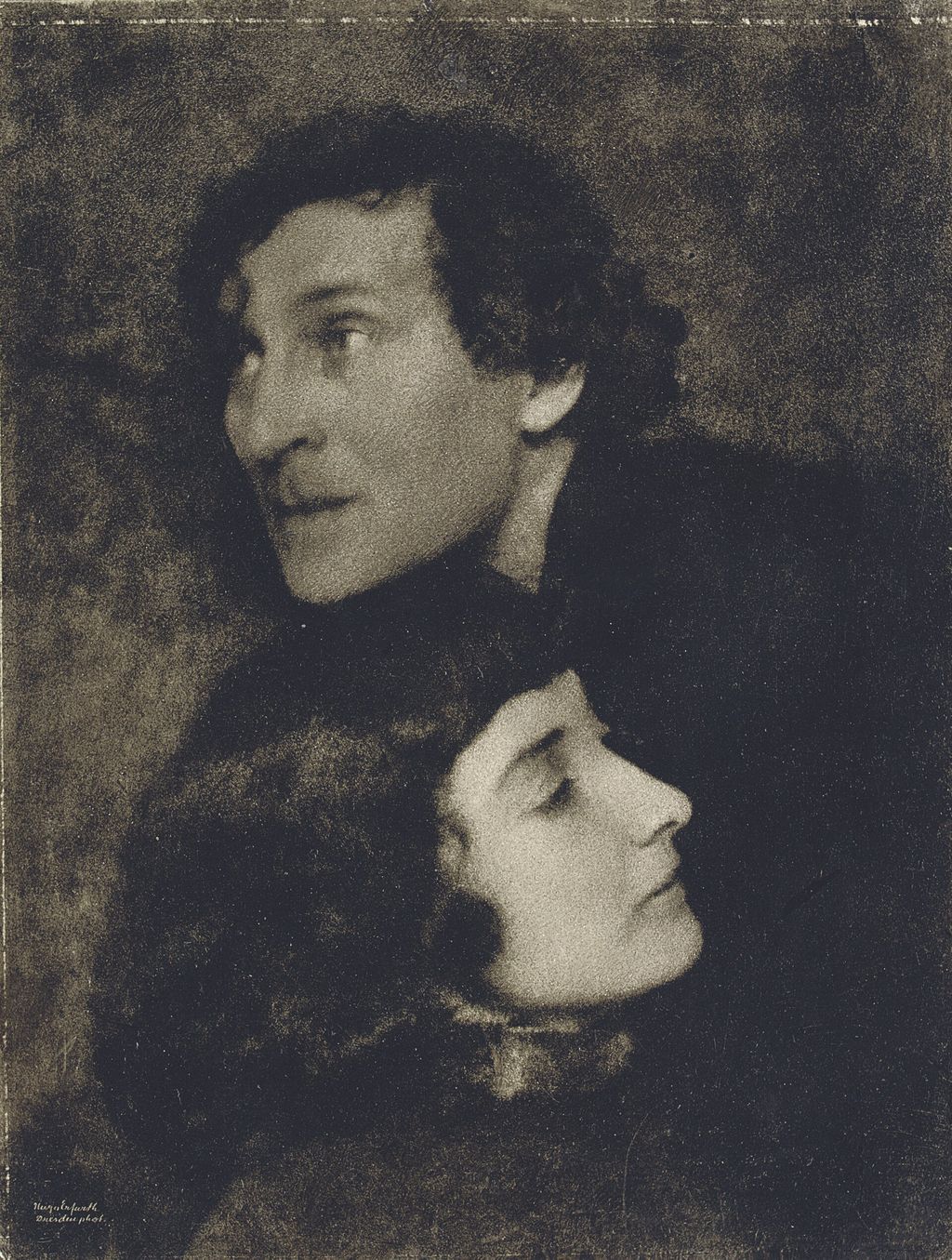
Bella Rosenfeld occupies two histories that are often collapsed into one. In Marc Chagall's paintings she becomes lover, bride, airborne companion, mother, lost presence and remembered face. Outside those paintings she was an educated, multilingual Jewish woman who wrote two books in Yiddish, translated and edited Chagall's autobiography, preserved family memory and negotiated repeated migrations through revolution, antisemitism and war.
Calling her Chagall's “muse” recognises her importance while threatening to make her passive. The word can turn a writer into the occasion for a man's creativity and treat paintings as transparent records of marriage. Neither move is adequate.
Bella helped shape the language through which Chagall presented his life, yet there is no evidence that she co-painted his canvases. Her literary voice survives, but in works completed after her death the painted Bella is necessarily Chagall's construction of memory.
Their partnership should therefore be read across different kinds of evidence: Bella's prose; correspondence and archival records; Chagall's autobiographical writing; dated objects; exhibition and publication histories; and the later romantic story built around them. Those sources sometimes disagree. The disagreement is part of the history rather than an inconvenience to remove.
At a Glance
- ArtistMarc Chagall
- SubjectMarc Chagall and Bella Rosenfeld
- Artistic contexttwentieth-century modern art
Contents
- Basia, Basha, Berta and Bella
- Meeting Chagall and writing the encounter
- The Dedicated to My Wife lovers
- Birthday and the invention of weightlessness
- Motherhood before and after Ida
- Double Portrait with a Glass of Wine
- Partnership in language and publication
- Bella writing, Bella monumentalised
- Bella's Burning Lights
- Lilacs, bouquets and the window
- Brides, blue faces and marriage lights
- Bouquet with Flying Lovers
- Flight from France and American exile
- The Wedding
- Around Her and Wedding Lights
- Postwar lovers: bridge, red sky and Nice
- How the romantic legend was made
- Bella as author and historical witness
- Reading love without reducing it
Basia, Basha, Berta and Bella
Bella was born Basia-Reiza Rosenfeld in Vitebsk, in the western borderlands of the Russian Empire. Her name appears in several transliterations and forms—Basia, Basha, Berta, Bella—because her life moved among Yiddish, Russian, French and English.[2][3]
Even her birth year is unsettled. Many museums and catalogues give 1895. Benjamin Harshav observed that this date conflicts with evidence about her gymnasium class and later study, and argued that she was probably closer in age to Chagall than the official chronology suggests.[2][6] An earlier date, often 1889, appears in other reference traditions.
Precision here means preserving the conflict, not choosing the most repeated number.
The Rosenfelds were a comparatively prosperous Jewish family associated with jewellery and watches. That social position distinguished Bella's childhood from Chagall's poorer household, although both inhabited Vitebsk's Jewish world. Economic difference later mattered to family negotiations around marriage and to the mythology of the penniless artist winning the jeweller's daughter.
Bella attended a secular gymnasium and pursued literary study in Moscow. Russian educational records and Jewish literary scholarship establish an intellectual formation extending beyond domestic accomplishment.[2][8] She read European and Russian literature, moved between languages and showed an interest in theatre. The Russian Art Archive Network identifies her directly as a writer and translator.[7]
The Moscow record is more specific. She attended the Higher Women's Courses founded by Vladimir Guerrier, studying history, philosophy and literature; her diploma work concerned Dostoevsky.[8] She also studied acting. These subjects locate her within the expanding, still contested field of higher education for women in the late Russian Empire and explain why translation, dramatic observation and sustained prose were trained capacities rather than accomplishments bestowed by marriage.
Her education does not make her a modern emancipated heroine in a simple sense. Burning Lights returns with affection and critique to a traditional Jewish household, religious festivals, shops, relatives and servants. Her writing inhabits the tension between female aspiration, family obligation and inherited ritual rather than escaping it.
Meeting Chagall and writing the encounter
Bella and Marc met in Vitebsk in 1909 through their friend Théa Brachmann. Both later wrote the episode, giving it the polished inevitability of an origin story. Their recollections agree on immediate fascination but should be read as literary constructions produced after the relationship had acquired its legend.[2][3]
Separation followed. Chagall left for Paris; Bella studied in Moscow. The Marc and Ida Chagall Archive preserves a postcard sent by Bella from Moscow in October 1912, material evidence that complements the retrospective memoirs.[9] Letters and cards record a relationship sustained through writing before it became the subject of celebrated pictures.
The postcard is dated 6 October 1912 and says that Bella was awaiting replies to her letters.[27] Its brevity corrects a familiar imbalance in the visual record. Before she became the silent face in an embrace, Bella was already an absent correspondent making demands on Chagall's attention and composing the relationship in words.
Chagall also pictured absence. The Metropolitan Museum's Bride with Fan of 1911 is a small oil on canvas in an unusually restricted blue-and-white palette, painted in Paris as an evocation of his distant fiancée.[28] Brighter colour showing through the white suggests that he reused an earlier canvas. The material revision makes memory an act of covering and recovery rather than a transparent likeness made from life.
Bella's Di ershte bagegenish—The First Encounter—does more than certify romance. Written in sensuous, image-rich Yiddish, it reconstructs adolescence, family observation and the unsettling experience of being seen by an artist. The Yiddish Book Center describes the book as one half of an artistic and literary partnership, not merely a memoir about a famous husband.[3]
The original Yiddish edition appeared posthumously in New York in 1947. The Digital Yiddish Library records a 234-page volume issued by the Jewish People's Fraternal Order.[4] Later English editions often combine this shorter courtship text with Burning Lights, so titles, contents and translation routes need checking before quotation.
Memoir is not deposition. Bella arranges sensations, dialogue and scenes for narrative effect. Yet this very artifice establishes authorship: she was not simply the woman remembered in Chagall's story but a writer who composed the conditions under which readers would remember her.
Chagall returned from Berlin to Vitebsk in 1914 expecting a short visit. The First World War prevented his return to Paris. He and Bella married in Vitebsk in July 1915, despite the Rosenfeld family's concern about his uncertain career.[1][22]
The official archive gives 25 July, while some object essays convert between calendars and give 15 July. The apparent contradiction reflects the Julian and Gregorian systems then in use. A responsible account records the calendar issue rather than treating one date as an error.
Their daughter Ida was born on 18 May 1916. Bella's brothers helped Chagall obtain work that kept him away from the front, and the young family moved between Vitebsk and Petrograd before the revolutions transformed public life.[1] Family networks were practical structures of survival as well as subjects for affectionate memoir.
The great lovers paintings arose inside this instability. They are not documents of an untouched private paradise. War, military obligation, revolutionary transformation, hunger and institutional conflict surround them.
Levitation answers gravity imaginatively; it does not prove the couple lived outside history.
The Dedicated to My Wife lovers
After marriage Chagall produced a sequence of close double portraits that he called Dedicated to My Wife. Pink Lovers of 1916 belongs with Grey Lovers and Green Lovers, each organised through a dominant colour and compressed embrace.[16][34]
The faces overlap, bodies merge and individual outlines become difficult to separate. Colour supplies atmosphere without functioning as a fixed code. Pink can intensify tenderness; grey can make union grave or sculptural; green can estrange familiar flesh.
The series tests how two persons can appear as one form while remaining visibly double.
This experiment extends beyond portrait likeness. Chagall's official thematic research traces hybrid couples back to works of 1911–12 in which dual heads and joined bodies question complementarity, division and lost unity.[17] Bella gave the problem intimate urgency, but the pictorial language was already broader than biography.
The paintings also reverse conventional hierarchy. Chagall may hide behind Bella's profile, twist towards her or depend on her body for balance. The male artist does not always occupy the stable viewing position while a female model is displayed.
Yet formal dependence should not be mistaken for social equality proven by paint.
The English titles Green Lovers and Lovers in Green create a genuine cataloguing trap. Centre Pompidou's Les Amoureux en vert, dated 1916–17 and signed 1917, is oil on cardboard mounted on canvas, 69.7 by 49.5 centimetres; it entered the national collection in the 1988 dation and is deposited at the Musée national Marc Chagall.[33] The museum also records an earlier attributed title, Figures in Green, showing how even one securely held object has circulated under several names.
The legacy pages, however, reproduced two visibly different compositions under near-identical English titles. One shows the resting double portrait held by Centre Pompidou; the other presents a couple beneath a parasol with an accordion and survives mainly through private-collection and reproduction records. They must not be silently merged into one image, but the thinner record for the second does not justify a separate authoritative object page.
Pink Lovers is more firmly locked. The official record identifies oil on cardboard, 69 by 55 centimetres, probably painted at a rented dacha in summer 1916; Bella inclines forward while Chagall's face recedes behind her profile.[16] Pink, green and grey name dominant pictorial fields, not stable emotional codes, and the sequence is better understood as sustained variation in bodily fusion, support and chromatic pressure.
Blue Lovers predates that named sequence. The Russian Museum Virtual Branch records a 1914 work on paper mounted on cardboard, 49 by 44 centimetres, now privately held.[15] It was exhibited at the 1916 Knave of Diamonds exhibition as Lovers (Blue), number 347, and was then associated with V. A.
Lurie's Petrograd collection, giving the object a public history even though its current technical record is limited.
Material descriptions vary between oil and combinations of gouache and pastel. That variance matters because the velvety blue field and worked paper surface have often been discussed as though the object were a conventional oil canvas. The official catalogue raisonné remains in progress, so medium and provenance should follow the strongest current record rather than image-reproduction websites.[15][24]
The couple's heads press together within blue that seems both surrounding space and shared emotional substance. Their closeness can read as shelter, absorption or near-erasure. Blue does not merely mean sadness; it detaches the faces from ordinary light and makes intimacy appear as an altered condition of seeing.
Bella is reasonably linked to the series, but the title does not name her. Identification comes from chronology, comparison and institutional interpretation. That is stronger than guesswork, though still different from an inscribed individual portrait.
Birthday and the invention of weightlessness
In Birthday of 1915, Bella holds flowers while Chagall bends through an impossible arc to kiss her. The Museum of Modern Art owns the oil on cardboard; the official archive records its relation to marriage and notes a closely repeated version made in 1923.[22]
MoMA gives the support and scale precisely: oil on cardboard, 80.6 by 99.7 centimetres, acquired through exchange from the Lillie P. Bliss Bequest.[29] Cardboard belongs to the picture's physical intimacy. It is a relatively modest, absorbent support for an image that later became one of modern art's most reproduced declarations of love.
The room is specific—cloth, furniture, window, food and patterned floor establish a domestic interior—while the bodies refuse ordinary anatomy. Ecstasy is represented as a pressure strong enough to reorganise the human figure.
Bella later described bringing flowers to Chagall for his birthday. Her account helped secure the painting as an autobiographical scene, but image and text were not produced as neutral corroborating records. Each transforms experience through a different medium.
The second version made after the couple returned west complicates the idea of spontaneous recollection. Chagall could revisit a composition as an established image of the marriage. Repetition helped convert an episode into an emblem.
Motherhood before and after Ida
The 1914 painting Maternity cannot be treated as a portrait of Bella with Ida. The Albertina records oil on paper mounted on cardboard, 50 by 38 centimetres, signed and dated 1914, produced before the 1915 marriage and Ida's birth in May 1916.[35] A lightly clothed woman lifts a child from a cradle towards her breast; the museum reads the action as an image of motherhood rather than a documented family likeness.
The object's history complicates its date without changing it. Chagall left works with Herwarth Walden in Berlin when he returned to Russia, and the Albertina suggests that the 1924 near-repetition may answer the loss or dispersal of this earlier group.[35] Its catalogue also notes that the picture appeared under the title The Bath and a broader 1914–20 date in Franz Meyer's monograph, evidence that title and chronology were once less settled.
Maternity is therefore relevant to the family story through anticipation and repetition, not prophecy. Chagall's later marriage and fatherhood can alter how viewers receive the image, but they cannot make its unnamed mother retroactively into Bella. The distinction separates subject history from biographical hindsight.
Bella and Ida by the Window, dated 1916, presents motherhood rather than airborne courtship. The privately held oil on canvas is generally recorded as 56 by 45 centimetres.[26]
The title identifies Bella and the infant Ida, born that May. Window, curtain and interior establish a threshold between family enclosure and the world beyond. Bella's body protects and displays the child, but the picture does not reduce either figure to a symbol detached from the demands of early parenthood.
The surviving online provenance is weak. No object-owning museum supplies a detailed technical or exhibition file, and commercial image databases repeat stylistic labels without evidence. Claims that the painting demonstrates Dada influence, psychological resilience or a precisely documented St Petersburg setting exceed what the available record can carry.
Its importance within the Bella story is nonetheless substantial. Chagall's public mythology often shows the couple alone, floating beyond domestic constraint. Here Bella's identity includes maternal labour, and Ida enters the partnership as a person who would later protect the archive, translate her mother's writing and shape her father's legacy.[1][9]
The window also anticipates later memorial compositions in which interior, bouquet and distant town occupy separate temporal zones. In 1916 it can still be read as part of a present-tense family space; after 1944 the same architecture becomes an instrument of memory.
Double Portrait with a Glass of Wine
Double Portrait with a Glass of Wine, painted in 1917–18, is a monumental oil on canvas measuring 235 by 137 centimetres. Chagall donated it to the French state in 1949; it is held by Centre Pompidou.[10]
Bella strides above darkened Vitebsk and carries Chagall on her shoulders. He raises a wine glass while their bodies cross water, bridge, town and sky. The arrangement literalises support: the celebrated artist is the smaller, acrobatic figure whose elevation depends on his wife.
A violet angel hovers above. Centre Pompidou and the official archive present the interpretation that this figure may represent Ida, surrounded by green discs.[10][11] “May” is important. The identification is a scholarly reading, not an inscription written into the object.
The picture belongs with Over the City, The Promenade and The Apparition, major works in which marriage, artistic vocation and revolutionary Vitebsk occupy the same unstable space.[10] Love is neither sealed indoors nor separated from civic transformation.
Centre Pompidou notes the possibility that Chagall's position recalls the lifting of bride and groom at a Jewish wedding; another interpretation makes Bella the link between earth and sky.[10] These readings can coexist. Ritual memory, circus acrobatics and personal metaphor all contribute to the extraordinary vertical stack.
The painting's scale corrects the common impression created by reproductions that this is an intimate cabinet picture. Bella approaches architectural size. If the image idealises her, it also gives that ideal physical authority.
Partnership in language and publication
When Chagall drafted My Life in Russian, Bella translated and edited the text into French after the family left Soviet Russia. The Yiddish Book Center treats this as a central fact of her biography.[2] Her labour helped convert a Russian manuscript, dense with multilingual Jewish references, into the form through which Western readers first encountered Chagall's life.
Translation here was interpretive work. Names, jokes, Yiddish-inflected Russian, Vitebsk institutions and avant-garde episodes did not move automatically between languages. Bella mediated the artist's self-presentation while negotiating publishers and new cultural settings.
Harshav's scholarship on language in Chagall's art shows why such mediation matters. Yiddish idioms, Russian verbal play, Hebrew letters and French titles interact with images rather than sitting outside them.[23] Bella's linguistic competence belonged to the practical world from which that multilingual art entered print.
Surviving archive records document correspondence, photographs and administrative traces, but much everyday labour remains hard to quantify.[9] It would be unjustified to attribute Chagall's images to Bella without evidence. It is equally misleading to tell the story as though books, migrations, exhibitions and family archives organised themselves around an isolated genius.
Bella writing, Bella monumentalised
A 1915 page from Chagall's sketchbook makes Bella's intellectual labour visible. Bella Writing uses graphite, ink and watercolour on paper, 22.2 by 32.3 centimetres; it entered the Centre Pompidou collection through the 1988 dation.[30] The subject is an interior action rather than a bridal pose. Hand, page and lowered attention identify a person occupied with language.
Two years later Bella with White Collar transforms her scale. The oil on canvas measures 149 by 72 centimetres and was also received through the 1988 dation.[31] Bella rises above a minute landscape containing Chagall and their daughter Ida. Centre Pompidou relates its tiered earth-and-heaven structure to religious painting and describes the figure as nearly heraldic.[31]
The contrast is productive. One object records a writer at work on a small sheet; the other turns that writer into a monumental, almost sacred presence. “Muse” describes the second role more readily than the first, which is one reason the word distorts.
Chagall's elevation of Bella grants pictorial authority while substituting his construction of her for the particulars of her own activity.
Her scale also reorganises family hierarchy. Marc and Ida occupy the lower register as tiny dependants, whereas Bella binds sky, forest and household together.[31] This is not evidence that she controlled the family socially, but it does show Chagall giving support and continuity a commanding form rather than assigning the wife a decorative edge.
Bella's Burning Lights
Bella began writing Brenendike likht—usually translated as Burning Lights—in Yiddish in France around 1939. The book reconstructs Vitebsk childhood through Jewish festivals, domestic preparations, food, clothing, shops, prayer and family relations.[2][25]
Its organisation by holidays gives women and household work unusual historical weight. Religious time is made through cleaning, cooking, lighting, dressing, waiting and watching as much as through public male prayer. Sensory detail converts what could have been ethnographic inventory into remembered experience.
Bella wrote from exile while the world she described faced destruction. The prose does not need to predict the Holocaust for readers to feel the historical gap between recollected Vitebsk and publication after the war. Memory preserves a social texture that persecution and mass murder were erasing.
The book's Yiddish is significant. Bella had been educated in Russian and knew French and German, yet chose the language of family and Eastern European Jewish intimacy for these memoirs. The choice resists a simple movement from provincial childhood to assimilated Parisian modernity.
Yiddish critic Shmuel Niger, who had known the Chagalls socially, later called attention to the richness of Bella's language and her command of both Russian and Yiddish literary worlds.[5] His testimony reveals how thoroughly her later reputation as a painter's wife had hidden an author from even informed contemporaries.
Because Marc and Ida organised, translated and illustrated the books after Bella's death, their published form is collaborative and posthumous. That does not cancel Bella's authorship. It requires readers to distinguish her manuscript, editorial preparation, translation and illustration as different contributions.
Bella had submitted the memoir to the Book League of the Jewish People's Fraternal Order but did not survive to see it in print.[2] Marc edited the material into two posthumous volumes and supplied drawings. The sequence can invite a false conclusion that he made the books his own; a better account treats editorial framing and illustration as a memorial apparatus built around Bella's extant writing.
Bibliography supplies a firmer sequence. The Yiddish Brenendike likht appeared in New York in 1945 through the Fraternal People's Order, followed by Norbert Guterman's English Burning Lights in 1946. Di ershte bagegenish followed in Yiddish in 1947; French translations of both were also issued after Bella's death.[32] Publication therefore moved swiftly across Yiddish, English and French, but not through one neutral text.
The Congress for Jewish Culture lists 254 pages for the first Yiddish volume and 230 for First Encounter.[32] The Yiddish Book Center catalogue gives 252 and 230 pages respectively, reflecting edition or cataloguing differences rather than a reason to merge the books.[2] Page counts, language and publisher help identify what a reader actually encountered.
Lilacs, bouquets and the window
The family returned west through Berlin in 1922 and settled in France in 1923. Bella lived not only beside Chagall's Parisian career but inside the work of translation, social contact and publication that made it possible.[1][2]
In the 1920s and 1930s, brides, bouquets, windows and the Eiffel Tower recur across paintings. These forms combine Vitebsk memory with French residence. The bouquet can be gift, still life, abundance or barrier; the window can open onto Paris while admitting a remembered Russian town.
The Jewish Museum's Love, War, and Exile exhibition placed the flower paintings beside the rise of fascism, French insecurity and forced migration.[19] That chronology prevents a decorative reading. Colour and love persist under pressure rather than proving that pressure absent.
Bella and Chagall became French citizens in 1937. Nazi authorities soon classified his art as “degenerate”, while antisemitic danger intensified. Their legal and cultural belonging was real but precarious.
The couple in late-1930s paintings therefore inhabits both domestic continuity and historical threat.
The old page titled Lilacs reproduced a late print, not the private 1929–30 painting generally called Lovers in the Lilacs. The reproduced composition is Les Lilas (1980), a colour lithograph on Arches paper, published by Maeght in an edition of fifty and catalogued as Mourlot 975.[43] Its vase, dispersed figures and animals belong to Chagall's late graphic practice, decades after Bella's death.
This correction matters because a flower name can conceal medium, authorship of printing and chronology. Lovers in the Lilacs places a reclining couple among flowers and belongs to the interwar painted group, whereas Les Lilas is one of the fourteen large lithographs of 1980. Neither should be reduced to a generic floral picture or used as direct evidence of one moment in the Chagalls' marriage.
Bouquet près de la fenêtre (Bouquet near the Window) is different again. Christie's records a monumental oil on canvas, 120 by 149.8 centimetres, signed and dated 1959–60, formerly with Galerie Maeght and authenticated by the Comité Chagall.[36] A large bouquet, open window, green rooster, embracing couple and Saint-Paul-de-Vence view assemble the Mediterranean present with Chagall's established language of love and recollection.
By 1959 Chagall was married to Vava, and the auction catalogue interprets the lovers and Mediterranean setting through that relationship.[36] Claims that a separate bridal apparition must be Bella remain interpretive rather than object data. The painting demonstrates why late bouquets can hold past and present together without assigning every female body to the first wife.
Brides, blue faces and marriage lights
Bride with Fan offers the most secure early bride record. The Metropolitan Museum identifies the 1911 oil on canvas as 45.7 by 38.1 centimetres and explains its restricted blue-and-white palette as an evocation of Bella while she remained in Russia.[28] Brighter colour visible beneath the white indicates reuse of an earlier canvas, so remembered absence is materially built over another state.
Bride with Blue Face, usually dated 1932, is privately held and lacks an accessible institutional technical record.[42] Its bride, encircling white veil, dark groom, flowers, animal musicians and layered town make marriage a crowded pictorial event rather than a stable portrait. Bella may inform the bride type, but the title identifies a role and colour, not a named sitter.
The evidence boundary is important here. Secondary records agree broadly on title and 1932 date, yet provenance, dimensions, support history and exhibition sequence cannot be locked with the confidence available for the Met painting. It belongs in comparative discussion, with those limits stated, rather than on a page that converts reproduction data into false certainty.
Les Lumières du mariage, often translated as The Wedding Candles or The Lights of Marriage, has a stronger public record. Kunsthaus Zürich gives 1945, oil on canvas, 123 by 120 centimetres, signed and dated lower right; the heirs of Ernst Göhner donated it in 1973.[38] The work's secure French title also prevents confusion with The Three Candles of 1939 or Wedding Lights, the right half cut from The Harlequins in 1945.
The 1945 canvas places a white bride, groom, musicians, animals and suspended lights within a dark ceremonial field. Its date makes mourning unavoidable, but not exclusive: the painting recalls Jewish marriage as communal ritual while Chagall was editing Bella's manuscripts and re-entering work after her death. Candlelight can bind celebration, remembrance and threatened continuity without operating as a one-word symbol.[38]
The work variously titled The Betrothed and the Eiffel Tower, Fiancés of the Eiffel Tower, Bride and Groom with the Eiffel Tower and Les Mariés de la tour Eiffel dates from 1938–39. Centre Pompidou records oil on linen, 150 by 136.5 centimetres, acquired through dation in 1988.[12]
Title variance is not trivial. “Betrothed” places the couple before marriage; “bride and groom” fixes a wedding; the French institutional title uses mariés. The museum also records Les Fiancés de la Tour Eiffel as a given title.[12] Readers should recognise these as names for one object rather than inventing separate paintings.
A huge white cockerel carries or encloses the bridal couple. The Eiffel Tower and Paris coexist with a Vitebsk-like Jewish quarter, musician, animals and an inverted angel holding a chandelier. Place is assembled through memory rather than observed from one viewpoint.[12][13]
The upside-down angel and threatened lights make the scene unstable. Centre Pompidou reads flames near the Jewish quarter and the date 1938–39 as signs of imminent war, describing the image as a fragile or protective happiness.[12]
Bella can be recognised in the bride through the work's relationship to Chagall's marriage imagery, but the couple is also emblematic. Their union carries a threatened Jewish world, the artist's French present and the uncertainty of exile. Love is shelter without becoming guaranteed safety.
Bouquet with Flying Lovers
Tate's Bouquet with Flying Lovers is an oil on canvas, 130.5 by 97.5 centimetres, dated approximately 1934–47. Tate acquired it in 1948.[14] The broad date is essential because Chagall began the picture before Bella's death and repainted it afterwards.
A vast bouquet occupies the centre. Lovers hover above it; an angel enters at the window; Vitebsk buildings gather at the side. Blue unifies flower, night, memory and distance, while red and white blossoms interrupt the field.
The bouquet is not merely a pleasant love token. Its scale blocks and connects zones of the image. It can stand between viewer and couple like an offering, screen or flowering memorial.
The lovers remain airborne, but mourning has altered the conditions of their flight.
Because work continued across 1944, no single biographical instant explains the whole surface. Parts conceived while Bella lived were retained or transformed after she died. Tate's dating makes the canvas a material record of revision rather than a retrospective picture made entirely in bereavement.[14]
The painting also demonstrates why every later female figure should not automatically be named Bella. Chagall could preserve an established lovers motif while his circumstances and relationships changed. Memory, type and present experience can occupy the same canvas.
Flight from France and American exile
After the German occupation of France, Chagall's Jewish identity, fame and condemned modernism placed the family in danger. Varian Fry's Emergency Rescue Committee and an invitation connected with the Museum of Modern Art helped secure their departure. Marc and Bella reached New York in 1941.[1][19]
Ida played a decisive role in rescuing works and reuniting the family. Exile therefore depended on an extended family network, paperwork, intermediaries and institutional action. The story cannot be reduced to an artist receiving a heroic invitation.
New York offered safety but not continuity. Chagall lacked ease in English and felt separated from France and Russia. Yiddish-speaking writers and Jewish cultural institutions provided points of contact.[6][19] Bella's languages and social knowledge mattered again in the daily life of displacement.
During these years Chagall's Crucifixions, refugees, burning towns and darkened animals respond to catastrophe. Lovers and brides continued, but their presence beside violence produces tension rather than escape. The marriage image becomes one of the forms through which a threatened world is carried.
In summer 1944 the Chagalls were staying at Cranberry Lake in northern New York State. Bella developed a viral infection and high fever. The official archive records that she was hospitalised but died thirty-six hours later, on 2 September, amid wartime limits on emergency treatment.[1]
Some accounts simply give New York City as the place of death; others attach the event to Cranberry Lake. The most reliable chronology distinguishes the summer location, sudden illness, hospitalisation and death in New York State without inventing a medical diagnosis more exact than the archive supports.
Chagall later wrote that everything went dark. He stopped painting for about nine months and turned pictures to the wall.[1][18] This pause is well documented, but it should not convert grief into another myth of solitary genius. Ida worked with him on her mother's manuscripts and translations.
The death occurred just as the liberation of Paris made return imaginable. Personal loss and historical release arrived together. That collision structures the memorial paintings: Vitebsk, France, America, wedding and funeral cease to occupy separate times.
The Wedding
The legacy title The Wedding refers to a 1944 painting in a private collection, not Chagall's 1910 The Wedding, the 1945 Wedding Lights, or the 1938–39 Eiffel Tower canvas. Similar English titles have repeatedly encouraged conflation.
The 1944 work reimagines the wedding of Bella's brother Aaron, an episode told in First Encounter. Bride and groom incline toward each other while musicians and attendants convert family recollection into a ceremonial scene.[3][20]
Read beside Bella's prose, the painting is an act of translation across authors and media. Her remembered wedding supplies narrative material; Chagall's picture changes its tone after her death. Celebration becomes subdued and spectral.
Dating requires caution. “Painted shortly after her death” is often repeated, while 1944 alone may include work begun earlier in the year. Without a technical chronology, the safest claim is that the work belongs to the year of her death and was understood through the mourning that followed.
The picture's private ownership limits available conservation, provenance and exhibition evidence. Interpretation should therefore remain tied to documented subject and comparison rather than elaborate claims about pigment psychology or exact sequence of execution.
Around Her and Wedding Lights
Centre Pompidou's Autour d'elle (Around Her) makes the material work of mourning unusually visible. In spring 1945 Chagall divided a large 1933 canvas, The Harlequins, and repainted its left half as Around Her. The right half became Wedding Lights.[18]
Reused canvas joined past and present physically. In Around Her, Bella's earlier figure was altered into a melancholy, death-associated presence. Chagall appears upside down; Vitebsk is enclosed like a memory object; lovers, acrobat and dove hover as emblems of broken happiness.[18]
Blue spreads across the composition as twilight rather than a simple symbol of grief. Earlier lovers pictures had already used blue, so colour carries its own pictorial history. Mourning changes that history without assigning one permanent meaning.
Wedding Lights centres a Jewish marriage under a canopy, with Torah scrolls and a floating bearer. The division of one support into two works produces a diptych of absence and ritual continuity even though the paintings were not necessarily installed as a pair.
These works are not portraits made from life. They are reconstructions produced through cutting, repainting and rearranging older material. Bella becomes a remembered figure whose image is inseparable from Chagall's manipulation of his own archive.
Postwar lovers: bridge, red sky and Nice
In 1945 Ida engaged Virginia Haggard McNeil to assist her father. Virginia and Chagall entered a relationship that lasted about seven years and had a son, David. After that relationship ended, Chagall married Valentina “Vava” Brodsky in 1952.[1][6]
Acknowledging these women is necessary for accurate interpretation. The official archive's account of love imagery explicitly relates female figures to Bella, Virginia and Vava.[17] A bride painted in the 1950s or 1960s cannot be assigned automatically to Bella merely because Chagall continued to remember her.
The Jewish Museum describes postwar pictures in which Bella's memory and Virginia's presence create tension.[19] That model is more useful than a succession in which one woman simply replaces another. Chagall's compositions could hold different times and attachments at once.
Nor should later relationships be treated as betrayals that prove the earlier marriage less important. Biographical moralising cannot identify figures or explain formal decisions. Dates, inscriptions, catalogue records and material revisions offer firmer evidence.
The private Lovers near Bridge is generally dated 1948 and described as oil on canvas, but no accessible owning-institution record currently supplies dimensions, provenance or technical history.[40] The year matters because it coincides with Chagall's return to France and his relationship with Virginia. Bridge, embracing couple and town can join passage and recollection, yet the female figure cannot be named from motif alone.
Lovers in the Red Sky has a secure contrast. SFMOMA records the 1950 oil on canvas at 65 by 66.3 centimetres, acquired in 1964 as a gift from Wilbur D. May.[37] Couple, animal, bouquet, buildings and red atmospheric field belong to a postwar painting whose institution and support are known; calling it a Bella portrait would still exceed the title and object record.
The legacy page Lovers in the Sky of Nice crosses the boundary from painting into collaborative print. The official Chagall catalogue records Nice et la Côte d’Azur as twelve lithographs printed on paper by Charles Sorlier in 1967.[39] Market records sometimes date individual impressions to 1964 and describe them loosely as Chagall lithographs, but the controlling record identifies Sorlier's printing role and the 1967 portfolio.
That distinction changes authorship language. The image was made after Chagall's composition within an authorised project, but an impression should be catalogued as printed by Sorlier after Chagall rather than treated as a unique oil or as a stone drawn solely by the painter.[39] Chagall's 1970 account describes the Côte d’Azur as a second, gentler Vitebsk whose flowers and light produced a sense of renewal.[41]
The Nice sky and airborne pair consequently relate to Vava and the Mediterranean present as readily as to Bella's remembered image. Local atmosphere enters a long-established lovers motif; it does not merely decorate it.
Together these three works refuse a post-1944 biographical shortcut. A private 1948 canvas, an institutional 1950 painting and a 1967 collaborative lithograph share lovers, landscape and suspension while differing in partner context, medium and evidential security. Recurrence carries memory forward, but it does not preserve one woman's portrait unchanged.
How the romantic legend was made
The legend of Marc and Bella rests on powerful evidence: correspondence, two autobiographical voices, dozens of paintings, family photographs, posthumous books and an extraordinary sequence of mourning works. It was also actively shaped.
Chagall repeated compositions and wrote about Bella; Ida translated texts and preserved archives; publishers paired Bella's memoirs with his drawings; museums selected floating couples as representative images; reproductions made brides and bouquets commercially ubiquitous.[1][3][9][20][21]
This afterlife tends to compress conflict. Differences of class, Bella's independent education, military and revolutionary pressures, professional labour, parenthood and migration disappear behind the phrase “great love story”. Recovering them does not debunk the relationship.
It makes its duration and cultural productivity historically intelligible.
The legend can also turn every woman into Bella and every airborne couple into autobiography. Chagall's lovers draw on Adam and Eve, Jewish wedding custom, circus bodies, folklore, poetry and modern experiments with divided form.[17][23] Biography is one active layer among several.
Bella as author and historical witness
Bella's strongest claim to an independent place in cultural history lies in her prose. Burning Lights preserves Jewish domestic and ritual experience from a woman's viewpoint; First Encounter makes courtship and artistic looking into literature. Together they survive as more than annotations to paintings.
Her writing also unsettles the direction of influence. Readers often use her words to decode Chagall, but his drawings later entered her books. Text and image form a posthumous conversation in which neither medium simply illustrates the other.[3][4]
Translation history matters. English readers have sometimes encountered a translation made through French rather than directly from Yiddish. Each stage can change cadence, household vocabulary and cultural specificity.
Editions should be identified before treating a phrase as Bella's exact wording.
Her memoirs remain partial. They focus on childhood and first encounter rather than providing a continuous record of adult work, migration, marriage and motherhood.[2] Absence of a conventional autobiography has helped biographers fill her adult life with Chagall's career. Archival correspondence and institutional records can recover parts of it, but gaps should remain visible.
Reading love without reducing it
Chagall's pictures of Bella earned their prominence because they transform recognisable attachment into a radical visual grammar. Bodies fly, reverse, merge, enlarge and occupy incompatible places. Marriage becomes a way to test what a modern picture can do with gravity, time and identity.
Yet love in these works is not consistently blissful. In Blue Lovers closeness approaches absorption. In Double Portrait support is joyous but precarious.
In the Eiffel Tower painting union shelters beneath the signs of war. In Bouquet with Flying Lovers an image begun in companionship passes through bereavement. In Around Her the past is physically cut and repainted.
Bella's own work adds another grammar: festival sequence, sensory recollection, household movement and multilingual narration. Her writing gives historical density to the Vitebsk that Chagall repeatedly painted, while retaining a perspective distinct from his.
To call Bella only a muse is therefore to miss the partnership's most consequential exchange. She was represented by Chagall, but she also represented their world in language. She carried the artist in a famous painting, translated the story he told about himself and wrote books through which a destroyed Jewish Vitebsk could continue to speak.
Discussion
Which piece of evidence most changes the way you read Marc Chagall and Bella Rosenfeld?
Reader Insights
Which visible detail most changes your reading of Marc Chagall and Bella Rosenfeld?
How do medium, setting and documented history shape the encounter?
What remains uncertain when documented fact is separated from interpretation?
Join the Conversation
Share your reading of Marc Chagall and Bella Rosenfeld below.
References
- Marc Chagall official archive, “Biography”
- Yiddish Book Center, “Burning Lights: Reading Resources”
- Yiddish Book Center, “Di ershte bagegenish”
- Yiddish Book Center Digital Yiddish Library, Di ershṭe bagegenish
- Yiddish Book Center, Sh. Niger, “Bella Chagall—Craftswoman of the Yiddish Word”
- YIVO Encyclopedia, Benjamin Harshav, “Chagall, Marc”
- Russian Art Archive Network, “Chagall Bella”
- Moscow Pedagogical State University, “Розенфельд (Шагал) Белла”
- Marc and Ida Chagall Archive, documents portal
- Centre Pompidou, Double portrait au verre de vin
- Marc Chagall official archive, Double Portrait with a Glass of Wine
- Centre Pompidou, Les mariés de la Tour Eiffel
- Marc Chagall official archive, Fiancés of the Eiffel Tower
- Tate, Bouquet with Flying Lovers
- Russian Museum Virtual Branch, Blue Lovers
- Marc Chagall official archive, Pink Lovers
- Marc Chagall official archive, “Love”
- Centre Pompidou, Autour d'elle
- Jewish Museum, Chagall: Love, War, and Exile
- Museum of Modern Art, James Johnson Sweeney, Marc Chagall (1946)
- Centre Pompidou, Marc Chagall collection guide
- Marc Chagall official archive, Birthday
- National Library of Israel, Benjamin Harshav, “The Role of Language in Modern Art”
- Archives & Catalogue raisonné Marc Chagall
- Jewish Virtual Library, “Bella Rosenfeld Chagall”
- Catalogue record for Bella and Ida by the Window
- Marc and Ida Chagall Archive, “Postcard from Bella Rosenfeld (Moscow) to Marc Chagall”, 6 October 1912
- Metropolitan Museum of Art, Bride with Fan, 1911
- Museum of Modern Art, Birthday, 1915
- Centre Pompidou, Bella écrivant, 1915
- Centre Pompidou, Bella au col blanc, 1917
- Congress for Jewish Culture, “Chagall, Bella”
- Centre Pompidou, Les Amoureux en vert
- Sotheby's, Les Amoureux, object essay on the 1916–17 colour-based lovers group
- ALBERTINA, Mutterschaft
- Christie's, Bouquet près de la fenêtre
- San Francisco Museum of Modern Art, Les Amants au ciel rouge
- Kunsthaus Zürich, Les Lumières du mariage
- Marc Chagall official catalogue raisonné, Le Message d'Ulysse and the 1967 Nice et la Côte d’Azur portfolio
- MutualArt, Lovers near Bridge
- Marc Chagall official archive, interview on Saint-Paul-de-Vence and the Côte d’Azur
- Artchive, Bride with Blue Face
- Art.Paris, Les Lilas, Mourlot 975