


 by Tom Gurney
Tom Gurney BSc (Hons) is an art history expert with over 20 years experience
Page Created on September 22, 2026 / Page Updated on September 22, 2026
Email: tomgurney1@gmail.com / Phone: +44 7429 011000
Introduction
Vitebsk was Marc Chagall's birthplace, subject, revolutionary workplace and most durable architecture of memory. He painted its wooden houses, church towers, bridges, market figures and animals while living there. After leaving, he kept rebuilding it in Paris, New York and southern France.
The later Vitebsk could be blue, inverted, burning, snowbound or carried inside another landscape.
This continuity has encouraged a misleading shortcut: Chagall painted a timeless Russian or Jewish village from childhood memory. The actual Vitebsk was a substantial, religiously mixed provincial city on the Western Dvina, with more than 65,000 inhabitants by the 1897 imperial census and a Jewish majority of roughly 52 per cent.[2][3] It had railways, factories, schools, churches, synagogues, political movements and sharp social divisions.
Chagall's city is neither an objective survey nor pure fantasy. Recognisable buildings and streets coexist with tilted houses, enlarged figures and Yiddish verbal images. Memory selects and recombines.
It can preserve an atmosphere while altering geography, and it can give buildings new meaning after the people who used them have disappeared.
At a Glance
- ArtistMarc Chagall
- SubjectMarc Chagall Vitebsk and Memory
- Artistic contexttwentieth-century modern art
Contents
- Which Vitebsk?
- The house on Pokrovskaia Street
- Paris remembers Vitebsk
- Birth : a Vitebsk room reconstructed in Paris
- Above Vitebsk and the person over the houses
- Window. Vitebsk and View from a Window in Vitebsk
- Return under wartime conditions
- The Blue House
- Over the Town
- The revolutionary city as a public canvas
- Departure and a city carried abroad
- Peasant Life : Russian memory in a French rural idiom
- Autumn in the Village
- Vitebsk during the Holocaust
- In My Country
- Blue Landscape
- Provence as a “new Vitebsk”
- Late self-portraits and the city inside the artist
- Return through museums
- Memory, evidence and loss
Which Vitebsk?
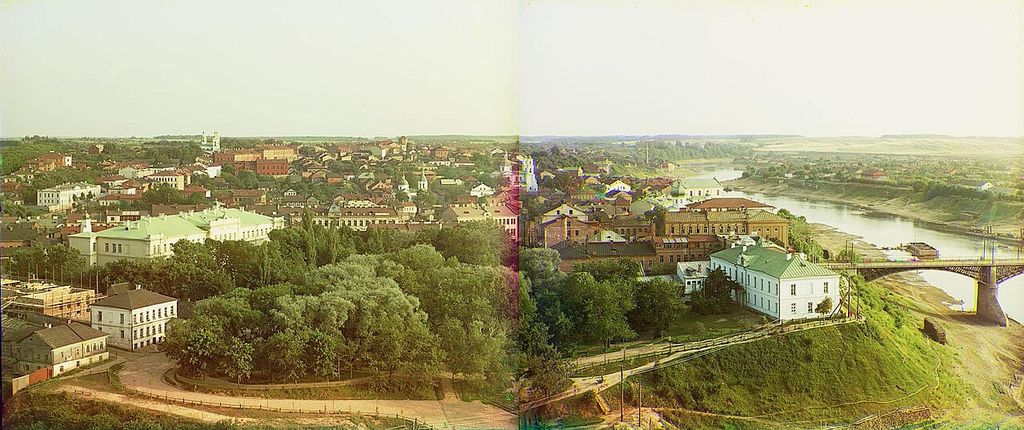
Chagall was born in 1887 when Vitebsk belonged to the Russian Empire. It is now Viciebsk or Vitebsk in independent Belarus. Between those frames it passed through revolution, civil war, Soviet reorganisation, Nazi occupation and postwar reconstruction.[1][2]
Calling it “Russia” can be historically correct for the imperial period while obscuring present-day Belarus. Calling every surrounding place Vitebsk creates another error. Liozno, associated with Chagall's maternal family and summer visits, lies around forty kilometres away and had its own Jewish communal life.[1]
Vitebsk stood at a river junction and transport crossroads. The Western Dvina divides and connects districts; bridges, slopes and banks recur in Chagall's pictures because they were material features of the city, not only symbols.
Its skyline joined Orthodox and Catholic or former Uniate churches with Jewish streets and synagogues. Chagall could use a church tower to locate Vitebsk without making the city culturally homogeneous. Jewish bodies, Yiddish idiom, Hebrew letters and domestic ritual supply a different map within the same view.
The familiar word shtetl also requires care. YIVO uses it for a particular East European small-town social formation; Vitebsk's size, administration and industrial growth exceeded the stereotype.[2][4] Chagall could draw on shtetl memories and nearby villages without turning a city of tens of thousands into a quaint settlement.
The Russian Jewish Encyclopedia records 34,420 Jewish inhabitants in 1897, 52.4 per cent of Vitebsk's population.[3] This numerical majority lived under imperial restrictions associated with the Pale of Settlement and did not translate into equal political power.
Jewish Vitebsk was internally diverse. Hasidic practice, traditional study, craft and trade coexisted with secular education, socialism, Zionism, Yiddish culture and Russian acculturation. The wider Belarusian region belonged to Litvak Jewish history, while Hasidism also gained important adherents there.[4]
Chagall's family inhabited this changing world. His father worked in a herring warehouse near the Dvina; his mother kept a grocery business. He attended heder, learning prayers and biblical passages, and later entered a Russian state school where Jewish enrolment was difficult.[1]
Belarusian archival research gives the school story documentary edges. An 1898 admissions list names “Moyshe Segal”, identifies him as a Jewish townsman and records his imperial-calendar birth date. Two surviving Russian-language examination papers from May 1902 include dictation and a short history of the 1812 war.[27] These records show a Jewish child being measured through the language and patriotic curriculum of the imperial school rather than passing directly from heder into art.
The artist's recurrent herring, shop sign, peddler, fiddler and praying figure emerged from an economic and linguistic environment, not a private dictionary of symbols. They can be autobiographical and social at once.
YIVO's history extends beyond the years Chagall lived there. Soviet institutions later supported and then closed Yiddish education; the Jewish division of the pedagogical institute closed in 1938.[2] A picture of remembered ritual made abroad acquired new significance as the public structures supporting that culture contracted.
The house on Pokrovskaia Street
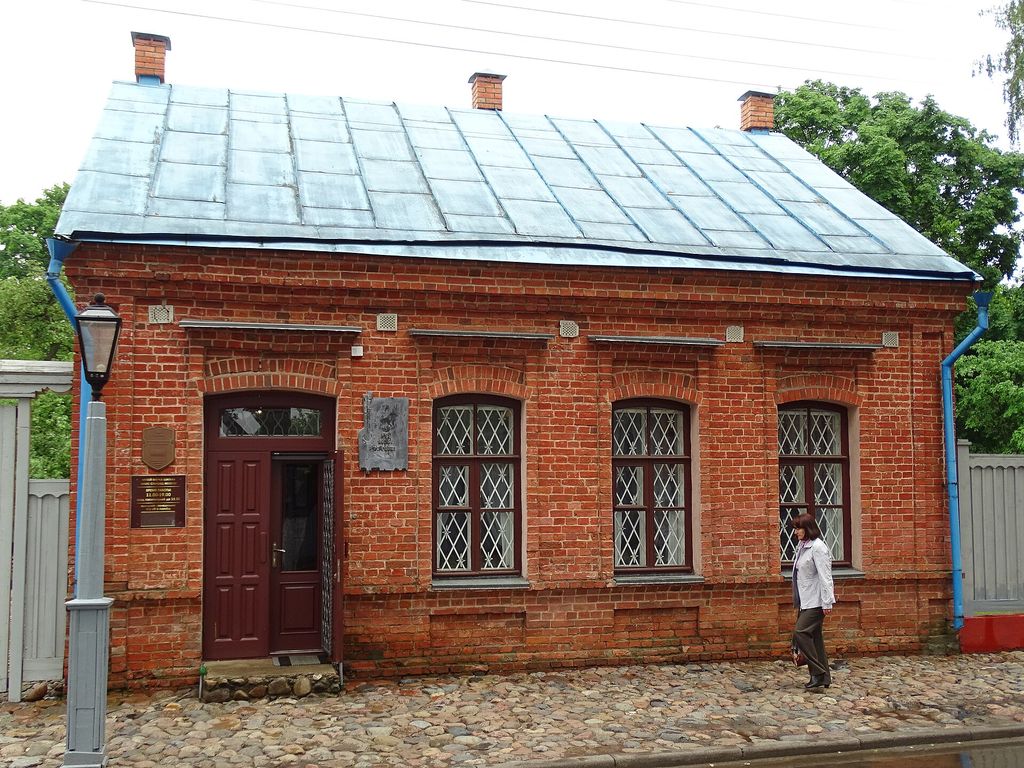
Chagall's father built the brick house on Pokrovskaia Street where the family lived during the artist's youth. It was not the airborne cluster of timber cottages that later came to represent all Vitebsk, but a specific domestic and commercial setting described in My Life.[1][24]
Windows mattered because the house offered framed views from an interior. In a 1977 interview Chagall recalled that as a boy he continually looked out of the window and searched the air and sky.[23] The recollection is retrospective, but it corresponds to an early group of window pictures.
The house now forms part of the Marc Chagall Museum in Vitebsk. Its period household objects, documents and reproductions create an interpretive reconstruction rather than a perfectly preserved childhood interior.[24] A memory site has to decide which date to restore, which missing objects to replace and how to represent a family within a later city.
The gap between house and museum resembles the gap between city and painting. Both retain physical anchors while arranging them for later viewers.
Chagall's first sustained art training came from Yehuda or Yury Pen, a Jewish painter who opened a private school in Vitebsk. Pen practised academically legible portrait and genre painting while treating Jewish workers, elders and local interiors as serious subjects.[1]
This combination was decisive. Professional art did not require leaving Jewish Vitebsk unrepresented, even though Chagall soon rejected Pen's naturalism. The younger artist learned that the barber, watchmaker, house and street could enter painting.
Pen's school also produced or taught artists beyond Chagall. The later revolutionary art school did not arise from empty provincial ground; it transformed an existing local ecology of teachers, students, workshops and ambitions.[5][7]
Chagall left for Saint Petersburg in 1907 because advanced training and professional recognition were concentrated elsewhere. As a Jew without ordinary residence rights in the imperial capital, he experienced the legal distance between provincial home and metropolitan opportunity.[1]
Vitebsk became more visible after he left it. Distance allowed local motifs to meet the lessons of Bakst, Russian modernism and, later, Paris.
Paris remembers Vitebsk
From 1911 to 1914 Chagall painted Vitebsk in Paris using forms associated with Cubism, Fauvism, Orphism, icons and popular prints. The result was not a belated provincial realism. Memory became a method for constructing modern pictures.
In I and the Village, To Russia, Asses and Others and The Cattle Dealer, scale follows association rather than optical distance. A face can confront an animal across the canvas; houses turn over; a street, field and memory of labour occupy one field.
This is sometimes called dream imagery. The term is useful only if dream does not mean arbitrary. Chagall organised repeated relations among human, animal, house, language and ritual.
Formal fracture allowed several remembered moments to remain visible together.
Yiddish is part of the construction. The National Library of Israel explains that the floating peddler in Above Vitebsk draws on an expression for the second-hand dealer who goes “over the houses”, from house to house.[6] A viewer who sees only fantasy misses the verbal hinge.
The same work signs Chagall's name in Hebrew letters and sets a Jewish peddler against a city marked by a dominant cathedral.[6] Vitebsk appears as a field of cultural coexistence and unequal visibility.
Birth: a Vitebsk room reconstructed in Paris
The Art Institute of Chicago records Birth as an oil on canvas of 1911–12, measuring 113.4 by 195.3 centimetres, given by Mr and Mrs Maurice E. Culberg in 1952.[35] Chagall therefore painted this large horizontal interior after moving to Paris, even though its room, clustered bodies and domestic event look back towards the social world he had left. Calling it a Parisian work and a Vitebsk memory are compatible statements about place of production and source.
The title also requires a date caution. Chagall's official archive associates Birth with The Wedding and Death as a youthful group organised around the cycle of life, and elsewhere gives Birth the earlier date 1910.[37] The Art Institute uses 1911–12, while the official biography records its public appearance at the Salon des Indépendants in spring 1913 beside Adam and Eve and drawings.[1][35] A responsible record preserves the museum's current date and notes the competing chronology rather than silently selecting one year.
The cramped room resists the polished convention of a serene maternity scene. Bodies meet from different angles, domestic furniture presses against the action, and the tilted construction makes communal attendance as important as the newborn. Chagall brought a remembered East European interior into contact with the fractured space he encountered in Paris, so Cubist geometry does not replace local subject matter; it permits several viewpoints and reactions to coexist.
This is also why “Expressionist”, “Cubist” or “Surrealist” cannot serve as a complete classification. The work predates Surrealism as an organised movement, while its bodily distortion and spatial compression answer a specific narrative problem. Its later Chicago history adds another layer: an Art Institute photograph shows Chagall standing before Birth with curator Katherine Kuh and director Daniel Catton Rich during his 1946 visit, six years before the Culberg gift entered the collection.[35]
Above Vitebsk and the person over the houses
Chagall returned to the motif of a solitary figure above snow-covered Vitebsk in several works. The National Library of Israel's Above Vitebsk is a 1914 gouache, watercolour and pencil on paper laid on board.[6]
The airborne person is not simply Chagall enjoying supernatural flight. He carries the sack and stick of an itinerant second-hand dealer, an alte-zakhn peddler moving from house to house. The Yiddish verbal association between travelling over or among houses and literal suspension gives the image a social base.[6]
The figure's marginal occupation matters. He is not a prosperous citizen surveying property from above but a poor Jewish worker whose route depends on other people's discarded objects. Enlargement makes a socially minor person monumental while also leaving him homeless within the view.
The Christian cathedral and compact roofs remain materially specific enough to locate the scene. Yet the peddler's position breaks normal topography: he occupies sky, street and idiom at once. This method differs from Surrealist automatism developed later.
Chagall builds strangeness from remembered language and social type.
Related works vary orientation, medium and detail. “Over Vitebsk”, “Above Vitebsk” and “Over the Town” are therefore not interchangeable titles for one picture. The first two usually centre a solitary peddler; Over the Town joins Marc and Bella in flight. Confusing them erases the distinction between precarious labour and conjugal self-image.
The motif also complicates nostalgia. Snow can quiet the city visually, but the traveller remains exposed. Home is present below him without becoming securely his.
Window. Vitebsk and View from a Window in Vitebsk
The legacy title Window Vitebsk points to an early work of 1908, but online records blur at least two titles: Window. Vitebsk and View from a Window in Vitebsk. One is often listed in a private collection while a View from a Window is associated with the Tretyakov Gallery.
The official archive identifies View from the Window in Vitebsk as the setting for one of Chagall's earliest painted bouquets.[16] A vase stands on the sill between sheltered interior and an exterior opened by colour.
The distinction is more than cataloguing pedantry. If two objects are collapsed, collection, dimensions and even depicted place can migrate from one work to another. The legacy claim that the scene is Liozno should therefore not be repeated without a catalogue record securely joining title and object.
What can be said with confidence is that the window operates as a picture within the picture. Frame, sill and curtain acknowledge that landscape is already selected by a viewer standing somewhere.
Chagall's later memory paintings keep this structure even when no literal window appears. Foreground figure and distant town occupy different registers, and the canvas becomes a threshold through which a present life looks towards Vitebsk.
Return under wartime conditions
Chagall returned to Vitebsk in June 1914 after his first major exhibition at Der Sturm in Berlin. He intended a visit and reunion with Bella Rosenfeld. War closed the route back to Paris and turned the planned stay into years in Russia.[1]
The enforced stay produced a new kind of local work. Parisian experiments did not disappear, but direct observation became more insistent. Wooden walls, gates, cemetery inscriptions, roads, soldiers and displaced people enter drawings and canvases.
The distinction between memory and observation is not absolute. Chagall returned as an artist already changed by Paris and Berlin. He saw his birthplace through a visual language developed away from it.
The Grey House, painted in 1917 and now in the Museo Thyssen-Bornemisza, belongs to this wartime city series.[13] Its faceted architecture and steep ground make the city solid and unstable at once. A recognisable Vitebsk building becomes an exercise in grey, brown and fractured plane.
This sober group counters the idea that Chagall's Vitebsk always floats. Weight, timber, mud, masonry and winter are as important as airborne lovers.
The Metropolitan Museum's The Marketplace, Vitebsk makes the public city equally concrete. Painted in 1917, the oil on canvas measures 66 by 97.2 centimetres and came to the Met through Scofield Thayer's bequest.[28] A large Baroque basilica confronts modest stalls and shopfronts across sharply intersecting planes. The contrast records religious and economic hierarchy without turning the square into a calm perspectival survey.
The Met notes that the scene contains no legible sign of the war then surrounding it.[28] Absence is historically useful. Direct observation did not oblige Chagall to document every crisis visibly; a wartime city picture can concentrate on persistent built relations while other drawings address soldiers, injury and displacement.
The Blue House
The Blue House, dated 1917, is held by La Boverie in Liège. A large blue wooden house dominates the foreground while the Dvina and a denser town rise beyond it.[12]
The river divides two built worlds. The open, isolated timber structure sits near the viewer; across the water, walls, roofs and religious monuments compress into an urban band. Blue makes the house conspicuous without making it ethereal.
La Boverie interprets the scene through the opposition between modest open house and closed town.[12] That is persuasive, though not exclusive. Scale may also register attachment: the humble structure grows large because it carries greater emotional weight than the distant centre.
Reflections and faceted banks transmit Parisian formal experience into a local view. Chagall does not choose between Cubist construction and remembered geography. The painting makes their encounter visible.
The exact building need not be his family home for the house to function autobiographically. “Home” in Chagall can be a category assembled from timber, roof, fence and position near water rather than a portrait of one address.
Over the Town
The Tretyakov Gallery dates Over the Town—also translated as Over the City—to 1914–18.[9] It is a large oil on canvas, approximately 139 by 197 centimetres, not the 45 by 56 centimetres frequently copied from an unidentified small record or reproduction.
Marc and Bella fly horizontally above Vitebsk. Their joined dark form crosses a pale sky while houses, fences and lanes spread below. The city is detailed enough to feel inhabited but ordered as a painted terrain rather than a surveyed map.
The couple's flight can express marriage, release and an elevated viewpoint. It also makes them strangely detached. Below, a tiny squatting figure introduces bodily necessity into the celebrated lyricism.
Chagall's humour prevents idealisation from becoming decorous.
The work was completed across war, marriage, the birth of Ida and revolution. A date range better represents that history than the single year 1918 often supplied in popular accounts.[1][9]
Scale again matters. At nearly two metres wide, the town is an environment and the couple a public pictorial claim. Reproduction turns the work into a charming love image; the actual canvas joins love to territorial overview.
The motif also fed revolutionary decoration. The official archive preserves a photograph of a flying-figure banner used in Vitebsk's 1918 anniversary festivities.[1] Personal, Yiddish and civic meanings could move between easel painting and street propaganda without becoming identical.
The revolutionary city as a public canvas
After the October Revolution, Chagall accepted appointment as commissar for the arts in Vitebsk province. For the first anniversary in 1918 he organised decorations across the city, commissioning banners, panels and temporary structures.[1]
Accounts describe green animals and flying figures confronting official expectations. The episode is often romanticised as Chagall colouring an entire city, but it involved students, artisans, committees, materials and political negotiation.
Urban space became a temporary collective artwork. Streets and buildings that had supplied private motifs now carried images intended for a mass public.
The project also exposed disagreement about revolutionary form. Was the new art to communicate political symbols clearly, transform perception, celebrate individual invention or establish an impersonal visual system? These questions would intensify inside the school.
Chagall's participation complicates any portrait of him as an artist naturally opposed to politics. He tried to build institutions under revolutionary conditions, even though administration and ideological conflict eventually drove him away.
The People's Art School officially opened in January 1919 with about 120 students from varied social backgrounds.[1] Chagall wanted access for talented children and workers who had previously lacked professional training.
His initial model was plural. Artists of different tendencies would lead workshops rather than enforce one doctrine. Teachers included Pen, Mstislav Dobuzhinsky, Vera Ermolaeva, Robert Falk, El Lissitzky and, later, Kazimir Malevich.[1][7]
The Jewish Museum's major Vitebsk exhibition restored students and less famous teachers to a story often reduced to three men. Its approximately 120 works and documents included Lazar Khidekel, Ilia Chashnik, David Yakerson, Nina Kogan, Ermolaeva and others.[7]
Jewish modernism was central. YIVO places the school within an East European Jewish artistic renewal while noting that Malevich's non-figurative programme attracted several Jewish students.[5] Jewish identity did not dictate one style.
Nor was the school simply a Jewish academy. Research presented by Moscow's Jewish Museum asks explicitly why Chagall's project did not become one and situates that question within arguments over proletarian art, free workshops and the later UNOVIS programme.[29] A Jewish founder, teachers and students could make Jewish modernism possible without establishing a denominational curriculum.
The boundary was contested. In early 1919 the Jewish Society for the Encouragement of the Arts proposed short courses by sculptor Ilya Ginzburg on Jewish plastic art and Rachel Wischnitzer on Jewish ornament. Archival scholarship reports no answer from Chagall even after a reminder.[30] Silence does not prove opposition, but it complicates claims that every institutional choice followed a settled programme of Jewish national art.
Lissitzky's arrival linked local teaching to print, architecture and propaganda. Malevich's UNOVIS group proposed a collective Suprematist programme whose black square and geometric designs moved across posters, buildings, porcelain and public events.
The conflict between Chagall and Malevich is sometimes narrated as poetic individual versus cold abstraction. That opposition is too neat. Both sought revolutionary transformation, taught students and used the city as a field for new visual practice.
Their difference concerned authority as well as style. Chagall defended plural workshops and the autonomy of personal imagery. Malevich and UNOVIS offered students a coherent system, collective identity and connection to an international project of abstraction.[7][8]
Students voted with their participation. Many moved toward Malevich, leaving Chagall administratively isolated. Claire Le Foll's institutional history shows that salary disputes, governance, resources and changing official structures joined aesthetic disagreement.[8]
Chagall left Vitebsk for Moscow in 1920. He later represented the departure as a consequence of Suprematist takeover, but retrospective testimony should not erase the school's unstable bureaucracy or the appeal UNOVIS held for young artists.
The conflict matters to memory because Vitebsk became two origin stories: Chagall's figurative city of Jews, lovers and animals, and UNOVIS's laboratory of geometric collective modernity. The contemporary museum of the school now has to hold both.
Alongside the school, Chagall worked to create a museum of contemporary art in Vitebsk. The 1919 exhibition of local and Moscow artists assembled 241 works by forty-one artists, including leading figures of the Russian avant-garde.[1]
The proposed museum challenged metropolitan concentration. Provincial students would encounter contemporary art without travelling to Moscow or Petrograd.
War, institutional change and departure prevented a stable Chagall-directed museum. Works were redistributed, lost or absorbed into other collections. Later accounts vary in the names they give the institution because its administrative identity changed.
This dispersal is part of Vitebsk's memory. The city was not only represented by Chagall; it briefly held a modern collection and educational network whose objects and participants then moved elsewhere.
The loss was not a single wartime accident. Archive-based research published by the Institute for Human Sciences reports that a 1929 inventory found the museum's contemporary collection missing; twenty-six works associated with Kandinsky, Ermolaeva, Chagall and Malevich had disappeared, probably destroyed or painted over.[31] The account also notes testimony that students sometimes removed canvases simply because they lacked supports of their own.[31] Poverty, reuse, administrative neglect and ideological rejection all entered the collection's afterlife.
This evidence sharpens the distinction between dispersion and survival. A loan exhibition can reunite works now traceable in outside museums, but it cannot reconstruct objects physically lost or stripped of identity. Museum history here concerns destroyed evidence as well as displaced masterpieces.
The Jewish Museum's 2018–19 exhibition depended on loans from Vitebsk and Minsk as well as European and American collections.[7] Reconstructing the school a century later required gathering a history that no longer existed in one place.
Departure and a city carried abroad
After Moscow and a period in Berlin, Chagall settled in France in 1923. He never returned to live in Vitebsk. In a 1971 radio interview he said he had not gone back and expressed a modest wish that a future museum there might contain two or three of his paintings—a small piece of himself.[11]
That testimony counters a myth of easy return. The artist could travel to the Soviet Union later without reaching his birthplace. Political division, institutional neglect and personal circumstance kept Vitebsk distant.
The motif nonetheless migrated. A 1922 etching and drypoint titled House in Vitebsk, held by the Jewish Museum, translated timber architecture into portable black line.[25] Prints could circulate where the city and its paintings could not.
In France, Vitebsk houses entered bouquets, biblical scenes, crucifixions and lovers pictures. They no longer denoted one date. A church tower or roof cluster might join childhood, marriage, exile and threatened European Jewry in a single background.
This portability is why “memory” should not be understood as faded recollection. Chagall used remembered forms actively, adjusting them to new materials and present crises.
Peasant Life: Russian memory in a French rural idiom
The legacy page calls this work A Peasant, but Buffalo AKG Art Museum catalogues it as La Vie paysanne (Peasant Life), dated 1925, signed and dated at lower left.[36] The museum acquired it from Pierre Matisse Gallery on 9 October 1941 through its Room of Contemporary Art Fund; the documented chain begins with the artist. These title, date, collection and provenance facts replace the unsupported private-collection claim repeated by the old page.
Buffalo identifies the foreground act as a young man feeding carrots to a horse, not a pony receiving a sugar beet.[36] Above them, the great arc of landscape and sky carries smaller scenes: a carriage ride, dancers and a family visible within a building. A sign probably abbreviates the Russian word lavka, or little shop, which the museum connects to the grocery business run by Chagall's mother.
The picture returns to the structural relation between person and animal explored in I and the Village: diagonals and circles bind the principal pair while subsidiary memories ignore normal gravity and scale. Yet the 1925 palette and rural abundance also belong to Chagall's renewed encounter with France after his 1923 return. The man's blue French work jacket and Russian peaked cap make cultural mixture visible within a single figure.[36]
Buffalo interprets the scene's bright colour, dancing and mutual care as an affirmative aspect of Jewish life rather than an image of oppression.[36] That reading is valuable when kept close to the picture, but “peasant” should not be treated as an ethnographic label for every figure. The work assembles folklore, family memory, French landscape and imagination; it does not document one farm outside Vitebsk or provide a transparent record of rural custom.
Autumn in the Village
The Wadsworth Atheneum dates Autumn in the Village to 1939–45 and identifies it as oil on canvas, acquired in 1952 through the gift of Mr and Mrs Alfred Jaretzki Jr.[14]
The range crosses the outbreak of war, the fall of France, Chagall's flight to the United States, the mass murder of Vitebsk's Jews and Bella's death. Treating it simply as a colourful rural landscape empties the date of meaning. Schirn's World in Turmoil research places the recurrent Vitebsk motif at the centre of Chagall's response to persecution, displacement and threatened cultural identity during precisely these years.[18]
Village, animal, human profile and slanting forms occupy an autumnal field where abundance and danger coexist. The season can suggest ripeness and decline without operating as a fixed allegory.
Its place is composite. “Village” need not mean that Chagall copied one Vitebsk street, and the work's long execution makes a single location improbable. The remembered town has become a structure able to receive several historical moments.
The Wadsworth's current Jewish Art and Culture Research Project is re-examining terminology, provenance and Jewish contexts across its collection, using this Chagall as one focus.[14] Museum interpretation is therefore ongoing rather than settled.
Vitebsk during the Holocaust
German forces occupied Vitebsk in July 1941. Soviet evacuation began late, leaving many residents trapped. Occupiers confined Jews in a ghetto and carried out mass murder during 1941.[19]
Victim totals and the chronology of individual killing actions vary among records. Yad Vashem's ghetto research provides the controlling framework; the manuscript should not produce a falsely exact number from incompatible postwar estimates.[19]
The Foundation Memorial to the Murdered Jews of Europe gives the range as 8,000 to 13,000 deaths, while also reporting that about 16,000 Jews remained in Vitebsk when the ghetto was imposed.[32] It dates a major liquidation action to 8 October 1941 and the following days, when approximately 10,000 men, women and children were taken to a ravine outside the city and shot.[32] The different totals reflect evacuation, hunger and disease, successive killing actions, territorial definitions and incomplete records; they should not be forced into one apparently exact figure.
Local documentary work adds street-level evidence. The Vitebsk-based Mishpokha chronicle, produced with archival and Yad Vashem assistance, reproduces a municipal order of 16 September 1941 forbidding non-Jews to enter the ghetto and maps surviving buildings and former street names.[33] Such evidence restores the ghetto as a coerced urban space, not merely a number attached to the city's edge.
The city's destruction was demographic, cultural and architectural. Synagogues, schools, households and neighbourhood networks that had sustained Jewish Vitebsk were killed or dispersed. Later Soviet reconstruction changed the physical city further.
Chagall did not witness the ghetto. His wartime images should not be treated as documentary depictions of events he could not see. News of persecution, personal knowledge of the city and the symbolic vocabulary of burning houses and crucifixion nevertheless made Vitebsk central to his response.
After 1941, the painted town could no longer be received only as childhood nostalgia. Roofs and figures also became remains of a social world. That later knowledge changes viewers even when a work was begun earlier.
Destruction did not mean that no Jews returned. The memorial-site research records a Jewish population of about 17,000 in 1970, followed by heavy emigration and a fall to roughly 2,800 by 1999.[32] Continuity and rupture therefore coexisted: a postwar community lived in Vitebsk, but not within the demographic or institutional world Chagall had known.
Material religious continuity was even thinner. More than fifty prewar synagogues had vanished; one ruined building on Revoliutsionnaia Street served for decades as a pharmaceutical warehouse, while a new synagogue was consecrated only in 2017.[32] The conversion of sacred architecture into storage and ruin gives a harder historical measure than a general claim that “old Vitebsk disappeared”.
Commemoration came late and remained uneven. A small stone near a building once inside the ghetto was probably installed in 1995, while the principal shooting site near Tulovo received a dedicated memorial in 2010 with Hebrew, Belarusian and English inscriptions.[32] Soviet public memory had foregrounded partisan heroism and victory while rarely naming Jewish genocide separately. Chagall's painted town entered museums within that contested landscape of naming.
In My Country
Dans mon pays, usually translated as In My Country or In My Village, was made in 1943 during Chagall's American exile. GAM Turin records gouache and tempera on paper mounted on canvas.[17]
The title's possessive is significant. “My country” does not map cleanly onto a state. Chagall had been born in an empire, worked in revolutionary Russia, become a French citizen and fled to the United States. The claimed country is a remembered cultural and pictorial territory.
Snow, dark sky, village forms and hybrid creatures produce a nocturnal homeland assembled at distance. The work is not evidence that the depicted place lies in rural Lithuania, as one aggregation suggests; Vitebsk's historical region and Chagall's composite memory require more careful naming.[17][26]
The 1943 date places the image during news of European Jewish destruction. Quietness is therefore not innocence. A snow-covered settlement can register distance, suspension and danger without illustrating a particular massacre.
Material helps. Gouache and tempera on paper offer a matte, immediate surface, while mounting on canvas stabilises the sheet as an object for exhibition. It is neither an oil landscape nor a colour lithograph.
Blue Landscape
Chagall's official archive records Blue Landscape of 1949 as gouache and watercolour on cardboard, 79 by 57 centimetres.[15] It should be distinguished from a 1958 colour lithograph with the same English title.
The 1949 work joins an embracing couple, flowers, bird or cockerel, fish-moon and dark star within blue. Calling it a literal landscape stretches the category: figures and emblems make a vertical field of relation rather than a view organised by horizon.
Chagall had returned to France, but return to Europe did not restore the destroyed Vitebsk or Bella. Blue holds present love, memory and night without assigning each form one biographical identity.
Popular explanations that a rooster proves childhood chicken farming or a fish records family diet are unsupported. Animals in Chagall's work accumulate biblical, folkloric, domestic, linguistic and compositional roles. Their recurrence cannot be reduced to one anecdote.
The work belongs to Vitebsk memory because village architecture and creatures form a portable homeland, yet southern France and postwar experience also enter its colour. Memory does not exclude the new landscape; it organises contact with it.
Provence as a “new Vitebsk”
In ceramics made after settling in the south of France, Chagall incised houses and bell towers into clay. Official catalogue research on Lovers and the Beast notes versions whose villages evoke Vitebsk and describes the native city as a symbolic earth carried into a new material.[22]
Other works replace those cottages with Vence or Saint-Paul-de-Vence. A Provençal hill town could become a “new Vitebsk” because steep streets, animals, churches and craft offered structural analogies without erasing geographic difference.[22]
Clay changes memory. A painted town appears on a plane; an incised town curves around a vessel and must be turned in the hand. Houses become part of an object associated with storage, nourishment and earth.
The movement also prevents an exclusively nostalgic reading. Chagall formed new roots, collaborated with ceramic workshops and translated old motifs through Mediterranean light and material.
Vitebsk was therefore not the only place he could love. It remained the matrix through which later places became pictorially inhabitable.
Late self-portraits and the city inside the artist
In The Artist's Family Appears, begun in 1935 and reworked through 1947, Chagall places himself with palette before parents, bride, angel, animal and a blue Vitebsk silhouette.[20] Family members and city arrive as apparitions across time.
The picture is not a family gathering that occurred. It is an archive constructed by paint, with dead and living figures sharing a field. Vitebsk acts as the ground from which their images become available.
In The Great Face of 1969, an enlarged yellow self-portrait is surrounded by inverted wooden houses, blue cock, church and possible parental figures.[21] The artist does not look back at a separate landscape; remembered architecture occupies the space of self-representation.
These late works show why recurring motifs are not evidence of creative exhaustion. Repetition changes the relation among artist, city and time. An early observed roof becomes a late component of identity.
At the same time, recurrence can harden into a public trademark. Museums and markets have helped make the Vitebsk cottage instantly “Chagallian”, sometimes detaching it from Jewish history and the specific city's destruction.
Return through museums
Chagall's name had a difficult Soviet afterlife. Formalism, emigration and Jewish particularity limited official recognition, even while major early paintings remained in Moscow and Leningrad collections.
The 1969 Grand Palais retrospective was able to borrow four important paintings from Soviet museums, evidence of selective institutional reopening.[10] The works could travel west while the artist still did not return to Vitebsk.
Late Soviet and post-Soviet initiatives restored local visibility. The house museum opened in the 1990s; the Vitebsk Art Centre and the Museum of the History of the Vitebsk People's Art School developed separate approaches to his life and the avant-garde institution.[24]
Recovery initially depended on reproductions and graphics rather than returned paintings. Martinovich records that a 1988 display of photocopies from Moscow magazines was stopped by local Communist authorities, even as perestroika reopened Chagall's name.[31] A regional museum guide now describes more than 300 original graphic works in the Vitebsk collection, including Dead Souls, Bible and Twelve Tribes of Israel series.[34] The medium of return matters: portable multiples rebuilt a local corpus where early paintings had vanished.
The school museum opened in its restored historic building a century after the 1918 project. Reconstruction follows surviving plans and exposes fragments of old fabric, but it also reflects present-day cultural policy. It is not the untouched school Chagall left.
Commemoration divides attention among Chagall, Malevich, Lissitzky, Pen, teachers and students. That plurality is historically appropriate. The city was a network, even when later fame made one artist its international emblem.
Memory, evidence and loss
Chagall's Vitebsk contains at least four cities. The first is the observed place of windows, riverbanks, shops and family life. The second is the modernist city reconstructed in Paris.
The third is the revolutionary laboratory where painting entered streets, school and museum. The fourth is the lost city carried through exile after Soviet suppression and Nazi mass murder.
No one canvas contains all four equally. The Blue House remains close to wartime observation; Over the Town joins lived city to marriage and revolution; In My Country claims a homeland from American exile; late self-portraits place roofs inside personal identity.
Topographic accuracy and imaginative transformation are not opposites. A cathedral, river or wooden house can be identified while scale, orientation and colour reorganise its meaning. Chagall preserved Vitebsk precisely by refusing to freeze it as a single view.
Historical research also limits what the images may be asked to do. They cannot replace census, institutional archives or Holocaust testimony. Chagall's city privileges family, animals, workers, ritual and artistic conflict; other Vitebsk lives remain outside his frame.
The achievement lies in making memory visibly active. Houses tilt because recollection is being rebuilt. Figures enlarge because emotional and linguistic weight exceeds optical distance.
Vitebsk survives in the work neither as a vanished paradise nor as a neutral map, but as a place continually altered by leaving, carrying, losing and looking again.
Discussion
Which piece of evidence most changes the way you read Marc Chagall Vitebsk and Memory?
Reader Insights
Which visible detail most changes your reading of Marc Chagall Vitebsk and Memory?
How do medium, setting and documented history shape the encounter?
What remains uncertain when documented fact is separated from interpretation?
Join the Conversation
Share your reading of Marc Chagall Vitebsk and Memory below.
References
- Marc Chagall official archive, “Biography”
- YIVO Encyclopedia, “Vitsyebsk”
- Russian Jewish Encyclopedia, “ВИТЕБСК”
- YIVO Encyclopedia, “Belarus”
- YIVO Encyclopedia, “Painting and Sculpture”
- National Library of Israel, Above Vitebsk
- Jewish Museum, Chagall, Lissitzky, Malevich: The Russian Avant-Garde in Vitebsk, 1918–1922
- Claire Le Foll, The Vitebsk Art School, Russian text
- Tretyakov Gallery, seminar on Над городом
- Marc Chagall official archive, 1969 retrospective interviews
- Marc Chagall official archive, 1971 Radioscopie interview
- La Boverie, The Blue House
- Museo Thyssen-Bornemisza, The Grey House
- Wadsworth Atheneum, Jewish Art and Culture Research Project
- Marc Chagall official archive, Blue Landscape
- Marc Chagall official archive, “Flowers”
- GAM Turin, Deposito Vivente collection guide
- Schirn Kunsthalle, Chagall: World in Turmoil
- Yad Vashem, Vitebsk ghetto encyclopedia
- Marc Chagall official archive, The Artist's Family Appears
- Marc Chagall official archive, The Great Face
- Marc Chagall official catalogue raisonné, Lovers and the Beast
- Marc Chagall official archive, 1977 Louvre interview
- Marc Chagall Museum, Vitebsk
- Jewish Museum, House in Vitebsk
- Google Arts & Culture, The Dreamlike Visions of Marc Chagall
- E. V. Karpova, “The Pride of Three States: Marc Chagall's Documentary Heritage in Russia, Belarus and France”, archival study
- Metropolitan Museum of Art, The Marketplace, Vitebsk, 1917
- Jewish Museum and Tolerance Center, “The Vitebsk Art School: From Chagall to Malevich”
- Arkady Zeltser, “Jewish Artists of Vitebsk, 1917–1941: Between the National and the Universal”
- Victor Martinovich, “Marc Chagall: Vitebsk's Unwanted Son”, Institute for Human Sciences
- Foundation Memorial to the Murdered Jews of Europe, “Memorial to the murdered Jews of the Vitebsk Ghetto”
- Mishpokha, Chronicle of Terrible Days: The Tragedy of the Vitebsk Ghetto
- Museums of the Vitebsk Region, English collection guide
- Art Institute of Chicago, “Chagall and Stained Glass”, collection context for Birth
- Buffalo AKG Art Museum, La Vie paysanne (Peasant Life)
- Marc Chagall official archive, Death