


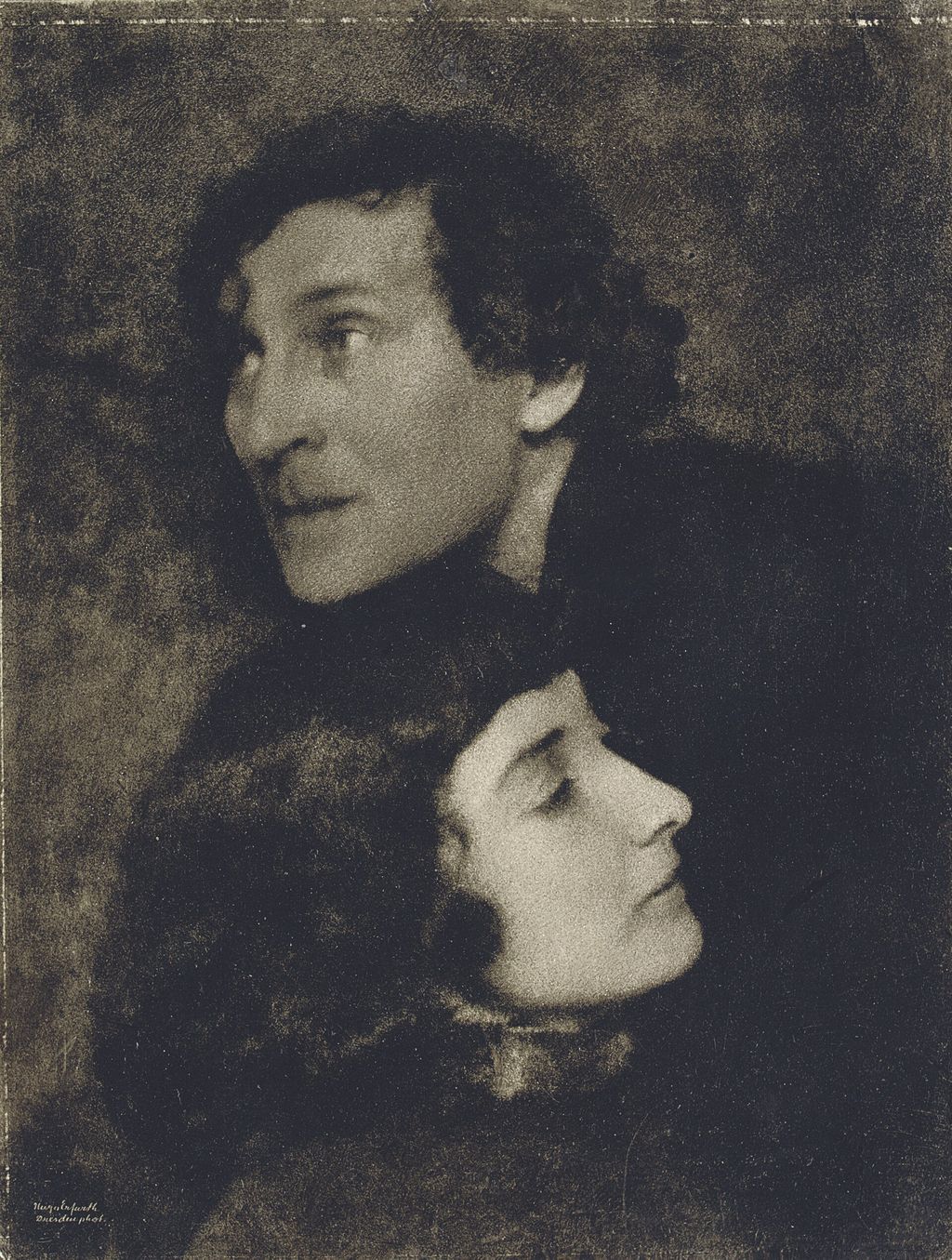
 by Tom Gurney
Tom Gurney BSc (Hons) is an art history expert with over 20 years experience
Page Created on September 22, 2026 / Page Updated on September 22, 2026
Email: tomgurney1@gmail.com / Phone: +44 7429 011000
Introduction
Marc Chagall's The Promenade turns a recognisable outing into an image whose physical impossibility is immediately clear and whose emotional logic remains persuasive. Chagall stands on the grass with a bird in one hand. With the other he holds Bella Rosenfeld Chagall, who sweeps almost horizontally across the sky. A red picnic cloth, food and drink occupy the foreground; Vitebsk extends behind them. The painting joins portrait, landscape and still life while refusing the normal gravity of all three.
The State Russian Museum in Saint Petersburg owns the canvas. Its object record calls it Прогулка (Promenade or The Walk), dates it 1917, identifies the medium as oil on canvas, gives the dimensions as 170 by 163.5 centimetres and assigns the inventory number ЖБ-1726.[1] Other museum and exhibition records use 1917–18. That variation should be kept visible rather than silently resolved: the owner's catalogue supplies the controlling date, while the wider range describes the period in which Chagall developed this group of double portraits.[2]
At a Glance
- ArtistMarc Chagall
- ArtworkThe Promenade
- Artistic contexttwentieth-century modern art
Contents
- An event held together by one hand
- What the Russian title permits
- Bella, marriage and a family chronology
- A cycle rather than an isolated emblem
- The surviving study and the making of the pose
- The picnic as still life and threshold
- The bird, branch and competing metaphors
- Vitebsk as lived place
- Jewish emancipation and the revolutionary horizon
- Cubist construction without analytic fracture
- Colour, costume and social visibility
- Humour, performance and the viewer
- Provenance and the early Soviet museum system
- Exhibition life and shifting frames
- Material evidence and its limits
- Interpretations that the evidence can bear
- Why The Promenade endures
An event held together by one hand
The joined hands are the picture's mechanical centre. Chagall's arm rises from a planted, dark-suited body; Bella's arm continues the line into her long diagonal flight. The contact is small compared with the mass it appears to bear. What looks at first like effortless levitation therefore depends on visible exertion. His stance, her extension and the grip between them turn affection into a structure.
Chagall does not merely place an airborne woman above a landscape. He constructs a system of counterweights. His body widens towards the ground, while Bella's narrows towards their hands and expands into the sky. The picnic cloth spreads laterally across the lower edge. The town forms a band of smaller shapes between the monumental couple and the distant horizon. Each zone answers another: earth and air, still life and body, frontal display and recession.
At 170 centimetres high, the canvas is close to a human scale. Reproduction can make it seem like a charming illustration, but the original dimensions make Bella's suspended body confront the viewer as an improbable physical presence. Chagall's raised arm is not a decorative flourish. It appears to carry a nearly life-sized partner.
What the Russian title permits
The Russian noun progulka means a walk, stroll or outing. Promenade, the common English and French title, adds a slightly more formal tone, but none of these translations names flight. The title begins with an ordinary social activity and lets the image transform it. This mismatch is part of the work's humour: a couple has gone for a walk, yet one partner has left the ground.
The owner classifies the painting as a portrait and describes it specifically as a double self-portrait with Bella.[1] This matters because the figures are not generic lovers added to a fantasy landscape. The man is the artist representing himself; the woman is his wife; the town is connected to their lives. The painting's metaphor begins in biography but does not end there.
Bella, marriage and a family chronology
Chagall married Bella Rosenfeld in Vitebsk in 1915, and their daughter Ida was born in May 1916. The Musée national Marc Chagall places The Promenade within the intensely productive Russian years that followed Chagall's enforced return from Western Europe during the First World War.[3] Bella was neither an anonymous muse nor merely a repeated visual type. She came from an educated Vitebsk family, wrote in Yiddish, and later shaped the literary record of the world that the couple had known.
The chronology guards against a familiar simplification. The painting celebrates a marriage already two years old and a family that already included a child. It is not a literal wedding portrait. The festive still life may recall a marriage feast, as the Russian Museum proposes, but the work also considers the continuing condition of being a couple: attachment, imbalance, pleasure and trust.[1]
Bella's identity should likewise restrain readings that make her only an embodiment of the artist's imagination. Chagall controls the painted image, but he represents the relationship as reciprocal and risky. Bella occupies more sky than he does. Her body sets the picture's longest direction. The figure apparently being held is also the force that pulls the standing artist out of a closed, stable pose.
A cycle rather than an isolated emblem
The Russian Museum identifies The Promenade as part of a 1917–18 cycle of self-portraits with Bella in which the motif of flight receives an especially direct expression.[1] The Centre Pompidou defines a closely related group of four major paintings: Over the Town, The Promenade, The Apparition (Self-Portrait with the Muse) and Double Portrait with a Glass of Wine.[4] Seen together, they show Chagall repeatedly changing the distribution of bodies, landscape and gravity.
In The Birthday, made in 1915, a kiss bends two figures inside a room. In Over the Town, dated 1914–18 by the Tretyakov Gallery, Marc and Bella travel together above Vitebsk.[5] In Double Portrait with a Glass of Wine, Bella supports Marc on her shoulders while an angel hovers above them.[4] The Promenade gives each partner a different relation to the ground: one stands, the other flies, and their hands keep the two conditions connected.
These variations make a fixed equation such as “flight means love” inadequate. Chagall treats flight as a flexible pictorial operation. It can compress an interior, release two bodies over a town, elevate the artist through Bella's support or stretch a couple across the boundary between field and sky. Love is a subject, but serial invention is part of the meaning.
The surviving study and the making of the pose
The Centre Pompidou preserves a study for La Promenade, dated about 1917, in graphite and ink on paper. It measures only 24.4 by 21.8 centimetres and entered the French national collection by dation in 1988.[6] The drawing is important evidence that the painted arrangement was developed through preparation rather than simply poured onto the canvas as spontaneous fantasy.
It also resolves a provenance confusion. The 1988 dation belongs to the Pompidou study, not to the Russian Museum painting. The painting's owner records its arrival in 1920 from the State Museum Fund of the Fine Arts Department of the People's Commissariat for Education.[1] Keeping the two objects separate prevents the acquisition history of a work on paper from being transferred to the oil painting.
The existence of a study encourages close attention to design. The long armature made by the coupled hands, the opposing directions of Bella and the cloth, and the compression of architecture below the figures are considered choices. Chagall's fantastic event has the clarity of an emblem because he worked out how it would carry across a nearly square field.
The picnic as still life and threshold
The red textile at the lower edge supports bread or food, a bottle, a glass and utensils. The Russian Museum compares this still life to a wedding banquet and places it among the canvas's authorial metaphors.[1] That interpretation is plausible without being exclusive. The objects also identify an outdoor meal and give the extraordinary scene an everyday occasion.
The cloth operates spatially as well as symbolically. It tilts towards the viewer, making its contents unusually available, while the town recedes behind it. Its sharp corners and broad red field make a platform at the bottom of the image. Bella's reddish-purple dress answers it in the sky, so colour binds the airborne body back to the material scene.
Food, glass and cloth introduce domestic provision into a public landscape. They prevent freedom from becoming pure escape. The couple's delight remains attached to eating, holding, dressing and occupying a piece of ground. Chagall's marvel occurs through the ordinary rather than in a separate supernatural realm.
The bird, branch and competing metaphors
Chagall holds a small bird close to his torso. A bird seems an obvious emblem for Bella's flight, yet the contrast is more interesting than a simple correspondence. The creature with wings is contained in a hand; the human body without wings occupies the open sky. Nature's expected order has been exchanged.
The Russian Museum also points to a tender branch beginning to blossom against the sky.[1] Bird and branch can support readings of spring, renewal, fertility or freedom, but none has the status of a documented one-to-one code. Their strongest evidence lies in their placement. The compact bird near Chagall echoes the large flying Bella, while the fine branch mediates between the close figures and the distant landscape.
This is why a symbolic inventory can flatten the painting. Chagall did not need the bird to “stand for” freedom when the whole composition performs release and restraint. The bird, branch, bottle and feast acquire meaning through relationships of scale, possession and repetition.
Vitebsk as lived place
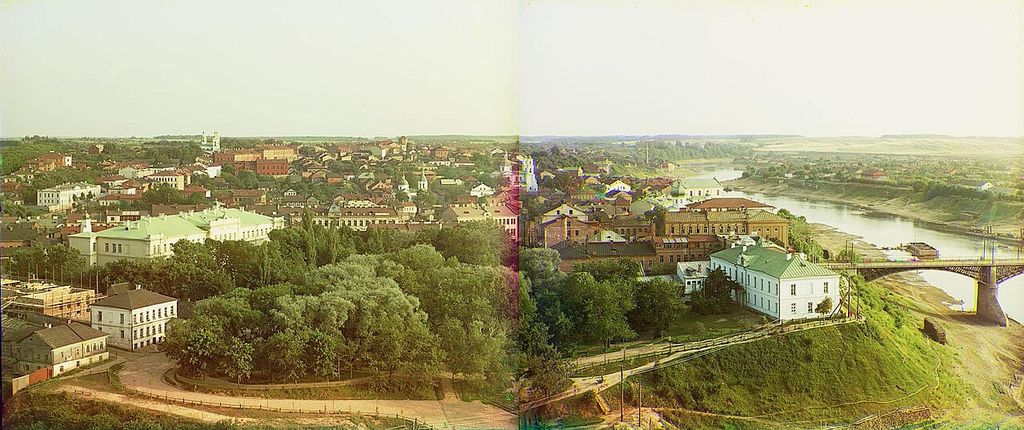
In 1914 Chagall came back to Vitebsk from Berlin expecting to remain only briefly, but war prevented his return to Paris. He married there, then lived for a time in Petrograd before becoming arts commissar for the Vitebsk region in 1918.[3] The Promenade therefore differs from his earlier Paris paintings of Vitebsk recalled at a distance. Here the town was present environment as well as remembered home.
The buildings are not a neutral backdrop. Their compressed scale lets the couple dominate, yet roofs, fences and religious architecture identify a social landscape rather than an empty pastoral. Chagall tests devices absorbed from Parisian modernism against renewed experience of his birthplace. The Musée national Marc Chagall describes the Russian-period work as combining fantasy with borrowings from Futurism, Cubism and Suprematism, using firm contours and strong, pale colour.[3]
A useful comparison is The Marketplace, Vitebsk of 1917, now at the Metropolitan Museum of Art. Its lower viewpoint, denser buildings and absence of monumental lovers show that Chagall could make the town itself carry the subject.[7] In The Promenade, by contrast, Vitebsk is deliberately subordinated to the enlarged couple. That difference is a compositional decision, not proof that the town mattered less.
Jewish emancipation and the revolutionary horizon
The date 1917 cannot be treated as incidental. The February Revolution ended legal disabilities that had constrained Jews in the Russian Empire, and Chagall initially embraced the new civic possibilities. The Musée national Marc Chagall connects his revolutionary hopes to Jewish citizenship and to his later belief that an open art school could change public life.[3] The Jewish Museum in New York describes the People's Art School that he founded in 1918 as an experiment joining education, collectivism and avant-garde invention.[8]
This context makes liberation a historically charged theme, especially for a Jewish artist representing himself and his wife at ease in a broad landscape. Yet the painting contains no flag, slogan, crowd or identifiable revolutionary ceremony. Bella should not be converted into a personification of February or October. The responsible claim is narrower: personal happiness, public visibility and bodily release acquired new resonance in a suddenly altered civic world.
Chronology also prevents hindsight from making the picture a simple celebration of Bolshevik success. The institutional conflicts at Chagall's school came later, as teachers including El Lissitzky and Kazimir Malevich advanced different accounts of revolutionary art.[8] The Promenade precedes that contest. Its freedom is intimate and relational, not a programme for Suprematism or state culture.
Cubist construction without analytic fracture
Chagall's contact with Cubism did not make him abandon figures, narrative or local memory. In The Promenade, modernist construction appears in tilted planes, abrupt changes of scale and the assembly of several viewpoints. The picnic cloth is seen more from above than the standing man; the town drops away quickly; Bella lies across the sky without a plausible recession into depth.
These discontinuities allow the story to remain readable while ordinary space breaks apart. Chagall's body supplies a dark triangular anchor. Bella becomes a long, widening diagonal. The red cloth establishes another plane at the bottom. Architecture is packed into small coloured units between them. The image feels clear because its distortions are organised.
The National Portrait Gallery's cataloguing of the work usefully lists both sitters and identifies landscape, glass, foliage, architecture and bird among its subjects.[9] That administrative description unintentionally captures the painting's hybridity. It is simultaneously a double portrait, a Vitebsk landscape, a still life and an invented bodily event. No single genre contains it.
Colour, costume and social visibility
Chagall's dark suit, pale shirt and broad smile make him conspicuous against the green field. Bella's dark red-purple dress is outlined against a light sky, becoming the canvas's largest continuous colour shape after the landscape. Their clothing identifies a modern couple on an outing rather than timeless mythological beings.
Costume contributes to the impossibility. Bella does not fly because fabric has become wings. Her dress retains weight and volume, increasing the burden implied by Chagall's stretched arm. His formal suit is equally unsuited to athletic exertion. Social decorum and bodily absurdity coexist.
The painting's strong reds and greens can look simply celebratory, but their placement is disciplined. Red passes between cloth, dress and small architectural notes. Dark masses connect the two figures while their scale separates them. Pale sky creates the visual interval across which the handclasp must work.
Humour, performance and the viewer
The Promenade is joyful and knowingly comic. Chagall grins towards the viewer while displaying the bird and holding up Bella, as though presenting two marvels at once. The frontal stance makes him part lover, part painter and part stage performer. Bella's rigid extension is too extravagant to be mistaken for natural movement.
Humour protects the painting from solemn allegory. The impossible feat is offered with picnic directness rather than mystical darkness. At the same time, the joke does not cancel feeling. Its success depends on our recognition that attachment can feel both burdensome and enabling, absurd and exact.
The viewer occupies an unstable position. We look down onto the cloth, across at Chagall and up towards Bella. Chagall's multiple spatial cues make us reconstruct the scene rather than stand securely before it. The work invites delight while making ordinary viewing conditions as unsettled as gravity.
Provenance and the early Soviet museum system
The painting's documented transfer to the Russian Museum in 1920 is a major part of its history.[1] The State Museum Fund redistributed works during the reorganisation of collections after the Revolution. The Promenade therefore entered a public Russian institution within a few years of its creation, rather than following Chagall when he left Russia in 1922.
That early accession has consequences for reception. The painting became available to histories of Russian and Soviet modernism from within a national collection, even as Chagall's career continued in France and his international reputation grew. It now sits inside a Russian Museum avant-garde collection whose institutional formation began in the same post-revolutionary period.[10]
Provenance language must remain exact. “Received in 1920” documents institutional entry; it does not by itself reveal every earlier movement, ownership decision or circumstance of transfer. A complete pre-1920 chain is not supplied in the public object record. The source supports a transfer from the State Museum Fund, not a speculative account of confiscation, sale or gift.
Exhibition life and shifting frames
The work has circulated through several interpretive frames. The Russian Museum included it in a 2016 exhibition in Málaga pairing Chagall with Russian contemporaries.[11] It appeared in the international project Chagall, Lissitzky, Malevich: The Russian Avant-Garde in Vitebsk, 1918–1922, where the familiar lovers opened onto the institutional struggle over art and revolution.[8] In 2025 it was listed in the Russian Museum's large permanent display Our Avant-Garde, among works by Kandinsky, Goncharova, Malevich, Popova and others.[10]
In 2026 the Russian Museum lent the painting to the National Art Museum of the Republic of Belarus in Minsk for a one-work exhibition, describing it as the first presentation of the canvas in Chagall's homeland.[12] That wording reflects a present-day national geography: Chagall's Vitebsk birthplace is now in Belarus, while the painting belongs to a museum in Russia. The loan made place, ownership and cultural inheritance unusually visible.
Exhibitions do not merely confirm fame. They change the neighbours through which the work is understood. Beside intimate double portraits it becomes a chapter in Chagall and Bella's marriage; beside Malevich and Lissitzky it becomes a figurative answer to revolutionary abstraction; in Minsk it becomes an object returning to the country of the artist's birth. Each frame reveals something, and none exhausts the canvas.
Material evidence and its limits
The public Russian Museum record identifies oil on canvas and supplies exact dimensions, inventory number and acquisition route.[1] It does not publish a conservation report, pigment analysis, X-radiograph, infrared study or detailed account of the support and paint layers. The Pompidou drawing proves that at least one preparatory work survives, but it cannot substitute for technical examination of the canvas.[6]
Claims about underdrawing, repainting, pigment choice, studio changes or original surface must therefore be withheld unless a conservation source emerges. Visual description can establish that areas appear flat, bounded or layered in reproduction; it cannot determine materials or sequence with scientific precision. This limit is itself part of responsible object history.
The discrepancy between 1917 and 1917–18 is likewise a cataloguing issue rather than evidence of a known campaign of physical revision. The owner currently says 1917; several specialist institutions use the range.[1][3] Without a dated technical study or documentary statement, the manuscript should preserve both practices and avoid inventing an explanation.
Interpretations that the evidence can bear
Three readings can coexist. The biographical reading sees a celebration of Bella and marriage. The historical reading places Jewish emancipation and revolutionary possibility around the couple. The formal reading sees a highly controlled experiment in weight, scale and pictorial balance. Each has institutional and visual support; none should displace the others.
The weakest readings turn every object into a fixed symbol or treat the painting as direct political propaganda. A bird may suggest freedom, but it is also a shape held in a hand. A feast may recall marriage, but it is also a picnic still life. Flight may resonate with emancipation, but it remains part of a sequence in which Chagall repeatedly reorganised lovers in space.
The painting's durable achievement lies in how those levels interact. Biography gives the figures names. History makes their public presence consequential. Design makes the impossible action convincing. Humour keeps the whole construction alive.
Why The Promenade endures
The premise can be understood in a glance, yet its implications expand under scrutiny. One body is grounded, another airborne; an ordinary meal meets an altered sky; a private marriage occupies a city landscape; a Russian Jewish artist presents himself within the political upheaval of 1917. The painting holds these conditions through a single small contact.
Attachment is neither simple restraint nor unrestricted escape. Bella's flight depends on Chagall's grip, while his balance is tested by the force he holds. Their difference becomes the source of the composition's energy. Chagall turns love into a problem of physics, and then solves it through paint.
Discussion
Which piece of evidence most changes the way you read The Promenade?
Reader Insights
Which visible detail most changes your reading of The Promenade?
How do medium, setting and documented history shape the encounter?
What remains uncertain when documented fact is separated from interpretation?
Join the Conversation
Share your reading of The Promenade below.
References
- State Russian Museum, “Прогулка” [Promenade], collection record, View Source
- State Russian Museum, “Chagall: A Promenade at the Art Museum”, exhibition record, View Source
- Musée national Marc Chagall, “Biography of Marc Chagall”, View Source
- Centre Pompidou, “Double portrait au verre de vin”, collection analysis, View Source
- State Tretyakov Gallery, “New Tretyakov Gallery”, collection display including Over the Town, View Source
- Centre Pompidou, “La Promenade”, preparatory drawing, View Source
- Metropolitan Museum of Art, “Marc Chagall: The Marketplace, Vitebsk”, View Source
- The Jewish Museum, New York, “Chagall, Lissitzky, Malevich: The Russian Avant-Garde in Vitebsk, 1918–1922”, View Source
- Smithsonian National Portrait Gallery, “Promenade (Marc Chagall and Bella Chagall)”, View Source
- State Russian Museum, “Permanent exhibition ‘Our Avant-Garde’”, View Source
- State Russian Museum, “Opening of the exhibitions in Málaga”, View Source
- State Russian Museum, “Minsk hosted the Russian Museum Days”, View Source