


 by Tom Gurney
Tom Gurney BSc (Hons) is an art history expert with over 20 years experience
Page Created on September 22, 2026 / Page Updated on September 22, 2026
Email: tomgurney1@gmail.com / Phone: +44 7429 011000
Introduction
Marc Chagall’s Paris Through the Window turns a studio view into an unstable account of modern life. The Eiffel Tower rises at the right; an upside-down train moves behind coloured panes; a parachutist descends through angled light. Inside, a human-faced cat confronts a blue, two-faced person who holds a heart and a flower.
Window, city, body and animal occupy the same fractured field.
Painted and dated in 1913, the canvas belongs to the Solomon R. Guggenheim Museum’s Founding Collection, accession 37.438. The Guggenheim records it as oil on canvas measuring 136 by 141.9 centimetres.[1][3] A Philadelphia Museum of Art exhibition record gives 135.8 by 141.4 centimetres.[2]
The small discrepancy should be retained as a difference between institutional records rather than silently averaged.
At a Glance
- ArtistMarc Chagall
- ArtworkParis Through the Window
- Artistic contexttwentieth-century modern art
Contents
- A window that does not separate worlds cleanly
- The blue double face
- The cat at the threshold
- Paris as a field of modern events
- Was the parachutist Franz Reichelt?
- Delaunay, Orphism and simultaneous colour
- La Ruche and an international neighbourhood
- An immigrant Jewish artist without explicit Jewish signs
- Thin paint and visible planning
- Title, poetry and the problem of “dream”
- Cendrars, the title and a bilingual Janus
- From private choice to a founding collection
- A second Paris Through the Window
- A Paris network larger than one influence
- What can be established about On the Roof of Paris
- Looking through the painting
A window that does not separate worlds cleanly
The title promises a view, but the opening does not behave as a neutral frame. A tall casement occupies much of the left side. Its bars divide eight panes, and its colour rises from red through yellow and green to blue.
Behind and around it, the city appears in shallow layers rather than in consistent perspective.
The windowsill crosses the lower field and creates an interior ledge for the cat. A chair back and a cluster of flowers occupy the bottom left. The two-faced figure sits or rises at the lower right.
These near objects should establish a stable room, yet the outside penetrates them through beams, colour and dislocated forms.
A broad pale diagonal cuts from lower right towards upper left, passing behind figure and cat and across the city. Another wedge moves from the upper right near the Eiffel Tower. The Guggenheim describes these bands as spotlight-like illumination and notes blue, white and red transitions that evoke the French flag.[1]
Light acts less as natural atmosphere than as a structure that slices the square.
The window therefore joins rather than simply divides. Its geometric grid continues the city’s fragmentation; its colours answer the sky; the sill supports a creature that is both domestic and fantastic. Interior and exterior remain distinguishable, but each is altered by the other.
The blue double face
At lower right, a blue head presents two profiles. One looks inward towards the cat and window; the other turns towards the city or beyond the painting’s edge. The figure holds a small ochre heart in an upraised blue hand and carries a purple flower at the mouth.[1]
Affection, speech and vision are distributed across separate parts.
The doubled head is often treated as a self-portrait looking simultaneously towards Paris and Russia. That interpretation is plausible within Chagall’s migration and within the wider structure of two directions. It is not proved by an inscription or explicit view of Vitebsk.
Unlike Self-Portrait with Seven Fingers, this painting does not write “Paris” and “Russia” into its wall.
Richard D. Sonn stresses that Paris Through the Window contains no overt Jewish or Russian references and reads it principally as a celebration of the modern city by an immigrant Jewish artist.[4] His caution is valuable. Biographical knowledge can make every divided form into homesickness, even where the canvas concentrates on contemporary Paris.
The two-faced body may instead visualise multiple kinds of attention: inside and outside, viewer and cat, memory and sensation, public city and private thought. Its formal function is clear even when its identity is not. It anchors the right side and counters the multicoloured casement at left.
The cat at the threshold
The yellow-green cat sits on the sill between figure and view. Its face appears unusually human, with an eye and profile directed towards the double-headed companion. The encounter resembles conversation without supplying words.
Animals in Chagall frequently cross the categories that naturalism keeps apart. Here the cat is neither a decorative pet nor a fixed allegory. Its body joins the horizontal sill while its face makes it an observing subject.
It guards the boundary and participates in the act of looking.
The cat also slows the movement towards Paris. A conventional cityscape would send the eye directly through the opening. Chagall places a sentient obstacle on the threshold, so that viewing the city first becomes a relation among bodies inside the studio.
Calling the creature a dream symbol does not explain how it works. Its colour answers the window frame; its profile faces the blue head; its placement joins the near ledge to the distant skyline. Formal relations make the strangeness precise.
Paris as a field of modern events
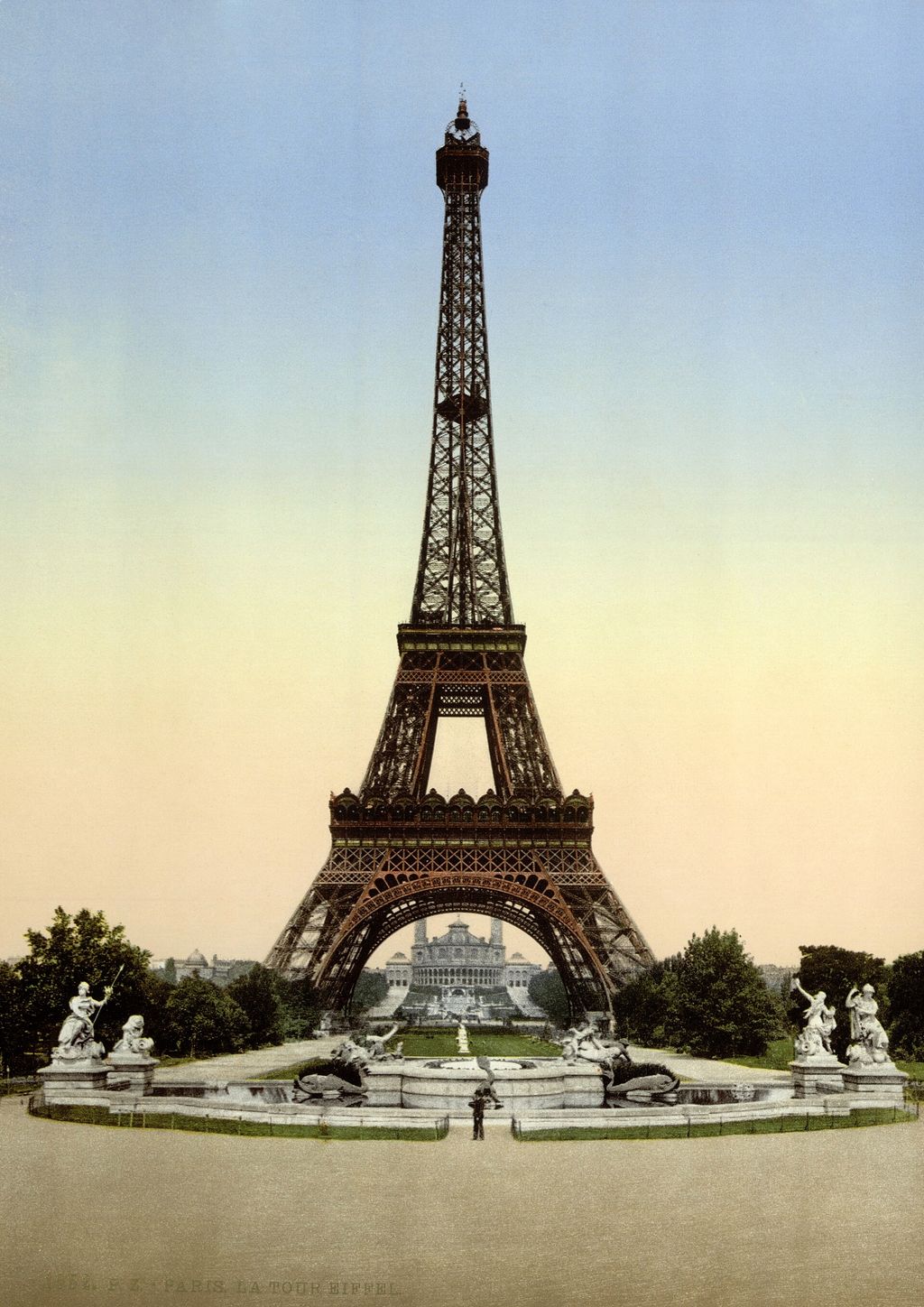
The Eiffel Tower rises along the right edge, its top cut by the canvas. It was already a powerful sign of engineering, mass spectacle and the transformed Paris skyline. Robert Delaunay had repeatedly made the tower a subject, and Chagall’s use belongs to his encounter with Delaunay’s Orphist circle.[1][5]
Below and around it, modern transport loses ordinary gravity. A string of train carriages appears upside down through the lower windowpanes, with smoke falling in the wrong direction. Two small, formally dressed people near the tower lie or stand sideways.
A parachutist hangs higher in the sky.[1]
These details are sometimes gathered under “fantasy”, but each begins with contemporary technology: railways, iron construction, aviation and parachute experiment. Chagall does not flee the modern city into timeless folklore. He rearranges modernity until it becomes as unstable as memory.
Robert Hughes described the work’s train, tower, parachute and prismatic shafts as an excited response to Paris in 1913.[11] That account corrects a common sentimental reduction. The picture is not merely an emigrant looking backwards.
It registers speed, light, mass transport and public sensation in the city where avant-garde form was being remade.
Was the parachutist Franz Reichelt?
On 4 February 1912, the tailor and inventor Franz Reichelt jumped from the first platform of the Eiffel Tower in a parachute suit of his own design and died on impact. The official Eiffel Tower history records the experiment, and film of the event survives through the Pathé archive.[6][7]
The timing, location and visual relationship make Reichelt a plausible source for Chagall’s descending figure. The event was recent, spectacular and mediated by moving images and illustrated news. An artist attentive to the tower as a sign of the present could have known it.
Yet no cited document establishes that Chagall intended a portrait of Reichelt. The painted figure carries a triangular canopy and floats away from the precise site of the fatal fall. It can also represent aerial modernity more generally.
The historical parallel should therefore be offered as evidence-rich possibility, not identification.
The uncertainty itself is instructive. A tiny detail can hold technological optimism and catastrophe together. The parachute promises a new relation to gravity, while the 1912 event demonstrated its lethal failure.
Chagall’s figure remains suspended between invention and danger.
Delaunay, Orphism and simultaneous colour
Chagall’s Paris years from 1911 to 1914 brought sustained contact with Cubism, Fauvism and the colour experiments associated with Robert and Sonia Delaunay. The Guggenheim sees the fragmented space, blending of figure and ground and release of colour from descriptive duty as central to the painting.[1] The Guggenheim Bilbao calls these years his decisive breakthrough.[5]
The relationship to Robert Delaunay is clearest in the tower, window and overlapping colour planes. Delaunay’s window pictures used simultaneous colour contrasts to make light and modern vision into structure. Chagall adopts translucent-seeming wedges, a chromatic grid and an urban emblem, but retains anecdotal bodies, animals and impossible events.
This is not incomplete abstraction. Chagall uses Orphist resources for a different purpose. Colour separates and reconnects heterogeneous things: cat, face, flag-like sky, flowers, train and tower.
Narrative clues remain active even when they cannot be assembled into one event.
The picture’s nearly square proportions heighten this construction. No long horizon dominates. Vertical tower and window, horizontal sill and city, and diagonal beams compete across a compact field.
Paris is experienced as simultaneous pressure rather than a view receding politely from the room.
La Ruche and an international neighbourhood
Chagall worked at La Ruche, the inexpensive artists’ residence in Montparnasse whose name, “the Beehive”, suited its dense community of studios. Artists from the Russian Empire and across Europe gathered there, including Alexander Archipenko, Ossip Zadkine, Chaim Soutine and others who were developing modern art through different languages and cultural histories.[2]
The Philadelphia exhibition Paris Through the Window: Marc Chagall and His Circle placed this canvas within that international network rather than presenting invention as solitary genius.[2] Paris offered museums, dealers, poets and artist communities, but it also required poor foreign artists to build lives across linguistic and social boundaries.
The label “School of Paris” later gathered many such artists without defining a shared style. A Guggenheim exhibition used windows to chart modernism from Cubism and Orphism through Surrealism and the wider École de Paris.[10] Chagall belongs to this history through exchange, not through membership in a single programme.
The studio view should not be treated as optical reportage. There is no need to prove that the Eiffel Tower was literally visible from Chagall’s window. The window constructs artistic location: an immigrant painter places himself inside Paris by assembling the city’s most charged signs.
An immigrant Jewish artist without explicit Jewish signs
Chagall arrived from a Jewish family and Yiddish-speaking environment in Vitebsk, where imperial restrictions had shaped education, residence and professional possibility. Those conditions remain part of the maker’s history even when ritual objects and Hebrew characters are absent.
Sonn places the canvas within a larger immigrant-Jewish investment in Paris as a place of modern freedom, while warning that its visual content does not overtly announce Judaism or Russia.[4] This distinction prevents two errors: erasing Chagall’s position as a Jewish migrant and forcing every form to encode that identity.
Paris could be both emancipatory ideal and difficult material environment. The bright tower and airborne figures convey exhilaration; the divided head and unstable transport resist uncomplicated belonging. A migrant can celebrate the city while retaining multiple directions of attention.
The painting’s modernism is itself part of this negotiation. Chagall learns from French avant-garde practices without giving up legible bodies or the hybrid creatures already emerging in his work. Cultural exchange appears as transformation rather than assimilation into one authorised style.
Thin paint and visible planning
The Guggenheim’s close description notes that colours were applied thinly with diluted paint. The beige ground and ivory diagonal remain mottled by plum and brown; grey drawing is visible beneath the light layers.[1] This material economy helps produce the sensation of overlapping transparency.
Visible underdrawing is important because the image can look spontaneous or dreamlike. Lines beneath the paint show planning. The window grid, architecture and figures were organised before or during the thin application of colour.
Impossibility is constructed rather than unconsciously spilled onto canvas.
The signature and date appear on the chair back at lower left, as if carved or embedded into the represented object: “Chagall” and “1913”.[1] Authorship occupies the interior furniture instead of floating outside the scene. The inscription becomes another object within the room.
Thinness also makes present condition significant. A 1973 conservation article by Orrin Riley and Gustav Berger included Paris Through the Window among case studies in a discussion of BEVA 371 adhesive for modern paintings.[8] The accessible abstract does not specify precisely what was done to this canvas, so it cannot support a detailed treatment narrative.
It does prove that the work has a published conservation history deserving fuller archival review.
Title, poetry and the problem of “dream”
The French title Paris par la fenêtre and English Paris Through the Window direct attention to viewing. Accounts have attributed the title to Chagall’s poet friend Blaise Cendrars, part of a circle that also included Guillaume Apollinaire. Whether or not the title originated wholly with Cendrars, poetry helped shape the language through which Chagall’s Paris work was received.
Apollinaire’s description of Chagall’s art as surnaturel—supernatural—predates Surrealism as an organised movement. The painting’s impossible gravity and hybrid faces later look compatible with Surrealist taste, but the 1913 work should not be retroactively absorbed into that movement.
“Dreamlike” is useful only if it identifies operations: reversal, simultaneity, altered scale and hybridisation. It becomes weak when used to avoid historical particulars. The Eiffel Tower, train and possible Reichelt reference belong to contemporary Paris, while Orphist colour belongs to a specific artistic exchange.
Chagall later resisted a strict boundary between fantasy and reality, arguing that the interior world was itself real.[3] That position suits this canvas. The city is not made unreal by subjective transformation; inner and outer experience are granted equal pictorial force.
Cendrars, the title and a bilingual Janus
The attribution of the French title to Blaise Cendrars has stronger scholarly support than a casual friendship anecdote. A University of Oxford study of bilingualism and modernist art states directly that Cendrars chose Paris par la fenêtre and reads the double-faced figure through the Roman Janus, whose faces turn towards different temporal directions.[13] The Marc and Ida Chagall Archives also preserve a postcard from Cendrars to Chagall dated 31 October 1913, material evidence of their active contact in the year of the painting.[14]
The title’s grammar is important. Paris par la fenêtre can mean Paris seen through the window, but par also emphasises the means or route by which the city becomes available. The window is not only a depicted object.
It is the procedure by which coloured, technological and poetic Paris is assembled.
Cendrars’s own poetry moved rapidly among cities, transport, advertising and disjunctive perception. The 1946 MoMA bibliography records his poems “Portrait” and “Atelier”, dated October 1913 and dedicated to Chagall’s studio world.[9] This does not make the canvas an illustration of a poem.
It places title, painting and poetry within a shared experiment in simultaneity.
The Janus reading adds another layer to the double face without settling its identity. The Oxford study connects bilingual or translingual consciousness to the ability to look in several linguistic and temporal directions.[13] One profile may face the visible city while the other registers an elsewhere, but the figure is not labelled as Chagall, Russia or Vitebsk.
Janus clarifies doubled orientation; it does not turn ambiguity into biography.
This distinction also refines the word “autobiographical”. Chagall’s migrant history gives the divided head experiential force, while Cendrars’s title locates the scene decisively in Paris. The picture can arise from a multilingual self without hiding a literal Russian landscape behind the second profile.
From private choice to a founding collection
Hilla Rebay introduced Solomon and Irene Guggenheim to European modernists and guided the collection that became the basis of the Solomon R. Guggenheim Foundation. The museum records that Rebay secured Paris Through the Window for Solomon and regretted not being able to acquire it herself.[3]
The accession number 37.438 and credit “Founding Collection, By gift” place the work at the institution’s beginning.[1][3] In 1937 Guggenheim established the foundation; the Museum of Non-Objective Painting opened in 1939, before Frank Lloyd Wright’s building gave the collection its later architectural identity.[3]
The public institutional record is more complete for Guggenheim custody than for the canvas’s earlier ownership. The official Chagall catalogue raisonné project is still assembling provenance, exhibition and bibliographic evidence from correspondence, administrative documents and archive photographs, and warns that such records can change as research develops.[12] A responsible account should therefore identify the present collection securely without inventing a continuous pre-1937 chain.
A second Paris Through the Window
The title does not identify only the Guggenheim canvas. A smaller work in gouache on buff-coloured paper, mounted on canvas, measures 48 by 47 centimetres and has circulated through Galerie Beyeler, Acquavella Galleries and private ownership.[15] Its composition is closely related to the large oil but its support, scale and provenance are distinct.
The smaller sheet appeared in the Jewish Museum’s 1985 exhibition The Circle of Montparnasse: Jewish Artists in Paris, 1905–1945 and was dated there to 1913.[15] That exhibition history gives the motif a specifically immigrant-Jewish reception even though, as Sonn cautions, the Guggenheim canvas contains no overt ritual object, Hebrew lettering or Vitebsk landmark.[4]
The related work matters methodologically. An image search can return either composition, and title-level claims can transfer dimensions or provenance from one to the other. The Guggenheim oil remains 37.438 in the Founding Collection; the smaller gouache is a separate object.
Similarity establishes a repeated compositional problem, not interchangeability.
It also shows Chagall testing the square format across media. Gouache on paper permits opaque, immediate colour and a more intimate object; diluted oil on a large canvas leaves drawing and mottled ground active. The same window-city relation changes when its material scale changes.
A Paris network larger than one influence
The Art Gallery of Ontario’s account of Chagall and the Russian avant-garde identifies a broader network around his early Paris years: Cendrars and Apollinaire, the Italian poet and critic Ricciotto Canudo, and the journal Montjoie!, which presented itself as a platform for the avant-gardes.[16] Delaunay’s colour remains the most visible formal comparison, but the painting developed within exchanges among poetry, criticism, exhibition and visual art.
This network helps explain why words such as Orphism, Cubism and Fauvism each illuminate only part of the canvas. The coloured window grid and flag-like rays relate to simultaneous colour; fractured space relates to Cubist practice; intense non-natural colour recalls Fauvism; the impossible figures answer poetic experiments in modern perception. Chagall combined resources that institutions often classify separately.
The network was also multilingual. Artists and writers at La Ruche and Montparnasse moved among Russian, Yiddish, French, Italian and other languages. Paris Through the Window contains no written multilingual label, but its very construction emerged from a foreign artist’s entry into that polyglot field.
Chagall’s figurative canvas occupied an interesting place in a collection strongly promoted through nonobjective art. Its fractured planes and autonomous colour allowed it to converse with abstraction, while its cat, faces, train and tower refused to relinquish represented things.
MoMA’s 1946 retrospective further established the work in American Chagall reception under its present title and 1913 date.[9] Later exhibitions have repeatedly used it to represent the School of Paris, Chagall’s circle, urban modernism and the window as a modernist device.[2][10]
What can be established about On the Roof of Paris
The legacy title On the Roof of Paris cannot presently be tied to a documented Chagall painting through an owning museum, the official research site or an accessible catalogue record. The one located market record using that exact English title classifies the object offered in April 2025 as a “reproduction” and “canvas print”, 17 by 25 inches.[17] It supplies no date for an originating Chagall work, catalogue number, support history or ownership chain.
That gap changes how the inherited page should be used. Its image shows a bouquet-bearing woman above Paris among a horse, musicians, dancers and other airborne forms, but visual resemblance cannot establish title, date or medium. The page's claims about a herring commemorating Chagall's father, a horse meaning freedom and a rooster meaning sex are uncited symbolic assignments.
They should not migrate into the manuscript as object facts.
Documented works show why the image nevertheless belongs to a recognisable Paris repertoire. The Eiffel Tower's official art history identifies Paris Through the Window as Chagall's 1913 engagement with the monument and also records the later Champ de Mars of 1954–55.[18] Centre Pompidou's The Bridal Pair with the Eiffel Tower, painted in 1938–39, joins Paris, a bridal couple, a cockerel, music and threatened Vitebsk in a 150 by 136.5 centimetre oil whose title, date, inscription and collection number are secure.[19]
Chagall's official research site describes the latter canvas as an image of Marc and Bella carried by a large cockerel, with Vitebsk below, an angel by the Eiffel Tower and an angel violinist joining the procession.[20] A 1953 work discussed by the Rouen museums again combines a recognisable Paris monument with a hybrid creature, cockerel and floating couple.[21] These records establish recurrence across decades, but they do not retroactively authenticate On the Roof of Paris as the title of an original painting.
The appropriate migration is therefore a documented comparison, not a free-standing object page. Readers arriving through the old title can learn which claims are verifiable, how Paris motifs moved among distinct paintings and why title-level image matching is unsafe. Redirecting the legacy route here preserves its useful Paris intent and backlink history while preventing a reproduction-market label from becoming an invented catalogue entry.
Looking through the painting
Begin with the window’s colours rather than with symbolic decoding. Follow red, yellow, green and blue upward, then locate their echoes in the sky, cat and face. The painting joins interior and city chromatically before it joins them narratively.
Next trace the competing directions: the two profiles, diagonal light, inverted train, sideways couple and descending parachutist. Gravity does not fail randomly. Each reversal makes the viewer reconsider which way the modern city is moving.
Keep possible histories at their proper strength. Reichelt’s 1912 death makes the parachute topical, but no document proves a portrait. Migration makes a Paris/Russia reading of the double face plausible, but the canvas supplies no Vitebsk view.
Strong interpretation preserves uncertainty where evidence ends.
Finally, look at the thin paint and visible drawing. The apparent vision rests on an organised web of lines and lightly built colour. Chagall’s Paris is neither direct transcription nor sealed dream.
It is a worked surface where an immigrant artist, contemporary technologies and avant-garde form meet.
Paris Through the Window celebrates modernity by refusing to make it stable. The tower rises beyond the canvas; transport reverses; a parachute may save or fail; a face looks two ways. Paris is not simply seen through the opening.
It is remade by the person who has arrived to look.
Discussion
Which piece of evidence most changes the way you read Paris Through the Window?
Reader Insights
Which visible detail most changes your reading of Paris Through the Window?
How do medium, setting and documented history shape the encounter?
What remains uncertain when documented fact is separated from interpretation?
Join the Conversation
Share your reading of Paris Through the Window below.
References
- Solomon R. Guggenheim Museum, “Description of Paris through the Window (Paris par la fenêtre), 1913”, View Source
- Philadelphia Museum of Art, “Paris Through the Window: Marc Chagall and His Circle”, View Source
- Solomon R. Guggenheim Museum, Visionaries: Creating a Modern Guggenheim — Teacher Resource Unit, View Source
- Richard D. Sonn, Modernist Diaspora: Immigrant Jewish Artists in Paris, 1900–1945, View Source
- Guggenheim Bilbao, Chagall: The Breakthrough Years, 1911–1919, View Source
- Eiffel Tower, “A Tower that inspires amazing feats!”, View Source
- British Film Institute, “Archives online: British Pathé’s Death Jump — Eiffel Tower (1912)”, View Source
- Smithsonian Museum Conservation Institute, bibliography record 49897, “New solutions for modern problems”, View Source
- Museum of Modern Art, Marc Chagall, 1946, View Source
- Solomon R. Guggenheim Museum, “Windows on the City: The School of Paris, 1900–1945”, View Source
- American Archive of Public Broadcasting, The MacNeil/Lehrer NewsHour, Marc Chagall discussion, View Source
- Marc Chagall official website, “Catalogue raisonné”, View Source
- Alessandra Ausoni, “Le sujet bilingue dans les arts visuels au XXe siècle”, University of Oxford doctoral thesis, View Source
- Marc and Ida Chagall Archives, “Documentary archives”, including Blaise Cendrars postcard of 31 October 1913, View Source
- Sotheby’s, “Marc Chagall, Paris par la fenêtre”, lot 57, 2013, View Source
- Art Gallery of Ontario, “Chagall and the Russian Avant-Garde: Masterpieces from the Collection of the Centre Pompidou, Paris”, View Source
- MutualArt, “Marc Chagall: On The Roof Of Paris”, reproduction sale record, View Source
- Eiffel Tower, “The Eiffel Tower and art”, View Source
- Centre Pompidou, “Les mariés de la Tour Eiffel”, View Source
- Archives & Catalogue raisonné Marc Chagall, “Fiancés of the Eiffel Tower or Bride and Groom With Eiffel Tower”, View Source
- Réunion des Musées Métropolitains Rouen Normandie, “The Monsters of Notre Dame”, View Source