


 by Tom Gurney
Tom Gurney BSc (Hons) is an art history expert with over 20 years experience
Page Created on September 22, 2026 / Page Updated on September 22, 2026
Email: tomgurney1@gmail.com / Phone: +44 7429 011000
Introduction
Marc Chagall’s paintings are widely recognisable and persistently difficult to classify. Lovers rise above towns, animals share rooms with people, and villages appear upright, inverted and remembered at once. These images can seem spontaneous, yet their effects depend on controlled scale, colour, direction, interval and revision.
Across more than seventy-five years, Chagall used paint to hold incompatible experiences together: Vitebsk and Paris, Jewish inherited culture and Christian iconography, intimacy and public history, celebration and catastrophe.
The paintings also resist the idea of one unchanging dream world. Early brown interiors, brilliant first-Paris canvases, wartime crucifixions, theatrical exile works, Mediterranean colour and late monumental cycles belong to different historical and material conditions. Recurring goats, fiddlers, brides and bouquets only become meaningful when their date, support, neighbours and pictorial role are identified.
At a Glance
- ArtistMarc Chagall
- SubjectMarc Chagall Paintings
- Artistic contexttwentieth-century modern art
- Art formPainting
Contents
- Before Paris: training, family and the close interior
- The first Paris studio: colour becomes structure
- I and the Village : simultaneity without abstraction
- Paris variants: wedding, animals and the modern village
- Return to Russia: observation and domestic elasticity
- Berlin, Paris, revision and painting beside print
- The Dance and the Circus and L’Âme du Cirque
- Jewish figures, crucifixion and the historical image
- American exile, Aleko and Bella’s death
- Return to France: Paris, time, family and Mediterranean colour
- Clock with Blue Wing : time, return and a private object
- The Biblical Message : seventeen paintings, not one programme
- Painting as architecture: Paris Opéra and New York
- What technical study reveals
- Provenance, displacement and title variants
- Reception: popular recognition and critical suspicion
- How to read recurring motifs
- Chagall’s place in modern painting
Before Paris: training, family and the close interior
The earliest surviving paintings emerged from study with Yehuda Pen in Vitebsk and later training in Saint Petersburg. Centre Pompidou records from 1907–10 include self-portraits, The Father at Table, Our Dining Room and local figures.[1] These works are often dark and spatially compressed. Faces bear the pressure of looking; furniture crowds bodies; brown, black and ochre dominate more than the saturated blue later associated with Chagall.
This groundwork corrects the myth that he arrived in Paris with a complete language of airborne fantasy. He learned portrait, still life and interior painting within available provincial and metropolitan conventions, then deliberately destabilised them. Jewish family and neighbourhood subjects appear before the famous floating figures, establishing social specificity beneath later transformations.
Titles and dates require caution even here. Works left in Russia, carried abroad or reconstructed through photographs acquired different translated names. Russian, Yiddish, French, German and English catalogues may identify the same sitter or scene differently.
A current institutional title is a research decision, not a transparent original label.
Two legacy titles demonstrate the problem. Man at Table is commonly dated 1911 in secondary databases, while Red Nude Sitting Up is generally placed in 1908; neither presently has a sufficiently detailed public collection record to secure every element of title, support, dimensions and ownership.[38][39] They can therefore illuminate the close figure and compressed room of Chagall's early practice, but they cannot bear the object-level certainty available for a museum painting.
The distinction also protects against a tempting false identification. A scientific paper concerning a purported “1910 Chagall nude” found pigments manufactured decades later and rejected that object's claimed date, yet the study does not identify its subject as Red Nude Sitting Up.[19] The case belongs to the history of attribution; it should not be used to condemn a separately titled work merely because both involve a nude.
The first Paris studio: colour becomes structure
Chagall moved to Paris in 1911 and lived at La Ruche among artists and writers. In The Studio of 1910–11, loaded brushwork and sharp greens, yellows and reds show engagement with Van Gogh and Fauvism. Receding edges converge on an empty red frame while a remembered portrait of Bella remains on the wall.[2] The room is observed, but colour already organises emotion and attention rather than merely describing surfaces.
Paris offered Cubism’s fragmented viewpoints and Robert and Sonia Delaunay’s simultaneous colour, yet Chagall used each selectively. He did not abandon beings, stories or memory. Cubist division allowed several moments to occupy one surface; chromatic contrast allowed distant forms to act upon each other.
His modernism lies in converting inherited and lived material through these structures rather than illustrating folklore in an otherwise conventional space.
The material surface matters. Paint can be thin in one area and heavily worked in another; contours may be drawn over colour; exposed canvas or ground acts as light. The visible unevenness is not necessarily unfinished.
It lets distinct temporal and spatial zones coexist without being harmonised into one illusion.
I and the Village: simultaneity without abstraction
In I and the Village (1911), a human profile, animal head, milking scene, flowering branch and inverted village are held by circles and diagonals. MoMA connects its construction partly to Cubism and its subjects to Chagall’s Belarusian home.[3] “Partly” is essential. Chagall fragments space but preserves recognisable figures, saturated colour and a chain of reciprocal gazes.
Scale does not follow distance: head and animal confront each other as equals while tiny figures perform remembered labour. Green crosses from the human face into the wider field; red and white accents distribute weight. The geometry does not conceal story but makes simultaneity possible—village, childhood, animal and adult self can occupy one present surface.
This procedure became fundamental. Scale can indicate intensity; bodies rotate while the composition remains balanced; colour joins discontinuous scenes; one canvas holds different times and degrees of reality. The result is constructed memory, not an unedited recollection or a universal dream.
Paris variants: wedding, animals and the modern village
In To Russia, the Asses and the Others, the Centre Pompidou finds only limited Cubist fragmentation. A red animal, airborne woman, village architecture and rural acts are enlarged or displaced according to pictorial need.[4] In The Wedding of 1911–12, chromatic bands, procession and sloping ground make a remembered Jewish ceremony unfold as both frieze and unstable street.[5]
These pictures establish a problem that later popularity can obscure. “Naïve” is an inadequate description for their calculated directional forces. Inverted buildings counterweight heads; circles interrupt rectangles; colour fields cross object boundaries.
Russian popular prints and village signs may be relevant, but Chagall’s pictorial intelligence is not reducible to folk authenticity.
The Thyssen-Bornemisza situates his language among Cubism, Fauvism and Delaunay’s Orphism while emphasising Russian Jewish experience.[6] None is an exclusive category. Chagall belonged to modernist networks yet resisted histories in which progress meant ever greater abstraction.
The luminous first-Paris pictures have often determined the whole reputation, but recent German and Austrian surveys have restored a darker early Chagall. Around 120 paintings and works on paper assembled by the Kunstsammlung Nordrhein-Westfalen placed his avant-garde contacts beside socially critical, anxious and grotesque subjects; the Albertina's career survey likewise organised painting around birth, motherhood, love and death rather than treating fantasy as an escape from mortality.[21][22]
Poverty, illness, labour and bodily vulnerability are visible before the catastrophes of the 1930s. Birth compresses childbirth, family and crowded interior space; The Dead Man turns a street around a corpse; newspaper sellers and beggars carry the pressure of events. Distortion can be comic and disturbing at once.
Enlarged hands, crooked rooms and abrupt colour do not lift these figures out of history: they deny the viewer a comfortable naturalism through which suffering could become picturesque.
Chagall's humour also deserves precision. Inversions and hybrid animals can parody authority, academic decorum and avant-garde purity; they can also produce tenderness or alarm. A red cow in a field and a human-animal body under persecution do not perform the same task.
The recent exhibition emphasis on social criticism corrects a long commercial habit of separating pleasure from discomfort, but it should not impose one political programme on every deformation.[21]
Return to Russia: observation and domestic elasticity
The outbreak of war in 1914 prevented Chagall’s planned return to Paris. During the Russian years he painted rabbis, newspaper sellers, houses, cemeteries, family portraits and Bella. Some works recover a comparatively direct, limited palette; others make domestic attachment physically impossible.
The Newspaper Seller records a recognisable street type whose placard announces war. The Centre Pompidou notes that war stranded Chagall in Russia until 1922.[7] The figure’s bent posture and written news join local observation to an international catastrophe. It should not be absorbed into a generic village reverie.
In The Birthday (1915), Chagall bends backwards to kiss Bella while his lower body travels horizontally. The table, patterned cloth, window and small objects stabilise the room; the impossible body converts exhilaration into structure. The Promenade of 1917–18 moves the relation outside: Chagall anchors Bella by one hand as she extends over the town.[8] Gravity changes to express attachment, but composition remains exact.
After the October Revolution, Chagall became arts commissar in Vitebsk and organised decorations, exhibitions and the People’s Art School. Painting expanded into banners, streets and theatre. El Lissitzky and Kazimir Malevich brought increasingly forceful Suprematist programmes into the same institution.
Suprematism was both rival and resource. Chagall could borrow flat planes, sharp diagonals and dynamic suspension while refusing the elimination of bodies and narrative. The institutional conflict was therefore not a simple opposition between tradition and modernity.
Competing versions of revolutionary art claimed the same school: one retained figurative, Jewish and autobiographical material; another privileged non-objective systems.
The Moscow State Yiddish Chamber Theatre murals of 1920 turned painting into a surrounding environment for performance. Figures, lettering, music and theatre occupied walls rather than frames. Chagall's visual direction affected the actors' exaggerated gesture as well as the room.
GOSET performed in Yiddish and developed alongside Hebrew-language Habima; both joined avant-garde performers, playwrights and painters, but their languages, audiences and later histories differed.[25]
The panels' survival cannot be separated from Stalinist repression. Solomon Mikhoels, GOSET's actor-director, was murdered by the state in 1948; the theatre closed the next year, and a 1953 fire almost destroyed its archive. Concealment protected Chagall's murals while removing them from their performing context.
Rediscovery and restoration recovered physical paintings, but not the original relation among wall, stage, audience and gesture.[25]
Berlin, Paris, revision and painting beside print
Chagall left Soviet Russia in 1922, worked in Berlin and returned to Paris in 1923. Contracts with Ambroise Vollard connected painting with long print projects for Gogol, La Fontaine and the Bible. Preparatory gouaches could function as autonomous colour works and as models for monochrome etchings.
Painting and graphic art developed through exchange rather than separate hierarchies.
Travel through France brought villages, churches, landscapes and animals into lighter atmospheres. La Fontaine’s fables sharpened the mobility between human and animal; Gogol reactivated Russian provincial types. Scriptural work began with travel to Palestine, Egypt and Syria in 1931.
These experiences did not simply supply subjects: changing medium and sequence altered how bodies, light and narrative were organised.
The interwar return is sometimes judged less radical than 1911–14. That view privileges formal novelty over purpose. Chagall was building extended narrative cycles, responding to French landscape, and testing how a recurring pictorial language could bear migration and historical change.
Chagall frequently returned to paintings. To My Wife was begun in 1933 and reworked in 1944; both dates appear in the inscription.[10] That span crosses intensifying persecution, American exile and Bella’s death. The physical object carries time rather than representing one moment.
The triptych now called Resistance, Resurrection, Liberation developed even more radically. The Centre Pompidou records Resistance as oil on linen and documents a history beginning in 1937, when a single revolutionary composition was cut and transformed across years.[11] A catalogue date may consequently identify conception, reworking, completion or inscription rather than one instantaneous act.
The Dance and the Circus and L’Âme du Cirque
Chagall’s performers are not only metaphors for the artist. Circus offered bodies made public through risk, rehearsed imbalance, costume, music and spectatorship. The Acrobat (1930) places an elongated performer before a church porch.
It became the first Chagall painting acquired for a French public collection.[9]
That acquisition marks institutional reception as well as subject matter. An immigrant artist previously associated with Russian fantasy entered the national collection through a poised but unstable performer. Circus paintings recur for decades, yet their formal roles change: a single vertical body can organise a façade-like field; rings produce chromatic enclosures; musicians shift between spectacle and ritual.
The Dance and the Circus (1950) belongs to a particular unrealised theatrical history. Tate identifies the small oil on canvas, measuring 34.9 by 26.7 centimetres, as a study made with The Blue Circus for murals intended for London's Watergate Theatre; Chagall presented it to Tate in 1953.[30] Its modest scale is therefore preparatory rather than evidence of a private miniature detached from architecture.
The legacy title Soul of the Circus points to a different work and medium. L’Âme du Cirque is a large 1980 colour lithograph on Arches paper, catalogued by Charles Sorlier as Mourlot 982; the documented impression is an artist's proof outside an edition of fifty, published by Maeght.[31] Calling it a painting would erase the collaborative press, paper, edition and late graphic practice that produced it.
Read together, the two works show why “circus” is a subject rather than a single object type. The 1950 oil tests a mural scheme through concentrated colour and balance; the 1980 lithograph makes its acrobatic spectacle through separately printed colour on a sheet nearly 1.2 metres wide. Thirty years separate their techniques, institutions and intended forms of circulation.[30][31]
Jewish figures, crucifixion and the historical image
Rabbis, Torah scrolls, Hebrew letters, prayer shawls and synagogue interiors appear with distinct functions. Some derive from sitters and memories of Vitebsk; others construct exemplary types for Western audiences; others respond directly to persecution. Treating them all as timeless spirituality erases clothing, language, social position and historical pressure.
The Praying Jew uses a restricted black-and-white field to monumentalise prayer shawl, face and book. Variants and later versions complicate the idea of one definitive image. Paintings of fiddlers can evoke Jewish celebration, theatre and precarious balance, but the surrounding scene must decide which associations matter.
Chagall also painted Christian subjects while insisting on their Jewish genealogy. That crossing was strategic, theological and historical rather than evidence of a vague blended faith. It allowed him to address Christian viewers through symbols they recognised while reattaching those symbols to Jewish bodies and contemporary violence.
Painted in 1938 after Kristallnacht, White Crucifixion places Jesus in a prayer shawl amid attacks on Jewish life: a burning synagogue, refugees, destruction, a Torah scroll and figures fleeing by boat and on foot. The Art Institute’s scholarship locates it within Chagall’s sustained use of crucifixion to represent Jewish suffering.[12]
The cross is not a conversionary symbol. It restores Jesus’s Jewish identity and directs a largely Christian audience towards modern Jewish persecution. White light cuts through zones of fire and smoke, while narrative incidents circle the central body.
The painting’s accessibility depends on Christian visual memory; its force lies in redirecting that memory.
Later crucifixions respond to war and genocide under different titles and colour climates. They should not be collapsed into one symbol. Date, surrounding events, inscriptions and subsidiary scenes determine whether a work stresses mourning, martyrdom, apocalypse, Jewish–Christian address or personal grief.
During American exile, remembered village and contemporary catastrophe converged. Centre Pompidou identifies The War (1943) as part of a group developed from 1940 to 1943 around the suffering of Jews in Nazi-occupied Russia.[13] Snow, animals, refugees and burning structures no longer function principally as nostalgic Vitebsk.
The village is useful precisely because Chagall had painted it before. A familiar pictorial home becomes a site of annihilation; displaced motifs acquire documentary urgency without becoming literal reportage. Animals share panic with humans, and diagonal flight breaks the village’s earlier circular memory.
Chagall followed Europe through Russian and Yiddish information networks. His war paintings therefore join distant knowledge, refugee experience and an image vocabulary formed before the catastrophe. Reading them as private dreams strips out the historical conditions that transformed familiar forms.
American exile, Aleko and Bella’s death
New York provided galleries, patrons and other displaced artists. Stage commissions for Aleko and The Firebird carried painted colour into curtains, costumes and moving bodies. Mexico, where Aleko premiered, introduced a different landscape and workshop environment; surviving costume designs and painted garments show how easel technique responded to fabric and performance.
MoMA's records turn three loose legacy titles into a coherent production group. A Fortune Teller and a Gypsy is a 1942 costume design for Scene I in gouache, watercolour and pencil, while Gypsy is another Scene I design in gouache and watercolour.[32][33] Both belong to the drawings and prints collection, so neither should be catalogued as an autonomous oil painting.
The historical title comes from Pushkin's poem The Gypsies, the source for Aleko, and from the ballet's contemporary cataloguing. It is retained when identifying museum objects, while “Roma” or “Romani people” is preferable in present-day prose about the living community. Chagall and choreographer Léonide Massine nonetheless worked with theatrical character types that can romanticise itinerancy, costume and supposed difference; title accuracy does not require repeating that stereotype as social fact.
The ballet premiered in Mexico City on 8 September 1942 and in New York on 6 October. MoMA's archival account records more than forty drawings and watercolours, alongside designs for protagonists, fortune tellers, dancers, animals and landscape.[36] A separate museum label notes that Chagall personally decorated many of more than seventy costumes and that Bella helped sew some of them, making the production a material collaboration as well as a sequence of designs.[34]
A Wheatfield on a Summer's Afternoon belongs to the third scene rather than to an independent landscape series. The Philadelphia Museum of Art records the 1942 design within the ballet's four changing settings, while a published catalogue describes its yellow field, red solar body and suspended scythe as visual preparation for the impending murder.[35] The work demonstrates how landscape could become dramaturgy: colour and emblem establish danger before action resolves it.
Bella died suddenly in 1944, and Chagall stopped working for months. When he resumed, bride and lover imagery acquired retrospective force. It is tempting to identify every later bride as Bella, but paintings may combine memory, scriptural femininity, Virginia Haggard, Valentina Brodsky and an established pictorial type.
Biography should generate testable context, not fix one identity onto every white dress.
MoMA’s 1946 retrospective placed paintings beside drawings, prints and stage designs. Its catalogue argued that Chagall renewed a deliberately limited repertoire through unfamiliar arrangements and increasingly complex technique.[14] Repetition is thus a method: the same cow, fiddler or couple changes role when colour, scale, date and historical neighbours change.
Return to France: Paris, time, family and Mediterranean colour
Chagall returned to France in 1948 and settled in Vence in 1950. Museum research describes the southern light, vegetation and daily rhythm as conditions for a freer colour practice.[15] Thick paint, thin wash, scratched line and floating motifs can coexist. A dense red may organise the field while blue forms atmosphere rather than object colour.
New media fed back into painting. Engraving sharpened attention to black line and reserve. Ceramics encouraged incision and images wrapping around form.
Sculpture gave bodies mass. Stained glass turned colour into transmitted light; mosaic made it granular and architectural. A gouache or painting could become the model for another material, then return in altered form to canvas.
Late colour should not be treated as pure joy detached from history. Bouquets and lovers coexist with crucifixion, Exodus and memory of war. Saturation can celebrate, memorialise or hold unlike episodes together.
The same blue behaves differently as night, body, sacred zone or compositional interval.
The Bastille (1953) makes the later Paris series precise. The official record identifies oil, coloured ink and India ink on canvas, 93 by 112 centimetres, and locates the July Column within a red protective beast.[27] An embracing couple, nocturnal female figure, animal and offered bouquet occupy chromatic zones rather than one continuous city view; Paris is assembled as affection, monument and remembered arrival.
The mixed medium matters because ink sharpens and redirects forms within the paint. The official catalogue's ceramic counterpart, also titled The Bastille, is a separate clay object rather than another record of the canvas. Chagall's return to a motif across supports should be described as translation between materials, not as an interchangeable duplicate.[27]
Clock with Blue Wing: time, return and a private object
Clock with Blue Wing is usually dated 1949 and described in secondary records as an oil on canvas, 92 by 79 centimetres, in a private collection.[28][37] Those particulars remain less secure than the data for a museum object, but the title and composition belong to a documented family of Chagall clock images rather than to an isolated surreal invention.
The Tretyakov Gallery Magazine relates the work to earlier images including The Black Glove and the officially documented Self-Portrait with Clock, where a domestic timepiece shares space with figures and recollection.[28][29] The blue wing does not supply a fixed symbol: it animates measured time, carries the clock away from furniture and joins recurrence to flight. Its force depends on the contradiction between a numbered dial and an impossible body.
Dating the canvas near Chagall's return to France after American exile gives the clock a historical pressure, though not a single decipherable message. Wartime absence, Bella's death and resettlement make time an active subject, but the painting's private status limits technical, provenance and exhibition claims. Interpretation should remain proportionate to the public record.
Fisherman's Family presents a similar evidence boundary. Secondary catalogues generally date the private oil on canvas to 1968 and give dimensions of 92 by 64 centimetres.[37] The visible conjunction of family, fish and nocturnal blue extends Chagall's long exchange between occupation, animal life and kinship, yet an unverified ownership narrative or exact commission history should not be built around it.
The Biblical Message: seventeen paintings, not one programme
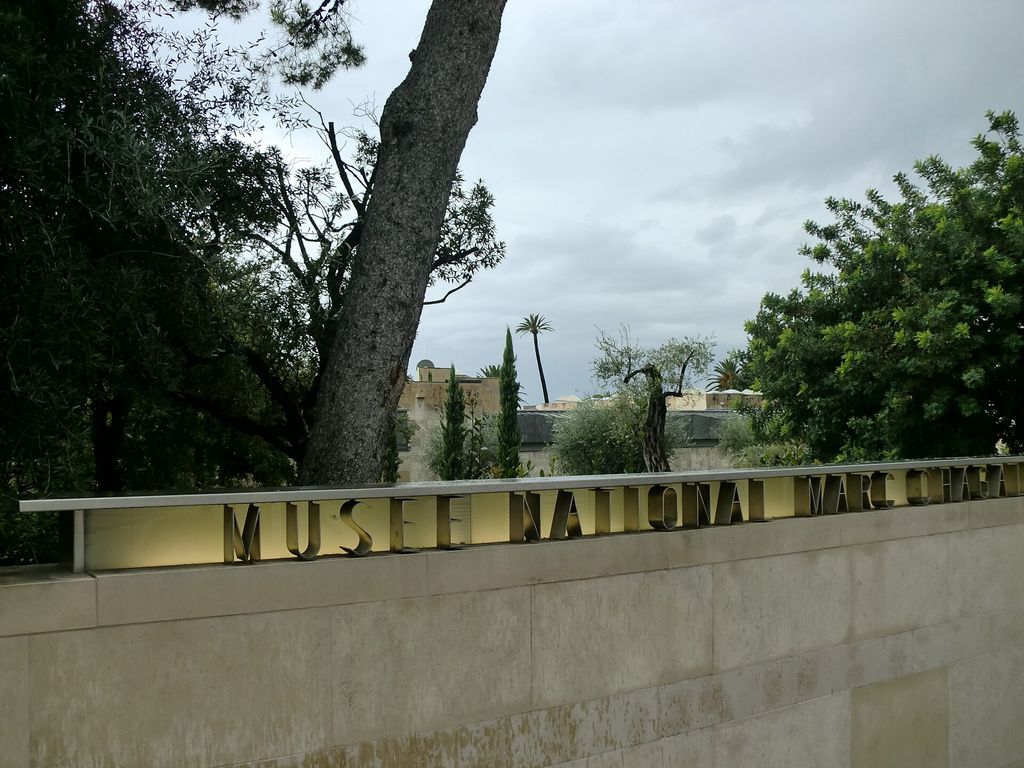
The seventeen large paintings now at the Musée national Marc Chagall in Nice were developed from a proposed decoration for the Calvary chapel at Vence. Twelve address Genesis and Exodus; five engage the Song of Songs. Chagall and Valentina donated the cycle to the French state, and the dedicated museum opened in 1973.[16]
Their supports already complicate the simple label “oil on canvas”. Collection records include oil, gouache and other painting media, with works on paper mounted to board or canvas as well as conventionally stretched fabric. Chagall's Biblical colour was built through opaque and translucent passages, drawn contours and changes in surface absorbency.
Material difference helps separate the five Song of Songs works from an imagined uniform decorative programme.[16]
The series is not a line-by-line Bible illustration. Creation, sacrifice, liberation and revelation occupy different chromatic climates. Angels, animals, crowds and prophets pass between panels, creating echoes across the room.
The Song of Songs joins sacred poetry to lovers, city and bouquet imagery familiar from apparently secular paintings.
Preparatory drawings show alternatives in figure, colour and balance. The change from chapel to national museum also changes reception: a project conceived for Christian sacred architecture became a state-held environment centred on a Jewish artist’s Biblical imagination. The cycle’s meaning includes that institutional migration.
Painting as architecture: Paris Opéra and New York
André Malraux commissioned Chagall’s ceiling for the Paris Opéra, unveiled in 1964. The work distributes scenes associated with composers and productions across coloured sectors around the chandelier. Because viewers look upward from changing seats, the composition has no single frontal position.
It was constructed from twenty-four canvases mounted on a removable synthetic shell a few centimetres below Jules-Eugène Lenepveu’s nineteenth-century ceiling, which survives behind it. Chagall worked with assistants at the Gobelins and insisted on reversibility.[17] The object is therefore neither a fresco nor the destruction of the earlier painting, though its visual covering provoked a major heritage controversy.
Public response concerned nationality, modernism, state power and architectural unity as much as style. Chagall’s position had changed dramatically: a Russian-born Jewish immigrant once marginal to French institutions now intervened at the centre of official culture. The technical solution preserved the earlier ceiling while making that institutional displacement visible.
A 2022–23 family donation to the Centre Pompidou, now shown at the Nice museum, adds forty-one sketches and maquettes for the ceiling to the public record. These reveal a sequence: Chagall first organised chromatic rhythms, then incorporated composers, productions and Parisian references. The finished dome should therefore not be read as an effortless outpouring of motifs.
It developed through scaled models, photographic enlargement, tracing, assistant labour and adjustment to an auditorium seen from below.[24]
The wider donation comprised 141 works and was presented in Paris before the 2026 Nice display. Its transfer from family ownership into national collections changes what can be compared publicly: preliminary decisions that once survived privately can now be set beside the installed ceiling. Provenance here is productive research history, not only a chain of possession.[24]
For the Metropolitan Opera at Lincoln Center, Chagall painted The Sources of Music and The Triumph of Music, installed in 1966. Their enormous scale, lobby placement and view through glass walls require reading at distance and in motion. Music is both subject and organising principle: colour zones carry composers, performers, lovers and city landmarks across architectural fields.
Like theatre curtains, these murals complicate the category “painting”. They are canvas-based pictorial works, but their scale and site govern sightlines, lighting and public access. Their commissioning also links modern cultural prestige to real-estate and institutional patronage.
A portable reproduction cannot convey how the murals frame arrival at the opera.
What technical study reveals
Chagall’s best-known support is canvas, but records include linen, board, cardboard and mixed media. He used oil in thin glazes, opaque layers, dry broken strokes and impasto; drawn contours may sit below, within or above paint. Revision, restretching and long campaigns complicate a surface’s chronology.
A technical study of nine paintings at the Stedelijk Museum combined ordinary, raking, ultraviolet, infrared, transmitted-light and radiographic imaging with handheld X-ray fluorescence and small-sample analysis by FTIR, GCMS, Raman microscopy, optical microscopy, SEM-EDX, XRD, HPLC and fibre identification.[18] The project began when deep cracking in the red background of The Pregnant Woman/Maternity raised treatment questions. Material knowledge was necessary because a visually simple field had a complex and vulnerable structure.
The supports changed art-historical interpretation. The Fiddler was painted over a checked tablecloth whose surviving grid and edge tassels could be identified; Chagall used the woven pattern to organise the block-like houses. Infrared examination of The Synagogue at Safed revealed an unrelated drawing that aligned, after rotation, with Ida at the Window of 1924.
This makes it plausible that the 1931 synagogue was completed in Paris on a support begun years earlier, rather than painted directly before the motif in Palestine.[18]
Heavy underlying layers in The Virgin with the Sleigh, completed in 1947, support the hypothesis that the canvas began in France and travelled with Chagall's works during the 1941 escape. In The Fiddler, an underdrawn figure reaching into a tree was abandoned as the background became less crowded. These findings make reuse, removal and migration part of composition, while remaining hypotheses bounded by nine objects.[18]
Pigment study found repeated materials but no mechanical recipe. Chagall used emerald green or viridian in every painting examined and also mixed chrome yellows with Prussian or cobalt blue for additional greens. Researchers counted four blue pigments and noted his careful differentiation of whites; bronze-coloured paint in The Fiddler was compared cautiously with metallic passages in other early works.
Binding media, fillers, zinc and lead carboxylates, wax-resin linings and later conservation additions complicate any attempt to identify colour by sight alone.[18]
Technical images can expose underdrawing, pentimenti, joins, ground and restoration, but they are not secret “true paintings” beneath the visible work. Each layer records a decision, and Chagall's later revision may be the intended final state. Wax-resin lining can also alter saturation and surface response, so imaging and sampling must be read with treatment history.[18]
Scientific analysis can test whether materials existed at a proposed date. Raman microscopy of a purported 1910 Chagall found phthalocyanine blue and green, pigments not available until decades later; the work could not have been painted in 1910 and was rejected by the Chagall Committee.[19]
That case demonstrates the power and limit of material evidence. An anachronistic pigment can disprove an early date unless it belongs to later restoration. A historically available pigment cannot by itself prove authorship.
Secure assessment combines material analysis with support, ground, technique, inscriptions, provenance, photographs, correspondence, exhibition history and catalogue research.
Conservation samples from accepted works create comparative evidence, but Chagall’s long career and international movement prevent an overly rigid “palette fingerprint”. Paint brands and availability changed; assistants participated in monumental projects; restorers added materials. Findings must be attached to specific objects and layers.
Oil paint and its support age together. Canvas relaxes and tightens with humidity; brittle layers crack; heavy impasto can cleave; natural-resin varnish yellows and alters colour relations. Unvarnished or matte passages attract grime and may be sensitive to solvents or water.
Lining, filling and retouching can stabilise a painting while changing texture or translucency.
Chagall’s saturated colour makes these effects consequential. Yellowed varnish warms blues and whites; abrasion thins veils; overcleaning removes delicate final lines. Large murals and architectural canvases face additional structural stresses from joins, mounting systems, vibration and building climate.
Conservation reports, historical photographs and condition records should therefore accompany stylistic analysis where available. A colour seen today may not equal its appearance at completion, and a smooth passage may contain later restoration. Responsible interpretation separates observed surface from claims about original intention.
Provenance, displacement and title variants
Chagall’s objects crossed borders through war, exile, dealers and changing states. Paintings were left in studios, acquired by European collectors, confiscated or labelled “degenerate”, moved to America, recovered or repurchased after the war, and later entered public collections. Provenance is not a market appendix; it can explain absence, revision, title and reception.
Records should identify ownership gaps and distinguish documented loss from inference. A painting’s survival through Nazi persecution does not mean its whole path is known. Works originating in Russian or Soviet institutions may carry changed inventory systems and translated titles.
The official catalogue raisonné builds records from archives, correspondence, administrative papers, photographs, provenance and exhibition history and explicitly allows updates.[20]
The online project currently exposes completed corpora for ceramics, sculpture and mosaics while paintings remain a developing category. Its method is authoritative, but the absence of a public painting entry cannot yet be treated as exclusion from the oeuvre. Museum object records, historic catalogues and archival photographs continue to carry much of the painting evidence until that corpus is released.[20]
The Father provides a precise example of why provenance belongs inside interpretation. Chagall painted it in 1911 and lost it from his possession during or shortly after the First World War. The Polish Jewish violin maker David Cender later owned it in Łódź; German persecution forced his family into the ghetto, and the painting was looted in 1940.
Cender survived several camps, while his wife, daughter and other relatives were murdered.[23]
Chagall reacquired the work after the war without knowing the intervening history. His heirs donated it to the French national collection in 1988, before being placed on long-term display in Paris's national museum of Jewish art and history. Provenance research identified Cender's ownership, leading France to restitute the painting to his heirs on 1 April 2022.[23]
The case resists a neat division between artist and victim-owner: Chagall was himself persecuted and displaced, yet unknowingly repurchased a work stolen from another Jewish family. State acquisition was lawful under the information available at the time, but later evidence changed the ethical title. The painting's subject and style remained physically stable while its public meaning altered through recovered ownership.[23]
Reception: popular recognition and critical suspicion
Chagall achieved unusual public recognition, but popularity encouraged critical suspicion. Early Paris critics could exoticise him as a Russian or Jewish primitive; the Fables commission provoked antisemitic objections to a foreign artist illustrating a French classic. Soviet institutions marginalised his figurative and Jewish work.
Nazi cultural policy denounced him and included his art among works attacked as “degenerate”.
After 1945, retrospectives, major commissions and the Nice museum established international authority. That success generated another simplification: lovers, bouquets and blue animals were detached from exile, persecution, workshop labour and pictorial construction. Commercial reproduction made the accessible motifs more familiar while narrowing the perceived range of the paintings.
Recent exhibitions mark a historiographic correction. World in Turmoil concentrated on the 1930s and 1940s, tracing displacement, persecution and Chagall's search for a visual language of the Shoah; the 2024–25 Vienna and Düsseldorf surveys set familiar themes beside dark and socially critical pictures.[21][22][26] This does not make the earlier popular Chagall false. It shows how selection—what museums borrow, reproduce and place at the entrance—constructs the balance between joy and catastrophe.
Historiography often positions Chagall awkwardly because accounts of modernism have privileged formal innovation leading towards abstraction. His continuing commitment to story, scripture and recognisable bodies can look conservative under that model. Yet he accepted flatness, discontinuity and colour autonomy while refusing the demand that modernity abandon memory and narrative.
How to read recurring motifs
A symbol dictionary flattens the paintings. A goat can belong to rural labour, affection, fable, sacrifice or comic inversion. A violinist can evoke wedding music, Jewish performance, theatre, precarity or artistic balance.
An upside-down house may create rhythm rather than simply mean dislocation. Meaning arises from formal job, textual context and historical neighbours.
Begin with visible relations. Track gazes, hands and repeated lines. Identify which colour joins separate episodes, which object fixes scale and where gravity changes.
Then establish date, location, support and revision history. A burning village during the Holocaust carries different evidence from a village painted in Paris in 1911.
Compare related works without forcing one-to-one identities. A bride before Bella’s death and one after may resemble each other while performing different memorial, erotic or Biblical roles. A Crucifixion in 1938 and one after the war share a figure but address distinct events.
Repetition is the beginning of comparison, not its conclusion.
Chagall’s place in modern painting
Chagall preserved story and recognisable beings within modernism without returning to academic illusion. He accepted that a surface could be flat, fragmented and chromatically autonomous, then used those freedoms to carry memory, humour, prayer, desire and historical violence.
His paintings are strongest when accessibility does not conceal construction. A flying lover is immediately memorable, but the work lies in how the body is hinged to a room, counterweighted by furniture and activated by colour. A blue prophet may seem timeless, but materials, commission and politics locate the image.
The achievement is neither one personal mythology nor a series of coded symbols. It is a long practice of reworking lived and inherited material into pictorial relations that remain open: intimate without being merely private, historical without becoming illustration, and fantastic without leaving the world.
Discussion
Which piece of evidence most changes the way you read Marc Chagall Paintings?
Reader Insights
Which visible detail most changes your reading of Marc Chagall Paintings?
How do medium, setting and documented history shape the encounter?
What remains uncertain when documented fact is separated from interpretation?
Join the Conversation
Share your reading of Marc Chagall Paintings below.
References
- Centre Pompidou, Marc Chagall collection search, View Source
- Musée national Marc Chagall, “The Studio”, View Source
- Museum of Modern Art, “I and the Village”, View Source
- Centre Pompidou, “À la Russie, aux ânes et aux autres”, View Source
- Centre Pompidou, “La Noce”, View Source
- Museo Nacional Thyssen-Bornemisza, “Marc Chagall”, View Source
- Centre Pompidou, “Le Marchand de journaux”, View Source
- State Russian Museum, “Chagall: The Promenade”, View Source
- Centre Pompidou, “L’Acrobate”, View Source
- Centre Pompidou, “À ma femme”, View Source
- Centre Pompidou, “Résistance”, View Source
- Art Institute of Chicago, Museum Studies, vol. 17, no. 2, View Source
- Centre Pompidou, “La Guerre”, View Source
- Museum of Modern Art, Marc Chagall, 1946, View Source
- Musée national Marc Chagall, Vence-years exhibition dossier, View Source
- Musée national Marc Chagall, “The Biblical Message cycle”, View Source
- Le Monde, “More than 60 years after it was redone, the feud over the Paris Opera’s ceiling isn’t over”, View Source
- Meta Chavannes et al., “Marc Chagall’s Painting Materials and Technique: Nine Paintings from the Stedelijk Museum Amsterdam”, Zeitschrift für Kunsttechnologie und Konservierung, 2021, View Source
- Robin J. H. Clark, “Identification by Raman microscopy of anachronistic pigments on a purported Chagall nude”, UCL Discovery, 2016, View Source
- Marc Chagall official website, “Catalogue raisonné”, View Source
- Kunstsammlung Nordrhein-Westfalen, “Marc Chagall”, exhibition archive and press material, 2024–25, View Source
- ALBERTINA Museum, Chagall, press release, 2024–25, View Source
- Ministère de la Culture, “Restitution du tableau de Marc Chagall, Le Père, aux ayants droit de David Cender”, View Source
- Musée national Marc Chagall, “Chagall à l’œuvre. Un prêt d’exception au musée”, 2026, View Source
- The Jewish Museum, “Chagall and the Artists of the Russian Jewish Theater, 1919–1949”, View Source
- Schirn Kunsthalle Frankfurt, Chagall: World in Turmoil, exhibition wall texts, View Source
- Marc Chagall official website, “Paris Series: The Bastille”, View Source
- Tretyakov Gallery Magazine, “Surrealism”, special issue Marc Chagall: Bonjour, la Patrie!, View Source
- Marc Chagall official website, “Self-Portrait with Clock”, View Source
- Tate, “The Dance and the Circus”, collection reproduction record, View Source
- Christie’s, “L’Âme du Cirque (M. 982)”, View Source
- Museum of Modern Art, “A Fortune Teller and a Gypsy. Costume design for Scene I of the ballet Aleko”, View Source
- Museum of Modern Art, “Gypsy. Costume design for Scene I of the ballet Aleko”, View Source
- Museum of Modern Art, “Aleko. Costume design for the ballet Aleko”, View Source
- Philadelphia Museum of Art, “A Wheatfield on a Summer's Afternoon”, View Source
- Museum of Modern Art, Aleko exhibition press release, 1966, View Source
- Artchive, Marc Chagall object records for Clock with Blue Wing and Fisherman's Family, View Source and View Source
- Artchive, “Man at Table”, View Source
- WikiArt, “Red Nude Sitting Up”, View Source