


 by Tom Gurney
Tom Gurney BSc (Hons) is an art history expert with over 20 years experience
Page Created on September 22, 2026 / Page Updated on September 22, 2026
Email: tomgurney1@gmail.com / Phone: +44 7429 011000
Introduction
Marc Chagall began sustained work in clay and stone after returning to France in 1948. These media changed the physical status of his figures. A painted animal could become the body of a vessel; a profile could be cut into a relief; two faces could emerge from one block of marble. Ceramics and sculpture were not late hobbies. The official catalogue raisonné currently records 350 ceramic works and 97 sculptures.[2]
At a Glance
- ArtistMarc Chagall
- SubjectMarc Chagall Ceramics and Sculpture
- Artistic contexttwentieth-century modern art
- Art formSculpture
Contents
- Vallauris and the turn to clay
- Vessels as bodies
- Relief and direct carving
- Two heads, lovers and divided identity
- From stone to bronze
- Ceramics, architecture and the sacred
- Collections and classification
- How to examine a ceramic or sculpture
- A material extension of Chagall's art
- The scale and chronology of the ceramic corpus
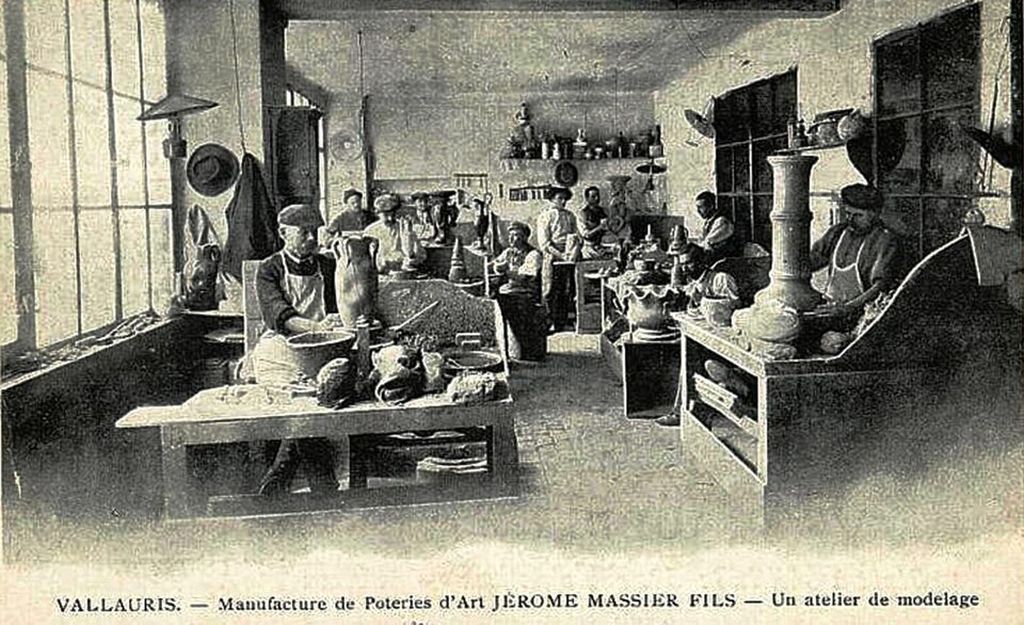
- Vallauris and the post-war ceramic revival
- A network of potteries, clays and skilled hands
- Plates, dishes and narrative cycles
- Jacob's Dream and the early Biblical group
- The House : vessel, body and building
- Greek pottery and White Matte Vase
- Exhibiting and publishing the ceramics
- From clay volume to carved stone
- Irregular stone and the idea of accident
- The Lovers and sculpture in the round
- Portrait, partner and Vava
- The Mermaid or The Song : intended and actual sites
- Bronze: models, casts and editions
- Painted pebbles, plaster and assemblage
- Conservation and display
- Reassessing the late work
Vallauris and the turn to clay
Chagall settled at Vence in 1950 and worked in the pottery environment of Vallauris, including the Madoura workshop associated with Georges and Suzanne Ramié. Picasso's ceramic activity formed part of the same regional renewal, but Chagall developed his own relation between image and object. The Musée national biography places ceramics at the centre of his technical expansion in the south.[1]
Clay offered immediacy and uncertainty. Chagall could incise wet surfaces, add relief, apply slips and oxides, then submit the work to firing. Heat changes colour and can warp or crack a form. The process requires knowledge of clay body, glaze chemistry, kiln atmosphere and temperature, making workshop collaboration essential.
Vessels as bodies
Chagall did not treat a plate or vase as a flat support waiting for a picture. Handles could become arms or horns; an opening could become a mouth; the curve of a pot could carry two figures that meet only when the object is turned. Incised lines catch glaze and shadow differently from painted marks.
Common subjects include lovers, animals, Biblical figures, fish, birds and hybrid beings. Their familiarity from the paintings should not conceal what clay does to them. A goat wrapped around a vase is encountered through handling and rotation. Front and back lose their ordinary hierarchy.
The Vence research notes that by 1950 Chagall's ceramics were becoming fully volumetric and helped lead him towards sculpture.[3] The border is genuinely porous: a vessel may be functional in origin but sculptural in form; a ceramic relief may operate like carved stone; a model can generate a cast bronze.
Relief and direct carving
Chagall developed stone sculpture through bas-relief and sculpture in the round. He worked closely with the Vence stonecutter Lanfranco Lisarelli, whose practical knowledge made direct carving possible. The catalogue identifies 65 stone sculptures, including 39 marbles, as well as plaster, painted pebbles and an assemblage.[4]
Direct carving differs from modelling. Removing stone is largely irreversible, and the existing block suggests limits, veins and possible fractures. Chagall often allowed a rounded stone to propose a head or pair of faces. Shallow relief preserves the sense of drawing: a contour cut into a surface becomes dark through shadow.
Texture mattered. Point, chisel, claw tool and bush hammer produce different fields, from rough granular skin to softened planes. Polished passages can catch light beside unfinished stone. The Vence dossier emphasises Chagall's interest in these tool-made textures and their changing shadows.[3]
Two heads, lovers and divided identity
Several sculptures join two heads or faces within one volume. The motif relates to double profiles and couples in the paintings, but stone changes its logic. A viewer walks around the object and discovers when one face becomes another. Shared mass can suggest intimacy, continuity or unstable identity without requiring a single allegorical answer.
Biblical subjects such as David also appear. A sculpted king or prophet does not inhabit the coloured atmosphere of the paintings; gesture, silhouette and material weight carry the meaning. Chagall's sculptural simplification is often structural rather than naïve: detail is reduced so the form survives changes of viewpoint.
From stone to bronze
The catalogue records 32 bronzes, most cast by the Susse foundry at Malakoff.[5] Bronze normally begins with a model in clay, plaster, wax or another material. Casting can preserve a modelled surface and permits an edition, unlike a unique directly carved stone. Patination then changes colour and the way light moves across the form.
Object records should distinguish the date of the model from the date and number of a particular cast. “By Chagall” may encompass modelling, selection, foundry translation and patina. Foundry marks, edition numbers and provenance are part of the work's identity.
Ceramics, architecture and the sacred
Clay also entered architectural settings. At Notre-Dame-de-Toute-Grâce in Assy, Chagall made a large ceramic mural connected to his first stained-glass work. The fired surface offered weather resistance and a tactile alternative to fresco. Relief and glaze respond to changing exterior or interior light.[1]
The Assy work, The Crossing of the Red Sea, comprises ninety tiles made at Madoura in 1956 and mounted in the baptistery in 1957.[15] Its segmentation is structural and visual: grout lines divide the image while firing smaller units reduces the risks posed by one enormous clay slab. Installed with two marble reliefs and two windows, it is also the first monumental test of the mixed-media environments that occupied Chagall thereafter.
In Biblical works, earth carries an additional resonance without functioning as a fixed symbol. Clay is both ordinary material and the substance from which human beings are formed in Genesis. Chagall could activate that association through subject and handling while retaining the vessel's practical history.
Collections and classification
The Musée national Marc Chagall received sculpture and a ceramic work within the 1972 donation and later broadened its holdings to represent the whole career.[6] The official catalogue raisonné now gives ceramics and sculpture separate chronological catalogues built from archival documents, photographs, exhibition history and provenance.[2]
Classification still needs judgement. Painted pebbles, assemblage, ceramic sculpture, relief and vessel forms cross museum departments. Dimensions and multiple views are necessary. A frontal photograph can make relief look like drawing and hide the reverse of a pot.
The Marc and Ida Chagall Archive preserves the documents needed to reconstruct workshop relationships and lost or dispersed objects.[7] Photographs may record an earlier state, a work before patination or a sculpture in the studio beside related drawings.
How to examine a ceramic or sculpture
Identify material precisely: earthenware or stoneware, slip, glaze, oxide, marble, limestone, plaster or bronze. Record whether the work was thrown, hand-built, pressed, incised, modelled, carved or cast. Name the workshop, stonecutter or foundry when known.
Then move around it. Watch how profiles merge, where an incision changes in depth and how glaze gathers. For stone, compare rough and polished surfaces; for bronze, separate modelled texture from patina. In a relief, ask which elements remain within the block and which project into shared space.
A material extension of Chagall's art
Ceramics and sculpture gave Chagall's recurrent beings weight, curvature and resistance. They required him to negotiate gravity rather than overturn it pictorially. Yet the results preserve transformation: a vessel becomes an animal; one stone contains a couple; a cut line behaves like a drawing made from shadow. Through workshops and skilled collaborators, the late work made touch and material inseparable from memory.
The scale and chronology of the ceramic corpus
The official catalogue lists 350 ceramics made from 1949 to 1972, including vases, plates, dishes, tiles and plaques.[8] The dates correct the vague idea of a brief experiment. Chagall worked in clay across more than two decades, while developing sculpture, glass, mosaic, tapestry and major paintings.
The catalogue's typology reveals concentration as well as breadth: plates and dishes form a large group, but wall ceramics, plaques, bowls, pitchers, tiles and shaped objects alter how imagery occupies space. Each object receives a reference number and is arranged chronologically. Technical descriptions derive from direct study with restorers and remain revisable where innovative processes are not fully documented.[8]
The searchable totals make that balance more concrete: 137 dishes and 63 vases form the largest groups, alongside 23 wall ceramics, nineteen plates, fourteen cups, nine tiles and smaller numbers of bowls, pitchers, saucers and shaped pieces.[8] These are catalogue classifications rather than fixed aesthetic ranks. A “dish” may carry built relief and a “vase” may function as a figure, so typology helps locate an object without settling how it behaves.
This scientific caution matters. A surface may combine slips, oxides, partial glaze, incision and added modelling. Visual inspection alone may not establish firing order or distinguish a coloured clay body from applied coating. The catalogue records current conclusions rather than pretending every workshop procedure is certain.
Vallauris and the post-war ceramic revival
Vallauris had a long pottery industry before modern artists arrived. After the war, workshops joined utilitarian traditions to renewed studio ceramics and attracted painters including Picasso, Chagall and others. Suzanne and Georges Ramié's Madoura workshop provided clay, kilns and specialist knowledge while allowing artists to work beyond conventional pottery training.[8]
Chagall began around 1949, soon after returning from American exile. The change of medium coincided with resettlement in the Mediterranean south. Local earth, light and craft history were not just picturesque inspiration; they supplied material and infrastructure.
Madoura was important but not the whole story. Catalogue research draws on the Musée Magnelli–Musée de la céramique in Vallauris and on Ramié family knowledge, while individual records identify other workshops where relevant.[8] Accurate object study names the documented pottery rather than assigning every ceramic automatically to Madoura.
A network of potteries, clays and skilled hands
Chagall's first ceramic in 1949 was made with Madame Bonneau at the Poterie des Remparts in Antibes. Thirteen early objects bear that workshop's stamp. He then worked with Serge Ramel at the Poterie des Remparts and Poterie du Peyra in Vence, conducted firing trials at the Lebasque studio in Clausonnes and used the Roux workshop in Juan-les-Pins. Later objects document occasional collaboration with Marius Giuge and Michel Muraour. Madoura was the longest relationship—hundreds of one-off works between 1951 and 1971—but it was one part of an experimental regional network.[15][16]
The movement among workshops affected form. Early Antibes pieces tend towards painted decoration under an even enamel, while later work takes greater advantage of clay grain, partial glaze, incision and built relief. Chagall even sought an estimate for a kiln at his Vence villa in 1956, although the archive does not establish whether it was installed. The request and photographs of Madoura pieces being painted at home show his wish to move objects between the communal pottery and his own studio.[16]
Local material was not singular. Technical research distinguishes a yellow or pinkish fire clay, a lean limestone-bearing clay used in mixtures, a highly plastic grey clay firing white and a red clay associated with Clausonnes. Suppliers around Vallauris drew from deposits at Clausonnes, La Bouillide, Le Carton and La Colle. Chagall selected among ochre-pink, white, red and grogged bodies for colour, grain, plasticity and resistance to heat.[15]
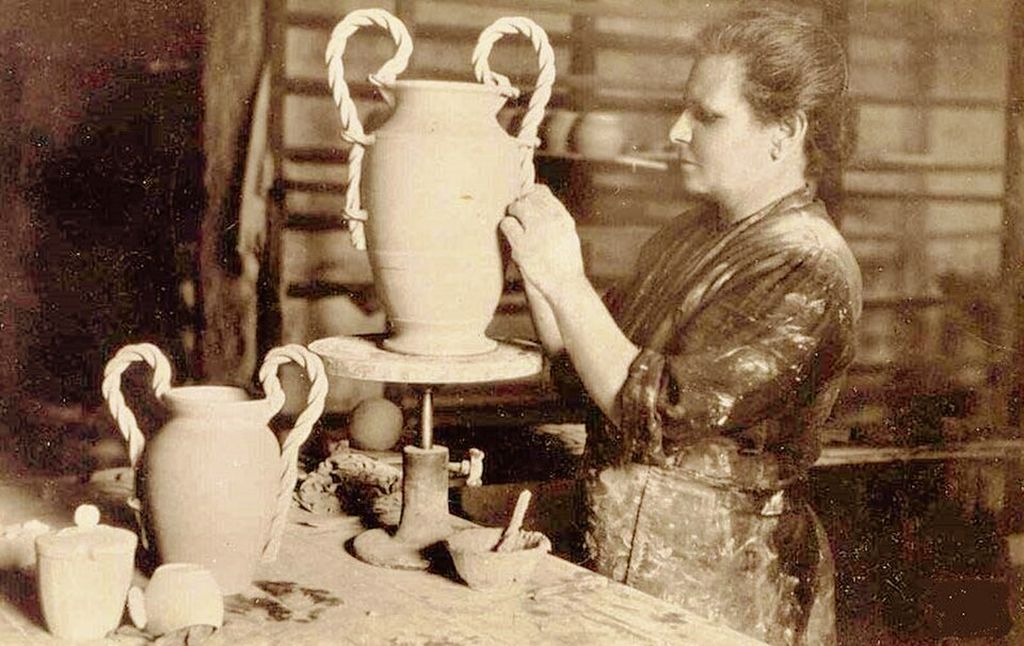
The assistants who formed the supports should be named. At Madoura, Jules Agard generally threw pieces on the wheel and Loris Cerulli moulded forms; Suzanne Ramié guided Chagall's development of sculptural vessels.[15] Chagall modelled, cut, incised, joined and decorated these prepared bodies. Barbotine—liquid clay used as adhesive and relief medium—attached modelled parts. Sgraffito cut through slip to disclose the body below; oxides supplied colour; underglaze or partial enamel determined which areas became lustrous. A catalogue entry that simply says “ceramic” suppresses this sequence and its divided labour.
Plates, dishes and narrative cycles
A plate offers a circular field whose rim can contain, interrupt or become part of a figure. Chagall used incised line and coloured slips to make animals, couples, Biblical scenes and circus figures turn with the object. Repetition across groups allowed him to vary a subject through firing and handwork without producing industrially identical editions.
Dishes and plaques can approach relief. Added clay creates projecting heads, wings or limbs; cuts deepen contours; partial glaze separates glossy and matte areas. The reverse, foot and edge carry workshop and handling evidence often absent from frontal reproductions.
Biblical subjects such as creation, Bathsheba or Elijah join ancient narrative to the elemental associations of clay and fire. That connection can enrich interpretation but should not replace technique. A named scene remains an object with weight, thickness, firing variation and a specific workshop history.
Jacob's Dream and the early Biblical group
Between 1950 and 1952 Chagall made about forty Biblical ceramics, including dishes, plaques and vessels, while developing the paintings that became the Biblical Message. Jacob's Dream of 1951 is a fine pink-ochre clay dish measuring roughly forty-three by thirty-three centimetres. Modelled additions were fixed with barbotine; slips and oxides supplied brown, ochre, yellow and green; knife and dry-point incision cut the surface beneath an underglaze.[17]
The image withholds the conventional ladder and ascending angels. Jacob's closed-eyed head fills the dish, with his hands, beard and pillow stone projecting in low relief. The change from a complete Genesis episode to an enlarged sleeping face makes the vessel intimate and bodily. It also turns the supporting earth of the story into actual fired earth: the stone under Jacob's head and the clay carrying his face are represented and material at once.
The catalogue relates the elderly face to Chagall's study of Rembrandt and the animated, shimmering relief to Mikhail Vrubel's glazed majolica.[17] These comparisons are useful when they remain propositions rather than sources copied into clay. The work sits among Hebrew scripture, Dutch painting, Russian ceramic modernism and southern French workshop technique. Its inscriptions on front and reverse, including “Marc Chagall Vence 1951”, anchor that transnational field in a specific moment and place.
The House: vessel, body and building
The 1952 ceramic The House provides a detailed example. Made at Madoura from pink clay, it uses slips and oxides, knife and dry-point incision and underglaze. Its form begins with the southern French coucourdon, a calabash-shaped pitcher revived by Suzanne Ramié.[9]
Chagall transformed the vessel anthropomorphically. Its belly becomes a body, two heads emerge, an irregular handle functions as an arm and a bird appears inside the neck. The title adds architecture to this bodily reading. House, human and container occupy one shape, extending the metamorphoses of his painting into an object held and turned.
The catalogue relates its deliberate archaism to Russian folk ceramic traditions while documenting the local Vallauris form.[9] This dual reference avoids a false choice between Russian memory and Mediterranean craft. The object was possible because both histories met in a workshop.
Greek pottery and White Matte Vase
Trips to Greece in 1952 and 1954 renewed Chagall's attention to ancient painted vessels. White Matte Vase of 1956 does not imitate a single archaeological object. Its pale slip, oxides and incised line organise animals, people and vegetation in bands that recall Greek frieze construction, while rooster, fish and hybrid figures retain connections to Russian popular art, Jewish funerary imagery and Chagall's Christian and Mediterranean subjects.[18]
The frieze is exceptional within his ceramic corpus, and it requires rotation. One side brings a rooster over a facing couple; another opens towards fish, sea and a crescent moon. Incision exposes the body beneath the velvety white slip, so drawing is created by material removal as well as added colour. The matte surface absorbs light more like fresco than glossy pottery, demonstrating that “glaze” cannot be assumed to cover every Chagall ceramic uniformly.[18]
Another Madoura object, The Rooster of 1954, makes sgraffito especially legible: decoration was cut into the still-raw clay under the guidance of Ramié and workshop artisans.[19] Incision links Chagall's printmaking hand to pottery without making the processes identical. A needle through slip displaces wet matter and changes how later firing and light register the line.
Exhibiting and publishing the ceramics
The Galerie Madoura exhibition of 1962 presented at least thirty-two catalogued works, including Biblical subjects, riders, lovers, beasts, Vence and Paris groups.[10] Such exhibitions moved ceramics from workshop and domestic use into the art market and museum discourse.
Publication alongside sculpture also affected reception. Ceramics could be judged as extensions of painting or as decorative art, categories that sometimes lowered their status within modernist hierarchies. The catalogue raisonné instead treats them as a coherent body requiring object-level technical research.[8]
From clay volume to carved stone
The transition to sculpture was not a rejection of ceramics. Modelling and adding clay made images volumetric; direct carving reversed the procedure by removing material. Chagall pursued both. The official sculpture research identifies sixty-five stone works within a total corpus of ninety-seven sculptures.[11]
Lanfranco Lisarelli's workshop stood opposite Chagall's villa in Vence. From 1951 to 1983, with a break in the 1970s, artist and stonecutter maintained a long dialogue. They experimented with low relief, high relief, sculpture in the round and plate-like forms, choosing stones for colour, texture, shape and existing “accidents”.[11]
The term collaborator is essential. Lisarelli was neither an anonymous assistant nor the independent author of Chagall's iconography. He supplied material knowledge, carving skill and continuous practical exchange. Official records now list him beside Chagall where documented.
Irregular stone and the idea of accident
Chagall valued cracks, chips, veins and roughness because they suggested forms rather than merely obstructing them. The official sculpture essay quotes his interest in “accidents” as openings onto another world.[11] A pre-existing swelling might become a cheek; a fissure could divide two profiles; an uneven edge might remain visible instead of being regularised.
This method differs from imposing a fully predetermined model on neutral stone. It also differs from claiming that the material made the image by itself. Recognition occurred through selection and carving. Chagall and Lisarelli negotiated how much of the found block to preserve.
Tool marks retain that negotiation. Point and tooth chisel, gradine, bush hammer and polishing create surfaces that receive light differently. Rough areas can merge with garden or architecture, while a polished face detaches sharply. Photographs need raking light and multiple views to show this range.
The division of work is clearer than the phrase “direct carving by Chagall” suggests. Chagall prepared drawings on paper or tracing sheets and sometimes drew in pencil directly on a block. Lisarelli selected or ordered Carrara marble, shell limestone and stones from Rognes, Gard or Jerusalem, advised on their behaviour and cut the principal forms. Contemporary testimony says Chagall handled the chisel relatively little and added details after the major carving.[11] His authorship lay in selection, drawing, instruction, revision and finishing within a sustained dialogue with a named stonecutter.
That evidence also changes how “accident” should be used. A crack did not automatically become an image, and admiration for a rough surface did not eliminate design. Chagall recognised a possibility; Lisarelli judged whether the block could sustain it; carving made some features legible and left others untouched. Chance entered a controlled sequence of decisions.
The Lovers and sculpture in the round
The marble The Lovers of 1951–52 is catalogue number S-17 and explicitly credits Lisarelli.[12] Two figures share a compact vertical mass. As the viewer moves, profile and embrace change; the relationship cannot be captured from one front.
Its early exhibition history, including Turin in 1953, shows that sculpture entered Chagall's public career quickly rather than remaining a private experiment.[12] Later publication in surveys of ceramics and sculpture helped establish a medium-specific corpus.
The lovers motif changes under gravity. Painted couples may fly, but marble must balance. Fusion occurs through shared stone, not suspended bodies. Material limitation becomes the metaphor: intimacy is a problem of how two identities remain visible within one block.
Portrait, partner and Vava
The sculpture Vava, dated 1968–71, was carved from white Carrara marble with Lisarelli and stands seventy centimetres high.[13] Its title names Valentina Brodsky Chagall, the artist's second wife. The work therefore belongs to portraiture as well as the broader couple imagery.
Carved likeness in Chagall is rarely academic description. Reduction and the stone's existing form mediate the sitter. Naming Vava prevents a generic reading of every female head as Bella and reminds viewers that the late domestic and professional partnership shaped the post-war career.
The Mermaid or The Song: intended and actual sites
The large marble The Mermaid or The Song was made in 1967–68 with Lisarelli. It was later acquired for a planned waterfront development in Jersey City, where it was intended for a pool facing New York, but the project was never realised; the sculpture remained at Château de Grandson in Switzerland.[14]
That history demonstrates why provenance and intended site matter. A mermaid beside the Hudson and Statue of Liberty would have joined water, migration and civic monument. In a Swiss castle, scale and associations change. The unrealised American plan remains part of the object's history without defining its current setting.
Bronze: models, casts and editions
The catalogue records thirty-two bronzes, many cast by the Susse foundry.[4] Bronze permits multiplication but each cast requires identification by foundry, date, edition and patina. The date of an original model may differ from a later authorised cast.
Lost-wax casting translates a model through mould, wax, investment and molten metal. Chasing removes casting seams and corrects surfaces; patination applies controlled chemical colour. These stages involve foundry specialists and can preserve or alter marks from clay and plaster.
The presence of editions makes authentication especially important. A signature alone does not establish when, by whom or under what authority a bronze was cast. Catalogue number, foundry mark, edition notation, provenance and archival documentation must be considered together.
Woman Bathing shows why related materials and dates must be separated. The catalogue links a 1953 grogged-clay figure, a 1953 gold-patinated plaster, bronzes dated 1957 and 1957–59, and a 1959 Susse cast marked 3/3.[20] These are not interchangeable descriptions of one timeless sculpture. They record a family of states in which modelling, scale, surface, foundry work and authorised multiplication produced materially distinct objects.
Chagall's Susse relationship ran from 1956 to 1982. Workshop photographs show him and Vava examining casts and Chagall adjusting patina with foundry staff.[11] Lost-wax casting translated plaster through mould and wax into metal; chasing and patination followed. Foundry specialists controlled high-risk technical stages, while Chagall evaluated surface and colour. The bronze therefore preserves a model but also embodies a later production event whose date and edition belong on the label.
Painted pebbles, plaster and assemblage
The sculptural corpus also includes plaster, painted pebbles and an assemblage.[4] These categories show Chagall testing the minimum intervention needed to activate a found form. A few painted or incised lines can turn a pebble into a face or animal while leaving its geological shape dominant.
Plaster occupies another position. It can be a model for bronze, a unique finished object or an intermediate state. Surface, armature and casting evidence help determine function. Museum labels should avoid assuming every plaster is merely preparatory.
Conservation and display
Ceramics can crack, craze, flake and suffer old adhesive repairs. Glaze appearance changes under dirt and restoration coatings. Stone is vulnerable to impact, salts and inappropriate outdoor exposure; bronze patina changes through handling and environment. Conservation therefore contributes to technical knowledge as well as stability.[8]
Display should permit more than a frontal view. Vessels need sight of neck, handle, interior and reverse. Sculpture in the round requires circulation. Secure mounts must protect fragile projections without making functional forms look like flat pictures.
Reassessing the late work
The corpus overturns the notion of a painter casually decorating pottery in retirement. Three hundred and fifty ceramics and ninety-seven sculptures required sustained workshop relationships, repeated technical experiments and public exhibition. Their chronology overlaps Chagall's most ambitious stained glass, mosaics and Biblical paintings.
Clay and stone forced different negotiations with chance. Fire could transform a ceramic beyond direct control; a crack in marble could guide carving; casting could multiply a model. Chagall's response was consistent with his painting but materially specific: he treated accident as a partner in making images rather than noise to be eliminated.
Discussion
Which piece of evidence most changes the way you read Marc Chagall Ceramics and Sculpture?
Reader Insights
Which visible detail most changes your reading of Marc Chagall Ceramics and Sculpture?
How do medium, setting and documented history shape the encounter?
What remains uncertain when documented fact is separated from interpretation?
Join the Conversation
Share your reading of Marc Chagall Ceramics and Sculpture below.
References
- Musée national Marc Chagall, “Biography of Marc Chagall”, View Source
- Catalogue raisonné Marc Chagall, View Source
- Musée national Marc Chagall, Vence-years dossier, View Source
- Musée national Marc Chagall, official catalogue raisonné announcement, View Source
- Catalogue raisonné Marc Chagall, “Sculptures”, View Source
- Musée national Marc Chagall, “La collection du musée”, View Source
- Archives Marc et Ida Chagall, “Documents”, View Source
- Catalogue raisonné Marc Chagall, “Ceramics”, View Source
- Catalogue raisonné Marc Chagall, “The House”, View Source
- Marc Chagall Archives, Marc Chagall: Céramiques exhibition catalogue record, View Source
- Marc Chagall Archives, “Marc Chagall's Sculptures”, View Source
- Catalogue raisonné Marc Chagall, “The Lovers”, View Source
- Catalogue raisonné Marc Chagall, “Vava”, View Source
- Catalogue raisonné Marc Chagall, “The Mermaid or The Song”, View Source
- Archives & Catalogue raisonné Marc Chagall, “Une sorte d'approche vers la nature: les aspects techniques des céramiques de Marc Chagall”, View Source
- Archives & Catalogue raisonné Marc Chagall, “Merging with the soil: Marc Chagall and ceramics”, View Source
- Catalogue raisonné Marc Chagall, “Jacob's Dream”, View Source
- Catalogue raisonné Marc Chagall, “Vase blanc mat”, View Source
- Catalogue raisonné Marc Chagall, “Le Coq”, View Source
- Catalogue raisonné Marc Chagall, “Femme au bain”, View Source