


 by Tom Gurney
Tom Gurney BSc (Hons) is an art history expert with over 20 years experience
Page Created on September 22, 2026 / Page Updated on September 22, 2026
Email: tomgurney1@gmail.com / Phone: +44 7429 011000
Introduction
Marc Chagall began working seriously with mosaic after the Second World War, when public art and collaboration became central to his practice. Mosaic turned colour into matter. Glass and stone tesserae catch light unevenly; mortar, texture and architectural distance remain visible; the viewer moves past rather than looking through a frame. Chagall supplied the designs and supervised their development, while trained mosaicists solved the demanding work of enlargement and construction.
At a Glance
- ArtistMarc Chagall
- SubjectMarc Chagall Mosaics
- Artistic contexttwentieth-century modern art
Contents
- From Italy to the first mosaic
- A collaborative medium
- Fourteen projects and twenty-eight catalogue entries
- The Prophet Elijah at Nice
- Orphée in Washington
- Four Seasons in Chicago
- How a Chagall mosaic was made
- Reading the mosaics in place
- Monumental colour after painting
- What the catalogue's twenty-eight entries represent
- From The Blue Rooster to Lino Melano
- The Lovers at the Fondation Maeght
- The Kostelitz courtyard and relocation
- The Knesset ensemble
- The Large Sun and the private Mediterranean garden
- The Message of Ulysses in Nice
- Orphée : private commission, public museum
- La Fête heureuse : friendship, medicine and a displaced garden
- The museum at Nice and a complete environment
- Four Seasons : route, wrapping and conservation
- Sacred commissions at Sainte-Roseline and Vence
- The Green River and posthumous completion
- Materials, methods and unresolved technical questions
- Reception, conservation and ethical description
From Italy to the first mosaic
Historic mosaics impressed Chagall before he made his own. The official chronology records his response to Torcello after a 1948 visit to Venice and to the Byzantine monuments of Ravenna in 1954. Lionello Venturi and contacts with the Ravenna mosaic community helped turn admiration into practice.[2]
In the late 1950s the Gruppo Mosaicisti sought modern artists' designs for an exhibition. Chagall contributed a gouache of a blue rooster. Antonio Rocchi and the Ravenna makers produced two versions of The Blue Rooster in 1958, establishing a method in which a painted maquette became a material interpretation rather than a squared-up copy.[3]
A collaborative medium
Chagall's collaborators included Rocchi, Lino Melano, Michel Tharin and makers formed by Ravenna's mosaic tradition. They selected tesserae, developed tonal passages, varied scale, laid directional courses and adapted a design to wall, floor or curved surface. The 2025 research programme reconstructed this network from maquettes, correspondence, site evidence and workshop histories.[4]
Authorship consequently has layers. Chagall devised imagery, colour relations and the intended site effect. The mosaicist decided how a brush passage could become stone and glass: a face might need a few large pieces, while sky might require hundreds of directional changes. Naming the maker acknowledges the object's actual creation.
Fourteen projects and twenty-eight catalogue entries
The official catalogue raisonné lists 28 mosaics made from 1955 to 1986. Museum research distinguishes fourteen projects because some designs produced multiple objects, versions or related executions.[1] They were installed in France, Italy, Switzerland, Israel and the United States, in private homes, museums, civic spaces, universities and religious or governmental settings.
The southern French route alone includes six monumental mosaics at Nice, Vence, Saint-Paul-de-Vence and Les Arcs-sur-Argens.[5] That regional concentration reflects Chagall's residence, access to collaborators and growing interest in making art inseparable from Mediterranean architecture and gardens.
The Prophet Elijah at Nice
For the museum built to house the Biblical Message, Chagall designed a large exterior mosaic of the prophet Elijah. Executed by Lino Melano with Michel Tharin, it sets the ascending prophet within a zodiac and a wide field of colour. The museum's object record notes a personal detail: Gemini is represented by Chagall's twin granddaughters.[6]
The mosaic helps organise the site. It faces a pool and garden rather than hanging inside the painting galleries. Reflections, vegetation and weather extend its surface. Biblical narrative, zodiacal time and family reference coexist without needing to be decoded into one message.
Orphée in Washington
The mosaic known as Orphée was made for the Washington home of Evelyn and John Nef and later installed in the National Gallery of Art Sculpture Garden. Its imagery joins Orpheus, lovers, animals, migration and city references within a broad blue field. The change from private garden to public museum altered its audience and conservation needs.[7]
The work exemplifies Chagall's use of classical myth alongside Biblical and autobiographical material. Orpheus is musician, traveller and figure of loss. Mosaic makes the surrounding blue tangible: variations in tesserae keep it from becoming an empty background.
Four Seasons in Chicago
Chagall's Four Seasons, dedicated in 1974 at First National Plaza in Chicago, wraps a rectangular structure in imagery of the city, lovers, musicians, animals, flowers and seasonal change. The project was executed with Lino Melano and assembled from a vast number of stone and glass pieces.[8]
This legacy subject now belongs within the mosaics page because technique, site and collaboration explain it better than an isolated short page could. Its imagery is panoramic rather than sequential. Viewers must walk around the four sides; there is no single authoritative front. Weather and heavy public contact made conservation and protective decisions part of the work's later history.
How a Chagall mosaic was made
The process began with drawings and coloured maquettes. Enlargement established the relation between small design and architectural scale. Tesserae could be cut from coloured glass, enamel and natural stone. Differences in opacity, reflectivity and grain replaced painted modulation. The maker set pieces into mortar, often following contours in courses that animate a body or radiate around a sun.
The interval between tesserae is not empty. Grout colour and width affect contrast. A face constructed from a few pieces reads differently at arm's length and across a plaza. Chagall and his collaborators planned for distance while preserving local incidents that reward approach.
Reading the mosaics in place
Start with site and movement. Determine whether the work is approached frontally, circled, reflected or passed in everyday circulation. Record the named mosaicist and installation date as well as Chagall's design date. A relocated mosaic such as Orphée has at least two spatial histories.
Then inspect material decisions. Stone tends towards opacity and geological variation; glass can flash or deepen with light. Directional setting can imply hair, water, flame or flight. Damage, repair and surface coating may change colour and texture, so current appearance should not be assumed identical to the first installation.
Monumental colour after painting
Mosaic let Chagall turn familiar figures into durable public environments. Its ancient prestige connected modern imagery to Byzantine, classical and sacred buildings, while modern civic commissions placed it in plazas and universities. The medium also made dependence productive: every finished surface records negotiation among design, specialised handwork, architecture and time.
What the catalogue's twenty-eight entries represent
The official mosaic catalogue is more precise than a list of fourteen architectural commissions. Its twenty-eight entries include autonomous experiments, duplicate transpositions, preparatory tests and twelve individual floor panels at the Knesset as well as monumental walls.[9] The distinction explains why “twenty-eight mosaics” and “fourteen projects” can both be accurate.
The catalogue names buildings in object titles and records collaborators, technique, dimensions, inscriptions, provenance, exhibition history and bibliography. Conservators contributed to the technical descriptions, and the editors explicitly state that some innovative techniques remain under study.[9] This is a useful warning against treating “mosaic” as a uniform recipe.
From The Blue Rooster to Lino Melano
The two Blue Rooster mosaics were transpositions of one gouache rather than a single work copied twice. Correspondence began after Lionello Venturi approached Chagall in 1955. Chagall requested tessera samples and asked practical questions before the Ravenna group executed the works. One version went to him; the group retained the other, now at the Museo d'Arte della città di Ravenna.[10]
The episode established translation as the central problem. Painted transitions could not simply be imitated by uniformly sized cubes. Antonio Rocchi and other Ravenna makers chose glass pastes and directional settings that preserved the rooster's energy while making a distinctly granular surface.
By 1963 Chagall was searching for a mosaicist able to work at architectural scale. The Bird Musician, made with Lino Melano in marble and stone, may have functioned as a test of their working relationship, although the official record states that the beginning of their collaboration is not fully documented.[11] That qualification is important: plausible workshop sequence is not the same as archival proof.
The Lovers at the Fondation Maeght
The mosaic for the Fondation Marguerite et Aimé Maeght in Saint-Paul-de-Vence was executed in 1963–64, with a separate trial preserved in the catalogue. Its couple, bird and surrounding forms belong to Chagall's familiar imagery, but the garden setting changes their operation. Vegetation, wall and moving visitors become part of the composition.
The commission coincided with the foundation's opening and with Chagall's long relationship with Aimé Maeght. Lino Melano's interpretation established the collaboration that would sustain much of the monumental corpus. The test mosaic is valuable evidence: it shows how artist and maker evaluated colour, tessera scale and contour before completing the wall.
The Kostelitz courtyard and relocation
The Winter Garden, also called The Chagall Courtyard, was Chagall's first monumental private mosaic commission. Irène Kostelitz asked for it in 1964 for the courtyard of her Paris house near the Élysée Palace. Lino and Heidi Melano and Leonard Leoni collaborated on the immense field of stones and glass pastes.[12]
The mosaic later moved to the Fondation Pierre Gianadda in Martigny. Relocation changes approach, surrounding architecture, daylight and social function. A work conceived for an intimate Parisian courtyard now belongs to a Swiss museum setting. The title preserves the original site even when the material object no longer occupies it.
The Knesset ensemble
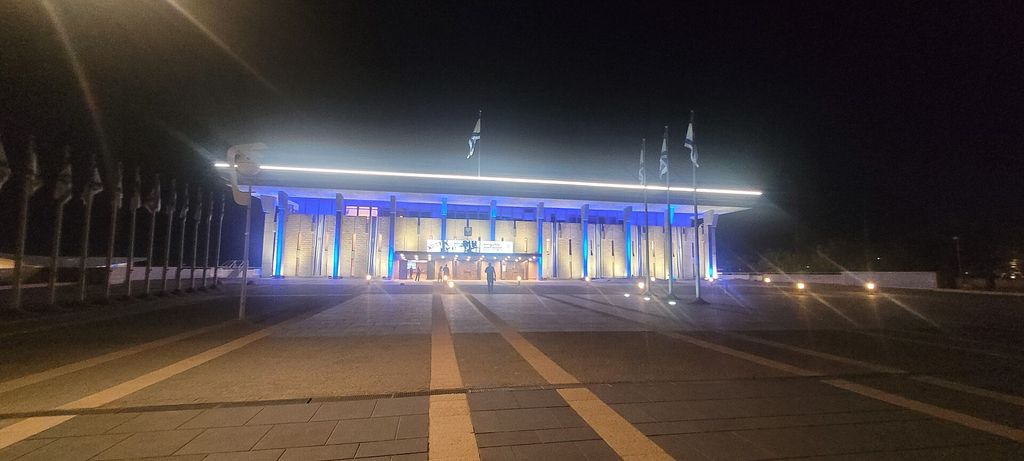
For the Knesset in Jerusalem, Chagall conceived a coordinated programme of three tapestries, a wall mosaic and twelve floor mosaics for the principal reception hall. The wall mosaic, The Wailing Wall, was designed in 1964–66 around Psalm 137: exile by the rivers of Babylon and the injunction not to forget Jerusalem. Its position in the legislature of the modern State of Israel connects Biblical displacement, sacred geography and contemporary sovereignty without making them historically identical.[9][13]
The floor scheme developed in dialogue with the building. In July 1964, polished stone replaced an earlier idea for wall-to-wall carpet, and Chagall proposed twelve asymmetrical mosaic fields based on motifs found in late-antique synagogue pavements in the region. Menorah, shofar, hands and eyes appear beside fruit, vegetation, birds, columns, animals and a smiling face.[15] The reference is archaeological as well as symbolic: fragments dispersed through a modern floor evoke an ancient visual culture whose surviving pavements already linked Jewish worship, ornament and the material land.
These mosaics must be understood underfoot. Walking, wear and oblique viewing differ from a frontal wall. Their irregular outlines interrupt the larger polished floor, while the separate catalogue entries preserve each field as a work within a single architectural system. Counting therefore matters: the catalogue's wall mosaic plus twelve pavements generate thirteen object records from one project and explain almost half of the apparent gap between fourteen projects and twenty-eight catalogue entries.[9]
The Knesset's architectural history also records disagreement. Chagall wanted to block windows whose natural light he feared would interfere with the tapestries, but architect Joseph Klarwein refused. The ceiling received 100,000 wooden cubes, selected over an aluminium alternative.[15] The room consequently emerged through negotiation among artist, architect, interior designer, patrons and fabricators. Chagall's favoured mosaicists, Lino and Heidi Melano, came from France after he concluded that no available Israeli workshop could execute his plan to his satisfaction.[15]
That decision complicates national readings. The iconography and institution are Israeli; the workshop lineage is Ravenna and Paris; Chagall worked from France; the hall joins French-woven tapestries to stone and glass installed in Jerusalem. The result is neither a self-contained national style nor a transplanted European object. It is a transnational state commission that turns diaspora, return and cultural transfer into both subject and method.
The Large Sun and the private Mediterranean garden
At Chagall's villa La Colline in Saint-Paul-de-Vence, The Large Sun brought mosaic into the artist's own domestic landscape. Executed in the mid-1960s, it placed a radiant form and recurrent figures against architecture and vegetation. Private location allowed sustained observation of how tesserae changed through seasons and hours.
The work also reverses the usual commission relation. Chagall was client as well as designer, and the mosaic belonged to the environment in which he painted and received visitors. Later provenance and access therefore raise different questions from a civic plaza or museum.
The Message of Ulysses in Nice
Made for the Faculty of Law and Economic Sciences in Nice in 1967–69, The Message of Ulysses extends eleven metres across the salle des pas perdus outside a 650-seat lecture theatre. Dean Louis Trotabas proposed Ulysses as a Mediterranean figure of intelligence, drawing on Gabriel Audisio's 1946 essay. Chagall dedicated the work to the students and gave his design without fee, while insisting that Lino Melano be paid according to his estimate through France's one per cent for art provision.[16] The arrangement separates artistic gift from the skilled labour needed to make it.
The long composition joins Homeric voyage, Mediterranean identity and modern university life. Its horizontal format makes narrative unfold through walking rather than one frontal glance. Preparatory collage and drawing established broad colour and incident, but the full wall required an enlarged tracing, a rolling scaffold and continuous comparison with the maquette. Lino and Heidi Melano cut and adapted tesserae directly on the Nice site during a five-month campaign that continued through the upheavals of May 1968.[16]
The recovered material list is exceptionally diverse: Carrara marble and other limestones, coloured glass paste, Murano gold, copper, onyx, enamel and green- or copper-reflecting minerals were set into fresh cement.[16] Chagall visited several times a week, corrected colours, specified lighting and apparently repainted some cement joints with a brush. This is stronger evidence of direct intervention than a general statement that he “supervised” the work. It also shows why authorship cannot be divided into conception by one person and neutral execution by others: design choices continued on the wall.
The 2023 conservation campaign found fifty-five missing tesserae, about 180 initially judged mobile and, after protective natural latex was removed, nearly 400 detached pieces requiring numbered storage and resetting. Conservators recreated the fifty-five losses, cleaned the lower area with low-pressure steam and closed a gap between the mosaic and ceiling.[17] Those numbers make durability measurable. A work of roughly 200,000 pieces can appear intact at room scale while hundreds of individual elements are insecure.
The intervention also illustrates documentation ethics. Numbering detached tesserae preserved their precise positions; replacement restored visual continuity but created distinguishable twenty-first-century material. Cleaning changed reflectivity across the wall, while the renewed room and ceiling altered its architectural frame. Conservation did not return an abstract original condition. It stabilised a work whose student traffic, dust, previous 1980s treatment and changing building had become parts of its biography.
Orphée: private commission, public museum
John and Evelyn Nef did not initially ask Chagall for a mosaic. During a 1968 visit to their Georgetown home, he decided that the house needed nothing but that he would make something for its garden. A shared encounter with Gluck's Orpheus and Eurydice may have informed the theme, although the catalogue presents this as remembered context rather than documented instruction. The commission began as friendship and gift before it became a museum object.[18]
The image combines Orpheus and his lyre with Pegasus, the Graces, lovers, animals and a group waiting beside a broad blue sea. Chagall related the travellers to immigrants and refugees crossing to America and to his own flight from Nazi-occupied France with help from the Emergency Rescue Committee and Varian Fry.[18] Classical myth and twentieth-century refuge operate together: Orpheus, protector of the Argonauts through music, becomes a figure for art accompanying dangerous passage.
Lino Melano executed the 3 by 5.18 metre mosaic as ten transportable panels using stone, marble, glass paste and gold and silver leaf. He rejected smooth stones and ceramic, favouring rough-cut pieces whose facets and deliberately varied angles could catch changing light. Supplies came from firms including Albertini near Paris and Orsoni in Venice. The Nefs paid fabrication and installation expenses; Chagall took no fee.[18]
Local regulation affected the finished setting. Washington's fine-arts authority allowed the purpose-built garden wall only if it was faced with brick, a surface Chagall disliked. After the ten panels crossed the Atlantic and Melano installed them in October 1971, Chagall mixed a grey with yellow and black to subdue the surrounding brick. The episode makes architectural compromise visible at the edge of the work.
Evelyn Nef bequeathed Orphée to the National Gallery of Art. It entered the collection in 2009, was removed panel by panel, conserved and installed on a new masonry support in the Sculpture Garden, where it opened publicly in November 2013.[18] The new greenery recalls a garden but cannot reproduce the magnolia shade, domestic scale or private approach of Georgetown. Interpretation should preserve both spatial lives and the conservation decisions linking them.
La Fête heureuse: friendship, medicine and a displaced garden
The fourteenth project omitted from many short surveys is La Fête heureuse, made with Lino Melano in 1971–72 for the Saint-Paul-de-Vence home of cardiac surgeon Jean-Paul Binet. Binet treated the Maeght and Chagall families and was linked to them through friendship, medicine and collecting. The surviving archive does not establish a formal commission narrative, so the mosaic is best described as a personal gift or work made within that network rather than assigned a more precise transaction.[19]
Its small scale—220 by 106 centimetres—contrasts with the university wall and Chicago plaza. A tall green tree, goat, lovers, bouquet and hill town create a framed Mediterranean view. Preparatory works combine watercolour, gouache, fabric collage and, unusually, dried cypress, yew and cornflower material like an herbarium. Melano translated printed textiles and organic fragments into marble, granite and glass paste, while graded blue tesserae imitate the wash of the painted sky.[19]
This is a particularly clear demonstration of translation across substances. A leaf adhered to paper has texture, fragility and direct botanical identity; a cut mineral piece can only reconstruct its position or colour. The geometric border turns the terrace view into an opening, joining the represented village to the actual landscape around Binet's house.
The mosaic was removed and sold in 1990 and is now in an anonymous private collection.[19] Its current status reduces the public's ability to test the catalogue account against site and object. Here provenance is not an administrative afterthought. Detachment ended the relation among mosaic, terrace and view that the border helped construct.
The museum at Nice and a complete environment
The Prophet Elijah was one of three monumental elements Chagall designed for his museum, together with the auditorium windows and a tapestry. Its reflecting pool, Mediterranean planting and zodiac create a transition between building and garden. Lino Melano and Michel Tharin executed the mosaic under Chagall's supervision.[6]
The work demonstrates why maquettes belong in the history. Two designs document changes in the chariot, surrounding signs and chromatic structure. Their comparison shows that enlargement involved reconsideration rather than mechanical scaling.
Four Seasons: route, wrapping and conservation
Chicago's Four Seasons wraps all four sides of a large rectangular structure in what the catalogue measures as about 270 square metres of mosaic distributed across 128 panels. Lino Melano, Michel Tharin and Alain Devy translated the designs with marble, granite, stone and glass paste in some 350 colours. Panels fabricated at Biot were shipped to Chicago and assembled during summer 1974; Chagall arrived in September to direct final alterations before the public unveiling on 27 September.[20]
The theme responds to a corporate plaza in the commercial Loop. Critics wondered whether Chagall's imagery could withstand the scale of a sixty-storey bank tower and the district's pace. He described the seasons as stages of physical and moral life and imagined the many peoples passing through the plaza. The patronage nevertheless remains specific: William Wood Prince initiated the commission for the First National Bank, and the apparent public gift formed part of a privately shaped urban redevelopment.[20]
The composition is meant to be followed clockwise. Spring and summer begin on the west, proceeding through harvest, music, lovers, animals, winter and renewed growth. Seasonal imagery creates continuity across corners without making the four walls interchangeable. Walking is mandatory, and no photograph of one facade represents the work's temporal or spatial argument.
Material abundance mediates the subject. Tiny chromatic incidents accumulate into monumental fields; pieces from different sources carry distinct grain and reflectivity. At plaza distance the walls read as colour and movement, while close inspection discloses hundreds of local adjustments in scale and direction. Chagall's familiar motifs are therefore reorganised by circulation and surface rather than merely enlarged.
Outdoor exposure brought water, Chicago freeze-thaw cycles, touching and pollution. A protective canopy and later conservation altered the plaza conditions to slow deterioration.[8] Such interventions form part of the object's history. Protection of mortar and tesserae can require a new roofline, different shadow and changed relation to weather—the very conditions through which the seasons were originally encountered.
Sacred commissions at Sainte-Roseline and Vence
The Angels' Meal, also called The Miracle of Saint Roseline, at the Chapelle Sainte-Roseline in Les Arcs-sur-Argens is the only one of Chagall's four religious mosaics drawn from the life of a Christian saint rather than a Biblical narrative. Marguerite Maeght initiated restoration of the deteriorated pilgrimage chapel and invited artists from the Maeght circle: Diego Giacometti designed liturgical furnishings and a relief, while Jean Bazaine and Raoul Ubac made glass. Chagall's mosaic, installed later, belongs to this negotiated meeting of medieval cult, historic fabric and post-war sacred art.[21]
The episode concerns the novice Roseline interrupting kitchen duty to pray, after which angels prepare the community's meal. Chagall arranged winged figures around a laden table, relating the scheme to the triangular hospitality of Abraham and the angels and to Andrei Rublev's Trinity. The Christian local legend thus passes through Hebrew scripture, a Russian Orthodox icon and Chagall's own recurrent table imagery. Those strata should remain distinct rather than reduced to a generic scene of charity.[21]
Michel Tharin began work on site in May 1975 after a seventeenth-century altarpiece was moved to give the new wall sufficient viewing distance. More than a tonne of marble, granite and glass paste contrasts matt cream stone with reflective colour; dark tesserae carry contours derived from the maquette. The composition responds to the round arch like a stage opening. Its dedication on the saint's feast day, 2 August 1975, placed modern art inside an active cycle of pilgrimage and local devotion.[21]
In 1979 Chagall returned to a place central to his post-war life with Moses Saved from the Water for Vence Cathedral. Michel Tharin collaborated on the stones-and-glass-paste wall. The official catalogue calls it the last mosaic completed during Chagall's lifetime and links the commission to civic and parish relationships already involved in The Message of Ulysses.[14]
The Green River and posthumous completion
The Green River at La Fontette school in Saint-Paul-de-Vence was completed in 1985–86 after Chagall's death. At Vava Chagall's request, Heidi Melano transposed a 1974 lithograph for the school façade.[13] The work therefore requires exact wording: Chagall made the source image and the project belongs to his catalogue, but its mosaic execution and installation continued posthumously.
The school setting differs from museums, parliaments and private gardens. Children and local families encounter it as part of ordinary civic life. That fulfils the public reach of mosaic while exposing the work to weather and daily proximity.
Materials, methods and unresolved technical questions
The corpus uses glass pastes, natural stones, marble and mixed settings. Some works were executed directly on site; others involved prefabricated sections. A direct method lets mosaicists respond immediately to wall and design, while an indirect or transfer method can reverse or segment the image before installation. The catalogue's technical language remains deliberately revisable because workshop practice varied and documentation is incomplete.[9]
Tessera orientation—the andamento—creates currents around figures and within backgrounds. Size changes can sharpen a face or broaden a sky. Glass paste supplies saturated, reflective colour; stone introduces opacity and geological variation. Mortar colour affects every joint. These decisions belong to named mosaicists, even when guided closely by Chagall.
Reception, conservation and ethical description
Mosaics are easily described as timeless because stone and glass seem durable. The corpus proves otherwise. Courtyards are dismantled, gardens change ownership, public plazas are rebuilt, outdoor surfaces weather and works conceived by a living artist may be completed after his death.
An adequate record therefore names original and current locations, design and execution dates, collaborators, relocation, restoration and posthumous stages. It also distinguishes the fourteen design projects from the twenty-eight catalogue objects. That precision does not diminish Chagall's authorship; it reveals the technical and social system through which his monumental colour became possible.
Discussion
Which piece of evidence most changes the way you read Marc Chagall Mosaics?
Reader Insights
Which visible detail most changes your reading of Marc Chagall Mosaics?
How do medium, setting and documented history shape the encounter?
What remains uncertain when documented fact is separated from interpretation?
Join the Conversation
Share your reading of Marc Chagall Mosaics below.
References
- Catalogue raisonné Marc Chagall, View Source
- Musée national Marc Chagall, “Chagall en mosaïque, une chronologie”, View Source
- Musée national Marc Chagall, mosaic chronology, View Source
- Musée national Marc Chagall, De verre et de pierre press dossier, View Source
- Musée national Marc Chagall, “Parcours de six mosaïques”, View Source
- Musée national Marc Chagall, “Le prophète Elie”, View Source
- National Gallery of Art, Marc Chagall collection, View Source
- Chicago Public Art, Marc Chagall, Four Seasons, View Source
- Catalogue raisonné Marc Chagall, “Mosaïques”, View Source
- Catalogue raisonné Marc Chagall, “The Blue Rooster”, View Source
- Catalogue raisonné Marc Chagall, “L'Oiseau musicien”, View Source
- Catalogue raisonné Marc Chagall, “The Winter Garden”, View Source
- Musée national Marc Chagall, De verre et de pierre press dossier, View Source
- Catalogue raisonné Marc Chagall, “Moses Saved from the Water”, View Source
- The Knesset, “The Knesset Building in Givat Ram: Planning and Construction”, View Source
- Catalogue raisonné Marc Chagall, “Le Message d'Ulysse”, View Source
- Université Côte d'Azur, “Restauration de la mosaïque Le Message d'Ulysse”, 2023, View Source
- Catalogue raisonné Marc Chagall, “Orphée”, View Source
- Catalogue raisonné Marc Chagall, “La Fête heureuse”, View Source
- Catalogue raisonné Marc Chagall, “The Four Seasons”, View Source
- Catalogue raisonné Marc Chagall, “Le Repas des Anges”, View Source