


 by Tom Gurney
Tom Gurney BSc (Hons) is an art history expert with over 20 years experience
Page Created on September 22, 2026 / Page Updated on September 22, 2026
Email: tomgurney1@gmail.com / Phone: +44 7429 011000
Introduction
Marc Chagall’s The Fall of Icarus turns the painter’s most familiar miracle upside down. For decades his lovers, animals, musicians and prophets had floated above towns without obeying gravity. Here a winged body plunges head-first towards a crowded village. Flight is no longer release. It has reached the instant of failure.
The painting belongs to the Musée national d’art moderne at Centre Pompidou in Paris—not, as the inherited page claimed, the Russian Museum in Leningrad. The museum dates it 1974/1977. It is oil on canvas, 213 by 198 centimetres, purchased by the French state in 1979 and registered as AM 1978-733.[1]
Two inscriptions explain the date span. At lower left Chagall signed and dated the work 1974. At upper right he wrote his name, the French title and 1977. The canvas was therefore not a single-session work loosely labelled 1975; it was conceived through studies in 1973–74 and carried to a signed conclusion in 1977.[1][2]
At a Glance
- ArtistMarc Chagall
- ArtworkThe Fall of Icarus
- Artistic contexttwentieth-century modern art
Contents
- Icarus above a remembered village
- What happens in Ovid
- A fall inside Chagall’s language of flight
- Catastrophe with a clown’s body
- Chagall and the Bruegel problem
- The Bruegel image after Auden
- Seven studies and a long making
- What the seven sheets actually contain
- Colour as structure
- Return, memory and the date 1973
- Don Quixote, Orpheus and late humanism
- The 1977 Louvre exhibition
- Material limits and catalogue caution
- Looking at The Fall of Icarus now
Icarus above a remembered village
Icarus dominates the upper field, falling inverted beside a radiating solar disc. Wings or loosened feathers spread into a turning mass around him. Below, a pale central void warms into red. Houses, people, animals and vegetation gather along the margins as though the fall has pushed the inhabited world aside.[1]
This is not ancient Crete reconstructed by an archaeological imagination. Centre Pompidou identifies the square below as a recollection of Vitebsk. Chagall fills it with the population of his art: mothers and children, villagers, a reclining nude, dream-coloured cattle and familiar roofs.[1]
The 1977 France Culture broadcast counted perhaps thirty or forty witnesses. Some lift their arms; others stand beside donkeys; some climb on a roof. A naked woman lies on an izba, or wooden house, while another woman holds a child.[3] Myth falls into the social world Chagall had been rebuilding since his earliest Paris paintings.
The crowd prevents Icarus from being a solitary emblem. His body is enormous but his meaning is distributed among those looking up. The painting asks what a community does when a figure once associated with freedom becomes a public catastrophe.
What happens in Ovid
In Book VIII of Ovid’s Metamorphoses, Daedalus fashions wings from graded feathers, thread and wax so that he and his son can escape Crete by air. He warns Icarus to follow a middle course: sea spray will burden wings flown too low, while the sun will scorch those flown too high.[6]
Icarus initially follows. Exhilarated by flight, he abandons his guide and rises. Heat softens the wax, the feathers fall away, and his bare arms can no longer support him. He calls his father’s name before the sea closes over him. Daedalus sees the floating wings, curses his own invention and buries his son.[6]
This differs sharply from the inherited account. Icarus is not forced down because he lacks muscular strength or because flight must be “self-powered”. Nor did Chagall demonstrably say that self-love killed him. Ovid’s tragedy involves youthful exhilaration, disobedience, technical invention and a father’s grief.
Chagall keeps the sun, wings and fall but removes Daedalus and the sea from the pictorial centre. The destination is a village square. By changing the place of impact, he makes the myth answer to communal memory rather than to a remote Mediterranean horizon.
A fall inside Chagall’s language of flight
Levitation normally carries several possibilities in Chagall: love, spiritual release, erotic joy, artistic invention, displacement and comic impossibility. Floating bodies do not always rise triumphantly, but gravity seldom threatens them with this degree of finality.
Writing at the opening of the 1977 Louvre exhibition, Jacques Michel described Icarus as an angel struck down beside an exploded sun. For him, Chagall’s habitual charm of levitation was interrupted for the first time.[4] The remark captures the shock even if “first” is rhetorically broad.
Centre Pompidou links the work to The Fall of the Angel, begun in the 1920s and completed in 1947. That earlier painting turned a descending red angel into a witness to historical disaster. The museum also associates Icarus with Orpheus, another ancient figure through whom Chagall explored art, loss and passage between worlds.[1]
The fallen flyer may be the painter himself; the museum places that suggestion in parentheses.[1] It is attractive because Chagall, aged eighty-seven when he dated the canvas in 1974, had spent a lifetime picturing impossible ascent. Yet the reading must remain provisional. Icarus can stand for artistic ambition without becoming a disguised self-portrait.
Catastrophe with a clown’s body
The falling body is grave and faintly ridiculous. Arms and legs open in an ungainly turn; feathers create a theatrical burst. Centre Pompidou calls the descent a clown-like somersault.[1]
Humour does not cancel death. It denies the hero the polished anatomy of an academic martyr. Chagall’s Icarus is caught in an involuntary performance above an audience. The pose belongs as much to circus and popular spectacle as to classical tragedy.
That comic element changes the moral. Hubris is present, but the picture does not simply punish an arrogant youth. Its empathy extends to an exposed body whose attempted transcendence has become entertainment, alarm and collective curiosity.
The crowd contains no single authorised response. Raised hands can signal warning, wonder or helplessness. Climbing onto roofs suggests fascination. A mother with a child makes the disaster part of ordinary generational life. The villagers see Icarus, but seeing is not the same as saving him.
Chagall and the Bruegel problem
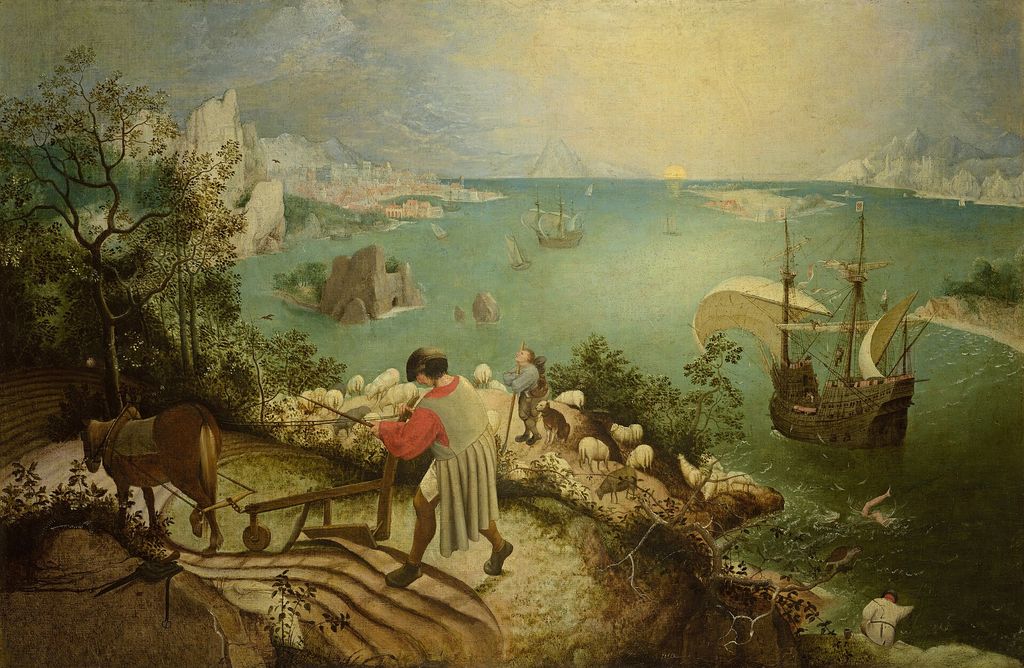
At the 1977 Louvre press preview, broadcasters immediately compared Chagall’s canvas with Landscape with the Fall of Icarus in Brussels. In the Bruegel-associated composition, only the victim’s legs remain visible in the sea while ploughman, shepherd, fisherman and ships continue their activity. Chagall’s crowd, the speakers argued, replaces indifference with participation.[3]
The comparison is powerful but needs two qualifications. The Royal Museums of Fine Arts of Belgium state that their painting is neither signed nor dated and that technical research has not confirmed its attribution to Pieter Bruegel the Elder. “Bruegel-associated” is more accurate than treating authorship as settled.[7]
That caution is now an active research question rather than a closed verdict. In April 2026 the Belgian museum announced a new collaboration with the Royal Institute for Cultural Heritage using non-invasive analysis and scientific imaging to examine attribution, date, technique and the extent of restoration. Results are planned for a Bruegel exhibition in autumn 2028.[15] Until then, Chagall’s documented response is to a celebrated composition and its reception, regardless of which workshop or later hand produced the surviving Brussels object.
Second, Chagall’s villagers are curious, not clearly compassionate. The 1977 broadcast itself moved from “participation” to the sharper observation that the village is interested without being deeply troubled.[3] The two pictures offer different economies of attention: one minimises Icarus within ongoing labour; the other makes him spectacular while leaving action uncertain.
Chagall also reverses scale. In the Brussels landscape, the fall is a detail viewers must discover. In Paris, the winged figure controls the canvas and ordinary life forms a dense perimeter. The myth is not hidden by the world; it reorganises the world around an empty, vertiginous centre.
The Bruegel image after Auden
By 1977 the Brussels composition had acquired a major literary afterlife. W. H. Auden’s 1938 poem Musée des Beaux Arts made its inconspicuous Icarus an example of suffering occurring beside the routines and destinations of other people.[16] The poem did not simply repeat Ovid. It turned pictorial marginality into a modern meditation on attention.
The Louvre broadcast’s contrast between Bruegelian indifference and Chagallian participation therefore entered an already mediated tradition.[3] Chagall makes the falling body impossible to overlook, but visibility does not settle responsibility. His villagers look, climb, point and gather; none is shown preventing the impact. The painting changes a disaster ignored into a disaster watched.
Auden should not be installed as a source Chagall demonstrably consulted. No evidence cited here proves that he read the poem. Its relevance is historiographic: it explains why twentieth-century viewers were primed to see the Bruegel-associated painting as a statement about ordinary life turning away, and why Chagall’s conspicuous crowd could appear to reverse that statement.
Seven studies and a long making
Centre Pompidou records seven preparatory studies made in 1973–74, inventories AM 1988-522 through AM 1988-528. They range across graphite and ink, gouache, pastel and wash, with some using collage made from coloured paper or fabric.[1]
One sheet, AM 1988-525 (R), measures 35.7 by 33 centimetres and combines graphite, ink, wash and pastel on wove paper.[2] The almost square proportion anticipates the large canvas, but a study is not a miniature painting. Changes of medium let Chagall test mass, movement, colour and the relation between figure and crowd.
The museum reads the studies as evidence of deliberate spatial experiment. Chagall moved beyond conventional perspective in search of tactile, fluid and energetic space. Collage was especially useful: pieces could be shifted, layered and replaced before relations hardened into paint.[1]
The final canvas retains that provisional energy. A large pale opening occupies the centre rather than a perspectival street or landscape recession. Figures bank around it. The viewer senses depth through falling, tilting and accumulation rather than through converging lines.
The studies entered the national collection through the 1988 acceptance-in-lieu after Chagall’s death, while the painting had been purchased in 1979.[1][2][8] Their different acquisition histories now reunite process and result in one collection.
Centre Pompidou’s 1984 works-on-paper retrospective insisted that Chagall’s drawing was an autonomous practice even though he thought primarily as a painter.[9] The Icarus sheets support both halves of that judgement: they are complete material experiments, and they participate in the long formation of a canvas.
What the seven sheets actually contain
The individual museum records make the preparatory sequence more concrete. AM 1988-522, the smallest at 28.9 by 25.9 centimetres, combines graphite, ink and gouache; its reverse carries a fragmentary squared-up sketch, and its face bears the written title. AM 1988-523 moves to charcoal and ink on a larger 37.9-by-35.5-centimetre sheet. AM 1988-524 is graphite on paper ruled with a grid, measuring 35.2 by 32.5 centimetres.[14]
AM 1988-525 (R) introduces ink wash and pastel to graphite and ink. AM 1988-526 uses graphite, pastel and ink. The last two registered sheets make collage explicit: AM 1988-527 combines ink, wash, watercolour, pastel, paper and attached fabric, while AM 1988-528 uses ink, gouache, charcoal and collaged textiles.[2][14]
These records show a movement across drawing, colour and movable material, but the consecutive inventory numbers do not prove that Chagall made the sheets in that order. All are broadly dated 1973–74. Gridding on one recto and a fragmentary squared sketch on another verso suggests procedures for transferring or enlarging relationships, yet the final canvas is not a mechanically scaled copy of any single sheet.[14]
The two textile collages are especially relevant to the painting’s mosaic-like surface. Fabric creates colour as a physical piece with an edge; wash and pastel create colour as stain or deposit. Chagall could therefore compare discrete blocks with fluid transitions before committing the nearly four-square-metre canvas. This is material evidence for experiment, although it does not identify the pigments, binding medium or revisions under the final paint.
The 2023–24 political exhibition selected four of the study sequence as catalogue numbers 184–87, followed by the painting as number 188.[1][14] Presenting process and result together encouraged viewers to see political and humanist meaning as something constructed through repeated formal decisions, rather than as a message pasted onto a finished myth.
Colour as structure
Centre Pompidou describes fluid, pearly whites, greys and yellows against more fragmented reds, with an energy like mosaic planes.[1] Colour does not fill an already stable drawing. It creates the field through which Icarus falls.
The solar disc initiates a vortex. Feathers rotate around it; the pale upper expanse opens; warmer colour gathers below. Darker figurative zones compress along the edges. The canvas is nearly square, so the descent gains force without the assistance of a tall vertical format.
The surface brings Chagall’s monumental media into painting. In the preceding decades he had worked with stained glass, mosaic and tapestry, coordinating coloured units across architecture. The Pompidou analogy to mosaic is therefore more than a visual metaphor, although there is no evidence that assistants painted this canvas.[1][5]
The museum also invokes late Titian: an elderly painter using loosened matter, vibration and unstable form as concentrated achievement rather than decline.[1] The comparison belongs to critical interpretation, not a claim of direct borrowing.
Return, memory and the date 1973
Chagall began the studies in the year of a charged return. In 1973 he travelled to Moscow for the first time since leaving Soviet Russia in 1922, signed his surviving panels for the former Jewish State Chamber Theatre and met two sisters. He did not return to Vitebsk. That July his museum devoted to the Biblical Message opened in Nice.[5]
It is tempting to make the Vitebsk-like crowd a direct consequence of the Soviet journey. The chronology makes renewed memory plausible, but no cited statement says The Fall of Icarus illustrates that return. Chagall had painted Vitebsk continuously during fifty years of absence.
Russian-language scholarship reads the work as a winged youth falling over a densely populated Jewish small town and compares its divided composition with Revolution of 1937.[11] That analogy opens a political possibility: individual aspiration breaks above a community already shaped by historical upheaval.
Jonathan Wilson’s biography advances a darker and more specific reading. In the Russian translation, he proposes that the red-divided crowd may separate peaceful Jews from hostile onlookers and that the naked woman on the roof may be a victim of violence.[17] This interpretation makes the fall an image of a community watching its own historical trauma, with spectators divided between grief and satisfaction.
The visual details can sustain anxiety, division and exposed vulnerability, but the proposed identities are not confirmed by the object record or an artist statement. The woman’s nudity belongs to Chagall’s long pictorial vocabulary and is not, by itself, evidence of assault. Wilson’s account is valuable as a forceful competing interpretation because it resists an easy humanist crowd; it should not be converted into iconographic fact.
Other readings see a warning about revolutionary overreach, artistic ambition or the dangers faced by Jewish modernists. These can illuminate the painting only when identified as interpretations. Icarus is not supplied with a Soviet insignia, and the villagers do not enact a documented political programme.
Don Quixote, Orpheus and late humanism
Centre Pompidou calls the 1975 Don Quixote a pendant to The Fall of Icarus.[1] Both transform literary or mythic figures into large late paintings and place impossible aspiration against an inhabited world. One hero rides towards a chosen ideal; the other descends after breaking the limit of flight.
Orpheus adds a different relation between art and prohibition. He crosses into the underworld through music but loses Eurydice by looking back. Icarus crosses the air through craft but loses flight by rising too far. Chagall’s late mythological figures turn boundaries into tests of human making.[1]
The museum calls myth a vehicle for Chagall’s humanism.[1] Here “universal” should not erase historical specificity. The village is populated by motifs formed through Russian Jewish memory; the crowd makes a Greek story pass through Vitebsk. Universality is produced by translation between traditions, not by removing local identity.
The painting’s humour also belongs to that humanism. Icarus is neither ideal nude nor pure symbol. He is vulnerable, awkward and watched. The myth becomes a test of how ordinary people meet another person’s failure.
The 1977 Louvre exhibition
The Fall of Icarus closed Chagall’s exhibition of recent paintings in the Pavillon de Flore at the Louvre. Showing a living artist’s recent work there carried institutional weight, and the press preview made the canvas a focus of debate.[3][4]
The broadcast preserves unusually direct disagreement. Critic Gérald Schurr complained that late Chagall merely repeated the themes of 1910–20; another visitor dismissed the exhibition in market-driven terms. The host answered by calling Icarus harsh, diverse and renewed, and by defending Chagall’s exceptional capacity to paint crowds.[3]
This reception matters because later praise can make the work seem immediately canonical. In 1977 it served as evidence on both sides of a dispute: proof of exhausted repetition for some, proof that recurrent motifs could acquire new tragic force for others.
Michel’s Le Monde review took the second position. He saw late Chagall deepening rather than inventing an entirely new vocabulary and treated Icarus as the monumental summation of the exhibition.[4] The French state purchased the canvas two years later.[1]
Subsequent exhibitions extended its frame. It appeared in Centre Pompidou collection presentations, the 1985 Philadelphia Chagall retrospective, Moscow in 2005 and the 2023–24 exhibition Chagall politique: Le cri de la liberté in Roubaix, Madrid and Nice.[1][12] The recent political setting confirms interpretive interest; it does not fix a single political meaning.
The official account of that exhibition describes it as the first comprehensive reading of Chagall through political positions and engagement, based on recent study of previously unpublished documents in the artist’s archives. It travelled from La Piscine in Roubaix, 7 October 2023–7 January 2024, to Fundación MAPFRE in Madrid, 2 February–5 May, and the Musée national Marc Chagall in Nice, 1 June–16 September. Ambre Gauthier and Meret Meyer directed its scientific curatorship.[18]
The Centre Pompidou lent thirty-three works to the project, and its records show four Icarus studies and the finished canvas placed consecutively in the catalogue.[14][18] That grouping shifts emphasis from a timeless warning against hubris to an artist repeatedly working through flight, failure and public witness after revolution, two world wars and exile. It remains a curatorial thesis produced in 2023–24, even when archival evidence strengthens the wider political account of Chagall.
Material limits and catalogue caution
The public record establishes oil on canvas, dimensions and inscriptions but supplies no object-specific conservation report.[1][10] The fluid surface can be described visually and through the museum’s account; claims about exact pigments, ground layers, hidden revisions or treatment history would be speculative. The scientific imaging now under way in Brussels concerns the Bruegel-associated comparator, not Chagall’s canvas.[15]
The double date should also be preserved rather than simplified. “1974” and “1977” are both on the object. “1975” belongs to some contemporary and later descriptions, perhaps reflecting exhibition or working chronology, but it cannot replace the museum’s material evidence.
The official catalogue raisonné project combines object study with correspondence, photographs and administrative records and warns that histories may change as research advances.[13] Future technical work may clarify the sequence between studies and canvas. Current evidence already proves an extended, deliberate process.
Looking at The Fall of Icarus now
Start with the inversion. Chagall’s flying figure does not glide horizontally above the town; head and torso point down. The surrounding feathers convert a familiar emblem of freedom into a broken apparatus.
Then look away from Icarus. Follow the crowd around the margins and distinguish alarm, curiosity, motherhood, animals and roof-top spectatorship. The community notices the disaster but does not form a unified moral chorus.
Compare the pale central opening with the dense edges. Space is created by colour, rotation and pressure rather than linear perspective. The village seems to tip around a fall that is simultaneously physical and pictorial.
Keep Ovid and Bruegel available but separate. Ovid supplies Daedalus’s warning, melted wax and paternal grief. The Brussels landscape supplies a precedent for a fall absorbed by daily life. Chagall makes the victim enormous and the witnesses numerous, then leaves their responsibility unresolved.
Finally, hold 1974 and 1977 together. The painting is the work of an elderly artist revisiting flight after his Soviet return, but it is not a simple confession of age. Its mixture of catastrophe, comedy, luminous matter and social attention makes falling another way to ask what art can carry.
Discussion
Which piece of evidence most changes the way you read The Fall of Icarus?
Reader Insights
Which visible detail most changes your reading of The Fall of Icarus?
How do medium, setting and documented history shape the encounter?
What remains uncertain when documented fact is separated from interpretation?
Join the Conversation
Share your reading of The Fall of Icarus below.
References
- Centre Pompidou, “La Chute d’Icare”, inventory AM 1978-733, View Source
- Centre Pompidou, “Étude pour La Chute d’Icare”, inventory AM 1988-525 (R), View Source
- Marc Chagall official website, “Program about Marc Chagall at his second exhibition at the Louvre — 17 October 1977”, View Source
- Jacques Michel, “Chagall, le peintre”, Le Monde, 19 October 1977, View Source
- Marc Chagall official website, “Biography”, View Source
- Ovid, Metamorphoses, Book VIII, “Daedalus and Icarus”, Theoi Classical Texts Library, View Source
- Royal Museums of Fine Arts of Belgium, Bruegel: Unseen Masterpieces press file, View Source
- Centre Pompidou, “Aide-mémoire Chagall”, 28 March 1988, View Source
- Centre Pompidou, “Chagall, l’œuvre sur papier”, 1984 press release, View Source
- DACS, “The Fall of Icarus, c. 1974”, View Source
- Ingo F. Walther and Rainer Metzger, “Marc Chagall: Late Period 1948–1985”, Russian edition, View Source
- Centre Pompidou, Chagall politique: Le cri de la liberté, 2023–24, exhibition registered in the object bibliography, View Source
- Marc Chagall official website, “Catalogue raisonné”, View Source
- Centre Pompidou, individual records for Étude pour La Chute d’Icare, AM 1988-522, 523, 524, 526, 527 and 528, View Source ; View Source ; View Source ; View Source ; View Source ; View Source
- Royal Museums of Fine Arts of Belgium, “New technical study of The Fall of Icarus”, 9 April 2026, View Source
- W. H. Auden, “Musée des Beaux Arts”, Poetry Foundation, View Source
- Jonathan Wilson, Marc Chagall, Russian translation, chapter 17, View Source
- Musée national Marc Chagall, “Chagall politique, Le Cri de liberté”, View Source