


 by Tom Gurney
Tom Gurney BSc (Hons) is an art history expert with over 20 years experience
Page Created on September 22, 2026 / Page Updated on September 22, 2026
Email: tomgurney1@gmail.com / Phone: +44 7429 011000
Introduction
In Half-Past Three (The Poet), a writer balances an open notebook on his knee while his green head turns upside down. Coffee, wine, fruit and cutlery lean across a fractured table; a green cat presses against his sleeve. Marc Chagall converts a late studio visit into a monumental image of thought losing its ordinary orientation.
Painted in 1911, the work belongs to Chagall’s first months in Paris and to his rapid encounter with Cubism.[1][4] It is now in the Philadelphia Museum of Art, where its enormous vertical canvas—nearly two metres high—makes a private act of writing occupy the scale of public portraiture.[2]
Contents
- At a glance
- One painting, several titles
- The poet Mazin
- An upside-down green head
- Coffee, wine and an open notebook
- The green cat as companion
- Diagonals and transparent planes
- Chagall and Cubism
- Paris in 1911
- Was it painted at La Ruche?
- Artists and poets in Montparnasse
- Yiddish thought inside French modernism
- The Arensberg collection
- Exhibitions and changing dimensions
- Beyond the museum gallery
- Correcting the legacy account
- Why the painting still turns heads
At a glance
- Artist: Marc Chagall
- Preferred title: Half-Past Three (The Poet)
- Other titles: The Poet; Half Past Three; Trois heures et demie (Le poète)
- Date: 1911
- Medium: Oil on canvas
- Dimensions: 195.9 × 144.8 cm
- Object number: 1950-134-36
- Collection: Louise and Walter Arensberg Collection, 1950
- Owner: Philadelphia Museum of Art
- Sitter: Mazin, a Russian poet and friend of Chagall
One painting, several titles
Philadelphia’s current title is Half-Past Three (The Poet).[1] Older English sources reverse the emphasis as The Poet, or Half Past Three, while the French form Trois heures et demie (Le poète) also circulates. These are title variants for the same 1911 canvas, not evidence of several versions.
The clock time directs attention towards an unusual hour, but no painted clock settles whether the scene occurs at half past three in the morning or afternoon. The coffee, wine, studio visit and disoriented head make the night-time reading plausible. It remains an inference from the arrangement rather than a recorded timestamp.
Calling it simply The Poet removes some of that temporal pressure. The combined museum title is more useful because it keeps profession and hour together: creative identity appears through duration, fatigue and altered attention.
The poet Mazin
The Philadelphia Museum identifies the sitter as Mazin, a Russian poet who visited Chagall’s studio and drank coffee while his friend painted late into the night.[1] The owner’s education dossier adds that the large canvas developed from a smaller, more naturalistic portrait.[2] Transformation, rather than exact likeness, is the work’s declared purpose.
Mazin is seated, yet the pose is far from restful. One hand lifts a cup and the other holds a pen near the open notebook balanced across his leg. The writer’s body must negotiate several tasks while the room seems to share his mental agitation.
The sitter’s name is less familiar than the image because Chagall does not present literary celebrity. He makes a working poet—friend, neighbour and nocturnal visitor—the vehicle for a broader account of invention.
An upside-down green head
Mazin’s head turns through 180 degrees while the neck and clothed body remain upright. Green links his face to the cat, separating both from the warmer fields and pale planes around them. The reversal is abrupt, but Chagall integrates it through repeated diagonals.
Philadelphia relates the turned head to the Yiddish phrase fardreiter kop, which describes a giddy or disoriented mental state.[1][2] The museum presents this as a possible linguistic connection, and that qualification matters. A phrase can illuminate the joke without proving a one-to-one translation from idiom into image.
The inversion also changes how portraiture works. Viewers can identify eyes, nose, moustache and hair, yet must mentally rotate them to recover a conventional face. Looking becomes an analogue for the poet’s own act of reorganising language.
Coffee, wine and an open notebook
The cup in Mazin’s hand has often encouraged a story about caffeine sustaining an all-night session. Nearby, a wine bottle occupies the table with fruit, fork and knife.[2] The combination suggests conversation, eating and drinking as much as disciplined literary labour.
The notebook remains the most stable evidence of the sitter’s activity. It rests on his knee rather than on the table, keeping written work close to the body while the other objects tilt away. Pen and page give the otherwise fantastic portrait a concrete occupation.
Chagall avoids the usual library or orderly study. Creativity happens amid domestic remains and interrupted hospitality, where a visitor can write while an artist works. The scene makes intellectual life social even though only one human figure appears.
The green cat as companion
A small cat rises at Mazin’s side and appears to lick or nuzzle his sleeve.[2] Its green colouring echoes the inverted face, creating a visual alliance between animal and poet. The cat is not a naturalistic accessory placed to soften the portrait.
Because the two green forms touch, the animal seems to participate in the sitter’s altered state. It remains physically upright while the human head overturns, so resemblance does not erase difference. Chagall distributes strangeness through colour rather than anatomy alone.
The legacy article described the cat as acting “in solidarity” with Mazin.[10] That phrase catches the visual link, but the painting supplies no fixed narrative about the animal’s intent. Affection, rhyme and comic doubling are all supported by what is visible.
Diagonals and transparent planes
Philadelphia describes diagonal shafts of colour and transparent forms that detach the portrait from ordinary reality.[1] Table edge, limbs, bottle and background meet at competing angles, preventing the room from settling into a single box. Objects remain recognisable while their spatial agreement dissolves.
Transparency is crucial because forms do not simply collide; they pass through or appear behind one another. Chagall can preserve Mazin’s seated body while opening it to colour fields and lines. The effect is prismatic rather than a literal record of a studio interior.
The monumental scale intensifies that instability. What might feel playful in a small sketch becomes bodily at nearly two metres high, requiring the viewer’s gaze to move between cup, notebook, table and inverted face.
Chagall and Cubism
The painting shows Chagall absorbing Cubist fragmentation soon after reaching Paris. Philadelphia stresses angled planes, multiple visual directions and refracted colour, while also describing the result as Chagall’s distinctive reformulation of the avant-garde.[1][4] He learned from Cubism without becoming an orthodox Cubist.
Analytical Cubism often subdued colour and fractured objects to test how they could be known. Chagall uses fracture for a different emotional pitch: saturated colour and recognisable storytelling remain active. Mazin’s head turns because poetic consciousness and Yiddish humour matter, not only because a face can be shown from several views.
This mixture makes labels useful but incomplete. Cubism explains the structural pressure; Russian memory, Jewish language and friendship explain why those devices gather around this sitter.
Paris in 1911
The official Chagall biography dates his arrival in Paris to early May 1911, travelling through Berlin.[5] He stayed first with a friend and then at 18 impasse du Maine, attended the Palette and Grande Chaumière academies, and visited galleries, exhibitions and the Louvre. The city offered both formal study and visual saturation.
Chagall remembered discovering a different light, colour and freedom in Paris.[5] Half-Past Three turns that exhilaration into pictorial pressure: bright fields split the room, familiar things tilt and portraiture expands beyond resemblance. The work is experimental without abandoning the personal encounter that prompted it.
Other large 1911 canvases, including I and the Village, likewise joined Parisian modernism to remembered Russian material. The poet portrait belongs to a concentrated period in which Chagall tested how much transformation a recognisable subject could sustain.
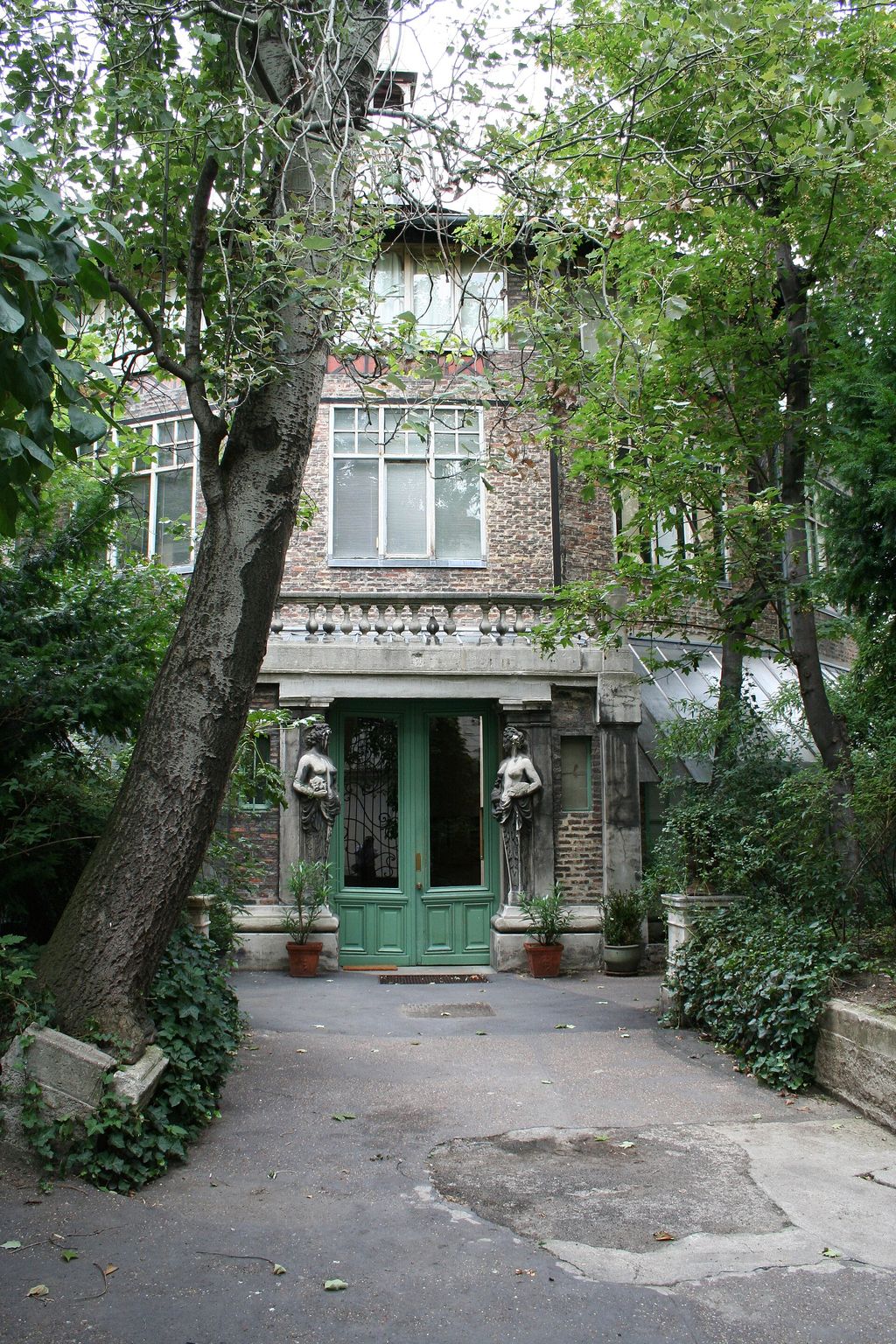
Was it painted at La Ruche?
The painting is frequently associated with La Ruche, the inexpensive Montparnasse studio complex where artists and poets met. Philadelphia uses that community to explain the social world in which friends visited studios at late hours.[3] Yet the official Chagall chronology says he moved into La Ruche in the winter of 1912.[5][6]
A 1911 date therefore requires care. The work can anticipate or embody the first-Paris studio culture later concentrated at La Ruche, but public records do not justify presenting the building as a securely documented 1911 place of execution. Chagall’s earlier impasse du Maine address is part of the same broader Montparnasse geography.
This small chronological correction improves the story. The poet’s visit need not depend on one famous address; it belongs to the wider networks of émigré artists, writers, cafés and studios that shaped Chagall’s first year.
Artists and poets in Montparnasse
Official archive research names Léger, Modigliani, Archipenko, Soutine, Zadkine and Shterenberg among La Ruche’s residents, with Cendrars and Apollinaire among Chagall’s poet friends.[5][6] Philadelphia describes a larger Eastern European émigré community attracted by low rents, artistic exchange and greater religious tolerance.[3]
The legacy page states that Chagall mixed with Picasso, Matisse, Modigliani and the Delaunays during these years.[10] Some are relevant Parisian influences, but proximity in an art-historical narrative should not be turned into evidence that each person entered this studio or shaped this canvas directly.
Mazin is the documented relationship that matters most here. The painting gives a relatively obscure Russian poet the scale and formal daring commonly reserved for a movement’s celebrated leaders.
Yiddish thought inside French modernism
The fardreiter kop proposal links the upside-down head to language Chagall knew from Vitebsk.[1] Cubist geometry and Yiddish idiom therefore need not compete as explanations. The painting allows a Parisian visual device to carry an Eastern European verbal joke.
That joining complicates the idea that modernism required an artist to discard local culture. Philadelphia’s School of Paris research emphasises how immigrant artists combined new French experiments with traditions and experiences from their places of origin.[3] Chagall’s portrait is a particularly clear example because the cultural mixture shapes its central body.
The result also resists treating Jewish identity only as religious iconography. No prayer object or biblical figure is needed; a familiar turn of speech can enter the construction of modern portraiture.
The Arensberg collection
Louise and Walter Arensberg acquired the painting before the Second World War and eventually gave their collection to Philadelphia in 1950.[2][3] The museum’s accession line makes their ownership part of the object’s permanent identity. Their modern-art collection placed Chagall alongside figures such as Duchamp, Picasso and Brancusi.
Their connection to the artist extended beyond collecting. Philadelphia records that the Arensbergs contributed funds to the effort led by Alfred H. Barr Jr that helped secure Chagall and his family an exit visa from Vichy France in 1941.[3] They owned Half-Past Three at that time.
That later history does not change the painting’s 1911 meaning, but it changes the social history of its ownership. A portrait born from artistic friendship entered a collection whose owners later assisted the painter’s escape.
Exhibitions and changing dimensions
The work appeared in MoMA’s 1946 Chagall retrospective while still lent by the Arensbergs.[7] It returned to New York in the 1972–73 exhibition Philadelphia in New York, devoted to modern works from the Philadelphia Museum.[8] These loans helped establish it as a major account of Chagall’s first Paris period.
Historical catalogues do not reproduce exactly the same inch dimensions. Philadelphia’s education record gives 77 1/8 by 57 inches, equivalent to 195.9 by 144.8 centimetres, while the 1972 MoMA catalogue prints 77 7/8 by 57 1/4 inches.[2][8] The current owner metric record should govern, with the older variance retained as cataloguing history.
No public technical study explains the discrepancy, and no work-specific conservation report was located. Measurements alone cannot establish whether earlier cataloguers treated edges, stretcher or sight size differently.
Beyond the museum gallery
Philadelphia later selected the painting for its Inside Out programme, which installed large reproductions of collection works in neighbourhood settings.[9] A studio portrait created within an intimate circle thus entered streets and community spaces far from Montparnasse.
This reception is more than a publicity footnote. The painting’s strong silhouette, saturated blocks and overturned face remain legible outside a conventional gallery, while the public setting echoes the sociability of its origin. A private working session becomes an encounter for passers-by.
Reproduction also requires distinction from the object. The 1911 oil retains scale, surface and material history that an outdoor image cannot transfer, even when the programme broadens access.
Correcting the legacy account
The inherited page recognised Mazin, coffee, notebook, green cat, Cubist fragmentation and the possible Yiddish idiom.[10] Its main weakness was compression: it moved quickly from Chagall’s arrival to La Ruche and listed famous contacts without separating documented relationships from general artistic context.
It also gave no object number, dimensions, collection history or account of the Arensbergs. Those omissions made the painting seem like an illustration of biography rather than a material object with its own journey through private ownership, rescue-era networks, museum donation and public display.
The expanded evidence sharpens interpretation. Chagall’s experiment becomes simultaneously a portrait of Mazin, a test of Cubist structure, a Yiddish-language joke and an object whose collectors later helped save its maker.
Why the painting still turns heads
The upside-down face remains unforgettable because it is supported by a whole system. Diagonal colour, unstable tableware, transparent planes, coffee, notebook and green cat all make mental reversal inhabit the room. One visual joke becomes an account of how creative attention reorganises ordinary things.
Chagall also preserves affection within experiment. Mazin is not broken apart to demonstrate a theory; his habits, friendship and late visits survive the transformation. The monumental format dignifies the poet even as it makes him comic.
Half-Past Three shows cultural translation happening on the canvas. Parisian Cubism supplies pressure and geometry, Vitebsk supplies language and memory, and a Russian friend supplies the living occasion. The painting’s modernity lies in keeping all three active.
Discussion
Which piece of evidence most changes the way you read Half-Past Three (The Poet)?
Reader Insights
Which visible detail most changes your reading of Half-Past Three (The Poet)?
How do medium, setting and documented history shape the encounter?
What remains uncertain when documented fact is separated from interpretation?
Join the Conversation
Share your reading of Half-Past Three (The Poet) below.
References
- Philadelphia Museum of Art, “Half-Past Three (The Poet)”
- Philadelphia Museum of Art, Half-Past Three (The Poet) education resource
- Philadelphia Museum of Art, Paris Through the Window: Marc Chagall and His Circle
- Philadelphia Museum of Art, Picasso and the Avant-Garde in Paris
- Official Marc Chagall site, “Biography”
- Official Marc Chagall site, “Marc Chagall’s studios from 1911 to 1923”
- Museum of Modern Art, Marc Chagall, 1946 exhibition catalogue
- Museum of Modern Art, Philadelphia in New York, 1972 exhibition catalogue
- Philadelphia Museum of Art, Inside Out programme announcement
- Legacy ChagallPaintings.com page, “The Poet, or Half Past Three”