


 by Tom Gurney
Tom Gurney BSc (Hons) is an art history expert with over 20 years experience
Page Created on September 22, 2026 / Page Updated on September 22, 2026
Email: tomgurney1@gmail.com / Phone: +44 7429 011000
Introduction
Marc Chagall's The Dream of 1939 holds intimacy and danger within the same sheet. In the lower-left corner, two figures embrace beside a bed. Beyond them, an entire village rises in blue and green, while a winged being descends through the roofs and dark forms gather at the horizon. The scene is tender, but it is not sheltered.
The work belongs to the Phillips Collection in Washington, DC. Its record identifies opaque and transparent watercolour and pastel on paper, measuring 52.23 by 67.95 centimetres, object number 0290, acquired in 1942.[1] The museum also records the framed dimensions as 7.62 by 88.26 by 72.39 centimetres. Those facts correct a recurring error: this is not an oil painting on canvas, and the frame measurements should not be mistaken for the sheet size.
Its date matters. Chagall made it as European war approached and antisemitism had already turned his public identity into a danger. The dream is therefore less an escape from history than a way of holding love, remembered place, scripture and threat together.
At a Glance
- ArtistMarc Chagall
- ArtworkDream
- Artistic contexttwentieth-century modern art
Contents
- Which Dream ?
- A bed at the edge of a village
- The angel crosses the roofs
- The rooster and the building marked with letters
- Vitebsk and Palestine in one landscape
- Watercolour, opacity and pastel
- Rembrandt, icons and older structures
- Dream, construction and Surrealism
- 1939: love under pressure
- Exile and a New York dealer
- Choosing The Dream
- The 1942 exhibition and American reception
- Competing readings
- Looking at The Dream now
Which Dream?
Chagall used dream titles more than once. The Phillips work should not be confused with Le Rêve, a 1927 oil on canvas in the Musée d'Art moderne de Paris, formerly titled Le Lapin, or with A Midsummer Night's Dream of 1939.[13][14]
Nor is it the smaller gouache catalogued by the Smart Museum of Art as The Dream, 1938–39, measuring 39.7 by 49.5 centimetres. That work appeared in the Schirn Kunsthalle's 2022–23 exhibition Chagall: World in Turmoil.[19] Identical English titles, adjacent dates and the shared medium of gouache make this a particularly easy collision. Dimensions and present collection are therefore essential identifiers.
The distinction is material as well as chronological. The Paris work is an oil measuring 81 by 100 centimetres. The Washington sheet is smaller, made with water-based colour and pastel, and dated twelve years later.[1][13]
The Jewish Museum and a Phillips anniversary feature captioned the object as a 1939 gouache on paper, while the collection's fuller catalogue separates opaque and transparent watercolour and pastel.[1][3][8] “Gouache” is useful shorthand for opaque watercolour, but the owning institution's fuller description should control.
Title repetition also warns against treating “dream” as one stable Chagall symbol. Each object has its own figures, medium, moment and history.
A bed at the edge of a village
The foreground does not occupy a sealed room. A wooden bed, white pillow and pink patterned cover sit at the edge of an outdoor village. A vase of flowers and a small bedside furnishing suggest domestic interior, but houses begin immediately behind them.[1]
Chagall abolishes the wall that would normally divide bedroom from landscape. Private life opens directly into communal memory. The lovers do not float above the town in the familiar manner of Birthday or Promenade; they remain anchored to bedding while the village presses close.
Their bodies are difficult to separate. One blue-clad figure bends protectively around the other. Arms, heads and fabric overlap. The Phillips Collection reads youthful and conjugal love, stressing a spiritual tenderness rather than pure erotic ecstasy.[1]
That reading is persuasive without settling every identity. The figures can be lovers and spouses without being literal portraits of Marc and Bella. Nor does the posture prove the legacy page's alternative suggestion of a mother comforting a child. The image is intimate precisely because relationship is shown through touch before biography.
The angel crosses the roofs
Above the couple, a winged figure descends head-first on a diagonal. Its pale wings make the largest luminous shape in the centre, and its outstretched arm directs movement towards the bed.[1]
The Phillips account calls the figure an angel in Western dress who offers a blessing. This introduces an Annunciation-like structure: a messenger crosses from an upper realm towards a private human encounter.[1]
Yet Chagall avoids the conventional Annunciation interior, Virgin, lily and lectern. The embracing pair and bed shift the scene towards marriage, protection and generation. Biblical form is present as an analogy rather than an illustrated episode.
Alfred Werner proposed a stronger Annunciation reading, linked to the ambiguous letters on the building at right.[1] It remains one interpretation among several. The angel can sanctify conjugal union without turning either figure securely into Mary.
The rooster and the building marked with letters
At the right, a rooster stands or hovers beside a narrow facade. The bird faces into the composition, answering the descending angel across the village.[1]
Roosters recur throughout Chagall's work as farm animals, comic presences, lovers' companions and signs of awakening. Here its wakeful posture contrasts with the title's promise of sleep. The dream contains its own dawn signal.
Letters above the doorway resist easy reading. The Phillips Collection records two proposals: they may approximate the Russian word for “shop”, recalling Chagall's early work as a sign painter, or read “Laz”, which Werner connected to a hospital.[1]
Neither reading is secure enough to make the building a documented shop or hospital. The uncertainty is productive. Commercial sign, place-name and institutional facade all tie the fantastic scene to a built social world.
Vitebsk and Palestine in one landscape
The pitched roofs, irregular houses and shop-like building recall Chagall's memory of Vitebsk. Yet the distant cupola, hills and biblical atmosphere also draw on his experience of Palestine.[1]
From 1 March to 4 June 1931, Chagall travelled with Bella and Ida through the British Mandate territory of Palestine after Ambroise Vollard commissioned Bible illustrations. He worked in Tel Aviv, painted synagogue interiors in Safed and landscapes in Jerusalem, then returned to France to develop the Bible gouaches and etchings.[4][6][18]
The trip was not the project's simple point of origin: Chagall had already made initial gouaches as foundations for the later etchings. It also answered an invitation from Tel Aviv mayor and co-founder Meir Dizengoff connected with the foundation stone of a Jewish museum.[18] The official archive describes the journey as bringing a new light to the biblical project and identifies Russian art, icons and Rembrandt among its sources.[6] The Dream inherits that decade of looking without functioning as a Bible illustration.
The Schirn's German-led research adds a necessary limit to the phrase “Palestinian landscape”. Chagall's works made there were unusually documentary, but his gaze selected Jewish sacred sites while largely omitting Arab and Christian populations and the contemporary political situation.[18] The landscape in The Dream should consequently be read as a remembered and religiously framed construction, not a comprehensive record of Mandate Palestine.
The Phillips Collection calls its setting an imagined promised land made by mingling Palestinian landscape with Russian memory.[1] “Promised land” should be understood pictorially, not as a precise map or political claim. No single geography contains these buildings.
The composite place makes exile imaginable before Chagall's physical departure from France. Home survives as an assembly: bedroom, shtetl roofs, sacred hill and remembered journey coexist because pictorial space permits them to.
Watercolour, opacity and pastel
The sheet's blues and greens do more than establish nocturnal mood. Thin transparent passages let underlying paper and drawing participate in the light, while opaque colour builds wings, bedding, faces and roofs. Pastel can supply dry, granular accents against wetter brushed areas.[1]
This mixed handling prevents the image from becoming a uniform blue wash. White pushes forward; pink and brown warm the couple's enclosure; green joins buildings to ground; dense navy forms press down from above.
The visible brushwork makes the village feel accumulated rather than mechanically planned. Repeated triangles create a Cubist echo, but they remain roofs with windows, doors and human scale. Geometry orders memory without abstracting it away.[1]
No public technical report located for this packet identifies pigments, paper manufacture, underdrawing, watermark, alterations or conservation campaigns. Material description must therefore stop with what the collection documents and what the surface visibly supports.
The archival sales records repeatedly call the work a gouache and, on one shipment list, “gouache pastel”.[16] These contemporary labels support the presence of opaque watercolour and pastel but do not cancel the collection's more precise inclusion of transparent watercolour. They also show why later catalogues can vary without necessarily describing different objects.
Rembrandt, icons and older structures
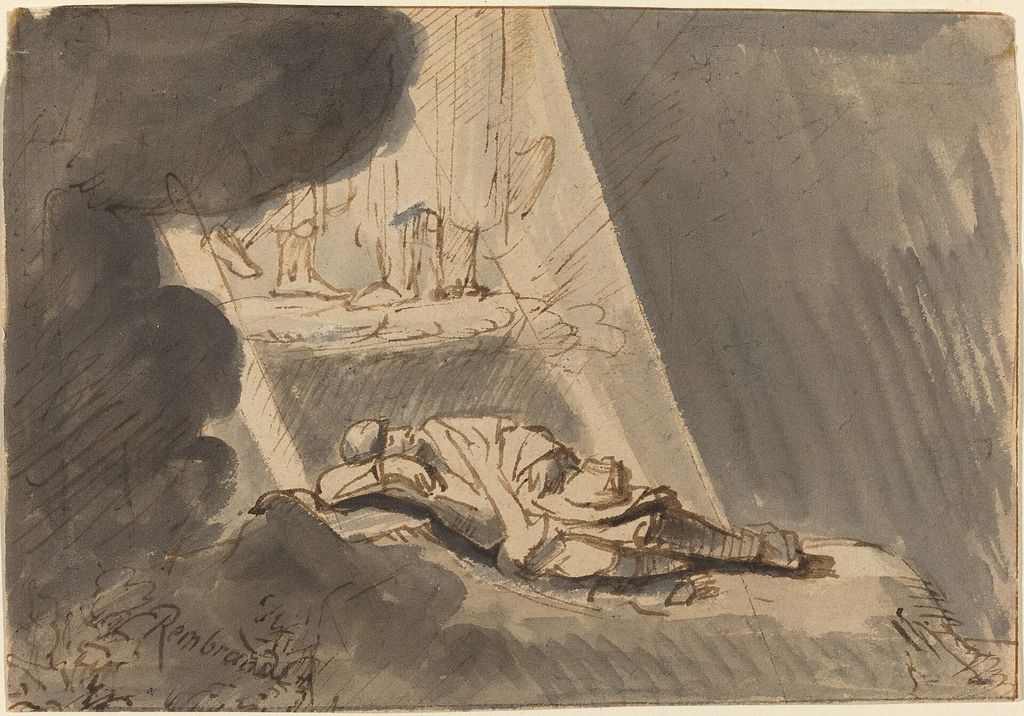
The owning museum compares the couple's tender gestures with Rembrandt's Isaac and Rebecca, long known as The Jewish Bride.[1] The Rijksmuseum describes Rembrandt's pair through their gazes and touching hands; the man's hand rests on the woman's chest while hers meets it.[10]
Chagall does not copy that pose. The comparison concerns the emotional weight carried by overlapping hands and protective proximity. It also connects conjugal love with a biblical couple without requiring modern portrait likeness.
The Phillips account further invokes Byzantine pictorial structure, medieval painting, Russian folklore, Hasidic culture, Venetian colour and early Renaissance expressive form.[1] These comparisons address different features: stacked rather than perspectivally unified space, sacred messengers, saturated colour and narrative simultaneity.
They should not be collapsed into a claim that the sheet belongs to one historical style. Chagall uses older visual structures inside a twentieth-century work whose materials, distortions and compressed planes remain modern.
Dream, construction and Surrealism
Suspended narrative logic invites a Surrealist label. An angel dives through rooftops, interior and exterior merge, relative scale shifts, and a rooster occupies an uncertain ledge.
Chagall's official archive cautions that dream language has often reduced his work. Although Surrealists recognised affinities, he did not join their movement. His elements were intentionally built into relations rather than offered as automatic transcription of the unconscious.[5][14]
That distinction is especially useful here. The bed does not prove that a sleeper is dreaming the rest of the picture. Indeed, neither figure is clearly asleep. “Dream” names a pictorial condition in which incompatible places and times can appear together.
The formal order is strong: the angel's diagonal answers the lovers' curve; wings balance the pillow; repeated roof triangles conduct the eye; blue and green unify discontinuous zones. Irrational space is carefully made.
1939: love under pressure
Chagall gained French citizenship in 1937 after an earlier refusal. By then the Nazi regime had removed his works from German museums and classified several as “degenerate art”. The official Chagall chronology places the transfer of his Paris studio contents to Saint-Dyé-sur-Loire shortly before war began; the Phillips account describes the family's retreat to the French countryside after the outbreak.[1][4] This small chronological difference should remain visible rather than be falsely harmonised.
The family had not yet entered the full sequence of invasion, Gordes refuge, Marseille arrest and emigration that followed in 1940–41. Reading every dark form as a literal prediction would overstate the evidence.
Even so, the sheet belongs to a period when danger was already legible. The Jewish Museum's Love, War, and Exile exhibition treated the rise of fascism through 1948 as a coherent, previously neglected span of Chagall's career, assembling 31 paintings, 22 works on paper and documentary material.[7] The Schirn later challenged the familiar reception of Chagall as merely poetic, dreamlike or removed from reality, arguing that the fantastic imagery of the 1930s and 1940s remained closely tied to political and social upheaval.[18]
The Phillips Collection sees the distant dark peaks as possible cataclysmic forces surrounding personal fulfilment.[1] This explains why tenderness does not cancel anxiety. The couple's enclosure is small; the village and sky are vast.
Hope is present as an action—touch, blessing, the preservation of home—rather than as proof that suffering will be avoided.
Exile and a New York dealer
After Germany invaded France in May 1940, Chagall moved south to Gordes. In 1941, Varian Fry of the Emergency Rescue Committee and US consul Hiram Bingham helped him leave after his detention in Marseille. Chagall and Bella reached New York on 21 June 1941.[4]
The United States Holocaust Memorial Museum places that rescue within Fry's effort to help about two thousand threatened refugees escape southern France, using both legal and illegal routes against obstruction from Vichy and American officials.[9]
Pierre Matisse became Chagall's American representative soon after the artist arrived.[4] Matisse included him in Artists in Exile, held from 3 to 28 March 1942 with thirteen other artists who had escaped fascist or totalitarian Europe.[23] That group presentation placed the personal displacement behind Chagall's work in public view before the year's solo exhibitions.
The Pierre Matisse Gallery then staged Marc Chagall: Paintings, Gouaches from 13 October to 7 November 1942. The official archive reconstructs it as three oils painted in France between 1937 and 1941 and thirteen gouaches, most made before the artist reached America.[20] The Dream thus entered the market within a show that made European memory and American exile visible side by side.
Choosing The Dream
The Phillips Collection acquired The Dream from the Pierre Matisse Gallery in 1942. A letter of 31 October transforms the public record's bare acquisition date into a documented decision. Matisse confirmed Duncan Phillips's purchase of the oil Village Street and one of two gouaches carrying the title The Dream. Phillips was to choose after the works reached Washington for the one-man exhibition he was planning.[16]
The letter does not establish which of its provisional catalogue numbers became object 0290, and that uncertainty matters. On 11 November Matisse sent fifteen gouaches and three paintings, enclosed a price list and explained that both same-titled candidates carried the same price. A surviving invoice records The Dream, dated 1939, alongside Village Street, with a fifteen per cent museum discount.[16] These documents securely name the dealer and transaction while leaving the object's ownership before Matisse undocumented.
The correspondence also reveals how collection-building and exhibition-making overlapped. Matisse sought loans from recent purchasers, replaced unavailable works and urged Phillips to retain a third Chagall so the museum would have a substantial group.[16] Phillips was selecting an acquisition from objects simultaneously being assembled into a temporary exhibition; the museum display was part of the act of judgement, not merely a celebration after the purchase.
The timing gave the work a new audience while its maker was a refugee. Duncan Phillips could read the domestic embrace as the security of the individual threatened by malevolent forces, an interpretation consistent with his own wartime writing.[1]
The 1942 exhibition and American reception
The Phillips exhibition, formally titled An Exhibition of Paintings by Marc Chagall, ran from 29 November 1942 to 4 January 1943. The institutional exhibition register records fifteen works and a catalogue.[17] It was Chagall's first solo exhibition in a United States museum.[1][2] Acquisition and exhibition therefore formed part of the same act of institutional recognition.
This was not Chagall's first American gallery exposure. Pierre Matisse had mounted a retrospective from 25 November to 13 December 1941, followed by the 1942 gallery exhibition from which Phillips bought the work.[20] The Washington presentation changed the institutional context: a work made as France approached war entered a museum collection during the United States' own wartime mobilisation.
Contemporary reviews show that American acceptance was not simple admiration. Time described crowds at the October 1942 New York exhibition and tried to organise its sixteen works through their recurring Russian village imagery.[22] In November 1943, reviewing another Pierre Matisse show, Robert M. Coates complained that European émigré painters remained visually attached to Europe. He conceded the wartime force of Chagall's Russian focus but found Connecticut absent even from works made there; cocks, lovers and blue villages still belonged to a European imaginative geography.[21]
That response is useful because it exposes an expectation placed upon refugees: physical relocation was supposed to produce new local subject matter. The Dream, made before emigration but acquired after it, instead demonstrates how remembered Vitebsk, biblical landscape and conjugal imagery travelled. Continuity could be read either as insulation from America or as the very substance of exile.
Chagall's US reception broadened further through theatre work, museum collecting and the Museum of Modern Art retrospective of 1946. MoMA's exhibition ran from 9 April to 23 June and was accompanied by James Johnson Sweeney's substantial catalogue.[11][12]
That later retrospective should not be mistaken for the Phillips first. The distinction is between a pioneering solo museum presentation in 1942 and a major retrospective four years later.
The catalogue raisonné project remains in progress across parts of Chagall's corpus.[15] Future archival publication may clarify the sheet's pre-1942 provenance or exhibition movements, but the existing institutional record securely establishes its early American museum life.
Competing readings
A conjugal reading begins with the bed and embrace. It sees love as a protected moral centre, deepened by the comparison with Rembrandt.[1][10]
An Annunciation reading begins with the descending angel, blessing gesture and possible hospital inscription. It makes revelation, healing or promised birth the scene's organising force.[1]
An exile reading begins with the composite town. Vitebsk and Palestine become portable memories, while dark ridges threaten the settlement from outside.
A political reading stresses 1939, Nazi persecution and the later rescue. Its danger is hindsight: events of 1940–41 cannot simply be projected backwards as facts already pictured.
A formal reading concentrates on colour, repeated geometry and shallow layered space. It usefully shows how the sheet works but becomes incomplete if it ignores why bed, village, angel and sign mattered in Chagall's history.
The strongest account keeps these possibilities in tension. The work constructs tenderness through historical pressure; it does not force love, religion, place and politics into separate compartments.
Looking at The Dream now
Begin at the bed, with the white pillow and patterned pink cover. These modest objects make the lower corner bodily and inhabited.
Then follow the angel's diagonal across the roofs. Its wings connect private touch to an event unfolding over the whole village.
Look right at the rooster and uncertain letters. They resist a purely mystical interpretation by retaining the specificity of an animal, a facade and a sign that may never be fully read.
Finally, compare the small enclosure of the couple with the dark upper field. Harmony survives inside pressure. The dream does not erase the year 1939; it creates a form in which human attachment can endure it.
Discussion
Which piece of evidence most changes the way you read Dream?
Reader Insights
Which visible detail most changes your reading of Dream?
How do medium, setting and documented history shape the encounter?
What remains uncertain when documented fact is separated from interpretation?
Join the Conversation
Share your reading of Dream below.
References
- Phillips Collection, “The Dream”, View Source
- Phillips Collection, “Phillips Firsts”, View Source
- Phillips Collection, “July #Phillips95 Challenge: Dream Big”, View Source
- Marc Chagall official website, “Biography”, View Source
- Marc Chagall official website, “Dream”, View Source
- Marc Chagall official website, “Bible: preparatory study for The Rainbow, sign of alliance between God and Earth”, View Source
- Jewish Museum, Chagall: Love, War, and Exile, View Source
- Jewish Museum, Chagall: Love, War, and Exile Family Guide, View Source
- United States Holocaust Memorial Museum, “Varian Fry”, View Source
- Rijksmuseum, “Isaac and Rebecca, Known as ‘The Jewish Bride’”, View Source
- Museum of Modern Art, “Marc Chagall”, 1946 exhibition, View Source
- Museum of Modern Art, “Retrospective Exhibit Works of Marc Chagall”, 8 April 1946, View Source
- Paris Musées, “Le rêve”, View Source
- Marc Chagall official website, “The Dream”, 1927, View Source
- Marc Chagall official website, “Catalogue raisonné”, View Source
- Phillips Collection Archives, Pierre Matisse Gallery correspondence with Duncan Phillips, 1941–54, including letters, shipment list and invoice of October–November 1942, View Source
- Phillips Collection, Exhibition History, 1919–1998, View Source
- Schirn Kunsthalle Frankfurt, Chagall: World in Turmoil, English exhibition wall panels, 3 November 2022, View Source
- Schirn Kunsthalle Frankfurt, Chagall: World in Turmoil Digitorial, source and picture credits, View Source
- Marc Chagall official website, “The Story of Three Paintings: From a Monumental Work to a ‘Triptych’ Between France and the United States (1937–1952)”, View Source
- Robert M. Coates, “Artists in America”, The New Yorker, 13 November 1943, View Source
- “Art: Unrealist”, Time, 26 October 1942, View Source
- National WWII Museum, “First Fruits of Exile: European Art at Pierre Matisse 1942”, View Source