 by Tom Gurney
Tom Gurney BSc (Hons) is an art history expert with over 20 years experience
Published on June 19, 2020 / Updated on October 14, 2023
Email: tomgurney1@gmail.com / Phone: +44 7429 011000
Introduction
Masaccio’s place in the history of Renaissance perspective is so important that the story is often oversimplified into a single sentence: Brunelleschi invented perspective and Masaccio applied it. The broad outline is useful, but the surviving paintings reveal something richer, because Masaccio did not merely import a mathematical device into painting; he learned how to make perspective control bodies, architecture, narrative and even the physical relationship between a picture and its viewer.
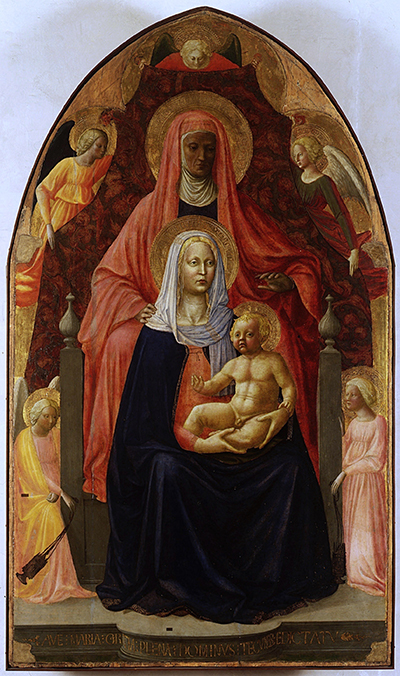
The National Gallery describes single-point linear perspective as a system developed by Filippo Brunelleschi in Florence, while Museo Masaccio identifies the San Giovenale Triptych of 1422 as one of the earliest paintings to apply central perspective systematically. By the time Masaccio painted the Holy Trinity a few years later, perspective had become capable of creating a fictive chapel so persuasive that generations of scholars proposed Brunelleschi’s direct involvement.
The most important point, however, is not priority. Perspective mattered because it gave painting a new way to organise the visible world, and Masaccio understood immediately that this could intensify sacred meaning rather than merely create technical spectacle. His development can be followed almost step by step. San Giovenale unifies a triptych through one ground plane; the Brancacci Chapel extends coherent recession across streets and landscapes; the Pisa Polyptych adjusts figures to their intended viewing height; and the Holy Trinity makes the spectator’s bodily position part of the image itself. Masaccio therefore helped transform perspective from a geometrical experiment into a visual language. His achievement was not simply drawing buildings accurately; it was making painted space behave as though the viewer could enter it.
At a Glance
- Central figure in perspective theoryFilippo Brunelleschi
- Masaccio’s rolerevolutionary early pictorial application
- Earliest known perspective exampleSan Giovenale Triptych, 23 April 1422
- San Giovenale vanishing pointnear the Virgin’s neck
- Major fresco applicationBrancacci Chapel
- Major panel applicationPisa Polyptych, 1426
- Viewing-from-below problemPisa upper-tier saints and Crucifixion
- Supreme architectural illusionHoly Trinity, Santa Maria Novella
- Traditional Brunelleschi hypothesispossible assistance with Holy Trinity perspective, not documented
- Important modern correctioneven the Holy Trinity bends strict single-point rules in places for visual effect
- Core principleperspective serves narrative, theology and viewer experience rather than functioning as an end in itself
Contents
- What Is Linear Perspective?
- Florence around 1420
- Perspective and the Body
- Architecture in Tribute Money
- The Oltrarno and Contemporary Space
- Perspective and Viewing from Below
- The Holy Trinity
- Two Viewing Positions
- The Skeleton Below
- Perspective and Narrative
- Filippo Lippi
- Why Masaccio’s Perspective Matters
- Frequently Asked Questions
- References and Research Sources
What Is Linear Perspective?
Linear perspective is a system for representing three-dimensional space on a flat surface through geometrically related lines. In a single-point system, parallel lines receding away from the viewer appear to converge towards a common vanishing point on the horizon. The great advantage is consistency. Floors, ceilings, walls and objects can all be made to belong to one coherent spatial field, allowing figures to inhabit a world that appears measurable rather than symbolic. This did not mean that earlier painters had no sense of depth. Giotto, Duccio and many northern European painters created convincing spaces empirically, but Brunelleschi’s Florentine system offered a more systematic method for organising them.
Brunelleschi’s Experiments. The National Gallery identifies Brunelleschi as the developer of the single-point perspective system in connection with his architectural work. Antonio Manetti’s fifteenth-century biography describes Brunelleschi producing small painted demonstrations of Florence, including views associated with the Baptistery and Piazza della Signoria. These demonstrations were not simply pretty pictures. They appear to have been experiments in how accurately a specific place could be represented from a fixed viewpoint, making the spectator’s location part of the construction. This conceptual change was profound. A painting could now be imagined as an extension of the viewer’s own visual field rather than as an independent symbolic surface.
Perspective as a Way of Depicting Place. Modern National Gallery scholarship has cautioned against treating perspective only as mathematical theory. Brunelleschi’s experiments can also be understood as attempts to depict a luogo, a real place, with unprecedented consistency. This distinction is useful for Masaccio because his greatest perspective works are not dry diagrams. Streets, chapels and thrones become believable places where people stand, move and act. Perspective is therefore better understood as a means rather than an end. Masaccio uses it because he wants sacred history to occupy space convincingly.
Florence around 1420
The early 1420s created ideal conditions for such experimentation. Brunelleschi was reshaping architectural thought, Donatello was treating sculptural bodies in increasingly spatial ways, and painters such as Masaccio, Masolino and Fra Angelico were encountering the problem of how these discoveries might change painted narrative. Masaccio’s rapid response is especially striking because his earliest known work dates only from 1422. Within a few years, he appears not merely competent in perspective but capable of using it as one of the fundamental organising principles of painting.
San Giovenale as a Starting Point. The San Giovenale Triptych provides the clearest early evidence. Museo Masaccio describes the work as the first known Masaccio and identifies the central perspective construction as a decisive Renaissance innovation. The green floor stretches continuously across all three compartments, while orthogonal lines converge near the Virgin’s neck. Although the frame divides the work physically, the painted floor tells the eye that saints, angels and Madonna belong to one space. This is more important than it may initially seem. Perspective begins by defeating compartmentalisation.
A Vanishing Point and a Sacred Centre. The choice of vanishing area near Mary’s neck gives geometry a devotional function. The spatial system directs attention towards the central sacred group while simultaneously creating the illusion of a shared ground plane. Masaccio therefore makes mathematical organisation serve hierarchy. The viewer is drawn physically and spiritually towards the Virgin and Christ. This principle would remain central to his later work. Perspective rarely operates neutrally; it guides interpretation.
The Throne at San Giovenale. The throne is another early demonstration of spatial thinking. Rather than appearing as a decorative screen, it projects backwards and surrounds the Virgin with a believable architectural volume. The effect strengthens Mary’s physical presence because body and throne obey the same logic. She appears seated inside a structure rather than attached to its front. This integration of figure and architecture is one of the foundations of Masaccio’s mature style.
Perspective and the Body
Masaccio’s innovation cannot be separated into “perspective” on one side and “figure painting” on the other. A convincing room requires convincing bodies because both must occupy the same visual world. This is why his paintings feel so different from works in which a perspectival setting contains figures that remain flat or weightless. Masaccio’s people possess mass proportional to the spaces around them. Perspective therefore reinforces bodily realism.
Giotto without Mathematical Perspective. Giotto provides an important comparison because his figures already possess extraordinary weight and emotional credibility. His architecture can also create convincing depth, but it does not follow the systematic single-viewpoint geometry that became characteristic of the fifteenth century. Masaccio effectively brings Giotto’s seriousness of body into a new spatial environment. The result is not simply “better perspective”; it is a stronger unity between figure and place.
The Brancacci Chapel. The Brancacci Chapel expanded the problem dramatically. Instead of one small altarpiece, Masaccio had to organise monumental frescoes containing streets, landscapes, groups and repeated narrative episodes across real architecture. Perspective here becomes less conspicuous than in the Holy Trinity but more socially complex. It has to support crowds and movement rather than simply create one illusionistic chamber.
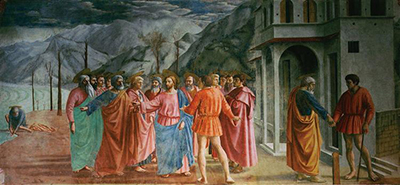
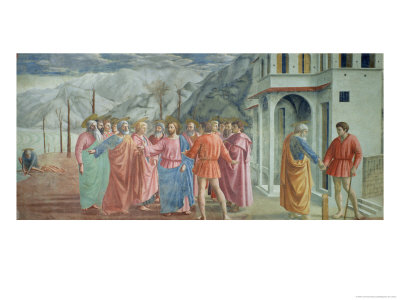
Tribute Money and Spatial Narrative. In The Tribute Money, several moments of the story occur within one continuous environment. Christ and the apostles occupy the central foreground, Peter appears at the left retrieving the coin from the fish, and the payment occurs at the right. Perspective allows these moments to coexist without breaking the world apart. Landscape and architecture remain stable while narrative time unfolds across them. The system therefore helps Masaccio solve a narrative problem. Different times can occupy one coherent space.
Architecture in Tribute Money
The building at the right is constructed through clear recession. It helps anchor the final payment episode while providing a measurable architectural reference against the more open landscape. This contrast between natural and built space gives the scene breadth. The figures do not stand against a decorative backdrop; they move between mountain, lake and building within one believable environment.
The Vanishing Logic of the Group. The apostles form a circular or clustered arrangement around Christ rather than lining up mechanically according to perspective. This reveals an important aspect of Masaccio’s method: geometry supports the human group instead of forcing figures into rigid positions. The painter therefore balances measured space with social composition. A mathematically coherent world still needs human relationships to feel natural.
Light and Perspective Together. The Brancacci frescoes also demonstrate why coherent light is inseparable from spatial credibility. Shadows fall in consistent directions, allowing bodies to feel governed by the same environment as the architecture. Perspective locates a figure; light gives it volume. Masaccio’s revolution lies partly in making those two systems reinforce one another.
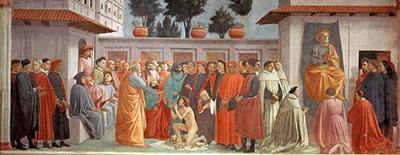
Saint Peter Healing the Sick with His Shadow. The urban street in Saint Peter Healing the Sick with His Shadow provides another sophisticated application. Architecture recedes along the street while sick bodies occupy the foreground and Peter moves through the space. The perspective does not advertise itself through spectacular geometry. Its purpose is to make charity and miracle appear as actions unfolding inside a recognisable city. This is perspective as social realism.
The Oltrarno and Contemporary Space
The urban setting has often encouraged viewers to connect Brancacci imagery with contemporary Florence. Whether every building represents a specific structure or not, the architectural language makes apostolic history feel present within the viewer’s own urban world. This translation is crucial. Perspective helps collapse the distance between biblical past and Renaissance present.
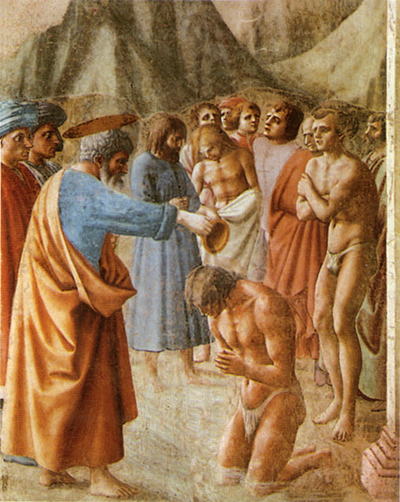
Baptism of the Neophytes. The Baptism of the Neophytes relies less heavily on architecture but still places figures coherently within landscape space. Bodies stand at different depths, and the group is organised so that the sacramental action remains clear despite varied poses. This reminds us that perspective is not only about drawing buildings. Relative scale, overlap and ground plane all contribute to spatial conviction.
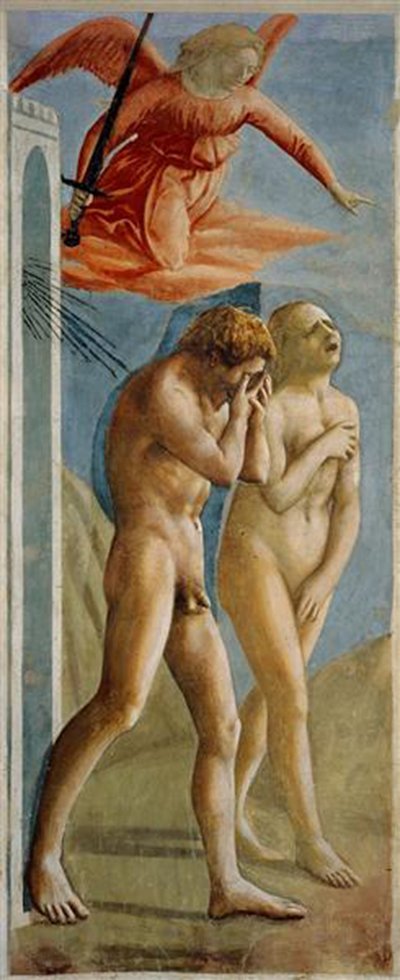
Expulsion from Eden. The Expulsion from the Garden of Eden contains almost no elaborate setting, yet Masaccio’s bodies still occupy believable space. Adam and Eve move forward under the force of an angel, and their weight makes the shallow ground emotionally powerful. The scene demonstrates that perspective alone does not create realism. Masaccio could strip architecture away because his understanding of bodily mass was strong enough to sustain spatial presence independently.
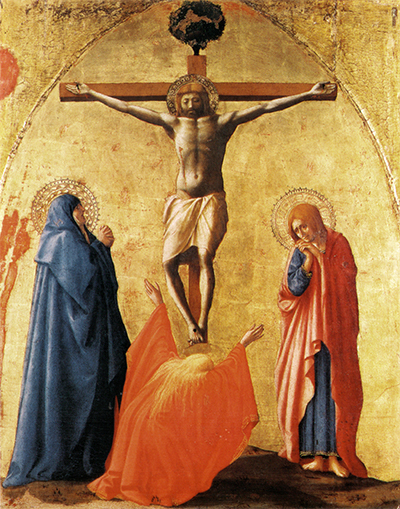
The Pisa Polyptych. The Pisa Polyptych introduced another problem: how should figures be designed when different panels are placed at different heights within a large altarpiece? Masaccio’s answer shows that perspectival thinking includes real-world viewing conditions as well as internal pictorial recession. The surviving Crucifixion and Saint Andrew are particularly important. Their proportions look unusual when seen at eye level in museums because they were designed for elevated positions.
Perspective and Viewing from Below
The Getty’s study of Saint Andrew connects Masaccio’s approach with sculptural problems familiar to Donatello. A figure placed high above a viewer must be adjusted so that foreshortening does not make it appear distorted from the intended position below. Masaccio therefore thinks perspectivally about the object’s actual installation. The painted body is designed for a spectator standing in a real chapel. This is a major conceptual advance. Perspective governs not only the painted world but the relationship between artwork and architecture.
The Pisa Crucifixion. The Crucifixion in Naples provides the most famous example. Christ’s body appears shortened when examined straight on, but the unusual proportions become intelligible when the panel is imagined high above the original altar. Masaccio therefore sacrifices abstract anatomical correctness for optical correctness from the intended viewpoint. What might look like distortion in a museum was a sophisticated adjustment in context. This principle would become increasingly important in Renaissance ceiling painting and sculpture.
The Central Pisa Virgin and Child. The central Virgin and Child also uses single-point perspective in the throne. The National Gallery notes the way architectural details and pietra-serena-like forms connect the panel with contemporary Brunelleschian architecture. The spatial construction makes Mary’s body feel even more monumental because the throne has measurable depth. As at San Giovenale, architecture and body reinforce one another.
The Problem of Dispersed Context. The Pisa Polyptych was later dismantled, making its perspectival intelligence harder to perceive. Individual panels now hang at ordinary museum viewing heights, even though some were designed for very different original positions. Reconstruction is therefore essential. Without it, optical adjustments can be mistaken for awkwardness. This is one of the clearest examples of how provenance and installation affect formal interpretation.
The Holy Trinity
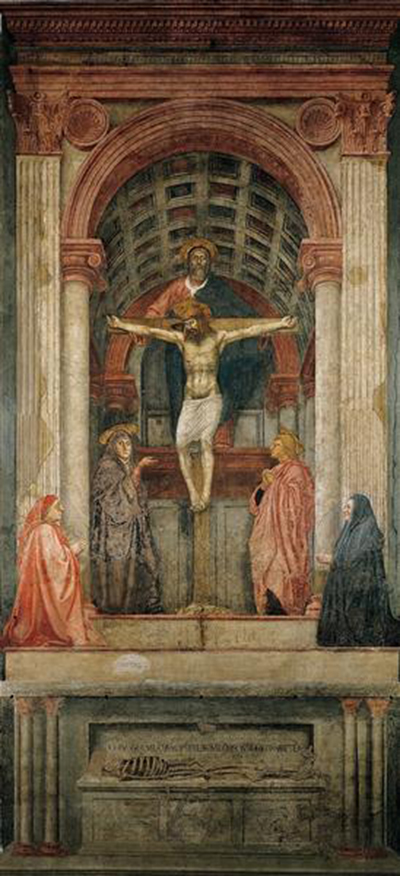
Masaccio’s Holy Trinity represents the most famous culmination of his perspectival thinking. Santa Maria Novella dates the fresco to 1425–26, while technical scholarship has proposed approximately 1424–25, but both chronologies place it within the same extraordinary mid-decade burst of experimentation. The fresco creates the illusion that the wall has opened into a deep barrel-vaulted chapel.
God the Father, Christ, the Holy Spirit, Mary and Saint John inhabit this fictive architecture, while kneeling donors occupy the threshold between sacred vision and the spectator’s real nave. Perspective here is no longer one component among many. It structures the entire devotional encounter.
A Fictive Chapel in a Real Church. The illusion succeeds because Masaccio relates the painted architecture closely to the actual church interior. The viewer sees what appears to be another chapel receding through the wall, even though no physical space exists behind the painted surface. This is not simply trompe-l’oeil decoration. The fictive architecture creates a theological place inside the real architecture. The viewer stands in Santa Maria Novella while simultaneously looking into a painted sacred chamber.
The Barrel Vault. The coffered barrel vault is one of the most famous elements of the fresco. Its receding coffers establish depth with such conviction that the painted chapel seems architecturally measurable. This structure also evokes the revived classical language central to Brunelleschi’s architectural culture. Antiquity, geometry and Christianity therefore converge inside one illusion.
Brunelleschi and the Trinity. Santa Maria Novella itself notes that the complex perspectival construction has long reinforced the hypothesis that Brunelleschi assisted with the scheme. The idea is plausible because the architecture depends on exactly the sort of geometrical knowledge associated with his experiments. No surviving document proves such a collaboration, however, so the strongest formulation remains cautious. Brunelleschi’s intellectual influence is secure; direct assistance is a long-standing scholarly hypothesis.
Two Viewing Positions
Santa Maria Novella has drawn attention to the possibility that the fresco was designed in relation to more than one viewing position within the nave. A distant approach and a closer central viewpoint may both have shaped the construction. This makes the fresco more sophisticated than a schoolbook diagram of one-point perspective. Masaccio adjusts geometry to real visual experience rather than obeying theory mechanically. The painting is designed to work inside a church, not on graph paper.
Perspective Bending Its Own Rules. The National Gallery’s modern perspective scholarship makes the same broader point. Even the Trinity, often treated as a manifesto of strict one-point perspective, bends mathematical rules in places, probably because visual effect mattered more than doctrinal geometrical purity. This is an important corrective to the heroic story of Renaissance science. Artists did not become servants of equations; they used geometry pragmatically to make images convincing. Masaccio’s perspective is therefore intelligent precisely because it can compromise.
The Vanishing Point and the Viewer. The vanishing point lies around the eye level of a standing spectator. This creates the sensation that the fictive architecture continues logically from the viewer’s own world. The device also positions the spectator below the divine figures. Geometry therefore produces hierarchy. Perspective determines not only where objects are but where the viewer belongs spiritually.
The Donors and Threshold Space. The kneeling donors occupy a spatial zone closer to the viewer than the central Trinity. They appear to exist near the boundary between real and fictive space, making them models for the worshipper outside the image. This layered construction creates several levels of reality. Viewer, donors, saints and Trinity belong to related but increasingly sacred zones. Perspective becomes a theology of access.
The Skeleton Below
The painted skeleton beneath the Trinity adds another spatial and theological register. It occupies a tomb-like lower zone closer to mortal reality, while the sacred vision rises above. The viewer therefore encounters death first and divine salvation beyond it. Perspective helps organise a vertical moral journey. This makes the fresco far more than a technical demonstration.
Memento Mori and Measured Space. The skeleton’s inscription reminds the viewer that death is inevitable. The geometrically perfect chapel above offers the Christian answer to that mortality. Masaccio therefore joins the measurable world with the immeasurable promise of salvation. Perspective makes the sacred vision believable precisely because the spectator’s own body is implicated.
Architecture and Theology. The Trinity shows why perspective mattered so deeply to religious painting. If sacred events can inhabit a convincing space, theology becomes visually present rather than symbolically remote. God, Christ and saints do not float in an abstract field. They occupy an architecture that seems continuous with the viewer’s church. The Renaissance search for naturalistic space therefore becomes a devotional tool.
The Question of Mathematical Purity. Modern diagrams often make Renaissance perspective look more exact than actual painting practice. Artists had to balance geometry with human bodies, architecture, frame shape and optical perception. Masaccio’s work is strongest when understood as practical visual intelligence. He uses mathematical structure rigorously enough to establish credibility but flexibly enough to preserve pictorial effect. This balance explains why the paintings feel natural rather than mechanical.
Perspective and Narrative
Across the career, perspective performs several distinct functions. At San Giovenale it unifies compartments; at Brancacci it coordinates narrative; at Pisa it adjusts figures to installation; and in the Trinity it determines the spectator’s relation to sacred architecture. This variety is the real measure of Masaccio’s importance. He did not discover one trick and repeat it. He understood perspective as a general language of visual relationships.
Perspective and Sculpture. The connection with Donatello reinforces this idea. Sculpture always exists in real space and changes according to where the spectator stands, so Masaccio’s attention to viewing height in Pisa translates sculptural thinking into painting. The relationship shows why perspective belongs to the broader Renaissance rethinking of the spectator. Art increasingly assumes a body looking from somewhere specific. Masaccio’s viewer is not an abstract eye.
Perspective and Human Presence. The ultimate purpose of Masaccio’s perspective is human presence. Architecture becomes credible so that bodies can become credible within it. This is why his innovations proved so influential. Later painters did not need simply to copy vanishing-point diagrams; they could use spatial coherence to make human action more convincing. The technique becomes inseparable from narrative psychology.
Fra Angelico after Masaccio. Fra Angelico provides an immediate example of this transmission. The Prado connects his mid-1420s works with the new spatial experiments associated with Masaccio and Masolino, particularly in the Brancacci environment. Angelico transformed these ideas into a more contemplative language. Perspective could organise silence as effectively as public drama. Masaccio’s influence therefore spread through principles rather than stylistic imitation.
Filippo Lippi
Fra Filippo Lippi likewise inherited a Florence in which Masaccio’s perspective had become part of the shared visual vocabulary. His paintings often use coherent architecture and bodily mass while developing more lyrical emotional relationships. This demonstrates how quickly innovation can become convention. What was radical in the early 1420s became a starting point for the next generation.
Filippino Lippi. Filippino Lippi’s completion of the Brancacci Chapel is particularly significant because he had to work literally inside Masaccio’s spatial system. New frescoes needed to occupy architecture and scale compatible with paintings made decades earlier. The commission therefore became a practical lesson in artistic continuity. Filippino did not merely admire Masaccio; he had to inhabit his visual logic.
Leonardo and Michelangelo. Later generations continued to study the Brancacci Chapel. Leonardo and Michelangelo encountered Masaccio’s figures inside coherent space, absorbing lessons about body, architecture and viewpoint that extended far beyond perspective diagrams. Michelangelo’s monumental bodies demonstrate how the spatial revolution became part of a larger Renaissance language of human form. Masaccio’s contribution therefore survives indirectly within later masterpieces.
Perspective Was Not the Whole Revolution. Masaccio’s importance should not be reduced to perspective alone. A geometrically perfect room containing weightless figures would not have transformed painting in the same way. His achievement lies in combining spatial order with mass, light and emotion. Perspective creates the stage; human bodies make the stage meaningful. This is why his paintings remain powerful even when the mathematics is invisible to viewers.
Why Masaccio’s Perspective Matters
Masaccio’s perspective matters because he helped turn an experimental geometrical method into a flexible language for painting. Brunelleschi’s discoveries offered a system, but Masaccio demonstrated how that system could make sacred history, human bodies and real architecture belong to one visual world. The transformation begins modestly at San Giovenale, where one floor unifies a traditional triptych. At Brancacci, perspective coordinates crowds and narrative time; at Pisa, it adjusts painted bodies to the viewer’s actual position below an altarpiece; and in the Holy Trinity, it makes the church wall appear to open into another sacred architecture. Across these works, Masaccio never treats geometry as an end in itself.
He bends rules when necessary, subordinates construction to visual effect and repeatedly uses perspective to position the viewer emotionally and theologically. That is the real revolution. Perspective becomes not merely a way of drawing depth but a way of organising experience.
Frequently Asked Questions
Discussion
Use this space to discuss Birth of Renaissance Perspective | Masaccio, its source evidence and how it fits into Masaccio's wider cluster.
Keep comments focused on close looking, attribution language, object evidence and page-specific caveats.
Reader Insights
Which detail on this page most changes how you read the work?
How does this page connect to Masaccio's paintings, fresco technique or Florentine setting?
Where should the wording stay cautious because the source evidence is qualified?
Join the Conversation
Share your reading of Birth of Renaissance Perspective | Masaccio below.
References and Research Sources
- National Gallery, London, glossary and research on linear perspective and Filippo Brunelleschi. View Source
- National Gallery, London, Building the Picture: Putting Perspective into Perspective. View Source
- Museo Masaccio, San Giovenale Triptych. View Source
- National Gallery, London, Masaccio, Virgin and Child from the Pisa Polyptych. View Source
- National Gallery, London, scholarly catalogue for the Pisa Polyptych. View Source
- J. Paul Getty Museum, Masaccio: Saint Andrew and the Pisa Altarpiece. View Source
- Santa Maria Novella, Masaccio’s Holy Trinity. View Source
- National Gallery, London, Masaccio artist biography. View Source
- Museo Nacional del Prado, research on Masaccio and Fra Angelico in the Early Renaissance.